What’s the biggest, brightest star in our neighbourhood? Your little explorers probably know the answer already. It’s the Sun. But what is the Sun, really?
It isn’t just a big lamp in the sky. It’s a giant star that helps hold our solar system together. It gives us light, warmth, and one of the best excuses to squint dramatically while pretending we’re on an important space mission.
Here at Space Ranger Fred HQ, the Sun is always on the mission board. Fred and Zando know that if you want to understand space, you start with the great glowing boss of our cosmic neighbourhood. So grab your imaginary space helmet, keep your real eyes safe, and let’s race through some of the most interesting facts about the sun.
1. The Sun is the heavyweight champion of the Solar System
How can one object boss around an entire solar system? Space Ranger Fred would call that your first mission puzzle.
The answer is mass. The Sun contains almost all the mass in our solar system, so its gravity does most of the organising. Planets, asteroids, and comets travel through a cosmic system built around the Sun’s pull, a bit like marbles circling the deepest part of a bowl.
That idea helps children see why the solar system is arranged the way it is. The planets are not floating about at random. They are following paths shaped by the Sun, because the biggest object has the strongest gravitational grip.
Fred explains it to Zando like this: “If the solar system had a team captain, the Sun would pick the kit, choose the pitch, and still have energy left to blow the whistle.” Silly? Slightly. Useful? Very.
Why that matters
Gravity can feel abstract, so give it something children can test. Put a heavy ball in the middle of a stretchy sheet, then roll smaller balls around it. The heavy ball changes the motion of everything else. The Sun works in a similar way, except with gravity rather than fabric and rolling toys.
The Sun shapes the whole neighbourhood because it is, by far, the biggest object in it.
Here’s a good Space Ranger Fred classroom mission. Ask, “If the Sun holds nearly all the mass, why don’t the planets crash into it?” That question gets children past simple memorising and into real scientific thinking about motion, force, and orbit.
If they want to explore how something so enormous began in the first place, try Fred’s guide to how stars are born.
- Mission question: What would happen to the planets if the Sun were much smaller?
- Hands-on activity: Use one heavy ball and several lighter ones to model how the biggest object affects movement.
- Discuss together: Why does “biggest” in space often also mean “strongest pull”?
2. The Sun is ancient, but not ancient in every kind of year
How can the Sun be unbelievably old and still sound oddly young?
That is one of Fred’s favourite mission puzzles, because it helps children see that age depends on the clock you choose.
In Earth years, the Sun is ancient. It formed billions of years ago from a huge spinning cloud of gas and dust. Over time, gravity pulled that material inward until a star was born. Fred tells Zando it was a bit like a cosmic pizza dough spinning and gathering itself into one blazing centre, except much hotter and with far fewer anchovies.
Here comes the clever part. Astronomers also talk about a galactic year, which is the time it takes the Sun to go once around the centre of the Milky Way. By that measure, the Sun has only completed a few dozen trips, so it sounds much younger.
That catches children out in the best possible way.
The number changes because the unit changes. A child can be 10 years old, or 120 months old, or about 3,650 days old. Same person. Different measuring stick. The Sun works in a similar way. Earth years tell one story. Galactic years tell another.
Fred can turn this into a mini-adventure straight away. Ask, “If Space Ranger Fred had a birthday on Earth and a birthday for every trip around the galaxy, which birthday cake would need more candles?” It is a silly question, yes, but it points children toward a serious idea. Science often depends on choosing the right scale.
If your young explorers want to connect the Sun’s age with what stars do over long stretches of time, Fred’s guide to how the Sun produces energy makes a strong next mission.
- Mission question: Which sounds older, the Sun in Earth years or the Sun in galactic years?
- Hands-on activity: Ask children to write their age in years, months, and days, then compare which number looks biggest.
- Discuss together: How can one thing have different ages without any of them being wrong?
3. The Sun makes energy every second
How can one star keep the whole Solar System lit and warm, second after second, without nipping out like a torch with tired batteries? That is one of Space Ranger Fred’s best mission puzzles.
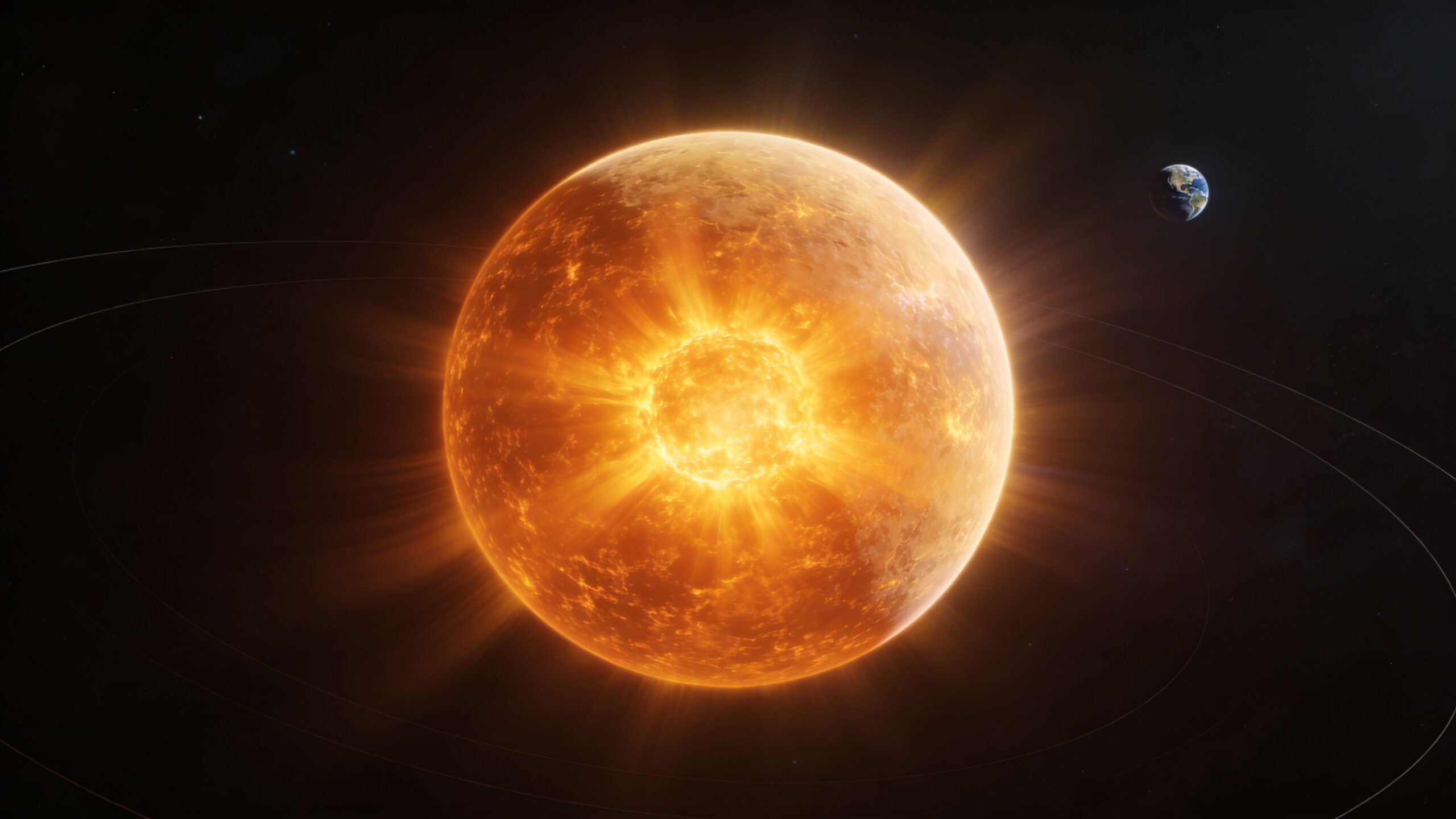
At the Sun’s centre, the pressure is so intense that hydrogen is forced together and changed into helium. That process is called nuclear fusion. It releases a tremendous amount of energy, and that energy begins a very long journey outward before some of it reaches Earth as light and heat.
Alt text: interesting facts about the sun showing a glowing star near Earth
The Sun’s giant power station
The Sun works like a colossal power station in space, only with no plugs, no coal lorries, and absolutely no chance of a family picnic nearby. In the core, tiny particles are packed together so tightly that a little mass is changed into energy. That tiny change matters because even a small bit of mass can produce an enormous amount of energy.
Children often get stuck on one point here. If the Sun is making energy all the time, why does it not run out tomorrow? The short answer is scale. The Sun started with an astonishing amount of fuel, so even though fusion happens constantly, the process lasts for billions of years.
Fred can turn that into a simple adventure task. Ask, “What jobs on Earth depend on the Sun’s energy, even if they do not look solar at first?” Plants use sunlight to grow. Animals eat plants, or eat animals that ate plants. We eat the plants and animals, and suddenly this faraway star is sitting in a sandwich. Science is funny like that.
If your young explorers want the full story, visit how the Sun produces energy. If they are ready for the next level of the mission, Fred’s guide to space weather and what the Sun sends into space helps them see that the Sun does more than shine.
Mission prompt: If sunlight helps plants grow, how many everyday things in your home can be traced back to the Sun?
A strong follow-up activity is to draw an energy chain. Start with the Sun, then add a plant, then an animal or person, then a meal on a plate. Parents and teachers can ask children to explain each arrow in the chain. That turns a giant space fact into something they can see, explain, and remember.
4. People have watched the Sun for more than 2,000 years
How do we know the Sun changes if no one alive can watch it for thousands of years? We know because people kept notes. Careful notes. Sometimes on paper, sometimes in official records, and later through telescopes.
Long before rockets, screens, and giant observatories, skywatchers were already doing real science. Ancient Chinese astronomers recorded dark marks on the Sun that we now call sunspots. Centuries later, other observers, including Averroes, described them too. Then telescopes arrived, and astronomers such as Thomas Harriot and Galileo Galilei could study those markings far more closely.
That history matters because science works a bit like a relay race. One generation notices something odd. The next writes it down. Another improves the tools. Then someone tests the old idea and finds a better one.
Galileo helped show that sunspots were part of the Sun itself, not tiny objects drifting in front of it. That may sound like a small correction, but it changed how people understood the Sun. Fred would call that a proper mission clue. One smudge in the right place can change the whole map.
This makes a brilliant mini-adventure for children. Give your young Space Rangers a notebook and ask them to observe the same thing every day for a week, such as the weather, moon shape, or sunrise direction from a window. The lesson is simple. Science is not only about fancy machines. It is also about patient watching and honest recording.
Parents and teachers can stretch the mission a bit further. Ask, “Why would old records still help scientists today?” Because a long timeline helps researchers spot patterns, compare quiet periods with busy ones, and ask better questions about space weather and what the Sun sends into space.
A cheerful classroom takeaway sits right here. People long ago were scientists too, and children can practise the same core skill today. Observe, record, compare, repeat. Delightfully simple. Surprisingly powerful.
5. The Sun still keeps secrets
What sort of neighbour can shine in our sky every day and still keep scientists guessing? The Sun, of course. Space Ranger Fred would call it a familiar face with a locked puzzle box in its pocket.
Scientists understand a great deal about how the Sun makes energy and how it behaves. Even so, some parts of the story are still being worked out. The Sun has quiet spells and busy spells, and those changes do not always follow a perfectly tidy script.
Alt text: interesting facts about the sun during a solar eclipse showing the corona
Quiet times and busy times
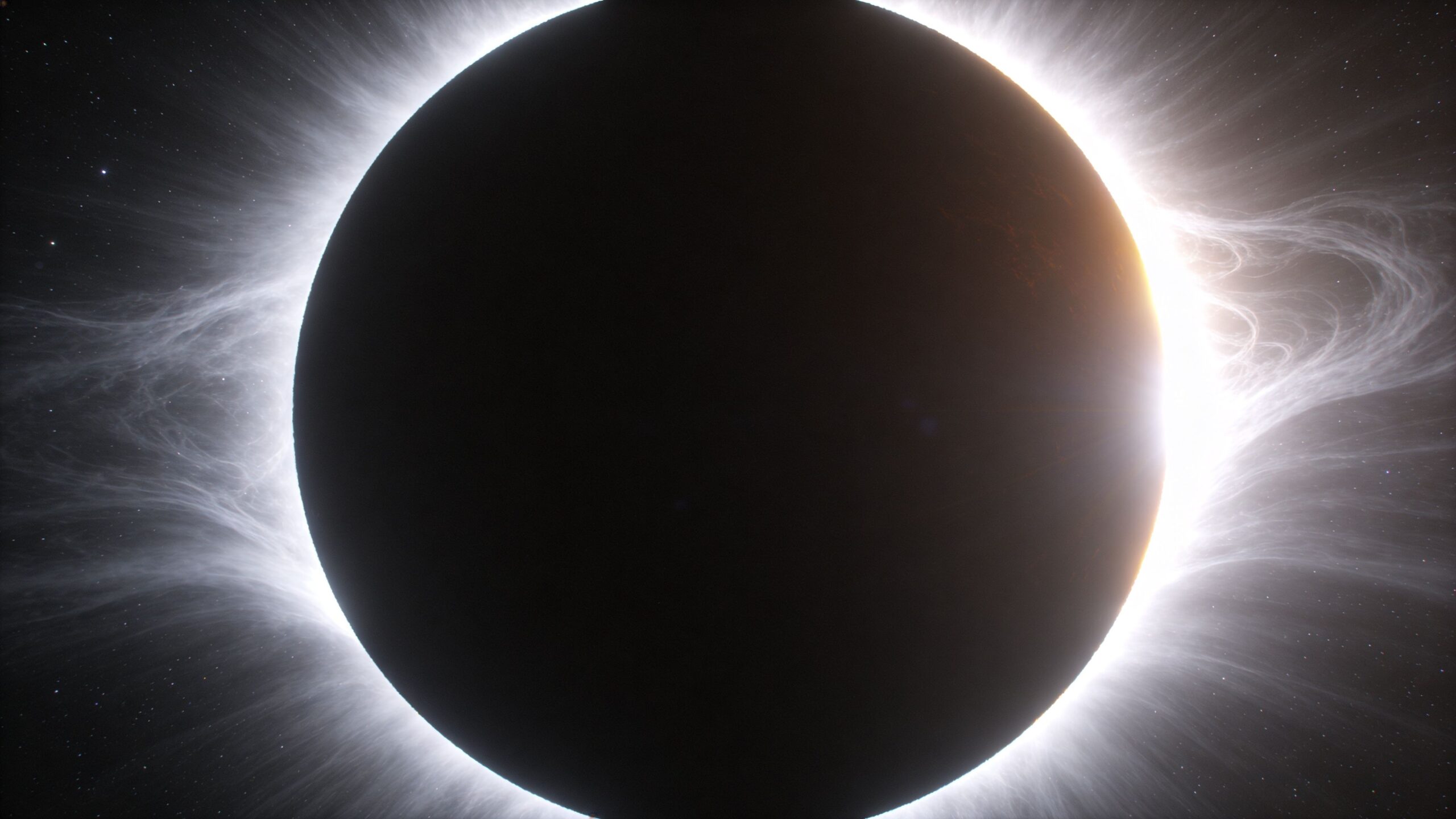
One mystery children can grasp quite quickly is this. The Sun is not equally active all the time. Sometimes it produces more magnetic drama, with more storms and bursts. Sometimes it settles into a quieter mood for a while.
That matters because the Sun behaves more like a changing engine than a lamp switched permanently to one setting. A lamp glows. An engine has cycles, pressure, and parts that interact in complicated ways. The Sun is far more complicated than either, but the comparison helps.
Scientists also study rare stretches when solar activity drops for a long time. Those quieter eras are clues from the Sun’s past. Fred would treat them like old mission logs. If you want to know how a star behaves, you do not only watch it on its best-behaved day.
Here is the lovely brain-tickler for children. How can something so bright still hide things from us? Part of the answer is scale. Part is physics. Part is patience. Researchers cannot pop over with a giant thermometer and have a quick peek.
A short video can help make that feel real:
Some of the best science begins with saying, “That’s odd. Why does it do that?”
That line fits this section perfectly. A good mini-adventure for young Space Rangers is to create a “mystery notebook.” Ask them to write down three things scientists still study about the Sun, then add one question of their own. For example: Why does the Sun’s activity rise and fall? What causes some eruptions to be stronger than others? Which clues come from light, heat, or magnetism?
Parents and teachers can keep it simple. The goal is not to solve the Sun in an afternoon. It is to help children see that science is an ongoing quest, full of clues, surprises, and the occasional cosmic head-scratcher. Delightfully annoying, if you are the Sun. Brilliant fun, if you are Space Ranger Fred.
6. The Sun is a yellow dwarf, which sounds rude but isn’t
Why do astronomers give our enormous Sun a name that sounds like a playground insult?
Because in space, labels mean something very specific. “Yellow dwarf” is a star category, not a comment on the Sun’s manners or its size. The Sun belongs to a group called G-type main-sequence stars. That tells scientists about its colour, temperature, and the stage of life it is in.
Space Ranger Fred would call this a classification puzzle. The word “dwarf” often trips children up first, so it helps to clear that fog straight away. In astronomy, a dwarf star can still be absolutely colossal by human standards. It means the star is in the long, steady part of its life, burning hydrogen in its core.
The “yellow” part can be a little sneaky too. The Sun may look yellow from Earth, especially when low in the sky, because our atmosphere scatters light. In space, it appears more nearly white. So the label is useful, but it is not as simple as saying the Sun is painted butter-yellow like a nursery wall.
Why astronomers bother with names like this
Star categories work like sorting trays in a science cupboard. If you put magnets with magnets and batteries with batteries, patterns become easier to spot. Astronomers do the same with stars. Once stars are grouped by type, scientists can compare how hot they are, how bright they are, and how they change over time.
That makes “yellow dwarf” a handy bit of shorthand. It tells experts, “This is a fairly ordinary, steady star in the main part of its life.” Ordinary for a star, anyway. For us, it is the blazing boss of daytime.
A fun Fred-style mission is to turn this into a sorting game at home or in class:
- Colour clue: Ask children what a star’s colour might tell us about how hot it is.
- Life-stage clue: Explain that “main-sequence” means the star is in its long middle stretch, rather like an adult in the busiest part of life.
- Name clue: Show how science words can sound odd in everyday speech but stay precise in scientific use.
For an extra mini-adventure, give children three labels on paper: colour, size, and life stage. Then ask them which label “yellow dwarf” belongs to most. The answer is a bit of a trick. It mixes colour and star type together, which is exactly why scientists need careful definitions.
That is a lovely lesson in itself. Science names are tools. Sometimes they sound funny. Sometimes they sound confusing. But once children learn what the words are doing, the Sun starts to feel less like a blazing mystery and more like a star they can properly get to know.
7. The Sun may have been born with help from exploding stars
How does a star like our Sun get its start? One intriguing idea is that a nearby supernova, a massive star exploding at the end of its life, sent a shockwave through a cloud of gas and dust and helped that cloud collapse into a new solar system.
That sounds dramatic because it is. But it also makes good scientific sense. A shockwave works a bit like a firm clap near a pile of glitter. The glitter suddenly jumps and shifts. In space, the “glitter” is gas and dust, and the shove can help bunch it together until gravity takes over.
So the Sun’s early story may have included a noisy neighbour.
This idea matters for another reason. Exploding stars make and scatter heavier elements into space. Those ingredients can later become part of new stars, planets, rocks, and eventually living things. In plain Fred language, the universe is an excellent recycler. One star’s ending can help set up another star’s beginning.
That gives children a lovely mission puzzle to solve. If bits of ancient exploded stars were mixed into the cloud that formed the Sun, then tiny parts of our world carry a much older cosmic history than the Sun itself.
A simple way to explore this at home or in class is with a hands-on “stellar recycling” activity:
- You need: flour, glitter, and a tray
- Step 1: Spread the flour out as your gas-and-dust cloud
- Step 2: Sprinkle in glitter as “star material” from an earlier explosion
- Step 3: Tap one side of the tray to mimic a shockwave pushing material together
- Ask: What happens when the material gets disturbed and clumps?
Space Ranger Fred might put it like this: “Before our Sun switched on, the neighbourhood may have had quite the fireworks display.”
That turns one solar fact into a proper mini-adventure. Children get a story, a scientific idea, and a physical model they can test with their own hands.
For a follow-up writing task, ask pupils to write a short mission log from the newborn Sun: “Report from Sector Solar. I may have formed after a giant star blasted the clouds around me into action.”
8. Sunspots helped people unlock solar mysteries
Sunspots look like small smudges on the Sun, but they turned out to be excellent clues. To a child, they may seem like stains on a giant glowing football. To scientists, they showed that the Sun is not a flat, perfect lamp in the sky. It changes.
That idea took time to understand. Early observers saw dark marks crossing the Sun and had to work out what they were. Were they tiny objects drifting past? Or were they part of the Sun itself? Careful watching helped people realise those marks belonged to the Sun. Our star had features, movement, and a story to tell.
That is a brilliant science lesson for young space rangers. A tiny patch can lead to a much bigger idea.
Space Ranger Fred might turn this into a mission puzzle: “Commander, you have spotted a dark mark on the solar surface. Is it a passing speck, or a real feature on the Sun?” That question teaches children how science often works. You notice something odd, test a few explanations, and keep the one that best fits the evidence.
Sunspots also help children grasp a slightly tricky point. They are dark compared with the brighter area around them, but they are still extremely hot. A campfire coal can look dim beside a bright flame while still being scorching. Sunspots work a bit like that.
Try a simple classroom or kitchen-table activity.
- You need: a torch, a sheet of white paper, and a small grey sticker or pencil dot
- Step 1: Shine the torch onto the paper to make a bright circle
- Step 2: Place the sticker or draw a small dot in the lit area
- Step 3: Ask children why the darker mark stands out so clearly
- Mission question: Does the dot look dark because it is cold, or because the area around it is much brighter?
That small exercise builds three useful habits at once.
- Observation: spotting patterns and changes
- Reasoning: comparing possible explanations
- Communication: describing what you noticed clearly
A proper Space Ranger Fred mission always sneaks in real science. Sunspots did not just give astronomers something interesting to sketch. They helped people understand that the Sun is active, changing, and far more complicated than it looks from Earth.
9. The Sun matters differently depending on where you live
Here’s a useful real-world twist. Not all sunlight feels the same in every place or season.
For the UK, winter UV Index is typically below 1, with an example of 0.5 at midday in London in December, and NHS 2024 data notes vitamin D deficiency affecting 16% of UK children under 11. That’s a very practical way to show that the Sun isn’t just an astronomy topic. It links to health, weather, and daily life.
A local science conversation
Children often hear warnings about summer sun, but winter sunlight can start a different sort of conversation. The Sun sits lower in the sky, and that changes how its rays reach us.
This is especially useful for parents, teachers, and librarians because it joins big space ideas to local experience. Why is the Sun lower? Why does winter light feel weaker? Why does that matter?
You could turn this into a short observation diary.
- Look outside: Where is the Sun in the sky today?
- Compare seasons: Does it seem high or low?
- Connect ideas: How might that change warmth and light?
That’s one of the best things about interesting facts about the sun. They don’t stay in a textbook. They step into ordinary life.
10. The Sun can also teach us about energy on Earth
What if one of Space Ranger Fred’s best Sun missions had nothing to do with rockets at all, but with the lights in your house?
The Sun gives Earth heat and light, and people have learned to use a tiny part of that sunlight to make electricity. That idea can sound a bit magical at first, so here is the simple version. Solar panels collect sunlight and turn some of it into usable energy. The more direct the light, the more concentrated it is, rather like a torch making a bright, neat circle on the floor instead of a faint stretched-out smear across the carpet.
That makes this a brilliant mission puzzle for children, because they can test the idea with their own eyes.
Turn it into a mission puzzle
Give your trainee rangers a torch, a sheet of paper, and a darkish room.
Shine the torch straight at the paper. You get a bright, compact patch of light. Tilt the torch, and that same light spreads over a larger area, so it looks weaker. Nothing mysterious has happened. The light has been spread out.
That is one of the big lessons behind solar energy on Earth. Angle matters.
You can turn it into a quick Fred-style challenge:
- Mission question: Which position makes the brightest patch, straight on or slanted?
- Test it: Move the torch slowly and watch the shape of the light change.
- Report back: Why might a solar panel collect energy better when light hits it more directly?
This also helps children see the work that engineers do. They do not just build gadgets and hope for the best. They observe, test, adjust, and try again. Very sensible behaviour, even if it does lack the glamour of battling space pirates.
Best of all, this fact links space science to everyday life. The same star that lights up a playground can also help power homes, schools, and satellites. That is a lovely reminder that learning about the Sun is not only about looking up. It is also about noticing how ideas from space can be used here on Earth.
Top 10 Sun Facts Comparison
Space Ranger Fred would never hand in a dry comparison chart and call the mission done. A proper ranger checks what they’ve learned, spots patterns, and explains them clearly enough that a younger cadet could follow along too.
Here’s the tidy version of our ten Sun missions, using the same facts you’ve already explored in the article:
-
The Sun is the heavyweight champion of the Solar System.
Fred’s way to remember it: the Sun is the great cosmic anchor, keeping the planetary team from drifting off like balloons in a windy park. -
The Sun is ancient, but not ancient in every kind of year.
That puzzle helps children see that “years” depend on what is doing the orbiting. A year on Earth and a year on Jupiter are very different clocks. -
The Sun makes energy every second.
At its centre, tiny particles are pressed together so fiercely that energy is released, rather like a pressure cooker from the most extreme neighbourhood in space. -
People have watched the Sun for more than 2,000 years.
Long before rockets and satellites, careful observers were already recording patterns, proving that science often begins with patience, not flashy equipment. -
The Sun still keeps secrets.
That is one of the best parts. Children learn that science is not a finished book. It is an ongoing investigation, complete with clues, questions, and the occasional baffling twist. -
The Sun is a yellow dwarf, which sounds rude but isn’t.
It is a scientific label for a certain kind of star. A bit like calling a dog a terrier. Accurate, helpful, and slightly less dramatic than “glorious fire emperor.” -
The Sun may have been born with help from exploding stars.
Earlier stars likely helped scatter the ingredients that later became our Solar System. In Fred’s mission log, that makes the Sun part of a much older cosmic family story. -
Sunspots helped people get solar mysteries.
Those dark patches turned into clues. By tracking them, observers could work out that the Sun changes, rotates, and behaves more like a busy, active world than a plain glowing ball. -
The Sun matters differently depending on where you live.
The same star can bring long summer light, short winter days, stronger sunshine, gentler sunshine, and very different daily experiences across Earth. -
The Sun can also teach us about energy on Earth.
The science becomes wonderfully practical. Light angles, heat, and solar panels all turn one big space idea into something children can test with a torch and a bit of curiosity.
That summary works well as a quick family or classroom review.
You could turn it into one final Fred-style challenge. Ask your young rangers to pick the fact that surprised them most, then draw it, act it out, or explain it to someone else in one minute. If they can teach it, they really do understand it. A splendid result, and much more exciting than memorising a gloomy table.
Your Mission Become a Sun Super-Expert
What would Space Ranger Fred ask at the end of a Sun mission? Probably this. Can you explain one Sun fact so clearly that another person understands it too?
That is what a Sun super-expert looks like.
In Fred’s world, real progress starts small and builds properly. A child may begin by saying the Sun is a star. Soon after, they can explain that it holds the Solar System together with gravity, rather like a conductor keeping an orchestra in time. Later, they might explain why daylight changes through the year, why sunspots matter, or how sunlight can help us make energy on Earth. Knowledge grows in layers, the same way a good tower of building blocks grows, one solid piece at a time.
Confidence grows that way too. First a child notices something. Then they describe it. Then they explain it in their own words.
That shift matters for parents, teachers, and anyone guiding a curious young mind. A child who can teach an idea has usually moved past memorising and into understanding. If they can explain it to a friend, a sibling, a teddy bear, or a politely confused grandparent, they are doing real science thinking. Very fine work.
The Sun also gives children something every good adventure needs. Answers, yes, but also unanswered questions. That helps them see science as an active process of observing, testing, and asking sharper questions. A much livelier business than reciting facts by rote, and far more fun.
For your final Fred-style mission, ask your young ranger to choose one Sun fact and complete one quick challenge:
- Draw it as a mission scene from Space Ranger Fred’s universe.
- Act it out in 30 seconds using only their body and voice.
- Explain it with a torch and a ball on the kitchen table.
- Teach it in one clear sentence, then expand it into three.
These activities turn curiosity into action. A torch works like the Sun. A football works like a planet. A window, a shadow, and a bit of careful noticing can turn an ordinary room into a tiny space lab.
Mission complete. Sun super-expert status is now within reach.