Your Next Mission: The Colouring Command!
Yesterday, a child in our reading corner announced that a rocket was definitely green because “number 3 said so”. Five minutes later, that same child was explaining patterns, matching symbols, and checking instructions like a tiny flight engineer.
That’s the magic of colour by numbers colouring pages. They look simple. They feel calm. But they can help build number recognition, attention, pencil control, and confidence. Give a child a code, a page, and a handful of pencils, and suddenly they’re not “just colouring”. They’re cracking a mission brief.
If you’re a parent, teacher, or librarian, you probably want resources that are easy to print and easy to trust. You also want options that fit different ages. Some children need bold shapes and only a few colours. Others want mystery pictures, maths clues, and a challenge worthy of a moon landing. This list is built to help you choose quickly.
It’s also worth remembering that the wider colouring market has grown strongly. One market report values the global adult colouring book market at about USD 500 million in 2023 and projects USD 1.2 billion by 2032, with a projected CAGR of 10.3%, driven by stress relief, relaxation, and digital access to colouring content via online platforms and downloadable pages (Dataintelo adult coloring book market report). That doesn’t give us UK-specific figures for children’s colour by numbers colouring pages, but it does show strong interest in colouring formats more broadly.
For publishers and creators, there’s also useful production guidance. A specialist source notes that colour-by-number pages are commonly designed at 8.5×11 inches or 8×10 inches, at 300 DPI, with half-inch margins, and that pages for ages 4 to 6 typically work best with 5 to 8 colours (colour by number KDP guidance video). In plain English, simpler pages usually help younger children finish successfully.
Before we launch into the list, one practical extra. If you create your own worksheets or want cleaner print results for classroom materials, this guide on achieve grayscale product listings can help you prepare images more neatly.
1. Twinkl
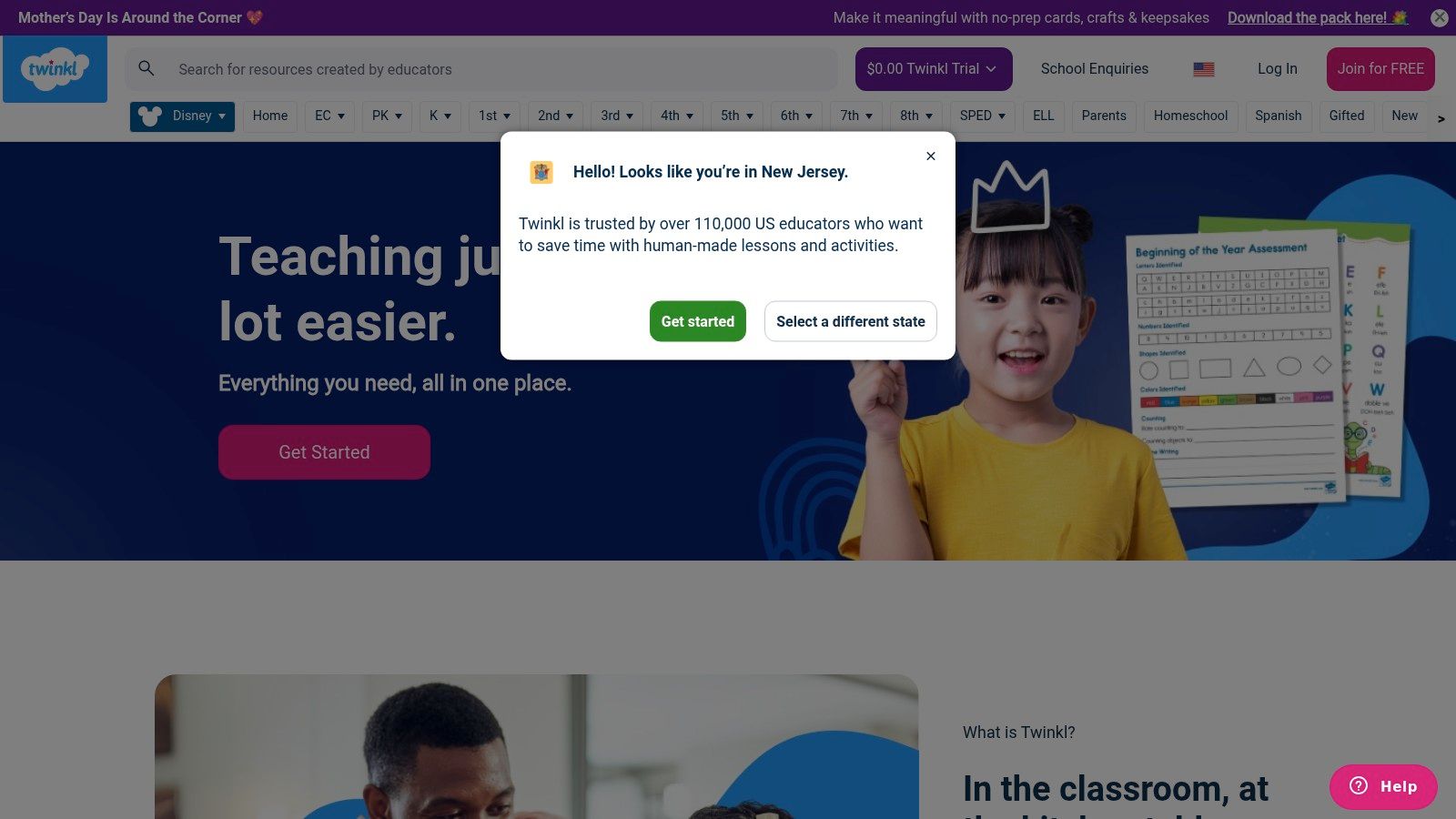
Alt text: Twinkl colour by numbers colouring pages resource library
Twinkl feels like the well-stocked mission control cupboard. If you teach in the UK, there’s a good chance you already know it, and that familiarity matters when you need something printable before the bell goes.
Its strength is range. You’ll find classic colour by number sheets, topic-based pages, and mystery-picture styles that add a bit of puzzle-solving. That’s handy when one child wants a calm colouring task and another wants a secret image to decode.
Why it works in classrooms
Twinkl suits EYFS, KS1, and KS2 because many resources are built with school use in mind. The UK spelling and general curriculum fit also make life easier for busy adults who don’t want to spend time adapting every worksheet.
A few especially useful points stand out:
- Teacher-friendly formats: Ready-to-print PDFs make quick deployment simple.
- Differentiated choices: Some resources come in easier and harder versions.
- Broad themes: Seasonal packs, maths tie-ins, and STEM-style topics help you match the page to your lesson.
- Editable options: In some cases, you can tweak content for your class.
Practical rule: Use Twinkl when you want colour by numbers colouring pages to behave like proper lesson tools, not just spare-time fillers.
There is a catch. A lot of the strongest material sits behind a subscription. Also, because the library is so large, you may need a few extra minutes to filter out the exact page you want.
That said, if your mission is “find something reliable for tomorrow’s lesson and don’t make me wrestle with formatting”, Twinkl is a strong candidate. Try pairing a number-colour page with one follow-up question such as, “What pattern did you notice first?” That shifts the activity from colouring only to explaining thinking.
You can explore the platform at Twinkl.
2. Activity Village

Alt text: Activity Village colour by numbers colouring pages for kids
Activity Village is a gentler launch pad. It’s especially good for younger children who need clear keys, familiar themes, and pages that don’t feel too busy.
This is one of those sites that families often return to because it feels straightforward. Animals, seasonal pages, and simple themed sets make it easy to match a child’s interest without overcomplicating the task.
Best for early confidence
If a child is still getting used to matching numbers and colours, Activity Village keeps the challenge manageable. That matters because finishing a page successfully is often what makes a child want another one.
Here’s where it shines:
- Simple keys: Children can follow the code without lots of adult support.
- A4-ready printables: Easy for home or classroom printing.
- UK and US spelling options: Helpful if you work across different resources.
- Free and member choices: You can try it without diving straight into a subscription.
The main limitation is complexity. Older primary pupils who enjoy mystery pages or maths-heavy decoding may outgrow it fairly quickly. Some of the stronger sets also sit behind membership access.
Still, for Reception, Year 1, and some Year 2 children, this is a lovely “I can do this myself” resource. And that phrase matters. In learning, small independent wins are rocket fuel.
A useful extension is to ask children to retell what they coloured. “This is my fox. I used red for 2 and green for 4.” That builds speaking and sequencing alongside number recognition.
Visit Activity Village colour by number.
3. TES Resources

Alt text: TES Resources colour by numbers colouring pages worksheets
TES Resources is more like a bustling teachers’ marketplace than a single tidy workbook. That’s its strength and its weakness.
You’ll find a wide mix of teacher-created worksheets, including colour by number sheets linked to maths facts, seasonal events, and classroom themes. If you want something specific like number bonds practice disguised as colouring, TES is often worth a search.
A strong option for targeted skills
TES can be especially useful when you want the colouring page to do double duty. Instead of matching a printed key, some worksheets require children to solve a sum first, then use the answer to choose the colour.
That creates a more active learning loop:
- Solve the clue
- Find the matching code
- Colour the section
- Reveal the full picture
Sometimes a child who groans at a worksheet will happily complete the same skill when it reveals a hidden dinosaur, snowman, or spaceship.
The platform’s filters, previews, and user reviews help, but quality does vary because resources come from many different creators. It’s wise to check previews carefully and look at when a resource was last updated.
TES works well for teachers who don’t mind browsing a little in exchange for variety. It’s less ideal if you want one consistent visual style across every lesson. For librarians and intervention staff, though, that variety can be a gift. You can often find one page that clicks with one child’s exact interest.
Browse TES colour by numbers resources.
4. Crayola

Alt text: Crayola colour by numbers colouring pages printable activity
Crayola is the quick-grab option. If your mission is “I need something free, printable, and ready before anyone starts climbing the furniture”, this site is handy.
The designs are brand-made, child-friendly, and generally clear on the page. That sounds simple, but good contrast and clean outlines make a real difference when you’re printing at home or from a school copier that has seen better centuries.
Best for fast home use
Crayola is a good choice for calm moments at home, wet play, or a classroom settling task. You won’t necessarily get a strong curriculum link on every page, but you will get pages that children can start using quickly.
One relevant note from the available material is that Crayola’s colour-by-number page appears in a wider context where UK teachers and librarians are often looking for more STEM-integrated colour by numbers pages, especially around topics such as space science. The verified material connected to that page also states that no top results identified in the available search set were providing UK-curriculum-aligned space edutainment resources at that point. So Crayola is useful, but it may not fully satisfy a teacher hunting for a space-and-STEM lesson match.
A few reasons families like it:
- Free access: No major barriers to trying a page.
- Recognisable artwork: Children often feel comfortable with familiar styles.
- Seasonal variety: Good for holidays and themed weeks.
- Straightforward printing: Handy for low-prep use.
Navigation can be a little mixed because numbered pages may sit alongside other activities. Even so, the site earns its place on this list because it removes friction. And sometimes that’s exactly what a busy Tuesday needs.
5. SuperColoring

Alt text: SuperColoring colour by numbers colouring pages worksheet library
SuperColoring is the big warehouse hangar. There’s loads in there. The challenge is not whether the site has enough, but whether you can resist opening twelve tabs and forgetting why you came.
Its library covers many themes, from animals and vehicles to holiday pages and more puzzle-like variants. That makes it especially useful if you need differentiation in one room. One child can have a simple picture. Another can tackle a more detailed page.
Good for older children too
Some colour by numbers colouring pages are clearly aimed at younger learners. SuperColoring stretches further. Older children, especially ages 8 to 12, may enjoy the more detailed or mystery-based options.
That extra challenge can support:
- Persistence: Children stick with a task for longer.
- Visual discrimination: They need to spot smaller sections carefully.
- Planning: They learn to colour methodically rather than randomly.
The downside is user experience. Ads can get in the way, and the site isn’t specifically built around the UK curriculum. If your goal is strict lesson alignment, other platforms may be more efficient.
Still, for a mixed-age club, a library corner activity, or a choice board at home, it’s very practical. You can also turn the page into a mini investigation. Ask, “What did you predict this picture would become halfway through?” That encourages inference and observation.
Visit SuperColoring colour by number worksheets.
6. Teach Starter
Teach Starter suits families and teachers who like order on the launchpad. Instead of hunting through a huge pile of printables, you can choose activities that feel built for a lesson with a clear objective.
That matters because Teach Starter often goes beyond classic colour by numbers colouring pages. Many resources use a colour-by-code format, where children follow clues linked to numbers, shapes, letters, or subject knowledge. The page works a bit like a training console. Children read the code, match the rule, then reveal the picture step by step.
A smart mission tool for linking subjects
For Space Ranger Fred’s Colouring Command Mission, this makes Teach Starter a strong tool for children who are ready to do more than fill spaces neatly. A maths code can rehearse number recognition. A phonics code can check sound knowledge. A science-themed page can help children revisit vocabulary while their hands stay busy.
That mix gives adults several useful options:
- Teacher-made resources: Pages are organised with classroom use in mind.
- Colour-by-code variety: Children practise decoding, not just colouring.
- Topic links: Helpful for connecting art, maths, reading, and science.
- Consistent design: Worksheets often feel easy to print, explain, and reuse.
Here is the key idea to make clear before starting. The colour key is the instruction map. If a child misses that, the activity can feel confusing very quickly. A simple fix is to pause for one minute and ask, “What does each code tell us to do?” That small check can prevent muddles and build confidence.
The main drawback is access. Many resources sit behind a subscription, and because the platform serves more than one region, adults should check spelling choices and curriculum fit before printing for a full class.
Used well, Teach Starter can turn a quiet colouring task into a mini decoding mission with a proper learning target.
Explore Teach Starter colour by code resources.
7. MadeForMums
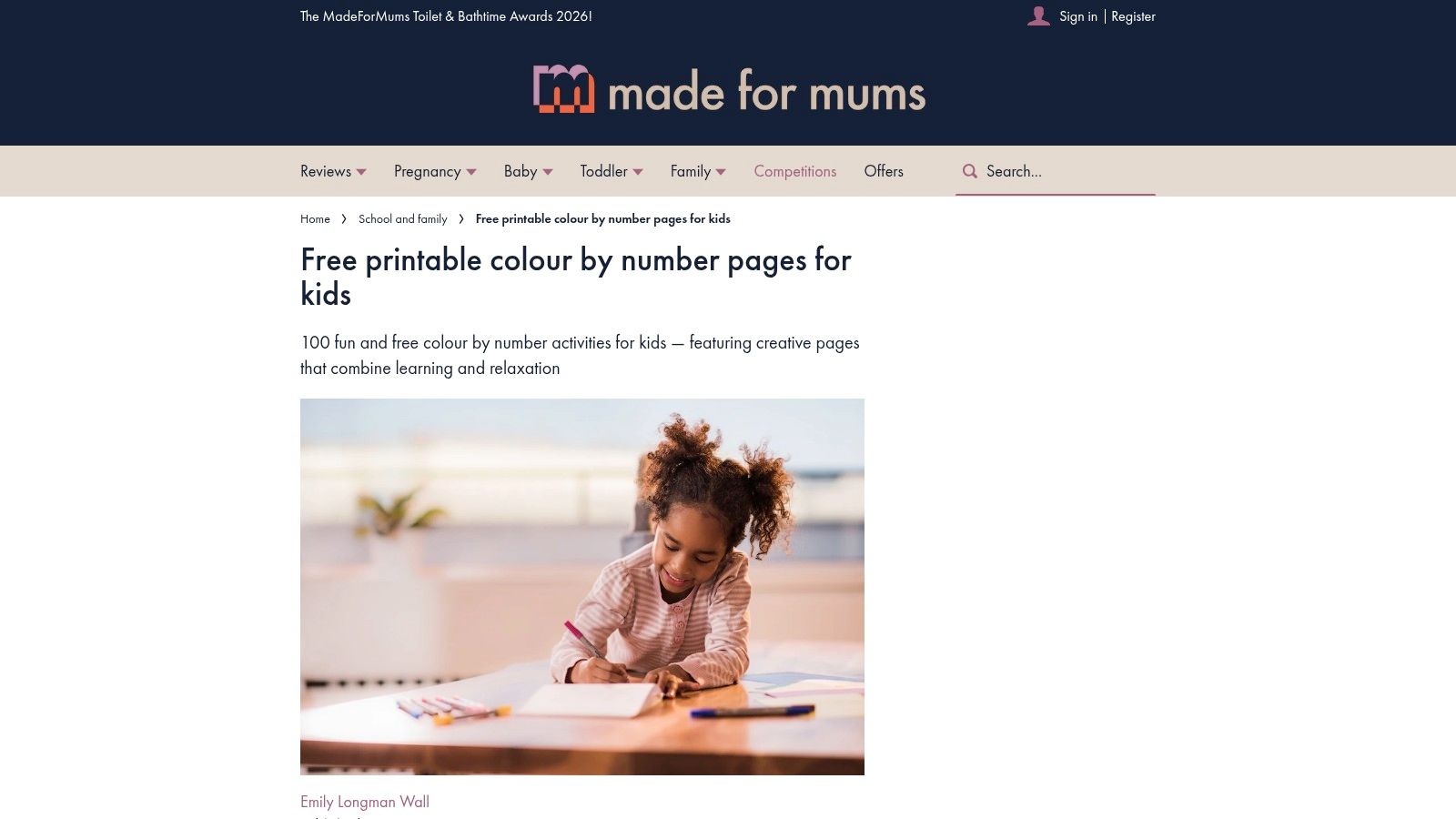
Alt text: MadeForMums colour by numbers colouring pages printable for children
MadeForMums is the no-fuss option for families. It doesn’t pretend to be a giant teaching marketplace. It offers quick printable pages that are easy to grab and use.
That can be perfect. Not every activity needs a grand educational speech and laminated folder. Sometimes you just need a sheet, some pencils, and ten peaceful minutes while the kettle boils.
A handy pick for younger children
The pages are simple and child-friendly, which makes them a sensible fit for younger primary ages. They also tend to be low-ink and straightforward, which your printer may greatly appreciate.
One important fact from the verified material is that no UK-region specific statistical or historical data on colour by numbers colouring pages was identified in the available search results connected with this area, and those results mainly featured general free printable resources and educational tools rather than region-specific metrics or milestones (MadeForMums colour by number page). So while MadeForMums is clearly useful in practice, we shouldn’t pretend there’s detailed UK market data attached to it.
Its strengths are practical:
- Free downloads: Easy for home and school use.
- Fast access: Good for unplanned activity moments.
- Simple outlines: Friendly for younger children.
- Family appeal: Suitable for kitchen-table learning.
The smaller catalogue means you won’t get the endless variety of specialist education sites. Older primary children may also want more challenge after a while.
Still, MadeForMums earns its place because it respects a busy adult’s time. And that’s worth something.
8. Crafts on Sea

Alt text: Crafts on Sea colour by numbers colouring pages craft printable
Crafts on Sea is ideal for seasonal missions. Christmas week. Halloween table work. A spring display. Those moments when you want an activity that feels timely without requiring a full planning saga.
The pages are usually simple, themed, and paired with blog-style suggestions that can spark a follow-on craft or display idea. That makes the site useful for families, childminders, and teachers setting up calm stations.
Best for themed weeks and celebrations
If your classroom or home learning setup follows the rhythm of the year, Crafts on Sea fits naturally. It’s not extensively curriculum-mapped, but it does support engagement because children often enjoy work that reflects what’s happening around them.
Useful strengths include:
- Seasonal relevance: Easy to match the calendar.
- Simple colour keys: Children can begin quickly.
- Child-friendly artwork: Good for independent use.
- Extension ideas: Helpful when one printable turns into a display or craft session.
Its limitations are also clear. There isn’t a huge spread of difficulty levels, and older children may not find enough challenge. But for set-and-forget station work, it does the job nicely.
A good extension is to ask children to invent a story about the finished image. A Halloween cat becomes a character. A Christmas tree becomes part of a setting. Suddenly the colouring sheet has wandered into literacy. Quite right too.
Visit Crafts on Sea colour by number printables.
9. Coloring Squared

Alt text: Coloring Squared colour by numbers colouring pages maths worksheet
Space Ranger Fred would file this one under Mission Control Maths. Coloring Squared turns colour by numbers into a puzzle console, where each square is earned through calculation rather than guessed from a simple key.
That change matters. Children are not only matching numbers to colours. They are solving sums, checking answers, and watching a hidden picture appear one piece at a time. It works a bit like building a spacecraft panel. Get each small part right, and the full system starts to make sense.
Best for maths practice with a built-in reward
Coloring Squared is especially useful when your learning objective is number fluency. Many pages weave addition, subtraction, place value, or similar maths ideas directly into the colouring task, so the worksheet and the practice are the same thing.
That gives this resource a clear job in your Colouring Command Mission:
- Maths-linked colour keys: Children solve before they colour.
- Pixel-style reveals: The final image encourages persistence.
- Topic-based organisation: Easier to choose work that fits a specific skill.
- Printable options: Helpful for quick prep at home or in class.
It also helps a particular type of learner. Some children switch off the moment a page looks like arithmetic practice. A mystery picture softens that resistance because the task feels like a code to crack. You can almost hear the engines starting again once the robot, animal, or shape begins to appear.
A sensible caution, though. The American grade labels may need a quick mental translation for UK families and teachers, and the blocky pixel format is better for logic-minded children than for those who want a more artistic colouring experience.
A strong STEM extension is to ask your young ranger to predict the image before it is finished, then explain which solved sections gave the clue. That adds observation, reasoning, and mathematical talk to a page that might otherwise stay quiet.
Have a look at Coloring Squared.
10. Super Simple

Alt text: Super Simple colour by numbers colouring pages for early years
Super Simple is built for the earliest stage of the mission. Bold outlines. Very small number ranges. Minimal visual clutter. That’s excellent for nursery, Reception, and lower KS1 children who are still building control and confidence.
When adults choose pages that are too detailed too soon, children can feel defeated. Super Simple avoids that trap nicely.
The best starting point for little hands
The simplest pages usually use only a few numbers and colours. That’s not “less educational”. It’s exactly right for learners who are practising how to hold the pencil, follow the key, and stay inside broad areas.
A younger child can focus on:
- Recognising the number
- Finding the matching colour
- Colouring one section carefully
- Repeating the process
Start with success. A child who finishes one simple page proudly is much more likely to attempt a harder one next time.
For older primary children, the site will probably feel too basic. The selection is also smaller than broad educator marketplaces. But as a calm-down corner tool or mixed-ability table option, it’s very useful.
Visit Super Simple.
If you want to keep the adventure going beyond one printable, children who enjoy simple creative tasks often also like story-led science activities such as those featured on the Space Ranger Fred blog.
Colour-by-Numbers: Top 10 Resource Comparison
| Resource | Core features | Age / Use case | Curriculum & STEM fit | Access / Price | Unique strength |
|---|---|---|---|---|---|
| Twinkl | Large teacher-made library, pixel/mystery variants, editable PDFs | EYFS–KS2; classroom-ready | Strong UK KS1/KS2 alignment; many STEM-themed packs | Subscription for most content | Highly editable/differentiated teacher resources |
| Activity Village | Themed colour-by-number sets, clear child keys, UK/US spellings | Early years & younger primary | Light curriculum tie-ins; good for early skills | Free selection + paid membership | Reliable, family-friendly simple designs |
| TES Resources | Teacher-uploaded marketplace with filters & reviews | EYFS–KS2; varied classroom uses | Many cross-curricular and calculated colouring options | Mixed free/paid; quality varies | Huge variety + community reviews for vetting |
| Crayola | Brand-created, high-contrast art; A4/Letter-ready downloads | Home & classroom; younger primaries | Not explicitly curriculum-mapped | Free downloads; no sign-up needed | Recognisable brand art and easy printing |
| SuperColoring | Huge library, subcategories, printable PDFs | Preschool up to older children (incl. 8–12) | Not UK-aligned; topical themes (space, dinos) | Free with ads | Extensive depth and challenging pages for differentiation |
| Teach Starter | Teacher-made packs, cross-curricular, class-ready PDFs | KS1–KS2 classroom use | Curriculum-aligned with regional filters | Subscription required for broad access | Polished layouts and teacher organisation |
| MadeForMums | Simple, low-ink printable pages for families | Early primary; quick fillers | Not curriculum-mapped | Free, fast downloads (no sign-up) | Fast, no-fuss downloads for classroom/home use |
| Crafts on Sea | Seasonal/event-led printables + activity ideas | Young primary; holiday planning | Not curriculum-mapped | Free | Timely seasonal packs with extension/activity tips |
| Coloring Squared | Math-first pixel/mystery pictures; grade/topic organization | Ages 6–12; numeracy practice | Strong numeracy/STEM focus (US grade labels) | Free worksheets + paid bundles | Calculated colouring that targets arithmetic skills |
| Super Simple | EYFS-friendly one-pagers, bold outlines, simple keys | Nursery, Reception, lower KS1 | Early-years appropriate; fine-motor practice | Free | Perfect for very young learners and calm-down corners |
Mission Complete What Did We Learn
Congratulations, Ranger. You’ve completed the Colouring Command mission, and you’ve probably noticed something important. A colour by numbers page isn’t just a colouring page. In the right moment, it becomes a tool for focus, number recognition, fine motor practice, language, and confidence.
That’s why choosing the right resource matters. Twinkl and Teach Starter work well when you want classroom structure and curriculum-friendly organisation. Activity Village, MadeForMums, and Super Simple are excellent when younger children need clarity, simplicity, and quick success. TES Resources and Coloring Squared are handy when you want to fold in more direct skills practice. Crayola, SuperColoring, and Crafts on Sea help when you need easy access, broad themes, or seasonal fun.
There’s also a bigger lesson here for adults. Children learn best when simple tasks are given a little meaning. A numbered picture can become a puzzle. A puzzle can become a conversation. A conversation can become real understanding. That’s the heart of good teaching, whether you’re in a classroom, library, or at the kitchen table with a slightly blunt green pencil.
You don’t need to turn every page into a major project. One or two follow-up prompts can do plenty. Try asking, “How did you know where to begin?” or “What did you notice as the picture appeared?” or “Can you explain the rule to someone else?” Those tiny shifts build the lovely learning ladder of I think, I try, I can, and I can explain.
For children who love space, there’s an especially interesting opportunity. The verified material available for this topic notes that UK teachers and librarians often look for more STEM-integrated colouring resources around themes like space, while many existing free printables focus on basic numeracy or generic topics rather than specific educational tie-ins. That means there’s real value in resources that combine simple coding tasks with planets, constellations, or science ideas in child-friendly ways, even though the available evidence doesn’t give us a complete UK regional market picture.
That’s one reason a story-led brand like Space Ranger Fred can fit naturally into this sort of activity. The brand offers printable colouring materials and books that connect creative play with science-flavoured adventure. Used well, that combination can help children see that colouring, reading, and questioning all belong in the same learning universe.
If you’re planning your next mission, keep it simple. Choose one resource from this list that matches your child or class right now, not the version of them you hope appears in six months’ time. Little hands need big wins. Curious minds need small doors into larger ideas. And yes, sometimes the best route into STEM begins with “Find all the number 4s and colour them blue”.
Learning should feel active. It should feel possible. It should leave children thinking, “I did that”. When a quiet activity gives them that feeling, it’s done more than fill ten minutes. It’s built momentum.
Ready for the next adventure? You can explore the Space Ranger Fred books for story-led STEM fun, try more printable missions on the free activities page, or bring live storytelling and science excitement to pupils through Space Ranger Fred school visits.
Meta title: Best Colour by Numbers Colouring Pages for Kids
Meta description: Discover the best colour by numbers colouring pages for kids, with UK-friendly picks for parents, teachers and librarians plus easy STEM activity ideas.
Space Ranger Fred brings books, printable activities, and school visits together in one playful STEM universe. If your young explorers enjoy colour by numbers colouring pages, they may also enjoy the Space Ranger Fred adventures, where storytelling, humour, and science help children read, imagine, and explain what they discover.