
Ready to launch into our cosmic neighborhood? Exploring the solar system is one of the coolest ways to get anyone excited about science. Think about it like a cosmic detective story, just like the adventures in Space Ranger Fred and the Umbrella Rescue. A great project starts with a simple question and a big dose of curiosity about the worlds beyond our own. Finding the right hands-on activity can turn tricky ideas like gravity, orbits, and what planets are made of into something you can actually see and touch. That's where our ultimate guide to solar system project ideas comes in.
This article blasts past the usual papier-mâché planets. We’re offering ten unique, super-engaging, and educational projects perfect for young astronomers. We’ve got everything you need to start, from what you'll need and step-by-step instructions to difficulty ratings for different ages. Whether you're an aspiring engineer, a future chef, or a budding artist, there's a creative challenge waiting for you. Each idea is designed not just to teach the basics of astronomy but to build skills in critical thinking, problem-solving, and to spark a real sense of wonder about the universe. Get ready for a creative blast-off into learning!
1. 3D Solar System Model with Scale Distances
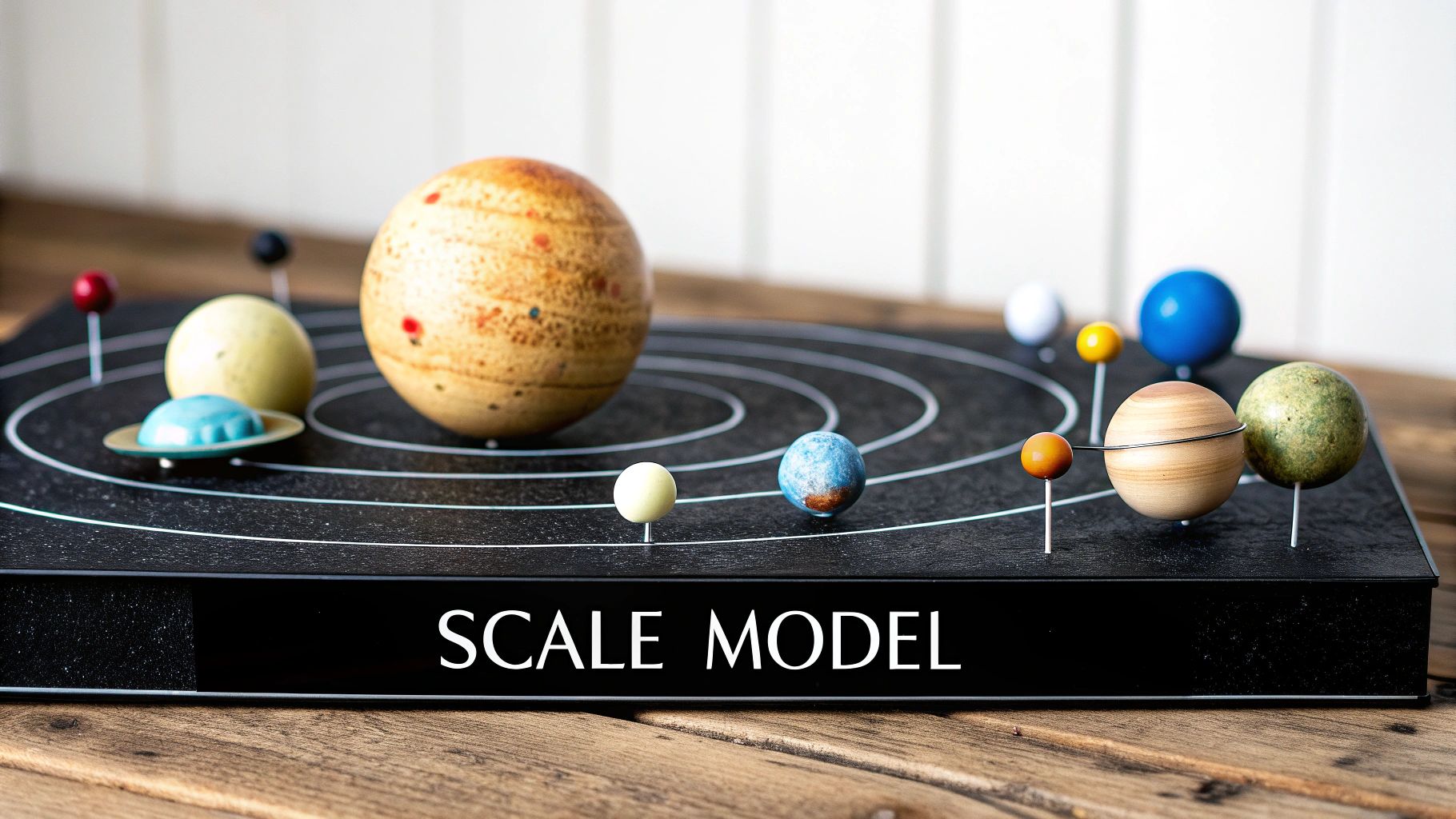
Most models you see in classrooms show the planets all bunched up. This project tackles the HUGE emptiness of space by building a model that shows not just how big the planets are compared to each other, but how incredibly far apart they are. It’s a fantastic way to really get how vast our cosmic neighborhood is.
Why does it take months, not days, to travel to Mars? A project like this makes the answer obvious. It provides a real-world understanding that you just can't get from a book. To get a better handle on the basics, you can explore what the solar system is.
Implementation Tips
- Choose Your Scale: Pick a scale that fits your space. A popular one is the "Thousand-Yard Model," where the distance from the Sun to Pluto is about 1,000 yards (or meters). On that scale, Earth is just the size of a pea!
- Represent Planet Types: Use different materials to show what the planets are like. How about small marbles for rocky planets like Earth and bigger styrofoam balls for gas giants like Jupiter?
- Go Outdoors: The best way to appreciate the scale is to take this project outside. Use a big field or a local park to lay out your planets at their correct scaled distances. It's a real eye-opener!
- Include More Than Planets: Don't forget the other cool stuff! Add a "belt" of small pebbles or glitter between Mars and Jupiter for the Asteroid Belt and another one way out for the Kuiper Belt.
This project offers a memorable lesson in scale, similar to the big ideas explored in the book Space Ranger Fred and the Shoelace Adventure. It transforms an abstract concept into a physical, walkable experience, making it one of the most impactful solar system project ideas for truly understanding our place in space.
2. Interactive Planetary Orbit Simulator
Let's move beyond static models and bring the planets to life! This project involves creating a digital or mechanical simulator to show how planets actually orbit the Sun. The goal is to see cool concepts like elliptical paths, different year lengths, and the gravitational dance that keeps everything in motion. This is a perfect STEM project for tech-savvy kids who love coding.
A simulator makes tricky physics—like why Mars has a longer year than Earth—instantly click. You're not just reading about it; you're seeing it happen. It turns complex science into an interactive game. This project helps build foundational knowledge, much like the scientific principles introduced in Space Ranger Fred and the Tick Tock Tale.
Implementation Tips
- Start Simple: Using a platform like Scratch or Codecademy, begin by coding planets in simple circular orbits. Once you've got that down, you can level up to the more complex math of elliptical orbits.
- Use Real Data: Want to be super accurate? Use real planetary data from NASA's public databases. Include orbital speeds, distances, and planet sizes to make your simulator a powerful educational tool.
- Add User Controls: Make it interactive! Let users pause the simulation, zoom in on planets, or change the camera angle. Adding trails behind the planets is a great way to clearly show their orbital paths.
- Incorporate Key Events: Program your simulator to highlight cool events like eclipses or when planets align in the sky (conjunctions). This adds another layer of fun and learning.
This is one of the most dynamic solar system project ideas because it mashes up creativity with computational thinking. It's a living model of how the cosmos works, offering a powerful visual lesson that a static display just can’t match.
3. Solar System Edible Model
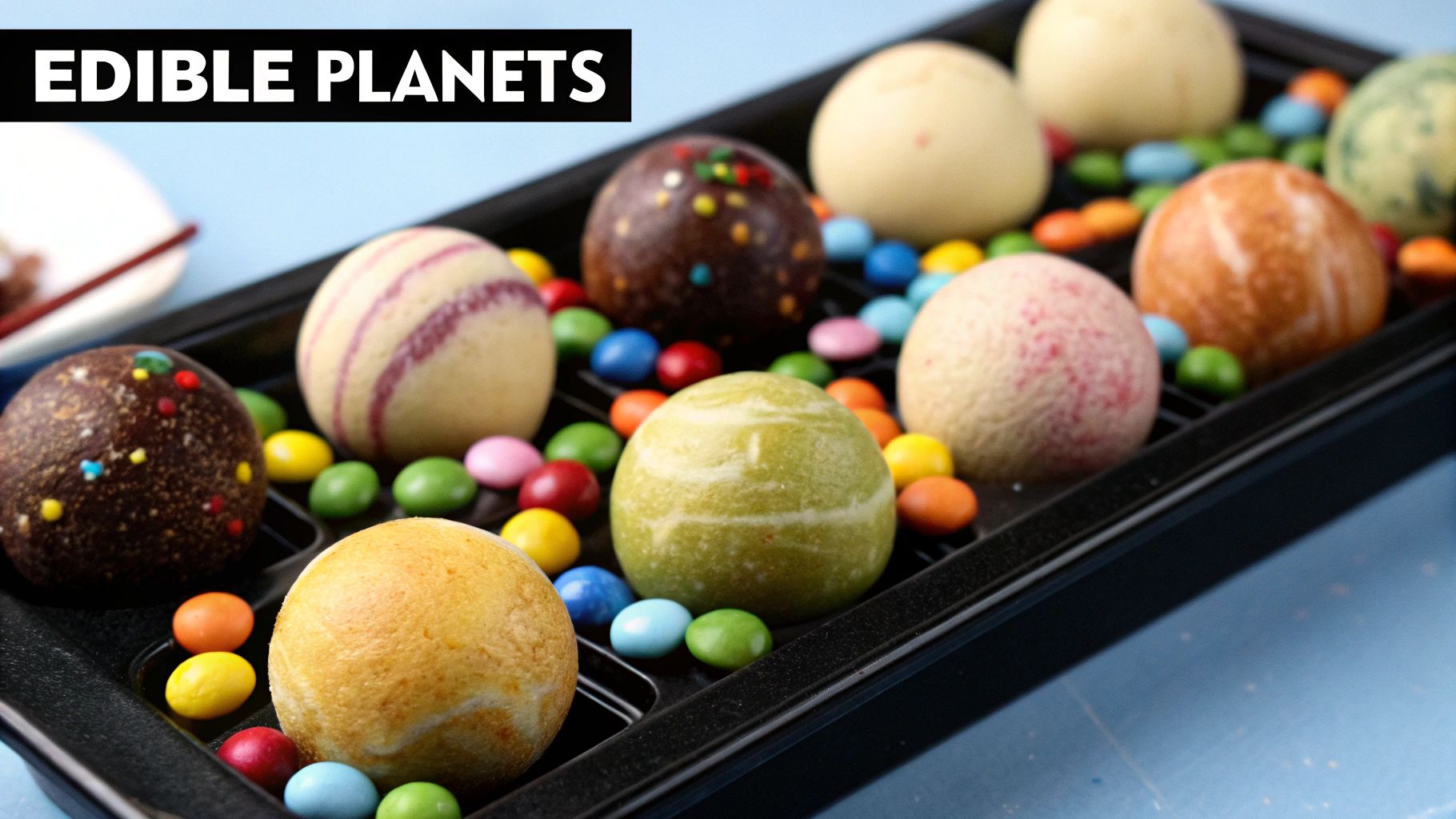
Get ready for one of the tastiest solar system project ideas ever! This activity turns planets, stars, and asteroids into delicious treats. The goal is to represent the solar system using different foods, paying attention to relative sizes, colors, and key features. It's a hands-on approach that makes learning about planetary science fun, memorable, and multi-sensory.
Making an edible model gets kids' creative juices flowing and helps them remember facts in a fun, accessible way. It's awesome for anyone who learns best by doing, and hey, you get a cosmic snack at the end! What’s not to love?
Implementation Tips
- Choose Your Base: You can build your solar system on a large pizza base, a dark-colored tray to look like space, or even a giant cookie. Use a big orange or grapefruit for the Sun at the center.
- Select Planet Foods: Get creative with round foods for your planets. Think grapes for Earth, a strawberry for Mars (the Red Planet!), an orange for Jupiter, and tiny sprinkles for the Asteroid Belt.
- Decorate for Detail: Use icing or food coloring to add details. How about a swirl for Jupiter's Great Red Spot or blue oceans and green continents on Earth?
- Create Information Cards: Make little labels for each edible planet with a fun fact or two. This turns a tasty project into a cool learning station.
This is a great way to chat about what different planets are made of, a concept that pops up in fun STEM adventures like Space Ranger Fred and the Shoelace Adventure. It turns abstract data into a delicious educational experience that's perfect for a classroom party or a weekend family activity.
4. Planetary Atmosphere Composition Laboratory
Time for some hands-on science! This project lets you demonstrate what the atmospheres of different planets are like using safe chemical reactions and gas experiments. You can learn what makes each planet’s environment unique by simulating things like Mars’s carbon dioxide fog with dry ice, creating acidic vapors to mimic Venus, or layering gases to model Jupiter’s dense atmosphere.
This lab-style approach really brings textbook concepts to life. It shows you exactly why Venus is a scorching hot-house and how Mars’s thin air affects its temperature. It’s even cooler when you connect each demo to real space missions that gathered this data. Ready to learn more? Learn more about what planets are made of in our detailed guide.
Implementation Tips
- Prioritise Safety: Always do experiments in a well-ventilated area, and make sure to wear goggles and gloves. Follow all safety guidelines for any materials you use.
- Create Observation Sheets: Make a chart to record what you see. Note things like gas volume, color changes, and pressure readings for each planet demo.
- Connect to Space Missions: When you’re showing CO₂ turning from a solid to a gas for Mars, mention the Mars rovers! Or talk about what the Galileo probe found when you're layering gases for Jupiter.
- Use Clear Visual Aids: Label each container with the planet's name and some key data so you can easily compare the different atmospheres side-by-side.
This engaging project is one of the most memorable solar system project ideas because it turns abstract gas laws into something you can see and measure. It’s perfect for inspiring budding astronomers, just like Space Ranger Fred in Space Ranger Fred and the Tick Tock Tale.
5. Solar System Timeline and History Project
This project moves beyond the planets themselves to explore the awesome history of how we learned about them. The goal is to create a timeline that shows everything from the solar system's formation billions of years ago to key discoveries and the milestones of space exploration. It connects science with history, showing how our understanding of the universe has grown over centuries.
A project like this highlights the human story behind the science, celebrating the curious minds who expanded our view of the cosmos. It gives you a deeper appreciation for modern astronomy by showing the amazing discoveries it was built on. For a closer look at our adventures in space, you can explore the space exploration timeline for kids.
The infographic below highlights a few pivotal moments, from the solar system's ancient beginnings to humanity's first steps on another world.
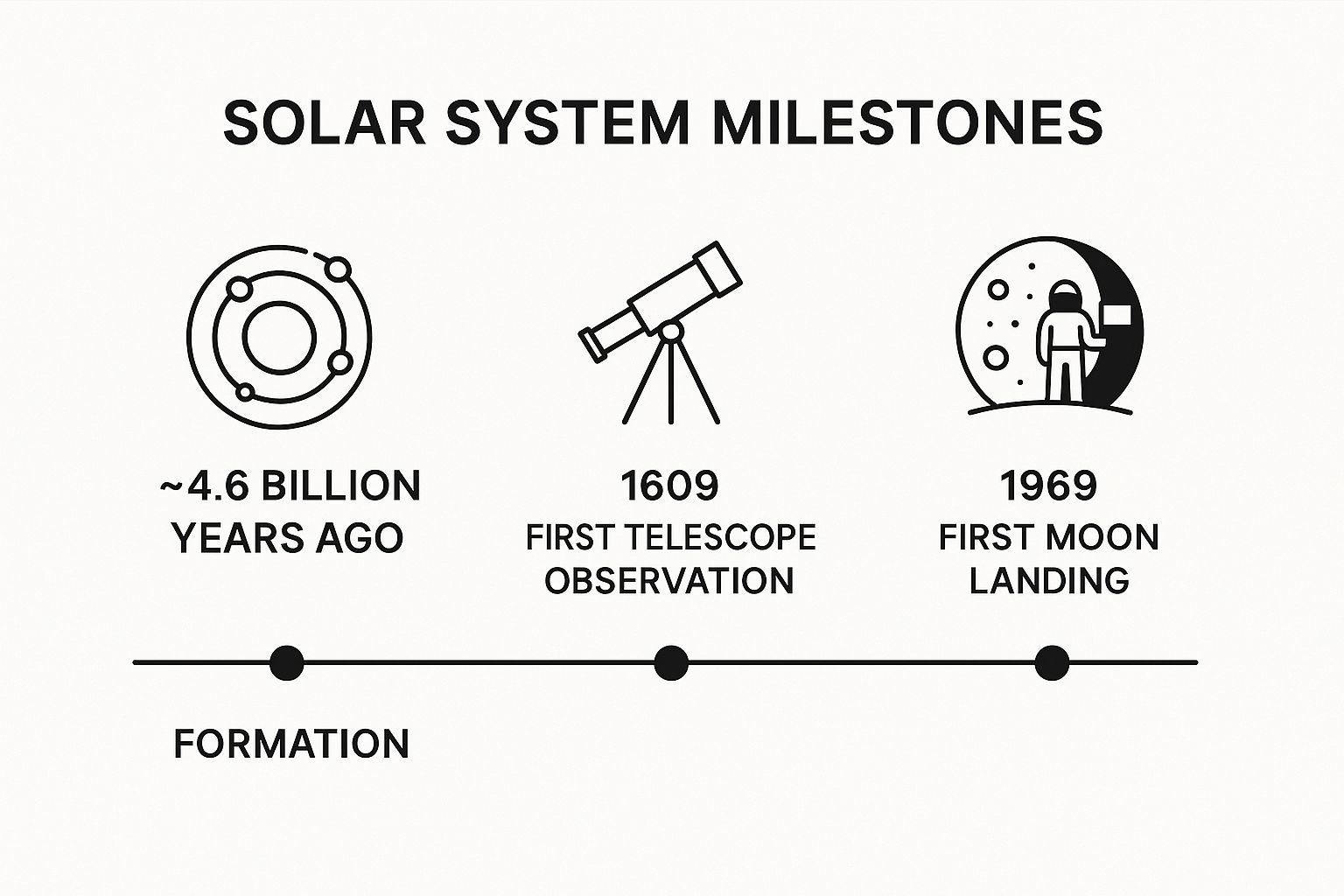
This visual timeline underscores the immense gap between the solar system's formation and our ability to scientifically observe and physically explore it.
Implementation Tips
- Focus on a Theme: So you don't get overwhelmed, try focusing on a specific theme. You could track the history of telescopes, focus on missions to Mars, or chart the discoveries of famous astronomers like Galileo and Copernicus.
- Create a Museum Display: Turn a hallway into a "Museum of Space History"! Use big poster boards for different eras, complete with cool images, quotes, and student-written descriptions.
- Go Digital: Use online tools like TimelineJS or Prezi to create an interactive digital timeline. You can embed videos of rocket launches, audio clips, and links to NASA's historical archives.
- Incorporate Historical Reenactments: Have some fun and act out key moments! You could reenact Galileo first seeing Jupiter's moons or the dramatic landing of Apollo 11.
This project is a fantastic way to blend science, history, and storytelling, much like the time-traveling lessons in Space Ranger Fred and the Tick Tock Tale. It turns historical facts into an engaging narrative, making it one of the most intellectually rewarding solar system project ideas.
6. Comparative Planet Surface Features Study
Ready to become a planetary geologist? This in-depth research project goes beyond just naming the planets to understanding what makes them unique. The goal is to compare the geological features across different planets and moons, like volcanoes, canyons, and craters. This analytical approach helps you grasp the powerful forces that shape these worlds and see why Earth is so different from Mars or Venus.
By digging into these surface features, you'll learn about planetary geology, weather, and history. It's a fantastic solar system project idea for building critical thinking skills, as you'll be comparing evidence and figuring out what it all means. This kind of scientific investigation is exactly what Space Ranger Fred might do before a mission!
Implementation Tips
- Use Authentic Data: Go straight to the source! Use NASA’s Planetary Photojournal or Google Mars/Moon to access real images from space missions. This makes your project feel like real science.
- Create Comparison Charts: Design side-by-side layouts to compare specific features. For example, put a picture of Mars's Valles Marineris next to Earth's Grand Canyon and note the differences in size and how they formed.
- Focus on a Theme: Narrow your focus to a specific topic, like "Volcanoes of the Solar System" (comparing Olympus Mons on Mars with volcanoes on Earth and Jupiter's moon Io) or "Impact Craters" (comparing the surfaces of the Moon and Mercury).
- Include Scale References: Always include scale references to help everyone understand how massive these features are. A label saying "this crater is the size of Texas" provides powerful context.
This project transforms learners into planetary geologists, offering a more advanced and analytical alternative to basic model-building. It encourages a deeper scientific curiosity, much like the one explored in the book Space Ranger Fred and the Tick Tock Tale, where understanding details is key to solving a big puzzle.
7. Space Mission Design Challenge
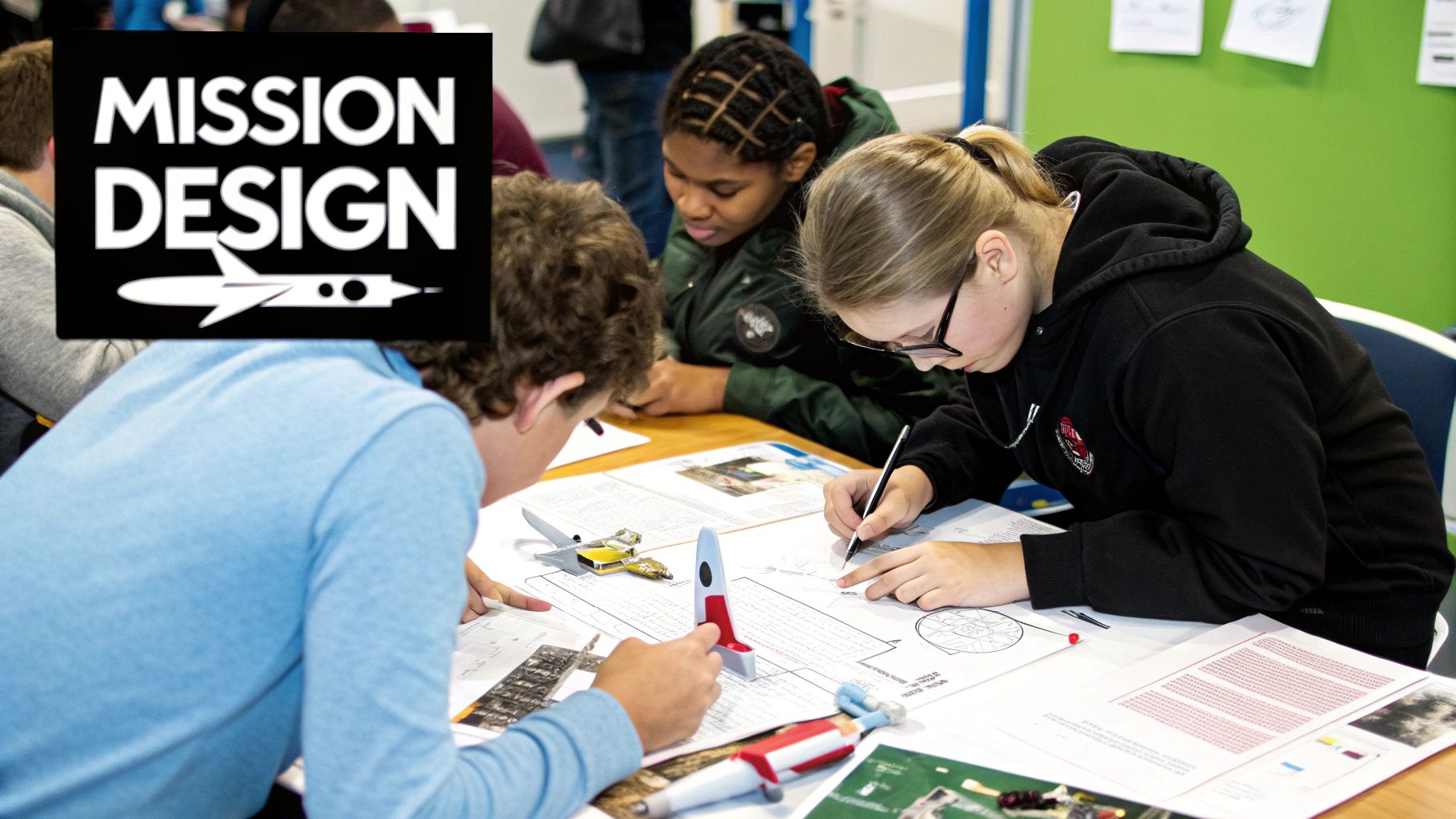
Time to level up! This project idea challenges you to become a space exploration engineer. The goal is to design a complete space mission from scratch. You'll choose a destination—like a planet or moon—and plan out every detail, from the mission's goals and spacecraft design to its flight path and scientific instruments. You even have to think about budget!
This challenge gets you thinking critically and solving problems creatively, just like the real engineers at NASA and the European Space Agency. It’s a fantastic way to combine science, technology, engineering, and math (STEM) into one super exciting project. Designing a mission is a big responsibility, kind of like the one Fred faces in Space Ranger Fred and the Umbrella Rescue.
Implementation Tips
- Provide Real-World Examples: Check out mission briefs from real NASA or ESA missions. This gives you a professional framework to use, whether you're designing a Mars rover or a probe to search for life on Europa.
- Break It Down: Divide the project into smaller, manageable steps over a few weeks: concept, design, budget, and presentation. This keeps it from being overwhelming and lets you really dive into each stage.
- Encourage Collaboration: Team up! Organize peer review sessions where teams can share their ideas and get helpful feedback. This is how real space agencies work.
- Organise a 'Mission Review' Panel: Have students present their final designs to a panel of 'experts' (teachers, parents, or maybe even a local scientist!). This adds a level of seriousness and excitement to the project.
This hands-on solar system project idea is perfect for older kids, transforming abstract concepts into a real engineering challenge. It builds a deep appreciation for the complexity and genius behind every robot explorer we send into the cosmos.
8. Solar System Energy and Heat Transfer Model
Let's talk physics! This project looks at how energy from the Sun affects different planets based on their distance, atmosphere, and what they're made of. You'll build experiments and models to demonstrate concepts like the inverse square law (how light gets dimmer the farther it travels), the greenhouse effect, and why planetary temperatures vary so much. By measuring how light and heat change over distance, you'll get a real sense of why Mercury is scorching hot and Neptune is an icy deep-freeze.
A bunch of hands-on activities can bring these ideas to life. Try measuring light intensity at scaled distances, create mini-greenhouses in jars, or use thermometers to map heat distribution. For a fun story tie-in, compare your scientific findings to the interplanetary puzzles in Space Ranger Fred and the Tick Tock Tale.
Implementation Tips
- Use consistent methodology across all your distance measurements to make sure your comparisons are fair.
- Create clear data tables to record light intensity, temperature, and any atmospheric variables you test.
- Connect results to real values by looking up actual planetary temperatures and comparing them to your data.
- Explore greenhouse effects with simple terrariums using different covers (like plastic wrap vs. glass) to trap heat.
- Discuss model limitations: Talk about what your model doesn't account for, like atmosphere thickness, how reflective a planet is (albedo), and its heat capacity.
This project really sharpens your scientific skills in designing experiments, analyzing data, and thinking critically. It earns its spot among the top solar system project ideas for turning abstract energy concepts into vivid, hands-on learning.
9. Exoplanet Discovery and Analysis Project
This project takes you beyond our familiar solar system and into the exciting frontier of modern astronomy. An exoplanet is a planet that orbits a star outside our solar system. Instead of building models, this idea turns you into a real data scientist, analyzing information from missions like NASA's Kepler Space Telescope to find and learn about these distant worlds.
Learning about exoplanets makes the universe feel vast, dynamic, and full of possibilities. It connects you to the cutting-edge of space exploration and tackles the huge question: "Are we alone?" This kind of scientific detective work mirrors the curiosity and problem-solving in Space Ranger Fred and the Tick Tock Tale, where understanding the rules of a new environment is the key to success.
Implementation Tips
- Analyse Light Curves: Use online citizen science platforms like Zooniverse's Planet Hunters project. You can look at real "light curve" graphs from telescopes, which show a star's brightness over time. A small, regular dip in brightness could mean an exoplanet is passing in front of its star!
- Create an Exoplanet Catalogue: After analyzing data, create a catalog of the planets you "discover." You can record the planet's estimated size, its distance from its star, and whether it might be in the "habitable zone," where liquid water could exist.
- Compare to Our Solar System: Challenge yourself to compare your findings to planets like Earth or Jupiter. Is the exoplanet a rocky world or a gas giant? How long is its year? This makes the abstract data feel more real.
- Explore Detection Methods: Learn about the different ways scientists find exoplanets, like the transit method (light curves) and the radial velocity method. You can even create simple demonstrations to explain these cool techniques.
This is one of the most forward-looking solar system project ideas, as it introduces you to the real scientific process of hypothesis, data analysis, and conclusion—all while exploring the potential for life somewhere else in the cosmos.
10. Solar System Art and Literature Integration Project
Let's get creative! This cross-curricular project mashes up solar system science with artistic expression through art, poetry, music, and storytelling. You'll research astronomical concepts—like planetary geology or orbital periods—and then translate what you've learned into original works that are both scientifically accurate and super imaginative.
By combining STEM with the arts (making it a STEAM project), you can deepen your understanding of the cosmos while also building your communication skills. You could create planetary landscape paintings with accurate colors, write science fiction stories based on real conditions on Mars, compose musical pieces that reflect each planet’s orbital speed, or produce digital collages that mix Hubble images with your own sketches.
For some amazing inspiration, check out how NASA combines art and science at https://www.nasa.gov/education/art-and-science.
Implementation Tips
- Set Dual Criteria: When you grade the project, have clear rules for both scientific accuracy and creative originality.
- Showcase Exemplars: Share cool examples of STEAM projects from the past to spark ideas.
- Offer Choice of Medium: Let students pick their passion, whether it's writing, painting, music, digital art, or even drama.
- Host a Gallery-Reading: Arrange a class exhibition where students can show off their work and explain the science behind their creative choices.
- Integrate Storytelling: Encourage students to connect their work to adventures like those in Space Ranger Fred and the Umbrella Rescue.
This project definitely deserves its spot on the list because it builds deep scientific knowledge through active creativity. It fosters critical thinking, celebrates different talents, and gives every child a chance to shine in both science and the arts.
Solar System Project Ideas Comparison
| Project Title | Implementation Complexity 🔄 | Resource Requirements ⚡ | Expected Outcomes 📊 | Ideal Use Cases 💡 | Key Advantages ⭐ |
|---|---|---|---|---|---|
| 3D Solar System Model with Scale Distances | Medium to High | Moderate to High (space, materials, tech) | Strong spatial understanding of scale | Visual/spatial learners; art & science integration | Tangible scale visualization; customizable |
| Interactive Planetary Orbit Simulator | High | Moderate to High (programming tools) | Enhanced physics & programming skills | Tech-focused learners; simulations | Real-time interaction; customizable |
| Solar System Edible Model | Low | Low (food materials) | Engaging sensory learning, memorable | Group activities; kinesthetic learners | Multisensory engagement; fun & interactive |
| Planetary Atmosphere Composition Laboratory | Medium | Moderate (lab equipment, safety gear) | Hands-on chemistry & atmospheric insights | Science labs; chemistry-astronomy link | Tangible experiments; scientific method |
| Solar System Timeline and History Project | Low to Medium | Low (research materials) | Improved research & historical context | History/science integration; presentations | Develops research & critical thinking |
| Comparative Planet Surface Features Study | Medium | Moderate (image/data access) | Geological & analytical skills | Detailed planetary geology study | Real mission data use; comparative analysis |
| Space Mission Design Challenge | High | High (research, planning tools) | Engineering & project management skills | Advanced STEM education; engineering focus | Integrative & creative problem-solving |
| Solar System Energy and Heat Transfer Model | Medium | Moderate (experimental setup) | Physics principles & quantitative analysis | Physics-astronomy labs | Hands-on experiments; quantitative focus |
| Exoplanet Discovery and Analysis Project | High | High (data/software access) | Data analysis & current astronomy knowledge | Advanced astronomy & data science | Uses cutting-edge data; real research link |
| Solar System Art and Literature Integration Project | Low to Medium | Low to Moderate (art supplies, media) | Creative expression with scientific basis | Cross-curricular STEAM activities | Appeals to diverse learners; interdisciplinary |
Mission Complete: Next Adventures Await
You've done it! You've journeyed through ten incredible solar system project ideas, turning everyday stuff into cosmic masterpieces and tricky science into hands-on learning. From building a scale model that truly shows the vastness of space to designing your own space mission, you've proven that the universe isn't just something to read about—it's something to build, explore, and understand. Each project was designed to spark a different kind of curiosity, showing that science, technology, engineering, art, and math (STEAM) are all connected pathways to figuring out our place in the cosmos.
The big takeaway here is that learning about space is an active, creative adventure. Whether you were calculating planetary distances, coding orbits, or even tasting the layers of a gas giant, you were engaging with astronomy in a way you won't forget. These projects go way beyond memorizing facts. They encourage you to think critically, solve problems, and gain a real appreciation for the amazing mechanics of our solar system.
Your Next Steps on This Cosmic Journey
Mastering these concepts isn't just about a science test; it's about igniting a lifelong passion for discovery. The skills you've worked on—like spatial reasoning, analyzing data from the exoplanet project, and creative design from the art integration—are valuable in every part of life. You've learned to ask big questions and find the answers through experiments and creativity.
So, what's next for our awesome space explorers?
- Share Your Creations: Don't hide your amazing projects away! Share them with your class, your family, or even online (with a parent's permission). Explaining your project to others is a fantastic way to lock in what you've learned.
- Revisit and Expand: Pick your favorite project and think about how you could take it to the next level. Could you add moons to your 3D model? Or research the specific weather patterns on Jupiter for your surface study?
- Explore Further: Use the resources from this article to dive deeper into a topic that blew your mind. If the Space Mission Design Challenge was your jam, look up recent missions by NASA or the European Space Agency.
Your adventure doesn't have to end here. The universe is endlessly fascinating, and this is just the beginning. Like the hero in Space Ranger Fred and the Shoelace Adventure, you've learned that even small steps and clever thinking can lead to big discoveries. Keep looking up, stay curious, and continue to reach for the stars. Your next great scientific adventure is waiting.
Ready for another cosmic quest after completing your projects? Continue the fun with Space Ranger Fred! The illustrated books, like Space Ranger Fred and the Tick Tock Tale, blend exciting stories with real science, making them the perfect companion for any young explorer inspired by these solar system project ideas. Discover your next adventure at Space Ranger Fred.