
Ever looked up at the night sky and wondered, what are planets made of? They might seem like tiny, glowing dots that all look the same, but each one is a completely unique world with its own secret recipe. It really all boils down to a cosmic mix of rocks, metals, and gases, but how much of each ingredient you use creates wildly different results.
Your Cosmic Ingredient Journey Begins Here
Time to put on your cosmic chef's hat! We’re about to explore the building blocks that cook up everything from solid worlds like Earth to the swirling, gassy giants like Jupiter. Getting to know these ingredients is the secret to understanding why you could stand on Mars but would fall straight through Saturn.
To really get our imaginations going, let's take a quick trip to the wonderfully weird planet Jambori from the Space Ranger Fred and the Shoelace Adventure book. Jambori is a bonkers purple and yellow world that looks like it has rivers of custard! On this imaginary planet, beautiful flowers smell like dung and what sounds like beautiful birdsong is more akin to that of a chicken clucking. It’s a great reminder of how a planet's ingredients can create some truly strange and wonderful places.
This simple diagram shows the three main "recipes" for planets based on their core ingredients.
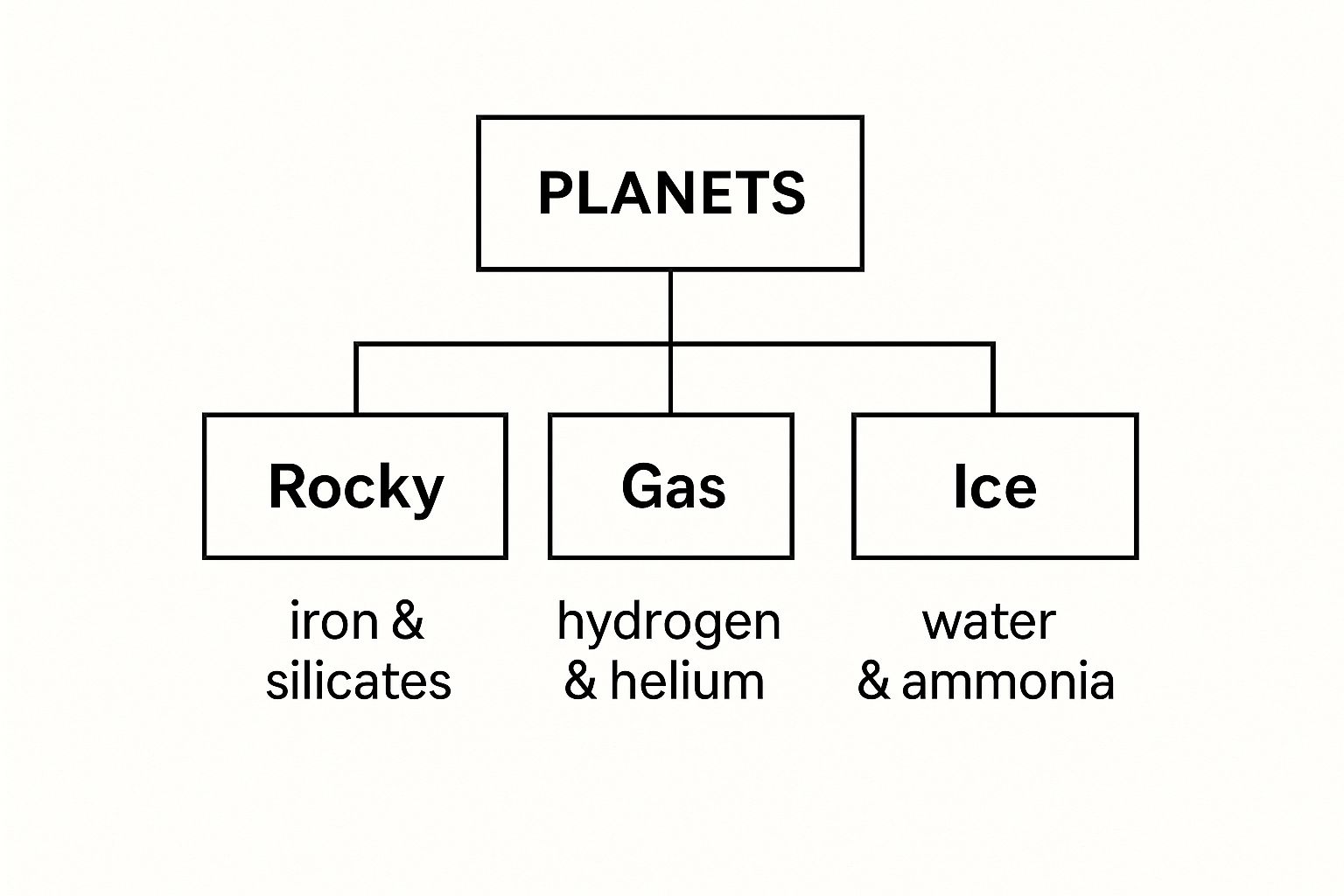
As you can see, planets are sorted into rocky, gas, and ice types, and each has its own primary building blocks. Let's get ready to uncover the fascinating materials that make each planet so special.
The Three Main Planet Types
The ingredients a planet is made of depend a lot on where it formed in its solar system. Planets that grew up closer to their star tend to be rocky, while those that formed much further away are often gassy or icy.
Here’s a quick summary of the main planetary recipes we will be exploring, their key ingredients, and a familiar example from our solar system.
The Three Main Planet Types At a Glance
| Planet Type | Primary Ingredients | Solar System Example |
|---|---|---|
| Rocky Planets | Primarily made of rock (silicates) and metal (iron, nickel). | Earth |
| Gas Giants | Mostly composed of light gases like hydrogen and helium. | Jupiter |
| Ice Giants | Made of "ices" like water, ammonia, and methane. | Neptune |
This table gives us a great starting point for our journey. Now, let's slice open a rocky planet to see what's cooking inside its fiery core and solid crust.
The Recipe for Rocky Terrestrial Planets
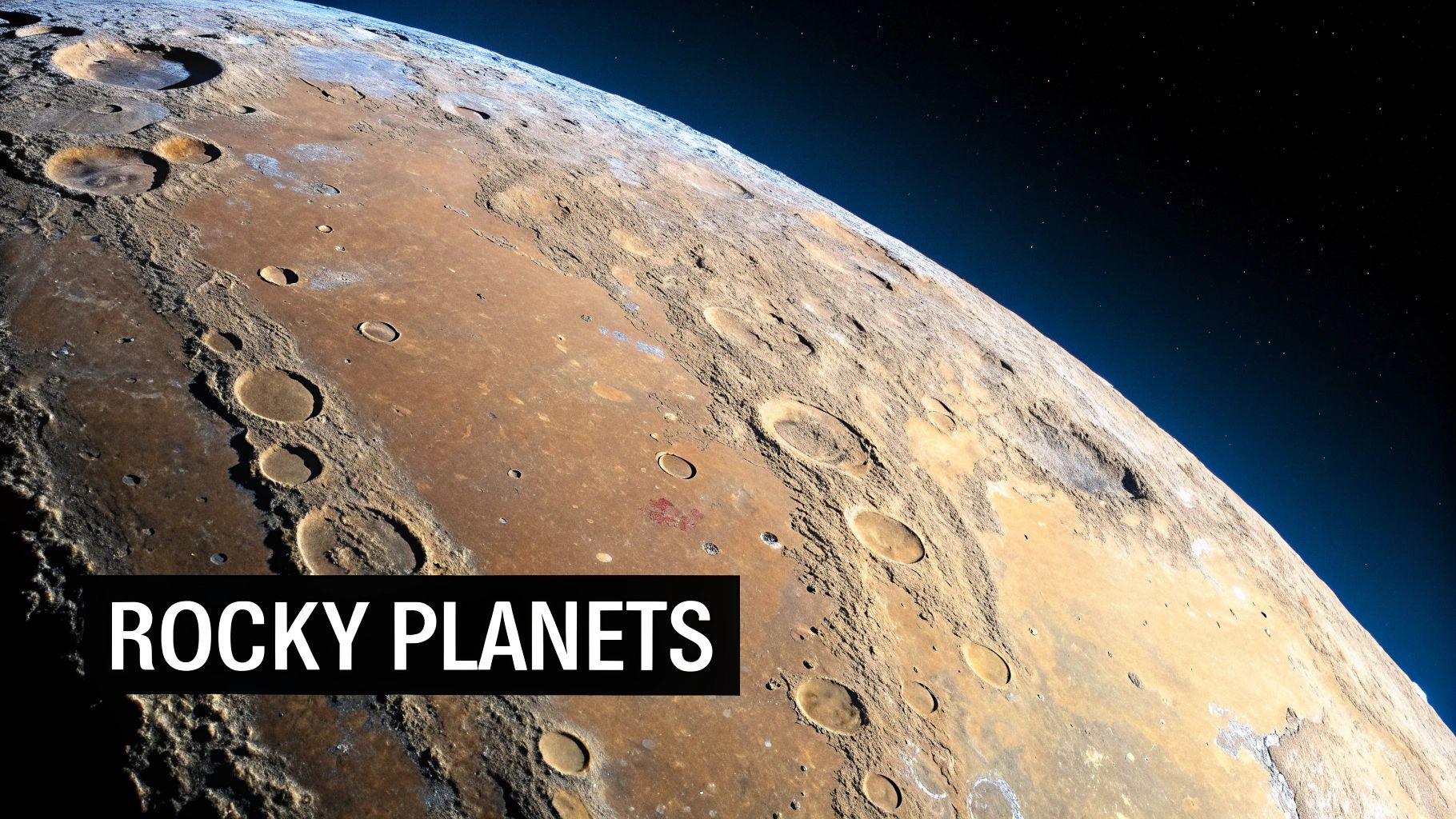
Think about baking a really dense, heavy cake. That’s a fantastic way to picture the terrestrial, or rocky, planets in our solar system. These are the solid worlds whizzing closest to the Sun—Mercury, Venus, Earth, and Mars—and they're all cooked up from a simple recipe of rock and metal.
Unlike their gassy cousins further out, these planets have solid surfaces you could actually stand on (if you had a spacesuit, of course!). This is because they formed in the hotter, inner part of the solar system where only the heavy stuff could clump together. The lighter gases were mostly blown away by the young Sun’s powerful solar wind.
Slicing Open a Rocky Planet
If we could slice open a rocky planet like a giant gobstopper, we’d see it’s made of different layers, a bit like an onion. This layered structure is a huge clue about what these planets are made of.
From the inside out, the main layers are:
- The Core: This is the super-hot centre of the planet. It’s made of the heaviest materials, mostly iron and nickel, and it can be solid, liquid, or a mix of both!
- The Mantle: A thick, gooey layer of molten rock called magma that sits around the core. It’s constantly churning away, which can cause things like volcanoes and earthquakes up on the surface.
- The Crust: This is the thinnest, outermost layer. It’s the solid rock on the surface that we live on, and it’s broken into massive pieces that float on the mantle.
This structure didn't happen by accident. It’s the result of a process called differentiation. When these planets were young and basically big balls of hot goo, gravity pulled all the heavy stuff like iron down to the centre. The lighter rocky materials naturally floated to the top.
Terrestrial planets like our Earth are made mostly of rock and metals. In fact, Earth is about 32.1% iron by mass, and almost all of it is packed into its core. The mantle and crust are dominated by something called silicate minerals.
Not All Rocky Worlds Are Alike
Even though they share the same basic recipe, not all terrestrial planets turned out the same. Mars, for instance, is called the "Red Planet" because of all the iron oxide—or rust—in its soil. Venus, on the other hand, has a thick, toxic atmosphere that traps heat, making it the hottest planet in our solar system.
These small differences in their ingredients create completely different worlds.
Every rocky planet is a unique creation, cooked up from the same basic stellar dust but baked at different temperatures and distances from the Sun. This is why our solar system is such a fascinating place to explore! You can discover more about these amazing worlds in our easy guide to the solar system: https://www.spacerangerfred.com/2025/08/28/what-is-the-solar-system-an-easy-guide/
These rocky worlds show us that even with a simple recipe of rock and metal, you can get some pretty amazing and diverse results. Just think of the wild creations you could make, like Space Ranger Fred did when he visited a planet made of shoelaces in Space Ranger Fred and the Shoelace Adventure
Mixing Up the Giant Gas Planets
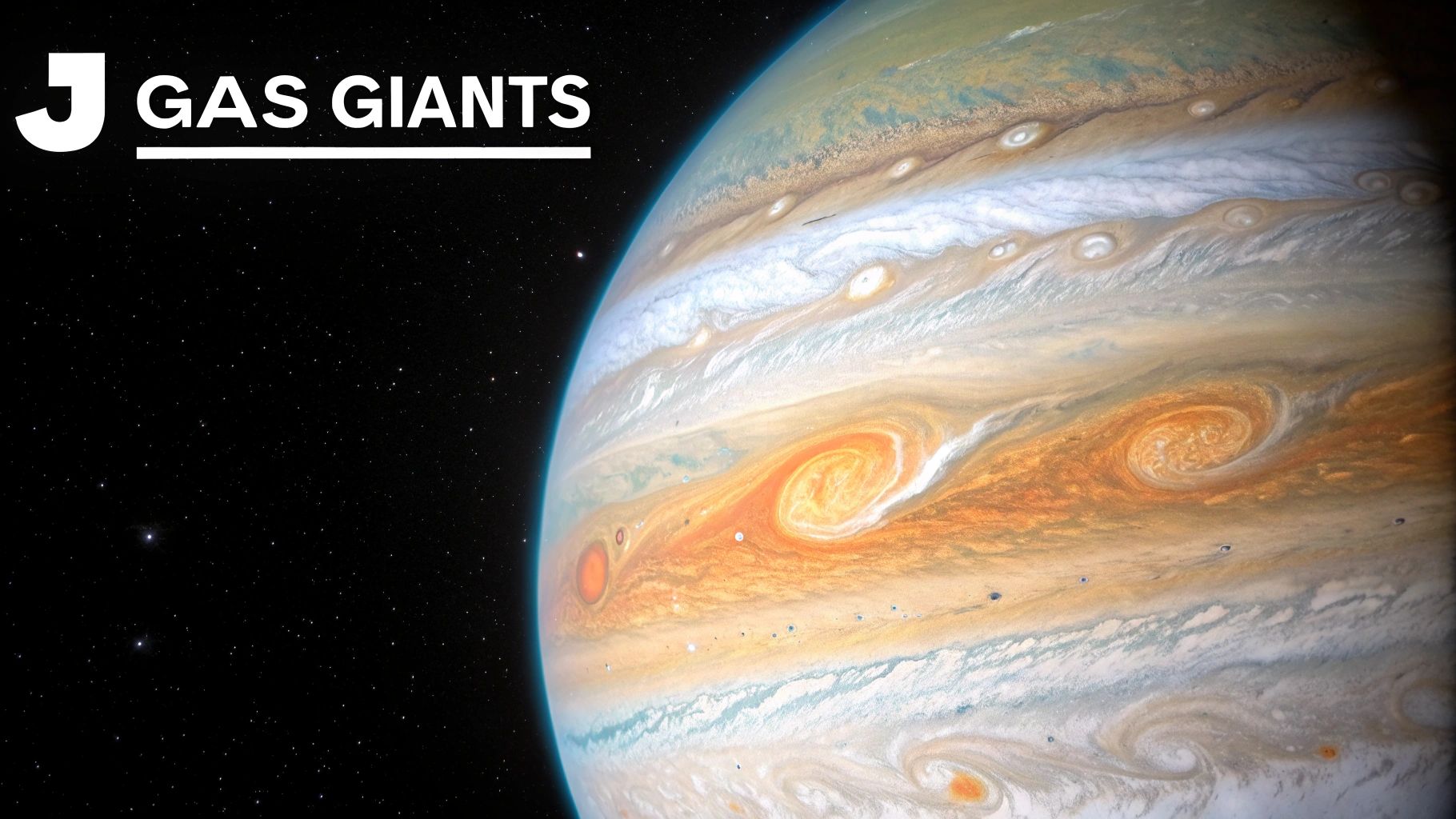
Right, let’s leave the little rocky worlds behind and say hello to the absolute titans of our solar system: Jupiter and Saturn. Think of them as colossal cosmic balloons, mostly filled with the two simplest and lightest gases in the entire universe – hydrogen and helium. They are so mind-bogglingly different from Earth that they make you rethink what a planet can even be!
For starters, you could never, ever land a spaceship on Jupiter or Saturn. Why? Because there’s no solid ground to land on! If you tried, you’d just keep sinking deeper and deeper into their incredibly thick, swirling atmospheres. It would be a bit like trying to land a plane on a cloud.
A Swirling Sea of Gas
What we see as the ‘surface’ of Jupiter and Saturn are really just the colourful tops of their cloud layers. Those beautiful bands and storms, like Jupiter’s famous Great Red Spot, are all down to different chemicals whizzing around and mixing at high speeds. These are just tiny traces of things like ammonia and water, which add a splash of colour to the main hydrogen and helium mix.
According to a UK space science report, these gas giants are made of over 90% hydrogen and helium. Their deep atmospheres are mostly molecular hydrogen, with helium making up about 9-10%. The tiny bits of methane, ammonia, and water vapour left over are what form the fantastic clouds we can see with our telescopes.
This simple recipe sounds a world away from the wild and wacky ingredients Space Ranger Fred comes across on his adventures. Just imagine Planet Jambori, the purple and yellow world from the book Space Ranger Fred and the Umbrella Rescue, which looks like it has rivers of custard! Its make-up must be truly bizarre compared to the straightforward gas cocktail of Jupiter.
What Lies Deep Inside a Gas Giant
So, if it’s all just gas, what’s going on deep inside these enormous planets? Well, the pressure becomes absolutely immense—so powerful that it does something truly strange to the stuff inside.
Deep within a gas giant, the crushing weight of the atmosphere is thought to squeeze hydrogen gas so hard that it turns into a bizarre, electrically conductive fluid known as liquid metallic hydrogen.
Scientists reckon this weird, sloshing metallic hydrogen is what creates the incredibly powerful magnetic fields around Jupiter and Saturn. Right at their very centres, they might have a small, hot, and dense core made of rock and ice. But it’s buried under thousands upon thousands of kilometres of gas and liquid metal, forever hidden from our sight.
The Chilly Ingredients of Ice Giants
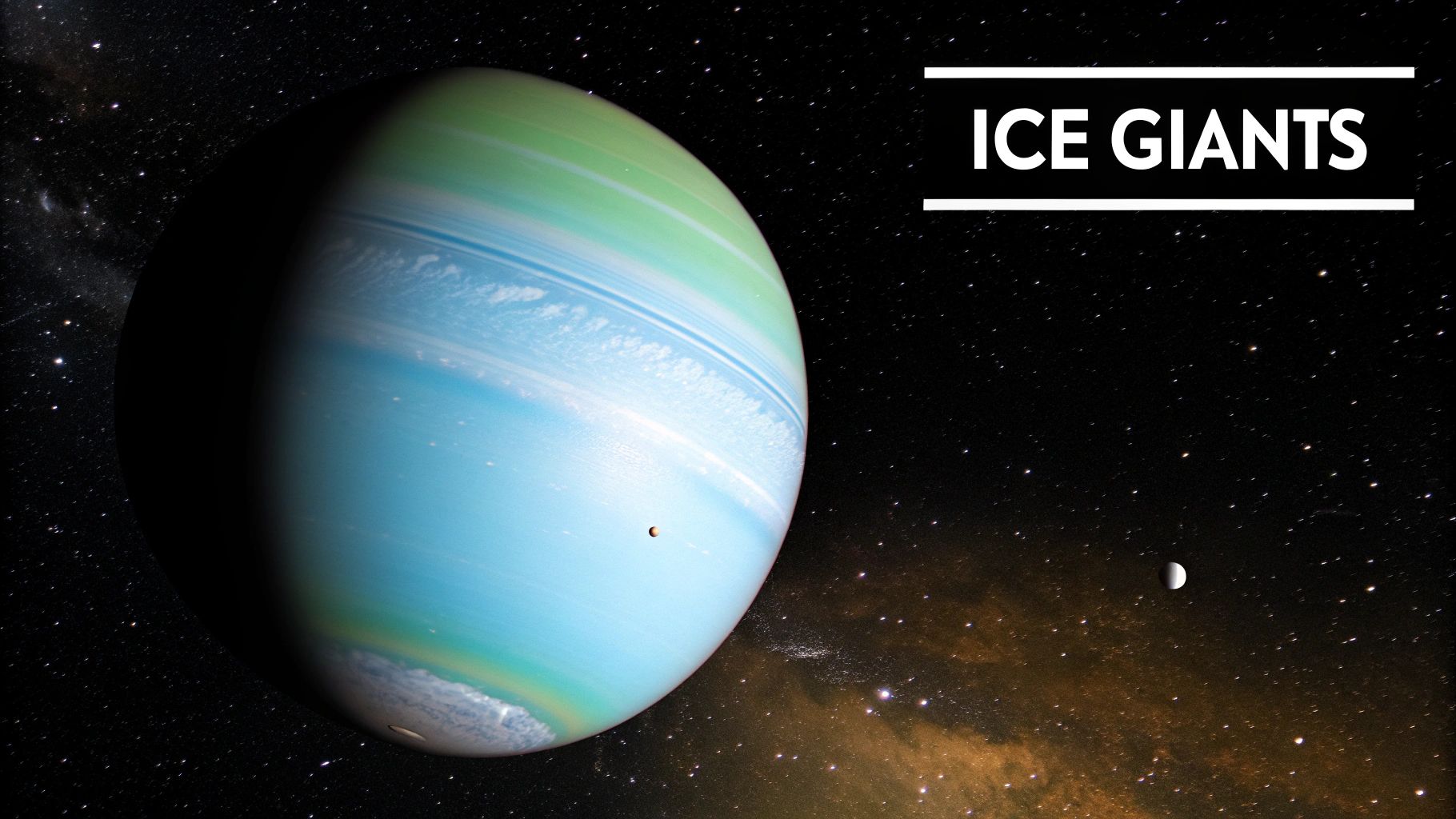
Right, let’s blast off to the far, chilly reaches of our solar system and say hello to the ice giants, Uranus and Neptune. These beautiful blue worlds are built from a completely different recipe than their rocky and gassy cousins, making them a truly unique and mysterious class of planet.
At first glance, you might mistake them for smaller versions of Jupiter and Saturn. They both have thick, puffy atmospheres made mostly of hydrogen and helium. But that’s where the family resemblance ends. The real secret to being an ice giant is what’s bubbling away just beneath those top layers of gas.
A Very Different Kind of Ice
Now, when astronomers talk about "ice" on these planets, they don't mean the stuff you pop into your lemonade on a hot day. In the world of space science, ‘ices’ is just a cool way of saying they’re made of heavier chemical compounds that freeze at very low temperatures.
The key icy ingredients for these planets are:
- Water (H₂O): The very same stuff we drink, but imagine it squeezed under incredible pressure and heat!
- Ammonia (NH₃): A pongy compound that’s a gas on Earth but forms a kind of slushy ice out there.
- Methane (CH₄): The same gas some people use in their stoves, but here it’s a crucial ingredient for giving a planet its amazing colour.
This weird and wonderful mix is a world away from the strange materials Space Ranger Fred sometimes stumbles upon. In the book Space Ranger Fred and the Tick Tock Tale, he visits the bizarre planet Jambori, a purple and yellow world with what looks like rivers of custard and beautiful flowers that smell like dung! It just goes to show how wildly different planets can be.
A Hot, Slushy Middle
So, what are planets like Neptune really made of deep down? Scientists believe that under their gassy atmospheres, ice giants have a hot, thick, and slushy mantle. This isn't a solid layer but a strange, swirling ocean of liquid water, ammonia, and methane, all smooshed together under extreme pressure.
Right at the very centre of it all, there's probably a small, rocky core, about the same size as Earth. But it’s that massive, slushy, icy mantle that makes up most of the planet’s bulk, which is exactly why they earned the name "ice giants."
Ever wondered why Uranus and Neptune are such a stunning blue? It's all thanks to the methane gas in their upper atmospheres. This gas is brilliant at soaking up the red light from the Sun and bouncing the blue light back into space, giving these chilly worlds their signature look.
How We Figure Out a Planet’s Secret Recipe
It’s a brilliant question, isn't it? If we can’t just fly to Jupiter and grab a scoop of its clouds, how on earth do we know what planets are made of?
Well, scientists are a bit like cosmic detectives. They use some seriously clever tricks and amazing tools to figure out a planet's recipe from millions, or even billions, of kilometres away.
One of their best tricks involves light. Planets don't make their own light; they reflect it from the Sun, like a giant mirror. Before that sunlight bounces back towards us, it has to pass through the planet’s atmosphere. All the different gases and chemicals swirling around leave their own unique ‘fingerprint’ on the light.
By catching that reflected light with powerful telescopes, scientists can analyse these fingerprints and work out exactly what gases are in the air.
Weighing a World from Way Out in Space
Another amazing trick is all about gravity. Spacecraft, like NASA's Juno mission which has UK researchers helping out, are sent to fly in super-close orbits around other planets.
As the spacecraft zips around, the planet’s gravity is constantly tugging and pulling on it. By tracking these tiny movements very, very carefully, scientists can work out how much the planet ‘weighs’ and where all its heaviest stuff is hiding.
This tells them if a planet has a huge, dense, heavy core buried deep inside, or if it’s mostly made of light, fluffy gas from top to bottom. It’s a bit like trying to guess what’s inside a birthday present just by weighing it in your hands!
By putting all these clues from light and gravity together, we can start to piece together a planet's secret recipe without ever landing there. It’s this kind of incredible detective work that makes exploring space so exciting.
This ongoing mission to understand our cosmic neighbours is a huge part of space history. You can learn more about the amazing missions that have taught us so much by checking out this great space exploration timeline for kids. Every new discovery adds another ingredient to what we know about the universe.
Exploring What Imaginary Planets Are Made Of
Okay, now that we’ve peeked at the real-life recipes for rocky, gas, and ice planets, it’s time to have some fun and bend the rules of science! Not every planet out there has to follow the same blueprints we see in our solar system.
This is especially true for the weird and wonderful worlds we find in amazing stories, like in books such as Space Ranger Fred and the Shoelace Adventure. In adventures like Fred's, our heroes get to explore all sorts of bizarre and fantastic planets that really get your imagination firing on all cylinders. It’s a great reminder that when you’re creating new worlds, the only real limit is your own imagination.
Cooking Up Planet Jambori
Let's cook up our own fictional world, taking a little inspiration from the Space Ranger Fred books. We'll call it Planet Jambori—a quirky purple and yellow planet that looks like it has rivers of flowing custard. So, what could a planet like that actually be made of?
For starters, that vibrant purple and yellow crust might not be made of normal rock at all. Maybe it’s formed from unusual sulphur compounds that create those brilliant colours. Here on Earth, sulphur can be a super bright yellow, so it’s not too much of a stretch!
And what about those gooey rivers? Instead of water, they could be thick, slow-moving streams of liquid hydrocarbons, like methane or ethane. On a really, really cold world, these substances could act just like rivers, carving paths through the strange, colourful landscape.
Imagining fictional planets isn't just silly fun; it's a brilliant way to explore what’s scientifically possible. By asking "what if?", we can think about how different ingredients and conditions could create environments totally unlike our own—which is exactly what real planetary scientists do every day.
Life on a Weird World
The amazing thing about a planet’s ingredients is how they shape everything else, right down to the kind of life that might live there. On our imaginary Planet Jambori, life would have to be very strange indeed.
Let's imagine its atmosphere is thick with chemicals that we would find pretty smelly. This could lead to some very peculiar biology:
- Dung-Scented Flowers: Perhaps the plants on Jambori have evolved to attract pollinators that are drawn to the whiff of ammonia or sulphur. What smells awful to us might be an irresistible perfume to a Jamborian insect!
- Chicken-Clucking Birds: The creatures on this planet would adapt to its unique atmosphere, too. The sound of their birdsong might travel differently through the thick air, making what they think is a beautiful melody sound more like a chicken clucking to our ears.
This little thought experiment shows us that what planets are made of is the most important piece of the puzzle. It decides their colour, their landscape, and even the kinds of life that could one day call them home. It’s a wonderful reminder that the possibilities for planets in the universe are truly endless.
Got More Questions About Planet Recipes?
Still buzzing with questions about what planets are made of? It’s a huge and fascinating subject, so that’s completely normal! Let’s tackle a few of the most common cosmic queries we get from curious explorers like you.
Why Are Some Planets Rocky and Others Gassy?
It really all comes down to one thing: location! When our solar system was just a cosmic baby, it was blazing hot right next to the Sun. Only tough, heavy stuff like rock and metal could stand the heat and clump together, which is exactly how our inner rocky planets were born.
Way, way out from the Sun, things were much chillier. This cold environment allowed lighter ingredients like hydrogen, helium, and water ice to gather up. Over millions of years, these light and gassy materials bunched together to create the ginormous gas and ice giants.
Is Pluto Made of the Same Stuff as Other Planets?
Pluto, our famous dwarf planet, has its own special recipe. Scientists believe it's a mix of about 70% rock and 30% ice.
Its frosty surface is coated in a thin layer of frozen nitrogen, methane, and carbon monoxide. This rock-and-ice combo makes it totally different from both the rocky planets and the gas giants, which is one of the big reasons it got its own special category.
Do All Planets Have a Core?
Most scientists are pretty sure they do, but they’re all incredibly different from one another. Rocky planets like Earth have super-dense, metallic cores made mostly of iron and nickel.
Gas and ice giants are thought to have much smaller, rocky or icy cores hiding right at their centres. The catch is, they're buried under unbelievably thick atmospheres and squeezed by crushing pressure, making it impossible for us to ever see them directly.
Even with all our amazing telescopes and space missions, scientists are still piecing together the exact ingredients and layers of distant worlds. Every new discovery adds another clue to the cosmic puzzle, reminding us that there's always something new to learn about our incredible universe.
For anyone who wants to keep exploring, there are tons of fun resources out there. You can dig deeper into these awesome topics and find even more answers in our collection of STEM articles for young explorers. It's the perfect way to keep that curious mind of yours firing!
Ready for an adventure that’s truly out of this world? Join Space Ranger Fred and explore the cosmos through amazing stories that make learning about space an absolute blast!