
Have you ever wondered why bananas are a tiny bit radioactive, or how many hearts an octopus really has? The world, and indeed the entire universe, is bursting with incredible secrets just waiting to be discovered. Science isn't just about lab coats and complicated sums; it's the ultimate adventure, all about feeding your curiosity, exploring the unknown, and finding the 'wow' in everyday life. This is your guide to some of the most amazing and fun science facts for kids, designed to spark your imagination and show you how incredible our world truly is.
Each fact we'll explore is a mini-mystery solved. We’ll uncover mind-boggling truths about everything from the human body to the furthest reaches of space. Just like in the book Space Ranger Fred and the Tick Tock Tale, where understanding how things work is key to a great adventure, we'll see how asking simple questions can lead to the most brilliant answers. Get ready to uncover astonishing truths, gather some fantastic trivia for your mates and family, and see the universe in a completely new light. Prepare to have your mind well and truly blown!
1. Your Heart Beats About 100,000 Times Per Day
Ever thought about the hardest working muscle in your body? That’ll be your heart! This amazing organ, roughly the size of your clenched fist, works non-stop, every second of every day, for your entire life. It’s a powerful pump that keeps blood flowing, delivering oxygen and nutrients everywhere from your brain to your toes.
This constant work adds up to some massive numbers. Every single day, your heart beats approximately 100,000 times. That’s an incredible feat, pushing around 7,500 litres (about 2,000 gallons) of blood through a vast network of blood vessels. Even when you're sleeping, your heart is diligently doing its job, ensuring your body has everything it needs to rest and repair. It's a bit like Space Ranger Fred's spaceship engine in Space Ranger Fred and the Shoelace Adventure; it's always running in the background, ready for action.
The Heart's Incredible Numbers
To put these amazing figures into perspective, this infographic summarises the incredible daily and lifetime workload of your heart.
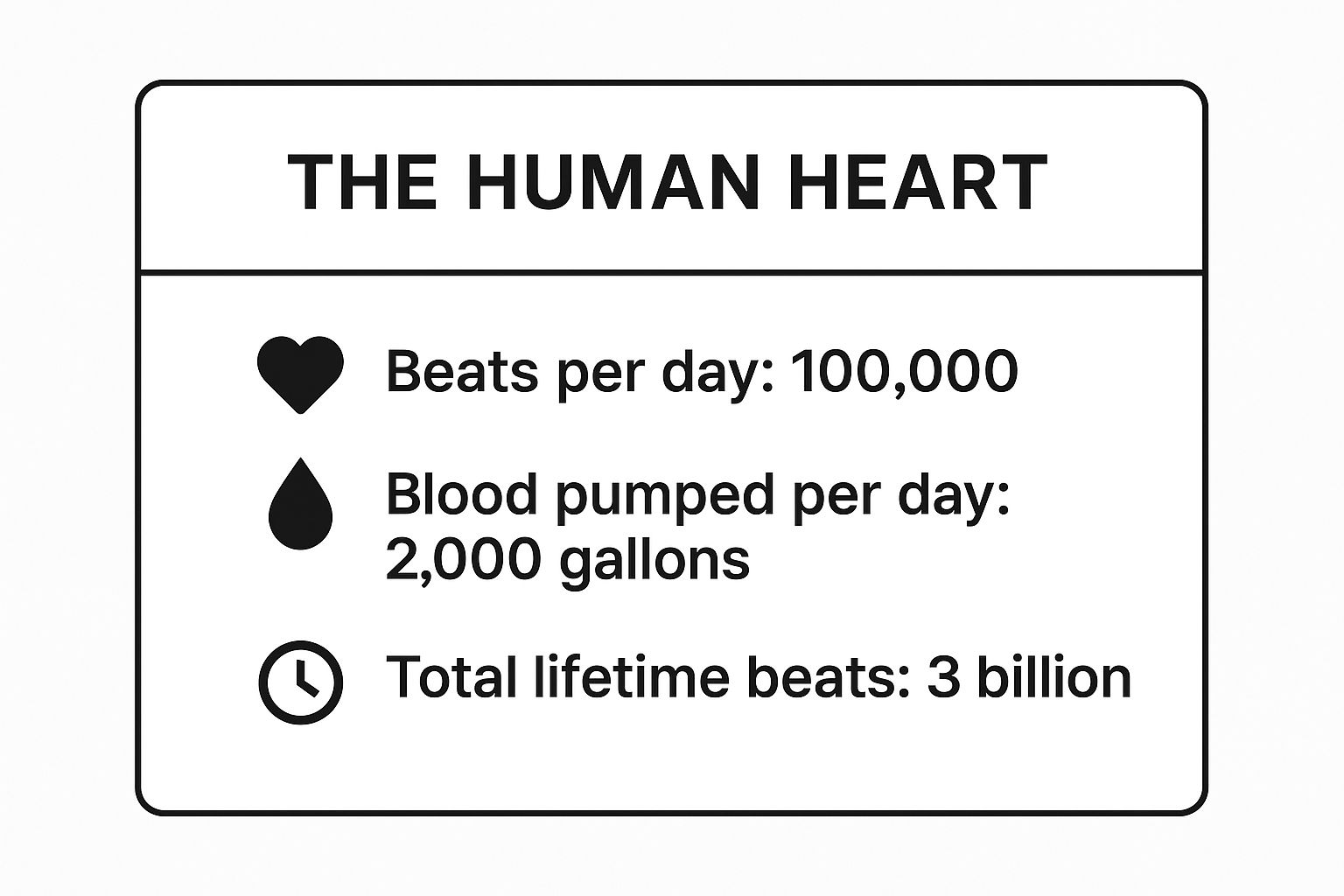
These numbers show just how vital and powerful this relatively small organ is, beating billions of times over a lifetime.
Try This at Home
You can check on your own heart's hard work with a simple activity. Here’s a fun science fact for kids you can test yourself: find your pulse on your wrist or neck, count the beats for 15 seconds, and then multiply that number by four. This will give you your heart rate in beats per minute (BPM). You'll notice it changes depending on whether you're resting or have just been running around.
2. Bananas Are Radioactive
Did you know that one of your favourite fruits is a little bit radioactive? It's true! Bananas contain a special type of potassium called potassium-40, which is a naturally occurring radioactive isotope. This sounds a bit like something that might power Space Ranger Fred's spaceship, but it’s a completely normal part of our world.
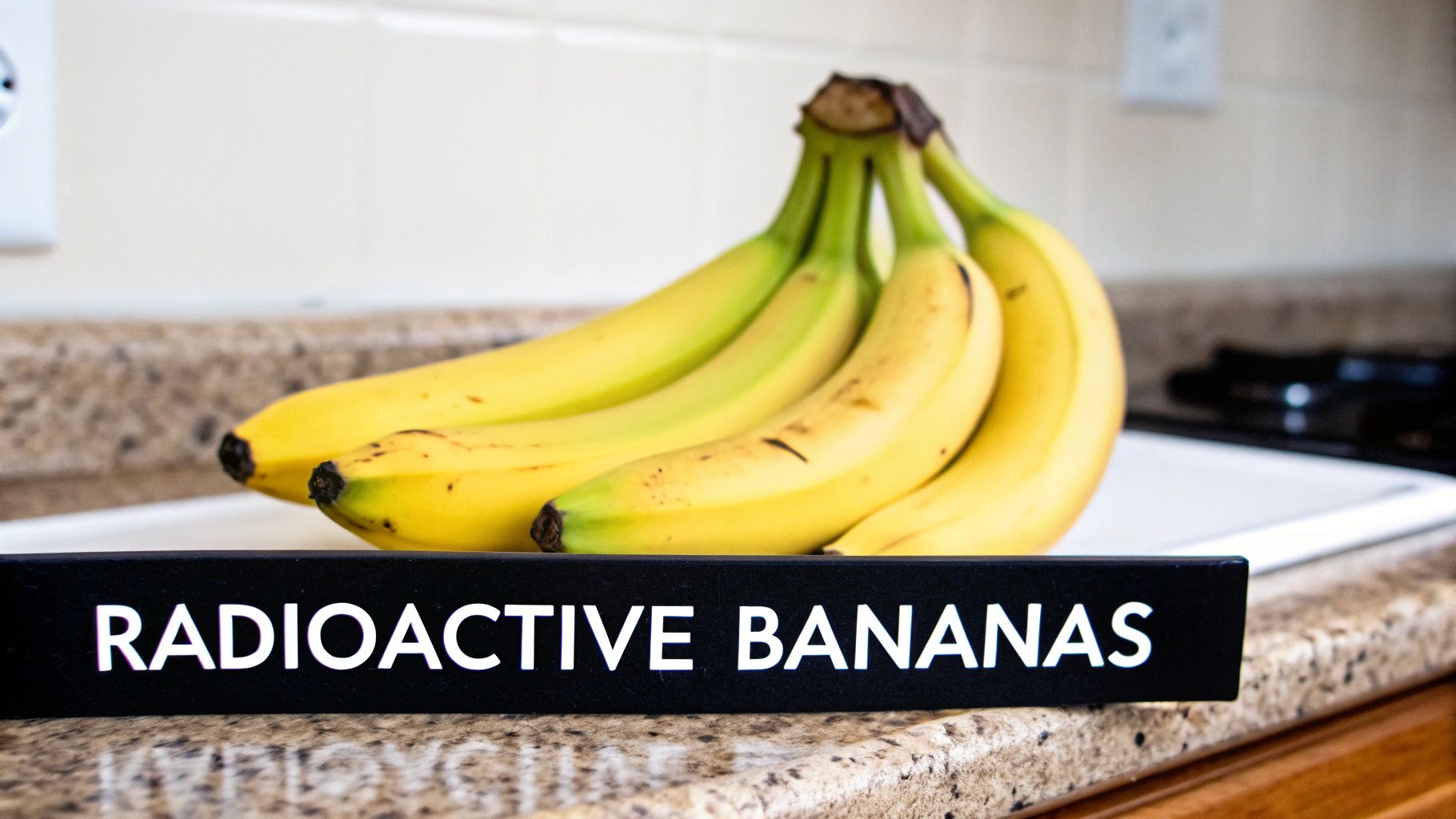
Before you worry, the amount of radiation is incredibly tiny and completely harmless. In fact, you'd have to eat about 10 million bananas all at once to feel any negative effects from the radiation. Scientists even use a measurement called the "banana equivalent dose" to help explain radiation levels in a simple way. This is a fantastic science fact for kids because it shows that radioactivity is all around us in nature, even in our fruit bowls!
Not Just Bananas
Many common things are slightly radioactive, and bananas aren't even at the top of the list for food. Here are a few other examples to show how common natural radioactivity is:
- Brazil Nuts: These are actually much more radioactive than bananas because the trees' roots absorb radium from the soil.
- Potatoes & Carrots: These root vegetables also absorb small amounts of radioactive elements from the ground.
- Your Own Body: People are naturally radioactive too, because we also have potassium-40 inside us.
Try This at Home
You can’t measure the radioactivity of a banana without special equipment, but you can use this fun fact to explore the world around you. Research other everyday items that are naturally radioactive, like granite worktops or even the air we breathe. It's a great reminder that science is everywhere. For more hands-on fun, you can find other amazing ways to investigate the world with these science experiments for children.
3. Octopuses Have Three Hearts and Blue Blood
Imagine having not one, but three hearts working to keep you going! That's reality for the octopus, one of the most fascinating creatures in the ocean. These intelligent animals have a completely different setup from us. Two of their hearts are dedicated to pumping blood through their gills (which are like our lungs), while the third, larger heart circulates blood to the rest of their body.
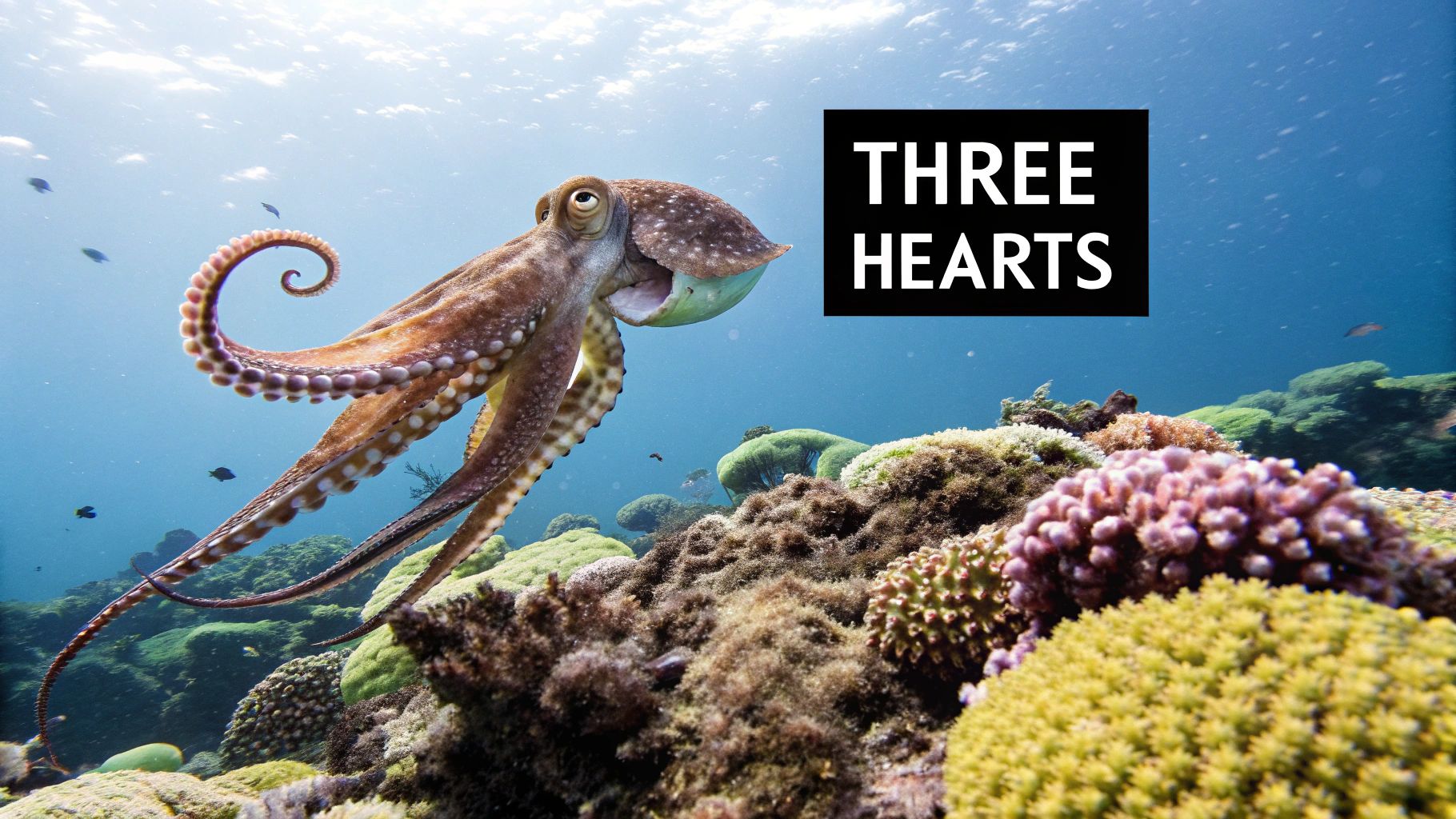
As if three hearts weren't enough, their blood is blue! Our blood is red because it uses an iron-based protein called haemoglobin to carry oxygen. Octopus blood uses a copper-based protein called haemocyanin. When this protein picks up oxygen, it turns a bright blue colour. It's a bit like the strange, colourful alien plants Space Ranger Fred discovered in Space Ranger Fred and the Umbrella Rescue; just a different, amazing way of doing things!
Try This at Home
You can see how copper changes colour with a simple experiment (with a grown-up's help). Find some old, dull-looking copper coins. Place them in a small bowl with a little bit of vinegar and salt. After a few minutes, take them out and let them dry. You’ll notice they are much shinier, but if you leave them exposed to the air, they may start to develop a blue-green tinge. This is the copper reacting with oxygen, similar to what happens in an octopus's blood.
4. A Group of Flamingos Is Called a 'Flamboyance'
What do you call a big group of bright pink birds standing together in the water? A 'flamboyance'! This fabulous name is the perfect way to describe a flock of flamingos. These social birds are famous for their brilliant pink feathers, but they aren't actually born that colour. Baby flamingos are grey or white and only turn pink because of the food they eat.
The secret to their colour is a natural pigment called carotenoids, found in the algae and shrimp that make up their diet. This is a fantastic science fact for kids that shows the direct link between what an animal eats and how it looks. Just imagine if Space Ranger Fred ate only green space-kelp from Planet Glarzon; he might start to turn a bit green himself! Some species, like the Caribbean flamingo, are a much brighter pink than others because their diet is richer in these pigments.
From Grey to Glorious
The transformation from a fluffy grey chick to a stunning pink adult is a great example of how an animal's environment and diet shape its appearance.
- You are what you eat: Flamingos absorb the pink and orange carotenoid pigments from their food.
- A gradual change: It takes a few years for a young flamingo to develop its full, vibrant pink plumage.
- Standing tall: Flamingos often stand on one leg to conserve body heat, tucking the other one up into their warm feathers.
Try This at Home
You can explore the science of natural colours right in your own kitchen! Ask a grown-up to help you see how pigments from food work. You could try using beetroot juice or crushed berries to dye a piece of white cloth or paper a brilliant pinkish-red colour. You can also practise your balance by trying to stand on one leg just like a flamingo. See how long you can hold the pose!
5. Lightning Strikes Create Glass
Did you know that one of the most powerful forces in nature can create something as delicate as glass? When a bolt of lightning strikes sandy ground, like a beach or a desert, its incredible energy creates a spectacular transformation. The heat from a lightning strike can reach a mind-boggling 30,000°C, which is about five times hotter than the surface of the sun!
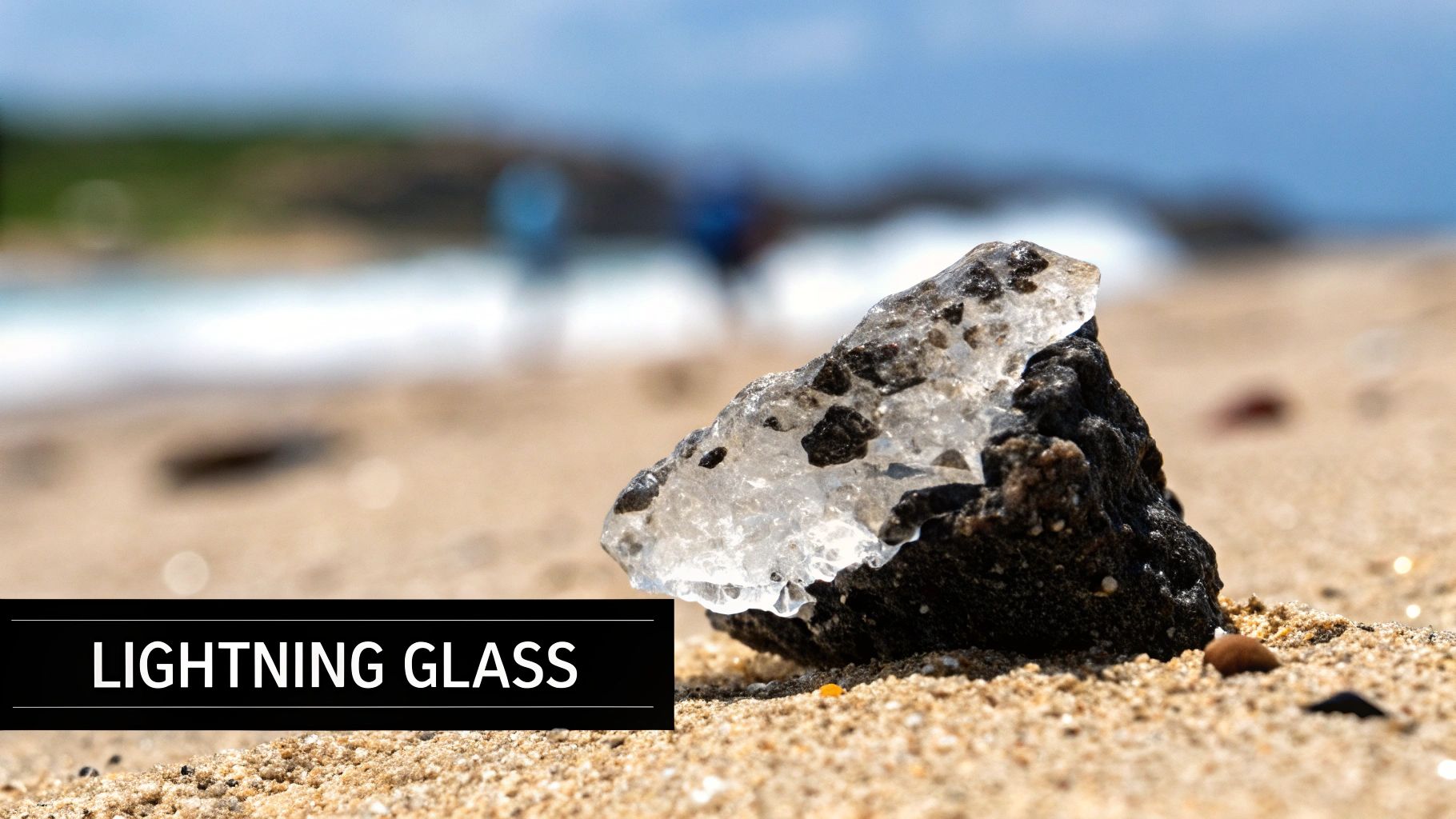
This intense heat instantly melts the sand along the lightning's path, fusing the grains of silica together. As the sand cools down rapidly, it forms a hollow, branching tube of natural glass called a fulgurite, also known as "fossilised lightning". These amazing formations look a bit like the strange, glassy plants Space Ranger Fred might discover on a faraway planet in Space Ranger Fred and the Tick Tock Tale.
The Science of Fossilised Lightning
Fulgurites are a fascinating fun science fact for kids because they capture a single, powerful moment in time. The shape of the fulgurite perfectly preserves the path the lightning bolt took as it travelled through the ground.
- Formation: Created by the extreme heat of a lightning strike melting sand or soil.
- Appearance: They are often hollow and can have a rough exterior covered in sand, with a smooth, glassy interior.
- Discovery: Geologists and storm chasers often find these delicate structures in sandy areas known for frequent thunderstorms. Some are even displayed in museums!
Try This at Home
While you can't create real lightning, you can explore the idea of how heat changes materials. With a grown-up's help, observe how sugar melts in a pan when heated, changing from solid crystals into a liquid and then hardening into a glassy sweet when it cools. This demonstrates how a change in temperature can completely transform a substance, just like lightning transforms sand. If you ever visit a sandy beach after a thunderstorm, keep your eyes peeled for these rare natural treasures.
6. Honey Never Spoils
Have you ever found an old jar of something in the back of the cupboard and wondered if it’s still okay to eat? Well, if that jar is full of honey, the answer is almost certainly yes! Honey is a super-special food because it practically lasts forever. Archaeologists have even found pots of honey in ancient Egyptian tombs that are over 3,000 years old and still perfectly edible.
The secret to honey's long life lies in its unique chemistry. It has very little water and a lot of sugar, which is a terrible environment for pesky germs and bacteria to grow in. It's also naturally acidic, which stops most microbes in their tracks. This makes it nature's own perfect preservative, a bit like the emergency goo Space Ranger Fred uses to seal up holes in his spaceship in Space Ranger Fred and the Umbrella Rescue; it creates a barrier that nothing can get through.
The Science Behind Everlasting Honey
Honey’s amazing preservation powers come down to a few key scientific reasons:
- Low Water Content: Honey is a supersaturated sugar solution with very little moisture, which dehydrates and kills any bacteria or microorganisms that land in it.
- Acidic Nature: With a pH between 3 and 4.5, honey is too acidic for most bacteria to survive.
- Special Enzymes: Bees add an enzyme called glucose oxidase to nectar, which helps create small amounts of hydrogen peroxide, a substance that fights off microbes.
Try This at Home
You can see one of honey's unique properties right in your kitchen. Has your honey ever gone hard and crunchy? This is a natural process called crystallisation, and it doesn't mean the honey has gone bad. It’s just the sugar forming crystals. You can easily fix it with a simple science experiment. Just place the jar (with the lid off) in a bowl of warm water and stir gently until the crystals dissolve. Never use a microwave, as it can overheat the honey and destroy its beneficial properties.
7. Your Stomach Gets an Entirely New Lining Every 3-5 Days
Have you ever wondered why your stomach doesn't digest itself? The inside of your stomach is filled with powerful acid, strong enough to dissolve some metals! This acid is fantastic at breaking down the food you eat, but it could be very dangerous to the rest of your body. To protect itself, your stomach has a remarkable superpower: regeneration.
Your body constantly creates a new protective inner lining for your stomach, completely replacing the old one every three to five days. This rapid renewal ensures the strong digestive juices only break down your lunch and not the stomach itself. It's a bit like the super-strong hull of Space Ranger Fred's spaceship in Space Ranger Fred and the Umbrella Rescue, which protects him from dangerous space debris; your stomach lining is your body’s own internal forcefield.
The Power of Stomach Acid
This fun science fact for kids highlights just how amazing our bodies are at self-maintenance. Here are a few points that show the incredible strength of your stomach's environment:
- Super Strong Acid: Your stomach acid has a pH between 1.5 and 3.5, which is almost as acidic as battery acid.
- A Vulture's Tummy: Some animals, like vultures, have even stronger stomach acid to help them safely digest rotting meat that would make humans very ill.
- Neutralising Power: Medicines like antacids work by neutralising some of this powerful stomach acid to relieve discomfort.
Try This at Home
You can safely demonstrate how acid works with a simple kitchen experiment. Place a piece of cooked meat (like a small bit of chicken) or a chalky sweet into a small container of vinegar, which is a mild acid. Leave it for a day or two and observe how the vinegar starts to break it down. This gives you a great visual idea of what the much stronger acid in your stomach does to your food.
8. Butterflies Taste With Their Feet
Imagine if you could taste your dinner just by standing on it! It sounds like something from another planet, but for butterflies, it's a completely normal way to find food. Instead of having taste buds on a tongue like we do, butterflies have special taste receptors on their feet. This incredible adaptation helps them decide if a plant is a tasty spot to get nectar or a safe place to lay their eggs.
When a butterfly lands on a flower or a leaf, it’s actually "tasting" it with its feet to gather important information. This helps the butterfly identify the right kind of plant. For example, a Monarch butterfly must find a milkweed plant because that's the only food its caterpillars can eat. It's a bit like how Space Ranger Fred uses his ship's sensors in Space Ranger Fred and the Tick Tock Tale to scan planets and find the right resources. A butterfly’s feet act as its own built-in food scanner.
How Do Butterfly Feet Work?
This amazing ability is all thanks to special nerve cells on their feet called chemoreceptors. These receptors react to different chemicals in the plants, telling the butterfly if the plant is sweet, bitter, or even poisonous.
- Finding Food: They can detect sugars in nectar, letting them know if a flower is a good source of energy.
- Finding a Nursery: Female butterflies "taste-test" leaves to ensure they are the correct host plant for their future caterpillars. This is a crucial step for the survival of their young.
Try This at Home
You can see this amazing science fact for kids in action in your own garden or local park. Plant some butterfly-friendly flowers like buddleia, lavender, or marigolds. Watch closely as butterflies land on different flowers. You'll notice them walking around on the petals, "tasting" them before they decide to unroll their proboscis to drink the nectar. It's a fantastic way to observe one of nature’s most fascinating superpowers.
9. A Day on Venus Is Longer Than Its Year
Have you ever wished a weekend could last forever? Well, on the planet Venus, the days are incredibly long, but perhaps not in the fun way you'd imagine! This is a truly strange and fun science fact for kids: a single day on Venus is longer than its entire year. It’s a topsy-turvy world that would definitely confuse Space Ranger Fred.
Venus takes 243 Earth days to complete just one rotation on its axis, which is what we call a day. However, it only takes 225 Earth days to travel all the way around the Sun, which is its year. This means that on Venus, you would celebrate your birthday before a full day has even passed! As if that wasn't strange enough, Venus also spins backwards compared to Earth, so the Sun rises in the west and sets in the east.
Venus's Weird World
Venus is full of fascinating extremes, making it one of the most interesting planets in our solar system.
- Earth's Twin? It's often called Earth's "twin" because it's a similar size and made of similar rocky materials.
- Hottest Planet: Despite not being the closest to the Sun, its thick, toxic atmosphere traps heat, making it the hottest planet, with surface temperatures hot enough to melt lead.
- Backwards Spin: Venus and Uranus are the only two planets in our solar system that rotate backwards, a phenomenon known as retrograde rotation.
Try This at Home
You can visualise how a day can be longer than a year with a simple activity. Find a ball (to be Venus) and a lamp (to be the Sun). Slowly spin the ball on its axis while you walk even more slowly in a circle around the lamp. You can show that the time it takes to walk all the way around the lamp (its "year") is shorter than the time it takes for the ball to complete one full spin (its "day"). To explore more about our planetary neighbours, you can learn more about the solar system on spacerangerfred.com.
10. Sharks Are Older Than Trees
Can you imagine a world without trees? It’s a strange thought, but long ago, that’s exactly what Earth was like. What’s even more incredible is that while the land was waiting for forests to grow, the oceans were already home to one of its most famous inhabitants: the shark!
Sharks have been swimming in our oceans for around 400 million years. To put that into perspective, the very first trees only began to appear about 350 million years ago. This means that sharks pre-date trees by a whopping 50 million years! These amazing predators have survived multiple mass extinctions that wiped out many other species, making them true champions of survival. Just like in Space Ranger Fred and the Tick Tock Tale, where Fred learns about ancient history, sharks are a living link to our planet's very distant past.
Living Fossils
Sharks aren't the only ancient creatures still around. Scientists call animals that have survived for millions of years with very few changes "living fossils." Here are a few other examples:
- Horseshoe crabs: These strange-looking sea creatures are even older than sharks and have been around for about 450 million years.
- Coelacanths: This ancient fish was once thought to be extinct along with the dinosaurs, but was rediscovered in the 20th century.
- Greenland sharks: Not only is the species ancient, but individual Greenland sharks can live for over 400 years, making them the longest-living vertebrates on Earth!
Try This at Home
You can explore this fun science fact for kids further with a trip to a museum. Here are a few ideas to bring this ancient history to life:
- Visit the fossil hall at a natural history museum to see real shark fossils and evolutionary displays.
- Look for fossilised shark teeth in museum shops or online; you can compare their shape to the teeth of modern sharks.
- Research different shark species and their unique adaptations that have helped them survive for so long. For more amazing STEM facts, you can always explore the Space Ranger Fred website.
Top 10 Fun Science Facts Comparison
| Item | Implementation Complexity 🔄 | Resource Requirements ⚡ | Expected Outcomes 📊 | Ideal Use Cases 💡 | Key Advantages ⭐ |
|---|---|---|---|---|---|
| Your Heart Beats About 100,000 Times Per Day | Low – natural human physiology | Minimal – no external resources needed | Continuous blood circulation, vital organ function | Education on human biology and health | Vital organ lifetime function, self-regulating |
| Bananas Are Radioactive | Low – natural phenomenon | Minimal – commonly available food | Low-level radiation awareness, educational tool | Explaining radiation safety and relativity | Familiar everyday item to demystify radioactivity |
| Octopuses Have Three Hearts and Blue Blood | Moderate – biological complexity | Moderate – requires biological study | Understanding unique marine physiology | Marine biology education and animal adaptations | Unique circulatory system and intelligence |
| A Group of Flamingos Is Called a 'Flamboyance' | Low – linguistic and biological fact | Minimal – observational data | Social bird behavior and ecological understanding | Ornithology, social animal studies | Memorable collective noun, diet-linked coloration |
| Lightning Strikes Create Glass | Moderate – natural high-energy event | Specialized equipment for study/collection | Natural glass formation and geological insights | Geology, storm science, natural phenomenon study | Natural glass preserving lightning path |
| Honey Never Spoils | Low – natural chemical properties | Minimal – accessible food substance | Long-term food preservation | Food science, natural preservatives | Virtually eternal shelf life, antibacterial |
| Your Stomach Gets a New Lining Every 3-5 Days | Moderate – complex biological process | Minimal – physiological study | Rapid tissue regeneration and digestive protection | Human biology, digestive health education | High acidity tolerance, self-renewal capacity |
| Butterflies Taste With Their Feet | Moderate – insect sensory biology | Minimal – observational study | Understanding sensory adaptation and reproduction | Entomology, pollination and lifecycle education | Advanced chemoreception enhancing survival |
| A Day on Venus Is Longer Than Its Year | Moderate – planetary science | Specialized astronomical data | Understanding planetary rotation/orbit dynamics | Astronomy education and planetary science | Unique rotation, extreme greenhouse effect |
| Sharks Are Older Than Trees | Low to moderate – paleontology basics | Minimal – fossil and specimen analysis | Evolutionary biology insights | Evolution education, marine biology | Long survival, evolutionary adaptability |
Keep Exploring, Young Scientists!
And there you have it, our mission is complete! We’ve journeyed from the far reaches of our solar system, where Venus spins bizarrely slow, all the way back to the fascinating workings of our own bodies. We've discovered that sharks have been swimming in our oceans for longer than trees have grown on our land, that lightning can create glass from sand, and that even a seemingly simple banana holds a tiny radioactive secret. These incredible, fun science facts for kids are more than just trivia; they are tiny windows into the gigantic, awe-inspiring universe of science that surrounds us every single day.
From the three hearts of an octopus to the amazing fact that honey can last for thousands of years, each of these discoveries started with one simple thing: a question. Someone, somewhere, looked at the world and wondered, "Why?" or "How?" This is the very heart of being a scientist. It’s about being curious, observing the world around you, and not being afraid to ask questions, no matter how big or small they might seem. Just like in Space Ranger Fred and the Tick Tock Tale, where understanding how things work is key to solving the mystery, your curiosity is your greatest tool for adventure.
Turning Facts into Action
The wonderful thing about science is that it isn’t confined to a laboratory or a textbook. It’s everywhere, waiting to be explored. You don’t need a fancy telescope or a powerful microscope to start your next scientific investigation. Your journey of discovery can begin right now, in your own home, garden, or local park.
Here are a few actionable ways to keep your scientific mind whirring:
- Become a Nature Detective: The next time you see a butterfly, watch it closely. Does it land on a flower? Can you see its proboscis? Remember that it tastes with its feet! Keep a small notebook to jot down your observations about local wildlife, plants, or even the weather.
- Explore Kitchen Chemistry: The fact that honey never spoils is a brilliant example of food science. With a grown-up’s help, you can explore other scientific wonders in the kitchen. Why does bread rise? What happens when you mix vinegar and bicarbonate of soda? The kitchen is a delicious laboratory.
- Look Up at the Stars: Thinking about Venus’s long day can inspire you to look at the night sky. On a clear night, step outside and see what you can spot. Can you find any planets? What about constellations? There are amazing apps that can help you identify what you’re seeing.
The most important takeaway from our list of fun science facts for kids is that the universe is packed with mystery and wonder. Whether you're fascinated by the human body, the animal kingdom, or the vastness of space, there is always something new to learn. Every question you ask sharpens your mind and takes you one step closer to your next amazing discovery. So keep asking, keep exploring, and never, ever stop being curious.
Ready for more adventures that blend science with storytelling? The Space Ranger Fred book series is designed to ignite that spark of curiosity! Join Fred on his exciting missions and see how he uses scientific principles to solve problems in a fun and accessible way. Continue your journey of discovery at Space Ranger Fred.