
Alright, agents, let's begin. Your mission, should you choose to accept it, is to step into the thrilling world of secret messages. This guide is your key to becoming a master code breaker, turning simple puzzles into powerful skills and transforming you into a detective for words. Think of this as your top-secret training manual for an amazing adventure.
Welcome to Your First Secret Mission

Ever wanted to send a message that only your best friend could understand? Or imagined yourself as a spy, cracking a secret note just in time to save the day? If that sounds like you, then you’re in exactly the right place.
Code-breaking, also known as cryptography, isn't just for spies in films. It’s a brilliant way to give your brain a workout, blending logic, creativity, and a little bit of detective work. Every solved puzzle is a small victory that makes you a sharper thinker.
What Makes a Great Code Breaker?
Being a great code breaker is about more than just knowing ciphers; it's about developing a special way of looking at the world. You learn to spot patterns where others see chaos, pay close attention to the tiniest details, and think outside the box to find a solution.
These are the same kinds of clever problem-solving skills heroes use in stories. For instance, in Space Ranger Fred and the Shoelace Adventure, Fred uses his keen observation to solve a tricky problem—much like a code breaker analyses a scrambled message for hidden clues.
The real thrill of code breaking is turning a confusing jumble of letters into a clear message. It’s that ultimate "Aha!" moment, where you realise you’ve unlocked a secret that was hidden in plain sight all along.
This guide will introduce you to the core ideas of cryptography in a fun, hands-on way. You’ll soon see this isn't homework; it's an exciting journey into the language of secrets. It's also a fantastic introduction to STEM (Science, Technology, Engineering, and Maths), showing how logic can be used in incredibly creative ways. Exploring fun educational books for kids can also spark this kind of curiosity.
So, are you ready to become a master of secret messages? Let’s get started on your first mission.
Exploring the Secret History of Codes
Every great spy knows their history. To become a proper code-breaker kid, we need to jump in our time machine and see how secret messages have shaped our world, from ancient battlefields to top-secret headquarters. This isn’t just a boring history lesson; it's a story full of suspense, high stakes, and the brilliant people who worked in the shadows.
Secret messages are almost as old as writing itself. One of the earliest and most famous methods was dreamt up by the Roman general Julius Caesar nearly 2,000 years ago. He needed a way to protect his military plans from his enemies, so he created a clever trick now known as the Caesar Cipher.
From Ancient Rome to Bletchley Park
The Caesar Cipher is a type of substitution cipher, where every letter in a message is simply shifted a few places down the alphabet. For instance, with a shift of three, an 'A' becomes a 'D', a 'B' becomes an 'E', and so on. It was a simple but surprisingly effective way to make sure that if a messenger was caught, the note they were carrying would just look like a bunch of gibberish.
This basic idea of scrambling letters became the foundation for centuries of secret communication. Fast-forward to World War Two, and the codes got much, much more complicated. At a secret country house called Bletchley Park, a team of Britain's brightest minds gathered to crack the fearsome German Enigma code.
These weren't soldiers in the usual sense; they were mathematicians, linguists, and puzzle-solvers. Their brains were their weapons, and their work was so secret that they couldn't talk about it for decades after the war. A bit like in a great adventure story, such as Space Ranger Fred and the Umbrella Rescue, these heroes used their smarts to help others in a time of great need.
The Unsung Heroes of Code Breaking
Many of the most important people at Bletchley Park were women whose incredible contributions were overlooked for far too long. Their sharp minds and amazing attention to detail were absolutely essential for finding weaknesses in the enemy’s complex codes.
The work at Bletchley Park proves that code-breaking isn't just a game; it's a powerful tool that can change the course of history. The heroes who worked there saved lives by uncovering secrets, proving that cleverness and persistence are real superpowers.
In fact, during the war, over 70 alumnae from Newnham College, Cambridge, were secretly recruited to work as code-breakers. These women, many of whom were experts in maths and languages, were hand-picked for their skills, showing just how crucial their intelligence was to Britain's success. You can discover more about their amazing contributions on the Newnham College website.
The secret history of codes is packed with thrilling tales of human ingenuity. By understanding these stories, we see that every cipher is more than just a puzzle—it’s a powerful piece of history waiting for you to unlock it. Now that you know where codes come from, it's time to start your own missions.
Your First Code Breaking Missions
Right, you’ve had the history lesson, now it's time to get your hands dirty and crack some codes! Think of this as your secret agent field guide. We’re going to jump straight in with a few classic ciphers that are brilliant fun and surprisingly easy to get the hang of.
Getting stuck in with hands-on practice is the best way to see how these puzzles really work. It’s all about spotting patterns—a bit like in Space Ranger Fred and the Tick Tock Tale, where a repeating sequence is the secret to saving the day.
This map shows just how far code-breaking has come, from ancient secrets to modern-day heroes.
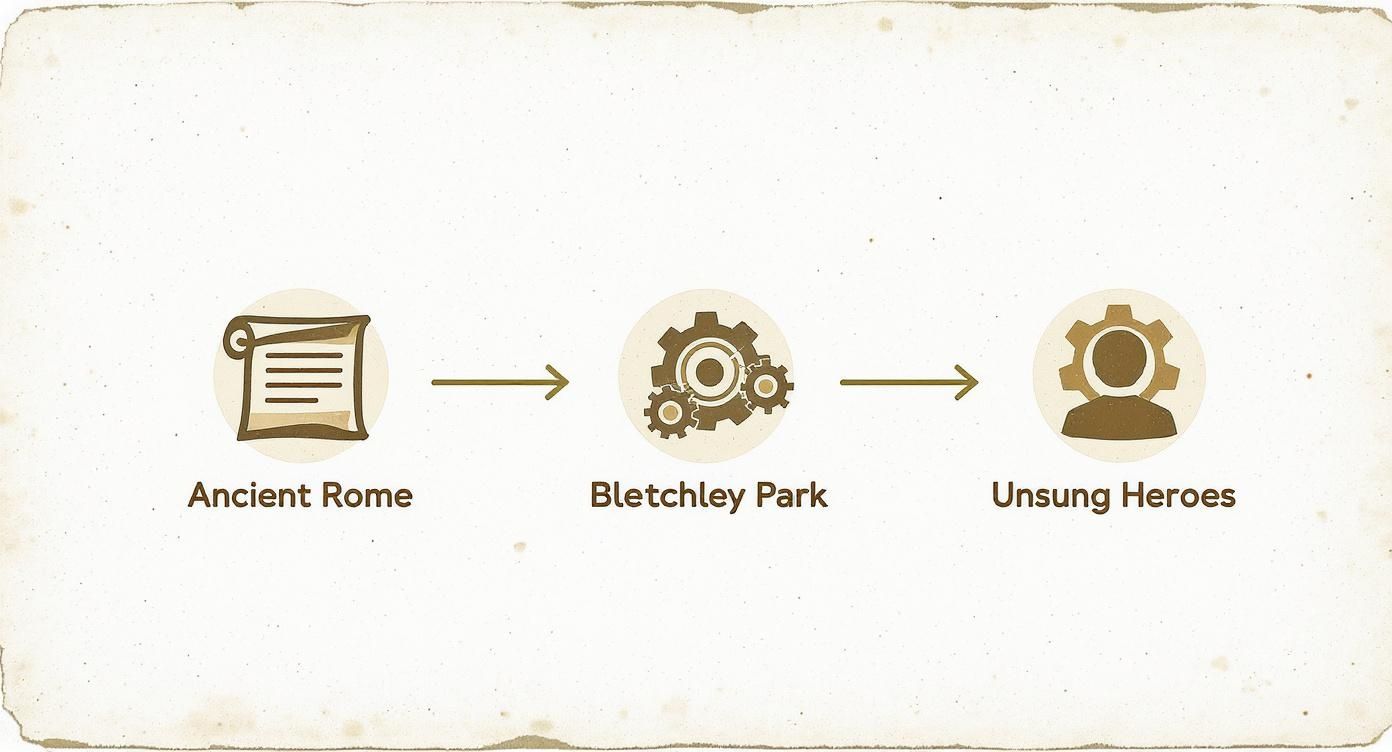
It’s amazing to think that the journey from Roman scrolls to the incredible machines at Bletchley Park all started with the simple idea of scrambling a message. The tools got fancier, but the mission stayed the same.
Ready to try some for yourself? Let’s equip you with your first code-breaking toolkit.
Your First Code-Breaking Toolkit
Here are three classic ciphers to get you started. Each one has a simple rule and a secret message for you to solve. Give it a go!
| Cipher Name | How It Works | Your Secret Mission (Example to Decode) |
|---|---|---|
| Caesar Cipher | You pick a secret number (the 'key') and shift every letter of the alphabet forward by that many places. If your key is 3, 'A' becomes 'D'. | MPEBI MW E GSQTYXIV (Encrypted with a key of 4) |
| Atbash Cipher | This one’s a mirror trick! You just reverse the alphabet. 'A' becomes 'Z', 'B' becomes 'Y', 'C' becomes 'X', and so on. No key needed. | HVTIVG ZTVMG |
| Pigpen Cipher | Letters are replaced with symbols based on where they sit inside a noughts-and-crosses grid. It looks complicated, but it's just a visual swap! | ⊓□ LΙFΕ ⊓□ Γ⊣⊏⊓ (Hint: Draw the grid to help!) |
Once you’ve cracked these, you’ll have taken your first proper step into the world of cryptography.
A Closer Look at Your Ciphers
Let's break down how two of those missions work.
The famous Caesar Cipher is named after Julius Caesar himself, who used it to send secret military orders. It’s a ‘shift cipher’. You and a friend just need to agree on a secret number—your ‘key’.
Say you pick a key of 3. To write your secret note, you slide every letter forward three spots:
- 'A' becomes a 'D'
- 'B' becomes an 'E'
- …and if you get to 'Z', you just loop back around to 'C'.
To read the message, your friend just reverses the process, shifting each letter back three spots. It’s like having a secret decoder wheel that only the two of you know how to use! This kind of problem-solving, where you ask questions and test your ideas, is an amazing way to train your brain. If you're curious about this style of learning, you can discover more about what inquiry-based learning is right here.
Next up is the Atbash Cipher, one of the oldest tricks in the book. It’s even easier because there’s no key to remember. You just reverse the alphabet!
Think of it like a mirror:
- A swaps with Z
- B swaps with Y
- C swaps with X
You keep going like that all the way to the middle. It’s a super simple but clever way to hide a message in plain sight. Any code breaker kid can master this one in minutes, making it perfect for passing secret notes.
By solving these puzzles, you’re not just playing a game—you’re learning to think like a real spy.
Levelling Up Your Spy Craft Skills
Ready for a greater challenge, agent? Now that you’ve got the hang of the basics, it's time to level up your spy craft and tackle some ciphers that need a little more brainpower.
These next missions will test your skills and turn you into an even better code breaker kid.
First up in your new toolkit is the Pigpen Cipher. This one looks super complicated at first glance, which makes it absolutely brilliant for sending top-secret messages! Instead of swapping letters for other letters, it uses a unique set of symbols based on a simple grid system.
Think of it like this: you draw two noughts-and-crosses grids side-by-side, and then two large 'X' shapes. You then fill these grids and shapes with the letters of the alphabet. Each letter’s code is simply the shape of the 'pen' it sits in.
Cracking the Pigpen Cipher
To master the Pigpen Cipher, you really just need to memorise the grids. A dot is often added to the symbols from the second set of grids and the second 'X' to tell them apart. It's a fantastic visual puzzle, so drawing the key is always the best way to start.
- Grid 1 (No Dots): A standard noughts-and-crosses grid holding the letters A through to I.
- Grid 2 (With Dots): Another noughts-and-crosses grid holding J through to R, but each symbol has a dot inside.
- X Shape 1 (No Dots): This holds S, T, U, and V in its four sections.
- X Shape 2 (With Dots): Finally, this one holds W, X, Y, and Z, with dots in each segment.
It’s a fantastic method because it turns your message into strange, geometric shapes that look like anything but words. This process of learning a new system and looking for visual clues is a vital skill. It’s the same kind of careful observation that helps characters in stories like Space Ranger Fred and the Umbrella Rescue figure out how to help someone in need.
Using Keywords as Your Secret Key
Next, let's explore the Keyword Cipher. This is a clever twist on a simple substitution cipher, but it's much, much harder for outsiders to crack. The secret is that you and your fellow spy agree on a secret keyword before you start.
To create the cipher alphabet, you write down your keyword but remove any repeated letters. So, if your keyword is "SPYMASTER", you would just write down "SPYMATER".
After your unique keyword letters, you simply write the rest of the alphabet in its normal order, skipping any letters you’ve already used from your keyword.
Example Keyword Cipher:
Keyword: SPYMASTER
Key letters: S P Y M A T E R
Cipher Alphabet: S P Y M A T E R B C D F G H I J K L N O Q U V W X Z
To encrypt a message, you just swap each letter of the regular alphabet for your new cipher alphabet. 'A' becomes 'S', 'B' becomes 'P', 'C' becomes 'Y', and so on. Only someone who knows your secret keyword can figure it out! This makes you a true code breaker.
Thinking Like a True Code Breaker
Becoming a great code breaker kid isn’t just about solving a few puzzles here and there. It’s about learning a whole new way of thinking. While you’re having a blast cracking ciphers, you’re secretly giving your brain an amazing workout and building skills that will help you in pretty much every part of life.
Every time you stare at a jumbled message, you're training your mind to spot patterns, test out different ideas, and, most importantly, be patient. This is exactly what real-world problem-solving looks like, whether you're tackling a tricky maths question, a science experiment, or even just figuring out the rules to a new board game.
This kind of clever thinking is a superpower both in school and at home. In stories like Space Ranger Fred and the Shoelace Adventure, big problems are often solved by noticing a small detail everyone else missed. That’s the code-breaker mindset in action!
The Power of Observation
Sometimes, the biggest clues aren’t hidden inside the message at all. True spy craft means looking at everything surrounding the secret note. This clever trick is called traffic analysis, and it’s all about gathering secrets without even cracking the code itself.
Imagine two friends are passing notes in class. Even if you can’t read a single word, you might start to notice a few things:
- They always seem to pass a note right before the bell rings.
- One of them looks a bit nervous every time they get one.
- The notes are always written on the same colour of paper.
This information—the who, when, and where—can tell you a surprising amount. That’s traffic analysis! It goes to show that being a keen observer is just as important as being a maths whizz.
Real-Life Spy Craft
This isn't just make-believe, either. It was a vital tool used by real-life code breakers. During World War Two, the brilliant British mathematician Gordon Welchman, working at Bletchley Park, turned traffic analysis into an art form. His teams would track the times, locations, and frequencies of enemy radio messages to figure out what they were up to, all without needing to decrypt a single word. His ideas became a cornerstone of modern intelligence. You can discover more about his incredible work in this detailed overview of Gordon Welchman's contributions.
By mixing logical thinking with sharp observation, a code breaker kid becomes a fantastic detective. You learn how to connect the dots and see the bigger picture—an invaluable skill for any young adventurer.
Building this powerful way of thinking is a journey that starts with simple puzzles and grows from there. If you're looking for more ways to sharpen these abilities, check out our guide on how to develop critical thinking. It’s the ultimate tool in any spy's toolkit.
Your Top-Secret Questions Answered
Even the most brilliant spies have questions, and a curious mind is your best gadget! As you start your code-breaking journey, you're bound to wonder about a few things. Here are the answers to some of the most common queries from aspiring agents, designed to help every code breaker kid on their mission.
What’s the Difference Between a Code and a Cipher?
That’s a top-tier question! Lots of people mix them up, but a real code breaker knows the secret.
A cipher is all about scrambling the individual letters in your message. Think of it like a substitution game. For example, in a Caesar Cipher, you might decide to swap every 'A' for a 'D', every 'B' for an 'E', and so on.
A code, on the other hand, replaces entire words or even whole phrases with something else. For instance, the codeword 'STARLIGHT' might secretly mean 'Meet at the treehouse after school!'. Most of the fun puzzles we've looked at are ciphers, and they’re a brilliant place for a code breaker kid to start their training.
Can I Invent My Own Secret Cipher?
Absolutely! This is where the real fun begins. You could start by writing out the alphabet, then writing a completely jumbled-up version right underneath it—voila, you've created your very own secret key!
Or why not get even more creative? You could design a cipher that uses symbols, numbers, or even little drawings instead of letters. The only rule is that your friend must have the 'key' to understand your top-secret message. Go on, give it a go and invent the world's next unbreakable cipher!
Who Was a Famous Female Code Breaker?
One of the most incredible code breakers in history was Joan Clarke, a genius mathematician who worked at Bletchley Park. During World War Two, she was a key part of the team trying to crack Germany's Enigma ciphers, which were some of the toughest puzzles on the planet.
Her work was absolutely vital and helped the Allies figure out secret enemy plans. Just like the heroes in books such as Space Ranger Fred and the Tick Tock Tale, her clever thinking made a massive difference.
Joan Clarke joined Bletchley Park in June 1940 after getting top marks in mathematics at Cambridge University. The work was so important that women actually outnumbered men there by a ratio of about 8:1! It just goes to show that anyone with a sharp mind and a love for puzzles can become a world-class code breaker. You can read more about Joan Clarke’s incredible story at School History.
Are Codes and Ciphers Still Used Today?
Yes, and they're more important now than ever before! Today, modern ciphers are called encryption. They’re incredibly complex and run by computers, but they’re built on the very same ideas of scrambling information to keep it safe.
Every time you send a message on a phone, play an online game, or buy something from a website, powerful encryption is working behind the scenes to protect your information from prying eyes. The problem-solving skills you build as a code breaker kid are exactly the kind of skills used to create the technology that keeps our digital world secure.
Ready for your next adventure? The universe is full of mysteries waiting to be solved! Join Space Ranger Fred on exciting missions that blend science, humour, and fun. Explore the book series and spark your curiosity at https://spacerangerfred.com.