
Have you ever wondered what stops you from floating off into space like a stray balloon? The answer is a totally amazing, invisible force called gravity! It’s like the Earth has its very own superpower, gently pulling everything towards its centre. It’s what keeps our feet planted firmly on the ground.
When you leap into the air, you can feel gravity at work, promising you’ll always come back down.
What Keeps Our Feet on the Ground?
Imagine the Earth is a gigantic, round magnet. But instead of pulling on metal, this magnet pulls on everything that has mass (which is just a science-y word for all the ‘stuff’ that makes up an object). That includes you, your toys, your house, and even the air we all breathe! This special pull is what we call gravity.
It’s a friendly force, acting like a constant, gentle hug that holds everything and everyone on the planet. This is why a ball you throw up always comes back to you, and why raindrops tumble from the clouds to the ground. Without gravity, things would be a right old mess, with everything just floating away. It’s one of the most important forces in the entire universe, and it’s working right here, right now.
Why is Gravity So Important?
Gravity does way more than just stop us from floating off. It’s responsible for some of the most important things that make life on our planet possible.
- It holds our atmosphere in place: Gravity keeps the blanket of air wrapped around our planet, which gives us all the oxygen we need to breathe.
- It creates the tides: The Moon has its own gravity, and it’s strong enough to pull on our oceans, causing the sea to rise and fall every single day.
- It keeps planets in orbit: The Sun’s enormous gravity is what keeps Earth and all the other planets in our solar system circling around it in a cosmic dance.
This force is a true superstar of the universe! Getting your head around gravity is the first step on an incredible adventure, just like the ones Space Ranger Fred goes on in his stories.
Imagine a World with Less Gravity
What do you think it would be like to walk on the Moon? Because the Moon is much smaller than Earth, its gravitational pull is about six times weaker. If you were up there, you could jump super high and feel as light as a feather!
Astronauts who have walked on the Moon say it’s like being on a bouncy castle in slow motion. Exploring different worlds means learning about different kinds of gravity, which is a key part of any space mission.
"Gravity is the glue that holds our universe together. From the smallest pebble to the largest star, everything is connected by this incredible, invisible force."
This gentle pull is your first introduction to the amazing science that runs our world and the stars beyond. Ready to discover more secrets about this invisible superhero? Let’s continue our mission!
How an Apple Sparked a Giant Idea
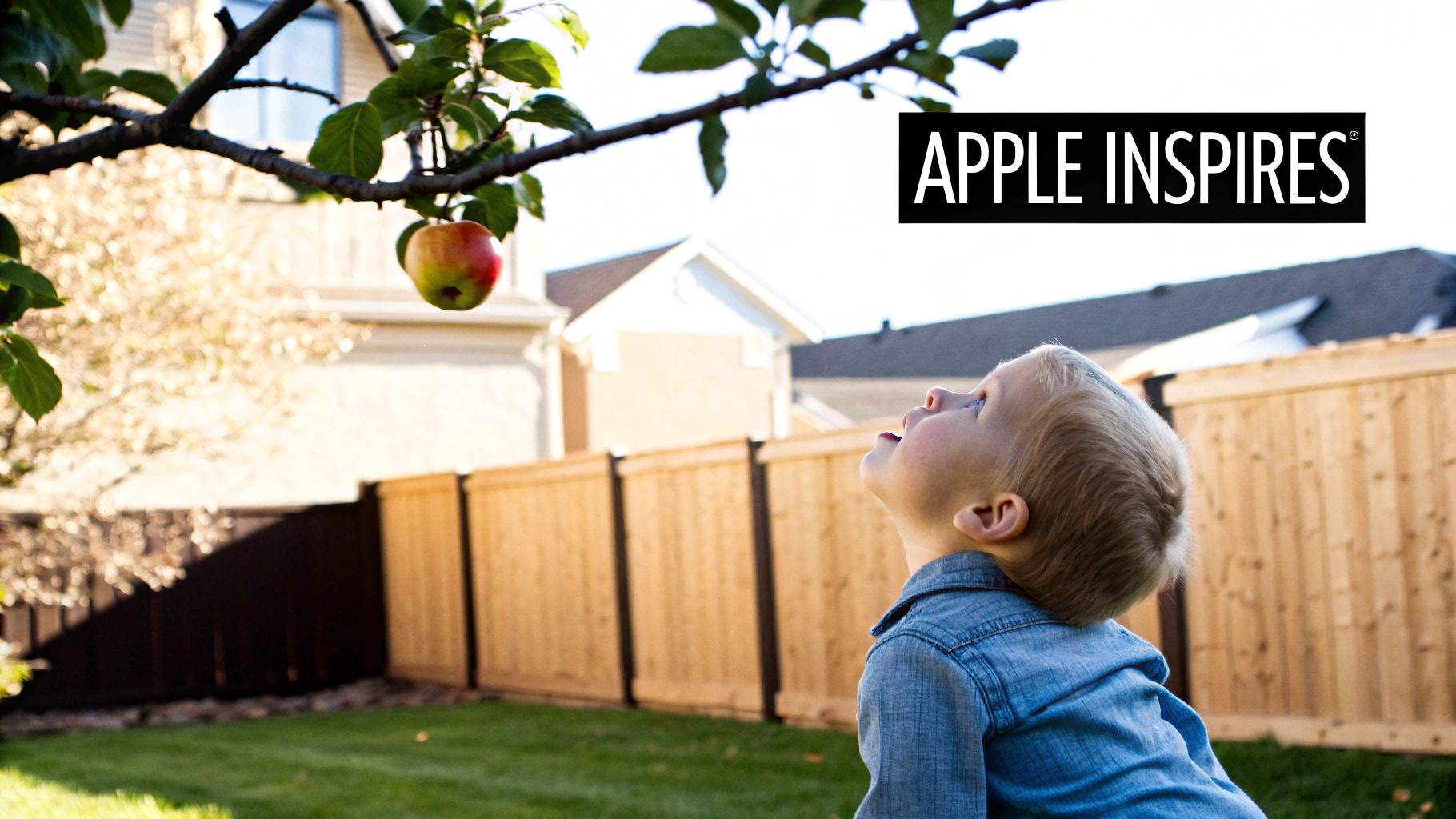
Let's hop in our imaginary time machine and travel way back to meet a brilliant scientist named Sir Isaac Newton. As the story goes, he was relaxing under an apple tree one afternoon, thinking about how the universe works.
Suddenly, an apple let go of its branch and—plop!—landed near him. Now, most of us would have just munched on the apple, but for Newton, this little moment lit up a gigantic idea.
He started asking some really big questions. Why did the apple fall down? Why not sideways, or even zoom up into the sky? He realised there had to be some kind of invisible force pulling the apple towards the centre of the Earth.
An Idea That Reached for the Moon
This is where his idea got even bigger. Newton realised this invisible pull, which he named gravity, wasn't just for apples. He gazed up at the Moon and had a proper brainwave: if gravity can pull an apple down, could it also be the very same force that stops the Moon from just wandering off into space?
Bingo! He figured out that the same invisible string pulling the apple to the ground also keeps the Moon circling the Earth. The Moon doesn't crash down on us because it's also zooming sideways really, really fast. It's this perfect balancing act that keeps it locked in orbit.
That simple apple helped explain how the whole universe is held together. Newton discovered that gravity is universal—it’s everywhere and it affects everything!
This amazing discovery proved that the same rules of science working in your back garden also apply to the planets and stars. It’s the Sun’s gigantic gravity that keeps Earth and all the other planets spinning around it in a cosmic dance.
From a Simple Question to a Universal Law
Newton’s curiosity completely changed science forever. Way back in 1687, he published his law of universal gravitation, which explained how gravity keeps the Moon orbiting the Earth just as surely as it keeps your toys from floating off the shelf. You can learn more about how big ideas are taught in schools over at the Institute for Government.
This story shows us that even the most ordinary moments can lead to incredible breakthroughs if we just stay curious. All it takes is asking "why?" For more missions exploring the history of science, blast off over to the Space Ranger Fred blog.
Do Heavier Things Fall Faster?
Here’s a classic gravity puzzle that has stumped even the cleverest grown-ups for centuries. Imagine you’re at the top of a very tall building. If you drop a heavy bowling ball and a light feather at the exact same time, which one do you think will hit the ground first?
Go on, have a guess! Most people would shout, “The bowling ball, of course!” It just feels right that heavier things should fall faster.
But here’s a mind-boggling secret from the world of science: gravity pulls on everything equally, no matter how much it weighs. If you could get rid of all the air (in a special room called a vacuum chamber), that bowling ball and feather would fall at the exact same speed and land at the very same moment. How cool is that?
So, if gravity treats everything the same, why does a feather float so gently while a bowling ball plummets like a rock? The sneaky culprit is something called air resistance.
Meet the Invisible Pusher: Air Resistance
Have you ever tried running really, really fast? You can feel the wind pushing against your face and body. That feeling is air resistance! Even though you can’t see it, the air all around us is made of tiny particles. When you move through it, you have to push all those particles out of the way.
Think of air resistance as an invisible, fluffy cushion that pushes back against anything trying to fall through it.
A feather is wide, flat, and light, so it catches a lot of this invisible cushion on its way down. The air pushes up against it, slowing its fall and making it drift from side to side. A bowling ball, on the other hand, is smooth, round, and dense. It slices right through the air with barely any trouble. It still feels that push from the air, but it’s so heavy and streamlined that the push isn’t strong enough to slow it down much.
This invisible pusher is exactly why parachutes work! They are designed to be enormous and wide, so they can catch as much air as possible. This creates a huge amount of air resistance, which slows a person’s fall right down to a safe landing speed.
Try This Super-Simple Gravity Experiment!
Ready to see this invisible pusher in action? Let’s become scientists for a moment. This awesome experiment will help you see exactly how air resistance can change the way things fall. Grab a grown-up to help!
You will need:
- Two identical pieces of paper (A4 paper works perfectly).
What to do:
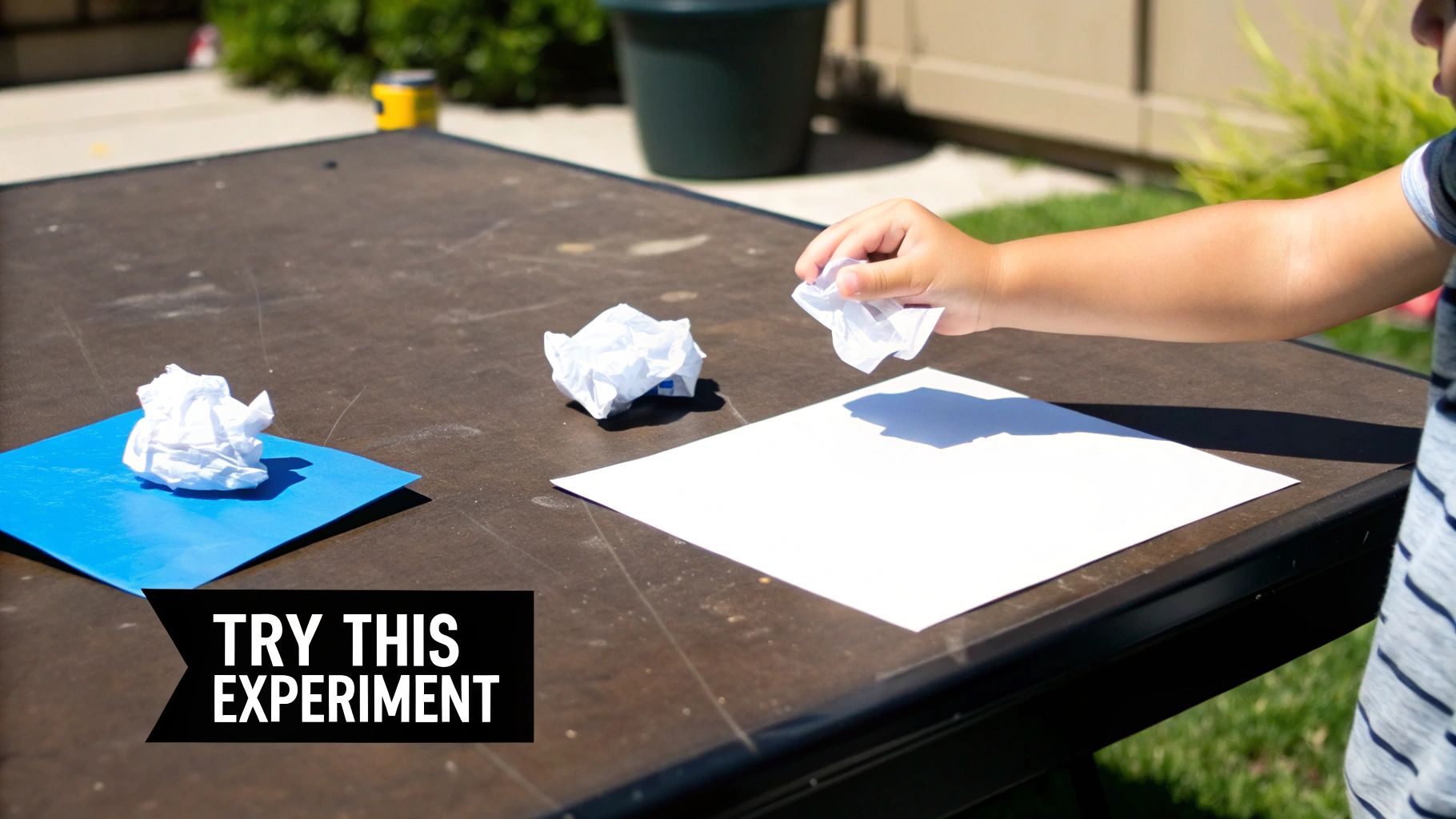
- Take one piece of paper and scrunch it up into a tight, little ball. This makes it more streamlined, so it can cut through the air easily.
- Leave the other piece of paper completely flat. This one is wide and will catch a lot of air.
- Now, find a safe spot to stand (maybe on a chair with your grown-up’s help) and hold both the scrunched-up ball and the flat sheet of paper at the same height.
- Ready, set… let them go at the exact same time!
Which one hit the floor first? The scrunched-up ball, right? Even though both pieces of paper weigh exactly the same, the flat sheet was slowed way down by air resistance. You’ve just done a real-life experiment that proves an object’s shape can be just as important as its weight when it falls.
Want to try some more amazing hands-on missions? Check out our activities page for more fun!
How Gravity Works in Outer Space
Ready to blast off on a new mission? Gravity isn't just a force we feel here on Earth; it’s a cosmic superhero that works all across the universe! Every single planet, star, and moon has its own gravitational pull. The secret to how strong that pull is comes down to two simple things: how much ‘stuff’ an object is made of (mass) and how far away you are from it.
Think about our Sun. It’s absolutely ginormous! Its gravity is so powerful that it keeps all eight planets, including our little Earth, circling around it in a huge cosmic dance. We call this an orbit. Without the Sun’s mighty pull, all the planets would just whizz off into deep space on their own.
Why Do Astronauts Float?
When we see videos of astronauts bouncing around inside the International Space Station (ISS), it’s easy to think there’s no gravity up there. But that’s a common mix-up! The truth is, the ISS isn’t that far from Earth, so gravity is still pulling on it and the astronauts inside pretty hard—about 90% as strong as it is on the ground.
So, why all the floating? It's because the space station and everyone inside it are in a constant state of free-fall. Imagine throwing a ball really, really fast. It travels so far that as it falls, the Earth curves away beneath it. That’s exactly what the ISS is doing! It’s continuously falling around our planet. Since everything is falling together at the same speed, the astronauts feel weightless and can pull off some amazing somersaults. To learn more about this incredible feeling, you can check out our special mission log all about what is zero gravity.
Here’s a cool picture that shows how gravity pulls on a heavy bowling ball and a light feather at the same speed when there’s no air to slow them down.
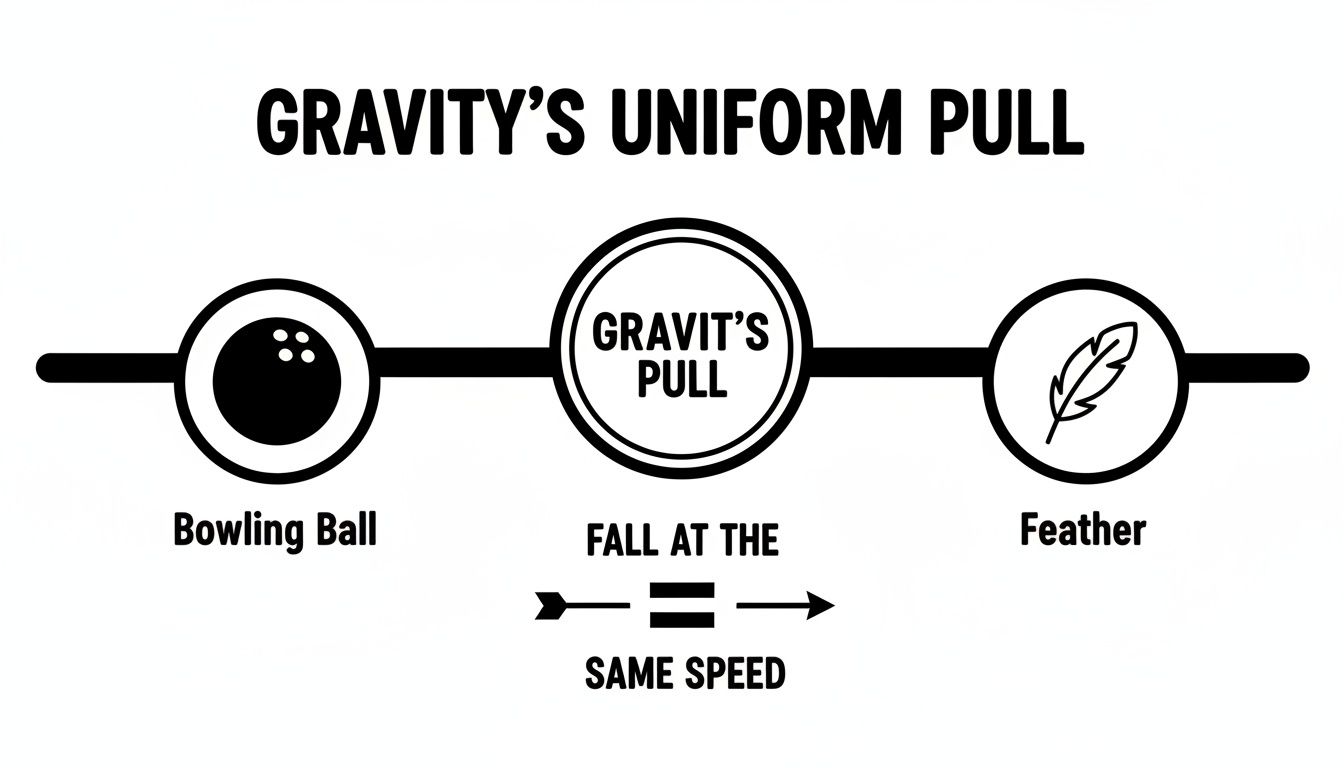
This shows us one of gravity's most important rules: its pull is the same on every object, no matter how big or small. It’s a rule that works everywhere in space!
Imagine Jumping on Other Worlds
Let’s pretend we’re taking a trip around the solar system to feel different kinds of gravity. This is a brilliant way to understand how this amazing force can change from place to place!
- On the Moon: The Moon is much smaller than Earth, so its gravity is about six times weaker. A tiny hop would send you soaring high into the air before you floated gently back down. Boing!
- On Jupiter: Now this is a different story. Jupiter is the biggest planet in our solar system—a true giant! Its gravity is incredibly strong, more than twice as powerful as Earth's. If you could stand on Jupiter, you’d feel super heavy. Even lifting your feet would feel like a massive workout.
Exploring how gravity works out in space helps us understand our own planet and the incredible forces that shape the entire universe. It’s where science meets adventure.
Hands-On Gravity Experiments for Young Scientists
Reading about gravity is one thing, but becoming a real gravity explorer is way more exciting! It’s time to pop on your lab coat (or just your favourite jumper) and try out some fun missions that bring this amazing science to life, right in your own home.
These brilliant experiments use simple things you can find around the house to help you see gravity in action. Each mission comes with a list of kit you'll need and a special ‘What’s Happening?’ debrief to explain the incredible science behind the fun. Let’s get experimenting!
Mission 1: Build a Gravity Well
Ever wonder how gravity keeps the planets circling the Sun? This experiment lets you create a mini version of our solar system, showing how a big object’s gravity can pull smaller ones into its path.
You will need:
- A bedsheet or a large piece of stretchy fabric
- Four chairs or four grown-up helpers
- One heavy ball (like a football)
- Several smaller, lighter balls (marbles or tennis balls work great)
What to do:
- Get your helpers to each hold a corner of the sheet, stretching it out tight and flat. Or, you can drape it over the backs of four chairs to create a taut surface.
- Place the heavy football right in the centre. See how it makes the sheet dip down? That's your gravity well!
- Now, gently roll the smaller balls one by one across the sheet. Watch what happens! Instead of travelling in a straight line, they curve and spiral in towards the heavy ball.
What’s Happening?
That heavy ball is bending the fabric of the sheet, just like the massive Sun bends the fabric of space-time all around it. The smaller balls are simply following that curve. It's a fantastic way to actually see how gravity guides the planets in their orbits.
Mission 2: The Balancing Act
Every single object has a special spot where its weight is perfectly balanced. We call this its centre of gravity. Finding it is a fun little challenge that shows how gravity pulls on every part of an object.
You will need:
- A ruler, a long pencil, or even a wooden spoon
- Your finger!
What to do:
- Hold the ruler flat on one finger.
- Try to get it to balance. Does it keep tipping over?
- Slowly move your finger along the ruler until you find that one magic spot where it balances perfectly without falling.
What’s Happening?
You’ve found it—the centre of gravity! It’s the point where the pull of gravity is equal on both sides. This is super important for everything from a gymnast doing a perfect flip to an engineer designing a skyscraper that won't fall over.
Lots of UK schools use hands-on activities like these to make science feel real. Teachers use fun experiments like dropping feathers and balls to show how gravity makes everything fall at the same speed, no matter the weight – just like Sir Isaac Newton discovered with his apple way back in 1666! To keep young scientists engaged, you can find brilliant resources online, including some fantastic free science coloring pages that make learning about tricky topics fun.
These are just a couple of ideas to get you started on your scientific journey. If you're hungry for even more ways to explore the world of science, check out our guide to more fun science activities for kids.
Your Gravity Questions Answered
Still got questions whizzing around your head about gravity? That’s brilliant! It means you’ve got the mind of a true explorer, just like Space Ranger Fred. Every great scientific adventure starts with a curious question.
Let's dive into some of the most common puzzles we get about this incredible force. We'll clear up any tricky bits and look at what gravity's made of and whether you can ever truly escape its pull.
Can We Turn Gravity Off?
Wouldn't it be fun to have a big red button that switched off gravity? We could all float around our bedrooms! But here’s the thing: it’s just not possible.
Gravity isn't like a light bulb you can switch on and off. It’s a natural, fundamental force of the universe, which means it’s always there, all the time, holding everything together. It's caused by mass—that’s the ‘stuff’ that everything is made of. The Earth is absolutely massive, so its gravitational pull is always on, keeping our feet firmly on the ground.
Gravity is one of the four fundamental forces of nature, along with electromagnetism and the strong and weak nuclear forces. Think of it as a built-in feature of our universe!
Is There Anywhere Without Gravity?
What a fantastic question! Since every single thing with mass creates gravity (even you!), you can never get to a place where there's absolutely zero gravity. Even in the deepest, darkest bits of space, faraway stars and galaxies are still giving you a gentle, tiny tug.
However, you can go to places where gravity feels so weak that you become weightless. Astronauts on the International Space Station know all about this. They are so far from Earth that its pull is much, much weaker, letting them float around and do somersaults all day long. For your next mission, you could discover more in the pages of a Space Ranger Fred book.
Continue Your Space Adventure
Your mission to understand gravity is just getting started! You’ve done an amazing job learning about the invisible force that keeps our feet on the ground, but there's a whole universe of discoveries still waiting for you.
Real science is all about asking brilliant questions and having fantastic adventures, and here at Space Ranger Fred, we're always ready for the next one. To keep exploring, why not blast off into one of our Space Ranger Fred books or download some fun challenges from our activities page?
It’s also really cool to see how new technology like 3D animation in education is helping to explain tricky topics like gravity in fun new ways.
The universe is absolutely bursting with wonders. Keep looking up, stay curious, and never, ever stop asking questions. Ready for your next mission, Space Ranger? For more cosmic fun, check out our guide to making space science for kids an everyday adventure.
Continue your journey with Space Ranger Fred and discover a universe of fun and learning at https://spacerangerfred.com.