
Welcome aboard, space explorers! Ever looked up at a rocket launching into the sky and wondered, “What on earth is that thing running on?” It's not petrol from a pump, that's for sure! It’s a very special, super-powered recipe called propellant.
Think of it as the ultimate packed lunch for a rocket's long trip to the stars.
Your Quick Guide To Powering A Rocket
To get your head around rocket fuel, just imagine you're building a brilliant campfire. You need two key things to get it roaring: wood to burn (that's your fuel) and air to feed the flames. The air has something special in it called oxygen, which we'll call the oxidiser.
A rocket works on the same idea, but with a cosmic twist! As it soars higher and higher, the air gets thinner and thinner until, in space, there’s no air at all. So, a rocket has to be clever. It packs both parts of its campfire recipe right from the start.
It carries its own fuel and its own oxidiser. When they mix and ignite inside the engine, they create an enormous, powerful push called thrust. It's this thrust that shoves the rocket off the ground and sends it on its way.
This powerful two-part mixture is what scientists call rocket propellant. It’s the secret sauce behind every single space adventure, from the smallest satellite launch to a mission to Mars.
The picture below shows this simple but mighty idea in action. A rocket needs both parts to make its fire.
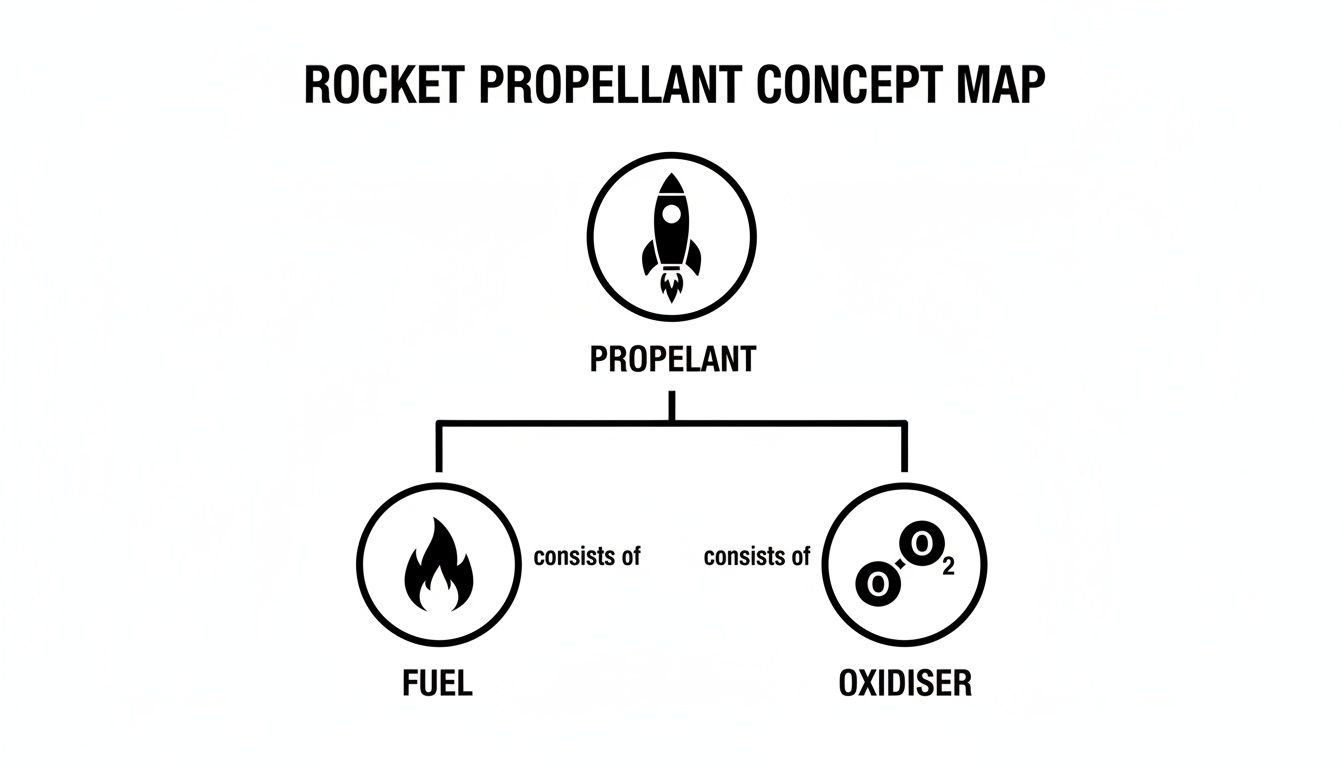
So there you have it. Propellant is simply the complete fuel-and-oxidiser package a rocket needs to get moving.
The Main Types Of Rocket Fuel
Now, not all rocket propellants are created equal. Imagine you're a cosmic chef. You'd choose different recipes depending on what the rocket needs to do.
Do you need a massive, quick burst of power to escape Earth's gravity? Or do you need delicate control to gently dock with the International Space Station? Each job calls for a different kind of fuel.
Let's take a quick look at the main types you'll discover on our journey:
- Solid Fuels: Think of a giant firework. These are pre-mixed and, once you light them, they burn until they're all gone. Simple and powerful!
- Liquid Fuels: These are kept in separate tanks and only mixed in the engine. This gives pilots much more control—they can even turn the engine off and on again.
- Cryogenic Fuels: These are liquid fuels that have been chilled to be incredibly cold. They pack a serious punch and are super-efficient.
Here's a little cheat sheet I put together to help you remember the key differences.
Space Ranger Fred's Quick Guide to Rocket Fuel Types
| Fuel Type | What It's Like | Main Ingredients (Simple Version) | Best For |
|---|---|---|---|
| Solid | A giant firework | A pre-mixed, rubbery-feeling solid | Booster rockets that need a big push |
| Liquid | Two drinks mixed together | Two separate liquids, like kerosene & oxygen | Main engines that need lots of control |
| Cryogenic | A super-chilled, powerful slushie | Freezing-cold liquid gases, like hydrogen & oxygen | Missions that need maximum power |
| Hypergolic | Magic ink that ignites on its own | Two liquids that burst into flames on contact | Spacecraft that need to restart engines reliably |
Getting to know these different types is a fantastic part of space science for kids. Right, are you ready to dive a bit deeper into each one? Let's go!
Understanding Powerful Solid Rocket Fuels
Have you ever held a sparkler and watched it fizz and sparkle all the way to the end? A solid rocket works in a very similar way! It's like a giant, super-powerful firework designed to give a rocket a massive, continuous push, especially when it needs it most—lifting off from the ground.
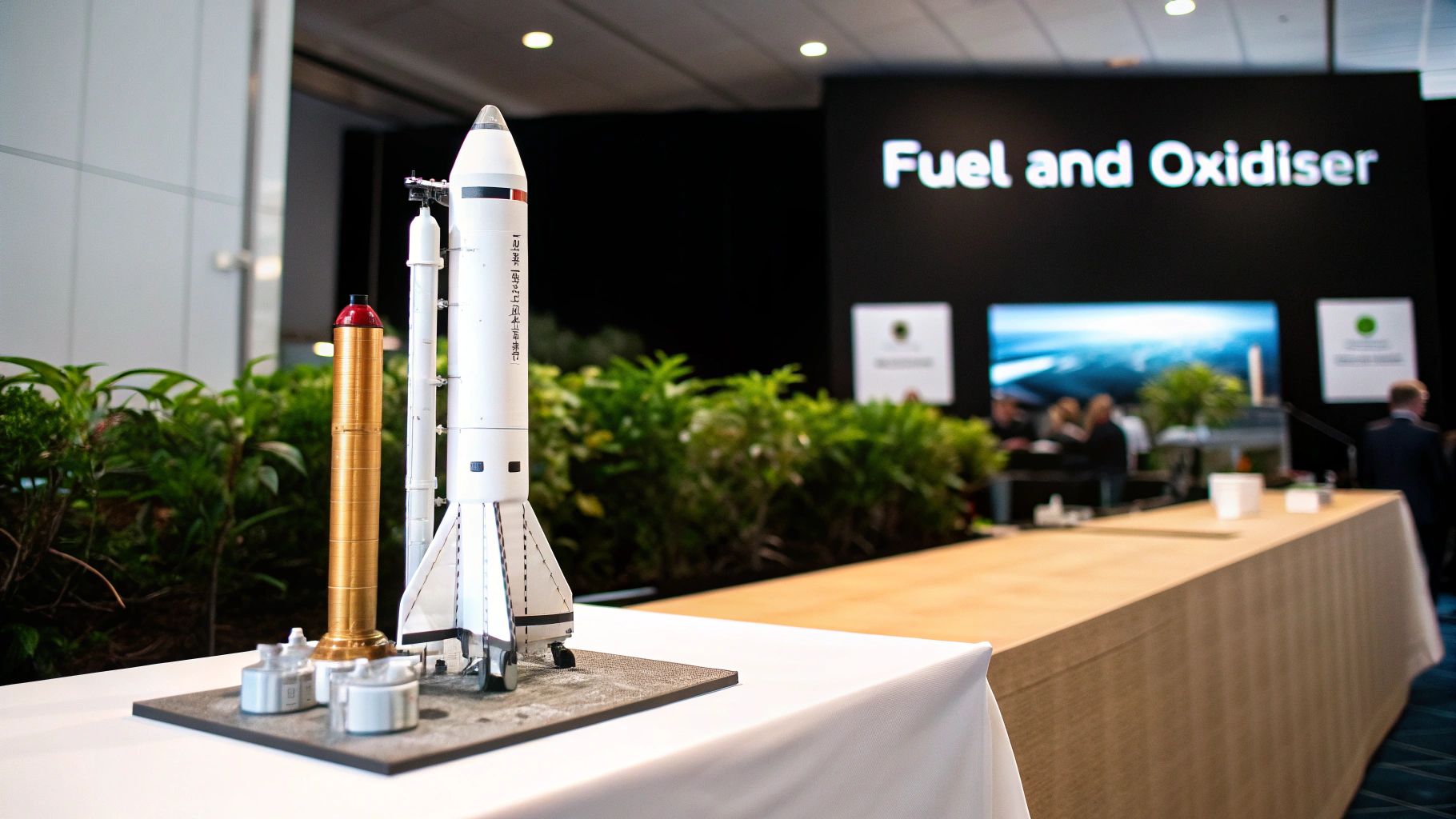
These rockets are filled with something called a solid propellant. Imagine you’re baking a cosmic cake. You mix all the ingredients together—the fuel and the oxidiser—into a thick, rubbery mixture. This mixture is then carefully shaped and left to set solid inside the rocket's casing. Once it's ready, it’s one single, solid block of power, just waiting for a spark.
The Recipe for a Big Push
So, what is this special rocket fuel made of? The recipe often includes a few key ingredients:
- A Fuel: Very fine, powdered aluminium is a popular choice. It's the same metal used in kitchen foil, but as a powder, it burns with incredible energy.
- An Oxidiser: A special salt called ammonium perchlorate is commonly used. This provides all the oxygen the aluminium needs to burn fiercely, even in the vacuum of space.
- A Binder: This is a rubbery substance that holds everything together in that solid, stable block.
The famous US Space Shuttle boosters, for example, used a recipe that was nearly 70% ammonium perchlorate, showing just how much oxidiser is needed to burn the metal fuel powerfully. This pre-mixed design is simple and incredibly reliable.
All or Nothing
Just like that sparkler, once a solid rocket engine is lit, there’s no turning it off. It burns with immense force until all the propellant is used up. This makes them perfect for the job of a booster rocket. Their whole purpose is to provide that huge initial burst of thrust to get a heavy spacecraft moving upwards, fighting against Earth’s gravity.
Space Ranger Fred's Mission Log: "Solid boosters are like the ultimate 'GO!' button. They provide a massive shove to get you started on your adventure. You can’t steer them, but when you need pure power, nothing beats them for getting off the launchpad!"
Because they are so powerful and relatively simple, solid fuels are a key part of many space missions. They are the muscle that begins the journey, handing over to more controllable engines once the rocket is high in the sky.
Exploring Controllable Liquid Rocket Fuels
If solid rockets are like unstoppable fireworks, then liquid-fuelled rockets are the precision race cars of space travel. They give pilots and mission controllers an amazing amount of control, a bit like having an accelerator pedal for reaching the stars. This is super important for those tricky manoeuvres way up in orbit!
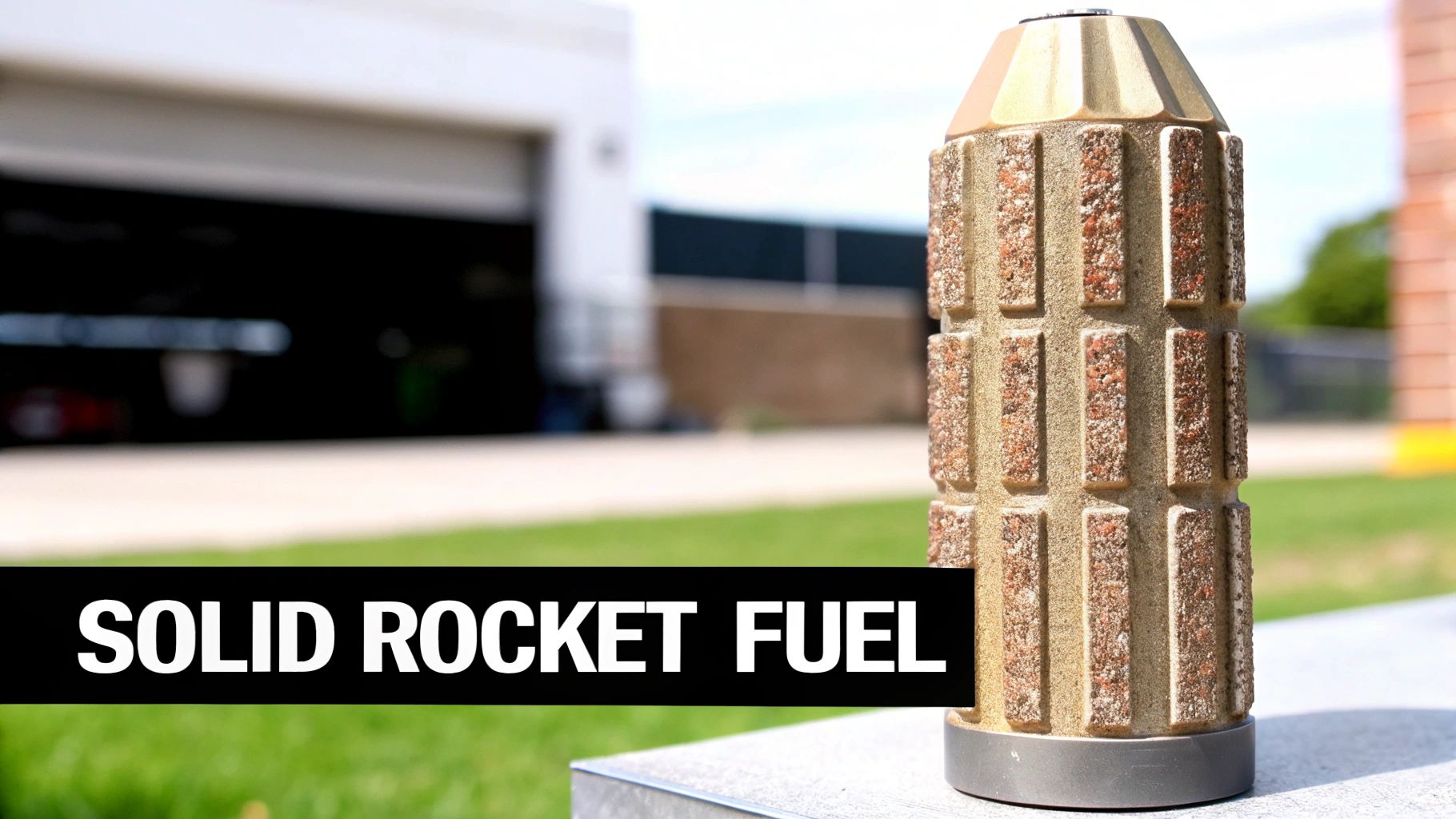
Unlike the pre-mixed solid fuels, liquid rockets keep their fuel and oxidiser in completely separate tanks. It’s only when it’s time for blast-off that powerful pumps mix them together in the engine to create that mighty push we call thrust. That simple separation is the secret behind their fantastic control.
A Recipe for Precision
So, what’s in this high-tech rocket juice? One of the most famous and reliable combinations is a dynamic duo of:
- Refined Kerosene (RP-1): Think of this as super-powered jet fuel. It's a special type of kerosene that has been made extra pure to give rockets a huge amount of energy.
- Liquid Oxygen (LOX): This is the very same oxygen we breathe, but chilled down to a mind-boggling -183°C! At that temperature, it turns from a gas into a liquid, which means engineers can pack a whole lot more of it into the rocket's tanks.
Kerosene-based fuels like RP-1, paired with LOX, are the true workhorses of the rocket world. They pack a serious punch and are much easier to handle than some of the other super-cold options. To give you an idea of the sheer scale, a single Falcon 9 rocket’s first stage burns through about 112 tonnes of kerosene in just one launch!
Turning the Power Up and Down
The real magic of liquid fuels is the ability to ‘throttle’ the engine—basically, to turn its power up or down. Imagine you’re watering the garden with a hose that has a spray nozzle.
You can squeeze the handle just a little for a gentle mist, or you can squeeze it all the way for a powerful jet of water. Rocket engineers do something very similar by using super-strong valves and pumps to control exactly how much fuel and oxidiser flows into the engine.
Try This at Home: Grab a grown-up and a garden hose with a spray nozzle. Try adjusting the handle to see how you can change the water from a gentle trickle to a powerful jet. You're being a 'propulsion engineer', controlling the flow just like on a real rocket!
This incredible control is absolutely vital. It’s what allows a rocket to carefully guide itself into the perfect orbit, to gently dock with the International Space Station, or even to perform the amazing feat of landing itself safely back on Earth after a mission. It's the precision of liquid fuels that makes these awesome achievements possible.
The Super-Cold Science Of Cryogenic Fuels
Now, let's talk about the chilliest—and most powerful—fuels in the whole universe: cryogenics! It sounds like a super-complicated science word, but it just means 'really, really cold'. When a rocket needs the biggest possible push for a long journey, like sending a rover to Mars, engineers turn to the ultimate fuel combination: liquid hydrogen and liquid oxygen.
Hydrogen is the lightest stuff anywhere in the universe. As a rocket fuel, that means it gives the most oomph for its weight. But there’s a catch. Here on Earth, hydrogen is a gas, which takes up a lot of space. To pack enough of it into a rocket's fuel tank, scientists have to cool it down to an unbelievably cold -253 degrees Celsius. That’s when it finally turns into a liquid!
Colder Than The Coldest Winter
Have you ever seen your breath on a really frosty day? The warm, steamy vapour from your lungs hits the chilly air and instantly turns into tiny liquid water droplets. That’s pretty much how cryogenic fuel works, just on a much, much colder scale. Gases are chilled so intensely that they become liquids, letting engineers squeeze way more fuel into the rocket.
This super-cooling process is exactly what makes these fuels so mighty. When the liquid hydrogen (the fuel) mixes with the liquid oxygen (the oxidiser) and burns, it unleashes a tremendous amount of energy. This massive push is perfect for the final stages of a rocket's flight, giving it that last powerful kick it needs to escape Earth's gravity and voyage into deep space.
Fun Fact: Ever see pictures of the huge, orange tank on the Space Shuttle? It wasn't for carrying astronauts! It was basically a giant thermos flask, built to keep the liquid hydrogen and liquid oxygen from warming up and boiling away before launch.
The Challenge of Staying Chilly
As you can imagine, keeping something that cold is a massive challenge. The fuel tanks need incredible insulation to stop the fuel from warming up. If it did, it would turn back into a gas, expand, and could even make the tank burst! It’s a tricky balancing act that takes some seriously clever engineering to get right.
Getting to grips with these different fuels is a big part of understanding how rockets work. To see how a powerful push can send something flying, why not check out our amazing free activities page? You can even build your own rocket, which is a fantastic way to see the science of thrust in action, right in your own home or classroom.
How We Can Make Space Travel Greener
Exploring the stars is one of the most incredible adventures we can imagine, but even a Space Ranger has a duty to look after our beautiful home planet. When a rocket blasts off, its engines burn through tonnes of propellant, releasing a whole lot of gas into our atmosphere. Think of it like the exhaust from a car, only on a much, much bigger scale.
This is a huge challenge for space scientists, who are working on some truly amazing ideas to make rocket launches cleaner and greener. It’s a bit like how engineers on Earth are designing electric cars and finding new ways to create clean energy; space engineers are busy inventing eco-friendly rocket fuels for our future missions.
Their big goal is to create propellants that give rockets all the power they need to reach space without leaving behind so much pollution. It's a tricky problem, but that’s what science is all about—finding brilliant solutions to tough challenges!
Tomorrow's Eco-Friendly Rocket Fuels
So, what are these clever new ideas? Scientists are exploring all sorts of fantastic possibilities to power the next generation of rockets.
Some are looking at biofuels, which are made from plants, while others are trying to perfect clean-burning fuels like liquid hydrogen. When liquid hydrogen burns, it produces mostly water vapour, which is much kinder to our atmosphere than fuels that release lots of carbon dioxide. Another clever idea is to simply make rockets more efficient so they don't need to carry as much fuel in the first place.
A Rocket That Eats Its Own Plastic Rubbish!
One of the most amazing ideas comes from researchers right here in the UK. A single rocket launch can release hundreds of tonnes of CO2, so scientists at the University of Glasgow tested a rocket that could actually eat parts of its own plastic body for extra power! During tests, it consumed about 20% of its plastic structure as extra fuel, turning what would be waste into useful thrust. It's a brilliant bit of recycling.
Turning Rubbish into Rocket Power
Turning old plastic into fuel sounds like something straight out of a Space Ranger Fred adventure, doesn’t it? But it’s real science! This kind of creative thinking shows us that yesterday’s rubbish could genuinely power tomorrow’s journeys to the stars.
It’s also a great reminder that cleaning up our planet and exploring space can go hand in hand. Protecting Earth is just as important as reaching for the Moon or Mars. After all, some of the leftover parts from old rockets and satellites can even become what is space debris, which is why cleaning up after ourselves is a big mission for everyone, on Earth and in orbit.
Fancy Trying Some Rocket Science at Home?
Reading about rocket fuel is one thing, but seeing the science blast into action is way more fun! These safe and exciting activities are perfect for showing young explorers the incredible power of propulsion.
Right, grab a grown-up, and let's get ready for launch!
Balloon Rocket Racers
This is a classic experiment and a brilliant way to see Newton’s Third Law of Motion in real life. Remember: for every action, there is an equal and opposite reaction!
- Start by tying a long piece of string between two chairs.
- Next, thread the string through a normal drinking straw.
- Blow up a balloon (but don’t tie it!) and keep the end pinched shut.
- Use a bit of sticky tape to attach your inflated balloon to the straw.
- Now for the fun part… let go and watch it zoom!
So, What’s Going On? As the air rushes out of the balloon (that’s the action), it pushes the balloon forward along the string (that’s the reaction). It’s the exact same idea behind a real rocket, which shoves hot gas out of its engines to climb into the sky.
Fizzy Film Canister Rocket
This one’s a blast! It’s a great way to show how building up gas pressure can create a powerful push, just like the fuel inside a solid rocket booster.
- First things first: put on some safety goggles. It’s what all the best scientists do!
- Break an Alka-Seltzer tablet in half.
- Find an old film canister (you need the kind with a lid that snaps on inside the rim) and fill it about halfway with water.
- Head outside to an open space. Trust me, this one can get a little messy!
- Drop the tablet half into the water, quickly snap the lid on tight, and place it lid-down on the ground. Now, step back!
- Wait for it… 3-2-1, liftoff!
So, What’s Going On? When the tablet hits the water, it starts fizzing like mad, releasing carbon dioxide gas. That gas gets trapped inside the canister, and the pressure builds and builds until it forces the lid off, launching the canister right into the air!
These are just the beginning of your engineering adventures. To keep that scientific curiosity firing, exploring some engaging children's science books is a fantastic next step for any future space ranger.
Your Rocket Fuel Questions Answered!
You've been asking some absolutely brilliant questions, space cadets! Let's dive into some of the most common curiosities about the amazing stuff that sends our heroes rocketing to the stars.

Can A Rocket Use The Same Fuel As A Car Or An Aeroplane?
That’s a fantastic question! While some rocket fuels, like super-pure kerosene, are cousins of jet fuel, they are definitely not the same. The biggest difference is that rockets have to carry their own ‘air’ with them in the form of a special ingredient called an oxidiser.
Cars and aeroplanes can just slurp up oxygen from the air around them to burn their fuel. But up in space, there’s no air at all! So, a rocket has to pack its own supply of oxidiser for the entire trip.
Why Is Some Rocket Fuel So Cold?
Some of the most powerful rocket fuels, like liquid hydrogen and liquid oxygen, are actually gases at room temperature. To squeeze enough of them into a rocket’s fuel tanks, engineers have to make them incredibly cold until they turn into liquids.
This deep-freeze process is called cryogenics. Turning the fuel from a gas into a liquid means it takes up far less space, allowing the rocket to carry a whole lot more power. It’s a bit like folding your T-shirts really tightly to fit more into your suitcase for a holiday!
What Is The Best Kind Of Rocket Fuel?
Honestly, there isn't one single 'best' fuel—it all depends on the mission! For a massive, powerful launch off the ground, simple and strong solid fuels are brilliant. But for making careful adjustments in orbit or landing gently on the Moon, controllable liquid fuels are a much better choice.
And if you need the most powerful kick possible to send a probe all the way to another planet, cryogenic fuels are the champions. Mission engineers choose the right fuel for the right job, just like you’d choose different shoes for playing football, going for a hike, or splashing in puddles!
Your journey into the science of space has only just begun! Keep asking questions, trying new things, and exploring the stars with Space Ranger Fred. Dive into more cosmic adventures by exploring our free activities page or discovering one of our awesome books today.