
Alright, Space Rangers! Have you ever looked up at the night sky, seen all those twinkly lights, and wondered… what actually makes stars shine?
It’s a brilliant question! The short answer is that every single star is a gigantic, super-hot ball of gas with a powerful engine hiding deep inside its centre. This engine runs on a special process called nuclear fusion, and it creates an unbelievable amount of energy.
The Secret Engine That Makes Stars Glow
That incredible energy has to go somewhere, right? It travels all the way from the star's fiery heart out to its surface. Once there, it bursts out into space as light. When that light finishes its long, long journey across the cosmos and reaches our eyes here on Earth, we see a beautiful, shining star. You can imagine it as a cosmic campfire that never, ever goes out!
In this guide, we’re going to find out exactly how these cosmic beacons work their magic, turning simple gas into the dazzling lights we see every night. It’s a story all about squeezing, smashing, and shining.
A Star's Recipe for Shining Bright
To really understand what makes stars shine, you only need three main ingredients. You can think of it like baking a cosmic cake! Each part is absolutely essential for creating the light that fills our universe. We’ll explore each of these ideas more, but here’s a quick peek at the recipe.
A Star's Recipe for Shining Bright
A quick look at the main ingredients that make every star in the universe glow.
| Key Ingredient | What It Does | Imagine It As… |
|---|---|---|
| Gravity | Squeezes huge clouds of gas together to build a star. | A giant cosmic hug that just gets tighter and tighter! |
| Nuclear Fusion | Smashes tiny particles together to create massive energy. | Billions of tiny popping candy explosions in the star's core. |
| Light Energy | Travels out from the star's core to light up space. | A brave messenger carrying a bright torch across the cosmos. |
Together, we'll uncover the secrets of gravity, fusion, and the amazing journey of starlight. You can even try some stellar experiments yourself with our collection of free activities and colouring sheets.
Let's get ready to solve one of the universe's most brilliant mysteries!
How Gravity Builds a Star From Scratch
Every single star you see twinkling in the night sky began its life not as a bright light, but as part of a huge, cold cloud of dust and gas floating in space. These stellar nurseries are called nebulas, and they're where the magic really starts. But how does a chilly, wispy cloud turn into a brilliant, shining star? The secret ingredient is gravity!
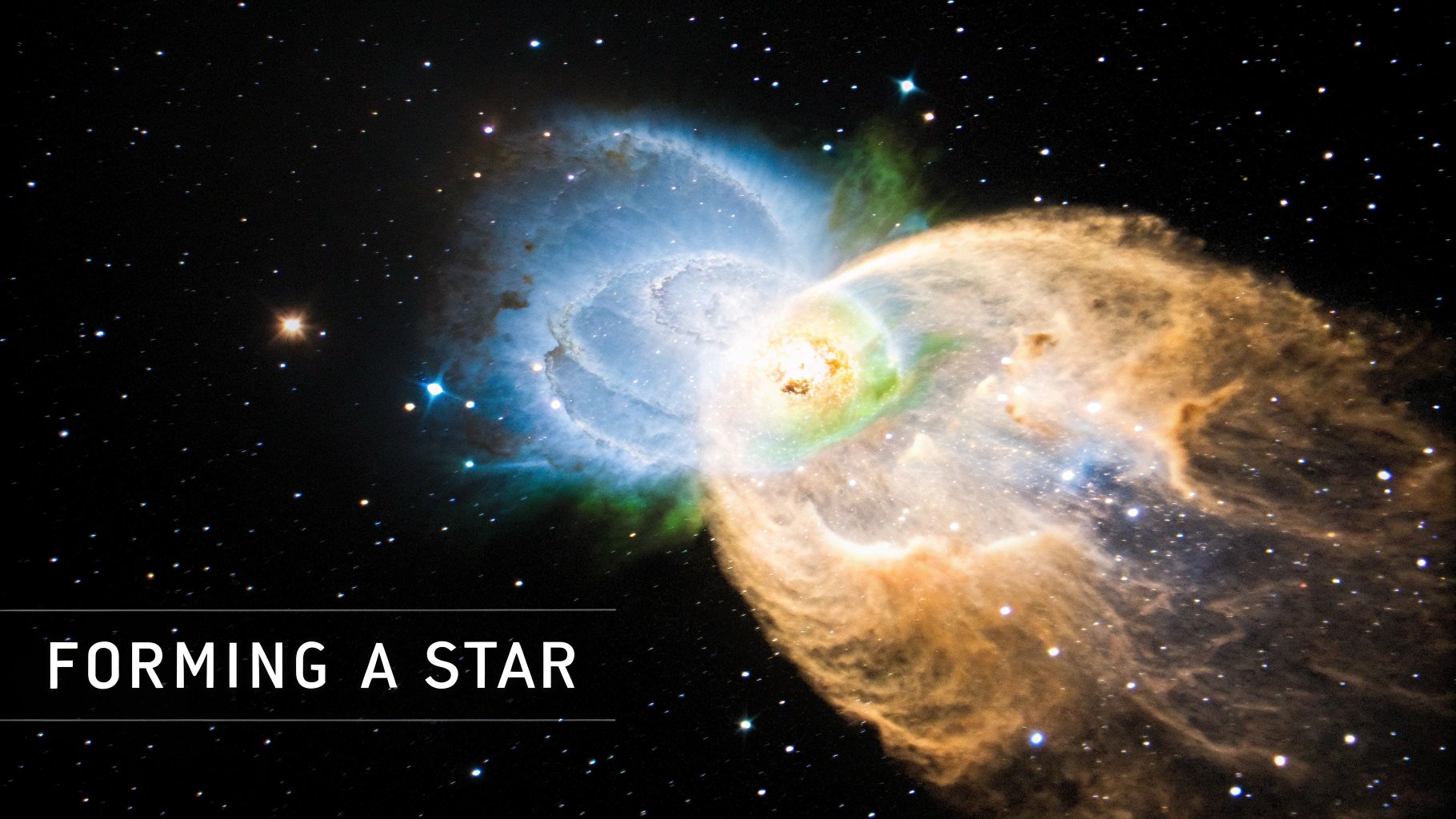
Imagine gravity is a giant, invisible cosmic hand that starts pulling all the little bits of dust and gas closer and closer together. It's a bit like how a magnet pulls things towards it, but on a mind-bogglingly huge scale! As this cosmic cloud gets squeezed tighter, it clumps together and starts to spin, forming a dense, hot ball at its centre.
The Great Cosmic Squeeze
This incredible squeezing action creates immense pressure and friction right in the middle of that ball. You can even try a small-scale version of this yourself! Rub your hands together really fast. Feel that warmth? That’s friction at work. A baby star, or protostar, is doing the exact same thing, but with so much force that its core gets hotter and hotter.
This process doesn't happen overnight; it can take millions of years. But gravity keeps pulling more material inwards and cranking up the heat. Eventually, the core becomes hot enough—around a scorching 15 million degrees Celsius—to ignite the star's engine and set the stage for its shining debut. You can explore more about how this powerful force shapes our universe in our fun guide explaining gravity for kids.
It’s this constant battle between gravity pulling everything inwards and the energy from the core pushing outwards that keeps a star stable and shiny for billions of years. Gravity’s big squeeze literally turns a simple gas cloud into a blazing powerhouse!
From Space Clouds to Stellar Science
This amazing process isn’t just something we imagine; it's a field of study that fascinates scientists all over the world. Right here in the UK, some of the world’s top universities are dedicated to understanding how stars are born. According to the QS World Rankings for 2025, the University of Oxford and the University of Cambridge are ranked among the top five globally for Physics & Astronomy. That just goes to show that stellar science truly shines bright! You can see more about these top university rankings and learn how experts are uncovering the secrets of the cosmos.
Once gravity has done its job building this super-hot, super-dense ball of gas, the next amazing step can begin. It's time to fire up the star’s engine and unlock its real power source.
Unlocking the Power of Nuclear Fusion
Once gravity has worked its magic and squeezed everything into a super-hot, super-dense core, the real show can begin. Inside this fiery heart, the conditions get so extreme that something amazing happens to the tiny particles of gas, which are mostly hydrogen atoms.
They aren't just drifting about anymore. Instead, they're zipping around at unbelievable speeds, smashing into each other with incredible force. You can imagine a cosmic game of bumper cars, only millions of times faster and hotter!
The Star's Powerful Engine
They collide so hard that they actually fuse—or join together—to create a brand-new, slightly heavier element: helium. This incredible process is what scientists call nuclear fusion.
Every time hydrogen atoms fuse into helium, a huge burst of energy is released as light and heat. Imagine billions upon billions of tiny explosions going off every single second! This non-stop chain reaction is the engine that powers a star, keeping it blazing hot and bright for billions of years. It’s this very fusion that answers the big question of what makes stars shine.
Our very own Sun uses this exact process to light up our days and keep our planet warm. It’s one giant cosmic campfire powered by the incredible heat of nuclear fusion! Space Ranger Fred learns all about this amazing energy source on his cosmic adventures.
This powerful reaction in the Sun's core is a fascinating topic all on its own. To see exactly how it works, you can explore our guide on how the sun produces its incredible energy.
A Cosmic Campfire Story
Think of it like this: deep inside every star, our Sun included, tiny bits of hydrogen gas are being smashed together under immense pressure and heat—we’re talking temperatures hotter than 15 million degrees Celsius! This fusion creates helium and releases a massive burst of energy as light and heat, allowing the star to glow for billions of years.
This engine is so powerful that it creates a constant outward push, perfectly balancing gravity’s inward pull. It’s this perfect balance that keeps a star stable and shining brightly for most of its life. But what happens to all that light energy created in the core? Well, its journey to escape the star and travel across space is another incredible adventure entirely.
The Incredible Journey of a Photon of Light
So, the star's core is a brilliant energy factory, but how does that light actually get out to twinkle in our night sky? The energy travels in tiny packets called photons. You might imagine they just shoot straight out, but their escape is actually a long and winding adventure!
The inside of a star is an unbelievably crowded place. As a photon starts its journey from the fiery centre, it immediately bumps into other particles. Every time it collides, it gets absorbed and then spat back out in a completely random direction.
A Long and Winding Road
Imagine trying to get through a massive, bustling crowd at a festival—you’d be nudged left, right, backwards, and forwards, making your path a slow, zig-zagging mess! That’s exactly what happens to a photon inside a star. This chaotic journey is often called a "random walk".
Because of this constant bumping and re-routing, a single photon can take a shockingly long time to travel from the core to the surface. For a star like our Sun, this journey can last anywhere from 100,000 to a million years!
This whole process kicks off with the fusion we talked about earlier, which is what creates the photon in the first place.
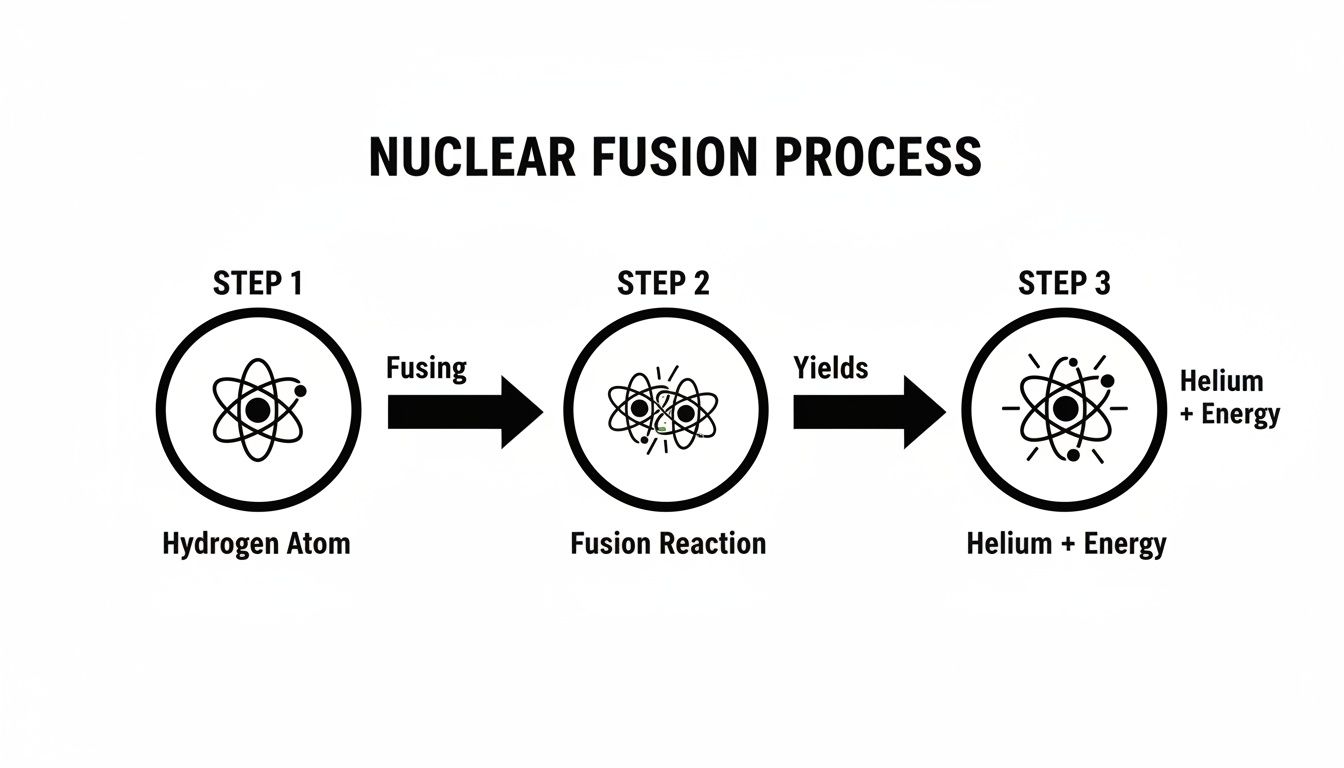
As you can see, smashing hydrogen atoms together to make helium is what releases the energy that becomes a little photon of light, ready for its incredible journey.
Free at Last
Once the photon finally breaks free from the star's surface, its journey through the emptiness of space is much, much faster. It now travels in a perfectly straight line, zipping across the cosmos at the fastest speed possible.
After taking hundreds of thousands of years just to escape the Sun, that very same photon only takes about eight minutes to reach us here on Earth!
That trip across space is a fantastic adventure in itself. You can learn all about its incredible velocity in our guide that answers the question, what is the speed of light? It’s amazing to think that the starlight we see tonight began its journey an unimaginably long time ago.
Why Do Stars Twinkle in Different Colours?
Have you ever gazed up at the night sky and noticed some stars seem to have a reddish tinge, while others are a brilliant white or even blue? That's not just your imagination! Stars really do shine in all sorts of different colours, and that colour is a fantastic clue that tells us exactly how hot that star is.
Think of it like the heating element in a toaster or an electric hob. When you first switch it on, it glows a dull, deep red. But as it gets hotter and hotter, the colour shifts to a much brighter orange-white. Stars work in exactly the same way!
A Rainbow of Star Temperatures
A star's colour is directly tied to its surface temperature. It's one of the first things astronomers look for, because it reveals so much about the star's story just from its light.
- Cool Stars: The coolest stars—though they're still unbelievably hot!—give off a reddish glow. A perfect example is the famous star Betelgeuse in the constellation of Orion, which is a massive star known as a red supergiant.
- Medium-Hot Stars: Stars with a medium temperature, like our very own Sun, shine with a bright yellow-white light. They're much hotter than the red stars but haven't quite reached the scorching temperatures of the blue ones.
- The Hottest Stars: The absolute hottest, most powerful stars in the universe burn with a fierce, brilliant blue-white light. These cosmic powerhouses, like Rigel (also in Orion), are so hot that they burn through their fuel much, much faster than their cooler cousins.
By studying the light from a star, scientists can figure out not only its temperature but also what it’s made of. It's like being a space detective, piecing together the story of the incredible variety of stars scattered all across our galaxy.
Try This at Home: Have a chat about other things that change colour when they get hot. With a grown-up's help, you could watch the flames on a gas hob, or maybe look at pictures of a blacksmith working with glowing hot metal. Notice how the colours change from red to orange and then to a brilliant white as the heat increases. That’s the very same idea that makes stars shine in different colours!
It's amazing to think that this simple observation connects us to the incredible science happening trillions of kilometres away. Learning to read these cosmic colour clues is a huge part of what makes stargazing so much fun.
Your Guide to Stargazing at Home
Ready to bring the incredible science of starlight to life? Let's try some fun, hands-on activities that make these massive ideas much easier to understand. You don’t need a fancy laboratory—just a bit of curiosity and a few things you can find around the house!
These simple experiments are perfect for seeing cosmic science in action, right on your kitchen table.
Try This Gravity Squeeze Experiment
Remember how gravity pulls all that gas and dust together to start building a star? We can create a mini-model of this cosmic squeeze to see how it works. It’s a brilliant way to imagine how a giant nebula begins to clump together.
What you’ll need:
- A balloon (any colour will do!)
- Some glitter or tiny bits of paper (like from a hole punch)
What to do:
- Sprinkle the glitter onto a flat surface like a table or a tray. This is all the cosmic dust and gas floating around in space.
- Blow up the balloon and tie it off.
- Now, rub the balloon really fast on your jumper or your hair for about 10 seconds to build up some static electricity.
- Slowly lower the charged balloon towards the glitter. Watch what happens! The glitter will jump up and stick to the balloon, just like gravity pulling all that cosmic material together.
This shows how an invisible force can gather lots of little pieces into one big clump. That’s the very first step in building a brand-new star!
Make Your Own Fusion Energy Burst
Next, let's try to picture the amazing energy that’s released during nuclear fusion. We can simulate that explosive power with something much tastier and safer: popping candy!
What you’ll need:
- A clear glass or jar filled with water
- A packet of popping candy
What to do:
- Listen closely as you pour the popping candy into the water.
- You’ll hear and see a fizzing, crackling reaction as the candy dissolves and releases tiny bursts of gas.
Each little pop and fizz represents a burst of energy released when hydrogen atoms fuse together deep inside a star’s core. Now, imagine that happening billions of times every single second—that’s what makes stars shine so brightly!
You can find step-by-step instructions for these and many more stellar experiments on our fantastic free activities page. For younger readers, or those looking for a creative activity related to the cosmos, you might also enjoy these brilliant star coloring pages. They’re a perfect way to continue your space adventure.
Your Questions About Shining Stars, Answered!
It’s brilliant to be curious! Exploring the universe always leads to more amazing questions. Here are a few of the most common ones our Space Rangers ask about those twinkling lights in our night sky.
Do Stars Shine Forever?
That’s a great question! Stars don’t shine forever, but they do last for a very, very long time—we're talking billions of years! A star keeps shining as long as it has enough hydrogen fuel in its core to keep the fusion party going.
When that fuel eventually runs out, its life as a shining star comes to a close. Sometimes, this happens in a spectacular explosion called a supernova, an event so bright it can briefly outshine an entire galaxy.
Why Do Stars Appear to Twinkle?
From our viewpoint here on Earth, stars certainly seem to twinkle. But it's actually a bit of a trick! Their light has to travel all the way through our planet’s atmosphere to reach our eyes, and our atmosphere is anything but still.
It’s full of swirling pockets of warm and cool air that act like a wobbly, invisible lens. As the starlight passes through all this turbulence, it gets bent and nudged around just enough to make the star look like it’s flickering. Astronauts up in space see the very same stars as steady, unwavering points of light!
Is Our Sun the Biggest Star in the Universe?
Our Sun definitely looks like the biggest and brightest star to us, but that’s only because it’s so close. In the grand cosmic scheme of things, it’s actually a fairly average-sized star!
The universe is home to some true giants known as supergiants. Some of these are so enormous that you could fit millions of our Suns inside them. It just goes to show, there’s always something bigger and more amazing to discover out there in space!
The universe is full of incredible stories, just waiting to be explored. To continue your journey through the cosmos, blast off into another adventure with Space Ranger Fred and discover even more secrets of the stars. Explore the world of Space Ranger Fred today.