
Have you ever watched a rocket launch on TV, totally amazed, and wondered how on earth such a huge machine can fly? It might look like magic, but it’s actually some really, really cool science! This guide is here to answer that big question—'how do rockets work?'—using simple ideas and fun things to imagine.
At its heart, a rocket works by blasting incredibly hot gas out of its engines at super-fast speeds. This powerful downward push creates an equally powerful upward force called thrust, and that's what lifts the whole thing towards the stars.
Your Countdown to Understanding Rocket Science
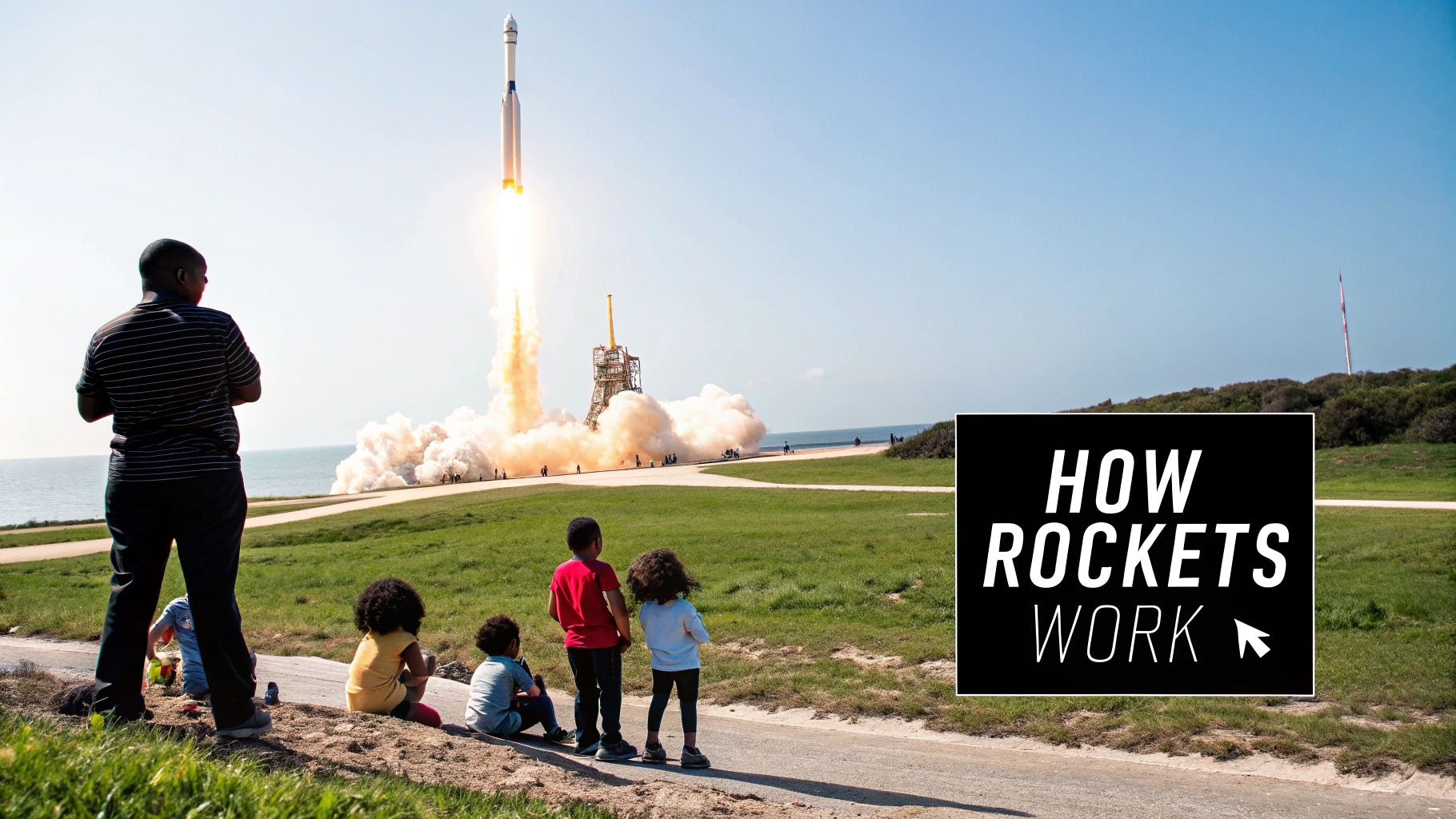
Getting ready for an adventure into the world of rockets is always a thrill. Just imagine it: you’re standing with your family, eyes fixed on the countdown clock… 5… 4… 3… 2… 1… LIFT-OFF! A massive tower of fire and smoke erupts below as the rocket starts its slow, mighty climb into the sky. It’s an unforgettable sight, but the science that makes it all happen is even more fascinating.
Think of our learning journey like building with LEGO. We'll start with the most basic bricks and click new pieces of knowledge into place, one by one, until you have a complete picture of these amazing machines.
What to Expect on Our Mission
Together, we’re going to explore the science of spaceflight in a way that’s super easy to follow. You don’t need to be a top scientist to understand how rockets work; you just need a bit of curiosity! We’ll look at everything from the gigantic push that gets a rocket off the ground to the clever way it sheds its own parts as it climbs higher and higher.
Here are some of the fantastic things you’ll discover:
- The Power of Push: We'll uncover the secret force called thrust and find out how one simple rule of science makes every space mission possible.
- A Rocket’s Recipe: Let's take a peek inside a rocket to see its main ingredients, from the thunderous engines to the precious cargo it carries.
- Climbing in Stages: Find out why rockets drop bits of themselves on the way up and how this clever trick helps them go faster and farther.
- Adventures Closer to Home: We’ll even talk about some of the exciting rocket launches happening right here in the UK!
Every big journey starts with a single question. Asking "how do rockets work?" is the first step on an incredible path of discovery, just like the missions in the Space Ranger Fred books.
Your Rocket Mission at a Glance
To help you get ready for our exploration, here’s a quick look at the amazing things we will discover about how rockets work. Think of it as your mission briefing before we blast off into the details!
| Key Rocket Concept | What It Really Means |
|---|---|
| Thrust | The powerful pushing force created by the engines that lifts the rocket off the ground. |
| Payload | The important cargo the rocket carries, like a satellite or astronauts. |
| Guidance System | The rocket’s ‘brain’ that helps it steer and stay on the right path to its destination. |
| Propulsion System | The engines and fuel tanks that work together to create the thrust needed for the journey. |
| Staging | The clever process of dropping empty fuel tanks to make the rocket lighter as it flies. |
Now you're all briefed, it's time to get ready! Ask questions, imagine incredible journeys, and maybe even try some hands-on science of your own with our fun space-themed activities. Our countdown has officially begun!
Understanding Thrust: The Big Push into Space
So, what exactly gives a rocket all that incredible power? It really all comes down to a special kind of force we call thrust.
Think about it like this: imagine you’re at the swimming pool. If you stand at the edge and push off the wall with your feet, you glide backwards through the water, right? That big push you give yourself is a lot like thrust!
Rockets do something very similar, just on a much, much bigger scale. Instead of pushing against a wall, a rocket powerfully shoves super-hot gas out of its engines. It’s a common mistake to think it's pushing against the ground or the air, but it’s actually pushing the gas itself away.
This whole idea was figured out ages ago by a very clever scientist called Sir Isaac Newton. He came up with a famous rule that you might have heard of: for every action, there is an equal and opposite reaction.
Action and Reaction in Action
For a rocket, the ‘action’ is all that hot gas blasting downwards from its engines. The ‘opposite reaction’ is the rocket getting pushed upwards, climbing higher and higher into the sky. It’s this constant, powerful push that finally lets it break free from Earth's gravity.
Seeing Thrust for Yourself
It might sound complicated, but you can try this amazing force for yourself with a really simple experiment. All you need is a balloon!
- Blow up a balloon but don't tie it off.
- Pinch the end tightly so none of the air can escape.
- Now, just let it go!
What happens? The balloon zips and zooms all over the room! The air rushing out of the end (that's the action) pushes the balloon in the opposite direction (the reaction). That’s thrust in action, just like a tiny rocket you made yourself!
The Fuel Behind the Fire
Of course, a real rocket doesn’t use air; it uses a very special rocket fuel. This fuel is mixed together and set on fire inside the engine, creating the hot gas it needs for launch. The type of fuel is incredibly important because it has to create an enormous amount of energy for that big push into space.
If you're curious about the secret ingredients that power these incredible machines, you can learn all about what rocket fuel is made of in our detailed guide.
Getting your head around this simple push-and-go idea is the first big step in figuring out how rockets really work. It’s not magic, just brilliant science that you can try and see for yourself.
A Guided Tour Inside a Rocket
A rocket might look like one big pointy tube from the outside, but it’s actually a team of four main parts all working together. Think about it: if you were building an amazing vehicle for a super important mission, what would you need? You’d want a strong body, a place for your special cargo, a way to steer, and, of course, a massive engine!
That’s exactly how a rocket is built, just on a much, much bigger scale.
Let's imagine we can take a peek inside and see how these incredible pieces fit together.
The Four Key Parts of a Rocket
Every single rocket, whether it’s a small one launching a tiny satellite or a giant one carrying astronauts, is organised into these four essential sections. Each part has a crucial job to do to make sure the mission is a success.
- Structure: This is the rocket’s skeleton. It's the strong outer body that holds everything together and is tough enough to handle the mind-boggling speeds and powerful forces of a launch.
- Payload: This is the whole reason for the trip! The payload is the precious cargo the rocket is carrying into space. It could be anything from a satellite that gives us TV and internet, to a robotic rover heading to Mars, or even a capsule carrying brave astronauts.
- Guidance System: You can think of this as the rocket’s brain. It’s a super-clever computer system packed with sensors and controls that steers the rocket and keeps it perfectly on course, just like a pilot flying a plane.
- Propulsion System: Now this is the real powerhouse. It includes the mighty engines and the enormous tanks holding all the fuel. This system is what creates the colossal thrust needed to blast the rocket off the ground and all the way into space.
This is where the magic of that action-and-reaction thing we talked about comes into play.
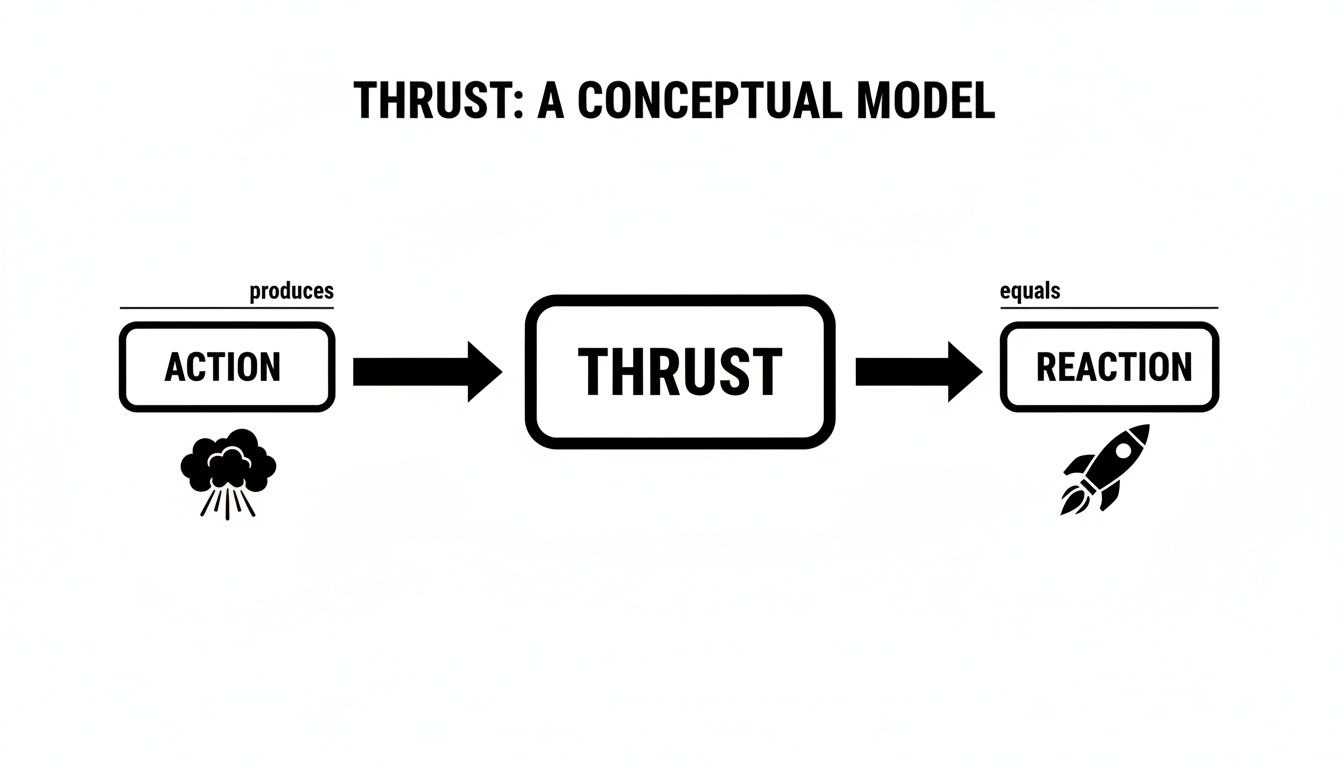
As you can see, the action of blasting hot gas downwards creates an equal and opposite reaction—the rocket pushing upwards!
Each part is vital. Without a strong structure, the rocket would just fall apart. Without a guidance system, it would fly wildly off course. And without the propulsion system, well, it would never even leave the launchpad!
And the payload? That’s the entire point of the journey. For loads of missions, that payload is a satellite. If you’ve ever wondered what those amazing machines get up to once they reach orbit, you can discover more about how satellites work in our handy guide.
How Rocket Stages Help Climb Higher
Have you ever watched a rocket launch and seen big chunks fall away as it soars into the sky? That’s not a mistake or something going wrong; it’s actually a super clever trick called staging.
Getting into space is incredibly hard work. It takes a massive amount of energy, and staging is how rockets make the journey just a little bit easier on themselves.
Imagine you're a hiker climbing a really steep mountain. For the first bit, you might need a big, heavy rucksack full of gear. But once you’ve scrambled past the steepest part, you could drop that heavy bag to make the rest of the climb much easier and faster. Rockets do exactly the same thing!
Shedding Weight to Gain Speed
Most large rockets are built in sections, or ‘stages’, stacked one on top of the other. Each stage is basically its own smaller rocket, complete with powerful engines and a huge fuel tank.
The first stage, right at the bottom, does all the initial heavy lifting. Its massive engines have one job: to push the entire rocket off the launchpad and through the thickest part of Earth’s atmosphere. Once its fuel is all used up, it's just dead weight.
By dropping this huge, empty stage, the rocket becomes instantly lighter. This means the next, smaller engine doesn’t have to work nearly as hard to push the rocket even faster and higher. It’s a brilliant way to save energy for the final push into space!
After the first stage separates and falls safely back to Earth, the engine on the second stage fires up and takes over. This whole process might even happen a third time, with each stage giving the rocket another powerful boost on its journey.

A British Rocket Pioneer
Did you know that Britain's own rocket story began with a launcher called Blue Streak? Developed way back in 1959, it had a perfect 100% launch success record in its tests, showing off some amazing engineering smarts from the get-go.
Although its original mission changed, its powerful first stage went on to be used in the European Europa rocket. An updated version even powered the successful Ariane 1 rocket for many years! You can see incredible footage of this pioneering rocket and learn more about its flight history on YouTube.
This idea of staging is a core part of how we get to space, allowing rockets to overcome gravity one powerful step at a time.
UK Rocket Launches Bring Adventure Closer to Home
Guess what? You don't have to fly halfway around the world to see a real rocket launch anymore! The UK is becoming a brilliant new hub for sending things into space, bringing the whole adventure much closer to home for all of us.
It’s an incredibly exciting time. Clever engineers are busy working on two different ways to send rockets soaring into the sky, right from our own country.
Two Ways to Launch from the UK
Each way of launching has its own special advantages, a bit like choosing between a train or a plane for a long journey. They both get you where you need to go, but they work very differently.
- Horizontal Launches: Picture a massive aeroplane with a rocket tucked neatly under its wing. That’s pretty much how a horizontal launch works! The plane flies way up into the sky before releasing the rocket, which then fires its engines to finish the journey into space.
- Vertical Launches: This is the classic launch you probably imagine—the big countdown, the thundering roar of the engines, and a fiery blast-off straight up from a launchpad. This is the method they’re working on right now in Scotland.
Why Scotland is Great for Space
You might be wondering, "Why Scotland?" Well, it's all about location, location, location! Scotland is perfectly placed to send satellites into a very special path around the Earth called a polar orbit.
Instead of circling the planet around its middle (the equator), satellites in a polar orbit fly over the North and South Poles. This clever flight path lets them scan the entire planet as it spins underneath them. It’s perfect for important jobs like monitoring our climate or taking super-detailed pictures of the land and sea.
On 9 January 2023, the UK made history with its very first orbital launch attempt from Spaceport Cornwall, a mission carried out by Virgin Orbit. Just like one of Space Ranger Fred’s exciting missions, it showed the world that Britain can send rockets to space right from its own backyard.
The government has invested over £40 million to help this industry grow, supporting both the horizontal launches and the vertical launch sites being built up in Scotland. You can read more about the UK's spaceflight goals on the government's official page. This makes learning how rockets work even cooler, because it’s happening right on our doorstep!
Your Turn to Be a Rocket Scientist!
Want to know the best way to understand how a rocket works? Build one yourself! Getting hands-on is a brilliant way to see science spring into action, and now it’s your turn to become a rocket engineer with these simple, fun activities you can try at home or in the classroom.
Don’t worry, you won’t need any fancy equipment—just a few bits and bobs from around the house and a big sense of adventure. These playful challenges are designed to get your curiosity firing and have you thinking like a real space explorer.
Build a Fizzy Rocket with Alka-Seltzer
Ready for a bubbly blast-off? This classic experiment is a fantastic way to see how a chemical reaction can create enough thrust to launch a mini-rocket. All you need is a film canister, an Alka-Seltzer tablet, and a little water to create your very own pocket-sized propulsion system.
When the tablet hits the water, it fizzes and releases carbon dioxide gas. This gas gets trapped inside the canister, building up pressure until… POP! It shoots into the air, showing you Newton’s Third Law in the most fun way possible.
For the full mission briefing, check out our step-by-step guide on how to make a rocket right at home.
Design a Powerful Stomp Rocket
If you’d rather use the power of air, a stomp rocket is the perfect project. This activity lets you explore how things like the angle you launch from or the shape of your rocket’s fins can change how far and high it flies. You can build one from a plastic bottle, some paper, and a bit of tubing.
So, What’s Going On? When you stomp on the bottle, you’re forcing a huge puff of air through the tube and into the rocket, creating the thrust it needs to launch. Try playing around with different fin designs on your rocket—you’ll quickly see how important the guidance system is for a steady flight!
If you're inspired to become a rocket scientist, you'll find that hands-on learning in science, technology, engineering, and mathematics is key. You can also find brilliant resources to explore other STEM subjects that are crucial to understanding space travel.
Got Questions About Rockets? We've Got Answers!
It's brilliant to be curious and ask big questions! It’s what being a Space Ranger is all about. Here are some of the most common things people want to know about how these incredible machines work.
How Fast Do Rockets Need to Go to Get to Space?
Getting into space is all about speed! To break free from Earth's gravity and stay whizzing around the planet, a rocket needs to hit a mind-boggling speed of about 17,500 miles per hour. That's called orbital velocity.
But what if you want to go even further, say to Mars? For that, you need to hit 'escape velocity'—an unbelievable 25,000 miles per hour. Talk about putting your foot down!
Why Is There So Much Fire and Smoke During a Launch?
That incredible cloud you see during a launch isn't just for show! It's called an exhaust plume, and it's the super-hot gas blasting out of the rocket's engines. Think of it as the rocket's superpower. Burning all that fuel creates a massive amount of energy, and pushing this gas down is what creates the epic thrust to lift the whole machine up.
A lot of what looks like smoke is actually huge clouds of steam. This comes from thousands of gallons of water being sprayed onto the launchpad to soak up the incredible sound and heat from the engines.
A single rocket launch can be as loud as 15 million stereos all playing at once! That water helps protect the rocket and everything around it from all that powerful energy.
Can Rockets Be Used More Than Once?
They certainly can now! For a long time, rockets were a one-and-done deal, which was a bit like throwing away a car after one trip—very expensive.
But now, clever companies like SpaceX have built reusable rockets. After launching their payload, parts like the first-stage booster can actually fly back to Earth and land safely on their own. They can then be checked over, refuelled, and sent on another mission. This has been a huge game-changer, making space travel much more affordable.
We hope this has helped you understand a little more about how these amazing machines work! At Space Ranger Fred, we believe learning about space is the greatest adventure of all.
Keep exploring, keep asking questions, and keep reaching for the stars. For more stories, fun, and facts, blast off into the rest of the Space Ranger Fred universe.