
Hello, Space Rangers! Ever stop and think about why Earth is so perfectly comfy for all our adventures, while other planets are either sizzling hot or freezing cold? It’s all thanks to a super clever, invisible shield called the greenhouse effect. Think of it as our planet's very own cosy blanket, keeping everything just right.
Earth's Cosy Blanket: The Greenhouse Effect
Picture our planet spinning around in space. The Sun shines down on us, sending a huge amount of light and warmth our way, a bit like a giant, faraway heater. Earth soaks up all that lovely warmth, but it also naturally tries to send some of it back out into space.
But here’s the clever bit. If all that heat just escaped, Earth would turn into a giant ice ball! It would be far too chilly for any of us to live here, let alone go exploring.
Luckily, our planet is wrapped in a special atmosphere filled with gases that work just like the glass roof of a greenhouse. These are called greenhouse gases, and they are amazing at trapping some of the heat that’s trying to leave. They let all the sunshine in, but they make sure not too much of the warmth escapes. It’s this natural process that keeps our world at a brilliant temperature, giving us oceans to splash in and parks to run around in.
Why does this matter so much?
Without this natural warming system, the average temperature here on Earth would plummet to a super-chilly -18°C! That's colder than the inside of your freezer. Brrr! Thanks to our planet’s special blanket, we get to enjoy a much friendlier average of about 15°C instead.
It’s all about getting that balance perfect. The greenhouse effect is completely natural and is absolutely essential for life to exist. You could even call it Earth’s personal climate control system.
To help you remember, here's a quick summary of the big ideas behind our planet's natural warming system.
Earth's Climate Control System
| Cool Concept | What It Means For Us |
|---|---|
| The Cosy Blanket | Gases in our atmosphere trap the sun's heat, keeping Earth warm enough for us. |
| Natural and Necessary | Without it, our planet would be a frozen, icy world where nothing could live! |
| Greenhouse Gases | Gases like carbon dioxide (CO₂) act like the glass in a greenhouse, trapping warmth. |
| A Perfect Balance | The natural effect keeps temperatures just right for life to thrive and for us to have fun. |
This amazing system is what makes our home planet so special and one-of-a-kind. To learn more about our planet's place in the solar system, why not blast off on another mission with Space Ranger Fred and his friends in The Search for Planet X? It’s a brilliant story for any budding explorer.
How do greenhouse gases trap heat from the Sun?
Ready to find out how this amazing planetary process works?
Imagine walking into a giant greenhouse, the kind where they grow delicious tomatoes and cucumbers. The sun’s light streams right through the glass, warming up all the air and soil inside. That glass is fantastic at letting the sunlight in, but it’s also brilliant at stopping all that lovely warmth from getting back out.
Well, Earth’s special greenhouse gases do exactly the same job as the glass!
The Sun’s energy, which you can find out more about in our guide on how the sun produces energy, travels all the way to us as sunlight. This light zips straight through our atmosphere and warms up the ground and the oceans. As our planet warms up, it tries to send some of this heat—called infrared radiation—back out into space.
This is where our team of heat-trapping gases comes in. While some of the heat does escape, the greenhouse gases in the atmosphere catch a lot of it and bounce it right back down to Earth. This clever trick keeps our planet much, much warmer than it would be otherwise.
Meet the main heat-trapping gases
A few different gases are really good at this job, but let's get to know the main members of the team:
- Water Vapour (H₂O): This is the most common one! It's just water in its gas form, like the steam that comes from a boiling kettle or the stuff that makes up clouds.
- Carbon Dioxide (CO₂): This is the gas we breathe out with every single breath. Plants need it to make their food, and it’s also released when we burn things like petrol or coal for energy.
- Methane (CH₄): This one comes from some pretty funny places, like cow burps and muddy swamps where tiny microbes are busy working away!
These gases are brilliant at absorbing the heat energy that Earth sends out. You can think of them like tiny pinball bumpers, constantly knocking the heat back down to keep us all cosy and warm.
This cool concept map helps you see how the Sun, the Earth, and our atmosphere's gassy blanket all work together.
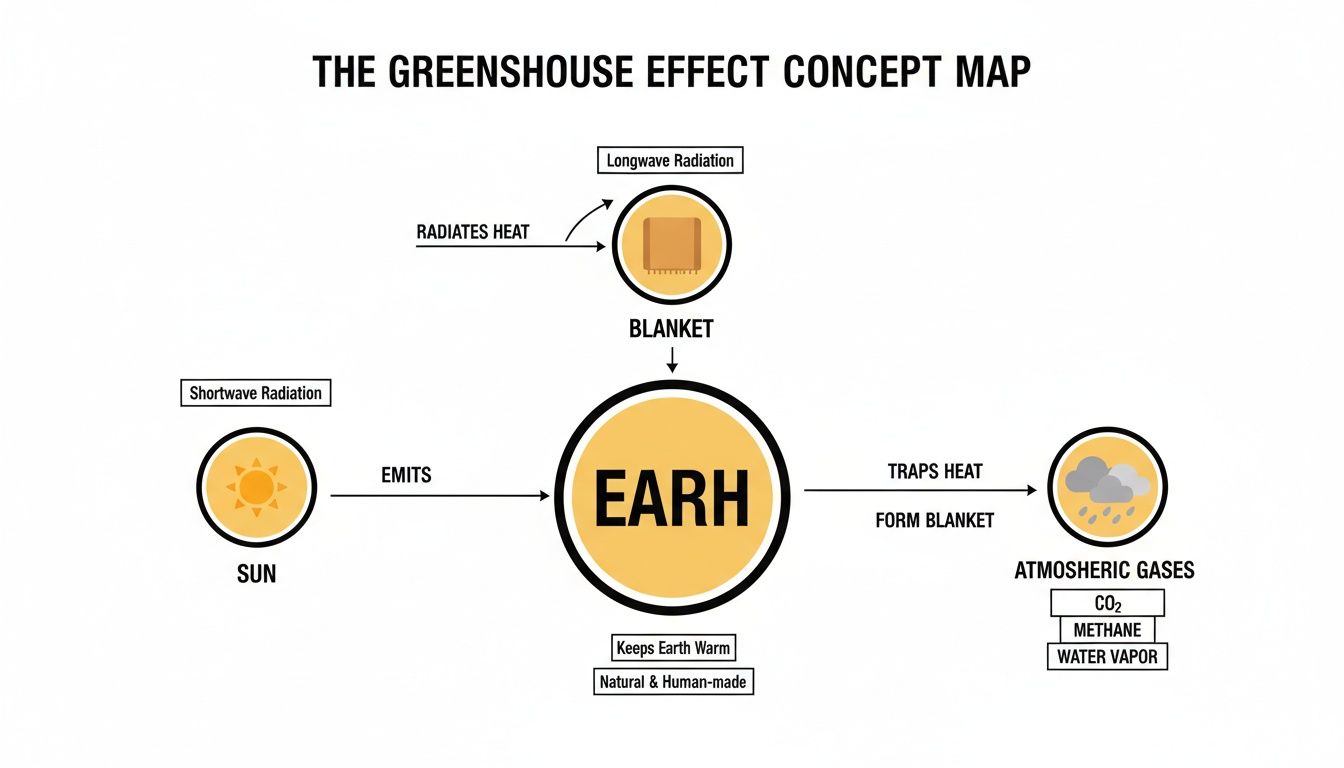
As you can see, it’s a pretty simple process: sunlight comes in, warms up the Earth, and our greenhouse gases trap some of that warmth before it can zoom off into space. It's a fantastic natural system that makes our planet just right for all our adventures.
Try this: build your own greenhouse in a jar
Reading about the greenhouse effect is one thing, but seeing it in action is way more fun! Let’s get our hands dirty and think like proper scientists with this super simple experiment. We’re going to build a tiny greenhouse in a jar to feel for ourselves how heat gets trapped.
It’s a fantastic way to really understand the greenhouse effect, because you can actually feel the difference. Ready for your mission, Space Ranger? Let’s begin!
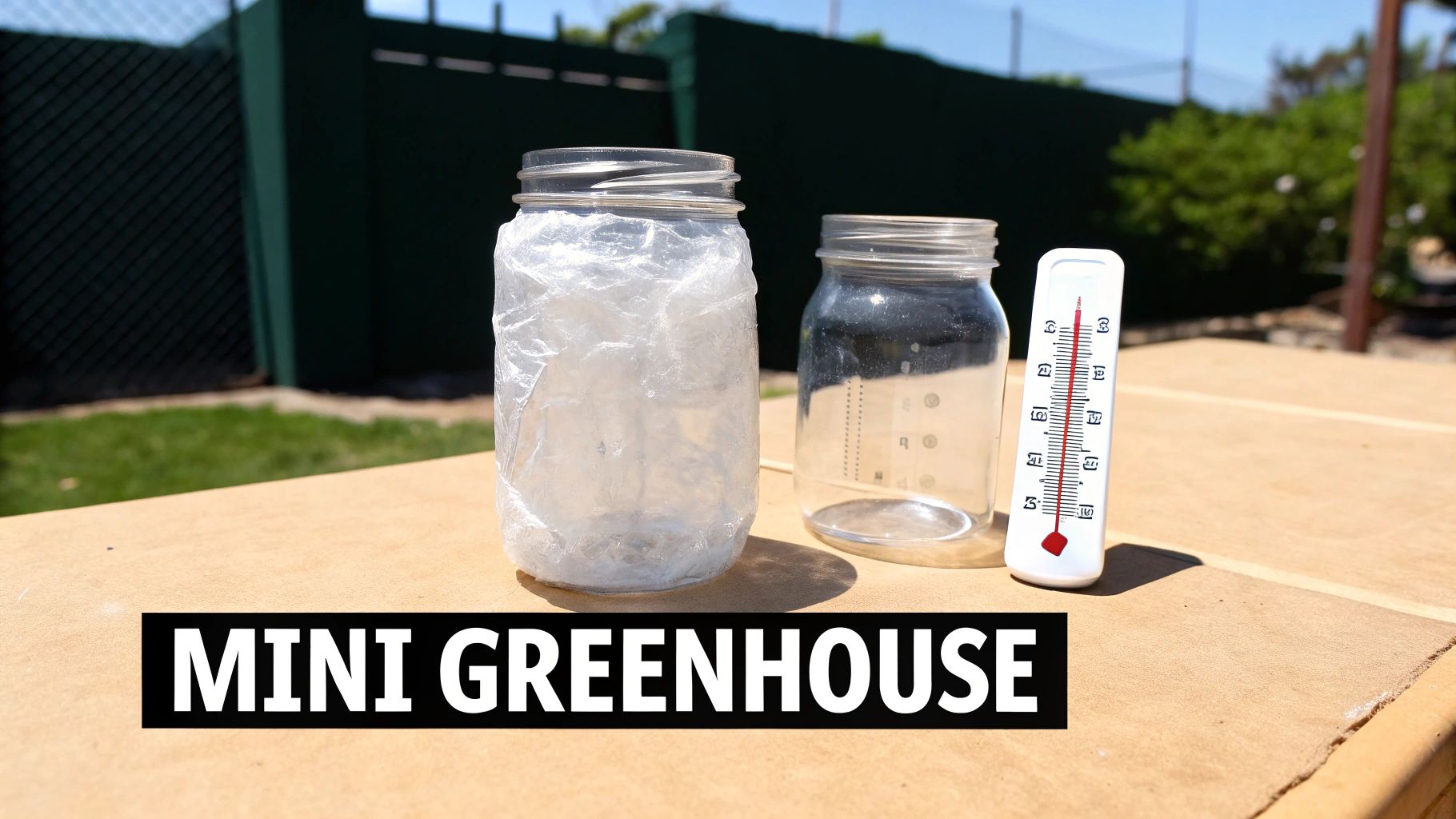
What you will need
- Two large, clear glass jars that are the same size.
- A little bit of soil or sand.
- A small splash of water.
- A piece of cling film or a lid for one of the jars.
- A sunny spot, like a windowsill or a table outside.
- Two thermometers (these are optional, but brilliant for measuring!).
Let's get building
This whole experiment is about comparing two different situations, just like real scientists do. One jar will be our mini Earth without an extra-thick blanket, and the other will be our Earth with its nice, cosy greenhouse blanket.
- Prepare your jars: Pop the same amount of soil or sand in the bottom of each jar. Add a little splash of water to make it damp, but not all soggy.
- Set up your thermometers: If you’ve got thermometers, place one inside each jar. Just make sure you can still read the temperature from the outside.
- Cover one jar: Take your cling film and stretch it tightly over the top of one jar. If you’re using a lid, pop it on securely. This is your mini greenhouse! Leave the other jar completely open.
- Find a sunny spot: Place both jars side-by-side somewhere sunny. It's important they both get the same amount of sunlight.
- Wait and watch: Now for the exciting bit—observation! Leave your jars for about an hour. What do you think will happen? Make a prediction!
After an hour, carefully feel the outside of each jar. What do you notice? The covered jar should feel much warmer inside. The cling film acted just like greenhouse gases, letting the sun’s warmth in but stopping it from escaping easily.
This is exactly how our planet's atmosphere works. Without it, Earth would be a freezing -18°C—far too cold for Space Ranger Fred's adventures!
For more hands-on fun that shows off a similar idea, you could try learning how to create a terrarium, which is like building a tiny, self-contained world right in your own home. And if you’re hunting for more brilliant experiments, check out our other fun science activities for kids.
What happens when the blanket gets too thick?
If our planet's cosy blanket is so important, why do grown-ups sometimes talk about it as a problem? That is a brilliant question! For thousands and thousands of years, Earth’s greenhouse effect kept everything in a perfect, comfy balance. The blanket was just the right thickness to keep us warm.
But lately, that blanket has started to get a little bit too thick. This time, it’s not a natural change. Instead, it’s because of some of the things we humans do every single day.
Things like driving cars, using lots of electricity from power stations, and making everything from toys to clothes in big factories all release extra greenhouse gases. This adds more and more of them, especially carbon dioxide, into our atmosphere.
Imagine putting a second, thick woolly blanket on top of the one you already have—suddenly, you’d start to feel a bit too hot! That's what's happening to our planet.
Why a thicker blanket matters
When the blanket gets too thick, it traps more heat than our planet needs. This is causing the Earth to slowly warm up, a change that scientists often call climate change or global warming.
Even a tiny bit of extra warmth can cause big changes all around the world. It can affect our weather, making some places hotter and drier and others much stormier and wetter. It also has a big impact on icy places like the North and South Poles.
The extra heat is causing the giant sheets of ice at the top and bottom of our world to start melting. This is a real challenge for amazing animals like polar bears, who rely on the sea ice to hunt for their food.
The UK was one of the first places to start adding lots of extra gases to the air a long time ago, but now we're becoming leaders in finding clever ways to fix it. Transport is still a big source of these gases, making up over a quarter of the total, mostly from cars and lorries. You can discover more about how the UK is measuring these emissions and see why every little action helps.
By recycling, saving energy, and dreaming up green inventions, we can help get Earth's blanket back to being just right for our adventures! This is a big mission, but it’s one that people all over the world are working on together.
In the exciting adventure book The Search for Planet X, Space Ranger Fred and his friends learn all about teamwork when facing a planet-sized problem.
How can we help keep Earth's temperature just right?
Now for some really good news! Even though the Earth’s blanket is getting a bit too thick, there are so many clever grown-ups and amazing kids all over the world working together to fix it.
It’s a huge mission, but just like in Space Ranger Fred’s adventures, teamwork and brilliant ideas can solve any problem.
Scientists and engineers have come up with some incredible inventions to help. Have you ever seen giant windmills spinning in a field? Those are called wind turbines, and they cleverly turn the power of the wind into electricity without making any extra greenhouse gases. There are also shiny solar panels that soak up the sun’s rays and turn them into power for our homes.
Making big changes together
It might seem like a huge challenge, but when we all work together, we can make a massive difference. Here in the UK, we’re already on an exciting mission to help our planet.
Since 1990, the amount of extra greenhouse gases we send into the atmosphere has been cut by more than half! A big reason for this is that we've stopped using as much coal to make electricity, which has slashed emissions from our power supply. It just goes to show that big changes are possible. You can learn more about the UK's amazing progress on Our World in Data.
This spirit of innovation and teamwork is exactly what Space Ranger Fred is all about. It proves that when we put our minds together, we can tackle even the biggest planetary problems and invent a better, cleaner future for everyone.
Every little action adds up, from big inventions to small changes at home. Understanding sustainable gardening practices, for example, is a wonderful way to help keep our planet healthy right from your own back garden.
Everyone can be part of this important mission, helping to get Earth’s blanket back to being the perfect thickness for all our adventures.
Your mission: become a Planet Protector
Alright, Space Ranger, you've got the knowledge. You know all about the Earth’s cosy blanket and how it works. Now it’s time for your real mission to begin: becoming an official Planet Protector!
You don't need a special suit or a rocket ship for this one. All you need are your brilliant ideas and a can-do attitude. Every little thing you do helps keep our planet’s blanket just right.
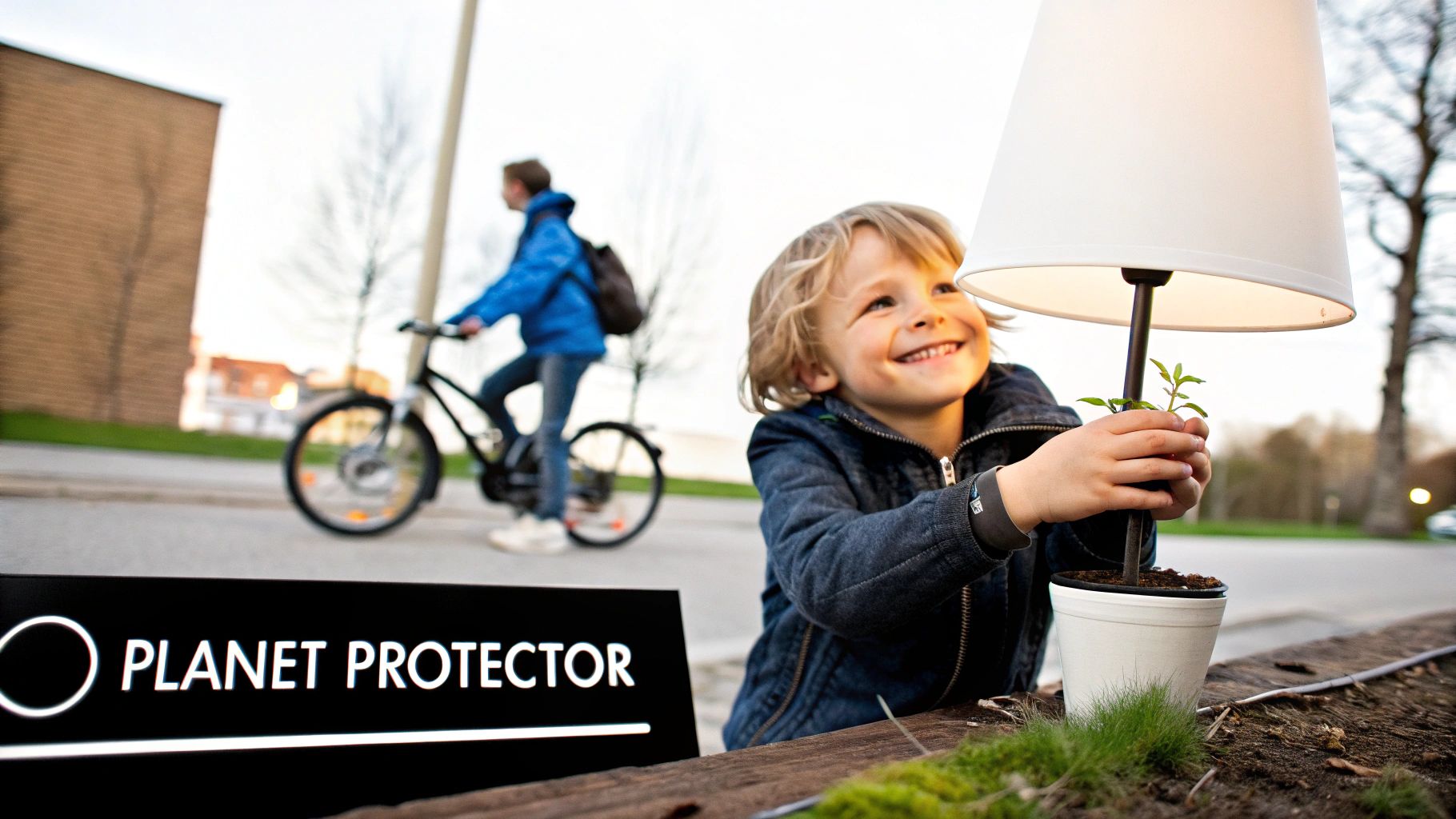
Here are a few simple missions you can launch today. Each one helps cut down on the extra greenhouse gases heading into our atmosphere.
Your Planet Protector missions
-
Become a Light Switch Hero: Every single time you leave a room, complete your mission by flicking that switch off. Making electricity often creates greenhouse gases, so saving power is a huge help for Earth's blanket.
-
Choose your super-powered transport: Think about shorter trips. Could you walk, scoot, or cycle instead of hopping in the car? Walking to school means one less car puffing out extra gases!
-
Be a Recycling Champion: Get really good at sorting your rubbish. When we recycle old paper, plastic, and tins, they can be transformed into something new. That saves a massive amount of energy compared to making things from scratch.
-
Plant a seed for the future: Plants are incredible because they actually breathe in carbon dioxide—one of the main greenhouse gases! By planting a seed for flowers, herbs, or even a tree, you're helping to clean the air.
Remember, Space Ranger, every single mission, no matter how small it feels, adds up to make a huge difference. You are a meaningful part of the solution, and your actions truly matter!
When we all work together as a team, we can protect our amazing home. To keep the adventure going, why not try some brilliant games about the Earth? They’re a great way to learn even more about our wonderful planet. Your next mission is just around the corner!
Your greenhouse effect questions answered
Even the sharpest Space Rangers have questions! Being curious is a superpower. Here are some simple answers to the most common things kids and grown-ups ask when they're learning about the greenhouse effect.
Is the greenhouse effect bad?
What a brilliant question! And the answer might surprise you: not at all. The natural greenhouse effect is actually a really good thing. It’s like Earth’s perfect, cosy invisible blanket that keeps our planet warm enough for us all to live and play here.
Without it, our world would be a giant, frozen ice ball!
The problem only starts when we humans do things like burning fuel for cars and power stations. That adds extra greenhouse gases to the air, making Earth's cosy blanket a bit too thick and trapping too much heat. So, the mission isn't to get rid of the effect, just to get Earth's blanket back to the perfect thickness!
Can we see greenhouse gases?
Great thinking! For the most part, no. Most greenhouse gases, like the carbon dioxide we breathe out, are completely invisible. You can't see them, smell them, or touch them, which makes it a little tricky to imagine them floating around.
But scientists have some very clever tools and special instruments that can measure exactly how much of these gases are in our atmosphere. That’s how we know the amount has been going up, even though the gases themselves are invisible.
What happens if the Earth gets a little warmer?
Even a tiny change in our planet’s temperature can make a massive difference. Think of it like this: a small change can affect weather all over the world, making some places much hotter and drier, while other places might get way more rain and bigger storms.
A warmer world also causes the huge sheets of ice at the North and South Poles to start melting. When that happens, the water in our oceans rises, which can cause problems for people and animals living near the coast. That’s why working together to keep Earth’s temperature just right is such an important mission for all of us.