
A solar eclipse is one of the most incredible sights you can ever see in the sky. It happens when the Moon slides directly between the Sun and Earth, throwing a shadow onto our planet and briefly turning day into a strange twilight. It’s a magical alignment that makes for a truly unforgettable moment for anyone who sees it.
The Ultimate Cosmic Hide-and-Seek
Hello, Space Rangers! Have you ever played a game of hide-and-seek? Well, a solar eclipse is a bit like a giant game of hide-and-seek in space, with the Sun, the Moon, and Earth as the players.
In this game, the Moon’s special mission is to perfectly hide the bright, shining Sun from our view here on Earth. When it lines up just right, the Moon wins the game for a few minutes, and we get to witness a spectacular eclipse!
This amazing event isn’t a random accident. It’s all thanks to the predictable paths, or orbits, that Earth and the Moon follow. Earth is constantly travelling in a giant loop around the Sun, while the Moon circles our Earth in a smaller loop.
Imagine it as a beautiful cosmic dance, with everyone moving in perfect rhythm. The force that keeps this incredible dance going is the very same one that keeps our feet planted firmly on the ground. To find out more, our guide explains gravity for kids in a really fun way.
Our Three Key Players
To really get what causes a solar eclipse, let’s meet our celestial team. Each one has a super important part to play in this amazing natural show.
- The Sun: Our very own star! It’s a massive ball of hot gas that gives us all our light and warmth, sitting right at the centre of our solar system.
- The Moon: This is Earth’s natural buddy, its satellite. The Moon is way smaller than the Sun, but it's also much, much closer to us.
- The Earth: That’s our home! Our beautiful blue and green planet, which is always spinning as it orbits the Sun.
When these three line up in the exact order—Sun, Moon, Earth—the Moon casts a shadow on our planet. If you happen to be standing right inside that shadow, you'll see a solar eclipse.
It’s a bit like holding your thumb up to the sky. Even though your thumb is tiny, if you hold it close enough to your eye, you can block out something massive and far away, like a distant building. The Moon does the exact same thing to the Sun!
Getting this perfect alignment is actually pretty rare. The Moon orbits Earth about once a month, but we don’t get an eclipse every time. Here in the United Kingdom, total solar eclipses are especially uncommon. The last one seen from the mainland was way back on 11 August 1999!
On average, a total eclipse is visible from the very same spot on Earth only once every 375 years. That’s what makes seeing one so incredibly special.
The Perfect Cosmic Coincidence
For a total solar eclipse to happen, something truly magical has to occur in our sky. It’s not just about the Sun, Moon, and Earth lining up. It’s about a perfect cosmic coincidence that makes our tiny Moon look like it’s the exact same size as the gigantic Sun!
So, what’s the secret behind this spectacular celestial show? It all comes down to a mind-boggling piece of space maths.
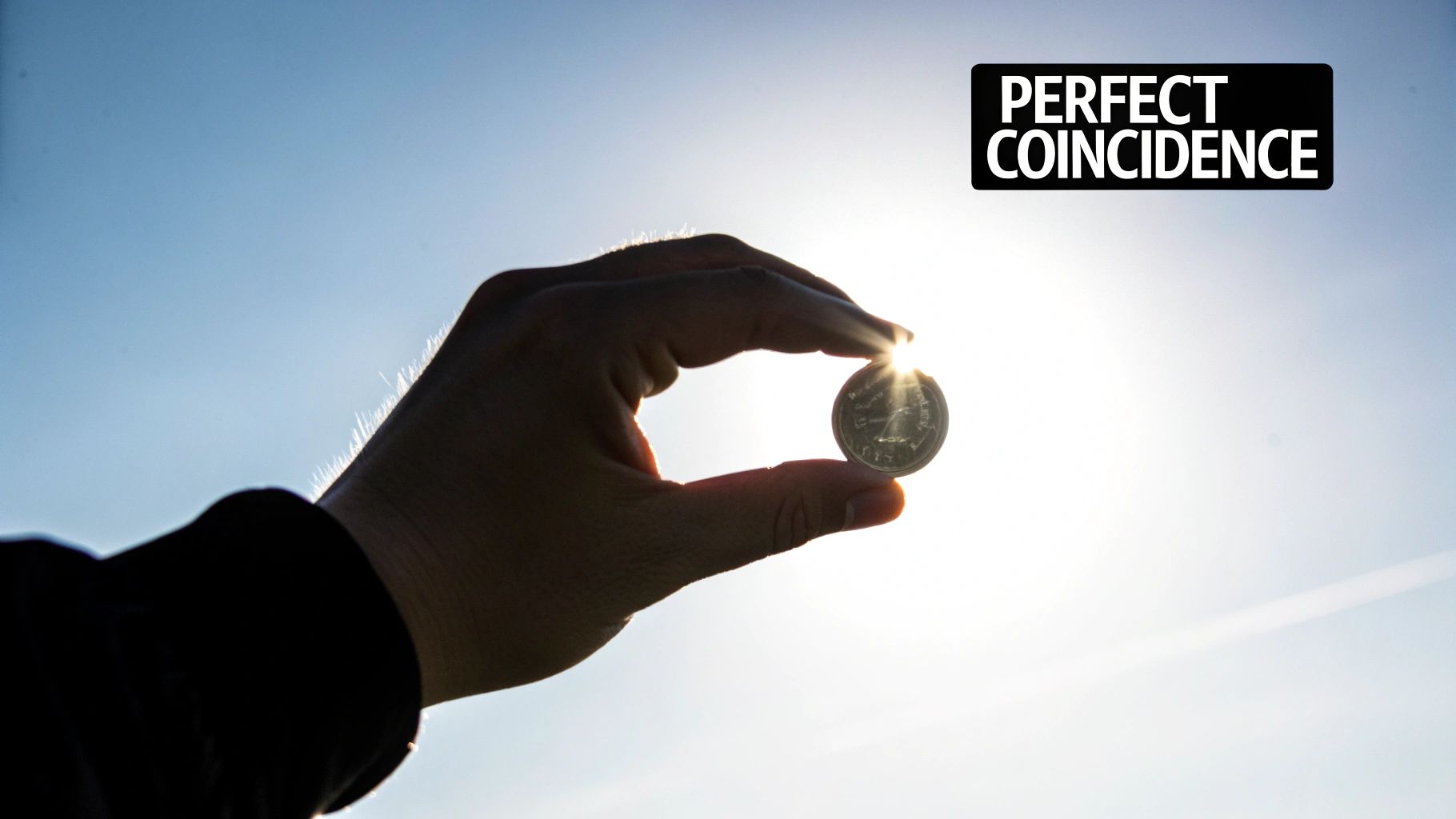
The Sun is enormous—about 400 times wider than our little Moon. But here’s the jaw-dropping part: it’s also about 400 times farther away. This incredible fluke of nature means that from our viewpoint here on Earth, they appear to be almost the exact same size in the sky.
Try This Fun Size Trick
You can see this amazing effect for yourself right now. It’s a brilliant way to understand this cosmic coincidence with your own eyes.
- Find a small object, like a five pence coin or even your own thumb.
- Now find a much larger object that’s far away, like a clock on the wall or a car parked down the street.
- Close one eye and hold the small coin up close to your open eye.
- Can you move it around until it perfectly covers the big object in the distance?
Just like your coin blocks the distant clock, our nearby Moon can completely block the faraway Sun. It’s this ‘just right’ positioning that makes a total solar eclipse possible, creating an unforgettable sight for those lucky enough to be in the Moon’s shadow.
A Giant Clockwork Universe
Because the Earth and Moon travel on such steady, predictable paths, scientists can work out exactly when and where eclipses will happen, sometimes centuries in advance! The universe works like a giant, beautiful clock, with every planet and moon moving in a precise and reliable dance.
This precision is truly awesome. The mechanics of why solar eclipses happen are perfectly mathematical and absolutely mind-blowing! This incredible accuracy allowed the famous astronomer Edmund Halley to predict the 3 May 1715 total eclipse in London to within just four minutes of its actual time. During the 11 August 1999 eclipse over Cornwall, observers saw temperatures drop and birds fell silent as daylight turned grey.
Sadly for many in the UK, the next total eclipse won't arrive until 23 September 2090, making these rare events a true once-in-a-lifetime experience. To learn more, you can read about the fascinating history of solar eclipses visible from the British Isles.
The Moon’s darkest shadow, called the umbra, races across Earth’s surface during an eclipse at incredible speeds—sometimes over 1,000 kilometres per hour!
This predictable motion isn't just a fun fact; it helps us understand the fundamental rules that govern our solar system. For anyone wanting to explore more cosmic wonders, you can find a universe of stories in the Space Ranger Fred books, which bring these amazing ideas to life. This cosmic clockwork is what makes our universe so orderly and so exciting to study.
Why Don't We Get an Eclipse Every Month?
This is a brilliant question, and one that even the most seasoned Space Rangers puzzle over. If the Moon zips around the Earth every single month, why don’t we get a jaw-dropping solar eclipse each time it passes between us and the Sun? It seems logical, right?
The secret to this cosmic puzzle is all down to a tiny wobble.
You see, the Moon’s journey around the Earth isn’t perfectly flat. Its orbit is actually slightly tilted by about 5 degrees.
Imagine the Earth is a marble spinning in the middle of a perfectly flat dinner plate. That plate represents Earth's path around the Sun. Now, imagine the Moon's path is a smaller plate, but it's tipped up slightly on one side. That’s the tilt we’re talking about.
Most of the time, when the Moon is in its new moon phase (passing between us and the Sun), that little tilt means its shadow completely misses us. It either sails just over our heads or skims just underneath us out in the darkness of space. A solar eclipse only happens on those very special, rare occasions when the Sun, Moon, and Earth line up perfectly.
Try This Tilted Orbit Activity
Here’s a fantastic way to see this cosmic wobble in action. You can try this right now at home or in the classroom to solve the mystery for yourself!
All you need are three things:
- A lamp (The Sun): Pop a lamp without a shade in the corner of a dark room.
- Your head (The Earth): You get to be planet Earth for this experiment!
- A small ball (The Moon): A tennis ball or even an orange works perfectly.
Right, stand in the middle of the room so the lamp is shining on your face. Hold the small ball out in front of you – this is your Moon. Now, slowly begin to move the ‘Moon’ in a circle around your head, just like the real one orbits Earth.
As you circle it, keep its path totally flat and level with your eyes. What happens? You’ll probably notice the ball blocks the lamplight every single time it passes in front of you, casting a shadow on your face. If the Moon’s orbit was flat, this is exactly what would happen in real life—an eclipse every month!
Adding the All-Important Tilt
Now, let’s add that crucial wobble. As you circle the ‘Moon’ around your head again, this time tilt its path slightly. Sometimes the ball should be a little above your head, and sometimes a little below.
What do you notice now? The ball’s shadow almost always misses your eyes, doesn't it? It passes over the top of your head or below your chin. It’s only when the ball happens to be at the exact same level as your eyes that it creates an eclipse.
This simple experiment shows what causes solar eclipses to be so rare. They can only happen during an "eclipse season"—those special twice-a-year moments when the Earth, the tilted Moon, and the Sun fall into a perfect line.
Understanding this tilt is the key to figuring out the patterns of both solar and lunar eclipses, which you can learn more about in our simple guide to the phases of the Moon for kids.
Understanding the Different Kinds of Solar Eclipses
Just like there are different flavours of ice cream, solar eclipses come in a few different kinds too! Each one is an absolutely spectacular show, but they all look a bit different depending on how perfectly the Sun, Moon, and Earth happen to line up.
Think of it like this: an eclipse is all about the Moon’s shadow falling on Earth. But shadows aren't just simple dark patches; they have a really dark bit in the middle and a lighter, fuzzier bit around the edges. Getting your head around these shadow parts is the key to understanding why we get different kinds of solar eclipses.
The Two Parts of the Moon’s Shadow
Imagine you’re standing under a giant beach umbrella on a sunny day. Right under the very centre of it, the shadow is deep and dark. But as you move towards the edge, the shadow gets lighter, doesn’t it?
The Moon’s shadow works in exactly the same way. It has two parts:
- The Umbra: This is the dark, inner part of the shadow, just like the bit right under the middle of that umbrella. If you're lucky enough to be standing in the umbra’s path on Earth, you will see a total solar eclipse!
- The Penumbra: This is the fainter, much larger outer shadow. If you’re in the penumbra, you’ll see a partial solar eclipse, where the Moon seems to take a bite out of the Sun.
This simple idea of light and dark shadows helps explain the three main types of eclipses we get to see from our amazing planet. Solar eclipses can be a bit confusing, so here’s a quick guide to tell them apart.
Your Guide to the Types of Solar Eclipses
| Type of Eclipse | What You See in the Sky | Why It Happens |
|---|---|---|
| Total | The Moon completely blocks the Sun, revealing its faint outer atmosphere (the corona). | You are in the direct path of the Moon's darkest, central shadow, the umbra. |
| Partial | It looks like a "bite" has been taken out of the Sun. | You are in the Moon's fainter, outer shadow, the penumbra. |
| Annular | A bright ring of sunlight shines around the dark silhouette of the Moon. | The Moon is at its farthest point from Earth and appears too small to completely cover the Sun. |
Each type offers a unique and incredible view of our solar system in action.
Total Solar Eclipse: The Superstar
A total solar eclipse is the most famous and dramatic of them all. This is the big one that people travel all over the world to see!
It happens when the Moon lines up absolutely perfectly with the Sun, completely blocking its bright face. For a few incredible minutes, the day turns into a deep twilight, the temperature can drop, and you might even see the Sun’s wispy outer atmosphere, called the corona. This is only possible if you are standing right in the path of the Moon’s dark inner shadow, the umbra.
Partial Solar Eclipse: A Cosmic Bite
A partial solar eclipse is much more common and can be seen over a much wider area of Earth. This is what happens when you are standing in the Moon’s lighter outer shadow, the penumbra.
From your point of view, the Sun, Moon, and Earth aren't in a perfectly straight line. The Moon passes in front of the Sun but doesn't completely cover it. It ends up looking like the Moon has taken a little bite out of the Sun.
This diagram shows how the Moon's tilted orbit means its shadow usually misses Earth, but when they align just right, an eclipse can occur.
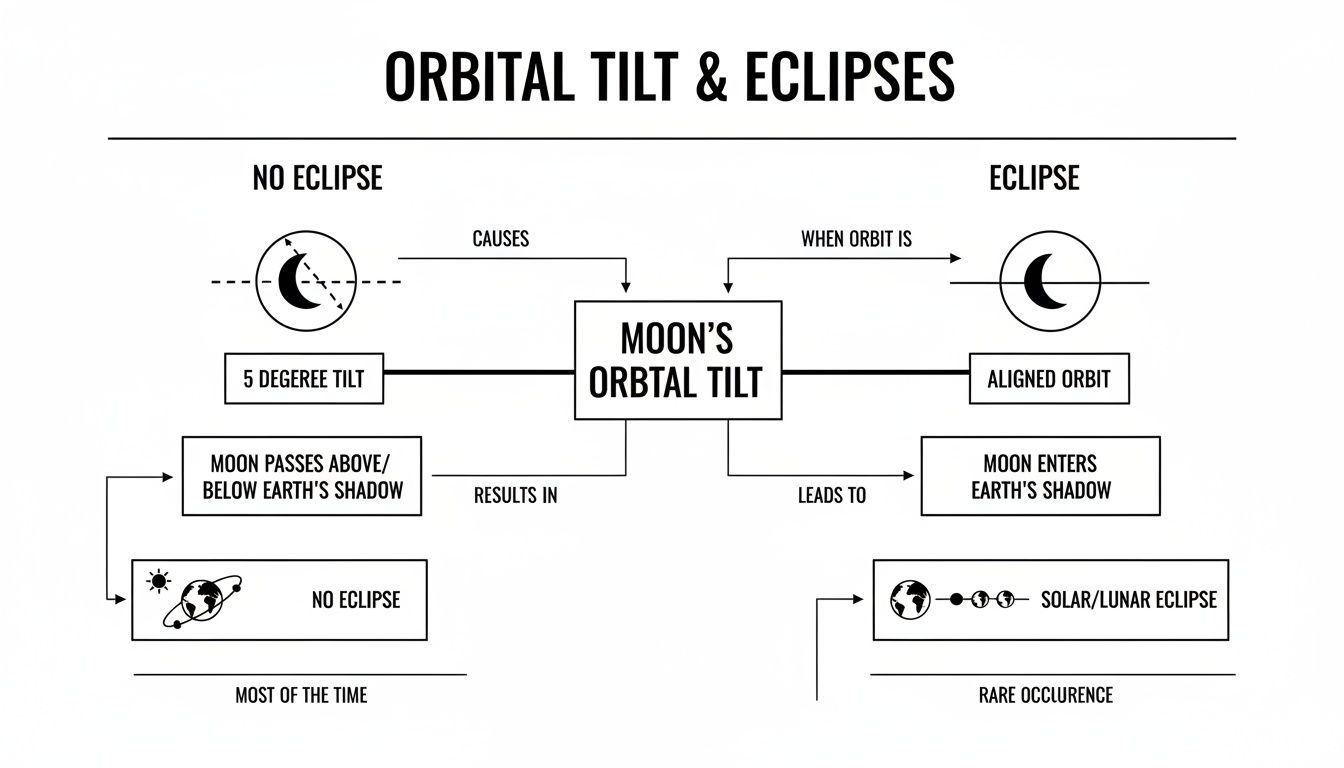
It helps us see that only when the Moon's tilted path crosses the Sun-Earth plane at the perfect time do we get these amazing celestial events.
Annular Solar Eclipse: The Ring of Fire
An annular solar eclipse is a very special and beautiful type of partial eclipse. It happens when the Moon passes directly in front of the Sun, but it’s just a bit too far away from Earth in its orbit to completely cover it up.
Because it’s farther away, the Moon appears slightly smaller in our sky. Instead of blocking the Sun entirely, it leaves a bright, fiery ring of sunlight visible around its edges. This is famously known as the "ring of fire"!
Each type of eclipse gives us a different view of the amazing dance between our Moon and Sun. Exploring these incredible events is part of the fun of being a Space Ranger, and you can find more cosmic adventures in the Space Ranger Fred books. For more fun things to try, check out our free activities page for awesome space-themed projects.
How to Watch a Solar Eclipse Safely
Watching a solar eclipse is a jaw-dropping moment, but Space Ranger Fred has one mission rule that you absolutely cannot forget: never, ever look directly at the Sun! Even when it’s partly hidden, the Sun’s intense rays can cause serious damage to your eyes, and you won’t even feel it happening. But don’t let that put you off! With a little bit of science and some clever kit, you can enjoy the whole spectacular show from start to finish.
Why Your Sunglasses Are Not Enough
Those cool shades you wear on a sunny day? They’re no match for an eclipse. Even the darkest sunglasses don’t block out the invisible (and dangerous) ultraviolet and infrared rays that can permanently harm your vision. The same goes for peeking through a camera, binoculars, or a telescope—unless you’ve fitted a special-purpose solar filter onto the front end.
It's super important to use only certified solar eclipse glasses or viewers. Before you use them, check that they meet the international safety standard, which should be printed somewhere on the glasses themselves. These things are literally thousands of times darker than regular sunnies. Using the wrong gear is a big no-no, so being prepared is key. And when it's not an eclipse, you can find out more about how to use telescopes safely to explore the amazing night sky.
Make Your Own Pinhole Projector: A Fun STEM Activity
One of the safest and coolest ways to watch an eclipse is by making a pinhole projector. It’s a brilliant hands-on activity that cleverly demonstrates how light travels in straight lines. The best part? You’re not looking at the Sun, but at a live projection of it!
Here’s how you can make a simple one with two bits of card.
- Get Your Equipment: Grab two pieces of stiff white card (or even a couple of paper plates) and a pin or a straightened paperclip.
- Make the Pinhole: Take one piece of card and carefully poke a small, neat, round hole right in the centre. That’s your projector!
- Set Up for Viewing: Head outside and stand with your back to the Sun. Hold the card with the pinhole up over your shoulder so it catches the sunlight.
- Project the Image: Hold up the second piece of card in front of you—this is your screen. Jiggle the projector card around until a small circle of light appears on your screen. That little dot is a live image of the Sun!
- Watch the Eclipse: As the Moon starts its journey across the Sun, you’ll see its shadow take a "bite" out of your projected image. It’s a completely safe and fascinating way to watch the event unfold.
Try a little experiment! What happens to the Sun’s image when you move the screen card further away from the projector? Does the spot of light get bigger or smaller? Clearer or fuzzier? You’re doing real science, right there in your garden!
Create a Super Pinhole Projector Box
For an even sharper and more stable image, you can upgrade your setup by turning a long cardboard box into a proper projector. This is a fantastic project for a classroom or the whole family.
- Step 1: Cut a small, square hole at one end of the box.
- Step 2: Tape a piece of kitchen foil neatly over this hole, then poke a tiny, clean pinhole in the centre of the foil.
- Step 3: On the inside of the box, at the opposite end, tape a piece of white paper. This will be your screen.
- Step 4: Cut a larger viewing hole in the side of the box, near the white paper screen, so you can pop your head in and see what's happening.
To use it, just stand with your back to the Sun and point the pinhole end towards it. The sunlight will stream through that tiny hole and project a perfectly clear, safe-to-view image of the eclipse onto the screen inside.
For a downloadable guide and more brilliant projects, be sure to check out our free activities page. It’s bursting with awesome ideas for all our young Space Rangers.
Your Guide to Upcoming Eclipses and Fun Activities
Right, you’re now a certified eclipse expert! It’s time to get ready for some real-life sky-watching. Even though a total solar eclipse is an incredibly rare treat here in the UK, we're lucky to have some fantastic partial eclipses on the horizon. Trust me, seeing the Moon take a bite out of the Sun is still one of the most amazing sights you’ll ever witness.
This guide will help you prepare for these brilliant cosmic events. Getting ready to be an astronomer is all part of the fun, turning a few minutes of sky-gazing into a proper adventure. It’s a chance to use everything you’ve just learned about what causes solar eclipses and see it happen right before your eyes.
Become an Eclipse Explorer
You don't need to wait for a total eclipse to kick off your journey as a Space Ranger. A partial eclipse is the perfect opportunity to see the cosmic dance of the Sun and Moon for yourself. It’s an awesome experience that reminds us just how incredible our solar system really is.
Looking ahead, the UK is in for some spectacular partial solar eclipse shows. On 12 August 2026, we'll see one of the decade's most impressive partial eclipses. Some lucky viewers in the Scilly Isles will see an extraordinary 96% of the Sun blocked! That's almost enough to make the day feel like twilight. This will be followed by another great partial eclipse on 2 August 2027, visible across the entire country. To find out more about these fantastic sky-watching opportunities, you can learn all about UK eclipses from Sky at Night Magazine.
Remember, even during a partial eclipse, you must use safe viewing methods like a pinhole projector. The Sun's rays are still incredibly powerful, even when partly covered.
These events are perfect for getting hands-on with science and making your learning come alive. Preparing for an eclipse is a mission in itself!
Your Eclipse Mission Activities
Here are some brilliant and fun ways to get ready for the next eclipse. These activities are perfect for the classroom or at home, helping you become an active astronomer.
-
Create an Eclipse Diary: Grab a special notebook and dedicate it to your sky-watching adventures. Before the eclipse, write down what you think will happen. On the day, draw what you see through your pinhole projector at different times. How does the "bite" out of the Sun change shape? Afterwards, write about what it was like!
-
Write an Eclipse Story: Imagine you're Space Ranger Fred on a mission during a solar eclipse. What happens? Does your spaceship get caught in the Moon's shadow? Do you meet any strange creatures who only come out when the sky goes dark? Let your imagination blast off!
-
Build a Family Eclipse Kit: Work together to gather everything you'll need for the big day. This could include your homemade pinhole projector, your eclipse diary, a flask of hot chocolate, and some cosmic snacks. Having a kit makes the day feel like a special expedition.
These activities don't just teach you about space; they get you asking questions, telling stories, and solving problems. Every observation you make is real science in action. For more amazing space adventures and to continue your journey, why not check out our blog post about the phases of the Moon?
Your Top Eclipse Questions Answered
Even with all this new knowledge, it’s normal to have a few more questions rattling around. After all, space is a big place! Let's tackle some of the most common cosmic curiosities we hear from our Space Rangers.
How Long Does a Total Solar Eclipse Actually Last?
Great question! The part everyone gets most excited about, called totality—when the Sun is completely hidden—is surprisingly short. In any one place, it typically only lasts for a few minutes. The longest it can possibly last is about seven and a half minutes.
But the entire celestial show, from the moment the Moon takes its first "bite" out of the Sun until it has moved completely past, takes a few hours. That gives you plenty of time to set up your pinhole projector and watch the magic unfold without rushing.
Do Animals Act a Bit Peculiar During an Eclipse?
They absolutely can! When the sky suddenly darkens and the air cools down during a total eclipse, some animals get confused, thinking it’s bedtime. It's a brilliant real-world example of how much life on Earth relies on the Sun's light and warmth.
You might spot some of these funny behaviours:
- Birds often stop singing and begin flying back to their nests to roost for the "night."
- Busy bees have been observed to stop buzzing around and return to their hives.
- Cows and other farm animals might even start making their way back to the barn, thinking the day is over.
What's the Difference Between a Solar and a Lunar Eclipse?
It's super easy to get these two mixed up! The trick is to remember which object is having its light blocked from our view here on Earth. A solar eclipse is all about the Sun, and a lunar eclipse is all about the Moon.
A simple way to remember is: a SOLar eclipse blocks our view of the SOL (Sun), and a LUNar eclipse involves our view of the LUNA (Moon).
A solar eclipse is when the Moon passes between the Sun and Earth (Sun-Moon-Earth), casting its shadow on our planet. A lunar eclipse is the other way around. It happens when the Earth gets right in between the Sun and the Moon (Sun-Earth-Moon), and Earth's huge shadow covers the Moon, often making it glow a spooky red colour.
The universe is packed with incredible science and amazing adventures just waiting for you to discover. Keep looking up, keep asking questions, and never stop exploring! For more exciting stories and STEM activities, blast off into the world of Space Ranger Fred and find your next mission at https://spacerangerfred.com.