
Have you ever seen a bright streak of light dash across the night sky and wondered what it was? Chances are, you spotted a comet! People often call them ‘dirty snowballs’, and honestly, that’s a pretty good description. They're giant, ancient chunks of ice, dust, and rock that cruise through our solar system, putting on incredible shows for us back on Earth.
Ready to find out more? Let’s blast off!
A Recipe for a Cosmic Snowball

Imagine we’re in a cosmic kitchen, getting ready to bake a very special space-cake. To understand what comets are truly made of, let’s look at the recipe. The ingredients are simple, but they come from the coldest, farthest-flung corners of our solar system.
The heart of every comet is its nucleus—the solid, frozen core that holds everything together. Think of it as a giant, lumpy snowball that has been packed tight over billions of years. To make one, you’d need just a few special things.
The Main Ingredients
First off, every good comet needs lots of ice. But this isn’t just the frozen water you get from your freezer at home. Comets are a mix of different frozen materials, including:
- Water Ice: This is the most common ingredient, just like the ice cubes you put in a drink. Simple H₂O, but frozen solid.
- Frozen Gases: Picture the gas that makes your fizzy drinks bubble (carbon dioxide) or even methane. In the freezing depths of space, these gases turn into solid ice.
- Dust and Rock: Now for the ‘dirty’ part! We need to mix in a generous amount of cosmic dust, which is made of tiny mineral bits called silicates. We’ll also toss in some small pieces of rock and grit to give it that classic comet texture.
Once you squash all these ingredients together, you get a dark, frozen lump that can be several kilometres wide. This cosmic snowball stays completely frozen as it drifts through the chilly outer reaches of the solar system.
A Comet's Cosmic Recipe
Here’s a quick summary of the main ingredients that make up a typical comet, explained simply for all our young Space Rangers.
| Ingredient | What It Is | Why It Matters |
|---|---|---|
| Water Ice | Just like the ice in your freezer, but in space! | It's the main building block that holds everything together. |
| Frozen Gases | Gases like carbon dioxide and methane, frozen solid. | When heated by the Sun, these turn into gas and create the comet's glowing atmosphere. |
| Dust & Rock | Tiny particles of minerals (silicates) and small rocks. | This is the 'dirty' part that makes the nucleus dark and provides material for the dust tail. |
| Organic Molecules | Complex carbon-based materials—the building blocks of life! | Scientists are excited about these as they might hold clues about how life started on Earth. |
These simple ingredients come together to create some of the most spectacular sights in our solar system.
Fun Fact: The nucleus of a comet is one of the darkest objects you can find in space! Its dusty, rocky surface absorbs most of the sunlight that hits it, making it even darker than a lump of coal.
Comets are truly fascinating space travellers, but they're not the only rocky objects whizzing around out there. To discover how they differ from their cosmic cousins, you can learn all about what asteroids are in our other guide. Knowing the difference will make you a real space expert!
Next up, we’ll explore what happens when this chilly cosmic snowball ventures a little closer to the Sun.
Exploring the Anatomy of a Comet
Alright, we know comets are basically giant, dirty snowballs hurtling through space. But let's grab Space Ranger Fred's super-telescope and zoom in for a proper look. A comet isn't just one solid lump; it’s made up of several different parts that all work together to create that spectacular streak of light we see from Earth.
Each part has its own name and a really important job, especially as the comet gets cosier with the Sun.
The Three Main Parts of a Comet
To get a handle on what makes a comet tick, let's break down its three main components. Each one plays a unique role in the comet's cosmic journey.
| Comet Part | What It's Made Of | Fun Fact |
|---|---|---|
| Nucleus | A solid core of ice, dust, and rock, all frozen together. | It's one of the darkest objects in our solar system—often blacker than coal! |
| Coma | A fuzzy cloud of gas and dust that forms around the nucleus. | It can grow bigger than entire planets, like Jupiter, making the comet look hazy and bright. |
| Tails | Long streamers of gas and dust pushed away from the comet by the Sun. | Most comets actually have two tails—a blue gas tail and a white dust tail. |
Now that we've got the basics, let's explore each part a little more closely.
The Nucleus: The Icy Heart
Right at the very centre of every single comet is the nucleus. This is the solid, frozen bit—the main ‘snowball’ we've been talking about. It’s a lumpy, jagged chunk made of water ice, frozen gases, dust, and chunks of rock all mashed together.
A nucleus can be pretty small, maybe just a few kilometres across, or it can be as big as a small town. When a comet is floating around in the coldest, most distant parts of space, the nucleus is all you'd see. It’s like a sleeping giant waiting for its big journey towards the Sun.
The Coma: The Glowing Cloud
As a comet gets closer and closer to the Sun, things start to get really exciting! The Sun’s warmth begins to heat up the nucleus, causing the frozen ices to skip being a liquid and turn straight into a gas. This amazing process is called sublimation.
This gas, along with all the dust it kicks up from the nucleus, forms a massive, fuzzy cloud around the centre. This cloud is called the coma. The coma can swell up to be absolutely enormous—sometimes even bigger than a planet like Jupiter! It's this glowing cloud that gives a comet its hazy, bright appearance in the night sky. It's almost like the comet suddenly grows its own temporary atmosphere!
The Tails: The Famous Streamers
The most iconic parts of a comet are, without a doubt, its magnificent tails. These streamers can stretch for millions of kilometres across the blackness of space. It's a common mistake to think the tails trail behind the comet like hair in the wind, but they are actually pushed away from the comet by the Sun's energy.
And here's a cool secret: most comets don't just have one tail, they have two!
- The Gas Tail (or Ion Tail): This tail is made of gases that have been zapped with energy by the Sun, causing them to glow a brilliant blue. It always points directly away from the Sun, pushed back by a constant stream of solar wind.
- The Dust Tail: Made of tiny bits of dust that have escaped from the nucleus, this tail is broader, whiter, and often has a gentle curve to it. It’s like a trail of cosmic breadcrumbs tracing the comet's orbital path.
Those little bits of dust left behind by comets are responsible for some incredible sights back on Earth. To find out how these tiny specks create dazzling light shows, check out our guide on what causes meteor showers.
Scientists have sent brave spacecraft on missions to study these parts up close. A famous example is the European Space Agency's Giotto mission, which flew right past Halley’s Comet back in 1986. It got close enough to discover that Halley's nucleus was about 15 kilometres long and was made of roughly 80% dust and 20% ice, proving they really are ‘dirty snowballs’! You can learn more about this historic mission at the British Astronomical Association.
What’s Really Inside a Comet?
Alright, Space Rangers, let's put on our imaginary science goggles and zoom right into a comet's core. We already know the nucleus is the solid, frozen heart of a comet, but what’s actually packed inside that "dirty snowball"? The recipe is a little more complex than just ice and dust!
The number one ingredient is plain old water ice, just like the stuff in your freezer. But it’s not alone. It's all mixed in with a bunch of other frozen gases that might sound surprisingly familiar.
This cosmic jumble of simple things is what makes comets so fascinating.
More Than Just Water
Alongside all that frozen water, a comet's core is a cocktail of other icy materials. These are gases we have right here on Earth, but out in the freezing darkness of space, they're frozen solid.
- Frozen Carbon Dioxide: This is the exact same gas that puts the fizz in your favourite fizzy drinks! In the cold of space, it becomes a solid known as 'dry ice'.
- Frozen Ammonia: You might recognise the strong, sharp smell of ammonia from cleaning products at home. In a comet, it’s just another frozen ingredient in the mix.
- Frozen Methane: Methane is a common gas on our planet, but inside a comet's nucleus, it's frozen solid, adding to the icy slush.
All these different ices are mashed together with tiny bits of rock and heaps of dust. A lot of this dust is made from special space minerals called silicates, which are a big reason why the nucleus has that dark, dirty look.
This simple diagram shows how all these parts work together when a comet swings by the Sun.
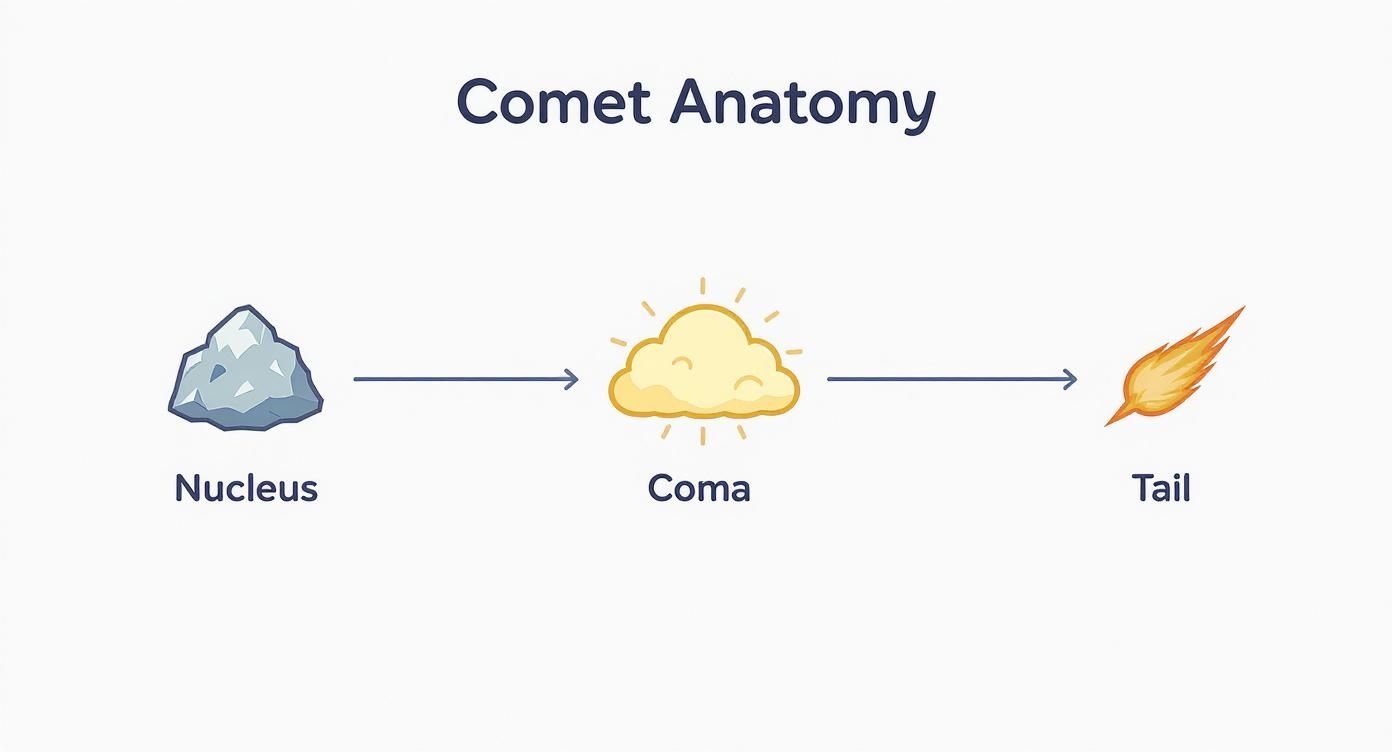
As you can see, it all starts with that solid nucleus. Once it heats up, it creates the glowing coma and those magnificent tails we see from Earth.
The Most Mind-Blowing Ingredient
Okay, now for the really cool part. Perhaps the most exciting ingredient hiding inside a comet's core is something called organic molecules. Don't worry, this doesn't mean little green aliens! In science, 'organic' just means the molecules are built around the element carbon.
And carbon is a super-important building block for every living thing on Earth, including you and me.
Finding these carbon-based building blocks of life inside comets is a huge deal for scientists. It gets them thinking… could comets have delivered these key ingredients to a very young Earth billions of years ago, helping to kick-start life itself?
It's one of space's most wonderful puzzles! And if you fancy solving more cosmic mysteries, you can find loads of fun missions on our activities page, perfect for curious explorers.
How Scientists Discover What Comets Are Made Of
It’s one thing to say a comet is made of ice and dust, but how do scientists actually know this for sure? After all, these cosmic snowballs are zipping through space millions of kilometres away! Let's put on our space detective hats and uncover the clever tools and incredible missions that help us solve these cosmic mysteries.
The first tool in our detective kit is the humble telescope. Scientists use huge, powerful telescopes, both on Earth and floating in space (like the famous Hubble Space Telescope), to get a really good look at comets as they fly past. These amazing instruments can see the fuzzy coma and those long, flowing tails in incredible detail.
But just looking isn’t quite enough to figure out what a comet is made of. For that, scientists attach a special tool to their telescopes called a spectroscope.
Cracking the Comet Code with Light
A spectroscope might sound complicated, but it works a bit like a prism. You know how when sunlight shines through a prism, it splits the light into all the colours of the rainbow? A spectroscope does the exact same thing with the light that bounces off a comet.
When the comet's light is split into this rainbow—called a spectrum—scientists notice something peculiar: certain colours are missing. These missing bits show up as dark lines, almost like a secret barcode written in light.
Every material, whether it’s water ice, carbon dioxide, or a specific type of rock dust, creates its own unique barcode pattern. By reading this pattern, scientists can tell exactly what ingredients are swirling in the comet's coma and tails, all without ever leaving Earth!
This technique is incredibly powerful. For instance, scientific institutions in the UK use spectroscopy to study comets, and their work shows that water ice is the main ingredient, making up about 80% of the frozen stuff. You can explore the history of UK comet research to see how they've been decoding these messages from space for years.
Sending Robots on a Cosmic Adventure
Sometimes, the best way to learn about something is to go and visit it! Since we can't send people that far out into space, we send super-smart robots instead. These spacecraft missions have given us our closest and most mind-blowing views of comets.
One of the most famous missions ever was the European Space Agency's Rosetta spacecraft. This incredible explorer didn't just fly by a comet—it travelled alongside one for years! Rosetta studied Comet 67P/Churyumov–Gerasimenko up close, sending back amazing pictures and data that left scientists speechless.
The mission even had a thrilling finale when it sent a little lander called Philae right down to the comet's surface. It was the very first time we had ever landed on a comet! This mission taught us so much about the dusty, icy, and surprisingly lumpy surface of a comet's nucleus. If you're curious about these robotic explorers, you can discover more about them in our guide that asks what is a space probe.
Meeting the Most Famous Comets in Our Solar System
Some comets are like space celebrities! They become famous for their spectacular appearances and the incredible secrets they help us uncover. Let’s meet a few of these cosmic superstars who have wowed stargazers for centuries.

First up is the most famous of them all: Halley’s Comet. This incredible visitor has been spotted in our skies for thousands of years. It wasn’t until 1705 that an English astronomer named Edmond Halley figured out its big secret. He realised that the comets seen in 1531, 1607, and 1682 were actually the very same object, coming back again and again!
This discovery made Halley’s Comet the first known periodic comet—one that follows a regular, predictable orbit around the Sun. It swings by Earth roughly every 75–76 years, making it a once-in-a-lifetime sight for most of us.
When it last visited in 1986, spacecraft got a closer look and found its nucleus was incredibly dark, made of about 80% dust and 20% ice. It was a brilliant bit of detective work that confirmed exactly what these icy travellers are made of. You can discover more about this legendary comet’s history and how it changed astronomy forever.
Recent Celestial Superstars
While Halley’s is a legend, we’ve had some more recent visitors that have really captured our imaginations.
One of the brightest was Comet Hale-Bopp, which put on a truly dazzling show back in 1997. It was so brilliant you could see it without a telescope for an incredible 18 months. That’s longer than any other comet in recorded history! Many of your parents and teachers might even remember spotting its magnificent twin tails lighting up the night sky.
Then there’s Comet 67P/Churyumov–Gerasimenko (let's just call it 67P). This one isn't famous for being bright, but for having a very special visitor! The European Space Agency’s Rosetta spacecraft spent two whole years orbiting this lumpy, duck-shaped comet, giving us our closest-ever look at one of these ancient, icy worlds.
Rosetta’s mission was a total game-changer! It showed us that 67P’s surface is covered in dark, organic dust and that its ice contains different kinds of water from what we have on Earth. These famous comets are like cosmic history books, and each one tells us a new story about our solar system.
Learning about these real-life space visitors is almost as thrilling as joining Space Ranger Fred on his own adventures! You can blast off on a new mission by checking out the exciting tales in our Space Ranger Fred books.
Fun Comet Activities for Kids
Alright, time to roll up our sleeves and get our hands dirty… or maybe just a little sticky! After all that learning, are you ready to become a proper comet explorer?
These activities are a brilliant way to bring all that cosmic science right down to Earth. Let’s get stuck in!
Make an Edible Comet
What’s a better way to get to know a comet’s ingredients than by making one you can eat? This is a super delicious way to wrap your head around that ‘dirty snowball’ idea.
Here’s what you’ll need:
- A big scoop of vanilla ice cream (this is your icy nucleus!)
- Some crushed-up biscuits or chocolatey cereal (for all the cosmic dust and rock)
- A drizzle of chocolate or caramel sauce (for those sticky organic molecules)
- A sprinkle of coconut flakes (for that extra icy sparkle)
Instructions:
- Pop your scoop of ice cream in a bowl—that’s your comet's frozen nucleus.
- Now, sprinkle the crushed biscuits all over it. See? The ice is all mixed up with loads of dust and rock.
- Next, drizzle the sauce over your creation. This is just like the complex organic materials hiding inside a real comet.
- Finish it off with a dusting of coconut or sprinkles for that extra cosmic glimmer!
And there you have it! A perfect (and perfectly tasty) model of a comet nucleus, showing exactly what those mysterious travellers are made of.
Build a Comet on a Stick
If you fancy a less messy but just as fun project, you can build your very own comet model to zoom around the house.
Just grab a small ball of scrunched-up tin foil for your nucleus. Then, tape some long, sparkly streamers or ribbons to one side. Blue ribbons can be your gas tail, and white or silver ones can be the dust tail. Stick it all on the end of a pencil or a craft stick, and you’re officially ready for launch!
Top Tip for Parents & Teachers: A lot of the 'shooting stars' you spot during a meteor shower are actually tiny bits of dust left behind by a passing comet! When Earth zips through this dusty trail, the specks burn up in our atmosphere and create those beautiful streaks of light across the night sky. This is a great way to link comets to other space phenomena.
To keep the cosmic creativity flowing, why not download a free colouring sheet from our Space Ranger Fred activities page? It’s packed with fun things to do for every budding explorer.
Your Comet Questions Answered
It's brilliant to be curious! Space Ranger Fred is here to tackle some of the biggest questions you might have about our cosmic snowball friends.
Where Do Comets Come From?
Most comets begin their lives in two very, very cold and faraway places right at the edge of our solar system. One is a place called the Oort Cloud, which you can imagine as a giant, icy bubble surrounding everything we know.
The other is the Kuiper Belt, a doughnut-shaped ring of icy worlds floating way out past the planet Neptune. Every now and then, a little gravitational nudge from a passing star or another object can send one of these icy chunks on a long journey towards the Sun. That’s when it starts its transformation into the beautiful comet we see from Earth!
Why Do Comets Have Tails?
A comet only gets its amazing tail when its journey brings it close to the Sun. The Sun’s powerful heat warms up the comet’s icy nucleus, causing the ice to skip the liquid stage and turn straight into a gas. This cool process is called sublimation.
All that escaping gas and dust creates a huge, glowing cloud around the nucleus called the coma. Then, the solar wind—a constant stream of particles blowing from the Sun—pushes this cloud of gas and dust away from the comet, creating those long, spectacular tails we can see streaking across the night sky.
Top Tip: Here’s a mind-bending fact! A comet’s tail doesn’t trail behind it like long hair blowing in the wind. It’s always pushed directly away from the Sun, which means sometimes the tail can actually travel in front of the comet!
What Is the Difference Between a Comet and an Asteroid?
The biggest difference comes down to what they’re made of. Comets are our 'dirty snowballs' – a mix of ice, dust, and rock. It’s the ice that makes them special, because when they get near the Sun, they heat up and form that glowing coma and long tail.
Asteroids, on the other hand, are mostly just rock and metal. Since they don’t have much ice, they don’t usually form tails when they get warm. The easiest way to remember it is: comets are icy, and asteroids are rocky! If you want to become a true space expert, you can learn all about their cosmic cousins in our guide on what asteroids are.
We hope you’ve enjoyed this cosmic journey! The universe is packed with incredible wonders just like comets, all waiting to be discovered. Keep looking up, stay curious, and join Space Ranger Fred for even more exciting adventures across the galaxy. Explore our books, activities, and stories to keep your love for space soaring! Find your next mission at https://spacerangerfred.com.