
For over 70 years, Pluto was famous for being our Solar System's ninth and final planet. But in 2006, scientists gave it a brand-new title: dwarf planet. So, why the change? The simple answer is that Pluto is a bit of a rule-breaker—it hasn't cleared its flight path of other objects as it zips around the Sun.
A Journey from Planet Nine to a New Team
Alright, Rangers, let’s fire up the time machine with Space Ranger Fred! Imagine it’s nearly 100 years ago. Astronomers knew we had eight planets, but they had a hunch another mysterious world, which they called ‘Planet X’, was hiding in the darkness.
Then, in 1930, a patient astronomer named Clyde Tombaugh finally found it! After months of taking pictures of the night sky and comparing them, he spotted a tiny dot of light moving against the faraway stars. Bingo! The world celebrated a new member of our cosmic family.
An 11-year-old girl from England, Venetia Burney, suggested the perfect name: Pluto, after the Roman god of the underworld. It stuck!
For decades, everything was simple. Children in classrooms everywhere learned the names of the nine planets, with little Pluto being the smallest and most distant friend in the group. But as our telescopes got better, our picture of the outer Solar System started to get a whole lot busier.
A Crowded Neighbourhood
Starting in the 1990s, astronomers began spotting other icy worlds hanging out in the same cosmic neighbourhood as Pluto. This chilly, faraway region is known as the Kuiper Belt. All of a sudden, Pluto wasn't so lonely. It looked like it was just one of many similar objects floating in a huge field of cosmic ice-pals.
This discovery sparked a big question: if Pluto is a planet, shouldn't all these other new worlds get to be planets, too? The real tipping point came in 2005 with the discovery of Eris, an object even more massive than Pluto. Our Solar System was about to get a major rethink, leading to a new rulebook for what makes a planet, a planet.
This story isn't about Pluto getting 'demoted'—it's about science making incredible new discoveries and finding better ways to organise our universe. Want to join Fred on his mission to explore our cosmic neighbours? You can in the exciting book, Space Ranger Fred and the Farthest Planet.
The Three Rules for Joining the Planet Club
Imagine our Solar System has a super-exclusive club just for planets. To get a membership card, a cosmic object has to follow three special rules drawn up by a group of top astronomers called the International Astronomical Union (IAU). Think of it as a cosmic checklist!
So, what does it take to get past the velvet rope? It’s as simple as one, two, three.
-
It must orbit the Sun. This one’s a doddle! A planet can’t just zoom around wherever it fancies. It needs to be locked into a set path, travelling around our star, the Sun.
-
It must be (mostly) round. A planet needs to be big enough for its own gravity to pull it into a round, ball-like shape. Scientists call this hydrostatic equilibrium. It’s a bit like squishing a piece of playdough into a ball with your hands—gravity does the same thing, but on a massive scale!
-
It must have cleared its neighbourhood. This is the trickiest rule, and the one that trips Pluto up. A proper planet has to be the gravitational boss of its orbit. It needs to have cleared its path of other big rocks and icy objects, either by hoovering them up or flinging them far away.
This decision tree shows exactly how astronomers check if a cosmic body, like Pluto, makes the grade.
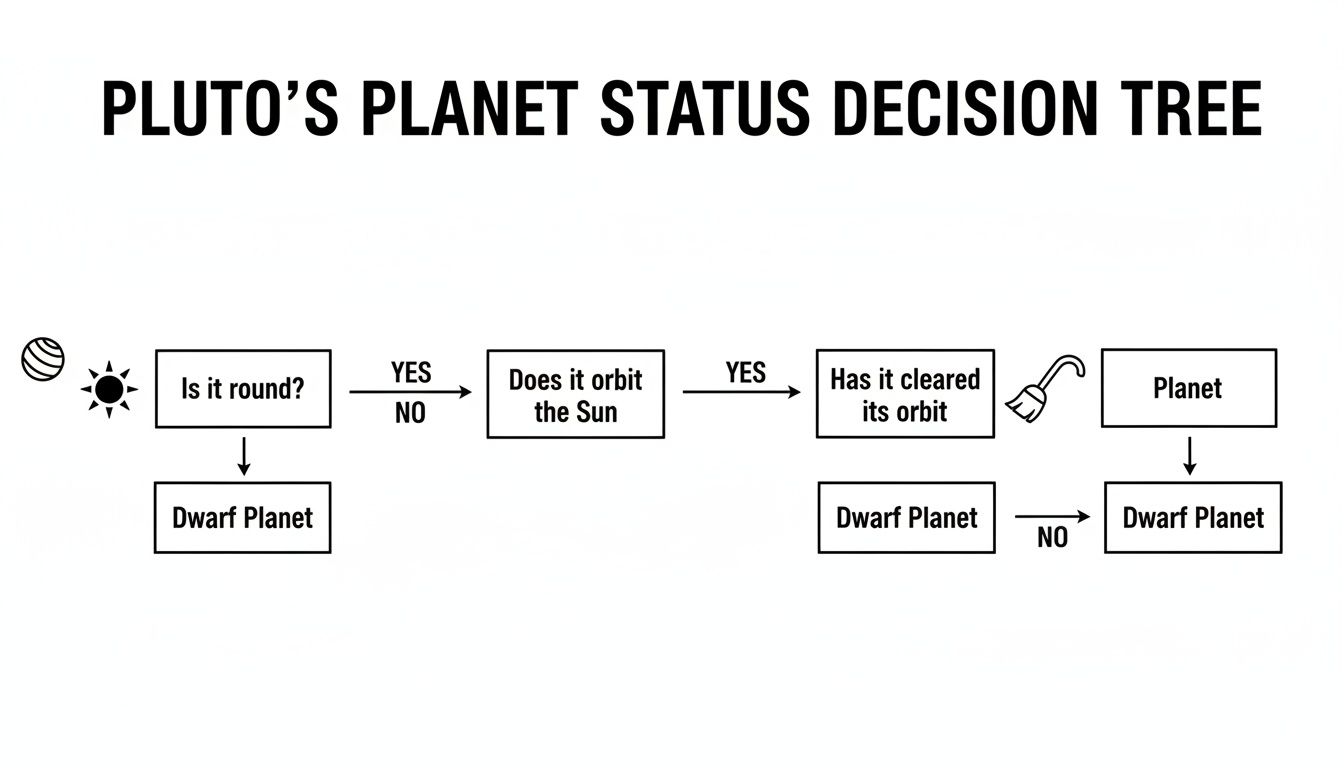
As you can see, Pluto ticks the first two boxes with flying colours. But it fails on that final, crucial step.
The Great Planet Debate
When the IAU voted on these new rules on 24 August 2006, it caused a huge stir! On one hand, it tidied up our view of the Solar System. On the other, a lot of people were pretty sad to see Pluto lose its place in the planet club.
But this big debate sparked a massive learning explosion in schools all over the UK. The Royal Astronomical Society actually saw a 25% jump in children joining astronomy clubs after 2006. It just goes to show how exciting science can be when we all get talking! You can read more about this exciting moment in UK astronomy history from the Royal Astronomical Society.
The new rules didn't just affect Pluto. They gave us a much clearer way to understand what makes a planet, a planet. It’s a brilliant example of how science works—as we learn more, we sometimes need to update our old ideas.
Thinking about what makes up these amazing worlds? You might be interested in our deep dive into what planets are made of.
So, we know Pluto breaks one of the rules. But what does "clearing its neighbourhood" really mean? Let's zoom in and find out.
Why Pluto Fails the Neighbourhood Clean-Up Rule
So, we know Pluto aces the first two planet tests with flying colours. It orbits the Sun? Check! It's a lovely round shape? Double-check! But it’s the third rule—the big neighbourhood clean-up—where Pluto stumbles. This is the main reason why Pluto is not a planet anymore, and it’s a brilliant way to understand how our Solar System is organised.
Let’s imagine you’re building a model Solar System in your bedroom. The big planets, like Earth and Jupiter, are like massive vacuum cleaners. As they formed billions of years ago, their powerful gravity hoovered up or flung away all the other rocks and rubble in their paths, leaving their orbits nice and tidy.
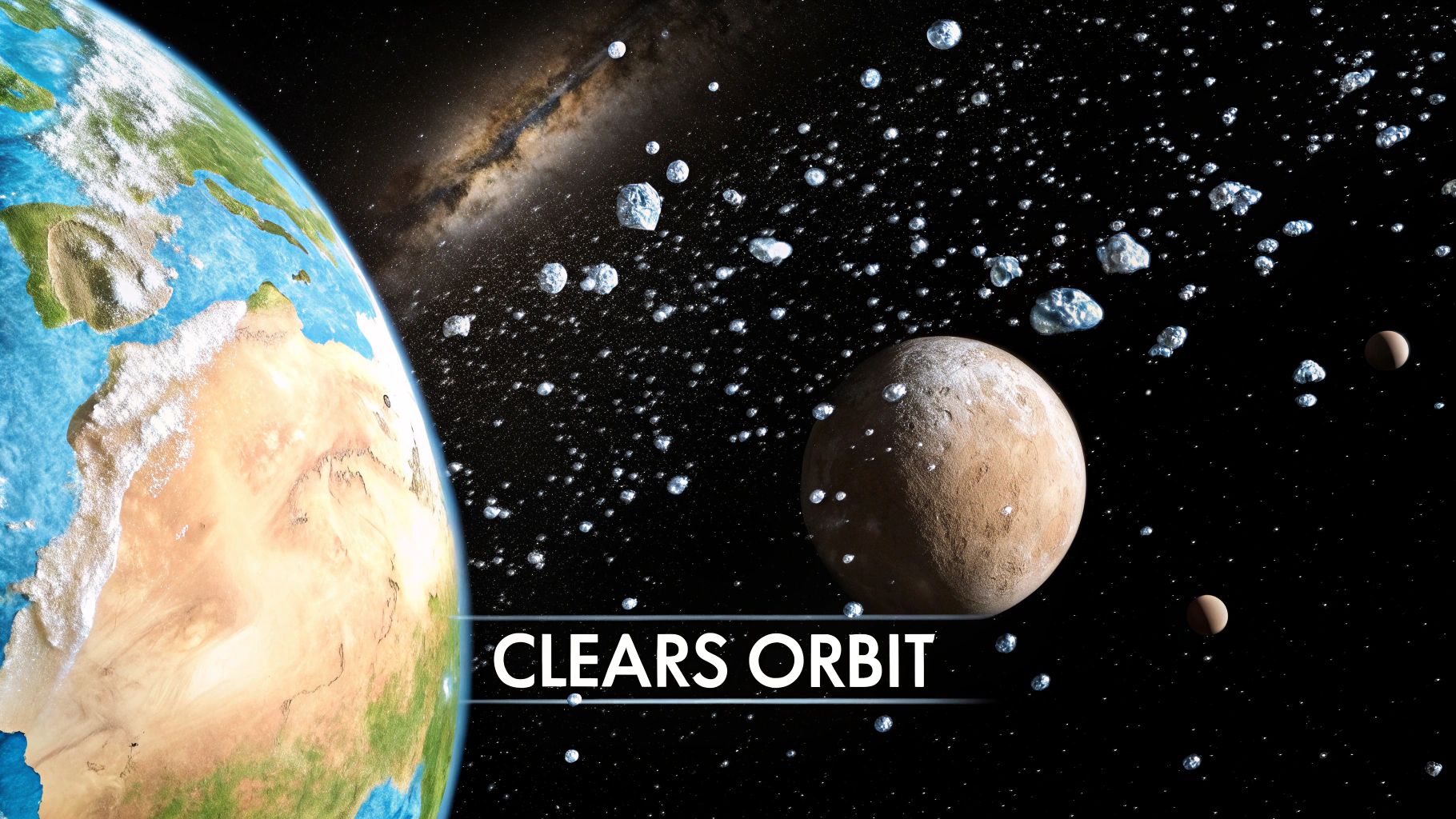
Pluto, however, is more like a small toy car driving through a very busy, messy cosmic traffic jam. It just doesn’t have enough gravitational oomph to be the boss of its own path. Its orbit is full of other icy objects, and some of them are nearly as big as Pluto itself!
A Cosmic Traffic Jam Called the Kuiper Belt
You see, Pluto isn't just floating out there on its own. It’s part of a huge, doughnut-shaped ring of icy bodies beyond Neptune called the Kuiper Belt. Think of it as a giant field of leftover bits and bobs from when our Solar System was first made. There are trillions of objects out there, from tiny ice pebbles to big worlds.
Because Pluto shares its orbital space with all these other objects and isn't big enough to clear them out, it fails that crucial third rule. It’s not the ‘gravitational bully’ of its neighbourhood.
A planet needs to be gravitationally dominant in its orbit. Pluto's mass is only about 0.07 times the mass of all the other objects in its orbit. In contrast, Earth's mass is a whopping 1.7 million times greater than everything else in its path!
This key difference is what separates planets from dwarf planets. It’s not about being small; it’s about being the undisputed king or queen of your cosmic lane. And that’s a job Pluto just can’t do.
The Big Decision in 2006
Imagine you’re Space Ranger Fred on a mission to discover why Pluto lost its planet badge! Back in 2006, a big team of astronomers from around the world decided Pluto wasn't a full planet anymore. Why? Because it didn't clear its cosmic neighbourhood of other rocky neighbours—it's got loads hanging around in the Kuiper Belt. Picture Pluto as a small child who can't boss the playground! You can discover more about this planet-defining moment.
This new understanding helps us see Pluto in a new light. It's not a lonely planet at the edge of our Solar System, but a fascinating member of a huge, bustling community of icy worlds. If this has got you wondering about the amazing force that holds everything together, you should check out our guide on gravity explained for kids.
Meet the Amazing Dwarf Planet Team
When Pluto’s title changed, it wasn't a demotion at all. Think of it more like a promotion to team captain of a whole new squad of cosmic worlds: the dwarf planets! This special category was created to give a proper home to all the other fascinating objects out there just like Pluto.
So, what does it take to join this cool new club? A dwarf planet has to follow the first two planet rules—it must orbit the Sun and be round. But just like Pluto, it hasn't quite managed to clear its path of other objects. It’s not about being small; it’s about sharing your space.
Losing its planet status simply meant that scientists realised Pluto wasn't a lonely wanderer at the edge of our Solar System. Turns out, it's the most famous member of a huge, bustling family of other incredible worlds.
Who Are Pluto’s Teammates?
Pluto is far from being alone! While astronomers think there could be hundreds of dwarf planets just waiting to be discovered, the International Astronomical Union (IAU) officially recognises a handful of them. Each one is a unique and mysterious place.
Let's meet some of the star players on the dwarf planet team:
- Eris: Discovered in 2005, this distant world is a real heavyweight! Eris is slightly smaller than Pluto but is actually more massive, which means it's packed with more rock and ice. Its discovery was the final push astronomers needed to create the dwarf planet category in the first place.
- Ceres: A true trailblazer, Ceres was the very first dwarf planet to be visited by a spacecraft. It’s the biggest object in the asteroid belt between Mars and Jupiter and was once considered a planet itself, way back in the 1800s!
- Haumea: Now, this is one of the strangest objects in our Solar System. It spins so fast—completing a full turn in just four hours—that it's been stretched into the shape of a squashed egg. Haumea also has its own faint ring system.
- Makemake: Another resident of the chilly Kuiper Belt, Makemake is a bright, reddish world that takes over 300 years to make just one trip around the Sun.
By creating the dwarf planet category, scientists gave us a brilliant new way to understand our cosmic backyard. It shows that our Solar System is far more varied and exciting than we ever imagined, with whole families of different objects out there.
These amazing worlds are mostly found in the icy doughnut of space beyond Neptune. To get a better picture of this cosmic neighbourhood, you can learn more about what is the Kuiper Belt in our detailed guide. It's the perfect place to understand why Pluto and its pals all belong together.
Try This! A Fun Planet Sorting Activity
Reading all the rules about what makes a planet is one thing, but getting hands-on is the best way to really understand why Pluto is not a planet. So, it’s your turn to be the astronomer!
These simple activities turn big, cosmic ideas into something small and fun, transforming your classroom or living room into a mini Solar System. Let's bring the 'clearing the neighbourhood' rule to life.
The 'Clear the Orbit' Game
This game is a brilliant, hands-on way to see what it means for a planet to be the gravitational boss of its own path. It’s a playful demonstration of the difference between a planet and a dwarf planet.
What you’ll need:
- A large plate or a circular tray (this will be your ‘orbit’).
- One big marble or a bouncy ball (this is your ‘planet’, like Earth).
- Lots of smaller things like beads, lentils, or tiny toy bricks (these are the ‘asteroids’ and other cosmic rubble).
- One medium-sized marble (this is your ‘dwarf planet’, Pluto).
How to play:
- Set Up a Messy Orbit: First, scatter all the small beads and bits across the plate. This is what a young solar system looks like—a busy, messy place full of leftover stuff!
- Bring in the Planet: Now, place the big marble (your Earth) onto the plate. Gently swirl the plate around and watch what happens. The big marble acts like a cosmic bulldozer, ploughing a clear path right through the little bits and knocking them out of the way. It’s cleaning its neighbourhood!
- Try the Dwarf Planet: Take the big marble off and replace it with the medium-sized one (your Pluto). Swirl the plate again. You’ll probably see that the medium marble moves some of the bits, but it mostly just weaves through the crowd. It isn’t big or powerful enough to clear a proper path for itself.
This simple game shows exactly what the IAU’s rule means in practice. A big planet like Earth has cleared its orbit, while a smaller dwarf planet like Pluto has to share its path with loads of other objects out in the Kuiper Belt.
If you want to make learning activities like this even more captivating, check out a friendly guide to gamification in eLearning for some brilliant ideas.
Create Your Own Solar System Model
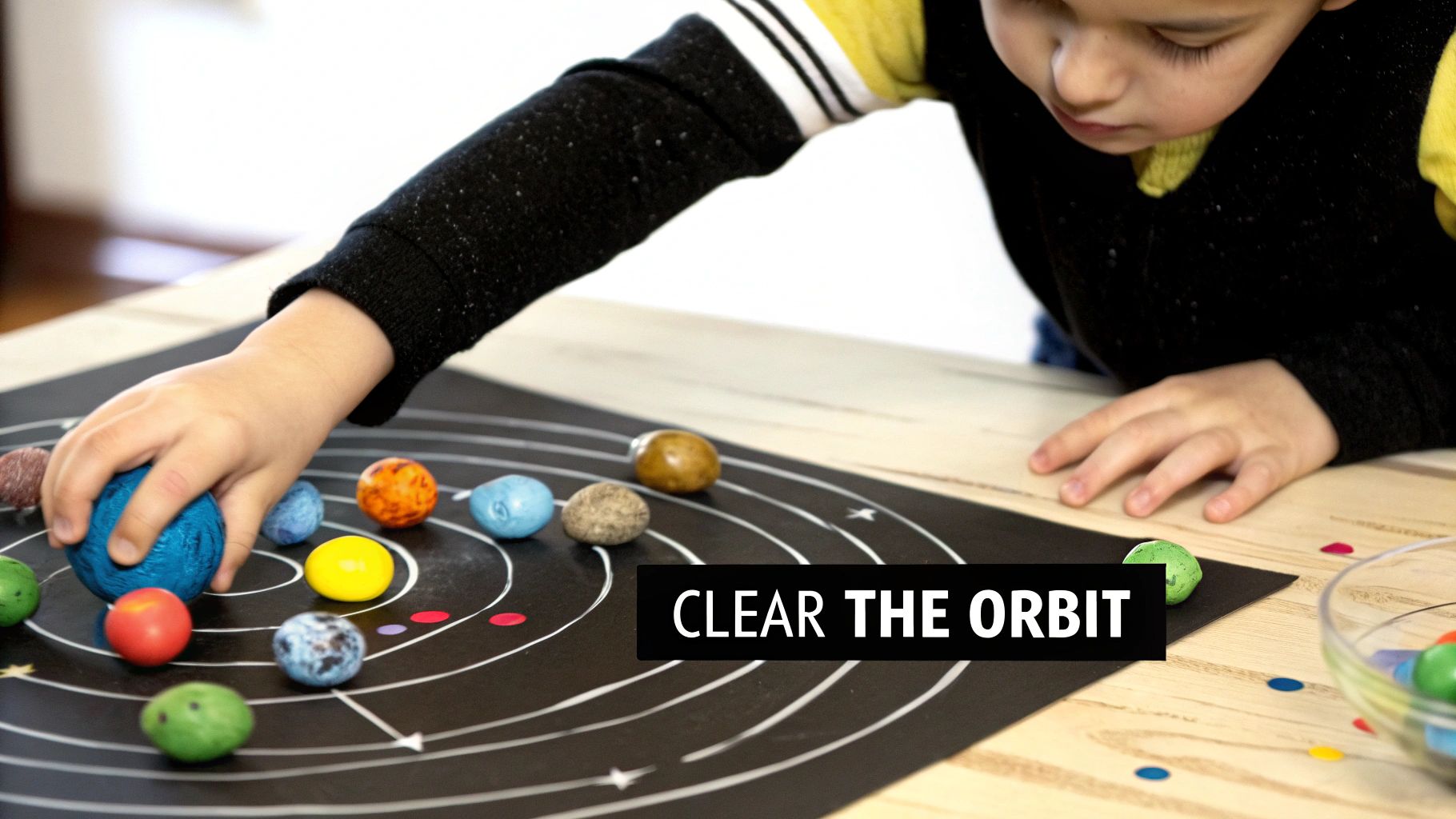
Seeing the orbits laid out helps to show just how crowded Pluto’s neighbourhood really is. You could create a simple model using string and paper cut-outs of the planets.
This is a great way to help children understand that orbits aren’t just neat little circles but are actually vast regions of space—some of which are much busier than others!
For even more amazing STEM projects and space-themed fun, blast off to the Space Ranger Fred activities page. You'll find loads of brilliant ideas to keep your young explorer curious.
Your Questions About Pluto Answered
The story of Pluto always sparks brilliant questions from curious space adventurers like you. It's fantastic to ask questions—that’s how every great scientific discovery gets started! Let's explore some of the most common ones and track down the answers together.
This is also a great chance to chat with your friends or family. What do they think? Do they remember when Pluto was called a planet? Starting a conversation is one of the best ways to learn.
Is Pluto sad that it’s not a planet anymore?
That’s a very thoughtful question! But don't you worry, Pluto isn’t sad at all. Pluto is a giant ball of rock and ice, so it doesn’t have feelings the way we do.
More importantly, scientists didn't actually take anything away from Pluto. They gave it a new, more accurate title: dwarf planet. Think of it like a promotion—Pluto is now the captain of a whole new team of amazing objects out in space! It’s still a fascinating world, and its new job helps us understand a whole family of similar icy bodies in our Solar System.
Could Pluto become a planet again?
It's possible, but it’s not very likely with the rules we have now. For Pluto to become a planet again, astronomers at the International Astronomical Union would need to hold a big meeting and vote to change the official definition of what a planet is.
Science is always learning and changing. New discoveries can lead to new rules. So, while it could happen one day, for now, Pluto is happily and officially the most famous dwarf planet in our Solar System.
The rules of science aren’t set in stone forever. They are simply our best understanding right now, based on all the evidence we have. As we explore more of the universe, our understanding—and sometimes the rules—will grow too!
Why did scientists change their minds about Pluto?
Changing your mind when you get new information is a scientist's superpower! For a very long time, we thought Pluto was all alone out there at the edge of the Solar System.
But as our telescopes got better, we discovered lots of other objects that were similar to Pluto, all orbiting in a chilly region called the Kuiper Belt. The real game-changer was finding Eris, an icy world that’s even more massive than Pluto. This made astronomers realise that Pluto wasn't a planet like Earth or Mars; it was part of a huge family of icy worlds. Creating the 'dwarf planet' category was simply a way to organise our Solar System better with all this exciting new info. It was a scientific upgrade!
Are there other dwarf planets besides Pluto?
Yes, loads of them! Pluto might be the most famous, but it has some amazing teammates. The IAU officially recognises four others right now:
- Eris
- Ceres
- Makemake
- Haumea
But that's just the start. Scientists believe there could be hundreds, or maybe even thousands, more dwarf planets waiting to be discovered in the faraway parts of our Solar System. Each one is a mystery waiting to be solved. Fancy joining an adventure to these distant worlds? Check out the story Space Ranger Fred and the Farthest Planet!
The universe is full of amazing stories and endless things to discover. Keep asking questions, stay curious, and continue your adventures with Space Ranger Fred. There’s a whole cosmos out there waiting for you.