
Ever wonder what scientists really do all day? It's not always about mixing colourful, bubbling potions in a secret lab! Think of a scientist as a detective for the universe. Their job is to ask brilliant questions about absolutely everything—from why stars twinkle to how a tiny bee can fly—and then blast off on an adventure to find the answers.
A Scientist's Super Toolkit
At heart, a scientist is just a super-curious person who loves solving puzzles. Just like Space Ranger Fred uses special gadgets to explore new planets, scientists use their own set of ‘super skills’ to understand the world all around us. It’s not about knowing everything already; it’s about being brave enough to ask questions and excited enough to hunt for clues.
This whole way of thinking is what powers STEM. Asking questions is always the first step in any adventure, and you can learn more about it in our guide to what STEM learning is.
The three most important tools any scientist can have are asking a great question, exploring for clues, and finding an answer. This simple picture shows you how it all fits together.
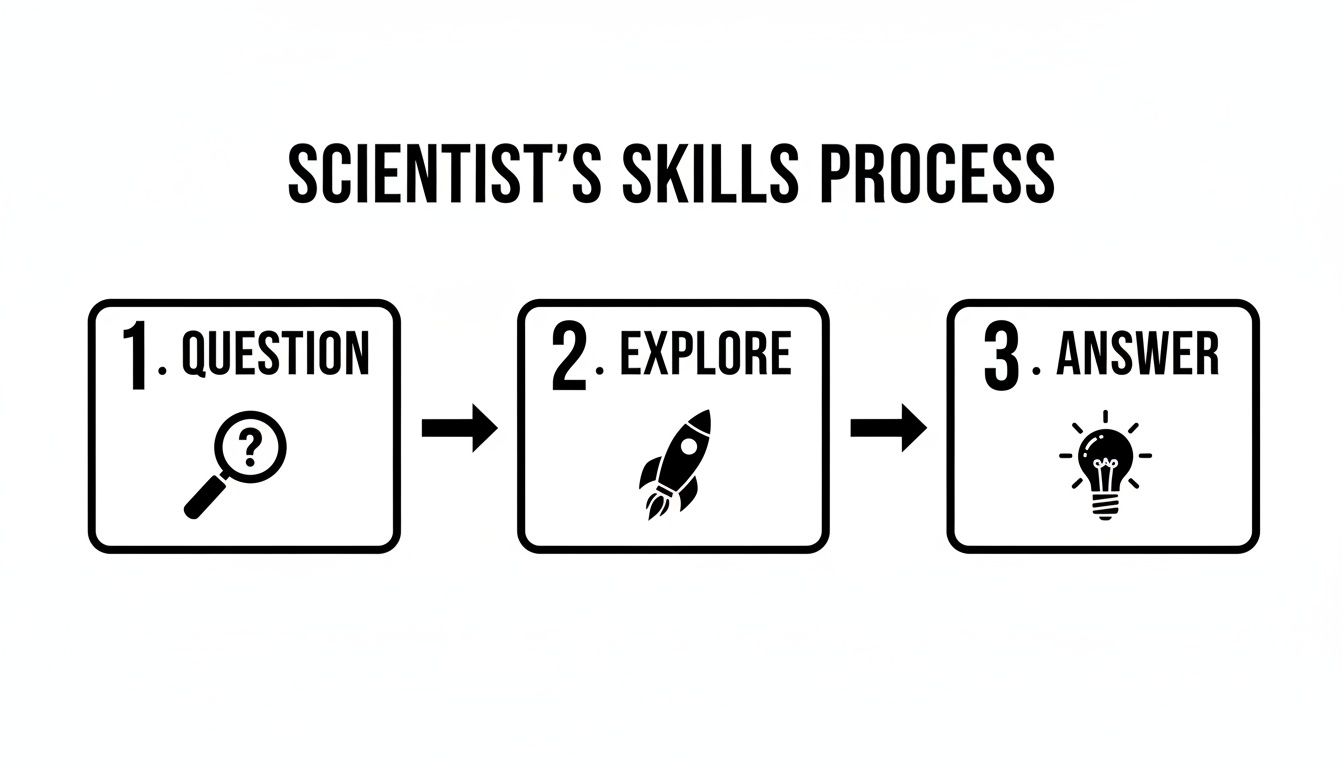
As you can see, every amazing discovery starts with a simple moment of wonder. That journey from "Hmm, I wonder why…?" to "Aha, I found it!" is exactly what being a scientist is all about. It’s a thrilling quest for knowledge that anyone, including you, can join.
Every scientist has a special toolkit of skills they use to explore the world. Here are a few of their most important tools you can start using today.
A Scientist's Super Toolkit
| Super Skill | What It Means | How You Can Try It |
|---|---|---|
| Observing | Watching and noticing the tiny details about what's happening around you. | Look closely at a snail on the pavement or watch how the clouds move across the sky. What do you see? |
| Questioning | Asking "Why?", "How?", and "What if…?" about the things you observe. | Why do leaves change colour? What if I mixed blue and yellow paint? |
| Predicting | Making a smart guess about what you think will happen next. | Guess which of your toys will float in the bath before you put them in. Then, test it out! |
| Measuring | Using tools to find out the size, weight, or temperature of something. | Use a ruler to see how tall your plant has grown or a timer to see how fast you can run. |
| Experimenting | Setting up a test to see if your prediction was right. | Plant two seeds but only water one. What happens? |
| Communicating | Sharing what you discovered with other people. | Tell your family what you learned or draw a picture of your experiment. |
These aren't just skills for people in lab coats—they're superpowers you can use every single day to make sense of the world and find your own amazing discoveries.
The Power of Curiosity
Ultimately, science is all about being curious. It’s about looking at a flower and asking, "How does it grow?" or watching a big boat float and wondering, "Why doesn't it sink?"
Scientists don't just see the world; they ask questions about it. They believe every single question, no matter how big or small, is a doorway to a new discovery. This is the first and most important step. You just have to notice something and ask.
The Adventure Plan Every Scientist Follows
Every great discovery, whether it’s finding a new planet or figuring out why toast always seems to land butter-side down, starts with a special kind of map. Scientists call this the scientific method, but we like to think of it as an Adventure Plan. It’s a simple series of steps that helps them find answers without getting lost along the way.
Just like Space Ranger Fred wouldn’t blast off to an unknown galaxy without a mission plan, a scientist needs a clear path to follow. This plan turns a massive, tricky puzzle into smaller, fun-sized pieces that anyone can solve. It’s what keeps the whole adventure of discovery on track.

Step 1: Ask a 'What If' Question
Every single scientific adventure kicks off with curiosity. A scientist spots something and thinks, "Hmm, I wonder…" or "What if I tried this instead?" That little question is the 'X' that marks the spot on their treasure map.
For instance, you might ask yourself, "What if I plant a sunflower seed in a dark cupboard? Will it still grow?" That’s a perfect scientist’s question because it’s something you can actually test.
Step 2: Make a Smart Guess
Once you’ve got your question, the next step is to make a smart guess about what the answer might be. This isn’t just pulling an idea out of thin air; it’s called a hypothesis. You use everything you already know to make your best prediction.
So, you might guess, "I think the sunflower seed won't grow in the dark because plants need sunlight." Now your mission has a clear direction.
Top Tip for Grown-Ups: Encourage kids to say their guess out loud. Saying "I think…" is a brilliant way to build confidence and shows them it’s perfectly okay if their guess turns out to be wrong—that’s just part of the adventure!
Step 3: Plan Your Mission
Right, now for the fun part: designing your experiment! This is your mission plan. You need to think carefully about what you’ll do, what kit you’ll need, and how you’ll make sure it's a fair test.
To test your sunflower idea, your plan might look something like this:
- Get two identical pots.
- Put the same amount of soil in each one.
- Plant one sunflower seed in each pot.
- Give them both the same amount of water.
- Place one pot on a sunny windowsill and pop the other one in a dark cupboard.
Step 4: Gather Your Clues
With your mission underway, it's time to become a detective and gather clues. This just means watching what happens very carefully and writing it all down. You could draw pictures of your pots each day or even measure how tall each plant grows with a ruler.
Step 5: Figure Out the Puzzle
After a week or two, it’s time to look at all your clues (your notes and drawings). This part is called analysing your data. Did the plant in the sun shoot up? What about the one in the dark? Your clues will help you solve the puzzle and finally answer your original 'what if' question.
Step 6: Share Your Discovery
The final step is the most exciting of all—sharing what you found out! Scientists tell other scientists about their discoveries so everyone can learn something new. You can tell your family, friends, or teacher what happened in your experiment.
Every shared discovery, no matter how small, helps us all understand the universe a little bit better. You can even find more fun missions to try on our activities page.
Exploring Different Kinds of Scientists
Just like Space Ranger Fred meets all sorts of different aliens on his missions, the world of science is filled with many kinds of brilliant people. A scientist isn’t just one type of person; they are explorers who focus on different parts of our amazing universe. Thinking about what scientists do is like opening a massive toy box—there are endless varieties to choose from!
Each type of scientist has a special mission. Some look up at the stars, some dive deep into the ocean, and others look at things so tiny you can't even see them. Let's meet a few of these incredible adventurers.
Meet the Planet Protectors
Ever wonder who looks after our planet? Environmental scientists are like Earth's guardians. It’s their job to understand how nature works and to figure out how to keep our air, water, and forests healthy for everyone, including all the amazing animals that live here.
They might explore a rainforest to study how trees help us breathe, or wade into a river to check if the water is clean enough for fish to thrive. They help us learn how to protect our world, making sure it’s a wonderful place for future explorers to enjoy for years to come.
Meet the Star Gazers
Do you love looking at the night sky? Then you’d get on brilliantly with astronomers! These scientists are cosmic detectives, using giant telescopes to peer into the deepest, darkest corners of space. They study everything from stars and planets to galaxies and mysterious black holes.
Their mission is to answer some of the biggest questions ever, like "How did the universe begin?" and "Are there other planets like Earth out there?" They map the stars and help space explorers like Fred navigate the cosmos.
Meet the Body Detectives
What’s going on inside our bodies? That’s a puzzle for biologists and medical scientists to solve. Think of them as body detectives, investigating everything from the tiniest bugs that can make us ill to the complex ways our brains work. They are the heroes who figure out how to keep us healthy and strong.
Did you know? There are millions of people working as scientists! In 2023, the UK had a whopping 9.4 million workers in STEM fields. That includes 2.6 million in high-tech jobs that could one day help us explore space, just like in the adventures of Space Ranger Fred! You can read more about the UK's amazing science workforce to see how many people are involved.
Meet the Gadget Gurus
Have you ever wondered how your tablet works or how a massive bridge stays up? Say hello to engineers and physicists! These scientists are the ultimate inventors and problem-solvers. Physicists figure out the fundamental rules of the universe—like gravity and electricity—while engineers use those rules to design and build amazing things.
They are the gadget gurus who create everything from rollercoasters to the powerful rockets that blast astronauts into orbit. Without them, we wouldn’t have computers, cars, or even the cool tech in Fred's spaceship, the Stardust. Their work shows how science helps us build a better and more exciting world.
Your Turn to Be a Scientist at Home
Ready for your first mission, Junior Scientist? The absolute best way to understand what scientists do is to pop on your own explorer hat and have a go yourself. Science isn't just for people in white coats; it's something you can do right in your kitchen or back garden with stuff you already have.
Let’s get our hands messy with a couple of exciting experiments, straight from the Space Ranger Fred mission logbook! Each one has special ‘Scientist Questions’ to get you thinking like a real investigator.
Mission 1: Build a Fizzy Volcano
It's time to make your very own erupting volcano! This is a classic experiment that shows how chemicals can react together in a really fun, fizzy way.
Your Mission Kit:
- A small plastic bottle
- A tray or baking dish to catch the mess
- A bit of playdough or mud to build your volcano shape around the bottle
- Bicarbonate of soda (that's baking soda!)
- White vinegar
- A few drops of red food colouring (optional, but it makes the 'lava' look amazing!)
Mission Steps:
- Stand your bottle in the middle of the tray.
- Use the playdough or mud to build a volcano cone around the bottle, making sure to leave the top open.
- Add two spoonfuls of bicarbonate of soda into the bottle. If you've got red food colouring, pop a few drops in now.
- Get ready for the eruption! Carefully pour some vinegar into the bottle and watch what happens.
Scientist Questions to Ask: What did you see and hear when you added the vinegar? What do you reckon would happen if you used more vinegar or more bicarb? Give it a try and find out!
Mission 2: Grow a Bean in a Jar
Let’s become Body Detectives (biologists!) and watch a tiny seed spring to life. This mission lets you see the secret world of a growing plant, right before your very eyes.
Your Mission Kit:
- A clear glass jar
- A few sheets of kitchen roll
- A dried bean (a lima bean or runner bean works great)
- Water
Mission Steps:
- Fold the kitchen roll and place it inside the jar, pressing it against the sides to create a lining.
- Gently wedge your bean between the kitchen roll and the glass so you can see it clearly.
- Carefully add a little water to the jar—just enough to make the kitchen roll damp, not soggy.
- Place your jar on a windowsill where it can get plenty of sunlight.
- Check on your bean every day and make sure the kitchen roll stays damp!
Scientist Questions to Ask: What’s the very first thing you see start to grow from the bean? Which way do the roots grow? How long does it take for a proper leaf to appear?
These simple activities are a brilliant start to your science journey. Just like guides on embroidery kits for beginners give you everything you need for a new hobby, these missions provide the tools to start exploring.
Want more missions? You can download more fun missions from our activities page and keep your scientific adventure going.
How to Support Your Young Scientist
Parents and teachers, you are the mission commanders for your young explorers! Nurturing a child’s natural curiosity is one of the most brilliant adventures you can go on together. You don’t need a PhD or a lab coat; you just need to be a fellow explorer, ready to ask questions and discover clues right alongside them.
The whole idea is to create a happy, supportive space where it’s safe to be curious, okay to be wrong, and fun to try again. Your encouragement is the rocket fuel that powers their confidence and helps them see science not as a tricky subject, but as a wonderful way of looking at the world.
Be a Fellow Explorer
Honestly, one of the best things you can do is simply wonder out loud with them. When you’re out for a walk, you could say, "I wonder why all those birds are sitting on that one telephone wire?" or "Look at that spider's web, how do you reckon it made that?" This shows them that asking questions is a normal, exciting part of everyday life.
You can also use stories to spark brilliant conversations. The Space Ranger Fred books are packed with cosmic puzzles and scientific ideas, making them a perfect launchpad for chatting about everything from wobbly planets to strange alien plants.
Create a 'Try It Out' Zone
Turn a part of your home or classroom into a place where trying things out is celebrated. This doesn't mean you need a fancy lab—a corner of the kitchen or a box of supplies will do perfectly. For some brilliant ideas, have a look at our guide to the best science kits for kids.
Top Tip for Mission Commanders: Let them lead the way. If they want to mix mud and leaves to see what happens, fantastic! The process of exploring and finding things out for themselves is far more important than getting the ‘right’ answer straight away.
Show Them Science Is Everywhere
By supporting their curiosity now, you're helping to build the next generation of problem-solvers, inventors, and big thinkers. It's a bigger deal than you might think! In 2025, across the UK, a whopping 5.1 million workers are needed in critical occupations, including thousands of scientists. You can discover more about the UK's need for future scientists and see just how important these skills are.
Every question you answer and every mini-experiment you try together is helping to prepare them for an exciting future. No pressure, though!
Start Your Own Science Adventure Today
Being a scientist isn't just a job title—it's a way of looking at the world with total wonder. It's about seeing puzzles everywhere and believing, deep down, that you can be the one to find the answers. The scientists of today are real-life heroes on missions to solve the world's biggest challenges, from protecting our precious planet to exploring galaxies light-years away.
Every single question you ask and every experiment you try is a step on your very own science adventure. What scientists are discovering right now is creating the world you'll live in tomorrow. That means the next generation of explorers—and yes, that means you!—has an incredibly exciting journey ahead.
A Future Full of Discovery
Right now, the world needs more curious minds than ever before. Just think about it: in the UK, there are over 300,000 people working as life scientists, studying everything from tiny, invisible cells to the amazing human body. To keep these incredible discoveries going, experts reckon we'll need 70,000 brand-new science jobs by 2035! You can learn more about the UK's growing need for scientists and see just why future explorers are in such high demand.
These aren't just jobs in labs, either. Future scientists will be designing eco-friendly cities, inventing life-saving medicines, programming friendly robots, and maybe even planning missions to Mars—just like in the Space Ranger Fred universe! The skills you build just by being curious and asking questions are exactly what you’ll need.
Every great discovery starts with a single question. Never stop asking "why?" or "what if?" Your curiosity is a superpower that can change the world. Keep it switched on!
Your science adventure has already kicked off. Every time you wonder how something works or try out some fun science activities for kids, you're already thinking like a scientist.
The universe is packed with amazing secrets just waiting for explorers like you to find them. So, keep asking big questions, dream even bigger dreams, and never, ever lose your sense of wonder. Your mission, should you choose to accept it, is to keep exploring.
Ready for your next mission? The Space Ranger Fred universe is bursting with cosmic adventures and scientific puzzles to solve. Blast off into our world of stories, games, and activities, and let your curiosity lead the way.
A Few More Questions from Mission Control
Looks like our comms channel is buzzing with a few more questions from our curious space cadets! Let’s tackle some common queries about the amazing world of scientists.
Do You Need to Be a Genius to Be a Scientist?
Not at all! You don’t need a super-powered brain to be a scientist. The most important tool in any scientist’s kit is good old-fashioned curiosity. It’s far more about asking brilliant questions, being patient when things don't work the first time, and not being afraid to make a few mistakes along the way.
Teamwork is a huge part of the job, too. Scientists almost always work together in big teams to solve massive puzzles, like astronauts on a space station. They share their ideas and discoveries to find the solution much faster.
Do All Scientists Work in Laboratories?
No way! While plenty of scientists do wear white coats and work with microscopes and bubbling test tubes, many others have incredible workplaces all over the world—and even beyond it.
- Marine biologists might be diving deep into the ocean to explore colourful coral reefs.
- Astronomers often work in observatories, using giant telescopes to gaze at distant stars and galaxies.
- Volcanologists bravely climb active volcanoes to understand the fiery forces bubbling beneath our feet.
A scientist’s office is wherever their questions lead them on their next big adventure.
What Is the Most Exciting Part of Being a Scientist?
Ask any scientist and they'll probably tell you it’s that incredible 'Aha!' moment. This is that flash of excitement when you finally figure something out or discover something completely new that nobody in the entire world knew before you.
It’s like being the first explorer to set foot on a new planet. Every single day brings a fresh chance to learn something amazing and help make our world a better, more interesting place for everyone.
Your own science adventure is just getting started! The Space Ranger Fred universe is packed with stories, games, and fun activities to keep your curiosity buzzing. Explore our world and continue your mission today!