
Welcome, Space Cadets! Ever look up at the night sky and wonder if all those twinkling stars get a bit lonely? Well, it turns out most of them have a friend! A binary star system is simply two stars that orbit around each other, held together by an invisible force called gravity, just like cosmic dancing partners.
The Secret of the Twinkling Stars
Have you ever held hands with a friend and spun around really fast in a playground? You both lean back, held together so you don't fly apart. That’s almost exactly what happens with binary stars!
Instead of holding hands, two stars are joined by the powerful, invisible pull of gravity. And they don't have one star as the boss, either. They actually orbit a shared spot right in the middle, a special balancing point called their centre of mass.
Imagine a seesaw in space. If two friends with the exact same weight sit on a seesaw, the balancing point is right in the centre. But if one friend is a bit heavier, that point has to move closer to them to keep things steady. Stars do the same thing! This cosmic dance makes our own Sun a bit of an oddball, as it’s flying solo. Most stars out there have a companion.

More Common Than You Think
It might sound like something straight out of a sci-fi adventure, but these star pairs are incredibly common. In fact, when you look up at the night sky from your back garden, there's a really good chance you're spotting one without even realising it.
Astronomers believe that over 50% of all the stars in our galaxy are part of these amazing cosmic duos!
Understanding how these stars stick together helps us learn about one of the most important forces in the entire universe. If you're curious about what makes them glow so brightly in the first place, you'll love our guide on what makes stars shine.
Here’s a quick summary to help you on your mission to understand these amazing star systems.
Binary Stars at a Glance
| Key Idea | What It Means |
|---|---|
| Two Stars Together | Instead of one star, it’s a pair orbiting each other, like dancing partners in space! |
| Held by Gravity | An invisible force called gravity keeps them connected, so they don't float away. |
| They Are Very Common | More than half the stars you see in the night sky could be binary systems! |
| How We Spot Them | Astronomers spot them because their gravity makes them wobble or change brightness. |
So next time you're stargazing, remember that many of those single points of light might actually be two stars, spinning through space together on an incredible cosmic journey.
How Cosmic Star Pairs Are Born
So, where do these amazing cosmic star pairs actually come from? The whole story starts deep inside a giant, swirling cloud of gas and dust floating through space. Think of it as a cosmic kitchen, and this enormous cloud is the main ingredient for baking stars!
These special star-making clouds are called nebulas. Usually, a big clump of this cosmic dough will pull itself together under its own gravity, getting hotter and hotter until—poof—a brand new, single star is born. It's an incredible process, and you can get the full recipe for these stellar nurseries in our guide to what is a nebula.
But sometimes, something even more interesting happens.
A Recipe for Two Stars
Instead of just one big clump forming, the cosmic dough inside the nebula breaks apart into two separate, smaller blobs. If these blobs are close enough, the pull of gravity between them becomes too strong to ignore. They become lifelong gravitational buddies, destined to orbit each other forever.
As these baby stars, called protostars, keep gathering more gas and dust, they grow bigger and hotter. All the while, they are spinning and dancing around each other, held in a cosmic embrace by gravity. This constant pull ensures that as they finally light up and become proper stars, they stay together as a binary star system.
It's a bit like making two biscuits from the same piece of dough. If you place them close together on the baking tray, they might just stick together as they bake! That’s how binary stars begin their life—as two clumps of cosmic material that were just too close to go their separate ways.
Watching Baby Stars Form Today
This isn't just a story; it's something scientists can actually see happening right now! In fact, astronomers, including UK researchers at the University of Manchester, have spotted this amazing process in action. They’ve been studying a very young binary star system called SVS 13, which is just 980 light-years away from us.
Using powerful telescopes, they found two baby stars, each with its own disc of gas and dust swirling around it. Even more exciting, there’s a much larger, shared disc of material surrounding both stars. This shared disc is the perfect place for planets to form, which means it’s possible to have worlds with two suns in their sky! It’s like watching planets being baked from cosmic dough in a twin-star kitchen. You can find out more about this cosmic detective work and how researchers observed the start of planet birth.
This incredible discovery shows that the formation of binary star systems isn't just a theory; it's a real and wonderful process happening all across our galaxy.
Meeting the Different Types of Star Pairs
Now that we know how these cosmic twins are born, let's meet the different 'personalities' you’ll find out there in the universe! Just like friends, not all star pairs behave the same way. Astronomers have clever methods for spotting them, and they group them into different types based on what they can see.
This simple diagram shows the journey from a giant cloud of gas to the birth of a star pair.
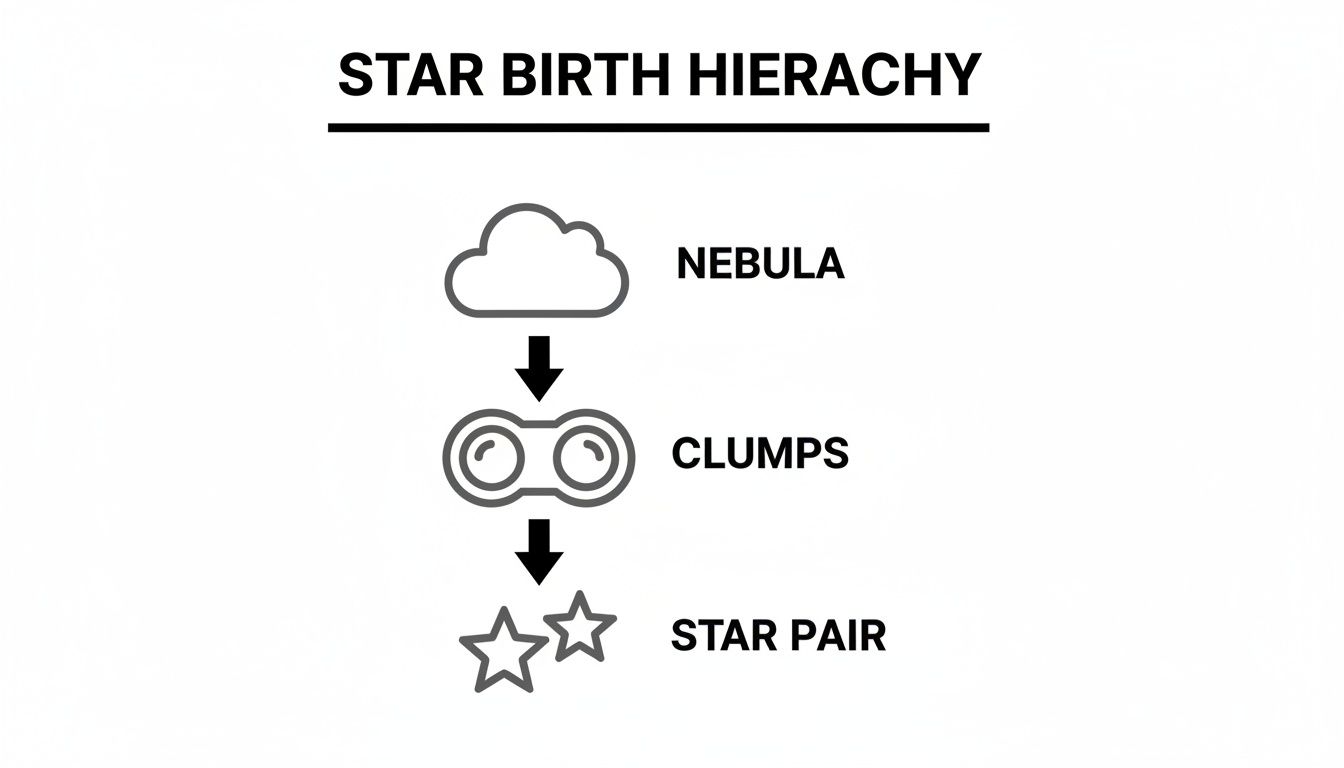
It all kicks off in a massive nebula, which collapses into smaller, dense clumps that eventually spark into a brand new binary star system. Let’s explore the main types astronomers have discovered.
Visual Binaries: The Show-Offs
Visual binaries are the easiest ones to get your head around. Think of them as the 'show-offs' of the star world because, with a powerful enough telescope, you can actually see both stars separately!
They are just far enough apart in their orbit that we can tell one from the other, watching them slowly waltz around their shared centre of gravity. It’s like spotting two friends walking side-by-side from a very long way away.
Eclipsing Binaries: The Hide-and-Seek Stars
Next up, we have the eclipsing binaries. These are the hide-and-seek champions of the cosmos! From our viewpoint here on Earth, their orbit is lined up perfectly so that one star passes directly in front of its partner, causing the light we see to dip for a little while. It's a cosmic eclipse!
By measuring these dips in brightness, astronomers can figure out amazing things about the stars, like their size and how far apart they are.
Try This at Home: Grab two torches in a dark room (one bigger than the other works best). Get a friend to hold one torch still while you slowly move the other one in front of it. Watch how the total light changes as one torch 'eclipses' the other. You’ve just made your own eclipsing binary system!
For more fun ways to play with light and orbits, check out the Space Ranger Fred activities page.
Contact Binaries: The Best Buddies
Finally, we have the contact binaries. These are the ultimate best buddies! These stars are orbiting so incredibly close to each other that their outer gassy layers actually touch and merge.
They end up sharing a common envelope of gas, looking a bit like a cosmic peanut from a distance. These pairs are so close they are literally joined at the hip, sharing their stuff as they spin through space together.
Each of these types tells us something different about what are binary star systems and the weird and wonderful ways they behave. By studying their light, movement, and how they interact, scientists piece together the amazing life stories of these cosmic duos—from the distant 'show-offs' to the stars playing an endless game of celestial hide-and-seek.
Famous Binary Stars in Our Night Sky
Right, you've got the basics down on these cosmic pairs, so let's go on a real-life mission! Some of the brightest, most famous stars twinkling above your back garden are actually secret binary systems, each with a brilliant story to tell.
Knowing what you're looking at turns a simple stargazing night into an adventure, just like the ones in Space Ranger Fred and the Starship Voyage. Let's blast off and meet a few of these amazing cosmic duos.
Sirius: The Dog Star’s Secret
Have you ever looked up and spotted Sirius? It’s the brightest star in our entire night sky! It gets the nickname the ‘Dog Star’ because it's the top dog in the Canis Major constellation, which is Latin for ‘the Greater Dog’. For thousands of years, everyone just assumed it was one, incredibly bright star.
But astronomers noticed something a bit odd—Sirius was wobbling! It was as if a tiny, invisible friend was giving it a little tug as it moved. And they were right! In 1862, they finally spotted its secret partner: a tiny but unbelievably heavy star called a white dwarf.
This hidden companion, now called Sirius B, is the leftover core of a much bigger star that ran out of cosmic fuel. It's a fantastic real-life example of a binary system where the two stars couldn't be more different.
It’s proper cosmic detective work! Scientists, including teams here in the UK, are using amazing data from space telescopes to hunt for even more of these hidden companions. As you can learn more about this stellar detective work, astronomers are trying to count all these pairs to figure out just how many are lurking in our galaxy.
Albireo: A Cosmic Jewel Box
If you have a pair of binoculars or even a small telescope, you absolutely must hunt for Albireo. You can find it in the constellation Cygnus the Swan, where it looks like just another single star to your eyes. But a little bit of magnification reveals its stunning secret.
Look closer, and Albireo magically splits into two beautiful points of light. One is a brilliant golden-yellow, and its partner is a sparkling sapphire-blue. It's one of the most colourful and beautiful binary systems you can see—no wonder it's often called the ‘jewel box’ of the summer sky.
Mizar and Alcor: Partners in the Plough
Here's a challenge you can try without any equipment at all! First, find the famous star pattern called the Plough (you might know it as the Big Dipper). Now, look closely at the middle star in the handle—that’s Mizar.
If your eyesight is sharp and the sky is properly dark, you might just spot a tiny, fainter star right next to it. That’s Alcor! For centuries, being able to spot Alcor was used as a kind of eye test.
But the story gets even better. When astronomers pointed a telescope at Mizar, they discovered it was a binary star, too! And then they found out that Alcor was also a binary. It's a star system inside a star system—a real cosmic surprise party!
A Family Guide to Spotting Binary Stars
Ready for a real-life space mission, Space Cadets? This guide will help your family head outside and become binary star detectives! While many cosmic pairs are shy and need a proper telescope to be seen, some of the most famous ones are just waiting to be spotted with a pair of binoculars or even your own sharp eyes.
Let's get ready for an adventure and take on a stargazing challenge together! The fun isn't just in what you find, but in the thrill of the hunt.
Choosing Your Mission Headquarters
First things first, every Space Ranger needs a good base of operations. The best place for stargazing is somewhere far away from the bright lights of towns and cities. The darker the sky, the more stars will pop out to say hello!
A few ideas for your HQ:
- Your back garden: Often the easiest and cosiest option! Just make sure to turn off all the house and garden lights.
- A local park or field: Check if it’s open after dark and find a wide-open space with a clear view of the whole sky.
- A designated dark sky spot: The UK has some amazing official dark sky parks that are perfect for a special family trip.
Your Stargazing Challenge: Find the Plough
Your first mission, should you choose to accept it, is to find the famous star pattern known as the Plough (or the Big Dipper, as it’s sometimes called). It looks like a giant saucepan hanging in the sky and is one of the easiest constellations to spot in the UK.
Once you’ve found it, look very closely at the middle star in the handle. That star is called Mizar. If you have really sharp eyes and the sky is nice and dark, you might see a tiny, faint star right next to it. That's its companion, Alcor!
Spotting Alcor is a classic stargazing test and your first step to finding a double star system. While they look like they're just close neighbours, they are a true binary system, orbiting each other over a very, very long time.
A top tip for any night-time adventure is to let your eyes adjust to the darkness. It takes about 20 minutes for them to become fully sensitive to starlight, so be patient! Using a torch with red light helps protect your night vision while you look at star charts.
Gearing Up for Your Adventure
Every great explorer needs the right kit! You don't need lots of fancy equipment, just a few essentials to make your stargazing night comfortable and fun. For more detailed advice, you can check out our simple guide on how to use telescopes for beginners.
Here’s a quick checklist for your family’s mission:
- Warm clothes, hats, and gloves (it gets chilly!)
- A comfy blanket or some camping chairs
- A flask of hot chocolate and plenty of snacks
- A red-light torch to see your charts without spoiling your night vision
- Binoculars (if you have them)
- A star chart or a stargazing app on a phone (with the screen brightness turned way down low)
To help your family embark on their own celestial adventure, this quick guide to fall stargazing can assist in identifying all sorts of amazing things in the sky.
And don't forget to download your own printable star map from the Space Ranger Fred freebies page! Happy hunting, Space Cadets!
Your Cosmic Questions Answered
Every great space explorer asks questions, and we've covered a lot of ground on this mission! It's totally normal if your brain is still buzzing with curiosity after learning all about binary star systems. Here are some of the top questions we get from Space Cadets just like you.
Can Planets Orbit Two Stars?
You bet they can! It would be just like the planet Tatooine in Star Wars, with two suns setting in the sky. These incredible worlds are called circumbinary planets.
Astronomers have already found real-life planets orbiting two stars, which is super exciting. Can you imagine the double sunsets? It just goes to show that planets can form in all sorts of weird and wonderful ways across our galaxy.
Is Our Sun Part of a Binary System?
That’s a brilliant question! For a long, long time, scientists were sure our Sun was a solo act, and most evidence today still points to it being single. It seems our Sun is flying through the Milky Way on its own, with its family of planets trailing behind.
But… some astronomers have a cool theory about a secret companion star they've nicknamed 'Nemesis'. They think it might be hiding very, very far away. For now, though, it’s just a cosmic mystery waiting to be solved!
Why Do Astronomers Study Binary Systems?
Binary stars are like a fantastic cosmic laboratory! By watching two stars dance around each other, scientists can figure out one of the most important things about a star: its mass (which is a fancy word for how heavy it is). You can't really 'weigh' a single star, but with a pair, you can.
This is a game-changer. The information helps astronomers understand how stars are born, how they live their lives, and what happens when they get old. It’s one of the best tools we have for testing our biggest ideas about how the whole universe works.
What's the Difference Between a Binary Star and a Double Star?
Great question, because this one can be a little tricky! A true binary star system is made of two stars that are gravitationally locked together—they’re genuine partners, orbiting a shared centre point.
A double star, on the other hand, can sometimes be just a trick of the eye. From here on Earth, it might look like two stars are huddled close together, but one could actually be thousands of light-years behind the other. Astronomers call this an ‘optical double’. So, remember this: all binary stars are double stars, but not all double stars are true binaries!
The universe is packed with amazing stories, and learning about binary stars is just the start of your adventure. Keep looking up, keep asking questions, and keep exploring the cosmos with Space Ranger Fred. Blast off on your next mission by checking out more of our amazing stories and activities!