
Your child might be asking this right now at breakfast. “What is an astronaut, exactly?” Not just someone in a shiny suit, surely?
They're right to ask. An astronaut isn't only a rocket passenger. An astronaut is an explorer, a thinker, a helper, and a brilliant team-mate. That means the journey starts long before launch day, and yes, a child with big questions and a brave heart is already on the right path.
So You Want to Know What an Astronaut Is
So, what is an astronaut?
An astronaut is a person trained to travel and work in space. But that simple answer can be a bit sneaky. It makes the job sound like sitting in a spacecraft and waving at Earth through a window. In real life, astronauts do much more than that.
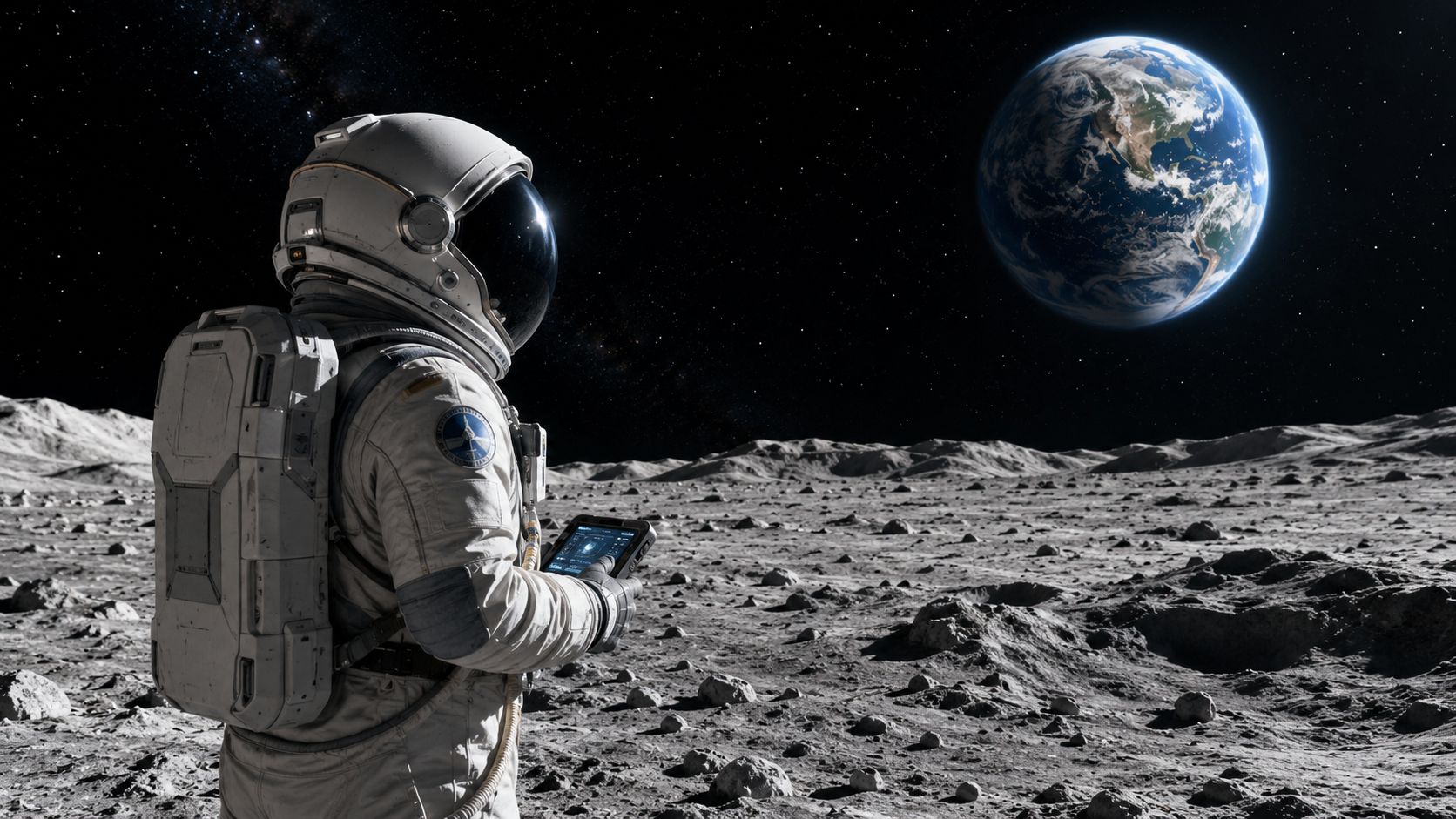
It starts with character
Astronauts need knowledge, of course. They study hard and learn how machines, people, and science work. But space agencies also care about something else. They look for people who can stay calm, pay attention, remember important details, and understand where things are around them.
While having a master's degree in a science subject is a rule, space agencies like the ESA also look for non-trainable personality traits like concentration, good memory, and spatial awareness. Your character is just as important as your qualifications, as Tim Peake explains in Ask an Astronaut.
That's a lovely thing for children to hear, isn't it? Being curious matters. Listening matters. Trying again matters.
An astronaut is a kind of problem-solver
Think of an astronaut as a mix of these jobs:
- Scientist who investigates questions
- Engineer who understands tools and machines
- Team player who helps others
- Explorer who goes somewhere unusual
- Calm thinker who solves problems under pressure
A child doesn't need a rocket to begin practising those skills.
Big idea: The first step towards space isn't leaving Earth. It's learning to say, “I think, I'll try, I can do this, and I can explain what I found.”
That's why the idea of what is an astronaut is bigger than a job title. It's a mindset.
More Than Just Floating Around
Many children imagine astronauts spending all day doing somersaults in zero gravity and squeezing food from packets. Fair enough. Floating is funny.
But astronauts are busy from morning to night.
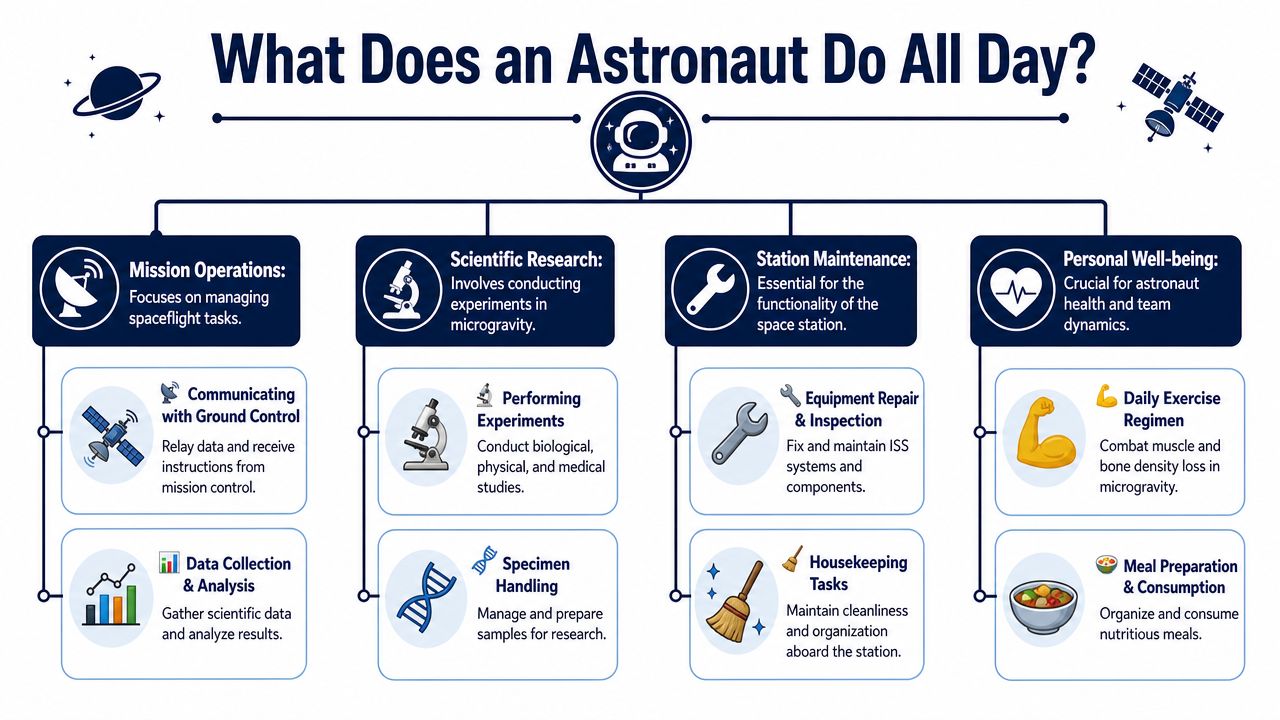
A day in space has jobs to do
On a space station, astronauts might run science experiments, check equipment, clean their living area, exercise, and speak with teams on Earth. Some lead the crew. Some focus on operating systems. Some carry out specialist tasks.
It is a school trip mixed with a science lab, a repair workshop, and a team challenge. In one place. In orbit.
If your family wants a child-friendly look at these tasks, this guide on what astronauts do in space is a handy next read.
Yes, they really move that fast
One of the wildest facts about life in orbit is speed. Astronauts in orbit travel at around 17,500 mph, and that's so fast they can see a sunrise and a sunset every 90 minutes, as explained in this astronaut Q&A reel featuring Jeanette Epps.
That sounds like a theme park ride designed by a science teacher.
“When astronauts are in orbit, they are travelling at around 17,500 mph. That's so fast that they get to see a sunrise and a sunset every 90 minutes!”
Do they feel that speed in the same way you feel speed in a car? Not quite. That can confuse children. In orbit, astronauts and their spacecraft are moving together, so it doesn't feel like being pressed back into a seat the whole time. What they notice more is the floating.
Their jobs can change
An astronaut might spend one part of the day doing careful science and another fixing something important. That's why the job is about flexibility as much as bravery.
Here's a simple way to picture it:
| Role idea | What it's like |
|---|---|
| Commander | The team captain |
| Pilot | The expert driver |
| Mission specialist | The science detective and problem-solver |
So no, they're not “just floating around”. They're working in one of the strangest workplaces humans have ever built.
The Right Stuff for Your Astronaut Toolkit
Children often ask, “Could I become an astronaut?” The honest answer is yes, it can be a real goal. It's a big goal, but it starts with ordinary things done well.
What adults need to qualify
For UK candidates hoping to join the European Space Agency, the path is clear. They need a Master's degree in a field like science or engineering, at least three years of professional experience, and they must pass a special medical exam similar to one for private pilots, according to the ESA astronaut selection FAQs.
That sounds very grown-up, because it is. But children don't need to worry about ticking those boxes yet.
What children can build now
The toolkit begins much earlier, with habits.
- Ask questions often. Why does the Moon change shape? Why do rockets need so much power?
- Practise solving problems. Puzzles, coding, model building, and even fixing a wobbly toy all help.
- Look after your body. Astronauts need strong, healthy bodies.
- Work with other people. Space is a team effort.
- Explain your thinking. Saying “Here's how I worked it out” is a superpower.
Clothing is part of the toolkit too. Children are often fascinated by helmets, gloves, and boots, so this article on what astronauts wear helps turn that curiosity into learning.
Practical rule: If a child loves science, enjoys teamwork, and keeps going when things are tricky, they're already practising astronaut skills.
School subjects that help
Science and maths matter, yes. So do reading, writing, computing, design, and even art. Why art? Because astronauts must notice details, sketch ideas, communicate clearly, and imagine solutions.
That's the secret many people miss. The astronaut toolkit isn't only facts. It's habits of mind.
The Ultimate Astronaut Training Adventure
Getting selected as an astronaut is only the beginning. Then comes training, and it sounds like a mixture of school, survival camp, engineering challenge, and giant swimming pool adventure.
Here's a visual snapshot of that journey.
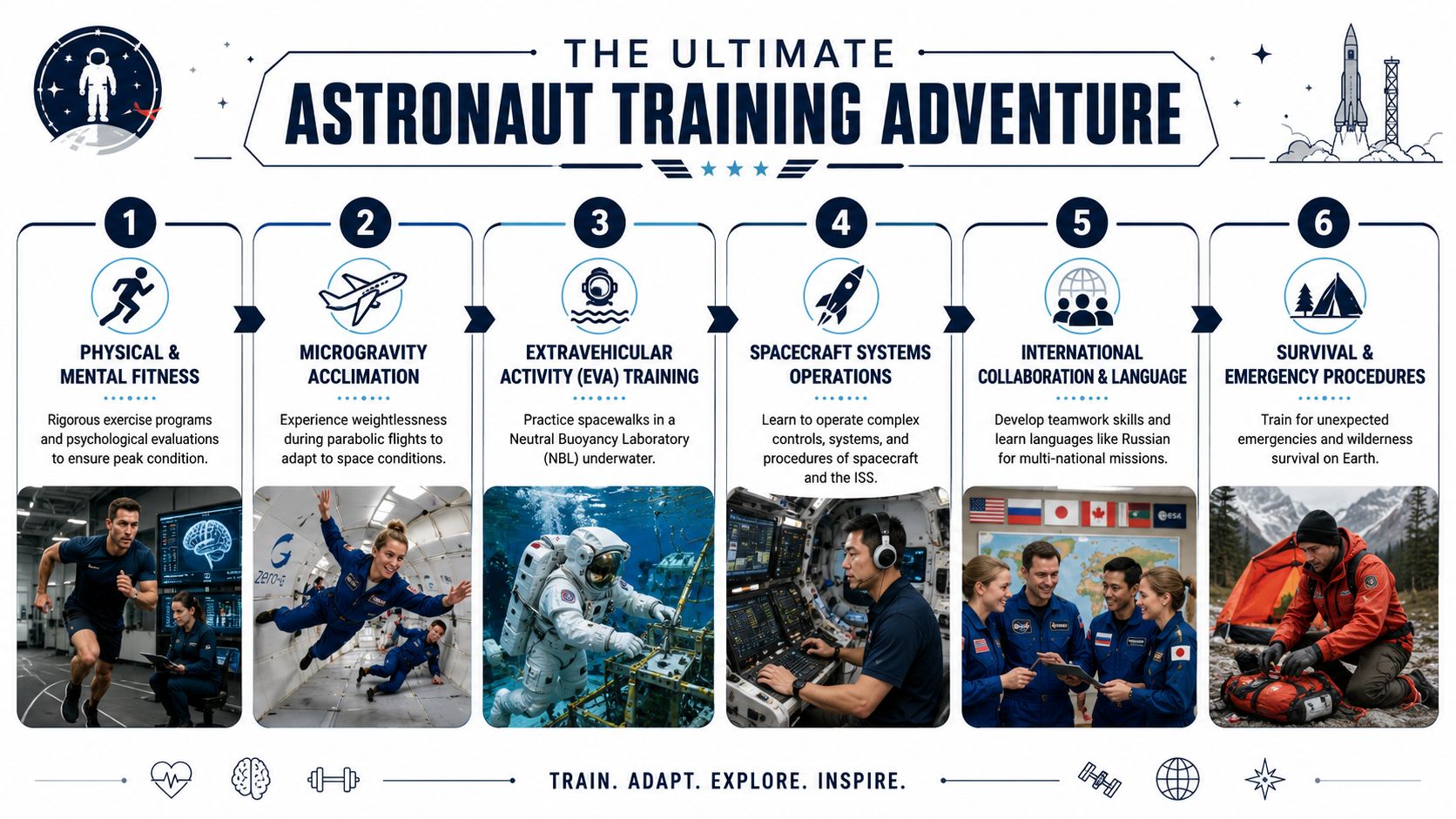
Training for the unexpected
Basic astronaut training takes about two years and includes learning spacecraft systems, emergency procedures, robotic arm operations such as Canadarm2, plus water and wilderness survival training, as described in this astronaut training overview video.
That's a serious list. It also happens to sound brilliant.
Some training prepares astronauts for daily jobs. Other parts prepare them for “what if?” moments. What if equipment fails? What if a landing happens in a difficult place? What if a team-mate needs help quickly?
Why a giant pool helps
Astronauts often practise for spacewalks in water because it helps them rehearse careful movements. It isn't exactly the same as space, but it gives them a way to train safely and repeat tasks until they become smooth and precise.
Children usually love this part because it sounds like swimming lessons turned into science fiction.
A short film makes the idea even easier to picture:
Training isn't about being fearless. It's about being prepared.
Teamwork is part of the adventure
Astronauts also train to communicate well, stay calm, and support one another. A clever person who can't work with others won't make a strong crew.
That's useful for children to hear. Team games, group projects, and taking turns are not small things. They are part of the explorer's path.
Meet the UK's Real-Life Space Heroes
Space heroes don't only belong in stories. Some come from the UK.
Tim Peake and Helen Sharman
Tim Peake, from West Sussex, became the first professionally recruited British astronaut selected by ESA in 2009, and in 2016 he became the first official British astronaut to walk in space during his mission on the ISS, according to Britannica's biography of Tim Peake.
That matters because children can look at him and think, “He came from here too.”
Before Tim Peake, Helen Sharman became the first Briton in space in 1991 through Project Juno, a milestone noted in this piece about British astronauts and the UK's growing space ambitions.
Why these stories matter
These aren't just history facts for a quiz. They show that space exploration is connected to real people, real effort, and real learning.
For a fun bridge between story world and real space life, children often enjoy reading about when Space Ranger Fred met a real astronaut.
Children don't need to see themselves as “geniuses” to dream about space. They need role models, encouragement, and chances to keep learning.
That's often the spark. A real person makes a big dream feel possible.
Start Your Astronaut Journey Today
Saturday morning. Fred is at the kitchen table with paper, crayons, and a big question in his head. How do astronauts get ready before they ever reach a rocket?
The answer starts much closer to home than many children expect. An astronaut journey begins with habits. Asking questions. Trying again after mistakes. Working with other people. Spotting small details. Those are explorer skills, and kids can practise them now, whether they are in class, at home, or curled up with a library book.
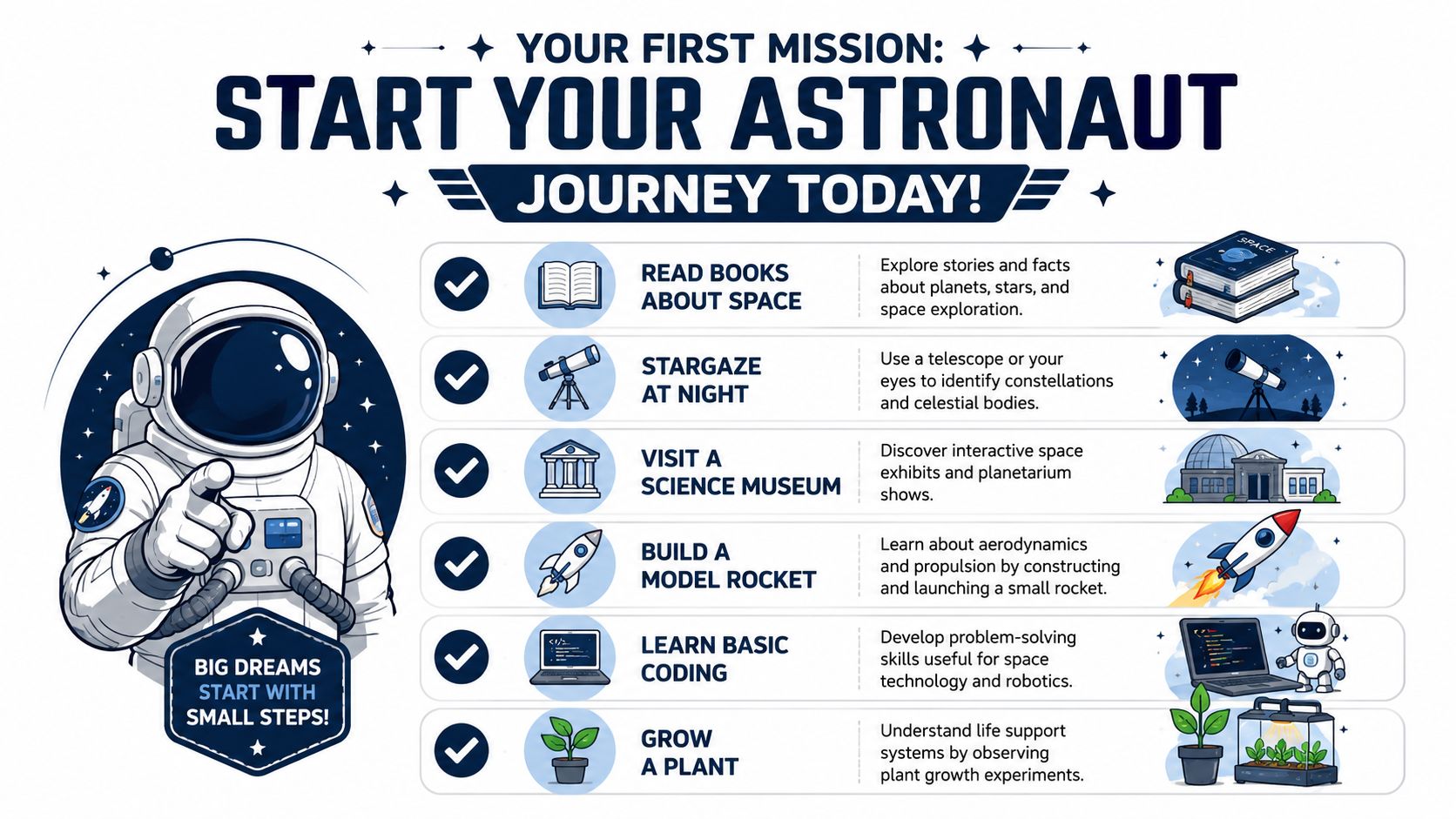
First missions for young explorers
A good first mission is anything that helps a child notice, test, build, or explain. A mission patch teaches planning and imagination. A stargazing journal trains careful observation, a bit like being a space detective. Growing a plant builds patience because science often means waiting, watching, and writing down what changed.
Here are a few great starter missions:
- Design a mission patch for your own space adventure
- Keep a stargazing journal and draw what you notice
- Build a model rocket from simple craft materials
- Grow a plant and observe changes like a scientist
- Read space stories and fact books together
- Practise explaining your ideas aloud like mission control
Each one adds a tool to the astronaut toolkit. Creativity helps with new ideas. Patience helps when experiments take time. Communication helps a team solve problems together. Secret astronaut truth. Space is full of teamwork.
A simple confidence ladder
Children also need a way to hear their own progress.
Try this short ladder:
- I think
- I try
- I can
- I can explain
That little sequence works like climbing steps on a launch tower. First comes curiosity. Then effort. Then confidence. Then sharing what you learned so someone else can learn too.
That is the beginning of an astronaut mindset. Fred does not need to know everything on day one. No child does. Explorers start by wondering, testing, asking for help, and coming back for another try.
And here is the best part. A child who reads carefully, solves problems, listens to teammates, and stays curious is already practising how explorers grow.