
A child colours Saturn's rings purple, gives Mars a stripy scarf, and suddenly asks, “Why do some planets have moons and others don't?” That's the moment the worksheet stops being filler and starts becoming a launchpad.
Most adults treat solar system colouring pages as a quiet task. We think that misses the best bit. Used well, they can build pencil control, prompt science talk, and turn a rainy afternoon into a proper Space Ranger Fred mission. If you want the practical version, start with one sheet, one question, and one story. Then add a few crayons and see where the crew goes. For even more hands-on ideas, pair these printables with engaging science projects for kids.
Colouring itself has real value. In early years practice, colouring sheets help children train grip and manoeuvrability by holding pens, pencils, and crayons and trying to stay within lines, which supports fine motor development for children aged 2 to 6, as discussed in Famly's guide to colouring sheets in early years. UK educators also use colouring as a simple way to help children wind down into a calmer, more focused mood, and resources on Twinkl's colouring sheets pages show how widely this fits classroom routines.
That's why this list isn't just a directory. It's a mission briefing. These are your mission supplies for home corners, library tables, wet play boxes, World Book Day displays, and those “I've got ten minutes before lunch” classroom moments.
1. NASA Space Place Solar System Coloring Pages
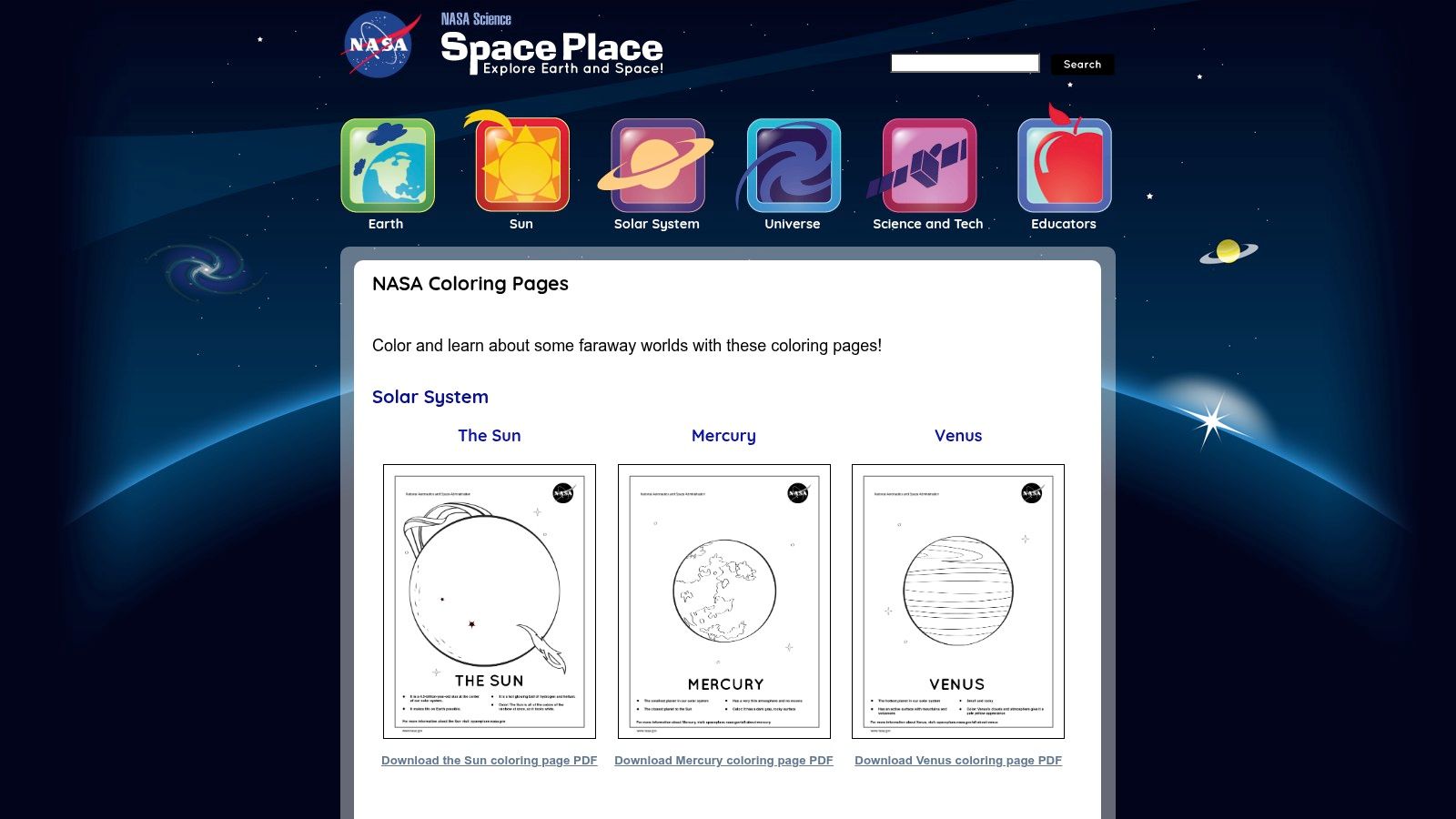
Alt text: solar system colouring pages from NASA Space Place
NASA Space Place solar system colouring pages feel like the dependable torch in your classroom supply kit. You go there when you want clean printables, recognisable planet shapes, and a source that already carries scientific trust.
The range is broad without becoming messy. You'll find sheets for the Sun, the planets, the Moon, and mission-linked pages that bring in spacecraft too. That makes it handy for homework packs and for carousel activities where one table colours Mars while another table tackles a rover.
Why it works on a busy day
The artwork is simple. This very simplicity is a strength. Younger children don't get overwhelmed, and older ones can add their own detail, labels, or background stars.
- Best for accuracy: NASA-backed material helps if you want a science-first starting point.
- Best for easy printing: The pages are straightforward black-and-white sheets that work well in class sets.
- Best for themed weeks: Mission pages give you a bridge from “planet names” to “how humans explore space”.
Practical rule: If you're using a factual sheet, let children choose creative colours first, then ask one science question after. Curiosity lands better when it doesn't feel like a test.
The main limitation is style. These aren't cutesy or character-led. If your child prefers smiling planets with big eyes, you may need a second source for variety. Still, for a no-fuss mission supply, this one earns a permanent place in the captain's folder.
2. NASA Science Coloring Books and Color Your Universe
NASA Science colouring books and activity collections are what you reach for when one page won't do. Instead of a single printable, you get hubs and bundles that can support a whole afternoon, a library station, or a mini topic week.
Some packs lean towards the Solar System. Others branch into the Sun, Earth, or specific missions. That wider spread is useful if your young astronaut starts with Jupiter and ends up asking about rockets, telescopes, or where astronauts go.
Strong choice for mixed activity packs
This hub suits adults who like options. One child can colour. Another can do a word find. A third can flick through a themed booklet and pick a favourite page.
Some children enter science through facts. Others enter through colouring, searching, or storytelling. A multi-activity pack gives each child a different door.
Because the collections vary, the style varies too. One PDF may feel polished and modern. Another may feel more like a classic worksheet. That inconsistency isn't a deal-breaker, but it does mean you should preview before printing twenty copies for a lesson.
If you're building a Space Ranger Fred-style mission session, this resource works nicely as your “base camp” pack. Add one challenge card, one discussion prompt, and one story moment. Suddenly the crew isn't just colouring Neptune. They're preparing for a deep-space patrol.
Mid-mission idea. Pair your printables with a read-aloud from the Space Ranger Fred books and ask children to choose which planet Zando would visit first and why.
3. ESA Colour with Paxi and Activity Books
ESA's Colour with Paxi has a slightly different flavour. It feels less like a printable warehouse and more like a cheerful European mission file. Paxi, ESA's friendly alien guide, gives the pages a bit of personality without turning the science into fluff.
That matters in a classroom. Some children warm to information fastest when a character escorts them in. Paxi can do that job neatly, especially when you want to soften the jump from simple colouring into astronomy talk.
A good fit for hands-on explorers
ESA's materials often combine colouring with cut-and-build activities and linked explainers. That gives you a natural progression.
- Start with colour: Children settle into the theme.
- Move to making: They cut, build, or assemble a related task.
- Finish with talk: You connect the activity to a planet, orbit, or mission idea.
This is particularly useful in mixed-ability groups. One child may stay with the colouring sheet. Another may tackle the build element. Both still feel part of the same mission.
The downside is navigation. ESA's children's resources can feel spread across different corners of the site, so it's not always the fastest place for a last-minute print job before registration. But if you've got a few minutes to explore, it rewards you with a broader, more playful toolkit than many one-sheet libraries.
4. Twinkl UK Solar System Colouring Sets
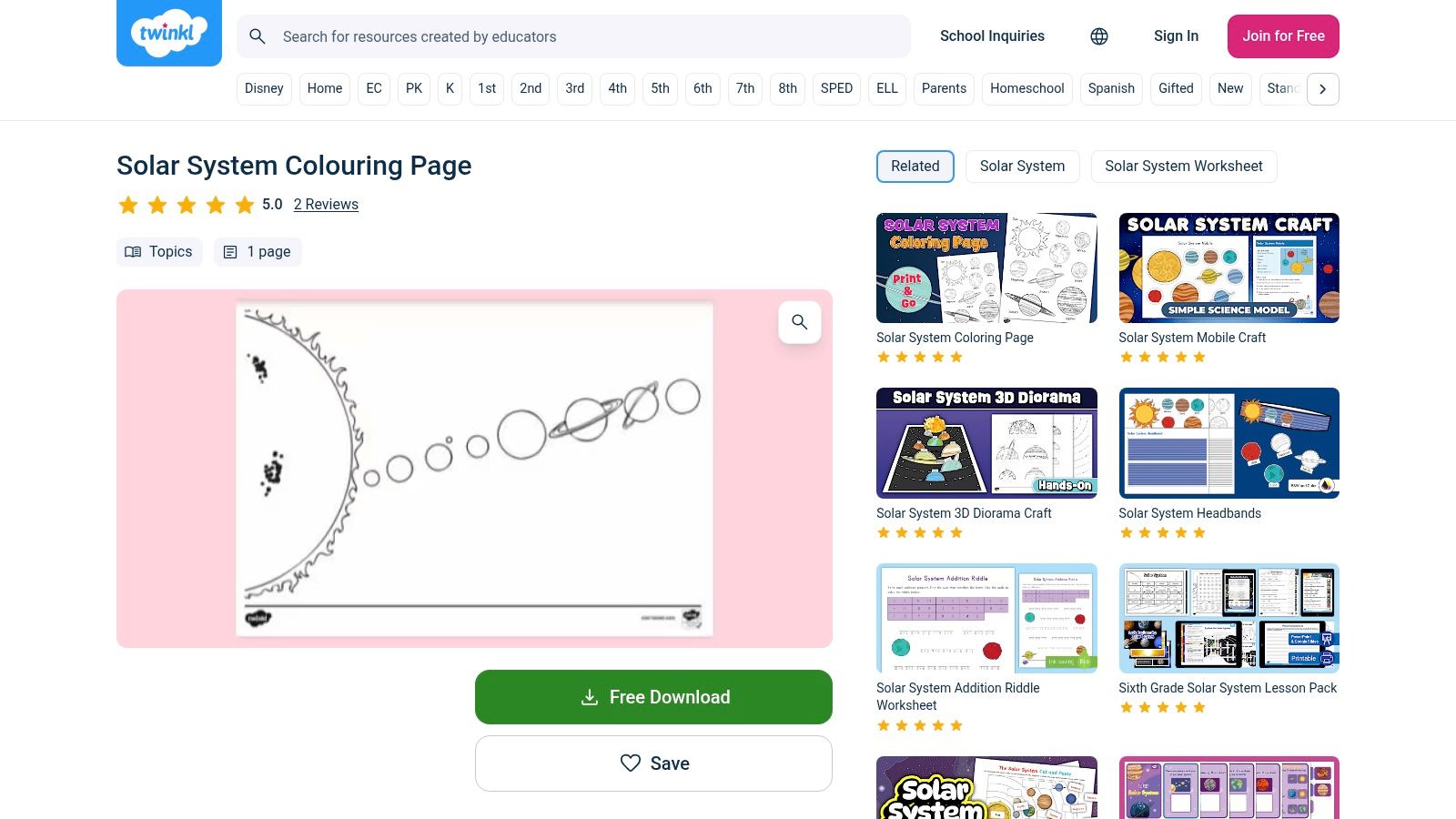
Alt text: solar system colouring pages from Twinkl UK
Twinkl's solar system colouring resources are the sort of mission supplies a teacher reaches for at 2:45pm when half the class wants Saturn's rings in glitter colours and the other half is still learning the planet names. The layout feels familiar in UK classrooms, the age guidance is clear, and the range is wide enough to support EYFS picture recognition through to KS2 topic work.
One of the biggest frustrations in primary teaching is finding something that works for more than one stage without feeling watered down. Twinkl handles that well. A simple colouring sheet can start the mission with younger children, while older pupils can move on to a more structured follow-up such as Twinkl's solar system answer colouring sheet page.
Where Twinkl shines
Twinkl is strongest when you want colouring pages to slot into a bigger space topic instead of standing alone. You can build a quiet starter, a display task, or a calm end-of-day activity from the same resource family, which saves teachers from stitching together mismatched materials from five different tabs.
That makes it especially handy for mixed-age rooms and busy classrooms.
Mission note: After lunch, a solar system mindfulness page can settle the cabin quickly. Children colour first, then share one fact they know about a planet before the next lesson begins.
There is one practical catch. Many of Twinkl's best pages are part of a membership library. For schools already using Twinkl, that usually feels normal. For a parent wanting one printable for tonight's home learning mission, the paywall may be the deciding factor.
5. TES UK Solar System and Planets Worksheets Coloring Pages
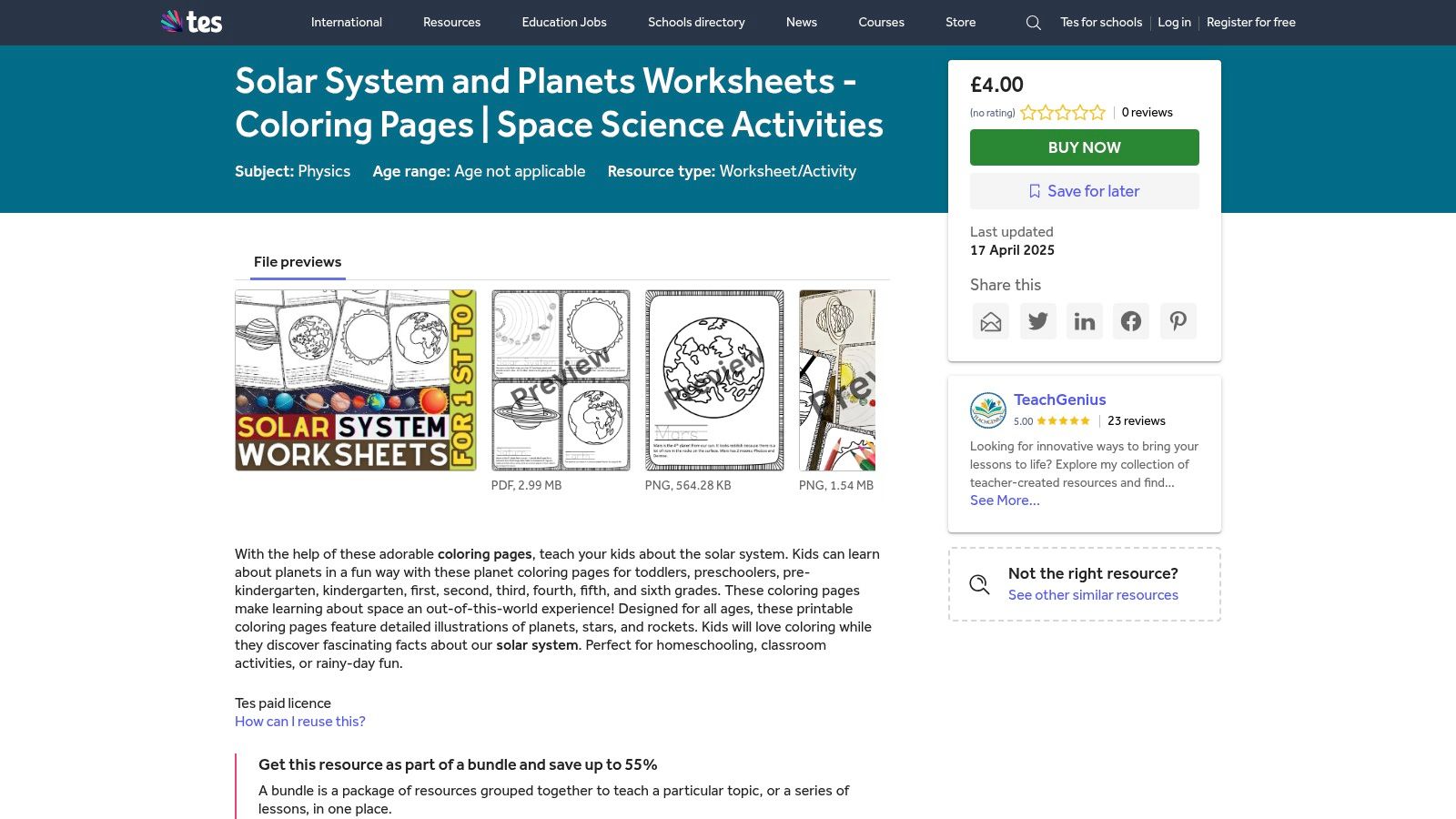
Alt text: solar system colouring pages on TES marketplace
TES solar system and planets colouring resources feel more like a market stall than a single shop. That's the appeal. Teachers create packs, bundle facts with colouring pages, and often include useful extras such as trace-the-word activities or quick-reference snippets.
If you prefer one-off purchases instead of subscriptions, TES is practical. You can browse, preview, and choose the pack that suits your class rather than signing up to a whole platform.
Best used with a teacher's eye
Marketplace resources always need a quick quality check. Some are excellent. Some are merely fine. Preview pages matter here more than they do on heavily standardised sites.
- Good for flexibility: You can buy exactly the pack you need.
- Good for topic bundles: Some listings combine colouring with writing or vocabulary tasks.
- Good for older pupils: Teacher-made packs often pitch a little higher than early years-only sites.
One example listing notes a price of £10.00 on the page itself, but TES pricing varies by seller and resource, so it's worth checking live before planning around it. For librarians and event organisers, that one-off model can be handy when you need a themed set for a short-term display or workshop without committing to another membership.
6. Activity Village UK Space Colouring Pages
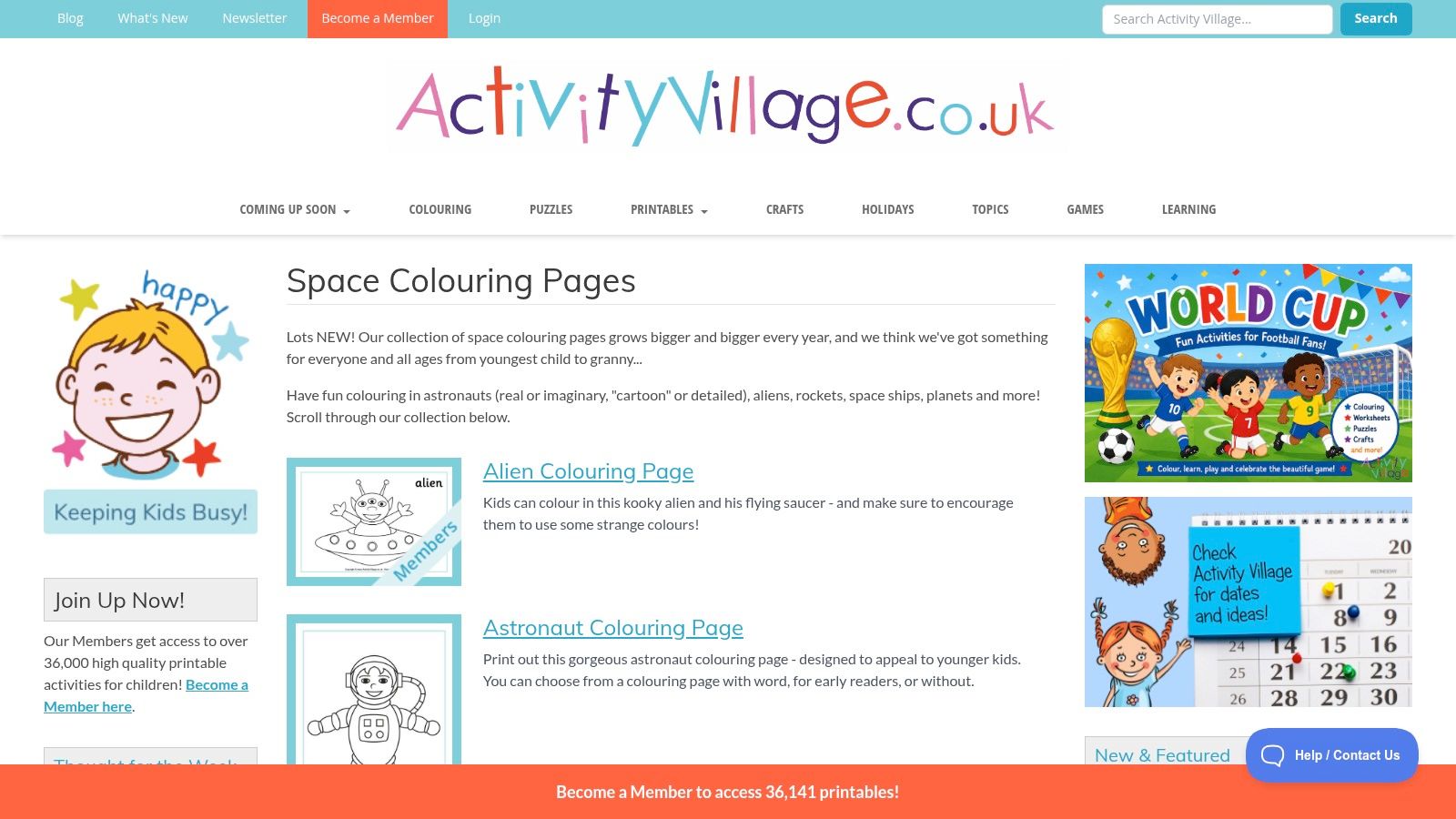
Alt text: solar system colouring pages from Activity Village
A reception teacher prepping for a rainy lunchtime, a parent setting up a quiet corner before dinner, a teaching assistant needing one more space activity for early finishers. Activity Village space colouring pages fit those moments beautifully. They have that ready-to-go feel that makes good mission supplies. Print, hand out, and the room settles into focused colouring surprisingly quickly.
The artwork is friendly rather than fussy. That makes these pages a strong pick for younger children who still need bold outlines and familiar shapes instead of tiny labels and crowded detail. Once coloured, they also look cheerful on a classroom wall or bedroom door, which helps children feel proud of their work.
A gentle launchpad for early space adventures
Some children love planets but hesitate the second a worksheet looks complicated. Activity Village handles that problem well. The pages are approachable, the themes are recognisable, and the task feels doable from the start.
Colouring supports pencil control too. Twinkl notes that solar system colouring pages for children aged 5 to 7 support fine motor skills linked to writing readiness, which matches how many teachers and parents use simple space printables in the early years and lower primary.
The limitation is clear enough. If your lesson goal is to memorise planet order, practise key vocabulary, or study labelled diagrams, Activity Village will usually need backup from a more fact-led source. Visual aids also matter for memory, but these sheets work best as the inviting first step, not the whole mission plan.
A nice Space Ranger Fred-style approach is to use these pages at the art table, then follow with a spoken challenge. Ask, “Which planet did you colour hottest?” or “Which one would you visit first and why?” That small shift turns a simple colouring sheet into the start of a real space conversation.
7. SuperColoring Solar System Category
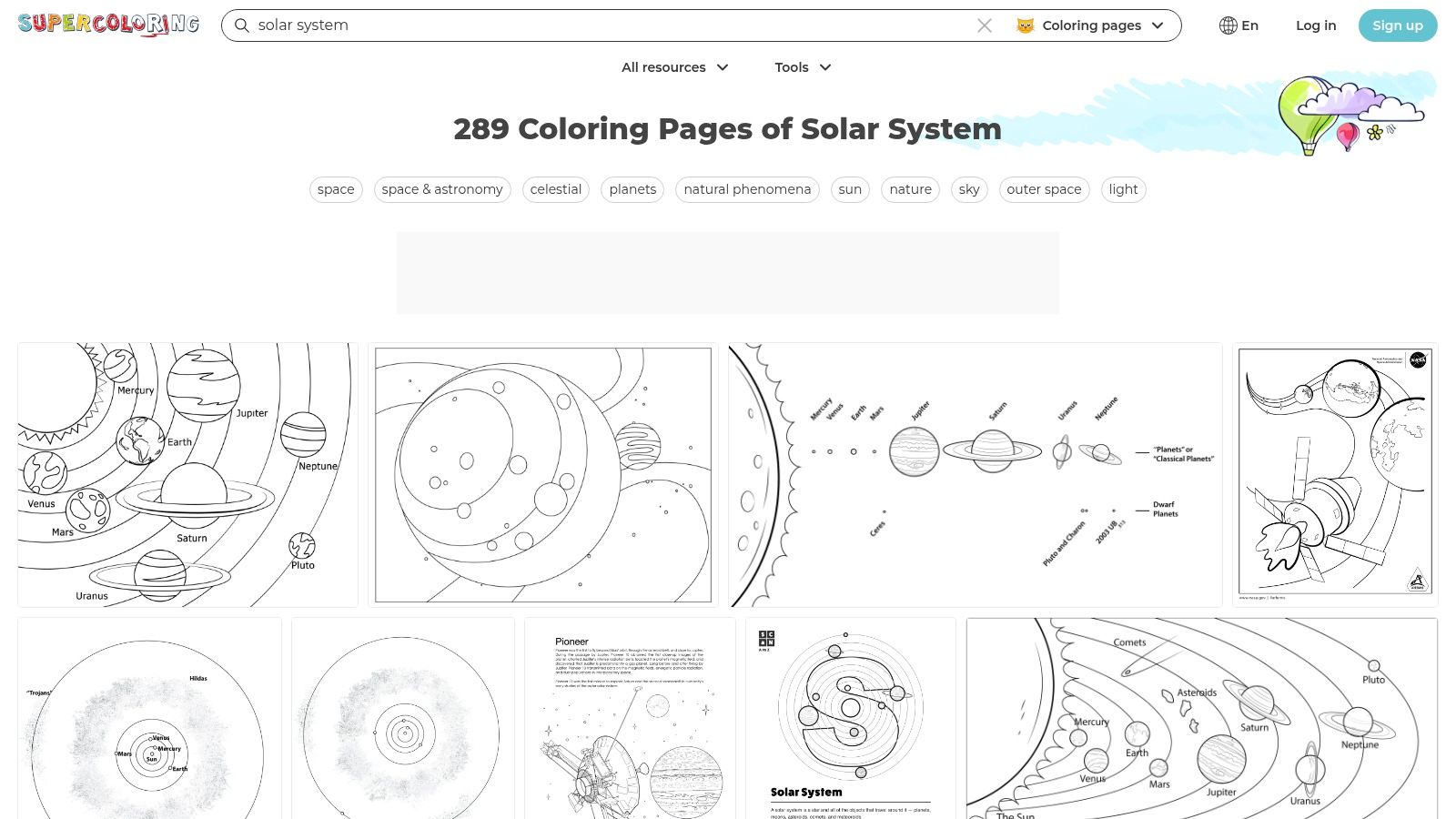
Alt text: solar system colouring pages gallery on SuperColoring
SuperColoring's solar system category is the giant supply cupboard. When you need volume, variety, and a quick search result, it's hard to ignore. The library includes full-system scenes, planets, spacecraft, and colour-by-number styles.
That kind of range is useful for homes and classrooms where children of different ages all want “a space sheet” but definitely don't want the same one.
Great for choice, less ideal for curation
You can find simple pages for younger children and more detailed pages for older ones. There's even an online colouring option, which some families may like on tablets.
A huge gallery is brilliant when you need options fast. It's less brilliant if you assume every labelled diagram has been checked to the same standard.
That's the key caution. Because the collection is broad, adults should quickly vet any page they plan to use for formal teaching, especially if labels or planet order matter. Ads can also distract on a shared screen.
Still, if your mission calls for “something for everyone”, SuperColoring is handy. Think of it as the mixed crate of crayons, stickers, and mystery supplies. Not every item becomes part of the lesson, but there's usually something in there that saves the day.
8. Education.com Planet Coloring Pages
Education.com's planet colouring pages feel like mission cards for a quiet but effective space lesson. A child picks Mars, starts shading in the red surface, then pauses to read a short fact beside the picture. A minute later, they are announcing to the room that Mars is dusty, cold, and worth remembering. That shift from colouring to explaining is what makes these pages useful.
For parents and teachers building a Space Ranger Fred-style adventure, that matters. You are not handing out a page just to fill ten minutes. You are giving young explorers a prompt to notice, read, say something aloud, and carry one clear idea into the next activity.
A strong fit for mini missions
The one-page-per-planet format keeps the lesson tidy. You can assign each child a different world, set up a simple astronaut briefing where everyone shares one fact, or pin the finished pages to the wall and turn the display into a solar system gallery.
The same principle applies here as in other good cross-curricular resources. Colouring supports vocabulary when children connect a word to a picture and then use that word in speech or writing. Education.com makes that easy because the reading load stays short and manageable.
A few practical uses stand out:
- Reading corner missions: children colour first, then read one fact aloud to a partner
- Homework packs: one sheet gives families a clear task with a natural discussion prompt
- Classroom displays: finished planet pages paired with a copied sentence create a science wall quickly
The catch is access. You will need an account, and some materials depend on membership level. Still, if your mission supplies need a printable that blends art, early reading, and confident retelling, this collection earns a place in the kit.
9. National Space Centre UK Post-visit Worksheets with Colour Tasks
Alt text: solar system colouring pages from National Space Centre UK resources
National Space Centre education resources use colouring in a slightly smarter way than many printable libraries. Instead of treating colour as decoration only, some tasks use it to check understanding. Colour green if true. Mark an idea by shade. Show what you know through the page itself.
That makes these resources especially useful after a museum visit, a themed workshop, or a class topic on Earth, Sun, and Moon relationships.
Strong for follow-up learning
If you've ever returned from a trip with excited children and no structure for the next lesson, this solves a familiar problem. The page becomes a bridge between the fun day out and the science concepts you want to stick.
In UK primary practice, creative activities linked with STEM can improve engagement with scientific facts about the Solar System, according to a survey cited on 123 Homeschool 4 Me's solar system colouring page roundup. The National Space Centre approach fits that spirit well because the colouring serves understanding, not just decoration.
These aren't the broadest printables for pure colouring fun. You won't get a giant library of one-planet pages. But for teachers who want evidence of learning tucked inside a creative task, this is a strong mission tool.
10. CPforKids Solar System Coloring Pages
Alt text: solar system colouring pages from CPforKids
CPforKids solar system colouring pages are generous, organised, and easy to grab in bulk. The mix of realistic and cute designs gives them broad appeal, which is useful when one child wants “real space” and another wants a smiling Saturn.
The labelled versions are where this set becomes especially practical for learning. A child can colour, point, and name. That's a strong trio.
A flexible pick for home and school
This resource suits print-and-go adults. If you need a stack for a club, family event, library craft table, or mixed-age classroom, bulk access is a real advantage.
Visual aids also matter for memory. Research cited on Teachers Pay Teachers solar system colouring listings notes that labelled planets paired with hands-on activity can improve recall accuracy when children learn the order of the planets. That makes labelled sheets more than a nice extra.
The caution is simple. CPforKids isn't a formal education publisher, so if you're teaching from the labelled diagrams, it's wise to review them first and match them to your own classroom preferences. Still, for free variety and easy downloading, this is a very usable mission pack.
Top 10 Solar System Colouring Pages: Comparison
| Resource | Core features | Educational quality & usability | Best for / Target audience | Cost & access |
|---|---|---|---|---|
| NASA Space Place – Solar System Coloring Pages | Individual planet PDFs, Moon, spacecraft/mission tie-ins, accurate line art | NASA-vetted science; simple kid-friendly art; limited teacher notes | Classrooms or events needing scientifically accurate planet shapes (ages 6–12) | Free, no sign-up |
| NASA Science – Coloring Books / "Color Your Universe" | Multi-page books, theme bundles, colouring + activities | High scientific trust; wide age span; design complexity varies | Building multi-activity toolkits and event packs | Free; hub with linked mission resources |
| ESA – Colour with Paxi & Activity Books | Paxi character sheets, colour-and-build books, multilingual content | European curriculum alignment; good multimedia lesson tie-ins; navigation can be scattered | UK/EU classrooms and mixed-ability groups | Free downloads (site navigation varies) |
| Twinkl (UK) – Solar System Colouring Sets | Level-targeted EYFS–KS2 sheets, mindfulness/doodle variants, topic collections | Strong UK curriculum tags; wide stylistic variety; teacher-ready | UK teachers needing fast lesson alignment and level differentiation | Paid membership required (pricing varies) |
| TES (UK) – Marketplace Packs | Teacher-created printable bundles with facts and activities, reviews | Quality varies by seller; review system helps vet resources | Teachers preferring one-off purchases and varied styles | One-off purchases per pack; prices vary (marketplace) |
| Activity Village (UK) – Space Colouring Pages | Simple, mass-printable line art, “colour pop” pages, display collections | Clear designs for early years; good for bulk printing; some content paid | Early years and primary classrooms, display resources | Mix of free and membership content |
| SuperColoring – Solar System Category | 200+ printables, searchable subtopics, online colouring option | Extremely extensive but mixed curation; site ads present | Quick variety for different ages and skill levels | Free with ads |
| Education.com – Planet Coloring Pages (with facts) | One page per planet with short facts; download/manage tools | Facts reinforce learning; clean layouts; download limits on free accounts | Integrating literacy and classroom discussion (primary ages) | Basic free account with limits; Premium subscription for unlimited access |
| National Space Centre (UK) – Post-visit Worksheets | Colour-to-check-understanding prompts, KS2-aligned PDFs, post-visit focus | Trusted institution; integrates colouring with concept checks | Museum follow-ups and KS2 lessons that need assessment tasks | Mostly free museum education resources |
| CPforKids – Solar System Coloring Pages (34 Free PDFs) | 30+ A4/Letter PDFs, mix of realistic and cute, labelled versions | Free bulk variety; not formal publisher so check labeled accuracy; few teacher notes | Bulk printing for events, mixed-age groups, casual/home use | Free bulk downloads |
Final Thoughts
The best solar system colouring pages don't just keep children busy. They give adults a low-pressure way to invite questions. Why is Neptune blue? Why does Saturn have rings? Which planet would Zando visit if his snacks ran out on Mars?
That's where these pages become more than paper. They become mission supplies. One child practises grip and pencil control. Another builds vocabulary. Another starts connecting planets, spacecraft, and stories into a bigger picture of how space works. In UK settings, colouring is already used to help children settle, focus, and practise learning across topics, and that's part of why these resources work so well in homes, libraries, and classrooms.
There's also a practical reason to take them seriously. The broader colouring books for toddlers market reached USD 1.72 billion in 2024, with the UK segment valued at USD 380 million in 2024 and projected to grow at a higher CAGR through 2033, according to Growth Market Reports on colouring books for toddlers. Even though that market is wider than space resources alone, it shows how strong the appetite remains for printable and book-based creative learning.
If you want the safest factual starting point, NASA Space Place is excellent. If you want curriculum convenience, Twinkl is strong. If you want broad choice, SuperColoring and CPforKids are useful. If you want colouring plus literacy, Education.com works well. And if you want a more immersive classroom feel, ESA and the National Space Centre bring in that wider sense of exploration.
My own favourite approach is simple. Don't hand over a page and walk away. Hand over a page and a mission.
Try this:
- Give a role: “You're the colour commander for Jupiter.”
- Ask one question: “What do you notice first?”
- Invite one explanation: “Tell mission control what this planet is like.”
That tiny shift builds the menturity layer children need. I think. I try. I can. I can explain.
For families and teachers who want to stretch the creative side, these sheets also pair nicely with adventure art for space lovers. Add a story, a challenge, and a bit of laughter, and your colouring table starts to feel less like seatwork and more like a launchpad.
If you'd like one extra mission layer, connect the pages to a story-led universe. A printable of Saturn becomes more memorable when it's tied to a character, a problem to solve, or a crew adventure. That's the Space Ranger Fred way. Learning should be experienced, not just delivered.
Space missions are always better with a crew. Explore the world of Space Ranger Fred for story-led STEM fun, discover books that make children laugh while they learn, browse activity extras for home or school, and invite the team in for interactive school visits that build confidence, reading, communication, and big curiosity about space.