So, you think you know what astronauts do in space? If your mind jumps to floating around and taking selfies with Earth, you're only seeing a tiny piece of the cosmic puzzle! An astronaut's day is a jam-packed schedule of mind-bending science, keeping their high-tech home from falling apart, and trying not to get dizzy.
A Day in an Astronaut's Orbiting Office
Imagine your office is also your house, your gym, and a world-class science lab, all hurtling around the planet at a face-melting 17,000 miles per hour. Welcome to life on the International Space Station (ISS)! Every single second is planned with military precision by the folks in mission control.
So, what are their main gigs? One moment, they're a scientist running an experiment you can only do in zero-g. The next, they're a plumber fixing a space toilet (more on that later, it's a wild ride). Sometimes, they even have to pop outside for a spacewalk to fix something on the station's exterior. It's a bit like the problem-solving in Space Ranger Fred and the Shoelace Adventure, where teamwork and a clever plan are everything.
And, of course, they have to work out constantly to stop their muscles from turning to jelly. But what about the really, really important stuff? Yep, we're talking about going to the bathroom. Let's just say it involves a special vacuum and some very careful aiming to prevent a floating disaster. It's not glamorous, but it's definitely one of the most talked-about parts of space life!
The infographic below gives you a sneak peek into a typical 24-hour cycle for an astronaut.
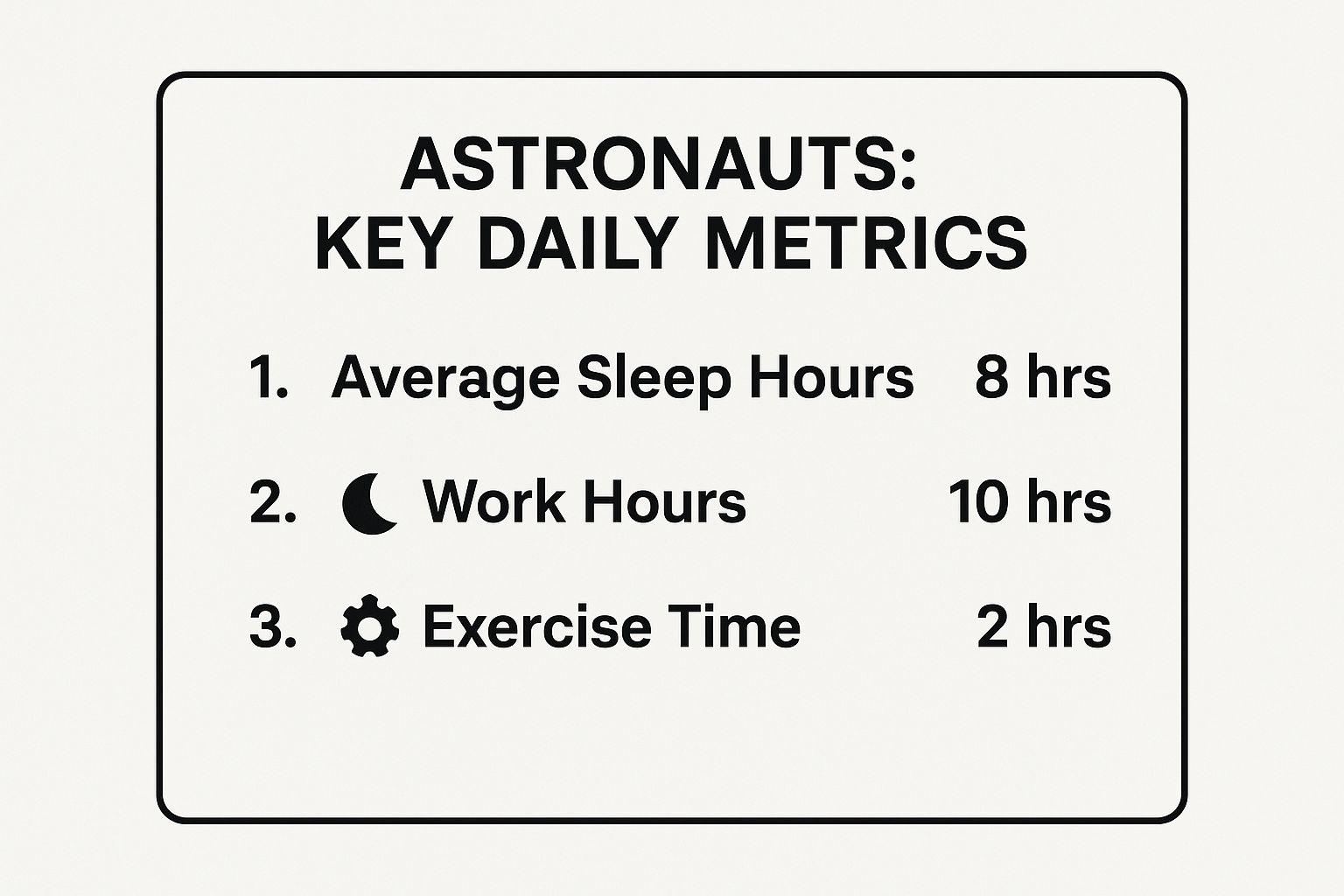
As you can see, their day is a careful balancing act between work, rest, and that all-important exercise to stay healthy and strong while orbiting our planet.
An Astronaut's Daily Mission Checklist
To give you a clearer picture, we've broken down an astronaut's main responsibilities into a quick mission checklist. These are the core activities that fill their busy days aboard the ISS.
| Activity Category | What It Involves |
|---|---|
| Scientific Research | Conducting experiments in biology, physics, and human physiology that can only be done in microgravity. |
| Station Maintenance | Checking systems, repairing equipment, and ensuring the ISS is a safe and functional home and laboratory. |
| Health and Fitness | Working out for 2 hours every day using special equipment to counteract muscle and bone loss. |
| Spacewalks (EVAs) | Performing Extravehicular Activities to install new hardware or make repairs on the outside of the station. |
| Housekeeping | Keeping the station clean, managing waste, and taking inventory of supplies. |
| Personal Time | Reading, watching films, talking to family back on Earth, and enjoying the incredible view from the window. |
From complex science to simple cleaning, every task is vital for the success of the mission and the well-being of the crew. It’s a true team effort, hundreds of miles above the Earth
Running Experiments in a Floating Science Lab
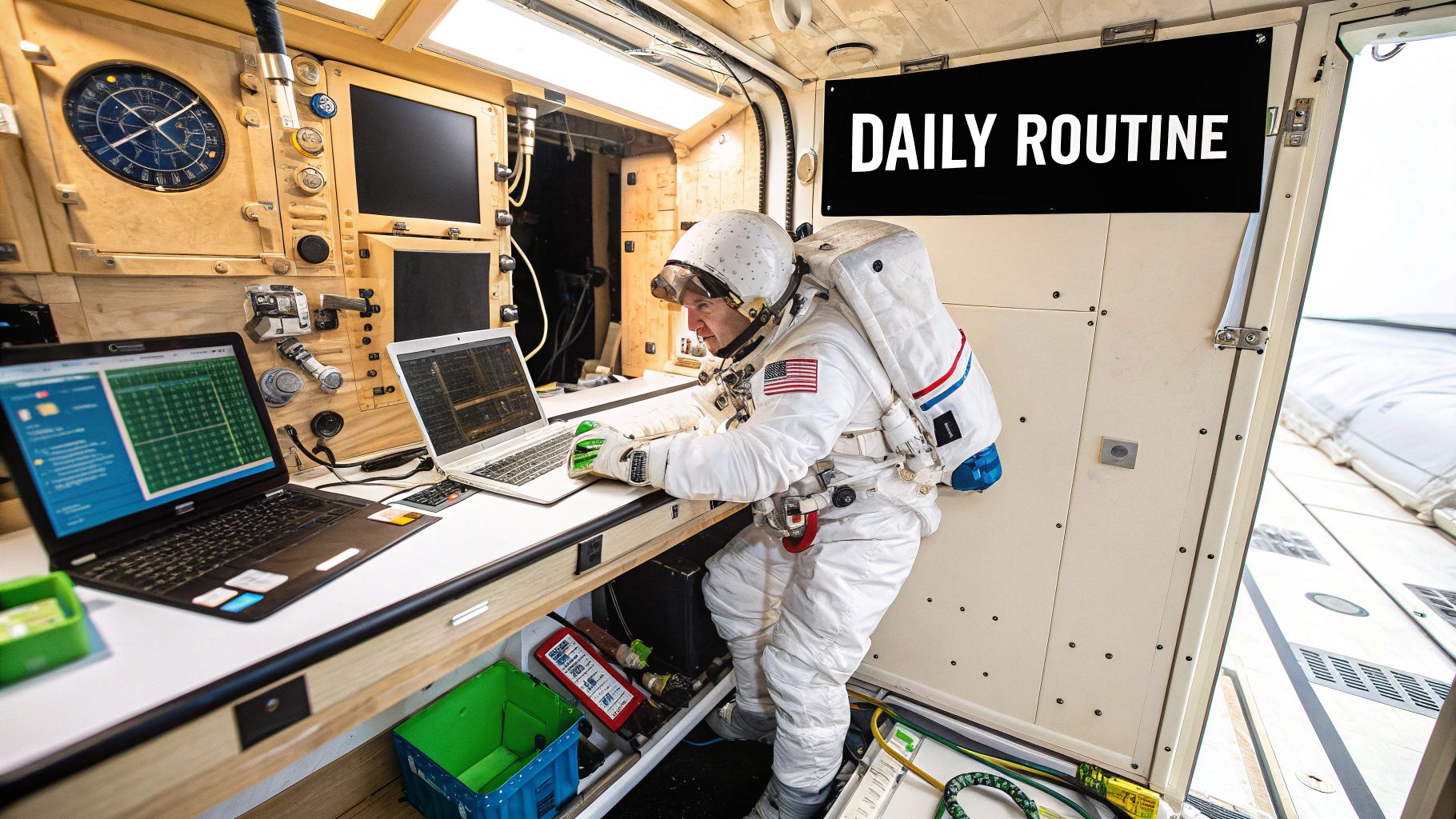
A massive part of an astronaut’s job is being a scientist in what has to be the most extraordinary laboratory imaginable. The International Space Station (ISS) is absolutely packed with experiments, each designed to help us understand our universe a little better and improve life back on Earth.
In the weightless environment of space, a condition known as microgravity, things behave in weird and wonderful ways. Liquids don’t pour like they should, flames burn in perfect spheres, and even tiny specks of dust float differently. This makes the ISS the perfect place to run tests that would be completely impossible down here.
Discoveries in Microgravity
What kind of tests? Well, astronauts might be studying how to grow plants without any soil, a vital skill if we ever want to make the long journey to Mars and have fresh food. They also look at how fire behaves without gravity, which helps us improve fire safety both on Earth and in future spacecraft.
By studying how their own bodies adapt to long-term spaceflight, astronauts are essentially living experiments. This research is vital for planning future deep-space missions and also provides valuable insights into health problems on Earth, such as muscle and bone loss.
Another fascinating area of research is creating new medicines. On Earth, gravity can mess with the process of growing pure crystals needed for some treatments. But in microgravity, you can grow perfect crystals, which could lead to much more effective medicines.
Problem Solving in Orbit
Of course, science rarely goes exactly to plan! Just like in Space Ranger Fred and the Shoelace Adventure, astronauts often need to think on their feet, using their curiosity and sharp problem-solving skills to fix a piece of equipment or tweak an experiment that isn't working.
Every day brings a fresh set of challenges and the chance for a new discovery. During a typical six-month mission, the crew will conduct over 200 experiments, covering everything from biology to physics. They follow detailed instructions sent up from scientists on the ground, carefully recording every bit of data and observing the results.
Their work isn’t just for future space explorers, either. It leads to real-world benefits for all of us, from medical breakthroughs to advanced new materials. It’s a truly cosmic collaboration between the crew floating in orbit and the dedicated science teams back home.
Keeping the Space Station Safe and Sound
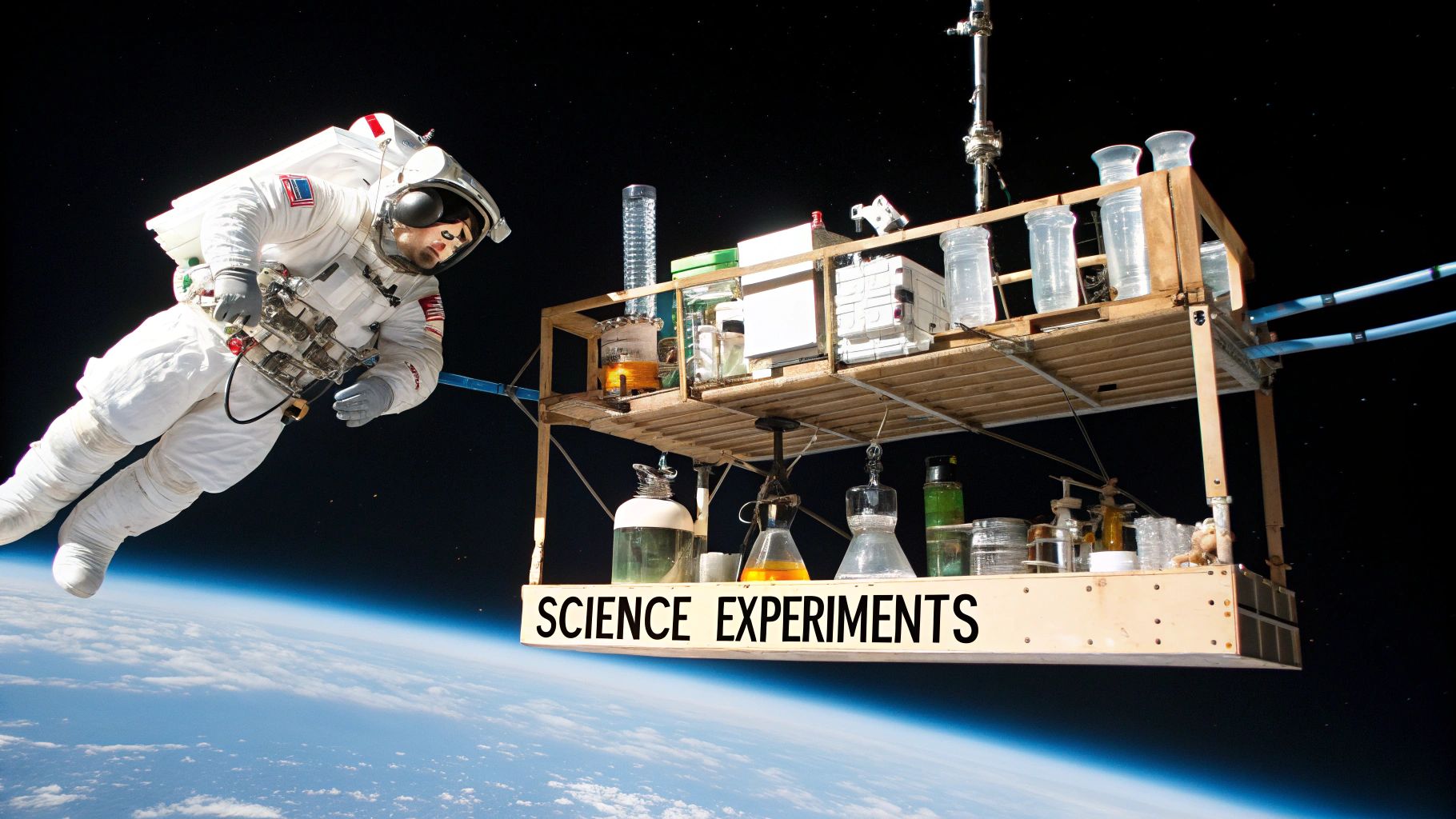
Picture your home, but imagine it’s a gigantic, complex machine hurtling through space at thousands of miles per hour. Keeping it running isn’t just a chore; it’s a matter of survival! A massive part of an astronaut's day is dedicated to maintenance, making sure the International Space Station (ISS) is safe and working perfectly.
This is far more than just wiping down surfaces, although cleaning is definitely on the to-do list. The jobs can be anything from fixing vital scientific equipment and upgrading computer systems to cleaning out air filters and carefully unpacking cargo that arrives from Earth. Every single system needs constant attention.
The Ultimate Repair Job: A Spacewalk
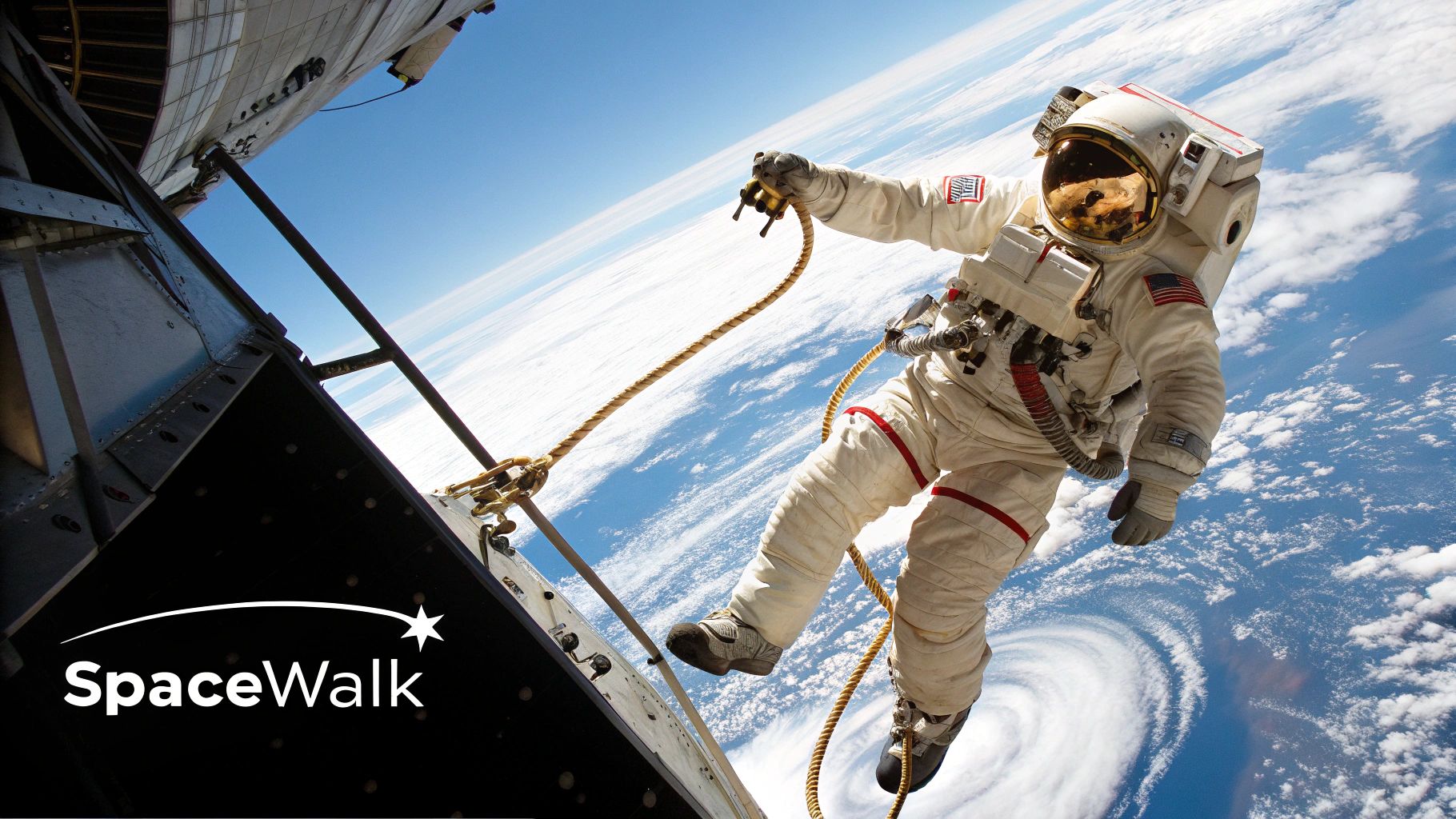
One of the most thrilling and dangerous jobs an astronaut can tackle is a spacewalk, or what's officially known as an Extravehicular Activity (EVA). During an EVA, astronauts climb into bulky, life-sustaining spacesuits and venture outside the station to carry out repairs or install new hardware.
They are always tethered to the station, of course, but floating in the absolute blackness of space with our blue planet spinning below them takes incredible focus, skill, and bravery. A single spacewalk can last for more than seven hours, pushing the crew's physical and mental endurance to the limit. It’s a task where there's simply no room for error.
Even the most ordinary-sounding jobs are critical to the mission's success. Forgetting to secure a tool or missing a single step on a checklist could have huge consequences, a bit like in the book Space Ranger Fred and the Umbrella Rescue, where having the right tools and a clear plan is the key to tackling unexpected problems.
This constant hard work ensures the ISS remains a safe home and a world-class science lab for everyone on board. From tightening a single bolt outside to updating software inside, the crew works together as a team of high-flying caretakers.
Staying Strong with a Zero-Gravity Workout
Living without gravity sounds like a blast, but it’s surprisingly tough on the human body. Here on Earth, just standing up is a workout because our muscles and bones are constantly fighting gravity’s pull. In space, that resistance is gone, and an astronaut's body can start to weaken very quickly.
That's why one of the most important jobs on their daily schedule is hitting the gym. To stop their muscles and bones from fading away, astronauts spend about two hours every single day exercising.
A Gym Built for Space
But you can’t just pack a set of dumbbells for a trip to orbit. How do you lift weights when everything is weightless? The gym equipment on the International Space Station (ISS) is specially designed for this exact problem.
- The Treadmill: To get their cardio in, astronauts have to be strapped down with a harness. Without it, they’d just float away with their first step! This setup creates the impact needed for a proper run.
- The Resistance Machine (ARED): To build muscle, they use a clever machine called the Advanced Resistive Exercise Device. Instead of heavy metal plates, ARED uses powerful vacuum cylinders to create resistance, cleverly mimicking the feeling of lifting weights back on Earth.
- The Stationary Bike: A space-age exercise bike is also on board to keep their legs and heart strong, which is vital for overall health on long missions.
This intense fitness routine is crucial for ensuring astronauts return to Earth strong and healthy. It's a perfect example of how discipline and sticking to a plan are absolutely essential in space.
This dedication to a daily plan is a lesson also found in Space Ranger Fred and the Tick Tock Tale, where following a clear schedule leads to a successful and safe outcome for the mission. It proves that whether you’re on Earth or in orbit, routine is key
How Astronauts Use the Toilet in Space
Okay, let’s talk about the thing everyone secretly wonders: how on Earth (or off it) do astronauts go to the bathroom? Forget everything you know about toilets. In space, it’s less of a flush and more of a… well, a vacuum cleaner for your bum.
On Earth, good old gravity makes sure everything goes down. But in space? Without suction, you’d have a seriously gross situation on your hands. To prevent floating "unidentified objects" from bumping into the computers, space toilets use air currents to pull waste away.
Number One vs. Number Two: A Tale of Two Vacuums
The space commode has two main parts, because in zero-g, you need a different strategy for different… business.
- For 'number one', there's a hose with a funnel at the end. Astronauts (both men and women use it) have to aim carefully as a fan sucks the liquid away. Miss, and you've got a floating puddle to chase.
- For 'number two', there's a tiny seat, way smaller than your toilet at home. When you "go," a powerful fan whizzes everything into a sealed bag. And yes, practice is key. Astronauts actually train on a special "potty trainer" on Earth that has a camera inside to help them perfect their aim!
It might sound hilarious, but this clever engineering is what makes long-term space missions possible. So next time you use your boring, gravity-assisted toilet, spare a thought for the astronauts and their high-tech suction loos!
For more amazing tidbits, you can discover a universe of other cool space facts for kids in our detailed guide.
This attention to detail is crucial for every part of life in space. Just like in Space Ranger Fred and the Tick Tock Tale, where planning and precision save the day, even something as simple as using the toilet requires clever thinking and careful execution to ensure a successful mission.
The UK's Exciting Future in Space Exploration
When you think of astronauts, you might picture American or Russian space explorers, but the United Kingdom is becoming a real trailblazer in the global space adventure! British heroes have already blasted into orbit, contributing to incredible scientific discoveries high above our heads.
Now, Britain is setting its sights even higher. By joining forces with private companies and other space agencies, the UK is cooking up brand-new missions. These will see more British astronauts floating in space, running amazing experiments, and inspiring a whole new generation of stargazers. Who knows, maybe one of them will even invent a better space toilet!
A New British Mission
The UK's space dreams are getting bigger and bolder. The UK Space Agency (UKSA) is teaming up with commercial space companies to launch an exciting new mission. The plan is for a UK-led flight to head into orbit for about two weeks, with British astronauts on board.
During their time in space, they'll be busy with crucial science experiments and connecting with kids back on Earth. It's proof that no matter where you're from, you can dream of reaching for the stars. You can learn more about the UK's amazing plans and other stories about space exploration for kids on our blog.
Just like in Space Ranger Fred and the Tick Tock Tale, where careful planning leads to success, these future missions are built on years of preparation and teamwork. It's an exciting time for space exploration for kids who dream of one day floating among the stars.
Your Questions Answered!
You’ve learned loads about what astronauts get up to on their missions, but I bet you still have a few questions floating around. Let's tackle some of the most common ones.
How Do Astronauts Sleep in Space?
With no gravity to keep you in bed, you’d just float away in your sleep! To stop that from happening, astronauts zip themselves into special sleeping bags. These aren't like the ones you'd use for camping—they're attached to the walls or bunks inside a small crew cabin to keep them safe and snug all night.
What’s for Dinner in Orbit?
Food in space has to be carefully prepared so crumbs and liquids don’t float off and damage equipment. Most of it is freeze-dried or packed in special pouches. When it's dinnertime, astronauts just add water to rehydrate their meals. They even drink from special bags with straws to make sure nothing escapes.
Fancy more fun tidbits? There are plenty of other amazing facts about astronauts to discover.
How Do They Keep in Touch with Family?
Even from hundreds of miles above the Earth, astronauts can still chat with their loved ones. They use internet phone calls and video chats to catch up with family and friends back home. Having email also helps them share stories from their out-of-this-world adventures, making home feel a little bit closer.
Ready for an adventure? Space Ranger Fred books, like Space Ranger Fred and the Tick Tock Tale, make learning about space exciting and fun. Blast off into reading by visiting https://spacerangerfred.com today.