
So, what exactly is collaborative learning?
Put simply, it’s an approach where children work together in small groups towards a common goal. But honestly, it's so much more than just putting them at the same table. It’s all about active engagement, mutual support, and building knowledge together, as a team. This simple shift turns learning from a solo chore into a dynamic, social mission.
What Is Collaborative Learning Really?
Let’s go beyond the textbook definition. Think of collaborative learning like the mission crew in Space Ranger Fred and the Umbrella Rescue. It’s not about children just sitting in a group; it’s about them truly functioning as a team where every member’s unique skill is vital to cracking the code or solving the problem. This approach helps children build knowledge together by bouncing ideas off each other, explaining concepts in their own words, and combining their different strengths.
This active participation is where the magic happens. Instead of passively soaking up information, children become the creators of their own understanding. They learn to listen, negotiate, and even lead—developing essential social and thinking skills right alongside their academic knowledge. It’s a game-changer in STEM subjects, where tough problems often demand more than one perspective to solve.
Beyond Traditional Group Work
It's easy to mistake collaborative learning for the traditional group work we all remember from school, but they’re worlds apart. Old-school group work often just meant dividing up tasks and sticking them together at the end. True collaboration, however, requires constant interaction and a real sense of interdependence. For a related approach, you can check out our guide on what is project-based learning.
Collaborative learning isn’t about who finishes first; it’s about ensuring everyone crosses the finish line together, with a deeper understanding than when they started. It fosters a 'we sink or swim together' mentality that builds both character and intellect.
To make the distinction clearer, here’s a quick look at the key differences.
Group Work vs Collaborative Learning at a Glance
| Feature | Traditional Group Work | Collaborative Learning |
|---|---|---|
| Structure | Often loosely structured; tasks are simply divided. | Highly structured with clear roles and goals. |
| Accountability | Individual accountability can be unclear. | Both individual and group accountability are emphasised. |
| Interdependence | Low; pupils can often work in isolation. | High; success depends on everyone contributing and interacting. |
| Goal | Focus is on completing a final product. | Focus is on the learning process and mutual understanding. |
| Skills Taught | Primarily focused on task completion. | Develops social skills, communication, and problem-solving. |
As you can see, collaborative learning is a much more intentional and powerful process. The infographic below really drives home the advantages it has over individual study.
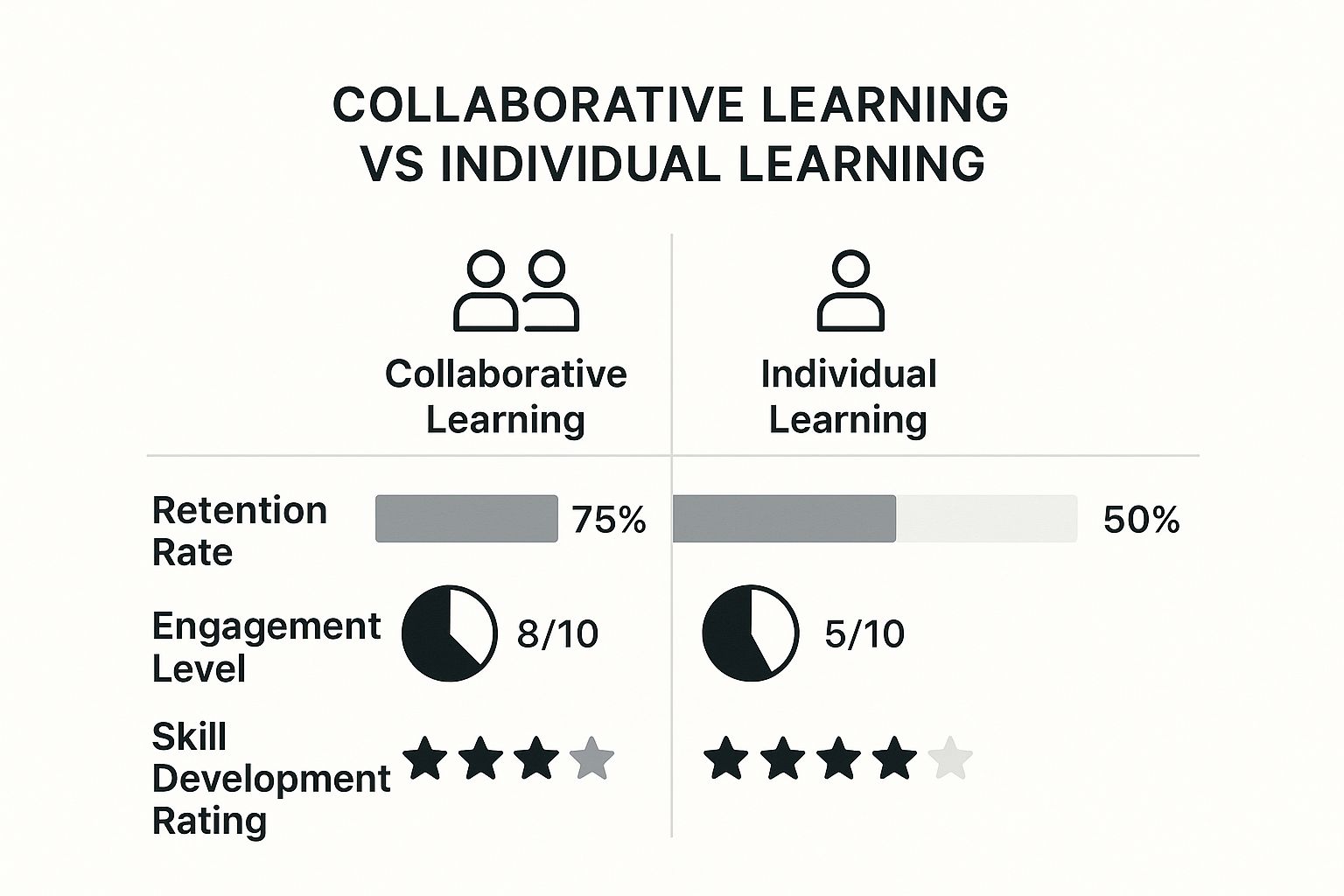
The data speaks for itself—this method seriously boosts knowledge retention and engagement. In fact, the impact is well-documented right here in the UK. Research has shown that collaborative learning can produce incredible academic gains, with pupils making an average of an additional five months’ progress in a single school year. You can dive into these findings from the Education Endowment Foundation yourself. It’s proof that this isn't just a nice idea; it's a powerful strategy for real, measurable growth.
The Science Behind Why Teamwork Boosts Learning
Have you ever been stuck on a problem, tried to explain it to a friend, and suddenly had the solution click into place? That’s the magic of collaborative learning in action. There’s some fascinating science behind why teamwork is such a powerful tool, especially for tricky STEM subjects. It’s not just about sharing answers—it’s about building understanding, together.
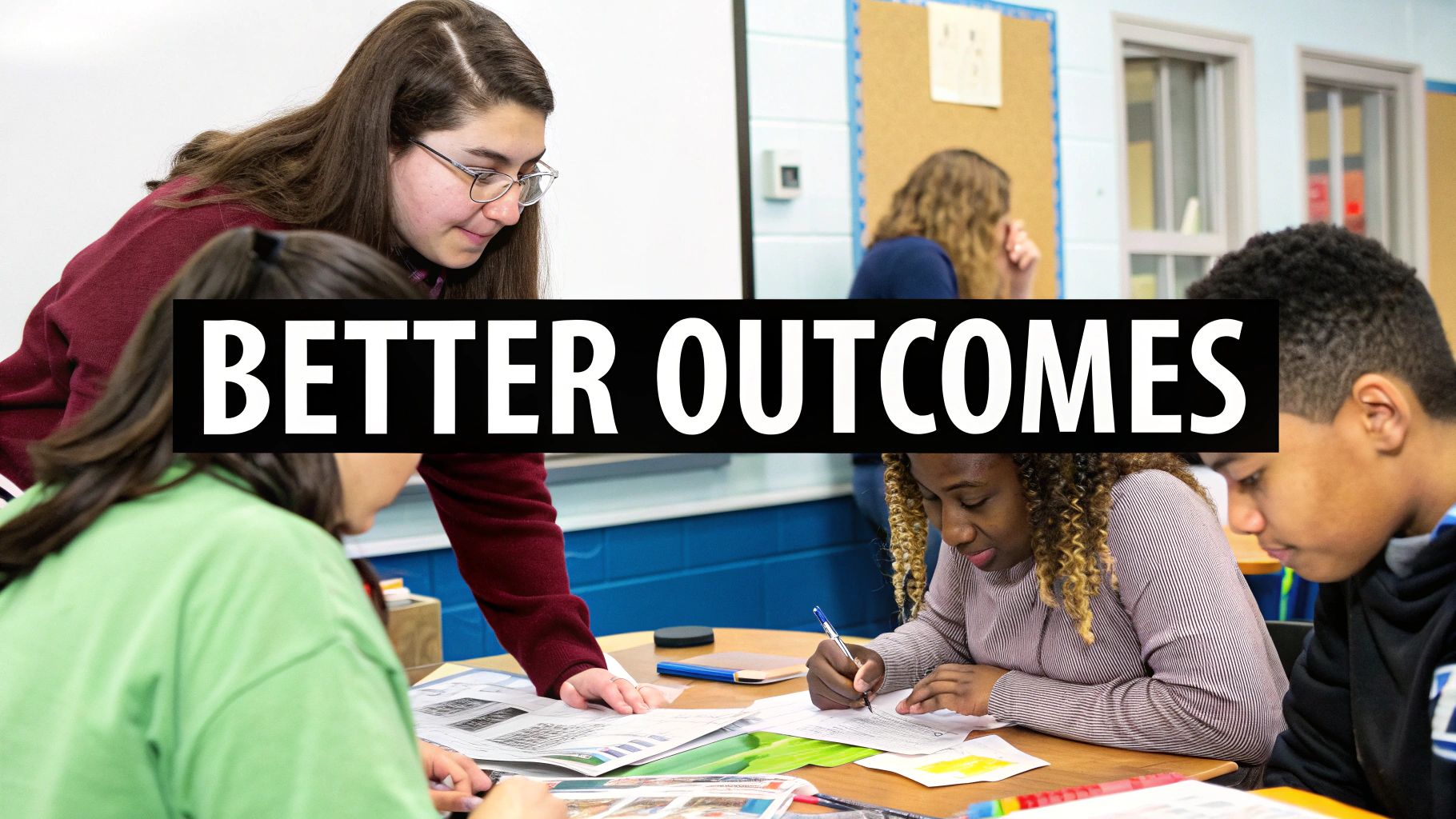
When children team up, they have to put their thoughts into words, defend their ideas, and listen to what others think. This whole process forces them to organise their thinking much more clearly than if they were just mulling it over in their own head. The simple act of saying it out loud can suddenly reveal gaps in their own knowledge, pushing them to ask questions and figure things out.
This kind of social interaction is fantastic fuel for brain development. It nudges children into a special learning space, a brilliant concept explored by the psychologist Lev Vygotsky.
The Zone of Proximal Development
Vygotsky came up with a powerful idea called the Zone of Proximal Development (ZPD). It might sound a bit academic, but it’s a beautifully simple concept. Think of it as the sweet spot between what a child can already do all by themselves and what they can achieve with a little bit of help. It’s that magical space where the real learning happens.
The ZPD is where a child, with a little guidance from a more knowledgeable friend or an adult, can tackle a challenge they couldn't conquer alone. This peer-to-peer support is often even more effective than an adult stepping in, as kids often speak the same "language."
For instance, one child might have figured out the basics of a coding command while their friend is still struggling. By working together, the more confident child reinforces their own knowledge by teaching it, and the other child gets a relatable explanation from someone on their level. They both level up in a way that just wouldn't happen if they were working alone. This is what makes group work so incredibly effective.
Thinking About Thinking
This process also nurtures another incredibly important skill: metacognition. Simply put, this is ‘thinking about your own thinking’. It’s the ability to step back and ask, “Do I really get this? What’s the best way to solve this problem?”
Developing this skill is crucial for any budding scientist, engineer, or problem-solver. It requires a level of self-awareness and planning, much like when Space Ranger Fred has to methodically think through his steps to rescue a stranded umbrella in Space Ranger Fred and the Umbrella Rescue.
When children work together, they are constantly flexing their metacognitive muscles:
- Planning their approach: They have to chat and agree on the best way to tackle a task as a team.
- Monitoring their understanding: If a teammate explains something in a confusing way, it forces them to question it and ask for clarity.
- Evaluating their strategy: Did their plan work? If not, they have to work together to figure out why and try a different way.
This continuous cycle of planning, checking, and adjusting builds a solid foundation for lifelong learning and sophisticated problem-solving.
Unlocking Your Child's Potential Through Collaboration
The real magic of collaborative learning isn’t just about getting better marks on a test; it’s about nurturing a whole toolkit of real-world skills that prepare children for whatever life throws at them. When kids work together, they don't just memorise facts—they learn how to think, communicate, and create in a way that studying alone simply can't replicate.
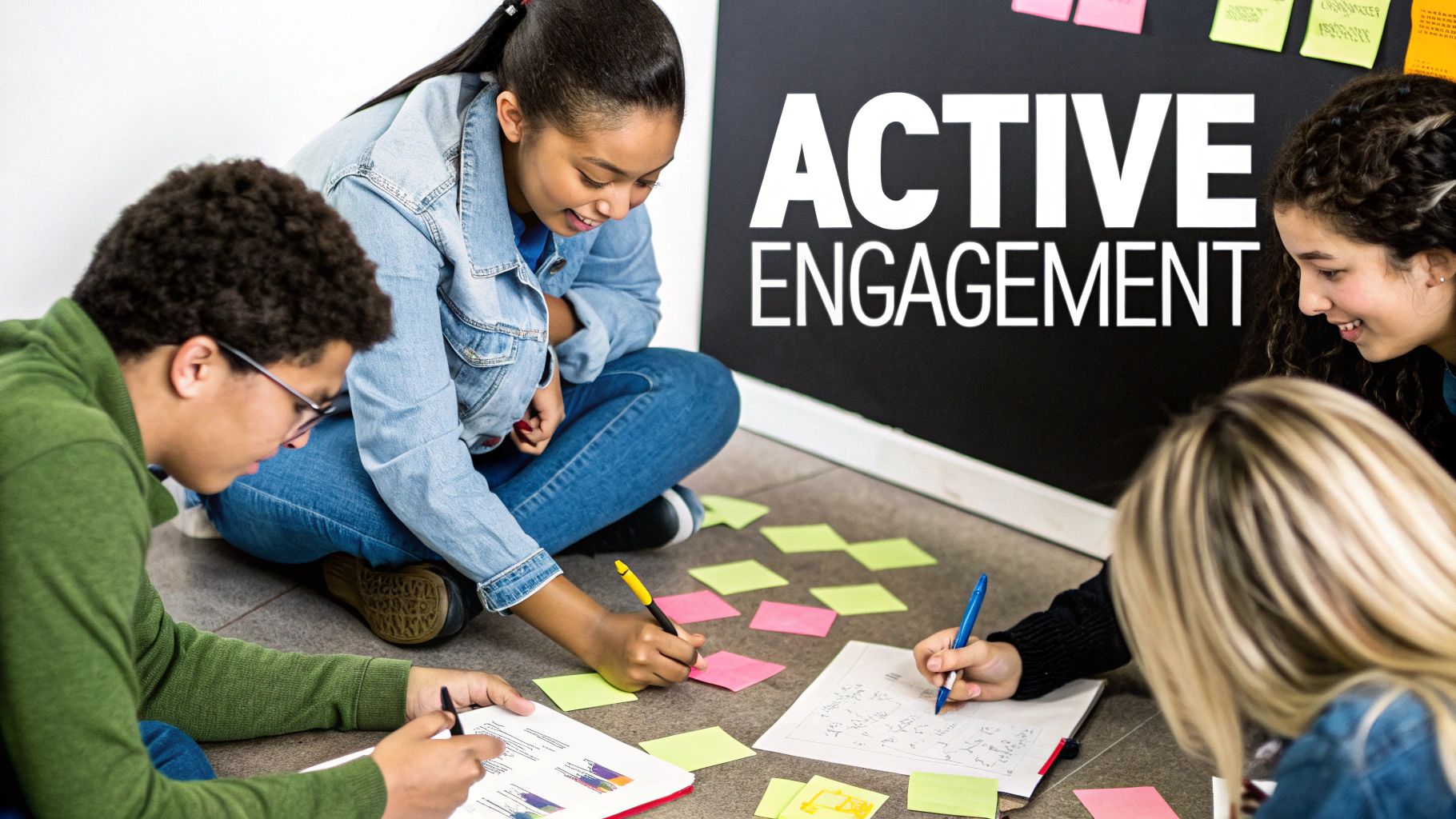
This team-based approach helps children flourish in three fundamental areas, laying the groundwork for them to become well-rounded, resourceful individuals ready to take on the world.
Sparking Academic Achievement
When children join forces to puzzle through tricky subjects, especially in STEM, their understanding goes so much deeper. Having to explain a concept to a friend forces a child to organise their own thoughts, which cements the knowledge in their own mind. It’s a dynamic process that’s far more powerful than just sitting back and listening to a lesson.
The results are so impressive they’ve been tracked on a national scale. Formal partnerships between schools in the UK have been directly linked to better student outcomes. In one major initiative, over 30% of the schools involved were rated ‘outstanding’ by Ofsted—more than double the national average at the time. You can dive into the full school improvement report for a closer look.
Building Social Intelligence
Beyond the textbooks, group learning is a fantastic training ground for social and emotional skills. It's where kids learn the delicate dance of negotiation, the importance of empathy, and the power of clear communication. They discover how to listen to different points of view, respect others' ideas, and find a way to meet in the middle.
These are the exact skills that help them build strong friendships and navigate social situations with confidence. Think about a group project to build the tallest tower out of spaghetti and marshmallows. It’s not just a lesson in physics; it’s a masterclass in teamwork, resilience when the tower inevitably wobbles, and creative problem-solving to find a better design.
Through collaboration, children learn that their voice matters, but also that listening is just as important as speaking. This balance is the very foundation of effective teamwork and strong leadership.
Nurturing Advanced Thinking
Finally, working in groups is brilliant for developing advanced thinking skills like problem-solving and creativity. When faced with a complex challenge, a team can dream up a much wider range of solutions than any one person could alone. Each child brings their unique perspective to the table, sparking new ideas and innovative approaches. It's a bit like the crew in Space Ranger Fred and the Shoelace Adventure, where every character's small contribution is essential to solving the bigger puzzle.
This process teaches children to:
- Analyse problems from multiple angles: Seeing how others tackle a challenge broadens their own problem-solving toolkit.
- Think creatively under pressure: Bouncing ideas off one another encourages them to come up with more original solutions.
- Become more resilient: When one idea doesn’t work, the group provides the support to pivot and try something new without giving up.
Ultimately, these experiences build resourceful, adaptable thinkers who are well-equipped for any future challenge—both in the classroom and far beyond it.
How to Encourage Collaboration at Home and School
Knowing the theory is one thing, but putting it into practice is where the real adventure begins. Creating an environment where collaboration thrives, both in the classroom and around the dinner table, is actually easier than you might think. It’s all about designing activities where teamwork isn’t just encouraged—it’s essential for success.
For parents, this can start with simple, playful activities. Think about tackling a massive jigsaw puzzle together, where each family member owns a specific section, like the sky or a tricky building. Building a complex LEGO masterpiece is another fantastic option, requiring everyone to communicate their ideas and contribute to a single, shared creation.
Classroom Strategies That Work
In a school setting, teachers can use more structured techniques to really foster deep collaboration. One of the most powerful is the ‘Jigsaw’ method. Here, a topic is split into smaller pieces, and each student in a group becomes the ‘expert’ on one piece. They then teach their part to the rest of the group, meaning everyone must participate for the full picture to emerge.
Another brilliant technique is ‘Think-Pair-Share’. It’s wonderfully simple. The teacher poses an open-ended question, and then:
- Think: Each student takes a moment to quietly ponder their own answer.
- Pair: They then team up with a classmate to discuss their ideas together.
- Share: Finally, pairs share their combined thoughts with the whole class.
This simple structure ensures even quieter children have a voice. It lets them build confidence by testing their ideas in a low-stakes setting first.
Building a Supportive Environment
The real secret to successful collaborative learning is creating a culture where asking for help is seen as a strength, not a weakness. It’s about celebrating the process of working together, not just the final result. Much like in Space Ranger Fred and the Shoelace Adventure, even a seemingly simple problem becomes a chance for step-by-step teamwork where every contribution matters.
This isn't just about grouping children by ability. In fact, research shows that active, equal participation from all group members is what truly boosts learning outcomes. Having a mix of perspectives is directly linked to greater creativity and a much deeper understanding of the topic. You can read the full research about these learning dynamics to dig deeper.
Fostering collaboration means teaching children how to work together. This includes setting clear expectations for listening respectfully, sharing ideas constructively, and offering positive feedback to one another.
Ultimately, these strategies shift the focus from individual competition to collective achievement. By making teamwork a regular part of learning, you're not just helping children grasp academic subjects; you're giving them essential skills for life. This method is a close cousin to hands-on learning, and if you’re curious, you might enjoy our guide on what is experiential learning.
Designing STEM Challenges That Inspire Teamwork
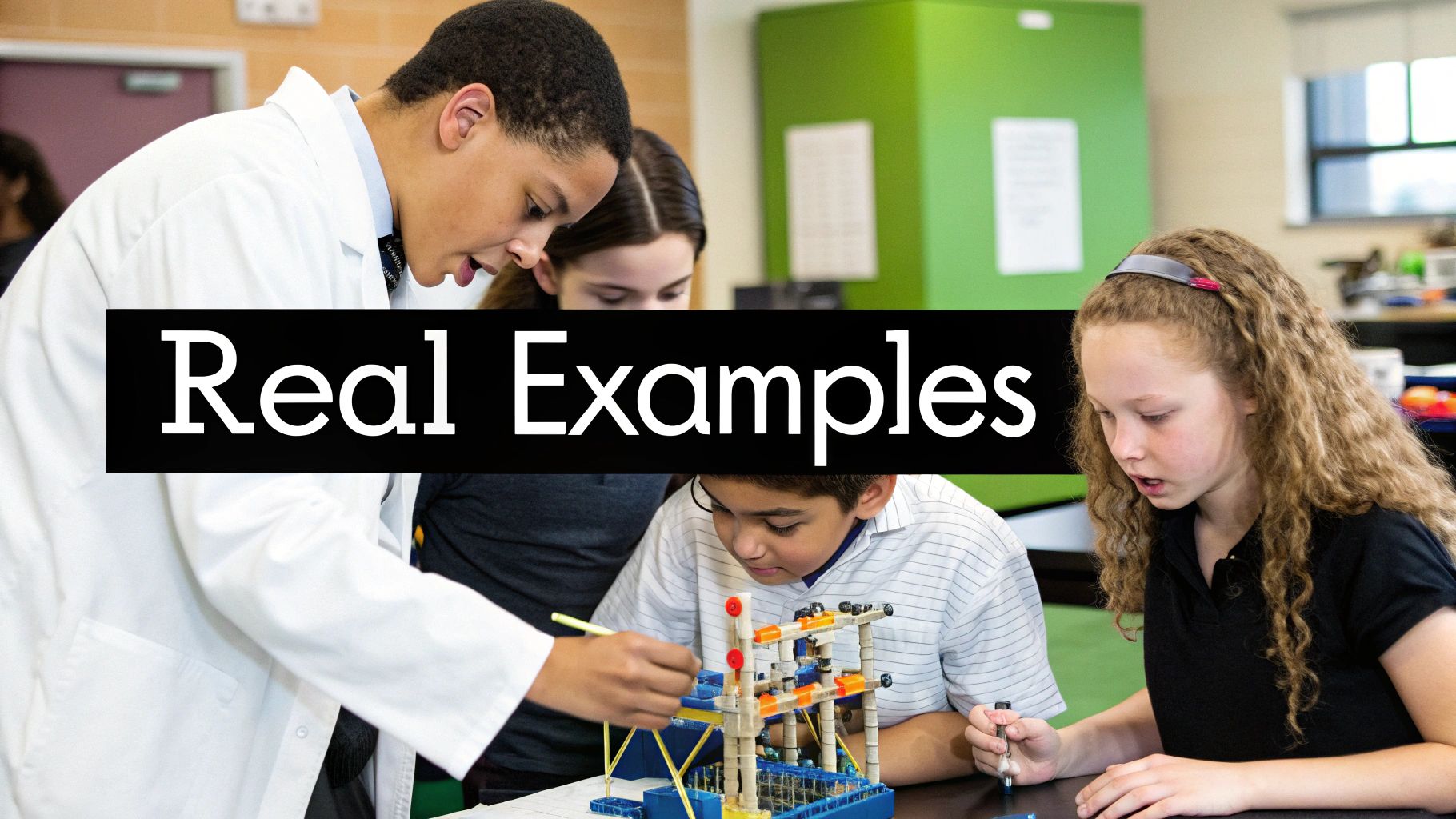
The real magic of collaborative learning isn’t just about putting children into groups. The secret lies in giving them a challenge so exciting and complex they have to rely on each other to figure it out.
A brilliantly designed task is the engine that drives proper teamwork. It turns a standard group activity into a genuine, shared mission where collaboration isn't just an option—it’s the only way forward.
This brings us to a core idea called positive interdependence. It sounds a bit formal, but it’s really just a simple concept: ‘we sink or swim together’. Every child’s contribution isn't just helpful; it's absolutely essential for the team to succeed. If one person doesn’t do their part, the whole group falls short.
The Blueprint for a Collaborative Mission
So, how do you create that all-for-one spirit? You build a challenge with interconnected roles that demand constant communication.
Imagine a mission pulled straight from the Space Ranger Fred books: design a rover to explore a newly discovered planet. This isn’t one big job for three kids; it's a mission with specific, interlocking parts.
You could structure the group like a real mission crew:
- The Lead Engineer: This child is responsible for the rover’s physical design and construction. They need to make sure it’s sturdy enough for the imaginary terrain.
- The Navigation Specialist: Their job is to map the rover's route, calculating distances and flagging potential obstacles for the crew.
- The Data Scientist: This person decides what information the rover needs to collect and how the team will record its findings for the mission report.
See how it works? No single child can complete the mission alone. The engineer can’t build the right wheels without the navigator’s route plan. The data scientist needs to understand the rover’s limits from the engineer to plan their experiments. It’s a setup that naturally creates that crucial ‘we’re all in this together’ feeling. If you’re hunting for more ideas, you’ll find some brilliant starting points in our list of 10 mind-blowing science experiments for kids.
Setting Clear Goals for Team Success
For positive interdependence to really take hold, the team’s goal must be crystal clear to everyone. It’s not enough to say, "build a rover".
Instead, make it specific: "Build a rover that can travel two metres, carry a small rock, and return safely to base." These clear, measurable targets give the team a shared finish line to race towards together.
The best collaborative tasks are designed so that the process of working together is just as important as the final outcome. The discussions, disagreements, and shared ‘aha!’ moments are where the deepest learning happens.
When you structure activities this way, you completely shift the classroom dynamic. Children stop competing against each other and start leaning on each other’s unique strengths. It transforms a project into an adventure—much like when the crew in Space Ranger Fred and the Umbrella Rescue has to combine their different skills to save the day. That’s the very heart of designing for teamwork.
Your Mission to Champion Collaborative Learning
When it all comes down to it, understanding what is collaborative learning is about so much more than a classroom trend. It’s about nurturing a fundamental life skill. When you champion this approach, you’re helping children grow into the creative problem-solvers, empathetic communicators, and resilient leaders of tomorrow. It’s a powerful way to get them ready for a future where teamwork isn’t just a nice-to-have, but an absolute must.
Think back to our space ranger analogy for a moment. Just like the crew in Space Ranger Fred and the Tick Tock Tale have to combine their unique talents to crack a mind-bending puzzle, our kids are best equipped for their own future challenges when they learn to lean on each other’s strengths. Every mission, whether in a classroom or a storybook, is a chance to practise this vital skill.
Your role in this mission is crucial. You have the power to shift the focus from individual competition to collective success, shaping the next generation of innovators and collaborators.
Your Call to Action
The journey starts with simple, intentional steps. There’s no need to overhaul everything overnight.
Your mission, should you choose to accept it, is pretty straightforward:
- Start Small: Introduce one collaborative game or puzzle at home this week.
- Create Opportunities: Look for everyday problems that can be solved together.
- Celebrate the Process: Praise the effort, the teamwork, and the shared journey—not just the final answer.
By doing this, you're not just teaching a subject; you're building character and helping to spark a lifelong love for learning together.
Got Questions About Collaborative Learning?
When you first dive into the world of collaborative learning, it’s completely normal for a few questions to pop up. Making sure you have clear answers is the best way to feel confident as you introduce these brilliant strategies and handle any little bumps in the road.
From navigating group dynamics to making sure every child gets a chance to shine, let's tackle some of the most common queries.
How Can I Stop One Child From Doing All the Work?
Ah, the classic question! The secret is to design tasks where every child has a specific, essential role. Think of it like the mission crew in Space Ranger Fred and the Shoelace Adventure—the mission only succeeds if everyone does their unique job.
You could try assigning roles like these:
- Materials Manager: The only crew member allowed to get the supplies.
- Recorder: In charge of writing down the group's amazing ideas.
- Time Keeper: Responsible for keeping the team on schedule.
With a structure like this, it's pretty much impossible for one child to take over. The group’s success depends on every single person playing their part.
What’s the Best Group Size for Young Children?
For most things you'll be doing with 6–12-year-olds, groups of three to four children work like a dream. Pairs can sometimes get stuck with just two viewpoints, while groups larger than five often make it too easy for some kids to fade into the background.
A group of four is often the sweet spot. It even allows for quick 'turn to your partner and chat' moments before ideas are shared with the whole group, which gets more kids talking.
Will This Work for My Shy Child?
Absolutely. In fact, properly structured teamwork can be a game-changer for quieter or more introverted children, helping them build up their confidence. It gives them a much smaller, safer space to share their thoughts, rather than having to speak up in front of the whole class.
A great starting point is a ‘Think-Pair-Share’ activity. This gives them quiet time to gather their own thoughts before chatting with just one trusted partner. You could also assign a specific, non-verbal role like ‘Fact Checker’ or ‘Illustrator’, giving them a clear and comfortable way to contribute in a really meaningful way.
Ready for the next mission? Continue the adventure and make learning a blast with Space Ranger Fred. Explore our collection of books and activities designed to spark curiosity and teamwork. Discover the fun at https://spacerangerfred.com.