
Authentic assessment is all about getting students to tackle realistic tasks they might actually meet in the real world. It’s a shift away from memorising facts for a test and towards applying knowledge in a meaningful way.
Defining Authentic Assessment in Simple Terms
Imagine you’re keen to teach a child to bake a cake. You could give them a multiple-choice quiz on ingredients and oven temperatures—sounds straightforward, right? They might even score full marks. But can they actually bake a cake?
That’s where authentic assessment comes in. Instead of the quiz, you hand them the flour, eggs and sugar, and say, “Let’s get our hands stuck in and bake this together!” This hands-on approach takes learning way beyond rote memorisation. It’s about doing, creating and solving problems that feel genuine. So, instead of asking a student to simply define photosynthesis, an authentic task would be to design and care for a small plant terrarium, observing and documenting its growth over a few weeks. It’s less about finding the one “right” answer and more about understanding the whole process.
Shifting from Memorisation to Application
The traditional classroom often leans heavily on standardised tests. While they have their place, they can be a huge source of stress and don’t always show what a student truly understands.
Authentic assessment, on the other hand, provides a much richer, more complete picture of a student’s abilities. It shines a light on critical thinking, creativity and problem-solving—skills that are utterly vital for navigating the modern world, especially in STEM fields.
This isn’t some new-fangled idea. The concept was first championed by Grant Wiggins back in 1989 as an antidote to abstract, out-of-context testing. Since then, its value has been widely recognised. A 2023 survey by Advance HE found that 78% of UK academics believe this method better prepares students for employment than traditional exams. It just makes sense—it builds practical, job-ready skills.
“Authentic assessment asks students to be performers and creators, demonstrating their understanding in a way that feels relevant and purposeful. It transforms them from passive recipients of information into active participants in their own learning journey.”
The infographic below shows how the key pieces of authentic assessment fit together.
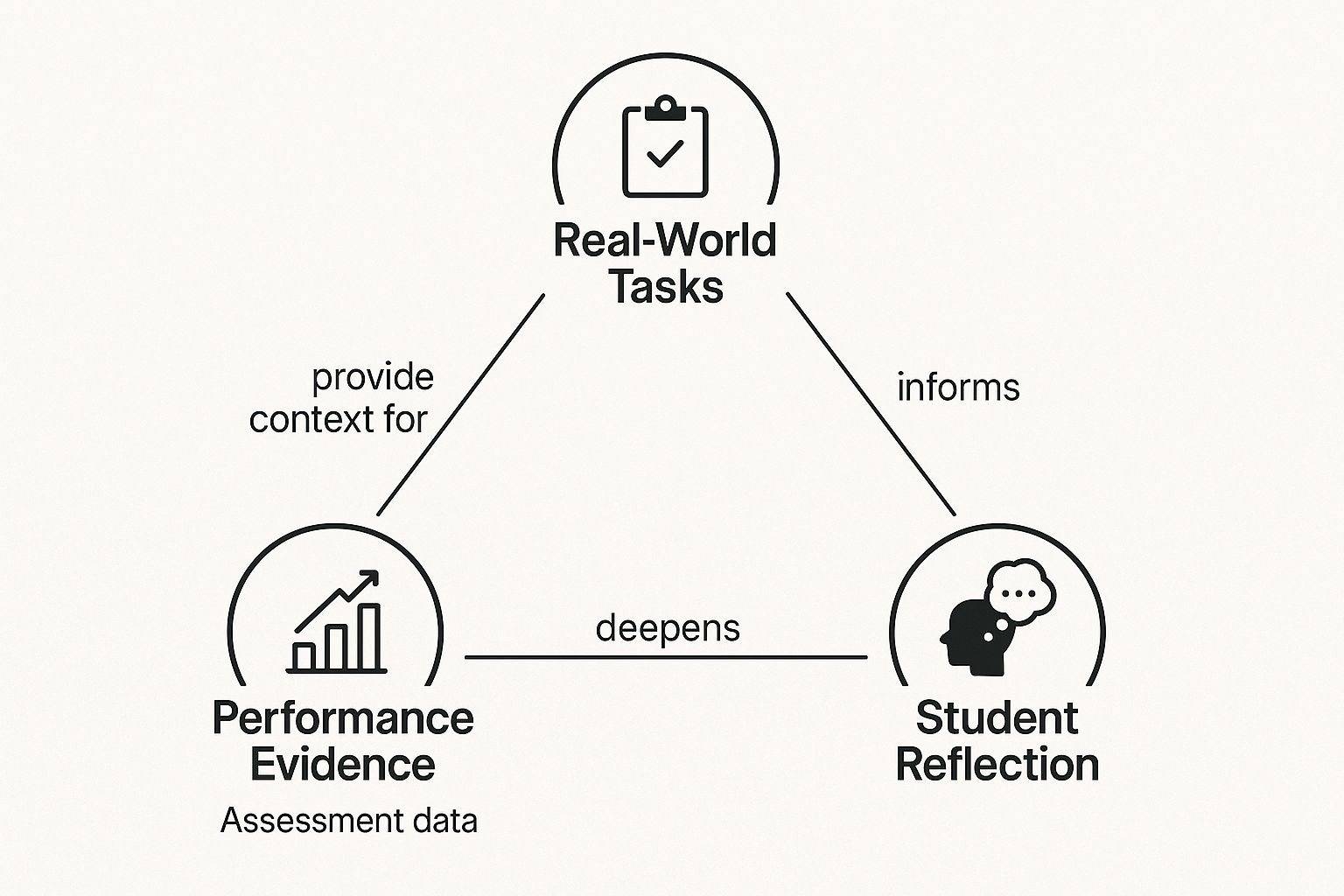
As you can see, it's a cycle: students tackle a real-world task, create something tangible as evidence of their learning, then reflect on their process and results. This is deeply connected to another powerful educational philosophy; you can learn more about experiential learning here: https://www.spacerangerfred.com/2025/10/02/what-is-experiential-learning/.
Traditional vs Authentic Assessment At a Glance
| Characteristic | Traditional Assessment (e.g., Multiple-Choice Test) | Authentic Assessment (e.g., Building a Model Rocket) |
|---|---|---|
| What It Measures | Recalling facts and specific knowledge. | Applying skills, creativity and critical thinking. |
| Student's Role | To select the correct answer from a list. | To perform, create or solve a complex problem. |
| Context | Often abstract and disconnected from the real world. | Directly mirrors real-world challenges and situations. |
| Task Structure | Highly structured with a single, predetermined right answer. | Open-ended, allowing for multiple solutions and approaches. |
| Feedback | Typically a score or a grade (right/wrong). | Detailed, ongoing feedback focused on the process and growth. |
This table shows how authentic assessment encourages deeper engagement and understanding—it’s not just another type of test, but a whole different way of thinking about learning.
The Heart of STEM Learning
In subjects like science and maths, authentic assessment is a complete game-changer.
Think about the kinds of problems Fred faces in stories like Space Ranger Fred and the Shoelace Adventure. He has to apply his knowledge to solve a real, if slightly quirky, problem. That’s the very essence of STEM—it’s not just about knowing things, but about using that knowledge to build, create and solve challenges.
When children engage in these meaningful tasks, they develop a connection to the material that is far deeper and more lasting than anything a textbook alone could provide.
The Core Principles of Effective Assessment
What makes authentic assessment such a game-changer? To really grasp it, we need to dig into the ideas that hold it all together. This isn’t just about swapping out a multiple-choice test for a hands-on project; it’s a completely different way of thinking about learning and measuring what a child truly understands.
Centred on Realistic Contexts
The first—and arguably most important—principle is that the task must be rooted in a realistic context. It can’t feel like a pointless school exercise. It needs to feel like a genuine problem crying out for a solution. That real-world connection sparks motivation and makes learning stick.
Storytelling is a powerful teaching tool. A book like Space Ranger Fred and the Shoelace Adventure doesn’t just list dry facts about knots and friction; it wraps them in a fun story where solving a problem truly matters to the characters.
“Authentic tasks give students a clear ‘why’ behind their learning. When they understand the purpose and can see the real-world connection, their engagement and willingness to persevere skyrocket.”
Demanding Sound Judgement and Innovation
Authentic assessments push students to use sound judgement and innovation. Unlike a standard test with one correct answer, these tasks are open-ended. There isn’t just one right way to solve the problem, which opens the door to creative solutions.
Students must:
- Analyse the problem from every angle.
- Plan a course of action, choosing the best tools and strategies.
- Adapt their approach when things go awry.
- Justify their final solution and explain their reasoning.
This mirrors what real scientists, engineers and designers do daily. They experiment, fail, learn and innovate—building resilience and a growth mindset.
Focusing on the Process, Not Just the Product
A truly effective authentic assessment values the learning process as much as the final outcome. The aim isn’t simply to get the “right answer,” but to understand how students arrive there.
Feedback isn’t reserved for the end. It’s an ongoing conversation throughout the project, helping children develop metacognitive skills—the ability to think about their own thinking—which is the key to becoming curious, independent lifelong learners.
Why Authentic Assessment Is a Game-Changer for STEM

Science, Technology, Engineering and Maths aren’t spectator sports—they’re about doing, tinkering and creating. It’s one thing to memorise the formula for kinetic energy; it’s quite another to build a ramp and see how a toy car’s speed changes with height.
Authentic assessment pulls STEM out of the abstract and drops it right into the tangible, hands-on world of real application. Traditional tests might tell you if a child remembers a definition; authentic tasks show if they can actually use that knowledge to solve a problem. It’s the perfect partner for STEM because it values curiosity and practical skills over simple memorisation.
Suddenly, a child isn’t just a student in a classroom—they’re a junior scientist, a budding coder or a young engineer on a meaningful mission.
Fostering Critical Thinking and Creativity
At its heart, STEM is all about problem-solving. Authentic tasks are designed to be messy and complex, just like the real world, encouraging critical and creative thinking.
For example:
- Coding a simple game to learn loops and variables.
- Designing a sustainable garden plan based on biology and engineering.
- Analysing local water quality by collecting samples, running tests and interpreting data.
These challenges force children to test ideas and learn from mistakes. They aren’t simply following a recipe; they’re inventing their own. That process of trial and error is fundamental to scientific discovery.
Building Confidence and Lasting Understanding
When a child successfully builds a circuit that lights an LED, or designs a paper bridge that holds far more weight than expected, the triumph is huge. That sense of achievement isn’t just about a good mark; it’s about seeing their knowledge in action.
This is the kind of problem-solving we see in Space Ranger Fred and the Umbrella Rescue. Fred observes his surroundings, applies his understanding of physics and ingeniously uses an everyday object to save the day. It’s a brilliant story that shows STEM principles as practical tools for overcoming real challenges.
This approach often pairs with project-based learning—dive deep into an extended investigation to solve a complex problem. Discover more about what project-based learning is and how it works.
“Authentic assessment proves to children that STEM subjects aren’t just for geniuses. With curiosity, creativity and persistence, they too can solve complex problems and make a real impact.”
Many universities now embrace this approach. Newcastle University’s ‘Education for Life 2030+’ strategy puts authentic assessment at the heart of its curriculum design. Their research found students scored 12% higher on measures of self-regulated learning and 15% higher on metacognitive awareness. Even better, 73% of students found these tasks more engaging than standard exams. You can explore Newcastle University's effective assessment practices and their findings on their website.
Practical Examples of Authentic Assessment in Action
Theory is one thing, but seeing authentic assessment in action is where the magic happens. It doesn’t require grand, complex projects—often the most powerful tasks are simple, creative and use materials you already have at home or in the classroom.
Simple STEM Challenges for Young Learners
For little ones, authentic assessment should feel like play. Focus on exploration, creativity and discovery:
- Build a bridge from paper, straws and tape that must hold a toy car.
- Try a “sink or float” experiment with household objects to explore density and buoyancy.
The key at this age is celebrating curiosity and encouraging “what if?” thinking.
More Complex Projects for Older Students
As children mature, tasks become more ambitious, blending multiple STEM disciplines:
- Create a public service video on plastic pollution:
- Research the science behind the issue.
- Organise a clean-up and categorise the rubbish.
- Script, film and edit a persuasive call to action.
- This mirrors multi-faceted real-world work and echoes the problem-solving steps in Space Ranger Fred and the Tick Tock Tale.
Authentic STEM Assessment Ideas for Different Age Groups
| STEM Discipline | Early Years (Ages 4–7) | Primary School (Ages 8–11) | Secondary School (Ages 12+) |
|---|---|---|---|
| Science | Create a “bug hotel” in the garden and observe the insects that visit over a week. | Design and conduct an experiment to see which paper aeroplane flies the farthest. | Analyse nutritional information on food labels to design a balanced weekly meal plan. |
| Technology | Use a simple stop-motion app to create a short animated story with toys. | Build a simple website or blog to document a school project or personal hobby. | Learn basic Python to code a text-based adventure game or functional calculator. |
| Engineering | Construct the tallest tower possible using only spaghetti and marshmallows. | Design and build a Rube Goldberg machine to perform a simple task, like watering a plant. | Create a working prototype of a device that solves a household problem, using a 3D printer or recycled materials. |
| Maths | Plan a pretend shop, price the items and use play money to practise adding and giving change. | Use a budget to plan a family day out, researching ticket prices, travel costs and food. | Collect and analyse daily screen time data for a week, then create graphs to present the findings. |
How to Implement Authentic Assessment at Home

Bringing authentic assessment into your home doesn’t require a teaching degree or fancy equipment. It’s a mindset shift: instead of asking “What do you know?”, start asking “What can you do with what you know?”
Think of yourself as a guide, not an examiner. Your role is to set an intriguing challenge, provide the tools and cheer your child on as they find their own way. This is where real confidence is built, showing them how their learning connects to the world around them.
Start With a Clear Goal
Before diving into a project, choose a simple goal. What skill or idea do you want to explore? It could be as straightforward as understanding a basic budget or practising logical thinking. A clear goal helps you craft a meaningful task, turning a fun activity into powerful learning.
Design a Meaningful Task
With a goal in mind, create a task that brings it to life. A great authentic task feels real and has a clear purpose:
-
Goal: Understand basic budgeting.
Task: Plan a real family meal for the week within a set budget. Let them research recipes, compare supermarket prices online and choose ingredients to stay on budget. -
Goal: Practise logical thinking.
Task: Create a treasure hunt around the house. Clues should require problem-solving and sequential thinking.
A truly authentic task gives children a sense of ownership. When they feel they’re solving a genuine problem, their motivation and engagement skyrocket.
Keep Evaluation Simple and Constructive
Forget the red pen and letter grades. Feedback should feel like a supportive chat, not a final judgement. Focus on the process and the skills used along the way.
Try making a simple checklist before the task begins so everyone knows the targets. For the meal-planning task, your checklist might include:
- Did the plan include a variety of food groups?
- Was the final cost within the budget?
- Were the chosen recipes practical for the family to make?
Chatting through this together afterwards celebrates successes and gently highlights areas for improvement. For more ideas, explore our guide on what is inquiry-based learning, which pairs perfectly with this assessment style.
Overcoming Common Hurdles
Let’s be honest—setting up these tasks can take more time than handing out a worksheet. A University of Bedfordshire study found 62% of academic staff spent more time designing authentic tasks, but 80% agreed that student engagement and work quality improved dramatically. Read more about the positive impacts of authentic assessment in their detailed findings.
Start small. Like in Space Ranger Fred and the Tick Tock Tale, where a big problem is solved one step at a time, you don’t have to change everything overnight. Try one weekend project a month and see how it goes. Before long, weaving these meaningful challenges into your family routine will feel second nature.
Got Questions? We’ve Got Answers
Is This Just for Science and Maths?
Not at all! While a perfect match for hands-on STEM projects, authentic assessment works beautifully across all subjects. Imagine a history lesson where, instead of writing another essay, a student creates a short documentary or curates a mini museum exhibit. That’s authentic assessment breathing life into the humanities.
How Can You Even Grade This Stuff Fairly?
Fairness comes down to clarity from the get-go. Use crystal-clear rubrics shared with students before they begin. Rubrics lay out exactly what success looks like, ensuring evaluation is consistent, transparent and focused on skill development—not hunting for one single “right” answer.
Does This Mean We Scrap Traditional Tests Altogether?
Not necessarily. Traditional tests remain a solid way to check foundational knowledge. But authentic tasks are where the magic happens—they show how well students can apply that knowledge in real situations. Together, they paint a much richer, more complete picture of what a child can really do.
You see this blend perfectly in adventures like Space Ranger Fred and the Shoelace Adventure. Fred needs facts, yes, but he also must think on his feet and use knowledge creatively to solve problems.
How Does This Help with Standardised Exams?
You might think this approach is too different from formal testing, but it actually prepares children brilliantly. By encouraging deeper understanding of core concepts, learners move well beyond memorisation. This stronger grasp, combined with polished critical thinking, often leads to better performance on all kinds of tests, including the big standardised ones.
Here at Space Ranger Fred, we believe learning should be a grand adventure, packed with discovery and real-world problem-solving. Explore our books and resources to bring the excitement of STEM to life. Learn more at https://spacerangerfred.com.