
Space science is a brilliant way to fire up a child's imagination about the universe, mixing the thrill of exploration with the basics of STEM learning. It’s so much more than just remembering the planets in order; it’s about asking huge questions, figuring out cosmic puzzles, and finding our own little spot amongst the stars.
Launching Your Child's Cosmic Adventure
Welcome aboard the greatest journey of all—a voyage into the universe that starts with just a simple glance up at the night sky. For any kid, the cosmos is a massive playground of wonder, full of sparkling stars, a glowing moon, and the promise of worlds yet to be discovered. This guide is your launchpad for fuelling that natural curiosity.
Exploring space with kids isn't about memorising dry facts from a textbook. It’s about framing the universe as the ultimate detective story. Every star, planet, and galaxy holds a clue to how everything began, and every question a child asks is a step towards uncovering another secret.
What Is Space Science Really?
At its heart, space science is simply the act of looking up and asking, "What's out there?" and "How does it all work?" It's a grand adventure that helps children make sense of our own world by exploring others. This cosmic quest isn't just for future astronauts—it's for every child with an imaginative mind.
This field of discovery pulls together many parts of STEM (Science, Technology, Engineering, and Maths) to tackle some of humanity’s biggest questions.
- It builds curiosity: Wondering why the moon changes shape or what stars are made of encourages a lifelong habit of asking questions.
- It fosters problem-solving: Figuring out how astronauts live in zero gravity or how a rover lands on Mars is a fantastic workout for critical thinking skills.
- It inspires creativity: The universe is overflowing with mysteries that ignite the imagination and push kids to dream big.
A Storybook Start to the Stars
One of the best ways to kick off this adventure is through storytelling. A great narrative can make abstract ideas feel real, immediate, and incredibly exciting. Children's books are perfect for this, turning complex science into a thrilling mission with characters they can root for.
Think of it this way: a good story is like a rocket ship for the imagination. It can transport a child to the rings of Saturn or the dusty plains of Mars, all from the comfort of their favourite reading corner.
This is where wonderful books like Space Ranger Fred and the Shoelace Adventure really shine. They cleverly blend humour and adventure with real scientific concepts, making learning feel just like playtime. When a character uses science to solve a problem, it shows kids that STEM subjects are really just tools for exploration and creativity.
These stories provide that initial spark that can light up a lifelong passion. For more tips on getting started, you can find a helpful overview on learning about space for kids in our detailed guide.
How Space Science Builds Brilliant Young Minds
So, why is staring up at the stars so good for a child's brain? Beyond the simple awe of it all, space science is a brilliant engine for building essential life skills. It’s a natural gateway to STEM subjects, turning abstract ideas into exciting, real-world puzzles just begging to be solved.
Pondering the sheer vastness of the cosmos naturally encourages kids to think bigger and ask deeper questions. It’s one thing to learn about gravity in a classroom, but it’s a whole other thing to imagine it as the force that keeps Earth swinging around the Sun like a giant cosmic yo-yo. This kind of thinking lays a seriously strong foundation for future learning.
From Cosmic Puzzles to Critical Thinking
Space exploration is, without a doubt, the ultimate problem-solving challenge. Imagine you’re planning a mission to Mars. You can't just point a rocket at the sky and hope for the best, can you? That single challenge requires a massive amount of planning, teamwork, and resilience—all skills that are invaluable at school and in everyday life.
Children quickly learn to think like mission planners, asking crucial questions like:
- What challenges will we face? (Thinking ahead and spotting obstacles)
- How do we pack enough food and air? (Resource management 101)
- What happens if something breaks? (Creative problem-solving on the fly)
This whole process teaches them to approach problems methodically, break them down into smaller pieces, and work together to find a solution. It's the very heart of inquiry-based learning, a method that empowers kids to take the lead in their own discovery. You can find out more about what inquiry-based learning is and see just how it boosts engagement.
Developing a Lifelong Love for Learning
The skills picked up from exploring space science reach far beyond the classroom walls. When a child learns about orbital mechanics, they're not just memorising a scientific principle; they're learning about cause and effect, patterns, and prediction. It’s a lot like planning a journey on a map—you need to calculate your route, speed, and timing to get where you’re going.
Space science teaches children that failure isn't an endpoint, but a data point. Every failed rocket launch or robotic hiccup provides valuable information that helps scientists get it right the next time. This builds real resilience and a healthy attitude towards making mistakes.
Stories are a fantastic way to illustrate this. In books like Space Ranger Fred and the Tick Tock Tale, the characters often face unexpected challenges that demand quick, creative thinking. These adventures show kids that science isn't about already having all the answers, but about having the courage to ask the right questions and try new things.
Building a Foundation for Future Success
Fostering an early interest in space science can also set children on a path towards fantastic, fulfilling careers. Education in this field is well-established here in the UK, making us a leading European nation for space-related academic programmes. There are around 40 higher education institutions offering degrees in the field, which is about 19% of all such programmes across Europe.
Within these courses, space sciences are the largest area of study, making up a whopping 27% of the focus. This creates a strong pipeline for the next generation of innovators. You can dig into more insights about Europe's space education landscape from the ESPI report.
Ultimately, introducing kids to space science is about so much more than just teaching them about planets and stars. It’s about arming them with a mindset of curiosity, resilience, and creative problem-solving that will help them succeed in whatever future they choose to explore.
A Child's Tour Through Our Solar System
All aboard for a grand tour of our cosmic neighbourhood! Let's fire up our imaginations and blast off on an exciting mission through the solar system, starting right at the very heart of it all—our magnificent, fiery Sun.
The Sun is the captain of our solar system. It’s a gigantic star, so massive that its powerful gravity keeps all eight planets in line, pulling them along in steady paths called orbits. This invisible force is a bit like a cosmic string, making sure planets like Earth don’t just float off into the endless dark.
The Rocky Inner Worlds
Our first few stops are the smaller, rocky planets that live closest to the Sun. These worlds are the inner-city neighbours in our solar system—compact, dense, and full of character.
-
Mercury: The smallest planet and the one whizzing closest to the Sun. A day here is scorching hot, but because it has almost no atmosphere to trap the heat, its nights are unbelievably cold.
-
Venus: Often called Earth's "twin" because of its similar size, Venus is anything but friendly. It's wrapped in thick, toxic clouds that make it the hottest planet in the entire solar system—even hotter than Mercury!
-
Earth: Our home! This is the only planet we know of that’s just right for life, with liquid water, a comfy atmosphere, and the perfect temperature. It's our very own "Goldilocks" planet.
-
Mars: Known as the Red Planet because of its rusty-coloured dust, Mars is a cold, desert world. Scientists are super curious about Mars because they think it might have had water, and maybe even life, a long, long time ago.
This chart helps to show the huge differences in size and distance between a small inner planet, our own Earth, and a gas giant.
As you can see, Jupiter isn't just many times farther from the Sun than Earth is, but it's also absolutely enormous in comparison.
The Colossal Gas Giants
Now, let's travel further out, past a big belt of space rocks called the asteroid belt. Here, we meet the giants of the solar system. These planets are enormous balls of gas and liquid, with no solid ground to stand on.
Jupiter is like the solar system's giant vacuum cleaner. Its immense gravity is so strong that it pulls in stray asteroids and comets, protecting smaller planets like Earth from potential collisions. It’s our very own cosmic bodyguard!
First up is Jupiter, the undisputed king of the planets. It’s so big that all the other planets could fit inside it! It's famous for its Great Red Spot, a storm bigger than our entire planet that has been raging for hundreds of years. Next is Saturn, the dazzling jewel of the solar system, known for its stunning rings made of ice, rock, and dust.
The adventure doesn’t stop there. Continuing our journey, we reach the icy, distant worlds of Uranus and Neptune. Uranus is the oddball of the group, tipped over and spinning on its side, while Neptune is a dark, cold, and incredibly windy place, marking the far edge of our planetary neighbourhood.
The UK's Role in Exploring the Stars
Thinking like a real space explorer is exactly what scientists in the UK do every day. The UK plays a huge part in amazing international missions, helping us understand our universe better. For example, the European Space Agency's Gaia mission has been a record-breaker, precision-mapping nearly 2 billion stars. UK institutions were vital to its success, contributing to its powerful camera and processing the enormous amounts of data sent back to Earth.
You can discover more about the UK's exciting contributions by exploring the latest annual report from the UK Space Agency.
This kind of teamwork and problem-solving is just what characters like Space Ranger Fred learn in adventures like Space Ranger Fred and the Umbrella Rescue. Every mission, whether in a book or in real life, is about working together to explore the great unknown.
Hands-On Space Experiments for Your Kitchen
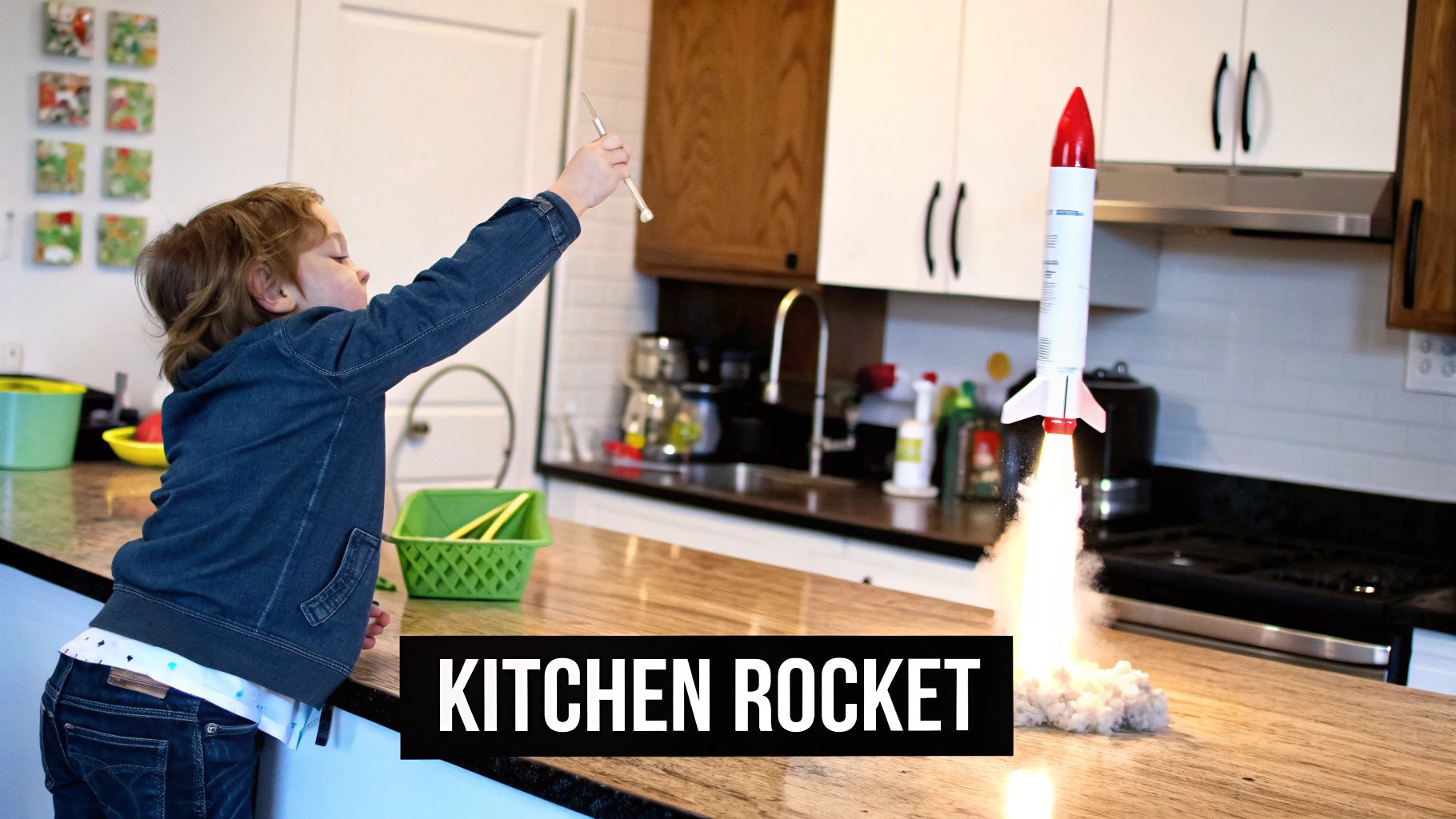
Reading about the cosmos is one thing, but the real magic happens when you bring space science down to Earth. The best laboratory for any young explorer is often right there in your kitchen, where everyday items can become tools for incredible cosmic discovery.
You really don't need a high-tech lab to get to grips with the universe. A bit of curiosity, a dash of creativity, and maybe an old plastic bottle or two is all it takes. Getting your hands messy is one of the very best ways to make those big, abstract scientific ideas stick.
Our goal is to show that science isn't just something you read about—it's something you can see, touch, and do. It’s about asking questions and then building, mixing, and launching things to find the answers, just like the characters do in Space Ranger Fred and the Shoelace Adventure.
At-Home Space Experiments
To get you started, here’s a quick look at a few simple, fun, and educational experiments you can do with things you probably already have at home.
| Experiment Name | Key Science Concept | Main Materials Needed | Age Suitability |
|---|---|---|---|
| Roaring Bottle Rocket | Newton's Third Law, Propulsion | Plastic bottle, cork, water, bike pump | 8–12 |
| Moon Craters | Impact Forces, Geology | Baking tray, flour, cocoa powder, marbles | 6–10 |
| Constellation Projector | Astronomy, Light & Shadow | Cardboard tube, pin, torch | 6–9 |
| DIY Solar System | Planetary Orbits | Balloons or balls, string, a central "sun" light | 7–11 |
These activities turn your home into a launchpad for learning, proving that science can be an adventure you can start anytime.
Build a Roaring Bottle Rocket
One of the most thrilling concepts in space travel is propulsion—that immense force that shoves a rocket upwards, fighting against gravity. You can show just how powerful this idea is with a few simple items.
What You'll Need:
- An empty plastic drink bottle
- A cork that fits snugly in the opening
- Water
- A bicycle or ball pump with a needle adapter
- Cardboard for fins (optional, but they look great!)
Step-by-Step Instructions:
- Prepare for Launch: Carefully poke the pump's needle right through the centre of the cork. Make sure it goes all the way through so air can get into the bottle.
- Fuel Up: Pour some water into the bottle until it's about a quarter full. This water is your rocket's fuel, or "reaction mass."
- Seal the Rocket: Shove the cork firmly into the bottle opening. You need a really tight fit to let the pressure build up.
- Ready for Countdown: Take your rocket outside to a wide-open space. Turn it upside down so the cork is pointing at the ground.
- Liftoff! Start pumping air into the bottle. You’ll feel the pressure building until—WHOOSH!—it forces the cork and water out, launching your rocket skywards.
Here's the Science: This is a perfect, hands-on demonstration of Newton's Third Law of Motion. For every action, there is an equal and opposite reaction. The rocket pushes the water down (the action), and in return, the water pushes the rocket up (the reaction).
Create Your Own Moon Craters
The Moon's surface is famously bumpy, covered in craters from billions of years of being hit by asteroids and meteoroids. You can recreate this process safely in a baking tray and see exactly how those iconic features are formed.
What You'll Need:
- A shallow baking tray or box lid
- Plain flour
- A light dusting of cocoa powder or cinnamon
- Marbles and small pebbles of different sizes
Step-by-Step Instructions:
- Create the Lunar Surface: Fill the tray with a few centimetres of flour and smooth it out to create a flat surface.
- Add Some Colour: Gently sprinkle a thin, even layer of cocoa powder over the top. This is the top layer of moon dust, or "regolith."
- Simulate Impacts: From different heights, drop your marbles and pebbles (your "meteoroids") onto the floury surface.
- Observe the Craters: Carefully lift the marbles out. You'll see detailed craters with bright rays of "ejecta" (the white flour) blasted out from the impact, just like you'd see on the real Moon.
This activity is a brilliant way to explore how the speed and size of an object change the crater it leaves behind. For even more inspiration, check out these other mind-blowing science experiments for kids to try that bring scientific principles to life right before your eyes.
Discovering the Universe Through Children's Books
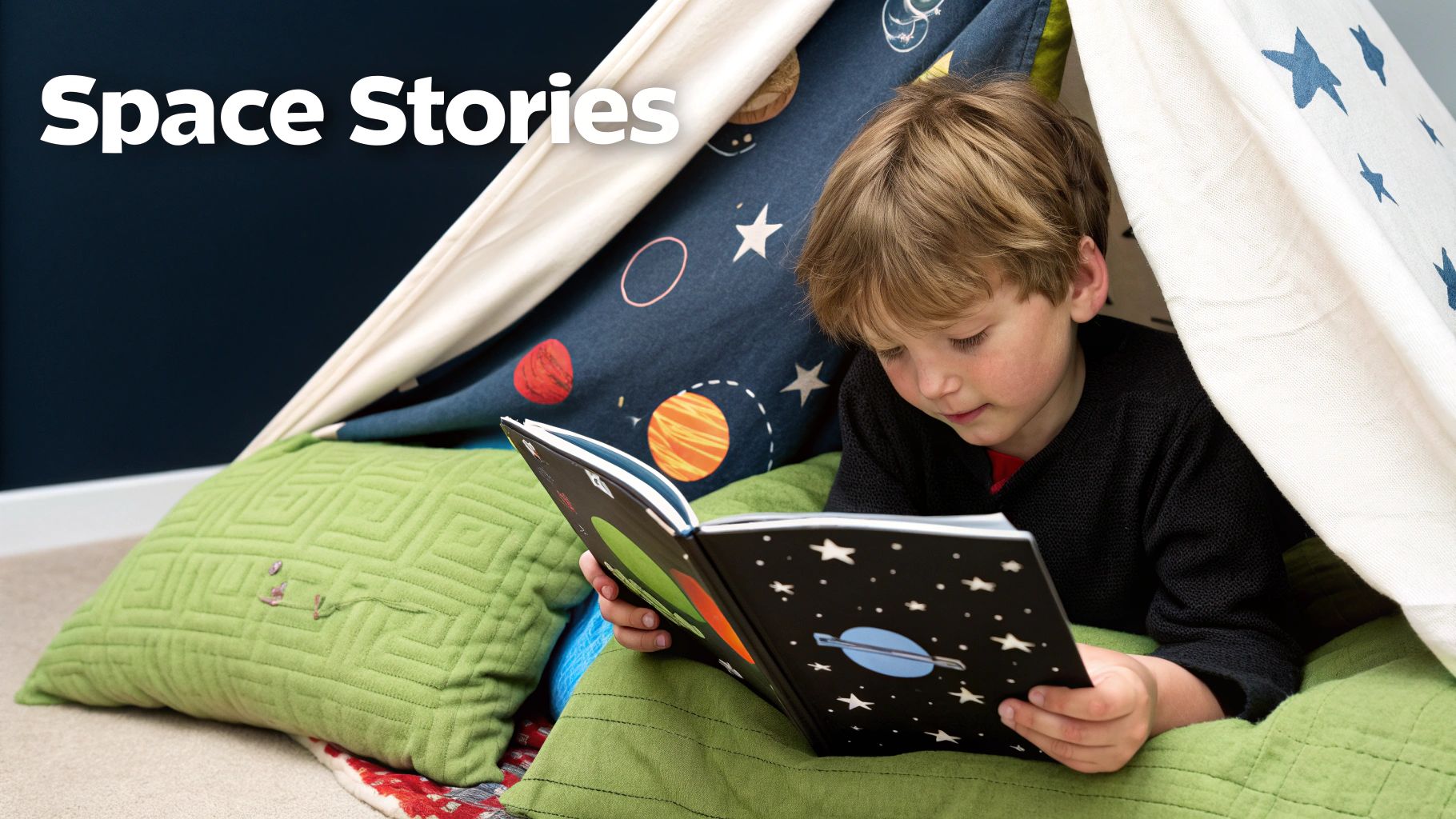
Sometimes, the greatest adventures don't start with a countdown and a rocket launch. They begin quietly, with the simple turn of a page. Long before a child can get their head around complex equations or build their own rocket, a captivating story can send them soaring to the dusty surface of Mars or the glittering rings of Saturn. Storytelling is a bit of a superpower, really. It transforms STEM education from a lesson into a thrilling mission.
The best children's books take big, abstract ideas about space science for kids and make them feel real and exciting. A good story gives context and an emotional hook, which is far more powerful than just memorising facts. It’s the difference between being told what gravity is and reading about an astronaut heroically using it to navigate a tricky situation.
How Stories Spark Scientific Curiosity
A good story doesn't just feed children facts; it invites them to think like a scientist. When a character in a book runs into a problem—say, a malfunctioning spaceship or a mysterious signal from a distant star—young readers can't help but start problem-solving right alongside them. It's a fantastic, almost accidental, introduction to critical thinking.
This is where books like the Space Ranger Fred series really shine. In Space Ranger Fred and the Umbrella Rescue, a simple, everyday object becomes the key to a clever rescue, subtly weaving in principles of physics and creative thinking. These stories show kids that science isn't about already knowing all the answers, but about using what you do know to figure things out.
The narrative helps them understand the why behind the science. It’s one thing to hear that timing is crucial on space missions, but that idea really sticks when you're on the edge of your seat reading a story like Space Ranger Fred and the Tick Tock Tale, where every single second counts in a high-stakes adventure.
Must-Read Books for Young Explorers
Building a small library of space-themed books is a brilliant way to fuel that fire. A good mix of fiction and engaging non-fiction gives kids the best of both worlds: the inspiration of a great story and the mind-blowing wonder of real-world facts. Here are a few recommendations to get your literary launchpad started.
Engaging Fiction:
- The Space Ranger Fred Series: Absolutely perfect for readers aged 6–10, these books are a brilliant blend of humour, heart, and clever science all wrapped up in page-turning adventures.
- Goodnight Spaceman by Michelle Robinson: A gentle, beautifully illustrated story inspired by British astronaut Tim Peake’s own children. It’s a wonderful choice for the younger explorers in your crew.
- The Way Back Home by Oliver Jeffers: A charming tale about a friendship between a boy and a Martian, sparking imaginations about what life might be like on other planets.
Captivating Non-Fiction:
- Professor Astro Cat's Frontiers of Space by Dominic Walliman: This book is a visual treat, breaking down complex topics like how stars are born and what black holes are with fun, stylish illustrations.
- National Geographic Little Kids First Big Book of Space: An ideal starting point for little ones, packed with vibrant photos and easy-to-digest facts about our solar system.
By blending thrilling adventures with subtle science lessons, these books do more than just entertain. They plant the seeds of curiosity, encouraging children to look up at the night sky and wonder, "What else is out there?"
Reading together is a shared journey. It’s a chance to explore the universe from the comfort of your sofa, ask big questions, and find the answers as a team. Every page you turn is another small step on a lifelong adventure of learning and discovery.
Inspiring the Next Generation of Space Explorers
So, where do we go from here? We’ve zipped around our solar system, launched a few kitchen-counter rockets, and turned the pages on some truly cosmic adventures. Now, it’s time to gaze at the horizon and imagine the incredible journeys that are still waiting to be taken.
Every child asking questions today could one day be the person who shapes humanity’s next giant leap. The universe is still packed with colossal questions, and it’s today’s young minds who will get to answer them. These aren’t just far-off scientific puzzles; they’re the grand adventures of tomorrow. The skills kids build with every experiment and every story are the exact same ones needed for these future missions.
The Big Questions Still Waiting for Answers
The next chapter of space exploration is all about tackling some of the biggest mysteries we've ever faced. Today’s young learners will be right at the forefront, using their natural curiosity and problem-solving skills to push the boundaries of what we know.
Future missions will be asking questions like:
- Are we alone in the universe? Future missions will be hunting for signs of life on the moons of Jupiter and Saturn, and even on planets orbiting distant stars.
- What is the universe actually made of? Scientists are still trying to get their heads around the invisible stuff called dark matter and dark energy that makes up most of our cosmos.
- Can humans become a multi-planetary species? Planning for future habitats on the Moon and Mars is going to need the most creative engineers and scientists we’ve got.
Fuelling Future Missions with Today's Learning
It's amazing how today's fun activities help build the foundation for these future explorations. When a child builds a model rocket, they’re learning the basics of propulsion that might one day send probes to distant galaxies. When they read a book like Space Ranger Fred and the Tick Tock Tale, they see how teamwork and precision timing are vital for any successful mission.
The most powerful tool for any future explorer isn't a complex computer or a powerful rocket—it's a curious mind. Every question asked is a step on an amazing journey, and every "what if?" is the spark that ignites discovery.
This is a fantastic time to get excited about space science for kids. The UK’s educational landscape has seen incredible growth in the resources available to young learners. The country's education technology sector, which is essential for delivering great STEM learning, was valued at around £3.2 billion in 2020—a massive 72% increase from previous years. This growing environment is brilliant for cultivating an interest in space science from a young age. You can discover more insights about the UK's educational growth on gostudent.org.
The universe is overflowing with possibilities, and a child’s potential is just as limitless. The next generation isn't just learning about space; they are preparing to explore it. Every experiment, every book, and every starry night is part of the launch sequence for their incredible future.
Got Questions About Getting Started with Space?
Diving into a new topic with your child can feel a bit like exploring a new galaxy—exciting, but you're not quite sure where to begin. That’s perfectly normal! We get a lot of questions from parents and kids who are just starting their cosmic journey, so we’ve put together a few answers to help you on your way.
Think of this as your mission briefing, designed to make this whole adventure less like a stuffy lesson and more like a brilliant new hobby you can share.
When’s the Best Age to Introduce My Child to Space?
Honestly, you can start whenever you feel they’re ready! The real trick is to match the ideas to their natural curiosity and stage of development.
For the little ones (ages 4-6), it's all about the wonder. Point out the moon in the night sky, talk about how the sun keeps us warm, and just lie on a blanket looking for twinkling stars. Simple picture books and a few minutes of stargazing are all you need to plant the seed.
Once they're a bit older (ages 6-12), you can start to bring in some bigger ideas. This is the perfect time to explore the planets in our solar system, understand what gravity is all about, and maybe even spot a few constellations. Hands-on activities and fun books like the Space Ranger Fred series are fantastic for making these concepts stick. Just follow their lead and keep it fun.
What Are the Best UK Resources for a Space-Mad Kid?
The UK is a brilliant place for budding astronomers and astronauts! There are loads of fantastic resources to feed their curiosity.
- Local Astronomy Clubs: You'd be surprised how many towns have clubs that welcome families. They often host stargazing nights where kids can look through a proper telescope for the first time.
- Inspiring Days Out: A trip to the National Space Centre in Leicester is an absolute must-do for any space fan. You could also visit the Royal Observatory in Greenwich or see what’s on at your local science museum’s planetarium.
- Online Adventures: The websites for NASA, the European Space Agency (ESA), and our very own UK Space Agency are treasure troves of kid-friendly games, cool videos, and mind-boggling facts.
How Can I Help if I Don't Know Much About Space Myself?
That's actually the best part—you get to learn together! Your enthusiasm is far more important than having all the answers. You don’t need to be an expert; you just need to be a fellow explorer.
Frame it as a joint mission. When your child asks a question and you don’t know the answer, one of the most powerful things you can say is, "Wow, what a great question! Let's find out together."
Watch documentaries like The Planets with Professor Brian Cox, read books as a family, and try the simple experiments in this guide as a team. Your willingness to discover things alongside them is the greatest encouragement they could ever get. Plus, sharing stories like Space Ranger Fred and the Shoelace Adventure is a brilliant way to learn scientific concepts through a fun, shared adventure.
Ready to launch your child's next great adventure? The world of Space Ranger Fred is packed with thrilling stories that make learning about science, technology, and space an absolute blast. Discover the books today and start exploring!