
When it comes to the best educational toys for 8 year olds, think things that spark their incredible, growing minds. We’re talking coding robots, complex construction sets, and hands-on science kits. These aren't just toys to pass the time; they're cleverly designed tools for building skills in logic, problem-solving, and creativity, turning proper learning into a brilliant adventure.
At Space Ranger Fred, we believe that the best learning happens when it feels like a grand cosmic mission. So, buckle up! Let's explore the universe of educational toys and find the perfect one to fuel your young explorer's journey.
Why The Right Toy Matters for Your 8 Year Old
Welcome to the amazing world of the eight-year-old! At this age, their minds are like starship engines, firing on all cylinders and ready for lift-off into new territories. Choosing the right toy is about so much more than just keeping them busy—it’s about fuelling their curiosity and helping them hit those crucial developmental milestones.
Consider this your mission briefing on finding toys that don’t just entertain, but inspire a genuine, lifelong love of learning.
Fuelling a Curious Mind
By the time they hit eight, kids are shifting gears. They're moving beyond simple cause-and-effect and are starting to grasp much more complex systems. Their attention spans are getting longer, and they're suddenly ready to get stuck into projects that require a bit of planning and patience.
The right toy meets them right where they are, offering a satisfying challenge that really builds their confidence.
Play is the highest form of research. It's how children make sense of their world, test ideas, and discover their passions. Providing the right tools for this "research" is one of the most important things we can do.
This is the perfect moment to bring in toys that encourage systematic thinking. A beginner coding robot, for example, is fantastic for teaching them that precise instructions lead to a specific outcome—a foundational concept in both programming and logical reasoning.
Building Foundational Skills
The best learning toys for this age group are brilliant for nurturing key skills that will serve them well in school and for years to come. They provide a hands-on way to explore concepts that might feel a bit abstract when they’re just stuck in a textbook.
Here's a quick look at the core skills these toys help develop and why they matter so much at this stage.
Key Skills Educational Toys Help Develop at Age 8
| Developmental Skill | Why It Is Important at Age 8 | Example Toy Category |
|---|---|---|
| Problem-Solving | They're moving beyond simple trial-and-error to thinking critically and logically about challenges. | Engineering kits, complex puzzles, coding games |
| Creativity & Imagination | Abstract thinking is taking off, allowing them to build entire worlds and stories from scratch. | Construction sets, art kits, open-ended building blocks |
| Strategic Thinking | Their ability to plan ahead and consider consequences is developing, perfect for games and logic puzzles. | Board games, strategy-based video games, logic puzzles |
| STEM Concepts | They can grasp foundational concepts in science, technology, engineering, and maths through hands-on play. | Science kits, robotics, electronics sets |
| Fine Motor Skills | Manipulating small, intricate pieces in construction or electronics projects refines their dexterity. | Model-building kits, advanced LEGO sets, circuit boards |
As you can see, it's about so much more than just fun and games.
To make it even better, you can pair these toys with great stories, like those in our Space Ranger Fred book series. A thrilling adventure in a book can easily inspire a whole afternoon of creative building, problem-solving, and out-of-this-world discovery.
How STEM Toys Unlock a Universe of Learning
So, what’s all the fuss about STEM toys? You’ve probably heard parents and teachers talking about them, and for good reason. The term stands for Science, Technology, Engineering, and Maths, and these toys are designed to make these big subjects feel less like a school lesson and more like a brilliant game.
Think of them as launchpads for curiosity. The best STEM toys don't just hand over the answers; they get kids to ask fantastic questions like, 'why does this work?' or 'how can I build that?'. It’s all about hands-on discovery, trial and error, and that amazing 'aha!' moment when a tricky concept suddenly makes perfect sense.
This playful approach is also fantastic for building resilience. When a robot veers off course or a block tower tumbles over, your child isn't failing. They're gathering data for their next attempt. This whole process—experimenting, tweaking, and trying again—is the very heart of scientific thinking.
From Playtime to Problem-Solving
The real magic of STEM toys is how they translate complex ideas into fun, bite-sized challenges. A coding robot, for example, might seem daunting at first. But what if you just think of it as a friendly alien that needs super-clear, step-by-step instructions to find its way home? Suddenly, a coding lesson becomes a creative storytelling mission!
By framing learning as an adventure, STEM toys help children build confidence in their ability to tackle tricky problems. They learn that curiosity is their superpower and that every challenge is an opportunity for discovery.
This kind of early exposure has incredible long-term benefits. It’s not just about preparing them for future careers in science or tech; it’s about building a foundation of critical thinking that’s useful in every part of life. A child designing a marble run is also learning about physics, planning, and cause and effect, all without even realising it.
A Growing Universe of Opportunity
It’s no surprise that parents and educators are embracing these tools. With a huge focus on cognitive skills, STEM-based toys are now the fastest-growing segment in the UK's educational toy market. The entire market is expanding rapidly, showing a massive shift towards toys that actively build future-ready skills. You can find out more about the educational toys market on grandviewresearch.com.
To help you get started on your own STEM missions, here are a few simple ways to make learning feel like an amazing space expedition:
- Start with a Story: Frame a challenge around a mission, like building a Mars rover that can navigate a treacherous crater (or just the living room carpet!).
- Encourage 'What If' Questions: Get them thinking with open-ended questions. "What if we used different wheels?" or "What if we made the tower taller?" This sparks all sorts of creative problem-solving.
- Celebrate the Process, Not Just the Result: Praise their clever thinking and persistence, even if the final creation isn't perfect. It’s all about building a positive relationship with learning.
For even more hands-on ideas, blast off into our guide to the best science kits for kids, which is packed with fantastic options to ignite your young explorer’s curiosity.
Finding the Perfect Educational Toy for Your Child
The universe of educational toys is vast and full of wonders, a bit like space itself. Trying to find the right one for your eight-year-old can feel like navigating an asteroid field, but don’t worry—this is your star chart. We’ll help you navigate the different galaxies of learning toys, making it easy to find the perfect match for your young explorer.
Let’s dive into the most exciting categories, from brain-boosting logic puzzles to creative construction sets. Each type of toy nurtures a different set of skills, so aligning them with your child's natural interests is the real secret to unlocking a universe of fun and learning.
Charting Your Course Through Toy Categories
At this age, a child’s interests can be incredibly diverse. One day they're fascinated by chemistry, and the next they're obsessed with building complex structures. The best educational toys for 8-year-olds are the ones that tap into these passions while gently stretching their abilities.
This simple diagram can help you decide where to start your toy exploration based on what your child already loves to do.
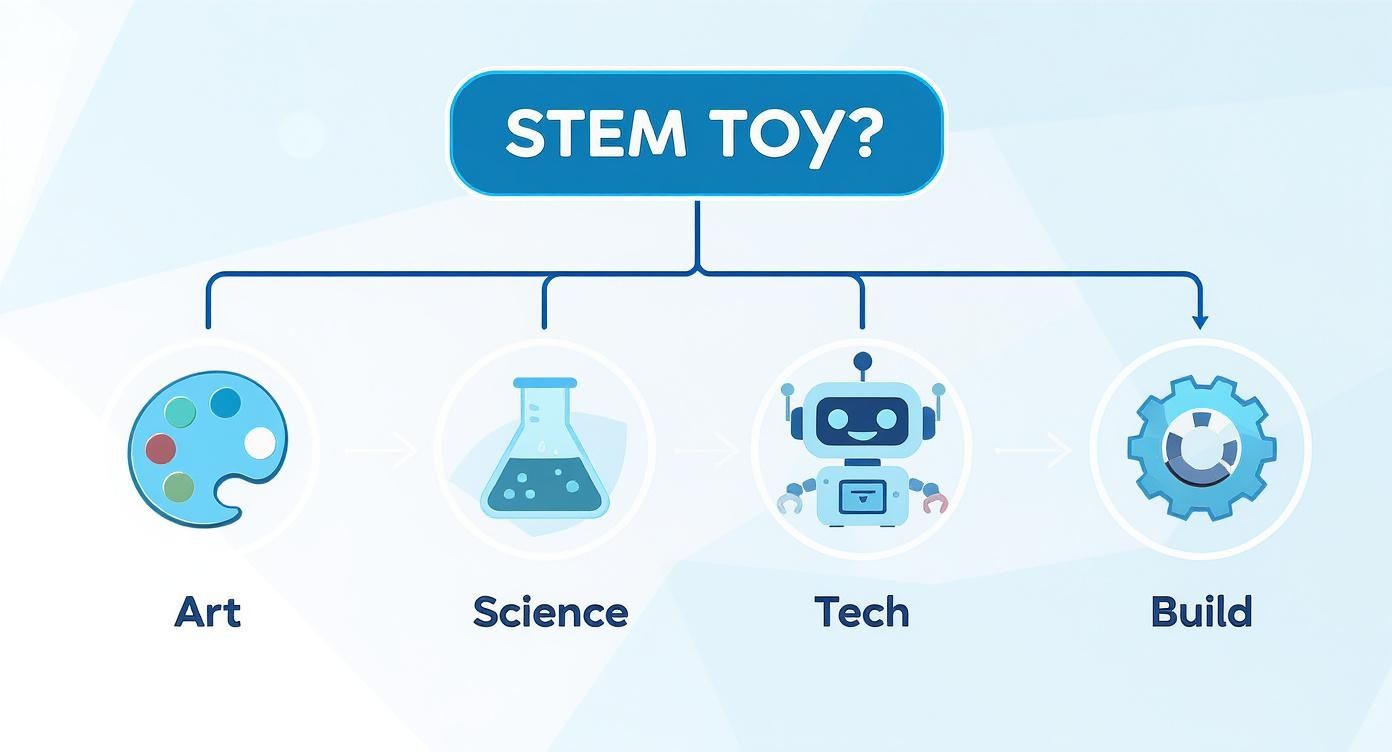
As you can see, every interest, whether it's art or technology, opens up a pathway to valuable STEM learning. A love for building can lead directly to engineering concepts, while an interest in science can be nurtured with hands-on experiment kits. It's all connected.
Matching Toys to Your Child's Passions
To make your decision even simpler, let’s look at some popular toy types and the skills they help grow.
-
Logic and Strategy Games: These are fantastic for developing critical thinking, planning, and patience. Board games, intricate puzzles, and strategy challenges teach children to think several steps ahead. It's not just about physical toys, either. For a child hooked on strategy, resources like the Best Chess Books for Beginners can be a brilliant next step.
-
Construction and Engineering Sets: Think advanced LEGO kits or magnetic tiles. These toys are brilliant for improving spatial awareness, fine motor skills, and an intuitive understanding of physics. They are literally the building blocks of engineering, letting kids design, test, and rebuild their own creations from the ground up.
-
Beginner Robotics Kits: These kits offer a fun, hands-on introduction to coding and technology. Children can build their own robots and program them to perform simple tasks, learning the fundamentals of sequencing and logic in a way that feels like pure play.
-
Science and Discovery Kits: From volcano-making sets to crystal-growing kits, these toys bring scientific principles to life. They encourage curiosity, observation, and a love for experimentation, making abstract concepts tangible and exciting. For even more ideas, check out our free activities page for simple science experiments you can do at home.
The table below breaks this down further, helping you pinpoint the best type of toy for the skills you want to encourage and the activities your child already enjoys.
Which Educational Toy Is Right for Your Child?
Use this quick comparison to find the best toy type based on your child's interests and the skills they'll develop.
| Toy Category | Primary Skills Developed | Great For Kids Who Love | Example |
|---|---|---|---|
| Logic & Strategy | Critical Thinking, Problem-Solving, Patience | Puzzles, board games, figuring things out | Chess Set, Gravity Maze |
| Construction & Engineering | Spatial Awareness, Fine Motor Skills, Physics | Building, designing, taking things apart | Advanced LEGO Technic Kits |
| Beginner Robotics | Coding Basics, Sequencing, Logic | Technology, video games, how things work | programmable robot |
| Science & Discovery | Observation, Experimentation, Curiosity | Nature, asking "why?", hands-on projects | Crystal Growing Kit |
Ultimately, the goal is to find something that sparks genuine excitement. When a toy aligns with what a child already loves, the learning happens almost by accident.
The Surprising Evolution of Learning Toys
If you think today's learning toys are just fancier versions of the wooden blocks you grew up with, you're in for a surprise. The journey from simple spinning tops to the incredible educational toys for 8 year olds we have now is a fascinating one, and it tells us a lot about how our understanding of childhood has deepened over the years.
Not so long ago, educational toys were pretty straightforward. They were all about hands-on materials designed to teach the basics—shapes, colours, the alphabet. Think classic wooden puzzles and building blocks. They were brilliant for tactile learning, but their potential stopped there. As we learned more about how children think and grow, the toys started to change, focusing more on sparking creativity, solving problems, and thinking outside the box.
From Postman to Pixels
That shift has really picked up speed in the last few decades. Here in the UK, we've always had a knack for innovative learning tools, from the mail-order science kits of the 1940s to the first electronic gadgets. But today's world is a different beast entirely. With around 73% of UK children using a mobile phone by the time they even start school, it’s no wonder that app-integrated and digital toys are everywhere. It’s a huge move towards interactive, tech-fuelled play. You can get a great overview of the history of educational toys on Wikipedia.
But this doesn’t mean the old ways have been left behind. Far from it. The best modern toys are the ones that blend those timeless play patterns with exciting new possibilities.
The goal of modern educational toys is to merge the hands-on joy of classic play with the interactive potential of technology. It’s about creating experiences that are both deeply engaging and powerfully educational.
This is something we think about all the time at Space Ranger Fred. Our stories, like The Fumbled Frost-Fuel Fiasco, are built to mix that classic, character-driven adventure with genuinely exciting STEM ideas. We believe a cracking good story is the perfect launchpad for real-world exploration—whether that’s with a high-tech robot or a simple box of bricks.
Knowing where toys have come from helps us see just how cleverly today’s best ones are designed to get our kids ready for whatever comes next.
What to Look for When Choosing an Educational Toy
So, you’re ready to pick the perfect toy? With so many options out there, it can feel a bit like charting a course through an asteroid field. This practical guide is your mission control, giving you the essential criteria to make a brilliant choice—one that’s genuinely valuable and a whole lot of fun.
The best educational toys for eight-year-olds are the ones that can withstand hours of enthusiastic play while keeping your young explorer totally captivated. We’ll cover the big three: safety, durability, and that all-important 'play value' that separates a truly great toy from a five-minute wonder.
Safety and Durability First
Before anything else, safety is mission-critical. Simple as that. Here in the UK and Europe, always look for the CE mark on the packaging. This is your guarantee that the toy meets strict safety standards. It’s still a huge deal for an eight-year-old, especially with science kits containing small parts or introductory electronics sets.
Durability comes a very close second. There’s nothing more frustrating than a toy that breaks after a couple of goes. It’s not just a waste of money; it’s a missed opportunity for learning. Look for sturdy materials and, if you can, skim a few reviews from other parents. A well-made toy isn't just safer; it’s an investment in countless hours of discovery.
Age Appropriateness and Challenge Level
The '8+' on a box is a decent starting point, but you know your child better than anyone. The goal is to find a toy that hits that sweet spot right between "too easy" and "I give up!" It needs to present a gentle challenge, encouraging them to stretch their skills without feeling overwhelmed.
Think of it like a puzzle they know they can solve with a bit of effort, not one that seems impossible from the get-go. This is how they build resilience and confidence. Master it too quickly and it gets cast aside. Too difficult, and it gathers dust. Finding that perfect balance is the secret to keeping them hooked.
A great educational toy meets a child where they are but shows them where they could go next. It’s about providing a scaffold for their growing skills, not a ladder that's too tall to climb.
This is where you can lean into their natural interests. If they're a budding builder, a more advanced construction kit offers the right kind of challenge. If they’re fascinated by how things work, a beginner robotics kit could be the perfect next step. A toy that nurtures their ability to think critically will help them in every area of their life. For more on this, check out our guide on how to develop critical thinking skills.
Long-Term Play Value
Finally, think about the toy’s long-term 'play value'. Can it be used in lots of different ways? Open-ended toys are fantastic for this. A good set of building blocks, for example, can become a castle one day and a spaceship the next. This kind of versatility sparks creativity and ensures the toy stays in the rotation for months, not just minutes.
Look for these key features:
- Open-ended potential: Can it be used for more than one purpose?
- Room to grow: Does it offer more advanced challenges as your child’s skills develop?
- Encourages imagination: Does it invite storytelling, creative thinking, and problem-solving?
Choosing a toy with high play value means you’re investing in a tool that will support your child's learning journey for a long, long time.
Bringing Learning to Life with Story and Play
Here at Space Ranger Fred, we know that storytelling is the ultimate launchpad for learning. The very best educational toys for 8 year olds are never just standalone objects; they’re props in a much grander adventure. When you combine a great narrative with hands-on play, you create a learning experience that really sticks.
Our books are designed to spark that first flame of curiosity, turning abstract STEM concepts into thrilling missions. When a child is truly invested in a story, they're not just playing—they’re right there alongside their favourite characters, solving problems and saving the day.
Creating Your Own Learning Adventures
This multi-sensory approach makes complex ideas feel instantly more approachable and fun. It's surprisingly easy to turn playtime into a real journey of discovery with a few simple pairings.
- Read and Build: Just finished reading about Fred’s latest mission to Mars? Challenge your child to build their own LEGO rover capable of navigating the bumpy terrain of the living room floor.
- Explore and Experiment: Inspired by a story about discovering new planets? Grab a simple science kit and grow colourful crystals that look just like alien minerals.
This method of linking a compelling story to a physical task helps to cement new concepts in a child's mind. It transforms passive learning into active, imaginative play, which is far more memorable and engaging.
What’s more, clever strategies like gamification in education are a brilliant way to keep kids hooked. By framing learning as a story-driven game, we can nurture a genuine love for discovery that lasts a lifetime. For more on this, check out our guide to the best educational books for kids and see just how powerful stories can be.
Common Questions About Educational Toys
Stepping into the world of educational toys can feel a bit like charting a course through a new galaxy. It’s exciting, but you want to be sure you’re heading in the right direction! Let's clear up a few of the most common questions we hear from parents and teachers.
How Do I Choose a Toy That Will Hold Their Interest?
The real secret here is to find that perfect sweet spot between what your child already loves and a gentle, rewarding challenge. Take a moment to observe what they gravitate towards naturally. Are they a master builder, creating entire cities from blocks? Or perhaps they're a puzzle-solver who loves a good mystery, or a storyteller with a universe of characters in their head?
Look for toys that offer plenty of "open-ended" play potential—that’s just a fancy way of saying they can be used in loads of different ways. A robotics kit that lets them build countless unique creations will almost always have more staying power than a gadget with only one function. It's also smart to find toys that can grow with them, offering tougher challenges as they get older and more skilled.
Are Screen-Based Educational Toys as Good as Physical Ones?
They both have their own superpowers! Physical educational toys for 8 year olds, like a good old-fashioned construction set or a hands-on science kit, are incredible for building fine motor skills and spatial awareness. There's a special kind of magic in that tangible, hands-on connection to learning.
At the same time, some really well-designed apps and games can be brilliant for introducing more abstract ideas, like the logic behind coding or the principles of digital art. Honestly, the best approach is usually a healthy mix of both. You can even find toys that cleverly blend the two, like a building kit that comes to life when connected to a tablet app. That way, your child really does get the best of both worlds.
How Can I Encourage a Child Who Isn't into Science?
This is a great question. If your child isn’t exactly a budding scientist, don’t try to force it. Instead, start with what they do love and find the science that’s already hiding in there.
- For the Artist: What about a kit that explores the science of colour mixing, or a 3D printing pen that lets them turn their sketches into real, solid objects?
- For the Storyteller: Look for something that lets them build characters and worlds. A stop-motion animation kit, for example, is a fantastic tool for bringing their epic tales to life.
The goal isn't to turn them into a scientist overnight. It’s about showing them that STEM is a creative and fun tool that’s part of everything they already enjoy. Frame it as an adventure or a puzzle to solve, not another lesson from school.
Ready for your next mission? Explore more of the Space Ranger Fred universe, from our thrilling books to our free activities, and keep the adventure going