
The best science kits are the ones that feel less like a lesson and more like a brilliant adventure. Think of things like growing colourful crystals, bubbling exploding volcanoes, or even piecing together a wobbly robot—activities that grab a child's attention the moment the box is opened.
Launching Your Scientific Adventure
Trying to find the perfect science kit can feel a bit like navigating an asteroid field, but it’s a mission worth taking! Your goal is to find something that doesn't just fill a rainy afternoon but genuinely sparks a passion for discovery. A great kit is so much more than a toy; it’s a launchpad for learning, helping kids understand the world around them through pure, hands-on fun.
The demand for toys that blend education with entertainment has never been higher. In fact, the UK toy market is seeing a huge surge in STEM-focused products, with a forecasted growth rate of 4.3% every year between 2025 and 2035. This just goes to show how much parents and educators are looking for tools that make learning feel like an adventure.
What Makes a Science Kit Great?
A truly fantastic science kit isn't just about flashy experiments. It’s about building core skills in a way that feels completely natural and exciting. When you're looking, try to find kits that encourage:
- Curiosity: It should make kids ask "why?" and inspire them to find the answers themselves.
- Problem-Solving: The best kits throw small, solvable challenges their way, building confidence with every little win.
- Hands-On Fun: There's real power in learning by doing. A kit should absolutely encourage kids to get their hands messy and experiment.
A brilliant way to introduce principles of physics and engineering is through something like Estes Model Rockets. These kits bring science to life in a thrilling, unforgettable way that really sticks.
To give you a clearer picture, here’s a breakdown of some popular types of science kits.
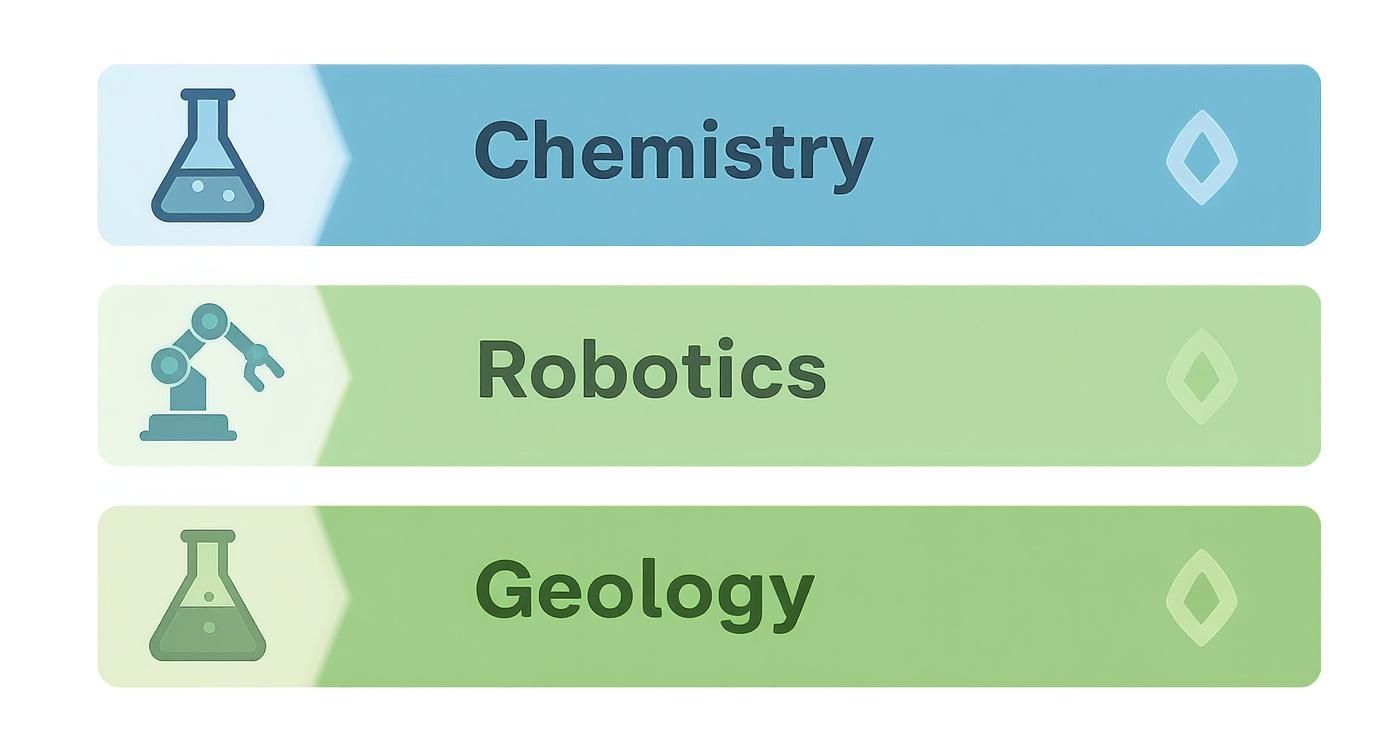
At-a-Glance Guide to Science Kit Types
Choosing between chemistry, robotics, or digging for fossils can be tough. This quick table breaks down some of the most popular kit categories to help you match one to your child's budding interests.
| Kit Type | Key Focus | Best For Ages | Example Activity |
|---|---|---|---|
| Chemistry | Reactions, potions, and states of matter | 8+ | Making a fizzy volcano eruption |
| Robotics | Building, coding, and basic mechanics | 10+ | Assembling a solar-powered bug |
| Geology | Earth science, crystals, and fossils | 6+ | Excavating a dinosaur skeleton |
| Physics | Forces, motion, and simple machines | 7+ | Building a simple catapult |
| Biology | Life cycles, plants, and ecosystems | 5+ | Growing a small herb garden |
Hopefully, that gives you a better idea of what's out there! Each type offers a unique window into the world of science.
This visual shows how different kits are designed for specific interests, from the exciting reactions in a chemistry set to the mechanical wonders of robotics. You can also find plenty of other simple and engaging experiments among our other fun science activities for kids.
Matching Kits to Your Child's Age and Passion
Choosing the right science kit is all about finding that perfect sweet spot between what’s fun and what’s right for your child's age. Give them something too simple, and they'll be done in five minutes. Too complex, and you’re heading for a full-blown frustration meltdown. The goal is to find a challenge that feels exciting, not overwhelming.
It’s a bit like choosing a bike. You wouldn’t hand a five-year-old a ten-speed racer, and a teenager won’t get much of a thrill from a bike with stabilisers. Science kits work exactly the same way—they need to match the rider's stage.
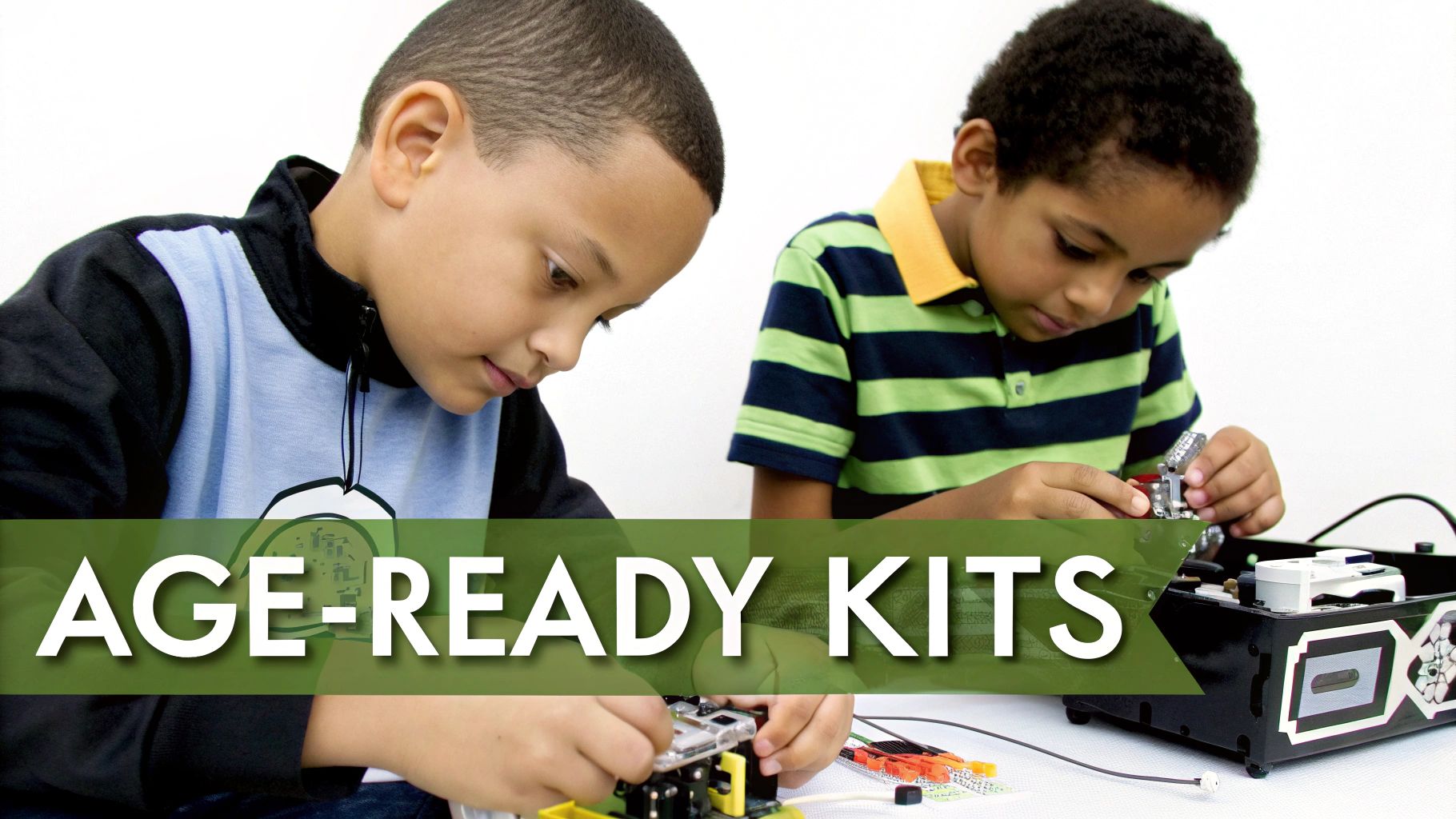
Finding the Right Fit for Younger Explorers (Ages 6–8)
For younger kids, science is all about big, hands-on experiences. They’re still learning through play, so look for kits with large, safe components and simple, highly visual instructions. At this age, a page full of pictures is infinitely more helpful than a wall of text.
Success here is all about getting immediate, visible results. Think about kits that offer a quick, satisfying payoff:
- Volcano Kits: That instant fizzy eruption is a huge win and a brilliant, unforgettable introduction to basic chemistry.
- Crystal Growing Sets: These offer a magical, slow-burn transformation that kids can check on each day, watching their creation take shape.
- Geology Dig Kits: Perfect for kids who love getting their hands dirty. They get to chip away and discover a hidden treasure, like a real fossil or gemstone.
These types of kits are fantastic for building confidence. They sneak in core scientific principles without ever feeling like a lesson.
Levelling Up for Older Scientists (Ages 9–12)
As children get older, their ability to follow complex instructions and grasp more abstract ideas grows exponentially. Kits for this age group can introduce more intricate concepts, smaller components, and multi-step projects that require a bit more patience and precision. This is also the age where their unique interests really start to shine.
Got a kid who is obsessed with how things work? A basic robotics kit could be the perfect challenge. If they love mixing and measuring, a more advanced chemistry set with dozens of experiments will keep them hooked for hours. The industry has noticed this shift, too. Research shows that as kids approach their teens, interest in complex STEM toys grows massively. In fact, in the 8-12 age group, STEM toys accounted for a whopping 41% of the market share in 2025. You can dig deeper into these trends in the UK toy market to see just how big this is.
Tapping into a child’s natural passion is the secret ingredient. A kit about rocks might seem simple to us, but for a child who already has a pocketful of pebbles, it’s the most exciting adventure in the world. That personal connection turns a simple activity into a lasting memory.
By matching the kit to what they already love—whether it’s space, nature, or technology—you’re not just giving them a toy. You’re showing them that science is already a part of their world. This approach is also a fantastic way to build knowledge, much like finding amazing educational books for kids can turn reading into an adventure.
Spotting Real Educational Value
A great science kit does more than just make a volcano fizz or a crystal grow; it builds real skills that stick around long after the experiment is cleaned up. It's easy to be drawn in by flashy packaging, but the true value of the best science kits for kids is how they encourage a child to think, not just follow a recipe.
A kit with genuine educational punch goes beyond simple steps. It's all about hands-on exploration that aligns with effective discovery-based learning principles. It should make kids wonder, ask questions, and yes, even get things wrong now and then.
Beyond the Instructions
The very best kits teach resilience. When an experiment doesn't go to plan, it's not a failure—it's just an unexpected result. This is a brilliant moment to talk about what scientists really do: they test, they observe, and they try again.
Look for instructions that explain the ‘why’ behind the ‘what’. A guide that just says, "Mix A with B" is a huge missed opportunity. But one that explains, "When you mix the acidic vinegar with the alkaline bicarbonate of soda, you create a chemical reaction that releases carbon dioxide gas," turns a five-minute activity into a lesson that lasts.
A brilliant science kit is like a great story. It doesn’t just tell you what happens next; it makes you want to turn the page and find out for yourself. It’s about igniting curiosity, not just delivering facts.
Connecting to the Classroom
Many of the best science kits tie in beautifully with school topics like chemistry, physics, or biology. They’re a fantastic way to bring classroom learning home in a fun, low-pressure way.
Is your child learning about ecosystems? A terrarium kit can make that lesson come alive on their windowsill. Are they tackling electricity? A simple circuits kit makes abstract concepts tangible and exciting.
This hands-on approach is incredibly powerful for cementing ideas. If you want to dive deeper into why this works so well, you can explore our guide on what experiential learning is and how it helps kids grasp big concepts.
Putting Safety and Quality First
When it comes to our curious little scientists, nothing is more important than their safety. Before any bubbling potions or whirring gadgets get going, taking a moment to check the kit’s quality and safety credentials gives you total peace of mind.
A well-made kit is a safe kit. You want to see sturdy, non-brittle plastics, especially for younger kids who aren't always gentle. If there are any electronics, check that the battery compartments are screwed shut – a simple feature that stops tiny fingers from getting where they shouldn't. And for chemistry sets, it’s crucial that all the ingredients are non-toxic and clearly labelled. You should never be left guessing what your child is handling.
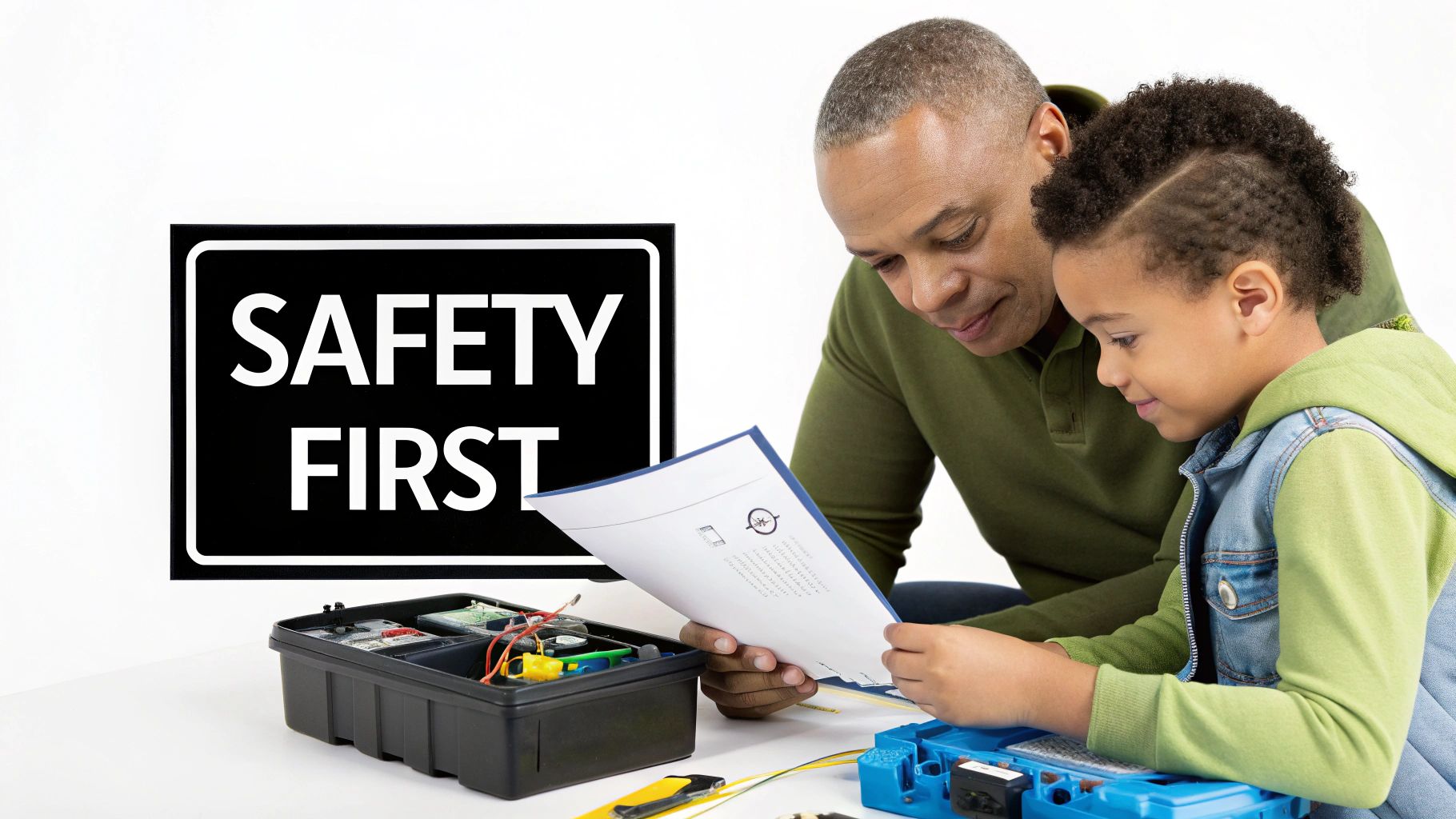
A Quick Safety Checklist
As you're browsing the best science kits for kids, keep this simple checklist in mind. It'll help you spot a quality product straight away.
- Look for UKCA and CE Markings: These little symbols are your guarantee that the product has been properly assessed and meets UK and European standards for safety, health, and environmental protection.
- Check the Age Guidance: It’s tempting to buy a more "advanced" kit, but always stick to the recommended age. A kit designed for a 10-year-old could have small parts or complex chemicals that are genuinely hazardous for a younger sibling.
- See if Safety Gear is Included: I always think it's a great sign when a kit comes with its own goggles or gloves. It shows the manufacturer cares and helps teach kids good, safe scientific habits right from the start.
A great rule of thumb is to always read the instructions together before you begin. It turns the setup into part of the fun and makes sure everyone knows the plan—and the precautions—before diving in.
Keeping the STEM Fun Going
The real magic of a brilliant science kit isn't just in the first fizz or pop. It’s what happens after the initial excitement fades. So, how do you keep that spark alive and turn a one-off experiment into a real, lasting passion for discovery?
It’s all about creating an environment where curiosity is part of the everyday routine.
One of the simplest things you can do is set up a dedicated ‘lab’ space. This doesn't need to be anything grand; a small table in a corner with a few pots for their tools and findings will do the trick. Giving their scientific exploration a proper home gives it a sense of importance.
Turning Experiments into Adventures
Another great tip is to get them a science notebook. Encourage them to draw what they see, jot down their questions, and record what happens—especially when things go wrong! This isn't just about making notes; it's about teaching them to think like a real scientist.
You can also help by connecting their small-scale experiments to big, real-world ideas. If they’ve just made a volcano erupt, spend a few minutes chatting about real volcanoes that form entire islands. If they're growing crystals, pull up some pictures of the giant crystal caves in Mexico. It helps them see that science isn’t just something that comes in a box; it’s happening all around them.
The appeal of hands-on science is massive and it's not going anywhere. The UK is a leading European market for STEM kits, which were globally valued at over $911 million in 2025. Science experiment kits alone make up roughly 30% of that total, which just goes to show how much parents and schools value these activities. You can explore more about the K-12 STEM kit market to see the full picture.
The most important lesson a science kit can teach is that failure is just another word for data. When an experiment fizzles out, frame it as a clue. Ask, “That’s interesting! Why do you think that happened?” This shifts the focus from getting it 'right' to the exciting process of figuring things out.
This mindset is so important for building resilience. For more ideas on sparking that curiosity, check out our other fun activities for kids that will keep their minds buzzing with questions.
Common Questions About Science Kits
Jumping into the world of STEM toys can feel a bit like exploring a new galaxy—exciting but full of questions. To help you on your mission, we've gathered some of the most common queries we hear from parents and teachers about finding the best science kits for kids.
What Is the Best Type of Science Kit to Start With?
If you're just starting out, I always suggest a multi-experiment kit. Look for one that covers a few simple concepts, like building a fizzy volcano, growing some cool crystals, or tinkering with basic circuits.
These kits are brilliant because they offer variety. You get to see what really sparks your child's interest without having to commit to one big, complex topic straight away. Kits with bright, colourful instructions and tools you can use again and again are always a winner for beginners.
How Can I Make Sure a Science Kit Is Worth the Money?
The secret is replay value. Ask yourself: can the experiments be done more than once? Does the kit come with durable, reusable bits and pieces like proper beakers or a good-quality magnifying glass?
Reading reviews from other parents is a fantastic way to get a real sense of the quality and how long it holds a child's attention. Honestly, a slightly more expensive kit with high-quality components that gets pulled out of the cupboard time and again is much better value than a cheaper one that's all over in a single afternoon.
My Child Gets Frustrated if an Experiment Fails. What Should I Do?
Ah, the failed experiment! This is actually a brilliant learning opportunity, not a disaster. It's the perfect moment to frame it as part of being a real scientist—experiments often need a few goes before they work out.
Top Tip: Work through the steps together, double-check the instructions, and have a little chat about what might have gone wrong. Make sure to celebrate the effort and the process of discovery, not just the perfect result. This is how you help build resilience and a true scientific mindset.
By embracing the little mishaps, you teach them that science is all about curiosity and trying again. That’s a lesson far more valuable than any single successful experiment.
At Space Ranger Fred, we believe that every question is a launchpad for a new adventure. For more stories that blend science, fun, and discovery, explore the exciting universe of Space Ranger Fred today.