
Ahoy, Space Rangers! Have you ever wondered why we get to build snowmen in winter but splash about in the sea during summer? It’s a brilliant question, and the answer is one of the most amazing secrets of our planet’s journey through space.
Lots of people think our seasons change because Earth gets closer to or farther away from the Sun. But that’s a common mix-up! In fact, our part of the world (the Northern Hemisphere) is actually a little bit closer to the Sun when it’s our winter.
So, what’s really going on? Let's find out! The true hero of this story is Earth's amazing tilt.
Why Our World Has Different Seasons
The real reason we have seasons is that our planet has a special wobble! Earth is tilted on its axis, a bit like a spinning top leaning over to one side. This constant lean of 23.5 degrees means that as we travel around the Sun each year, different parts of our planet get more direct sunlight than others.
This cosmic wobble is what gives us summer, autumn, winter, and spring.
A Cosmic Wobble Creates Our Year
Imagine you’re on an adventure with Space Ranger Fred, looking down at our planet from his spaceship. You’d notice that Earth doesn’t spin perfectly straight up and down. Instead, it’s always leaning over.
It’s this lean that causes seasons on Earth.
As our planet orbits the Sun, this tilt changes which part of the world is pointing towards the Sun’s warm rays.
- When our half of the world is tilted towards the Sun: We get more direct, concentrated sunlight. The days get much longer, and we get to enjoy the glorious warmth of summer.
- When our half is tilted away from the Sun: The sunlight has to spread out over a larger area, hitting us at an angle and feeling much weaker. The days get shorter, and we bundle up for a chilly winter.
It’s the combination of Earth’s tilt and its journey around the Sun that gives us the four seasons we know and love. It’s a wonderful cosmic dance that happens every single year without fail!
To help you see how it all connects, here’s a quick summary for us in the UK.
Earth's Seasons at a Glance
| Season | Our Hemisphere's Tilt | What Happens to Daylight? | How Does the Weather Feel? |
|---|---|---|---|
| Summer | Tilted towards the Sun | Days are long and bright | Warm and sunny |
| Autumn | Tilting away from the Sun | Days start getting shorter | Cool and often windy |
| Winter | Tilted away from the Sun | Days are very short and dark | Cold, frosty, and maybe snowy! |
| Spring | Tilting back towards the Sun | Days start getting longer again | Mild and often rainy |
This simple tilt is the secret behind our changing world.
In this guide, we'll solve this cosmic puzzle together. We’ll discover why it’s warm here in the UK when it’s cold in Australia and even try some fun, hands-on activities to see exactly how it all works.
The Secret Behind Earth’s Amazing Tilt
Let’s zoom in on the real hero of our story about the seasons: Earth’s wonky tilt. If you were up in a spaceship with Space Ranger Fred, you’d spot something curious. Our planet isn’t spinning perfectly straight up and down.
Instead, Earth is tipped over on its side by 23.5 degrees. This constant lean is the master switch for our weather, and it’s what makes our world so interesting all year round. It never straightens up; it just stays tilted as it journeys around the Sun.
Believe it or not, this slight lean is the single biggest reason we have seasons at all.
Try This Fun Seasons Experiment at Home
You don’t need a spaceship to see how this works—just a lamp and a piece of fruit! Let's try a super simple experiment to bring this cosmic idea down to Earth.
What you’ll need:
- An orange or a ball (this will be our Earth)
- A torch or a lamp without a shade (this will be our Sun)
- A dark room
First, ask a grown-up to help you make the room nice and dark. Now, hold your orange ‘Earth’ and give it a slight tilt, just like our real planet. Then, switch on your torch ‘Sun’ and shine it directly at the middle of the orange.
What do you notice? You should see that the light from the torch shines more brightly and directly on one half of the orange. The other half gets light too, but it looks more spread out and dimmer because it’s angled away.
This is exactly what happens to our planet every single day!
How the Tilt Changes Our World
That focused beam of light on your orange is just like summer. For half of the year, our part of the world (the Northern Hemisphere, where the UK is) is tilted towards the Sun. We get that direct, powerful sunlight, which warms everything up and gives us those long, sunny days perfect for adventures.
Now, think about the other side of your orange, where the light was spread thin. Six months later, as Earth continues its orbit, our Northern Hemisphere is tilted away from the Sun. The sunlight now hits us at a much lower angle, making it feel weaker and less warm. This brings shorter days and the chilly weather we all know as winter.
This simple, playful activity makes the big idea of an axial tilt easy to understand. It shows that science isn't just something you read about in books—it’s something you can do right in your own home!
The seasons are really a story of angles and light. When we’re tilted towards the Sun, we soak up its rays like a sunbathing cat. When we’re tilted away, we only get a glancing blow of light, telling us it’s time to wrap up warm.
This constant tilt is what keeps our seasons cycling, from the new beginnings of spring to the cosy nights of winter. Ready to see what happens when we add Earth's yearly journey into the mix? You can find even more hands-on ideas on our activities page.
Our Planet's Yearly Journey Around the Sun
Now we know the secret behind Earth’s amazing tilt, let’s add the next piece of the puzzle: our planet’s year-long trip around the Sun. It takes Earth roughly 365 days to complete one full journey along a path we call an orbit. It's this epic voyage, combined with our planet's permanent 23.5-degree lean, that really gets to the heart of what causes the seasons.
As Earth travels, the part of our world angled towards the Sun slowly changes. This steady, predictable movement is what brings us the four distinct seasons we know and love here in the UK.
It’s All About the Angle of the Sun
Imagine Space Ranger Fred zooming through the cosmos and spotting Earth spinning like a wobbly top! That little wobble is the big secret to our seasons. Our home planet is tilted on its axis by 23.5 degrees, and as it orbits the Sun, different parts of the globe get more direct sunlight than others.
When it’s summer in the UK, usually around June, our half of the world—the Northern Hemisphere—is tilted right towards the Sun. This gives us wonderfully long days, with up to 17 hours of daylight in London on the summer solstice! This is why our summers can feel so warm and bright. You can find out more about the UK's changing weather patterns over at Carbon Brief.
Lots of people think seasons happen because Earth gets closer to or farther from the Sun. But here in the Northern Hemisphere, we're actually closest to the Sun in January—the middle of winter! This proves it’s the angle of the sunlight, not the distance, that really counts.
This timeline shows just how important Earth's tilt is for creating our seasons.
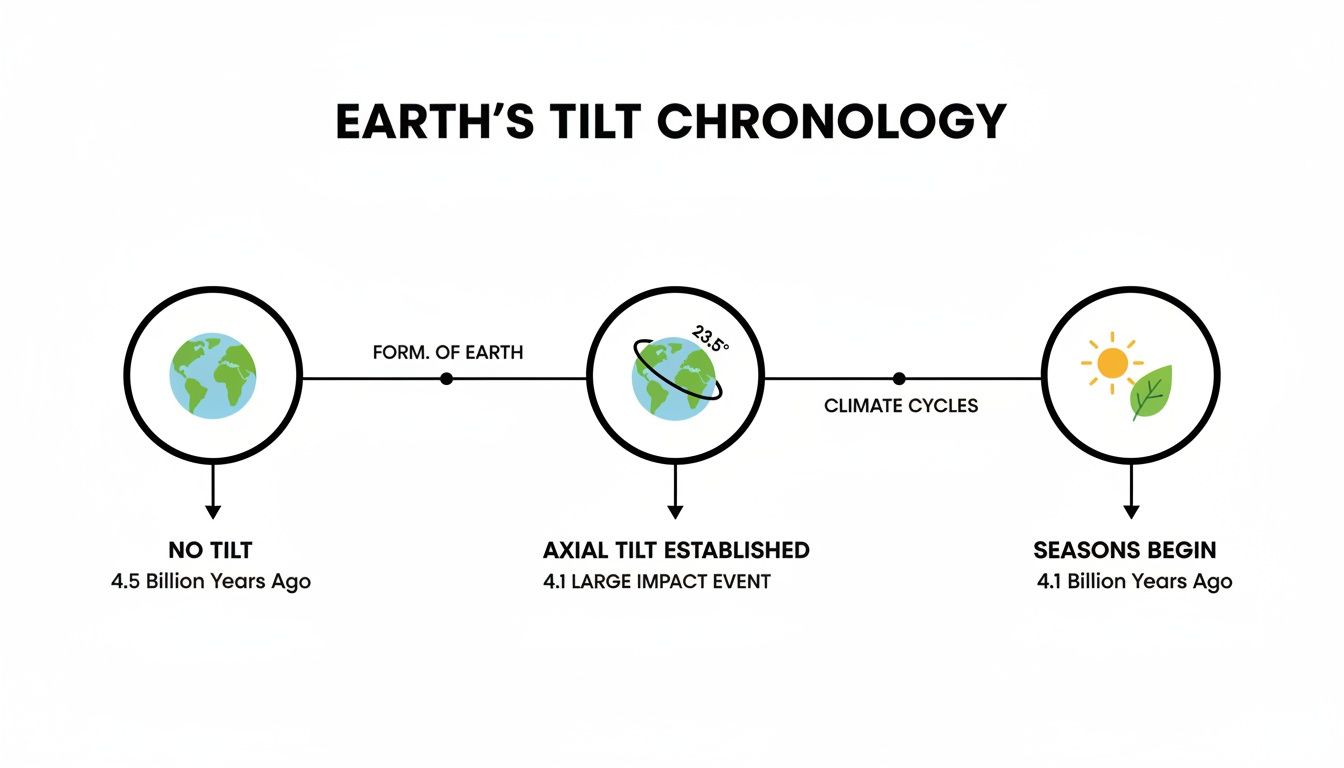
Without this tilt, our climate would be pretty much the same all year round. How boring would that be?
Following Earth Through Its Orbit
Let’s follow our tilted planet on its journey to see how this works:
- Summer: When the Northern Hemisphere is angled towards the Sun, we get hit with direct, powerful rays of sunlight that warm us up. The days are long, and the nights are short.
- Winter: Six months later, we're on the other side of our orbit. Now, our hemisphere is tilted away from the Sun. The sunlight hits us at a much shallower angle, which spreads its energy out and makes things feel a whole lot cooler.
This annual trip around our home star is one of the most important rhythms of our planet. If you'd like to explore more about our planet's neighbourhood, check out our easy guide to what the solar system is.
Understanding Summer Here and Winter in Australia
Have you ever wondered why you might be building a sandcastle on a sunny beach here in the UK, while your friends down in Australia are pulling on their winter jumpers? It’s a fantastic question, and it gets right to the heart of what causes seasons on Earth.
Our planet is split into two halves by an imaginary line called the equator. Everything above this line is in the Northern Hemisphere (that’s us!), and everything below it is in the Southern Hemisphere. Thanks to Earth's special tilt, these two halves always have opposite seasons.
So, when our Northern Hemisphere is leaning in for a good dose of sunshine, we get our long, warm summer days. At the very same time, the Southern Hemisphere must be tilted away, which means it gets less direct sunlight. The result? Their days are shorter and cooler, and they get to have winter. It’s like a giant cosmic seesaw!
A Tale of Two Hemispheres
Let’s grab our orange and torch again to see this in action. Hold your tilted ‘Earth’ and shine the ‘Sun’ on it. See how the top half is getting lots of direct, concentrated light? That’s summer in the UK.
Now, without changing the tilt, have a look at the bottom half of the orange. Notice how the torchlight is more spread out and looks a bit weaker? That’s winter in Australia. They’re happening at exactly the same time, just on opposite sides of the world.
This is why our seasons are a perfect mirror image of each other. When we’re enjoying our summer solstice, they’re having their winter one.
The Four Turning Points in Earth’s Orbit
As Earth makes its year-long journey around the Sun, there are four special moments that mark the official start of each season. These are called the solstices and the equinoxes.
- Summer Solstice: This happens around 21st June for us in the Northern Hemisphere. It’s the longest day of the year because our part of the world is tilted most directly towards the Sun. More sun time!
- Winter Solstice: Around 21st December, we get our shortest day of the year. This is when our hemisphere is tilted furthest away from the Sun, making for a long, cosy night.
- Spring Equinox: Around 20th March, the Sun shines directly over the equator. On this day, night and day are almost equal in length everywhere on Earth, and it marks the beginning of spring for us.
- Autumn Equinox: The same thing happens again around 22nd September! The Sun is once again right over the equator, giving us another day of nearly equal day and night as we head into autumn.
These four key dates are Earth’s big turning points in its yearly dance around the Sun. They show us exactly how our planet’s steady tilt creates a beautiful, predictable pattern of changing seasons year after year.
How the Tilt Affects Our Daylight and Weather
Right, let's bring all these big, spacey ideas down to Earth and see how they affect what we see and feel every single day. We know our planet's wonky tilt is the secret ingredient for the seasons, but how does it actually change the weather and make our days longer or shorter? It's all about how the Sun's rays hit us.
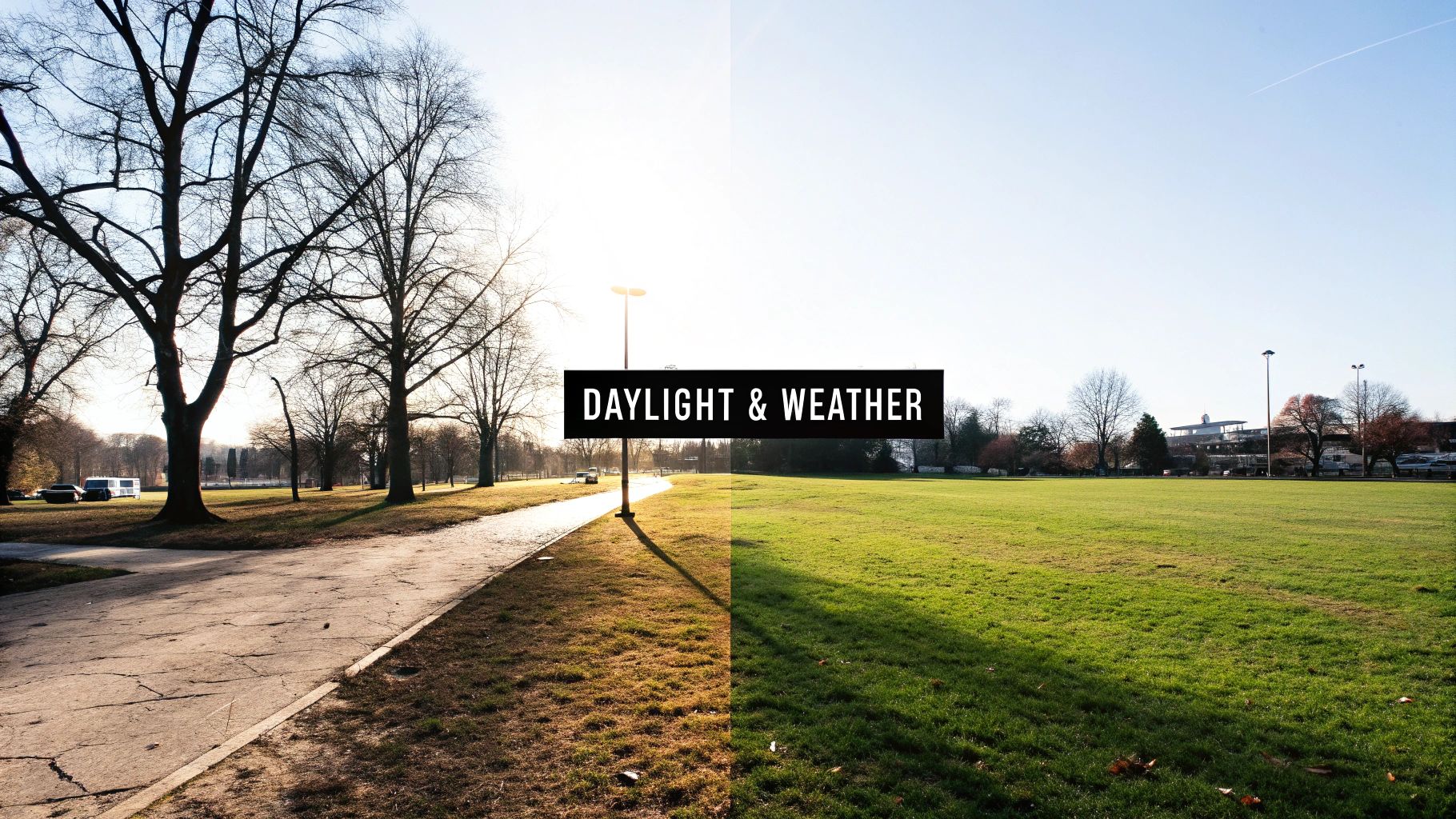
Think about summer. The Sun seems to be much higher in the sky, doesn't it? When the UK is tilted towards it, the Sun's rays hit us more directly, like shining a torch straight down onto a piece of paper. This focused energy feels much warmer, and it does a brilliant job of heating up the ground, the air, and even the sea.
On top of that, the days are lovely and long, which gives the Sun even more time to warm everything up. That's why a summer day feels so bright and toasty—we’re getting a double whammy of powerful, long-lasting sunshine!
From Sunny Days to Chilly Nights
Now, let’s imagine winter. During winter, our part of the world is tilted away from the Sun. The Sun hangs much lower in the sky, and its rays reach us at a really shallow angle. Try shining that same torch beam at the paper from the side. The light spreads out over a much bigger area, so it feels weaker and a lot cooler.
Plus, the days are frustratingly short! This means there’s far less time for the Sun to warm us up before night falls again. This combination of weaker sunlight and shorter days is exactly what gives us our chilly winter weather. It's why you need your sunglasses and shorts for a summer adventure but a big coat and wellies for a winter one.
This is what makes the UK’s seasons so varied and interesting. As we start tilting back towards the sunnier days of spring, everything bursts into life. It just goes to show how our planet’s tilt creates a wonderful seasonal rollercoaster for us to enjoy.
You can become a ‘weather detective’! Try noticing where the Sun is in the sky at lunchtime in summer versus winter. These little clues help us understand our planet’s amazing journey through space.
Your Space Ranger Questions Answered
Every great explorer has questions, and I’m here to help answer some of the most common ones about Earth's seasons. Let’s dive into your brilliant cosmic queries!
Does Earth's Wobbly Orbit Make Seasons?
That's a super smart question! It’s true that Earth’s orbit around the Sun isn't a perfect circle. It’s actually a slight oval, an ellipse, which means our planet is sometimes a little closer to the Sun and sometimes a bit farther away.
But here’s the twist: this small change in distance doesn't really affect our seasons. In fact, our part of the world (the Northern Hemisphere) is actually closest to the Sun in January—right in the middle of winter!
This is a fantastic clue showing that distance isn't the real reason for the seasons. The true hero of the story is our planet's steady 23.5-degree tilt, which makes a much bigger difference to our weather throughout the year.
What Would Happen If Earth Had No Tilt?
Imagine a world without any changing seasons! If Earth spun perfectly upright with no tilt at all, the Sun’s powerful rays would hit every part of the planet in the same way, all year long.
The equator would still be incredibly hot and the poles would stay freezing cold, but the weather where you live would stay almost exactly the same, day in and day out.
We wouldn’t have warm summers for playing outside, crisp autumns for jumping in piles of leaves, or cosy winters for sipping hot chocolate. Our planet’s amazing tilt is what makes our world so interesting and full of variety.
Do Other Planets Have Seasons?
Yes, they absolutely do! Any planet with a tilted axis has seasons, but they can be very, very different from what we experience here on Earth.
- Mars: The Red Planet has a tilt that’s very similar to Earth's, so it also has four seasons. The catch is that a year on Mars is almost twice as long as an Earth year, meaning its seasons are much longer, too.
- Uranus: This icy giant is a truly strange one—it’s tilted almost completely on its side! This creates some of the most extreme seasons in the solar system, where one part of the planet gets 42 years of continuous daylight, followed by 42 years of total darkness.
So, while other planets have seasons, Earth’s are just right for us to live, explore, and enjoy.
Why Are the Days Longer in Summer?
This is all thanks to our planet's special tilt! During summer, your half of the Earth is tilted towards the Sun. As our planet spins on its axis each day, this lean means your part of the world spends much more time in the sunlight, giving you those lovely long days and shorter nights.
Then, in winter, your half of the world is tilted away from the Sun. As the Earth spins, you spend less time in the sunlight and more time in the dark. That’s why winter days feel so short and the nights are so long.
It’s another amazing effect of our planet’s tilt! The way the length of our days changes is a bit like how the Moon seems to change shape in the sky. You can discover more about these cosmic patterns by exploring the different moon phases for kids.
Understanding these rhythms helps us see how beautifully connected everything in our solar system really is. From our planet's wobble to its orbit, it all works together to create the world we call home.
I hope that's answered some of your biggest questions about what causes the seasons on Earth! Keep looking up, asking questions, and exploring the wonders of the universe. The team at Space Ranger Fred is always here to help you on your next adventure.