
Have you ever wondered what stops Earth from zooming off into the cold, dark corners of space? It’s a brilliant question! The answer is a kind of cosmic tug-of-war between two invisible forces. One tries to send our planet flying straight ahead, while the other keeps pulling it back towards the Sun.
That perfect push-and-pull is what creates the beautiful, looping path we call an orbit. Ready to find out how it all works? Let's go!
Why Don't Planets Just Float Away From The Sun?
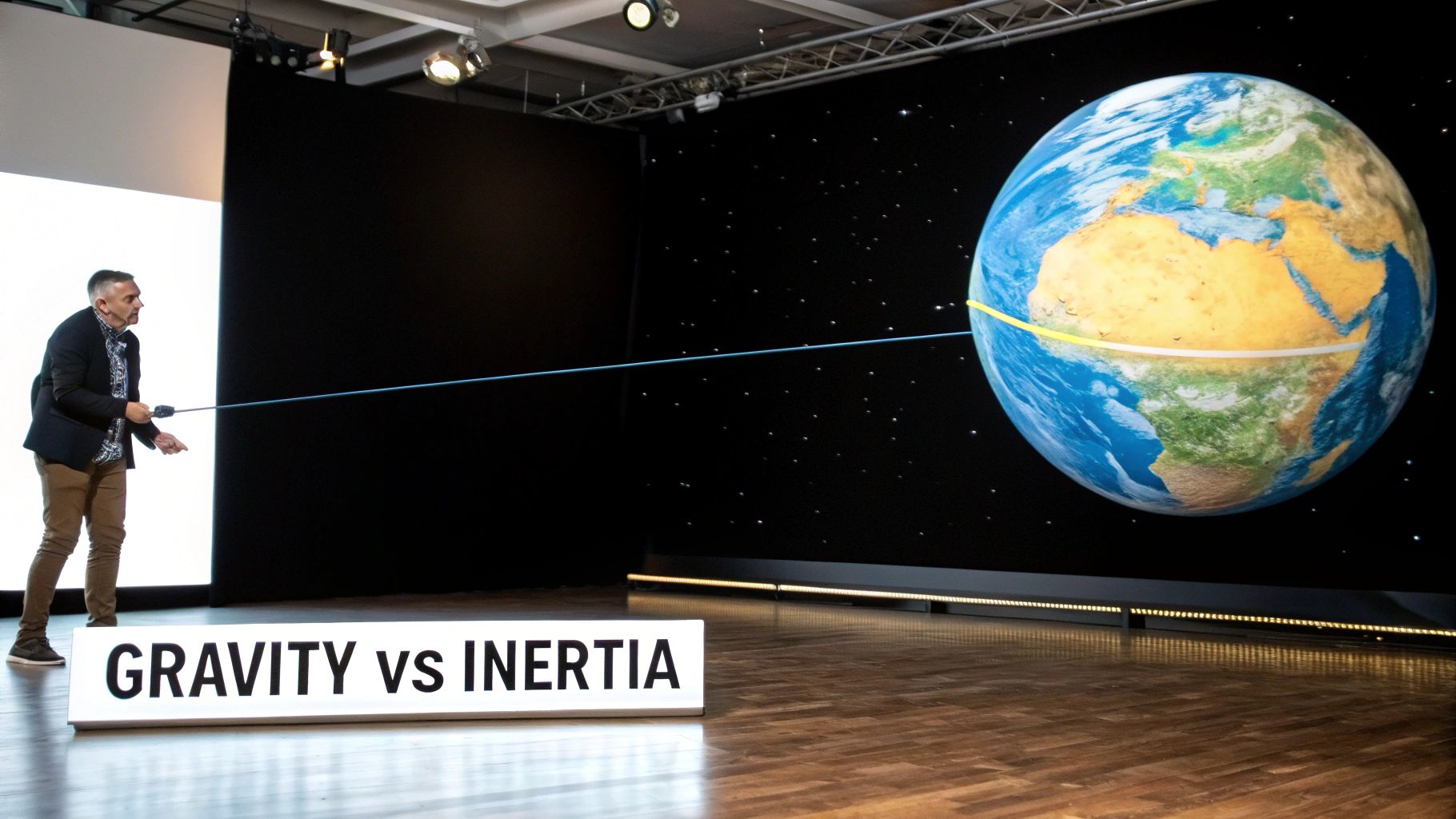
Imagine this: Earth wants to travel in a perfectly straight line, forever and ever. But the Sun has a giant, invisible rope called gravity that’s always gently tugging Earth towards it.
This constant game of "go straight!" versus "come here!" is what keeps every planet, from Mercury to Neptune, circling the Sun. It's an incredible dance between two very important partners. Let's get to know the two heroes of our story: Gravity and Inertia.
The Two Big Ideas Behind Orbits
To really get our heads around how orbits work, we need to meet the two forces that are always in charge. They might sound like big, grown-up science words, but the ideas themselves are actually super simple.
First up is gravity. This is the universe’s invisible superglue. It's a pulling force that all massive objects have, and since the Sun is the biggest and heaviest thing in our neighbourhood by far, its gravity is incredibly strong. It’s constantly pulling all the planets towards its centre.
Then we have inertia. This is just a fancy way of saying that once something is moving, it wants to keep moving in the same direction—a straight line. Planets are always trying to dash straight ahead through space, and they won't stop or turn unless another force nudges them.
Let's take a closer look at how these two ideas work together.
The Two Forces Behind Every Orbit
Here’s a quick look at the two key ideas that work together to keep planets in their cosmic dance around the Sun.
| The Big Idea | What It Does For Planets | Imagine It Like This |
|---|---|---|
| Gravity | It’s the Sun’s constant PULL, trying to draw the planet in. | Tying a ball to a string and swinging it around your head. The string is like gravity, keeping the ball from flying away. |
| Inertia | It’s the planet’s tendency to PUSH forward in a straight line. | Rolling a bowling ball. It keeps going straight until it hits something. That’s inertia in action! |
See? It’s this never-ending tug-of-war that’s the real secret behind every orbit. Gravity pulls a planet inward, while inertia makes it want to fly straight past. When these two forces are balanced just right, the planet ends up travelling in a beautiful, curved path around the Sun.
The Sun’s powerful gravity is a whole adventure in itself, and you can find out more about what makes our star so mighty in our guide on how the sun produces energy.
Understanding Gravity: The Universe's Invisible Glue
Let's meet Gravity, the first hero in our cosmic story. Ever wondered why, when you jump as high as you can, you always come back down? That’s gravity in action! It's a completely invisible force that pulls things towards each other.
You can think of it as the universe’s superglue. Every single thing with mass has its own gravity, but the rule is simple: the bigger and heavier something is, the stronger its gravitational pull.
The Sun is the biggest and heaviest object in our entire solar system. In fact, it holds more than 99% of all the stuff in the solar system! Because of this, it has the most powerful gravity of anything around, acting like a giant cosmic magnet that constantly pulls on everything near it, including our home, Earth, and all the other planets.
Bending Space Itself
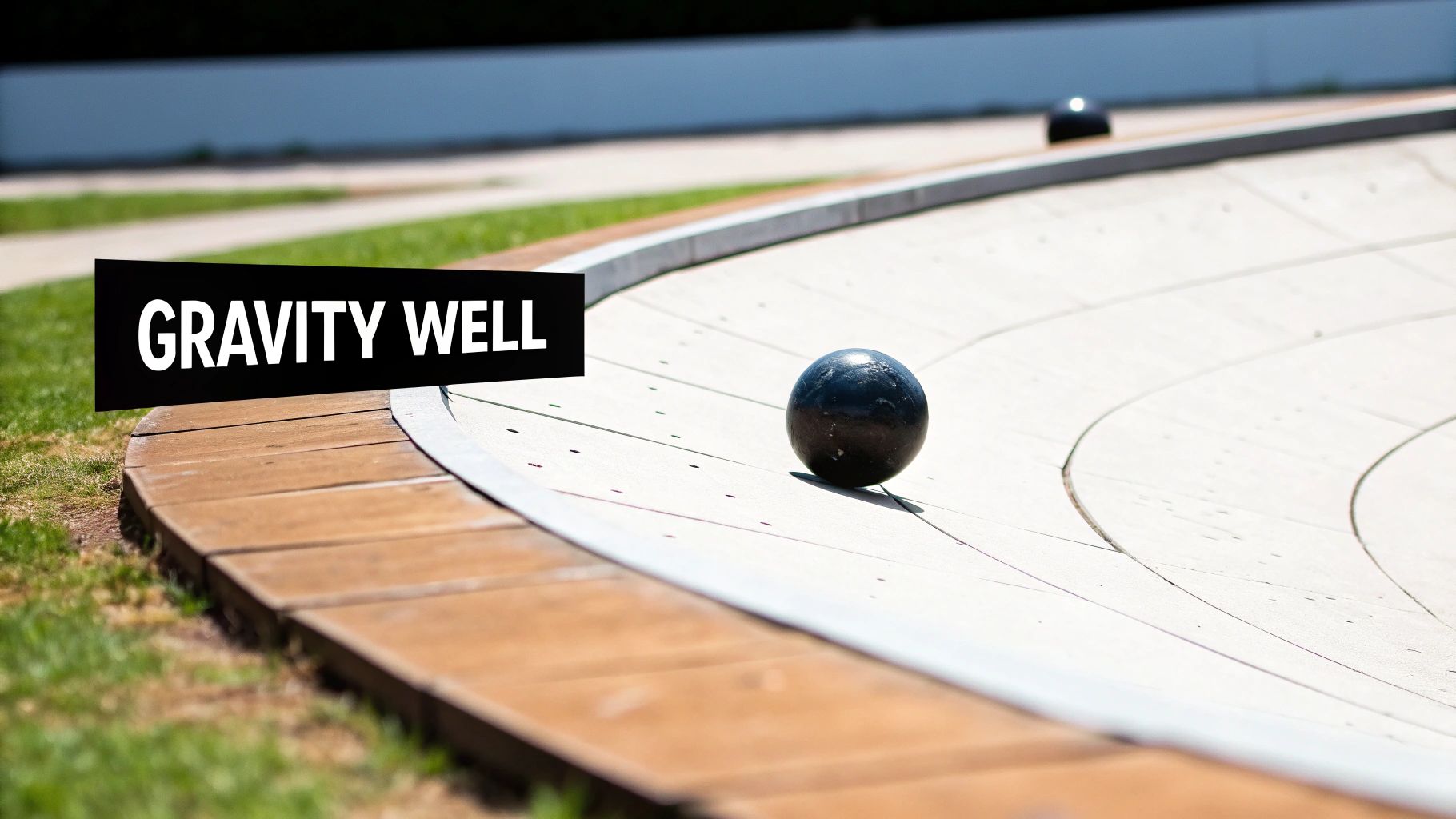
Here’s a really cool way to picture how the Sun’s gravity works. Why not try this with a grown-up? Imagine a giant, stretchy trampoline. Now, what happens if you place a heavy bowling ball right in the centre? The fabric sinks down, creating a big dip around the ball.
That bowling ball is our Sun.
Now, if you gently roll a smaller ball—like a marble—onto the trampoline, what will it do? The marble represents a planet. It won't travel in a straight line, will it? Instead, it will start to circle around the dip made by the heavy bowling ball, following the curve in the fabric.
This is an amazing way to think about how planets orbit the Sun. The Sun is so massive that it actually bends the space around it, just like the bowling ball bends the trampoline. Planets are simply following that curve through space.
This constant pull is what keeps the planets from flying off into deep space. They are essentially trapped in the 'gravity well' created by the Sun, held in place by a powerful but gentle force that orchestrates a perfect cosmic dance. Gravity is a huge topic, and if you want to become a real expert, you can learn even more in our fun guide, Gravity Explained for Kids.
Of course, gravity is only half the story. If the Sun is always pulling the planets in, why don’t they just crash straight into it? Well, that’s where our second hero, Inertia, comes into play.
Exploring Inertia: The Unstoppable Forward Push
Right, we've met Gravity, the mighty puller of the cosmos. Now it’s time to say hello to the second hero of our orbital story: Inertia. It sounds like a really grown-up word, but the idea behind it is actually super simple.
Inertia is just a rule in the universe that says things that are moving want to keep moving, and in a straight line, unless something else gives them a push or a pull.
Think about it like this: if you roll a toy car across the kitchen floor, it zips along in a straight line, right? It only ever stops or swerves if it bumps into a chair leg or if the floor's friction slows it down to a halt. That urge to keep going straight is inertia in action!
The Great Sideways Shove
So, what has this got to do with planets orbiting the Sun? Well, billions of years ago, back when our solar system was just a big, swirling cloud of cosmic dust, all the planets got a gigantic sideways shove. This massive push sent them hurtling through space at incredible speeds.
Thanks to inertia, the planets have wanted to keep travelling in that straight line ever since. They’re like cosmic bowling balls that were rolled ages ago and just want to keep going forward, forever. If there were no other forces out there, Earth would just zoom right past the Sun and disappear into the darkness of deep space. But something stops that from happening, doesn't it?
Imagine Space Ranger Fred cruising in his starship, the Stardust. If he cuts the main engines while coasting through empty space, the Stardust doesn't just stop dead. Inertia keeps it gliding forward in a perfect, straight line until he fires up his thrusters to change direction. Planets are just the same!
This powerful forward momentum is the other half of what makes an orbit work. You’ve got the Sun’s gravity constantly pulling the planets inward, while at the same time, their inertia is always trying to make them fly straight ahead.
This unstoppable forward motion is described brilliantly in the adventure of Space Ranger Fred and the Lost Comet, where Fred has to get his head around inertia to figure out a comet’s path. The perfect balance between this forward push and gravity’s inward pull is what bends a planet's straight-line journey into a graceful, looping path around the Sun.
It’s not just falling, and it’s not just flying away—it's the perfect cosmic dance between the two.
How Gravity And Inertia Create The Perfect Orbit
Right, so we've met Gravity, the constant puller, and Inertia, the unstoppable forward-pusher. But how do these two cosmic forces team up to keep the planets spinning around the Sun? This is where the real magic happens, creating the perfect balance that we call an orbit.
You can think of an orbit as a planet constantly falling towards the Sun but moving sideways so fast that it always misses!
Let's try a little experiment with a grown-up. Imagine you're holding a bucket tied to a rope, swinging it around in a circle. Your hand is the Sun, the rope is gravity, and that bucket is a planet.
Feel The Forces
As you swing that bucket, two things are happening at once:
- Your arm gives the bucket its forward motion. This is its inertia, that big 'whoosh' that makes it want to fly off in a straight line right across the garden.
- The rope is constantly pulling the bucket back towards your hand. This is a perfect stand-in for the Sun’s gravity, always tugging the planet towards its centre.
It’s the combination of that forward ‘whoosh’ and the inward pull from the rope that keeps the bucket spinning in a neat circle around you. If you suddenly let go of the rope (maybe don't try that bit!), the bucket would shoot off in a straight line. That's exactly what a planet would do if gravity suddenly vanished!
This simple diagram shows inertia in action, showing how a planet’s natural instinct is to just keep moving straight ahead.
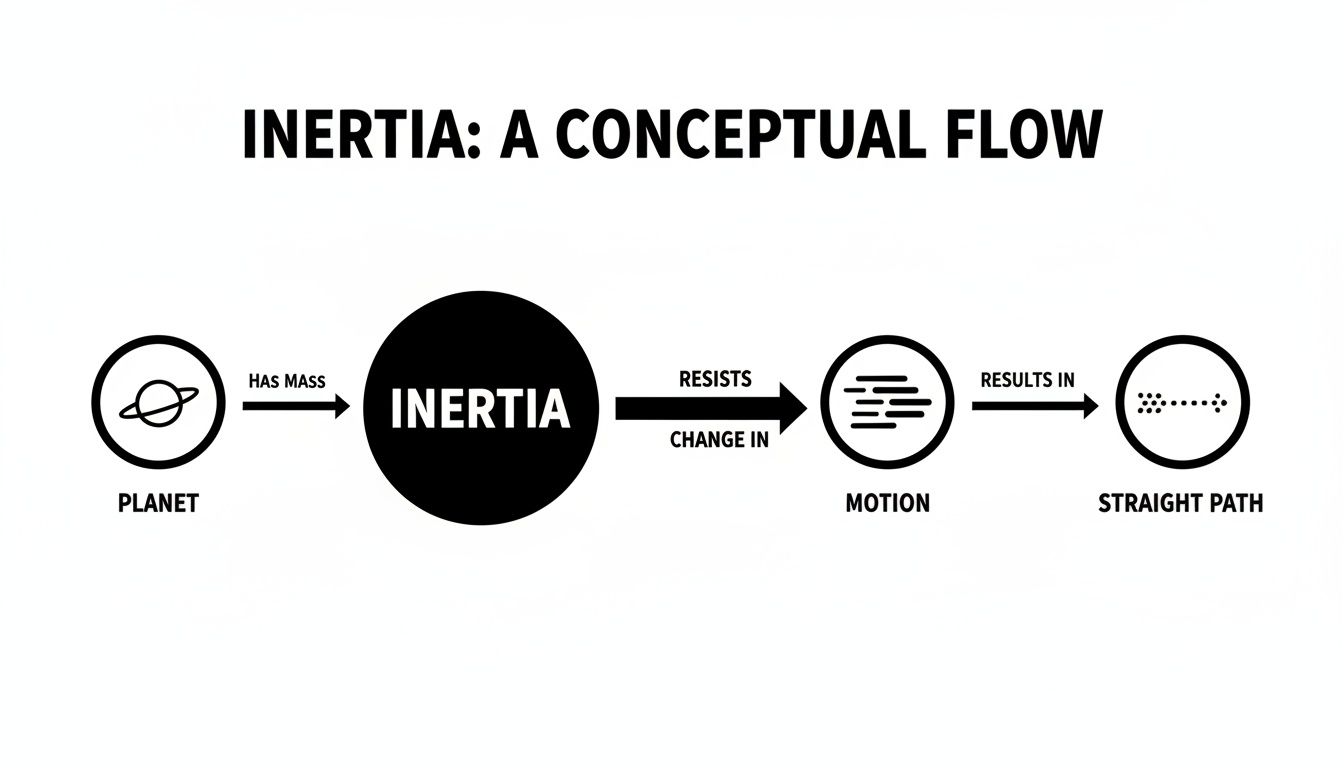
This helps us see that without gravity’s constant tug, a planet would simply zoom off on a straight path into deep space. If you're keen to get into the nitty-gritty, there are some great resources for understanding common force concepts.
From The Playground To Outer Space
This idea of learning by doing is a brilliant way to get your head around big ideas like orbits. In the United Kingdom, children don’t just read about space; they get to experience it. During British ESA astronaut Tim Peake’s Principia mission, over 2 million UK children got involved in space-related activities. Researchers found that children really clicked with the concept when orbits were taught through stories and hands-on fun, not just boring diagrams.
This beautiful balance of forces isn't just for planets. It’s the same cosmic dance that keeps spacecraft, satellites, and even the amazing James Webb Space Telescope locked in orbit, sailing smoothly through space.
So, Are Planetary Orbits Perfect Circles? Spoiler: Nope!
Now that we’ve seen how gravity and inertia are the perfect cosmic team, let’s dive into a little secret about the way planets travel. We often picture their paths around the Sun as perfect, neat circles, right? But the truth is, they’re actually slightly squashed circles called ellipses.
Think about the running track at a stadium. It’s not a perfect circle, is it? It’s more of an oval, and a planet’s journey is a lot like that. This means a planet isn't always the same distance from the Sun. Sometimes it’s a little closer, and other times it's a bit farther away.
The Cosmic Slingshot: Speeding Up and Slowing Down
That slightly oval-shaped path has another cool effect: it changes the planet's speed. A planet doesn't just cruise along at one steady pace all year.
When a planet's orbit brings it closer to the Sun, gravity’s pull gets a whole lot stronger. That extra tug gives the planet a little boost, making it move fastest when it's nearest to the Sun.
Then, as it swings back out to the far side of its orbit, the Sun's gravitational pull gets a bit weaker. With less of a tug, the planet slows right down to its most chilled-out speed.
Imagine Space Ranger Fred has to navigate a tricky asteroid field. To get around a massive asteroid, he steers his starship in close. The asteroid's gravity gives his ship a tug, zipping him around it at high speed before he slows down again on the other side. That's exactly what happens to a planet as it whips past the Sun!
This constant speeding up and slowing down is part of every single planet’s journey. For some, like Earth, the orbit is so close to being a circle that we barely notice the difference. But for others, like comets, the orbits can be wildly stretched out. You can learn all about these cosmic wanderers in our post about the amazing journey of comets.
This incredible dance—a slightly oval path with a constantly changing speed—is all part of the amazing science that keeps our solar system in motion. It's not a simple circle, but a beautiful, dynamic journey through space.
Bring Planetary Orbits To Life With Hands-On Activities
Reading about gravity and inertia is a brilliant start, but there's nothing better than seeing it in action! When you get your hands on a concept, it stops being a big, floaty idea and becomes something you can properly feel and understand.
These simple activities are perfect for the classroom or a sunny afternoon at home. They’re designed to make the science behind orbits real, memorable, and most importantly, a whole lot of fun.
Create Your Own Gravity Well
This classic experiment is a fantastic way to visualise how a massive object like the Sun actually bends space around it. You just need a few things: a stretchy sheet (a bedsheet or piece of Lycra is perfect), a few friends to hold it, a heavy ball (like a football), and some smaller balls (marbles or golf balls work great).
- Stretch the Sheet: Get four people to each grab a corner of the sheet and pull it tight and flat. This is your very own slice of the universe!
- Add the Sun: Place the heavy football right in the centre. See how it makes a dip, or a ‘gravity well’, in the fabric? That's exactly what the Sun does to space-time.
- Launch Your Planets: Now, gently roll the smaller marble ‘planets’ across the sheet. Instead of zipping across in a straight line, they’ll curve and spiral around the heavy ball, caught in its gravity well. That’s orbital mechanics in action!
Run A Playground Orbit
Ready to get a bit more active? Grab some chalk and head outside! Draw a huge circle or a slightly stretched-out oval (that's an ellipse!) on the playground tarmac. This is your planet's orbital path, with an imaginary Sun right in the middle.
Now it's time to become the planet! Take turns running along the chalk line as fast as you can. You’ll feel your body wanting to shoot off in a straight line (hello, inertia!), but you have to keep turning to stay on the path. That constant turning is just like gravity, always pulling a planet back towards the Sun.
UK agencies often use huge projects to help children feel how orbits work. The ‘Rocket Science’ project sent 2 kg of rocket seeds to the International Space Station. Back on Earth, around half a million UK children grew them, using data about the ISS’s orbit to imagine just how fast our planet is whizzing through space. Find out more about this amazing school experiment that brought space science down to Earth.
To truly appreciate the celestial ballet of planets orbiting the sun, a stargazing experience for two can be an unforgettable adventure.
And for even more great ideas, check out our full guide to other fun science activities for kids.
Your Questions About Planetary Orbits Answered
It's brilliant to be curious! When we start talking about enormous ideas like planets spinning around the Sun, it’s only natural for big questions to follow. Here are a few of the most common cosmic queries we hear, answered simply to help you feel like a real space expert.
Why Don't The Planets Ever Crash Into Each Other?
What a fantastic question! The best way to think about it is to picture the solar system as a gigantic running track, but with eight super-wide lanes. Each planet has its very own lane—its orbit—that it sticks to as it zooms around the Sun.
Because these orbital paths are so massive and incredibly far apart, the planets have more than enough room to move without ever bumping into each other. They’re all following the rules of the cosmic road!
Does Everything In Space Orbit Something Else?
Almost! Gravity is the invisible force that’s everywhere in the universe, so nearly every object is being pulled by something bigger than itself. Moons orbit planets, planets orbit stars (like our Sun), and even whole star systems orbit the centre of their galaxy.
It’s one massive cosmic dance. There are a few exceptions, like stray comets that might fly through our solar system just once and never come back, but for the most part, everything is locked in a gravitational groove.
If The Earth Is Moving So Fast Why Can't We Feel It?
This is a really clever one! The reason you can't feel the Earth moving is because you—and everything else on the planet, from houses and trees to the very air you breathe—are all moving right along with it at the same steady speed.
Think about being in a car cruising smoothly down the motorway. You don’t feel like you’re zipping along at 70 miles per hour because everything inside the car is travelling at the exact same speed as you. You only really notice movement when the car speeds up or slams on the brakes. The Earth’s spin is so smooth and constant, we don’t feel a thing.
We hope these answers have fuelled your cosmic curiosity! The universe is packed with amazing stories and wild adventures. To keep exploring, why not blast off with the exciting tales and activities from Space Ranger Fred? Dive into our library of fun books and keep the learning journey going.