
Alright, Space Rangers, settle in! Ever look up at the night sky and wonder where it all came from? How did everything—every star, every planet, every single thing in the universe—get started? The answer is a story called the Big Bang theory, and it’s the best one science has.
Imagine this: everything you can possibly imagine, from the biggest galaxy to the smallest speck of dust, all squished together into a wobbly, super-hot dot smaller than the end of a pencil. Then, in an instant, it started to stretch outwards, a bit like blowing up a balloon. That was the moment our universe was born!
What Is The Big Bang Theory Anyway?
The Big Bang is the mind-boggling idea that explains how our universe kicked off around 13.8 billion years ago. Now, it wasn't a loud 'bang' like a firecracker. It was something much bigger—the very beginning of space and time itself, growing and expanding from that tiny starting point.
Here’s a great way to think about it: the Big Bang wasn’t an explosion in space, it was the expansion of space. Imagine you’re baking a loaf of raisin bread. As the dough (that’s space) puffs up in the oven, all the raisins (those are the galaxies) move further away from each other. The Big Bang theory is the cosmic recipe that explains how our universe-bread began to rise!
The Universe In A Nutshell
Getting your head around an idea this massive can feel tricky, so let’s break it down into a simple mission log. Understanding these key bits is the first step in our mission to explore the cosmos. It shows us how everything is connected to that one amazing moment it all began. And if you're curious to learn more about the awesome cosmic neighbourhood we live in, you can check out our simple guide on what is the universe.
To make it even clearer, here’s a quick summary of the main points.
| The Big Idea | What It Means For Us |
|---|---|
| The universe began as a tiny, hot, dense point. | Everything we see—stars, planets, and even you—came from this amazing beginning. |
| It has been expanding and cooling down ever since. | Space is still getting bigger today, with galaxies moving further apart from each other. |
| This 'bang' created space and time. | There was no 'before' or 'somewhere else' in the way we understand them. |
Thinking about what the Big Bang really means is a bit mind-bending, but it’s also incredibly cool. It’s the first chapter in the greatest story ever told—the story of our universe.
Our Universe's Story Through Time
Ready for a trip through time? Let’s zoom right back to the very first moments of our universe and watch its incredible story unfold, chapter by chapter. Right at the beginning, everything we know was squashed into a sizzling hot soup of tiny particles—hotter and denser than you can possibly imagine.
For about 380,000 years, the universe was a foggy, glowing place where light couldn't really travel very far. Then, something amazing happened. As the universe kept expanding, it cooled down enough for the very first atoms to form. Suddenly, the fog cleared, and light was free to zoom across space for the very first time! This ancient light is still travelling across the cosmos today.
This handy timeline gives you a brilliant snapshot of how the universe went from a tiny hot dot to the vast, starry space we see today.
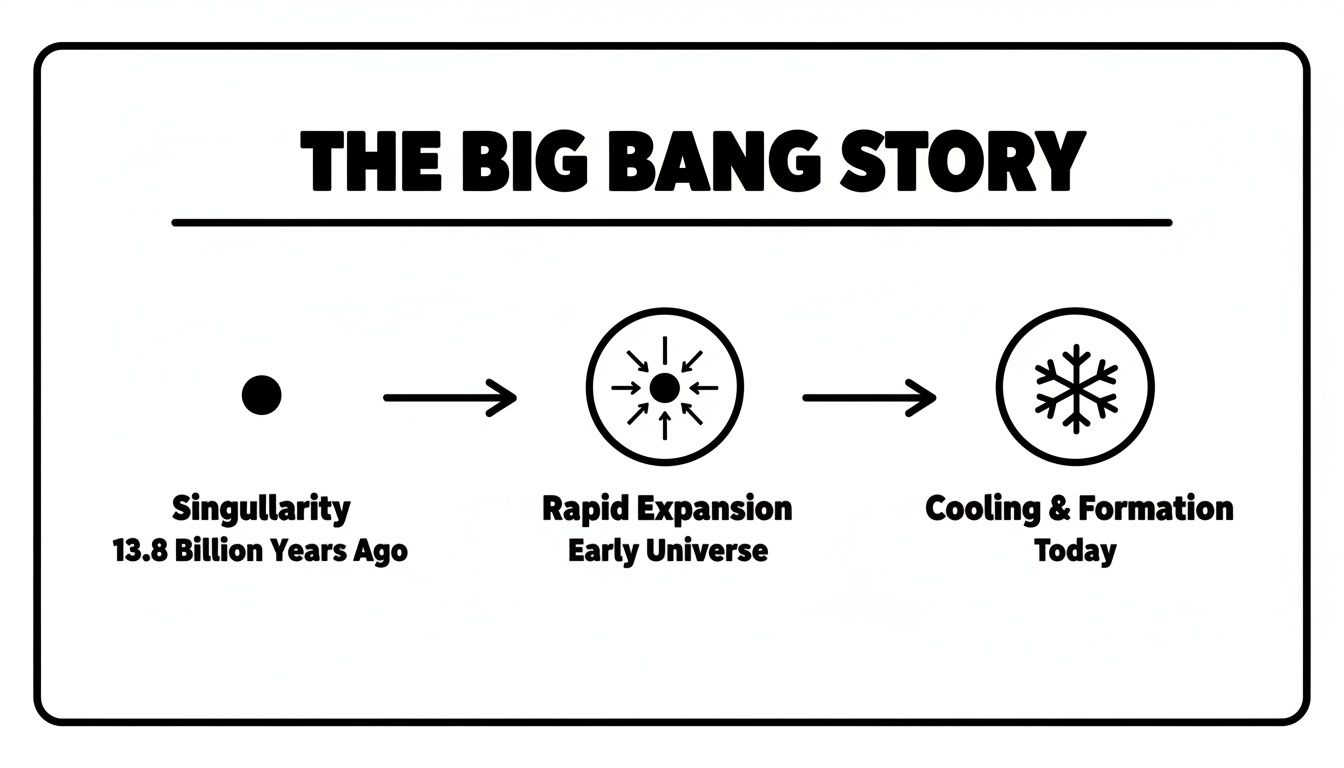
It shows us the three big steps: that tiny beginning, the super-fast expansion, and the long cooling process that eventually allowed stars and galaxies to take shape.
The First Stars Light Up The Dark
Even after that first light broke free, the universe was still mostly dark and empty. But a powerful new force was taking charge: gravity. Over millions of years, gravity started pulling the newly formed atoms together into giant clouds. As these clouds grew bigger and denser, their centres got hotter and hotter until—whoosh! The first stars ignited, lighting up the cosmic darkness.
These weren't just any old stars; they were the universe's first factories. Inside their fiery cores, they cooked up heavier elements—the building blocks for planets, moons, and even you and me. When these giant stars reached the end of their lives, they exploded, scattering all these new ingredients across space.
Gravity then went back to work, pulling all this star stuff together to form the very first galaxies. One of those galaxies would eventually become our home, the Milky Way. It’s a long and epic story, and every star you see in the night sky is a part of it. The mind-boggling distances between them are often measured in light-years, which you can learn all about in our guide on what is a light-year.
Finding The Clues To The Big Bang
If nobody was around to see the Big Bang happen, how can scientists be so sure it did? It’s a brilliant question! Science is a bit like being a detective, and our universe has left some amazing clues behind for us to find. Let’s put on our detective hats and investigate the evidence together.
It all started with an astronomer named Edwin Hubble way back in the 1920s. Using powerful telescopes, he noticed something incredible: almost all the galaxies in space are moving away from us! Not only that, but the further away they are, the faster they seem to be speeding off.
This discovery completely changed how we see the universe. It showed us that space isn't just sitting still; it's getting bigger all the time.
Redshift: The Stretching Light
So, how did Hubble know the galaxies were racing away? He spotted a clue called redshift.
Imagine a fire engine racing past you. As it moves away, the sound of its siren stretches out and becomes lower in pitch. Well, the same thing happens with light! When a galaxy moves away from us, the light waves it sends out get stretched. This stretching makes the light appear redder than it actually is.
- A galaxy moving away: Its light stretches and shifts towards the red end of the spectrum.
- A galaxy moving closer: Its light would get squashed and shift towards the blue end.
Because nearly every galaxy Hubble looked at was redshifted, he realised the universe must be expanding. This was the first major clue that supported the Big Bang theory. It's like watching a film in reverse—if everything is moving apart now, it must have been incredibly close together in the past. To fully appreciate this cosmic detective story, understanding some fundamental physics principles can be a huge help.
The discovery of an expanding universe is one of the most important scientific finds of all time. It tells us that our universe had a beginning and has been growing ever since.
The Universe's Baby Picture
Another amazing clue is called the Cosmic Microwave Background, or CMB for short. You can think of it as the leftover heat from the Big Bang—a faint, ancient glow that fills the entire universe. It’s like the universe’s very first baby picture, taken just 380,000 years after it started.
Scientists stumbled upon this glow by accident in 1965. It’s a very faint radiation that is almost exactly the same temperature everywhere they look. This perfectly matches what the Big Bang theory predicted: a super-hot, early universe that has cooled down over billions of years, leaving behind this gentle warmth.
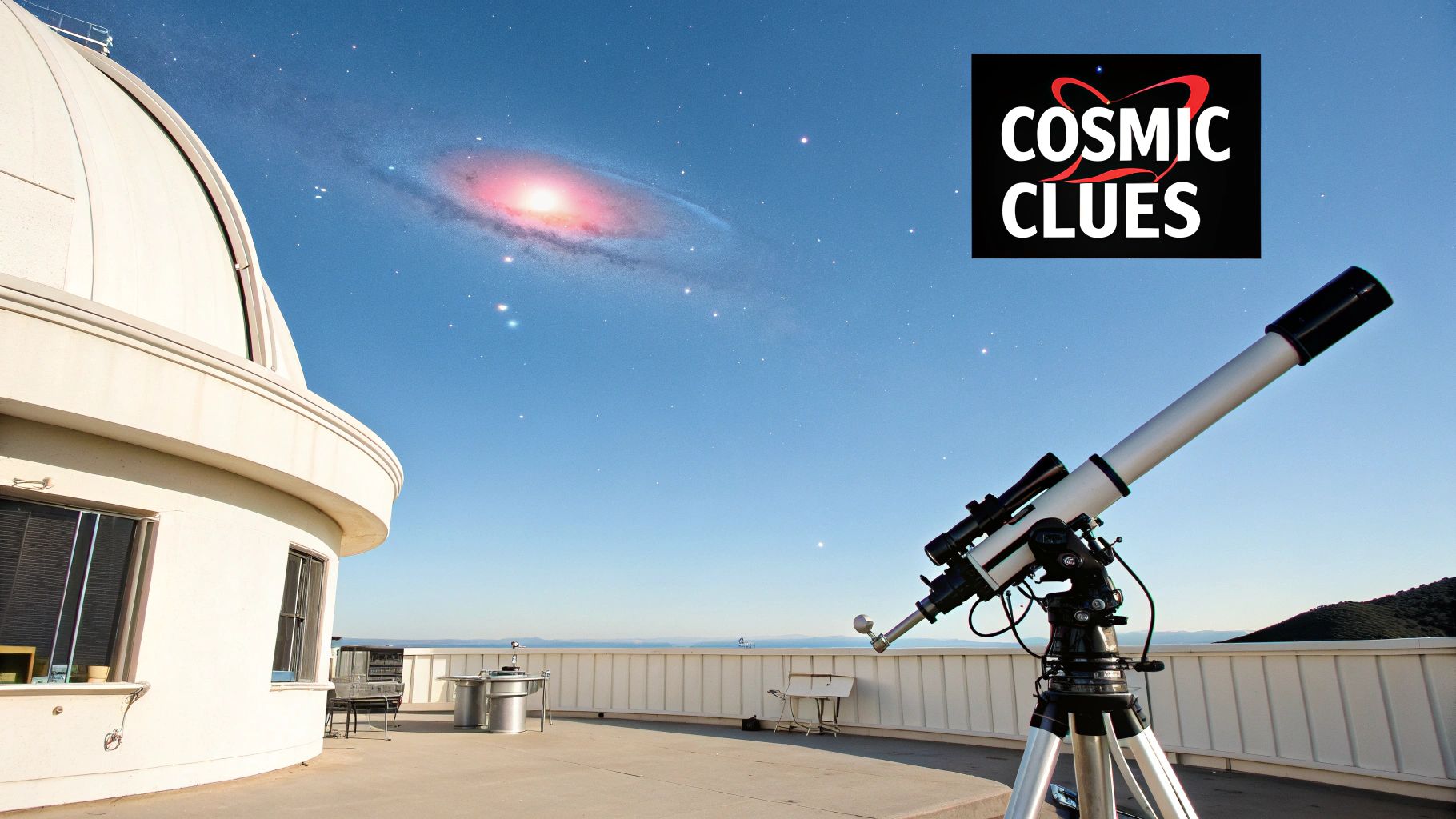
Studying clues like these is what modern astronomers do. With powerful observatories, they look deep into space to piece together this cosmic puzzle. If you want to learn more about the tools they use, our guide on how to use telescopes is a great place to start your own stargazing adventure.
Bring The Big Bang To Life With Fun Activities
Reading about the universe is one thing, but actually creating your own mini-version is a whole lot more fun! Big ideas like what is the big bang theory suddenly click into place when you can see and touch them.
So, let's get our hands messy and try a couple of brilliant experiments to explore how it all might have started. Turning complex science into simple, hands-on challenges is a fantastic way to spark curiosity. After all, the best way to learn is by doing!
Activity 1: The Expanding Universe Balloon
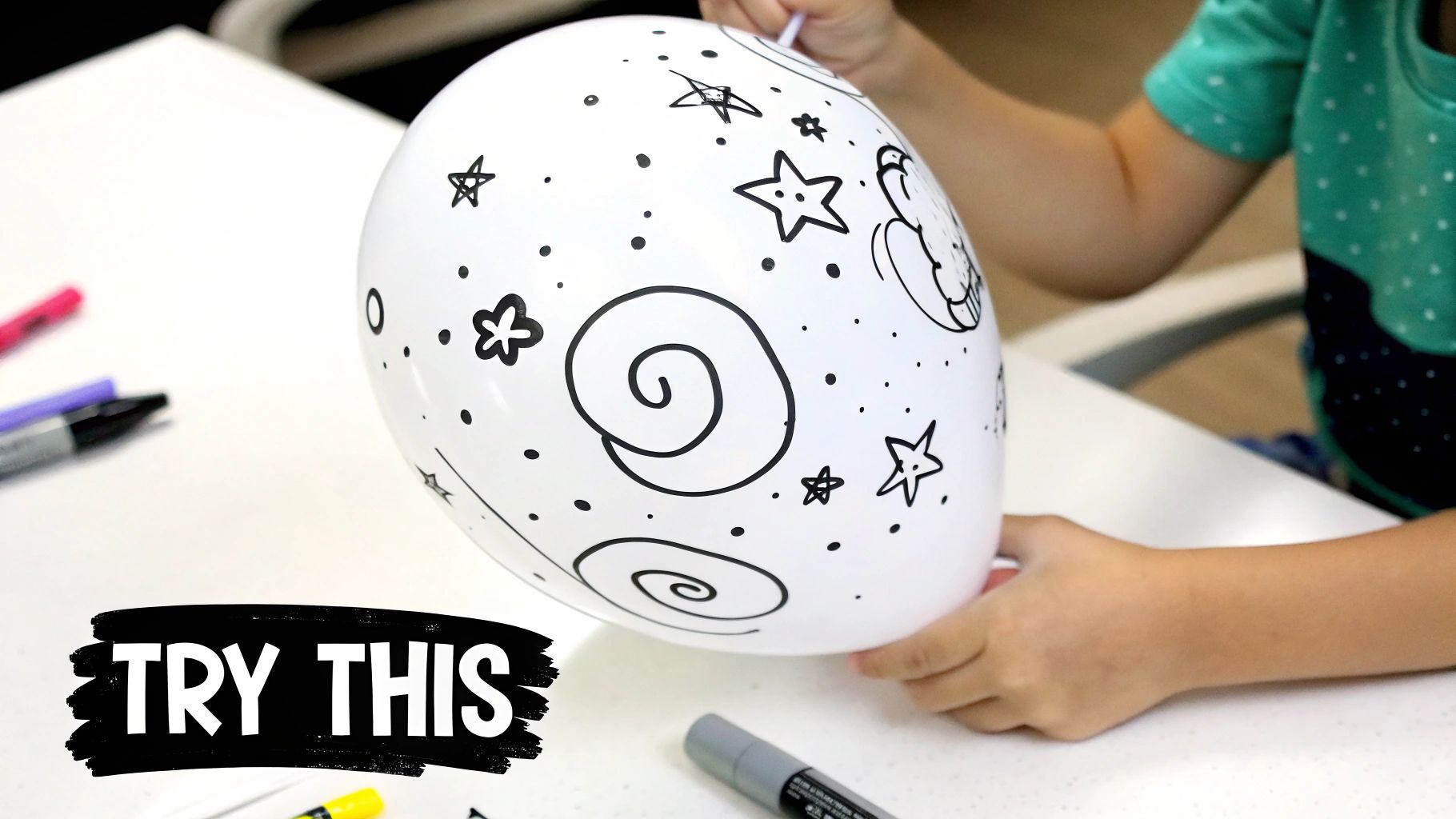
This classic experiment is the perfect way to see cosmic expansion in action. It’s a brilliant visual that shows you exactly how galaxies move away from each other as space itself stretches.
- Get your gear: You just need a balloon (any colour will do!) and a felt-tip pen.
- Draw your galaxies: Before you blow it up, cover the balloon's surface with little dots, stars, and swirls. Each little drawing is a galaxy.
- Inflate the universe: Now, slowly start blowing up the balloon.
- Watch what happens: As it gets bigger, you'll see all your galaxies move further apart. Notice how no single galaxy is at the centre—the expansion happens everywhere at once, just like in our universe!
Activity 2: Cosmic Goo Creation
Let’s imagine what the universe was like in its first few moments: a super-hot, super-dense soup of tiny particles. What better way to picture that than by making your own 'cosmic goo'?
- Make your mixture: In a bowl, mix together some PVA glue, a little splash of water, and a few drops of food colouring. A cosmic purple or deep blue works really well!
- Add the magic: Slowly stir in a small amount of slime activator (like a contact lens solution that has boric acid, or a simple borax solution—get a grown-up to help with this bit!).
- Feel the change: As you stir, the liquid will magically transform into a stretchy, gooey substance. This gooey blob is like our early universe—a single, connected mass before any stars or planets had formed.
This kind of playful learning really works. A 2014 survey of 1,500 UK students found that nearly 50% felt that science-focused entertainment made STEM subjects much more appealing. You can find out more about how popular media inspires young learners in this fascinating study.
For more brilliant experiments and creative missions, zoom over to our activities page
Asking Big Questions About Our Universe
Learning about something as huge as the Big Bang gets our minds whirring. Suddenly, we're not just asking what happened, but we're wondering about our own place in this massive, amazing cosmos. This part of our adventure is all about sparking those brilliant conversations with your young Space Rangers.
The Big Bang theory is a scientific story. It gives us a fantastic explanation for how the universe got started, but it doesn't try to answer why it started. That’s a totally different kind of question, and it's one people have been exploring through faith, philosophy, and storytelling for thousands of years.
Science And Wonder Working Together
For many people, science and faith aren't battling it out. Think of them as two different, equally amazing ways of looking at the universe. Science tells us about cosmic microwaves and expanding galaxies, while faith can explore questions of meaning, purpose, and pure awe.
Chatting about these big ideas helps create a safe and curious space for children to ask their own deep questions without feeling like there's only one right answer. It’s so important to show them that it’s brilliant to wonder about it all. In fact, schools in the UK have even recognised this, launching resources to help teachers explore the relationship between science and faith—a topic both science and RE teachers often felt unsure about. You can read more about how this conversation is being supported in schools.
To get a better grip on these vast and complex ideas, it really helps to develop strong visual spatial skills. These are the skills that help our brains picture enormous concepts, like an entire cosmos expanding from a single point.
Thinking about how the universe began is like being an explorer of ideas as well as stars. The most important thing is to keep asking questions and sharing your thoughts with others.
These are exactly the kind of big, exciting questions we love to explore in our book, The Mystery of the Missing Planet, where curiosity always leads to incredible discoveries. You can also continue your journey by finding out How Are Stars Born? in another of our cosmic blog posts.
Your Big Bang Questions Answered
When you start thinking about something as mind-boggling as the beginning of the entire universe, it's only natural for your head to fill with questions! In fact, asking big questions is what being a Space Ranger is all about.
So, to wrap up our mission, let's tackle some of the most common questions our fellow explorers have about the Big Bang.
Was The Big Bang A Loud Explosion?
That’s a brilliant question, and you’re right, the name is a bit misleading! The simple answer is no. Because space itself was only just beginning to exist, there was no air or anything else for sound to travel through, which means the Big Bang was completely silent.
A better way to picture it is as a rapid expansion. Think of a tiny, folded-up piece of paper that suddenly and silently unfolds into a huge map. It was more like that than a big, noisy bang.
What Was Here Before The Big Bang?
Now this is a question that makes even the cleverest scientists scratch their heads! The Big Bang theory suggests that time itself began at that very first moment. This means the whole idea of 'before' doesn't really work in the way we're used to.
It’s a bit like asking, "What's north of the North Pole?" The question doesn't quite fit the rules. For now, what came before (or if there even was a 'before') is one of the universe's biggest and most exciting mysteries for future scientists to solve.
Is The Universe Still Expanding Today?
Yes, absolutely! And this is one of the most important clues we have. Just like the galaxies on our expanding balloon, astronomers can see that real, distant galaxies are still zipping away from us. This tells us the universe is still growing.
Even more amazingly, scientists have discovered the expansion is actually getting faster. It seems the universe is in a real hurry to get bigger, pushed along by a mysterious force they’ve nicknamed 'dark energy'.
The Big Bang isn't just something that happened a long time ago; it's an ongoing process. The expansion that started 13.8 billion years ago is still happening all around us, shaping the cosmos as we speak.
Where Did The Big Bang Happen?
Here’s another one that can make your brain do a little flip! The Big Bang didn't happen in a single spot in space—it happened everywhere at once because it was the moment that created space itself.
That tiny, hot, dense dot at the very beginning was the entire universe. So, the Big Bang happened right where you're sitting, and in the furthest star you can see, and in every single speck of empty space in between—all at the same time.
Learning about the Big Bang helps us understand our place in this huge, incredible story. It shows us that everything, from the biggest galaxies to our own small world, is connected to that one amazing starting point.
At Space Ranger Fred, we believe asking big questions is the best way to start an adventure. Keep looking up, stay curious, and explore more cosmic stories and fun activities on our website. Your next discovery is just a click away at https://spacerangerfred.com.