
Ever wondered if the universe sends secret messages? In a way, it does! Cosmic radiation is a constant shower of super-fast, invisible particles zipping through space. Imagine them as tiny adventurers on a massive journey, sent from our very own Sun and from stars millions of light-years away.
Your Guide to Cosmic Radiation
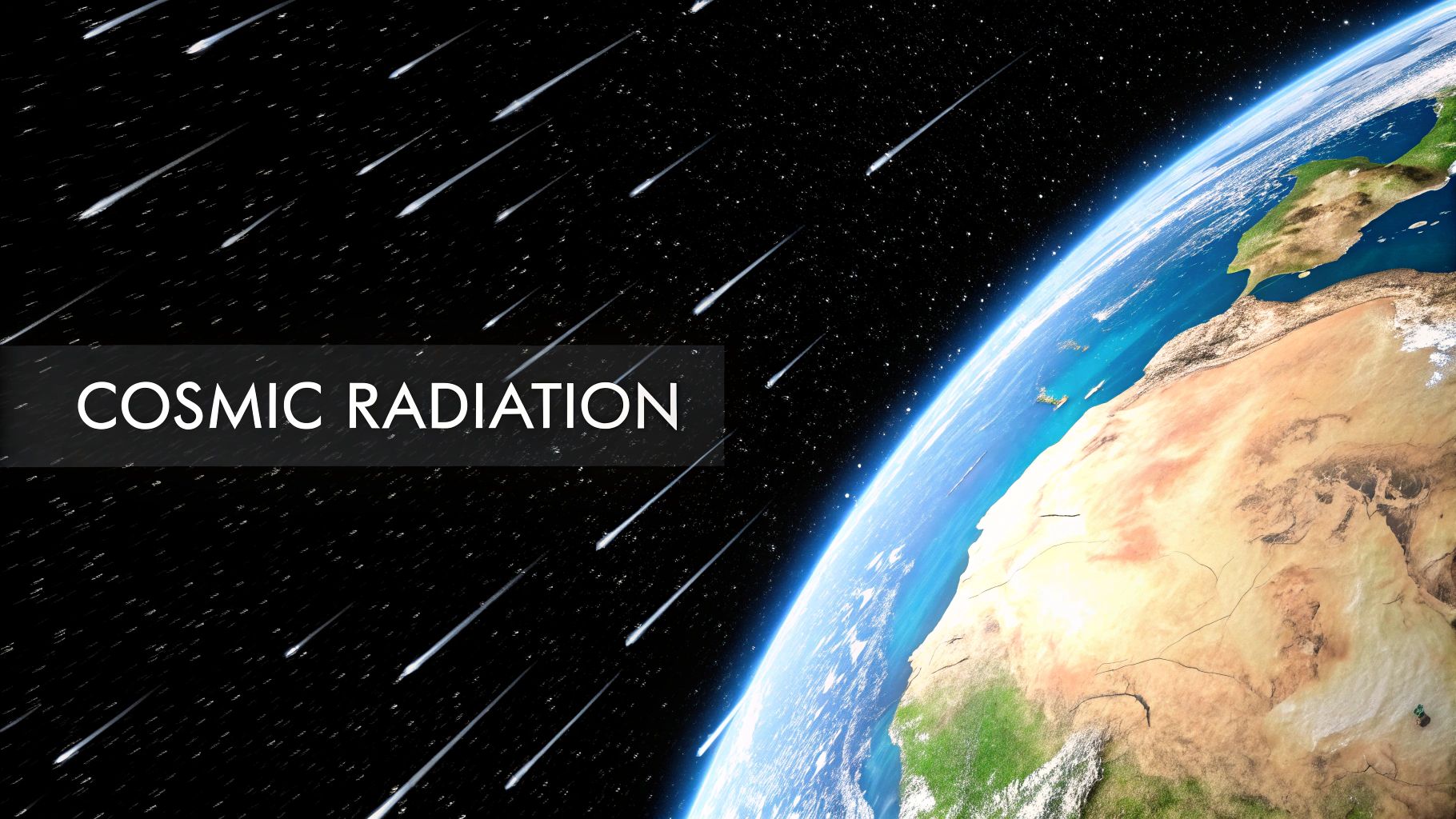
Welcome, fellow space explorers! It's time to put on our detective hats and uncover the mysteries of this amazing 'space rain.' You see, space isn't empty—it's a buzzing, bustling place, humming with energy and particles shooting around in every direction. That's cosmic radiation in a nutshell.
It might sound like something straight out of a comic book, but it's a completely natural part of how our universe works. These particles are incredibly tiny, way smaller than a grain of sand, and they travel at mind-boggling speeds, some getting close to the speed of light!
Earth's Amazing Shields
Now, you're probably thinking, "If these speedy particles are everywhere, why don't we notice them?" Great question! It's because our brilliant planet has a couple of powerful, invisible shields to keep us safe. It's one of the things that makes Earth such a perfect home for us.
Our planet has two main shields that work together like a superhero team: the magnetic field and the atmosphere. They block or slow down most of the cosmic radiation long before it can ever reach us on the ground.
These shields are so good at their jobs that we can go about our days without ever worrying about these cosmic travellers.
Here’s a quick look at how our planet’s brilliant defences keep us protected.
Earth's Two Amazing Shields
A quick look at our planet's main protectors against cosmic radiation.
| Shield | What It Is | How It Protects Us |
|---|---|---|
| Magnetic Field | An invisible force field that wraps all the way around our planet. | It acts like a giant, protective bubble, bouncing most cosmic particles away from Earth. |
| Atmosphere | The thick blanket of air that surrounds us, from the ground up to space. | It's like a giant cushion, slowing down and stopping most particles that manage to sneak past the magnetic field. |
Pretty cool, right? Understanding these amazing shields is the first step in our cosmic adventure, and it shows just how incredible our home planet really is.
Ready to find out where these particles actually come from? Let's go explore the cosmic 'post offices' that send them on their journey!
Where Does Cosmic Radiation Come From?
Every space traveller has a starting point, and cosmic rays are no different! To figure out the mystery of what is cosmic radiation, we first need to track down where it comes from. Let's take a look at the cosmic 'post offices' that send these speedy particles zipping across the universe.
Think of the universe as a giant, energetic place, fizzing with power. Cosmic radiation is created during some of the biggest and most explosive events that happen out in space. These particles are launched on their journeys from two main places—some fairly close to home, and others very, very far away.
Our Very Own Star, The Sun
First up is a source right in our cosmic neighbourhood—the Sun! Our star is a bubbling, churning ball of hot gas, and it’s always sending out a stream of particles called the solar wind. It's a bit like a gentle space breeze that flows throughout our entire solar system.
But sometimes, the Sun does something much, much bigger. It can have enormous eruptions known as solar flares or coronal mass ejections. You can imagine these as giant, fiery burps or sneezes that blast a huge cloud of particles out into space at incredible speeds. These particles make up a big chunk of the cosmic radiation we find near Earth.
Faraway Galactic Travellers
Now, let's journey much further afield, beyond our solar system and into the wider Milky Way galaxy. This is where we find the most powerful type of cosmic rays, known as Galactic Cosmic Rays (or GCRs for short).
These particles are true cosmic explorers. They have travelled for millions of years from some of the most spectacular events the universe has to offer.
- Exploding Stars (Supernovae): When a giant star reaches the end of its life, it goes out with a massive bang called a supernova. This explosion is so powerful it can briefly outshine an entire galaxy, and it flings particles out into space with tremendous force.
- Other Powerful Cosmic Events: Other mind-boggling events, like super-fast spinning neutron stars and the areas around giant black holes, can also act like cosmic particle accelerators, sending GCRs on their way across the cosmos.
These GCRs are the real heavy hitters of the cosmic ray world. It’s pretty amazing to think that some of the energy reaching our planet might have started its journey millions of years ago in an exploding star!
How Earth's Super Shields Keep Us Safe
Even with all that cosmic radiation zipping through space, we’re perfectly safe down here on the ground. How? Because our amazing planet has its very own set of super-shields, just like a superhero! These two incredible force fields work together to protect us from almost all of those speedy space particles.
It's brilliant when you realise our planet is constantly looking out for us, creating a safe bubble for life to thrive. This protection system is one of the most important things that makes Earth such a special and cosy home in the vastness of space.
The Mighty Magnetosphere
First up is our magnetosphere. Just imagine an enormous, invisible bubble that wraps all the way around our planet. This bubble is created by the swirling, molten iron deep inside the Earth’s core, which turns our whole planet into a giant magnet!
This magnetic field is a powerful shield. When high-energy particles from the Sun and distant galaxies come flying towards us, the magnetosphere deflects most of them, bouncing them away like a superhero's shield blocking space arrows. They're safely guided around our planet, continuing on their journey without ever bothering us.
The Cosy Atmosphere Blanket
Next, we have our amazing atmosphere—think of it as a big, thick, cosy blanket of air wrapped around the Earth. A few of the most energetic cosmic rays might manage to sneak past the magnetosphere, but they still have to get through this super-thick blanket.
When these particles hit the atmosphere, they bump into all the air molecules. This collision slows them down and breaks them apart into smaller, harmless bits long before they can ever reach us on the ground. It’s exactly why astronauts need special protection—they're flying above the thickest part of this protective blanket! You can learn more about this vital layer in our guide to what is the atmosphere.
This diagram shows the two main cosmic 'post offices' sending particles our way.
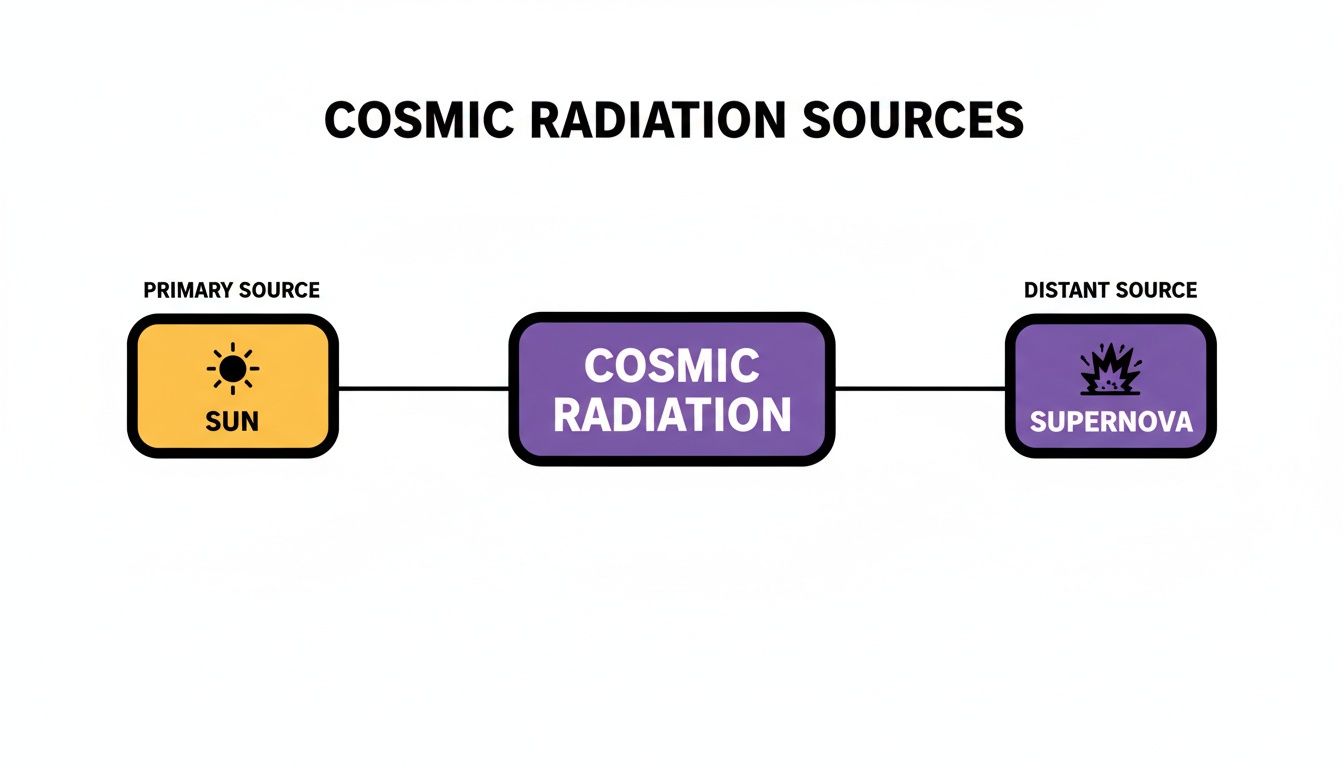
It highlights how both our nearby Sun and faraway supernovae contribute to the cosmic radiation our shields protect us from.
Sometimes, when these shields are doing their job, they create a beautiful side effect—the auroras! This spectacular light show happens when particles collide with our atmosphere near the North and South Poles, making the sky glow with incredible colours.
Even with these incredible shields, a tiny amount of cosmic radiation does make it to the surface. Did you know that in the UK, this cosmic 'space rain' contributes about 14% of the average radiation dose people experience each year? It's one of the biggest natural sources of radiation, but it is a perfectly normal amount that our bodies are used to.
Cosmic Rays and Our Brave Space Explorers
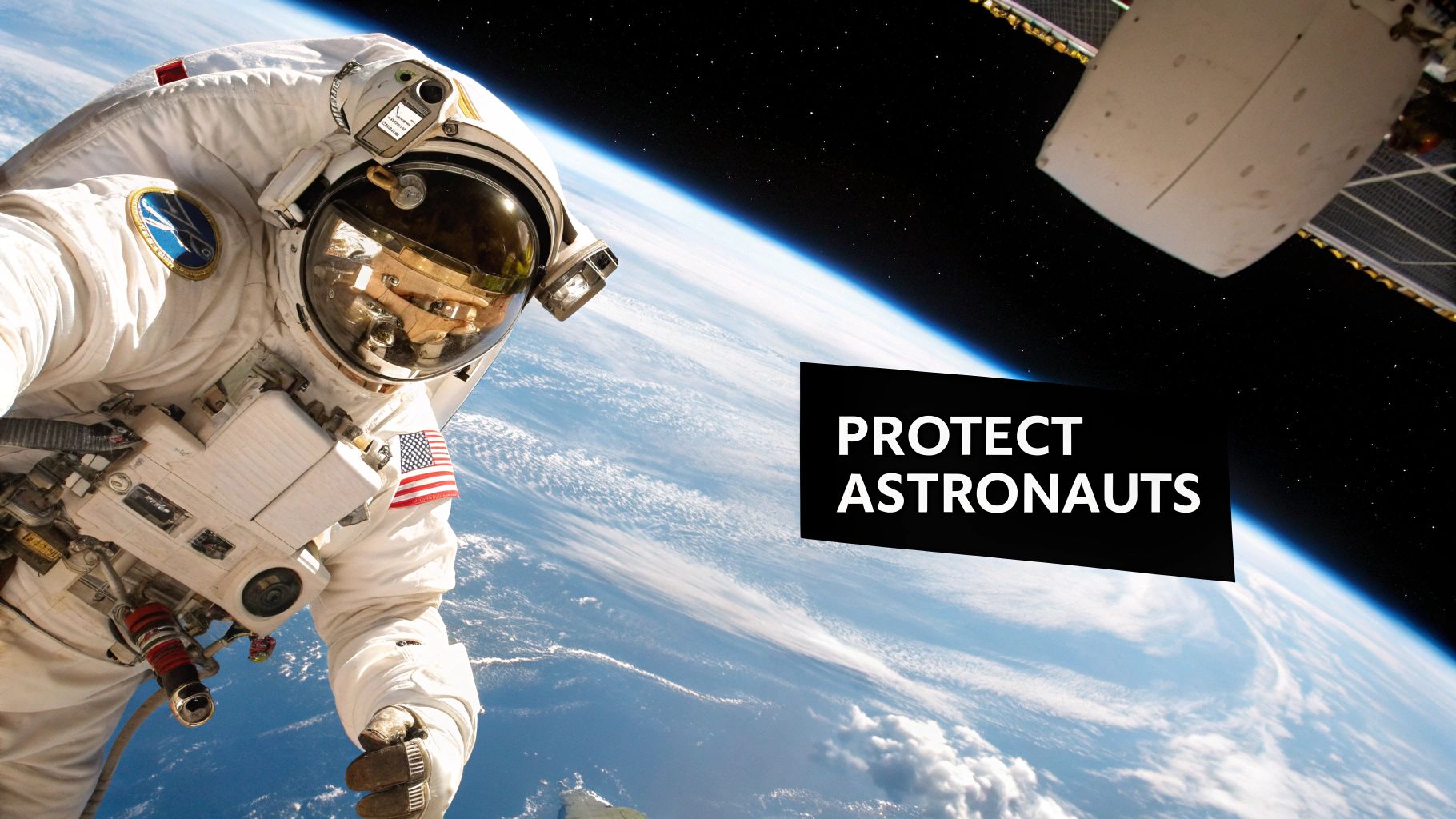
So, we know our planet has incredible super-shields, but what happens when brave explorers like Space Ranger Fred travel beyond them? Once astronauts leave the thickest part of Earth’s atmospheric blanket, they face much more of this cosmic 'space rain'.
This is one of the biggest challenges for space travel! High-energy cosmic rays can zip right through a standard spaceship, which is why astronauts, their equipment, and satellites all need special protection. These tiny particles can interfere with computers and, over a long mission, could be harmful to the astronauts themselves.
Super Spaceships and Clever Suits
This is where brilliant scientists and engineers come in! They have designed amazing solutions to keep our space heroes safe. It’s all about clever problem-solving and using science to explore safely.
Space agencies have developed special ways to protect astronauts, turning a huge challenge into an exciting engineering puzzle.
Here’s how they do it:
- Special Shielding: Spaceships and the International Space Station are built with materials that help block or slow down cosmic rays. Often, even the water and food stores are packed around the sleeping areas to create extra shielding. It's a clever way to use what's already on board.
- Advanced Spacesuits: When astronauts go on a spacewalk, their suits are made of multiple, high-tech layers. These layers protect them from the harsh environment of space, including that sneaky radiation.
- Constant Monitoring: Scientists on the ground are always keeping an eye on 'space weather'. If they spot a big solar flare heading our way, they can warn the astronauts to take shelter in the most protected parts of their spacecraft. To find out more, you can check out our guide on what is space weather.
Keeping Safe from Solar Storms
Sometimes, the Sun sends out huge bursts of particles in events called solar storms. While these are rare, scientists study them very closely.
The most powerful solar event ever recorded was way back in 1956. If something that big happened today, it could have given aeroplane passengers a radiation dose much higher than the recommended yearly limit for the public. Thankfully, almost all solar particle events since then have been much, much smaller.
Exploring space means facing big challenges, but it also leads to incredible new ideas. The technology created to protect astronauts from radiation helps us design better satellites and even leads to new materials we can use right here on Earth!
By understanding cosmic radiation, we can build better, safer ways to travel to the Moon, Mars, and beyond. It’s a perfect example of how curiosity and clever thinking help us reach for the stars.
Become a Cosmic Ray Scientist at Home
Reading about cosmic radiation is a fantastic start, but the best way to understand science is to get your hands dirty and try it for yourself! These simple and safe activities bring the amazing science of our planet’s super-shields right into your home or classroom.
Learning by doing is a brilliant way to build curiosity and confidence. So, let's become cosmic ray scientists for the day, using everyday items to see these huge ideas in action.
Activity 1: Build a Magnetic Shield
Let's whip up a mini-magnetosphere to see how Earth’s magnetic field protects us from those zippy space particles. It's a great way to visualise that invisible force field we were talking about!
What You'll Need:
- A strong bar magnet (this is our 'Earth')
- A clear plastic tray or a piece of card
- Iron filings (these are our 'cosmic rays')
- A salt shaker or a folded piece of paper to help sprinkle the filings
What to Do:
- Pop the bar magnet on a flat surface. This represents our planet Earth, with its powerful magnetic core.
- Carefully place the plastic tray or card on top of the magnet. This creates our 'space' for the cosmic rays to travel through.
- Gently sprinkle the iron filings onto the tray, all over and around the magnet. Now, watch what happens!
Talk About It:
You'll see the iron filings magically arrange themselves into curved lines, looping from one end of the magnet to the other. These lines show you the shape of the invisible magnetic field!
Notice how the filings are pulled towards the ends (the poles) and how they form a shield-like pattern around the magnet. This is almost exactly how Earth’s magnetosphere guides cosmic radiation safely around our planet.
Activity 2: The Atmosphere Blanket Challenge
Now, let’s see how our atmosphere works like a big, protective blanket. This activity shows how the air above us slows down and stops cosmic particles long before they can reach the ground.
What You'll Need:
- A large, fluffy blanket
- Several small, soft balls (ping-pong balls or pom-poms work a treat)
- Two or more people to hold the blanket
What to Do:
- Ask two people to hold the blanket stretched out tightly, about waist-high. This is our 'atmosphere'.
- Stand a little way back and gently toss the soft balls (our 'cosmic rays') onto the blanket.
- Watch what happens. Do they bounce off? Do they slow down and stop? The blanket catches them easily!
Talk About It:
The blanket stops the balls from hitting the floor, just like our atmosphere stops most cosmic rays. Chat about how the thicker the blanket, the better it works. This is similar to how Earth’s atmosphere is thickest near the ground, giving us the best protection. You can even try using a thinner sheet to see the difference!
These playful experiments help make gigantic ideas feel real and understandable. To keep that curiosity firing and inspire the next generation of scientists, you can discover engaging space books that delve into the mysteries of the cosmos.
Keep asking questions and exploring—just like a true Space Ranger!
Your Cosmic Questions Answered
It's brilliant to be curious about the universe! Asking big questions is what being a true space explorer is all about. So, let’s tackle some of the most common questions young adventurers have about cosmic radiation.
Time to clear up any cosmic confusion so you can get back to planning your next imaginary mission!
Is Cosmic Radiation Dangerous for Me on Earth?
That’s a super important question, and the simple answer is no, you are perfectly safe. Think of it like this: Earth has its own fantastic protection system, a bit like a super-strong raincoat (our atmosphere) and a giant magnetic umbrella (the magnetosphere).
These two amazing shields work together to block almost all of the cosmic 'space rain' from ever reaching us down here. The tiny little bit that gets through is completely natural, and it’s something our bodies have been used to for as long as humans have existed. So go on, play outside, look at the stars, and dream of space adventures without a single worry!
Do Aeroplanes Get Hit by More Cosmic Rays?
What a clever observation! And yes, they do. When you’re flying high in an aeroplane, you’re much closer to space, where Earth's atmospheric 'blanket' is a lot thinner. With less protection, more of those speedy cosmic rays can zip through.
But there’s no need to worry. Pilots and scientists have known about this for years and studied it carefully. The amount of extra radiation you get on a flight is very, very small—perfectly safe for passengers who fly now and then. In fact, aeroplane designers and space scientists work together to make sure flying is one of the safest ways to travel.
Can We See Cosmic Radiation?
We can’t see the cosmic ray particles themselves. They’re tinier than atoms and completely invisible to our eyes. But sometimes, we can see the incredible effect they have on our planet!
When cosmic rays and particles zipping from the Sun bump into our atmosphere near the North and South Poles, they create a spectacular light show called the aurora (you might know it as the Northern and Southern Lights). It’s like the sky is putting on a party to celebrate our planet's amazing protective shields! So, while you can't see one cosmic ray, you can sometimes see millions of them working together to paint the sky with colour.
How Is Space Ranger Fred Safe from Cosmic Rays?
Great question for a future space explorer! Just like real astronauts, Space Ranger Fred has a spaceship and a spacesuit specially designed to protect him from cosmic radiation.
His ship, the 'Stardust,' has special shield plating that blocks most cosmic rays from getting inside. When he’s out on a spacewalk, his spacesuit is made of special materials that do the same thing. On top of that, the clever scientists at the Space Ranger Academy are always monitoring 'space weather'. They can warn Fred if a big solar flare is coming, so he knows to stay safe inside his ship.
It’s all about using amazing science and clever engineering to explore the universe safely. The lessons learned from protecting astronauts help us build better technology for everyone, right here on Earth!
By understanding challenges like what is cosmic radiation, we can find brilliant solutions that make space exploration possible. It’s all part of the grand adventure, just like the ones you can read about in the Space Ranger Fred books!
The universe is full of wonders just waiting to be discovered. Keep asking questions, keep exploring, and keep imagining! For more amazing adventures that blend story, science, and fun, explore the world of Space Ranger Fred and find your next mission. You can also download some amazing free colouring sheets and puzzles from our activities page to continue your cosmic journey at home.