
Meta title: How Many Stars Are in the Universe?
Meta description: Explore how many stars are there in the universe with simple explanations, fun examples, and a hands-on estimation activity for children.
You might be reading this because a child has just asked one of those enormous questions at bedtime.
“How many stars are there in the universe?”
It’s the sort of question that can stop a grown-up in their tracks. You look up at the night sky, see a sprinkling of bright dots, and realise the answer must be far, far bigger than anything you can count on your fingers, in a notebook, or even in a very patient library session.
A Question as Big as the Universe
A child points up at the night sky and asks a question that feels bigger than bedtime itself.
How many stars are there in the universe?
That question carries two mysteries at once. One is the number. The other is how anyone could know a number so enormous. Space Ranger Fred would call that the start of a proper mission, because the fun is not only in the answer. It is in learning how people figure it out.
No one can zoom around the universe with a giant clicker and count stars one by one. The universe is far too large, and much of it is far beyond what our eyes can see. So astronomers work like careful cosmic detectives. They observe, compare, measure, and estimate.
That is a wonderful lesson for children.
It shows them that science is a way of thinking, and giant questions become easier when you break them into smaller ones. A family can try the same idea at home with marbles, beads, or cake sprinkles, which is one reason this topic feels so exciting. Kids are not only hearing a huge fact. They are getting a first look at how scientific guessing can be smart, careful, and testable.
If your young explorer wants a clearer picture of the setting for this question, this guide to what the universe is gives a helpful starting point.
Why this question feels tricky
A single star is easy to picture. The universe is a much bigger container.
Children often get stuck there. They can see stars above the garden, out the car window, or from a campsite, so it is natural to wonder whether counting those bright dots would solve the puzzle. But the stars we can spot are only a tiny sample, like seeing a few grains of sand on a beach and asking how many grains are in the whole bay.
So the main challenge is scale.
Scientists answer this kind of giant question by building an estimate for the part of the universe we can observe. That makes the problem feel less like an impossible riddle and more like a space adventure with a map, a method, and a very curious crew.
How Astronomers Make a Very Good Guess
Astronomers don’t count every star directly. They estimate in stages.
A simple way to explain it to children is with cake sprinkles. If you had an enormous birthday cake covered in tiny sprinkles, you probably wouldn’t count every single one. You might count the sprinkles on one small slice, work out how many slices the cake has, and then make a sensible estimate.
That’s very close to what astronomers do.
Step one is counting galaxies
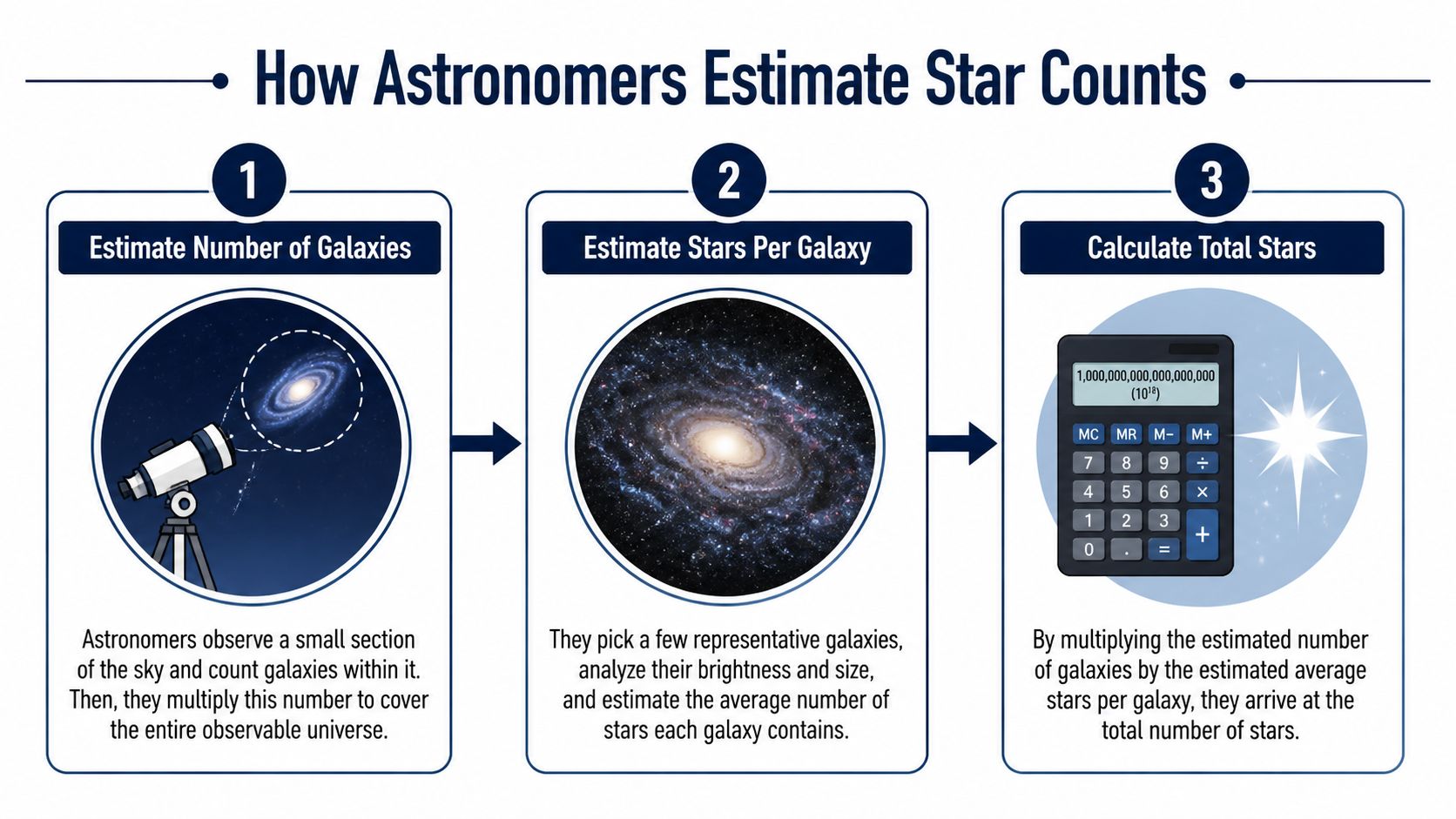
Astronomers study the observable universe, which means the part we can detect from Earth with our instruments. They look at small patches of sky, count galaxies there, and use that to estimate how many galaxies exist across the whole observable universe.
Professor Christopher Conselice from the University of Nottingham led a 2016 study using the Hubble Space Telescope. His team’s work raised the estimate of galaxies in the observable universe to around 2 trillion, which was ten times higher than earlier figures, as reported by Space.com’s summary of the Hubble galaxy estimate.
If a child asks what a galaxy is before they can go further, this guide to what a galaxy is can help make the picture clearer.
Step two is estimating stars in a typical galaxy
Then astronomers ask another question. If we know how many galaxies there are, how many stars might be in an average galaxy?
They often use the Milky Way as a model. One common estimate gives our galaxy about 100 billion stars, and that becomes a useful average for a big calculation.
Then they multiply
The logic is surprisingly child-friendly:
- Count galaxies carefully
- Estimate stars in one typical galaxy
- Multiply the two
You don’t need to count everything to think scientifically. You need a method you can explain.
That’s one of the loveliest lessons in astronomy. The answer comes from reasoning, not guessing wildly.
So What Is the Gigantic Number
Space Ranger Fred has reached the moment every young explorer waits for. The star counter machine beeps, the screen flickers, and out comes a number so large it barely feels like a number at all.
Using 2 trillion galaxies and 100 billion stars per galaxy, astronomers get an estimate of 200 billion trillion stars, also called 200 sextillion, in the observable universe, as explained in Little Passports’ star count overview.

For many children, that is the point where the brain says to itself, “Too big. Come back later.”
That reaction makes sense. Huge numbers are slippery. We can count marbles in a jar or books on a shelf, but 200 sextillion is far beyond everyday experience. So the job is not just to say the number. The job is to give it a shape.
Little Passports notes that there are about 27 stars in the observable universe for every grain of sand on all of Earth’s beaches combined. Suddenly the estimate becomes easier to feel. Sand already seems endless. The universe still has more.
Space Ranger Fred might explain it like this:
- One grain of sand is tiny
- All the sand on Earth’s beaches feels impossible to count
- The observable universe still has about 27 stars for each grain
That comparison works like a child-sized ladder for climbing up to a giant idea. You start with one grain. Then a beach. Then every beach. Then you look up and realize the sky is holding something larger still.
That is often the moment when a child stops trying to memorize the number and starts to understand the wonder behind it.
Why You Can Only See a Tiny Handful
Many children often get stuck here.
If there are so many stars, why can’t we see the sky packed solid with them?
On a clear, dark night, a person can see only about 6,000 stars with the naked eye, while NASA notes that the universe may contain up to one septillion stars, which is a 1 followed by 24 zeros, in its upper-bound estimate on NASA’s stars page.
Why the sky doesn’t show us everything
Most stars are too far away for our eyes to detect.
Some are too faint. Some are hidden within distant galaxies. Some are far beyond what human vision can pick out without special tools. So the stars we see are only a tiny glimpse of what is really out there.
That’s a reassuring point for children. The night sky is not empty. It’s just that our eyes are limited.
A child-friendly way to explain it
Try this idea.
Standing outside and looking up is a bit like peering through a keyhole into a giant hall full of fairy lights. You can see some. You cannot see all. The hall is still full.
If you want to add a bit of story play, pretend your explorer needs a super telescope to spot the next layer of the universe. Suddenly astronomy becomes a mission rather than a worksheet.
Become a Star Counter with Space Ranger Fred
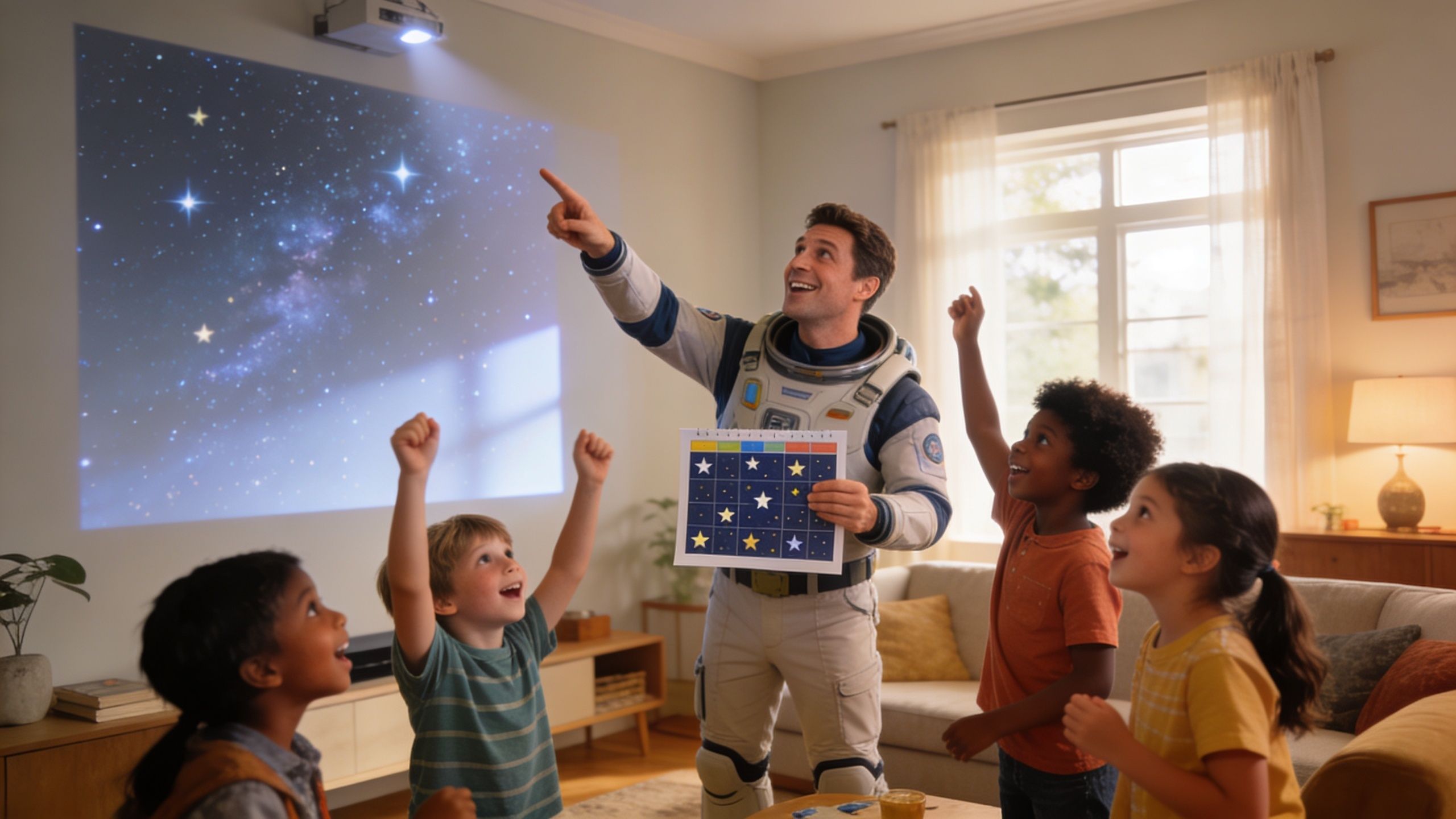
Saturday afternoon. The kitchen table becomes Mission Control. A jar full of beads sits in the middle, and Space Ranger Fred has a challenge for your young astronaut: find out how many are inside without counting every single one first.
That is the same kind of puzzle astronomers face. The numbers are far too huge to count one by one, so they use smart clues, careful samples, and maths that helps them make a strong estimate.
Try the estimation station activity
You only need a clear jar, lots of matching small objects, and a little patience. Beads, pasta shapes, paper clips, counters, or small Lego pieces all work well.
Here is the mission:
-
Make a first guess
Let your child study the jar and give their best quick estimate. -
Take a sample
Scoop out one small cupful or one spoonful. -
Count that sample carefully
This is your clue pile. -
Estimate how many sample-size groups fit in the jar
You can compare heights in the jar or refill the cup to test it. -
Multiply the numbers
Items in one sample × number of samples = estimated total. -
Check the result if you want an extra challenge
Older children often love counting the whole jar afterward to see how close they got.
A jar works like a tiny practice universe. You cannot count everything at once, so you study one part and use it to understand the whole.
What children learn from it
This activity teaches the method behind the mystery.
- Observation: They slow down and look closely.
- Sampling: They learn that a small piece can help describe a big collection.
- Multiplication: They use maths for a real purpose.
- Reasoning: They explain why their estimate makes sense.
That last step is gold for learning.
Ask, “How did you figure that out?” Children begin to see science as a way of thinking, not a race to blurt out the right answer. If they want to connect that idea to real space tools, they may enjoy this child-friendly look at what the Hubble telescope does.
Space Ranger Fred mission language
You can make the whole activity feel like an adventure:
- I notice patterns in the jar.
- I test a small sample.
- I estimate the whole.
- I explain my method like a real space scientist.
That simple sequence builds confidence. It also helps children understand that good science is careful, curious, and playful.
Classroom tip: Set out several jars with different objects. Some will be easy to estimate. Some will be trickier. That opens the door to a great conversation about why some collections are easier to sample than others.
For families who enjoy turning space questions into creative keepsakes, That Blanket Co.'s star map guide adds another fun way to bring the night sky into everyday life. You can also explore the freebies and activities page for printable missions that keep the Space Ranger Fred adventure going at home or in the classroom.
Our Star Map Is Always Getting Better
Science doesn’t stand still.
Astronomers keep improving their tools, and better tools lead to better estimates. One of the most exciting examples is the European Space Agency’s Gaia spacecraft. It has already measured the precise positions and movements of nearly 2 billion stars in the Milky Way, with major input from UK astronomers, as described by the European Space Agency’s Gaia overview.
Why that matters for children
It shows that science is alive.
Today’s answer is built from the best evidence we have now. Tomorrow’s telescopes, maps, and missions may sharpen that picture even more. If your child enjoys visual ways to connect stars with personal meaning, That Blanket Co.'s star map guide is a useful companion resource.
Children who want to know how scientists captured those deep views of space may also enjoy this introduction to what the Hubble telescope is.
That’s one of the most encouraging messages in STEM. There is still more to discover.
Your Mission FAQs From Star Command
Is the number of stars always the same
No. The universe is busy.
New stars form inside giant clouds of gas and dust, while older stars swell, fade, explode, or cool down at the ends of their lives. So the total is always shifting, even if those changes happen across enormous stretches of time.
What’s the difference between the universe and the observable universe
The universe means everything that exists.
The observable universe is the part we can detect from Earth with light, telescopes, and other instruments. It works like seeing one lit-up section of a huge city at night. You know the city keeps going, but you can only count what your eyes and tools can reach from where you stand.
That idea can feel slippery at first, especially for children. A helpful way to say it is this. The universe is all of reality. The observable universe is our current viewing zone.
Will we ever know the exact number
Probably not as a final, perfect total.
That is not a sign that science is stuck. It shows how huge the mission is. Astronomers build better answers the same way Space Ranger Fred would tackle a giant puzzle, one careful clue at a time, one checked estimate at a time, and one better map at a time.
What should children remember most
Children often remember the giant number first, and that is part of the fun. The bigger lesson is how people figure out something so enormous.
Scientists ask smaller questions, test ideas, compare evidence, and improve their estimates. That is the core adventure in this topic. A huge mystery becomes something you can work on, piece by piece, even from your own kitchen table with a simple counting activity.
If your young explorer is full of big questions and loves story-led science, Space Ranger Fred is a great next stop. You’ll find books that mix adventure, humour, and STEM in ways children can enjoy. Schools, libraries, and events can also explore interactive visits that build reading confidence, communication, and curiosity through memorable storytelling.