Ever stared at a tangled shoelace or a puzzle with missing pieces? For a child, these aren't just minor frustrations—they're the launchpads for one of life's most essential skills.
When we develop problem-solving skills in kids, we’re turning everyday moments into powerful learning opportunities. It’s about encouraging them to think critically, break down challenges, and explore creative solutions. This approach builds a mental toolkit that prepares them for everything from a tricky science project to navigating the complex world of friendships.
The Superpower of Solving Problems

Have you ever watched a child’s face light up when they finally click two building blocks together? That "aha!" moment is more than just a small victory; it's a foundational experience in learning how to think, adapt, and overcome. Problem-solving isn't about memorising formulas—it's a dynamic skill that helps kids navigate our complex and ever-changing world with confidence.
This ability is so crucial that it’s tracked from a very young age. In fact, recent government statistics from England show that 92.5% of children aged 2 to 2.5 years achieved the expected level in problem-solving. It just goes to show how fundamental this skill is, long before formal schooling even begins. You can dig into these early childhood development findings on the official government website.
More Than Just Finding Answers
At its heart, strong problem-solving is about fostering a specific mindset. It’s the engine that powers other critical abilities, turning children from passive listeners into active, engaged thinkers.
When kids learn to tackle challenges head-on, they also build:
- Resilience: They learn that setbacks aren't failures but opportunities to try a new approach. A different angle. A fresh start.
- Creativity: They're pushed to think outside the box and brainstorm multiple solutions instead of searching for a single "right" answer.
- Confidence: Every small problem solved, from a tricky knot to a difficult puzzle, builds self-belief and a sense of independence.
Stories are a fantastic way to bring this to life. In books like Space Ranger Fred and the Shoelace Adventure, a seemingly simple challenge becomes an exciting mission. It’s a great way to show children that big problems are often just a series of small, manageable steps.
Problem-solving is less about having the answers and more about having the curiosity and courage to find them. It’s the difference between being told what to think and learning how to think.
Ultimately, by focusing on how to develop problem-solving skills, we're giving children a versatile toolkit for life. It’s a superpower they can use for everything from building a stable pillow fort to understanding complex STEM concepts, preparing them for a future where adaptability is everything.
A Simple Framework for Solving Any Problem
When a problem feels like a giant, tangled knot, it’s easy for kids (and adults!) to get overwhelmed and just give up. But what if they had a reliable map to navigate any challenge? The good news is, there is one.
By breaking the process down into a few manageable chunks, we can turn any obstacle into an exciting mission—much like the ones faced by our favourite space adventurers. Think of it as a mission plan for the brain. This simple framework helps children learn how to develop problem solving skills in a way that feels natural and empowering, not like a rigid chore.
First, Understand the Real Challenge
Before anyone can solve a problem, they need to know what the real problem is. The first step is to encourage your child to become a detective. What's actually going on here? What are we really trying to do?
Help them get to the heart of the issue by asking clarifying questions:
- What is the finished puzzle supposed to look like?
- Why does this tower of blocks keep falling over?
- What keeps making my character lose in this video game?
This part is all about pausing to observe and gather intel before rushing into action. It’s the most important step, and one kids often skip.
Next, Let the Creative Ideas Flow
Once the challenge is clear, it's time for the really fun part: brainstorming! This is where you encourage wild, out-of-the-box ideas without any judgment. Right now, the goal is quantity over quality. No idea is too silly or "wrong."
Just like an inventor sketching out dozens of weird and wonderful gadgets, this phase is about pure creativity. The more possibilities you can imagine, the more likely you are to find a brilliant one.
For example, if the challenge is a messy room, solutions could range from "shove everything in one big box" to "organise toys by colour," or even "invent a robot to do it for us!" Fostering this kind of playful, creative thinking is the foundation of strong problem-solving.
Visualising this creative burst can be a massive help, especially when you're working together and ideas start bouncing off each other.
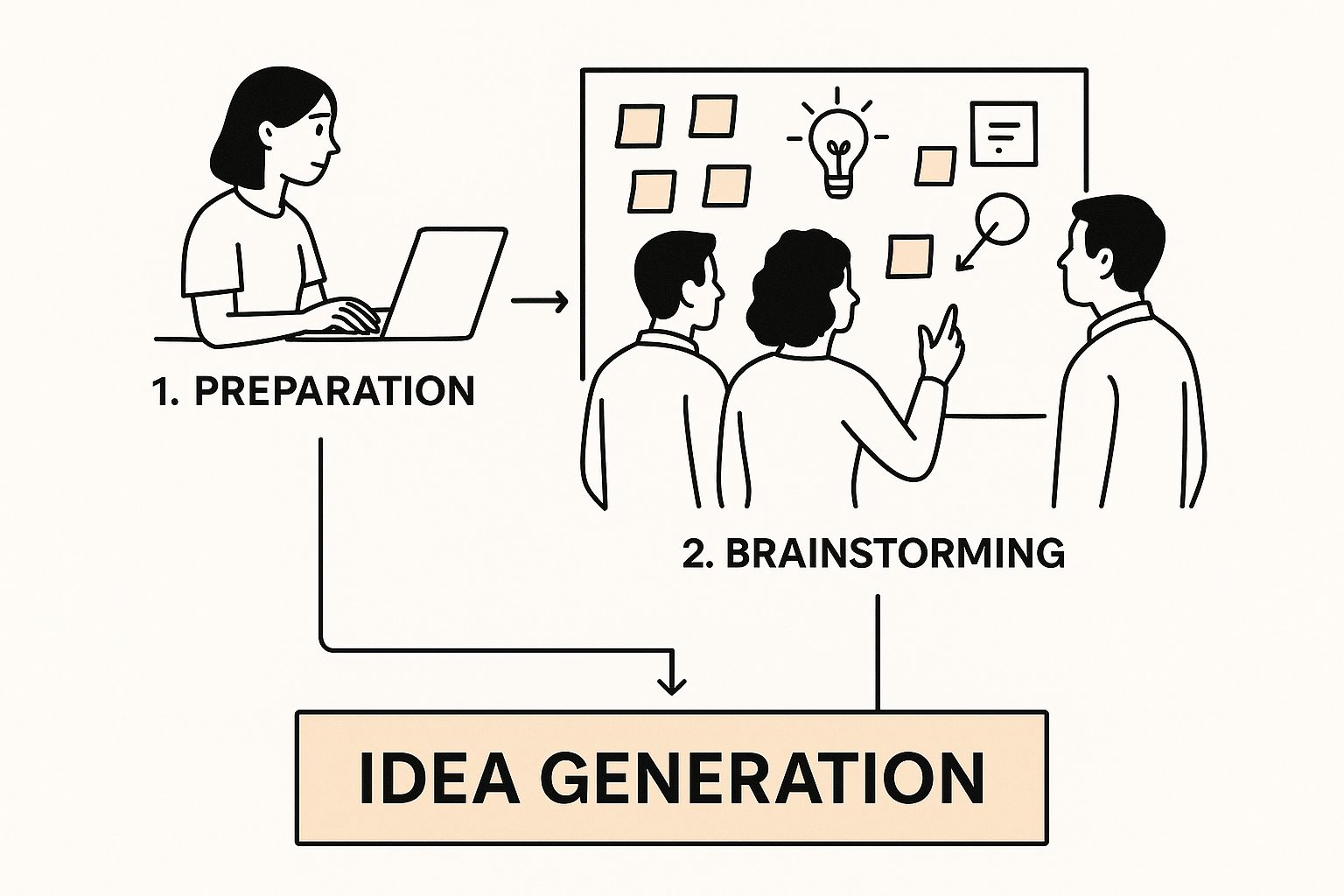
This process of splatting ideas onto sticky notes and sketching them out is often how the best solutions begin—as a dynamic, collaborative mess.
Then, Choose a Plan and Take Action
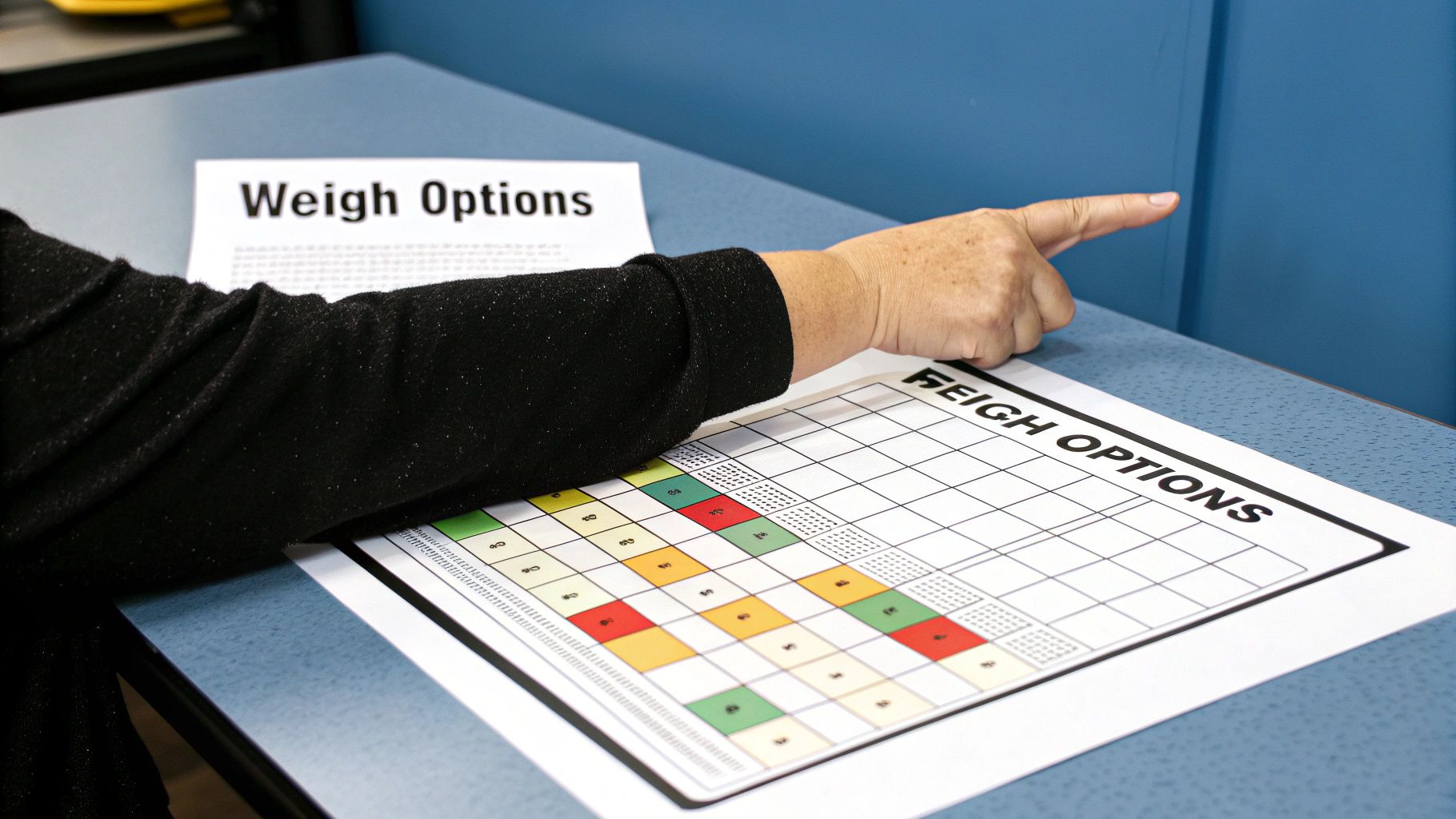
After the brainstorm storm has passed, it’s time to put on the strategist's hat. Sift through all the ideas together and help your child evaluate them. Which one seems most likely to work? Which one can we try right now?
This isn't about finding the single perfect plan, but about choosing a good starting point. Sometimes the best way to learn is simply by doing. Think about it: in Space Ranger Fred and the Umbrella Rescue, Fred doesn't have time to weigh endless options. He observes, picks a plan, and goes for it.
Finally, Test It Out and See What Happens
The last step is to see if the plan actually worked. If it did, brilliant! Celebrate the win. If it didn't, that's just as valuable. This is where real resilience is built.
A "failed" attempt isn't a failure at all; it's just new information. Frame it that way. Ask your child, "Okay, what did we learn from that? What could we try differently next time?" This cycle of trying, learning, and trying again is the real engine behind all great problem-solving and innovation.
To make this framework easy to remember, I've put together a simple table. You can use these questions to guide your child through each stage of solving a problem, from figuring out the issue to reflecting on the outcome.
A Parent's Guide to the Four Problem-Solving Stages
| Stage | What It Means for Kids | Helpful Questions to Ask |
|---|---|---|
| Understand | Becoming a detective to figure out the real problem. | "What's really going on here?" "What are we trying to make happen?" |
| Brainstorm | Coming up with lots of ideas—no idea is a bad one! | "What are all the different ways we could try?" "What's the silliest idea you can think of?" |
| Act | Choosing one of the best ideas and giving it a go. | "Which idea seems like the best one to try first?" "What's our first step?" |
| Test & Learn | Seeing what happened and learning from it. | "Did it work? Why or why not?" "What did we learn? What should we try next?" |
Walking them through these stages turns you from a 'fixer' into a 'coach', empowering them to tackle challenges on their own, one step at a time.
Turn Your Home Into a Problem-Solving Lab
The best place for a child to learn problem-solving isn't always a classroom. More often than not, it's right in the middle of the living room floor, the kitchen, or the back garden. Your home is a natural laboratory, packed with daily chances to investigate, experiment, and think critically.
When you start reframing everyday challenges as fun "missions," you help your child develop problem solving skills without it ever feeling like a lesson. These real-world puzzles are far more memorable and meaningful than any abstract worksheet.
Everyday Mysteries and STEM Challenges
Simple, ordinary household moments are the perfect launchpad for building investigative skills. Instead of just jumping in with the answer, try guiding them with questions that get them thinking like a scientist.
Think about these common scenarios:
- The Drooping Houseplant: Before you reach for the watering can, ask, "Hmm, what do you think our plant needs? What could be the problem?" This can spark a mini-experiment about sunlight, water, or even the soil.
- The Collapsing Pillow Fort: When the blanket roof inevitably caves in, it's not a failure—it's an engineering challenge! Ask, "Why do you think it fell? What could we use to make the walls stronger? Should we try a different shape?"
- The Mystery of the Missing Sock: A classic laundry day annoyance can easily become a logic puzzle. "Where did we last see that sock? Could it be stuck somewhere? Let's retrace our steps like detectives."
These small but consistent moments train children to observe their environment, form a hypothesis, and test their ideas in a low-stakes setting. It’s a hands-on approach that makes big STEM concepts feel tangible and relevant. For more project-based fun, you can find some fantastic solar system project ideas that bring space science right into your home.
The Power of Storytelling in Problem Solving
Stories are one of our most powerful tools for teaching complex ideas. They give kids a ready-made framework for understanding how to break down a big problem into smaller, more manageable steps.
Characters in books often model brilliant problem-solving without even trying. In Space Ranger Fred and the Umbrella Rescue, the challenge isn't just a rescue mission; it's an obstacle that needs to be understood, analysed, and overcome with a clear plan. Fred doesn't just panic—he observes, thinks, and acts methodically.
By discussing how characters like Space Ranger Fred tackle their missions, you give your child a mental script for their own challenges. You're teaching them that even heroes have to stop, think, and try different approaches before they succeed.
This narrative approach works so well because it connects logical thinking with emotion and imagination. It transforms a frustrating tangle into an exciting adventure, a key ingredient for building resilience. When a problem is a story, it’s just so much more engaging to solve.
You can even create your own problem-solving stories together. Start a tale with a simple challenge: "A little robot wants to cross a big puddle, but it can't get wet. What could it do?" Then, let your child's imagination run wild brainstorming the rest of the story. This simple activity gets them thinking creatively and weighing up different solutions.
Weaving this kind of thinking into your daily routine turns your home into a vibrant learning hub. It shows your child that problem-solving isn't just a subject at school, but an integral—and even fun—part of life.
Games and Activities That Build Critical Thinking
Learning how to solve problems doesn't have to feel like a chore. In fact, some of the best learning happens when kids are so lost in play they don’t even realise they’re building brilliant new skills. The right games and activities can turn abstract concepts like logic and strategy into exciting, hands-on challenges.
Play is how children naturally explore and experiment with the world around them. Think about classic board games—they're fantastic training grounds. A game of Chess isn’t just about moving pieces; it’s about thinking ahead, predicting what your opponent might do, and changing your entire plan on the fly. Games like Settlers of Catan are brilliant for teaching resource management and long-term planning, all wrapped up in a fun, competitive package.
Hands-On STEM Challenges at Home
Beyond the board, hands-on STEM activities are a fantastic way to bring scientific principles to life. These challenges give kids the freedom to tinker, test ideas, and learn from their mistakes without any pressure. It's all about seeing cause and effect right in front of their eyes.
You don't need a fancy lab to get started. Here are a few simple ideas to try at home:
- Popsicle Stick Catapult: With just a few lolly sticks, rubber bands, and a plastic spoon, kids can design and build a working catapult. This little project teaches them about physics—things like tension, force, and trajectory—as they experiment to launch a marshmallow as far as possible.
- Simple Circuit Creation: Grab a battery, some wires, and a small light bulb, and you can introduce the basics of electricity. The challenge is simple: connect everything to make the bulb light up. That "aha!" moment when it works is a powerful lesson in how closed circuits function.
- Beginner Coding Apps: There are heaps of apps and websites that introduce coding in a fun, gamified way. They often use drag-and-drop blocks to teach logical thinking and sequencing—the core skills needed to break down big, complicated problems.
For more hands-on fun, have a look at our guide on 10 mind-blowing science experiments for kids to try in 2025 for even more inspiration.
These activities aren't just about building things; they're about building a thought process. Each attempt teaches pattern recognition, hypothesis testing, and the resilience to try again when the first design doesn't work.
This connection between play and practical skill is something we see in stories like Space Ranger Fred and the Umbrella Rescue. When Fred faces a sudden challenge, he doesn’t panic. Instead, he observes his surroundings and creatively repurposes an everyday object. It’s a perfect example of how paying attention can lead to a brilliant solution on the spot.
Connecting Play to Future Success
Nurturing these skills through play is more than just a bit of fun; it’s a crucial part of preparing kids for the future. You might be surprised to learn that demand for problem-solving skills in the UK surged by an incredible 51% between 2017 and 2022, growing much faster than other core skills. As People Management points out, this highlights a real skills gap, which is why it's so important to start building these abilities from a young age.
Ultimately, every logic puzzle solved and every strategic game won is another step towards creating a confident and resourceful thinker. These playful moments lay the groundwork, helping children build the confidence to tackle much bigger challenges later in life.
Cultivate a Resilient Growth Mindset
The most powerful problem-solving tool isn't a game or a clever technique; it's a mindset. How a child sees their own abilities can either supercharge their problem-solving skills or stop them dead in their tracks. This is where the idea of a growth mindset becomes a complete game-changer.
A growth mindset is simply the belief that our skills and intelligence are built through effort, not something we're just born with. It’s the engine that drives resilience, turning moments of frustration into fuel for another try. The real goal is to help a child shift their internal monologue from a fixed, final statement to a more hopeful one.
The Magic of "Yet"
One of the most effective ways I've seen to build this mindset is by adding a single, tiny word to your child's vocabulary: yet. When they say, "I can't figure this out," you can gently reframe it for them: "You can't figure this out yet."
This small change has a massive impact. It instantly:
- Reframes the problem as temporary, not a permanent dead end.
- Implies that a solution is entirely possible with more time, effort, or a different strategy.
- Teaches them that learning is a process, full of twists, turns, and the occasional setback.
When you consistently model this kind of language, you help them see challenges not as threats to their intelligence, but as normal, expected parts of the learning journey. This approach is right at the heart of inquiry-based learning, where curiosity and persistence are the real heroes. You can dive deeper into this educational philosophy in our detailed guide on what is inquiry-based learning.
Praise the Process, Not Just the Result
How we praise our children matters, maybe more than we think. If we only praise the final correct answer ("You're so smart!"), it can accidentally make kids afraid to tackle problems where they might fail. Instead, try focusing your praise on the things they can actually control.
Praise their effort ("I love how you kept trying different ideas!"), their strategy ("That was a clever way to approach that puzzle!"), and their resilience ("I'm so proud of you for not giving up when it got tricky.").
This teaches them that the real victory lies in the hard work and creative thinking they put in along the way. Stories are such a great way to reinforce this. In Space Ranger Fred and the Tick Tock Tale, the mission isn't solved instantly. Fred’s success comes from his perseverance and his willingness to think through the problem, even when the clock is ticking.
This idea of continuous learning doesn’t just stop in childhood, either. The 2023 Survey of Adult Skills for England found that adults in the UK actually score above the OECD average in problem-solving. It turns out that workers in professional sectors like science and engineering show the highest abilities, which really proves that lifelong engagement is the key to keeping these skills sharp. You can read more about these fascinating findings in the official report on problem-solving in the UK workforce. Building a growth mindset early on truly sets the stage for this kind of adult success.
Your Problem-Solving Questions Answered
Even with a great plan, a few tricky questions are bound to pop up as you guide your child. It happens to all of us. Here are some of the common hurdles I’ve seen parents and teachers face, along with some practical ways to clear them.
What If My Child Gets Frustrated and Gives Up?
First off, frustration is totally normal. It’s a sign they’re stretching their abilities, which is exactly what we want. The trick is to validate how they’re feeling before jumping in with a solution.
Try breaking the problem down into even tinier, bite-sized pieces. If they’re stuck on a tricky model, just focus on finding the next two bits. Celebrate that small win! It builds momentum and reminds them they can do it. It also helps to show them how you handle it yourself. Something like, "Wow, this is a tough one! Let's take a five-minute break and come back with fresh eyes," works wonders. The goal isn't to avoid frustration, but to teach them how to push through it.
Acknowledging a child's frustration is the first step to turning a moment of defeat into an opportunity for resilience. It shows them that their feelings are valid and that challenges can be overcome with patience.
How Can I Help a Child Who Is More Creative Than Logical?
That's fantastic! Creativity isn't the opposite of problem-solving; it's the heart of it. A creative thinker will spot solutions that a purely by-the-book approach would miss entirely.
So, lean into their strengths. Instead of asking for a list of pros and cons, suggest they draw or storyboard their ideas. You could even ask them to make up a story where a character—maybe someone like Space Ranger Fred—has to solve a similar puzzle. The same framework we talked about earlier still works, it just looks a bit different. In Space Ranger Fred and the Shoelace Adventure, creative thinking under pressure is every bit as important as cold, hard logic.
Are There Specific Toys That Are Best for These Skills?
Absolutely. The best toys for building problem-solving skills are nearly always the open-ended ones. Think of things that can be used in a million different ways, without a single 'right' way to play.
You can't go wrong with choices like:
- Building blocks like LEGOs or Magna-Tiles
- Art and craft supplies
- Simple science or robotics kits
These kinds of toys encourage kids to create their own rules, set their own goals, and invent their own solutions. That’s the very essence of problem-solving. It turns playtime into a powerful, hands-on learning experience driven by their own imagination.
At Space Ranger Fred, we believe in turning curiosity into a lifelong adventure. Our books and activities are designed to make STEM exciting and accessible, helping kids develop the critical thinking skills they need to explore the universe. Discover our stories and join the mission at https://spacerangerfred.com.