Ready for a Creative Mission? Let’s Go!
Looking for a simple way to keep little hands busy and big imaginations buzzing? What if a humble colouring page could launch a mission into space, uncover dinosaur fossils, or even help save a planet? It can.
Colouring isn’t just about staying inside the lines. It can support focus, storytelling, observation, and those lovely little moments when a child says, “I know what this is!” or “Can I make up my own version?” That’s where learning starts.
In UK education, printable activities are integral to everyday practice. The National Literacy Trust reported that 92% of primary teachers used printable activities like colouring pages for early years development, with 65% specifically using them for ages 4 to 7 to support pencil grip and creativity (Twinkl statistician colouring sheet). That feels about right from a teacher’s point of view. A single sheet of paper can open the door to conversation, confidence, and curiosity.
For children aged 6 to 12, I like to think of colouring as a mission briefing. First, they notice. Then they choose. Then they explain. That’s a brilliant learning rhythm. I think. I try. I can. I can explain.
So let’s get to the fun part. Below are some of the best childrens printable colouring pages I’d happily use at home, in the classroom, or in a library activity corner. Some are perfect for quick rainy-day wins. Others are brilliant for STEM sparks, storytelling, and themed displays. One or two might even make your printer feel like mission control.
1. Space Ranger Fred – Colouring
If you want childrens printable colouring pages that feel like the start of an adventure rather than just a filler activity, this is my top pick.
Space Ranger Fred’s colouring hub is built around characters, stories, and a playful STEM spirit. That matters. Children often stay with an activity longer when there’s a world behind it. They’re colouring more than “a rocket”. They’re joining a mission, meeting a character, and imagining what happens next.
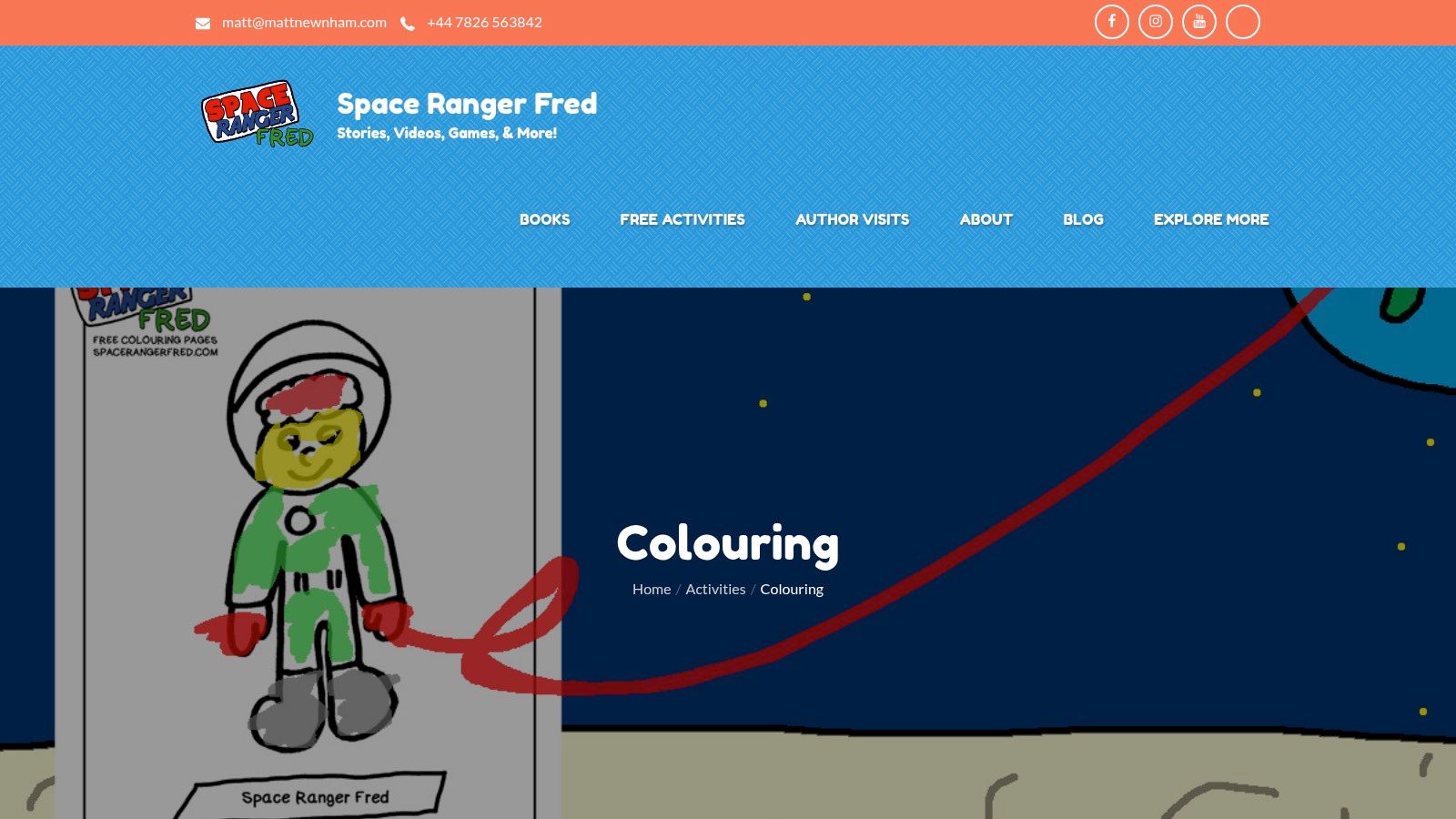
Alt text: childrens printable colouring pages from Space Ranger Fred
You can go straight to the Space Ranger Fred colouring pages. The direct PDF format is especially useful when you need something now, not after creating an account and answering seventeen questions about your favourite biscuit.
Why it works so well
These sheets are strongest when you use them as a springboard.
A child colours Fred. Then you ask, “Where is he going?” Suddenly you’ve got descriptive writing. Another child spots a spaceship. Now you can talk about travel, planets, materials, or forces in simple language. That’s the sweet spot for story-led learning.
I also like that the pages fit the wider Space Ranger Fred universe, so colouring can lead naturally into reading, role-play, and discussion. If you’re building a themed week, that’s gold dust.
Practical rule: Ask one science question and one story question for every colouring page. Try “How would this work?” and “What happens next?”
A few strengths stand out:
- Instant access: Direct printable sheets make life easier for teachers, parents, and librarians.
- Story connection: The characters give children something to talk about while they colour.
- STEM-friendly feel: Space themes naturally invite questions about planets, movement, shapes, and exploration.
There are limits, of course. You still need a printer and colouring supplies, and children who want puzzles or more complex activities may want to pair these with something else from the wider brand.
If you want to extend the activity, the Space Ranger Fred books are a natural next step. A colouring sheet can become a reading hook very quickly.
2. Crayola – Free Coloring Pages
Crayola is one of those dependable names that teachers keep returning to. Not because it’s flashy, but because it usually prints cleanly and gives children clear, bold outlines to work with.
You can browse the collection at Crayola Free Coloring Pages.
Alt text: childrens printable colouring pages on Crayola
Crayola’s strength is range. Animals, holidays, seasons, and character pages are easy to find, and that makes it handy when a child wants something familiar and cheerful without a lot of fuss.
Best for quick wins
This is a very practical option for home and classroom use. If your plan is, “I need something printable before the glue sticks roll off the table,” Crayola usually delivers.
The pages also work nicely with craft follow-ups. Colour a bug, then make a bug fact card. Colour a tree, then sort leaves by shape. Colour a rocket, then compare it with one from another site.
One useful verified point sits in the background here. Crayola UK’s free maths colouring printables saw over 500,000 downloads in 2022 alone (Twinkl statistician colouring sheet). That tells you there’s a real appetite for printable learning resources tied to colouring.
A couple of watch-outs:
- US flavour: Some seasonal content feels more American than British.
- Less curriculum-led: You may need to add your own questions if you want a stronger lesson link.
For classroom organisation, I also smiled at this helpful read on durable labels for crayons. Not a colouring page resource, but very sensible if your red crayons keep joining other families.
3. Twinkl (UK) – Colouring Pages Collections
What if a colouring page could do more than keep little hands busy?
Twinkl is strong at turning colouring into part of a lesson. You can browse the library at Twinkl colouring pages.
The big difference is how closely the resources connect to classroom topics. A page about planets can sit beside science vocabulary. A seasonal page can support a display board. A flags sheet can lead into a geography conversation. For parents and teachers using a Space Ranger Fred style of learning, that matters. The colouring page becomes the launchpad, not the full mission.
Strong for school use
Twinkl works well when you already have a learning goal in mind. If you are teaching habitats, space, weather, celebrations, or feelings, you can usually find pages that match the topic instead of forcing the topic to fit the page. That saves time, and it also helps children make links between art, words, and ideas.
Some resources are editable, which is especially helpful for early literacy and speaking practice. You can add a child’s name, change a prompt, or pair the sheet with topic words. Editable labels and word banks give you a simple way to turn colouring time into vocabulary rehearsal. Children colour the picture, then match, read, or say the key words aloud.
A well-chosen colouring sheet works like a labelled diagram in a gentler form. Children are busy with colour, but they are also meeting the words and concepts you want them to notice.
Here is a simple mission briefing. Print a space-themed page, add three target words such as orbit, crater, and astronaut, then ask the child to use each word in a sentence before they swap colours. That small step adds language, memory, and storytelling to an activity that might otherwise stay at the level of filling shapes.
There are a couple of practical limits. Full access often needs a membership, and the sign-in process can slow you down if you need a page quickly before a lesson starts.
If you want a follow-up craft after a Twinkl session, a stained glass window template activity works nicely for display work, pattern spotting, and careful fine motor practice.
4. BBC CBeebies – Colouring Printables
What helps a young child begin with confidence. A packed worksheet, or a page with a familiar friend smiling back at them?
You can find printable pages through BBC CBeebies colouring with Hey Duggee.
Alt text: childrens printable colouring pages from BBC CBeebies
CBeebies works well for that first step. The characters are already known, the browsing environment feels safe for adults to hand over, and the designs are usually clear enough for younger children who are still learning how to guide a crayon around a shape.
That matters more than it may seem. For many children, starting is the hardest part. A familiar page lowers the pressure. It works like stabilisers on a bike. The child is still doing the pedalling, but the support helps them focus on control, colour choice, and enjoyment instead of worrying about getting it wrong.
A strong fit for early confidence and story play
I’d keep this resource in mind for nursery tables, KS1 settling activities, family library sessions, or any moment when you need a quick win. CBeebies is character-led, and that is useful in its own right. Children often talk more freely when they already know the world of the character in front of them.
That gives you a simple Space Ranger Fred style opening for STEM talk. Start with the page the child chose, then add one small “mission briefing” question linked to that character. If they are colouring Hey Duggee, ask, “What badge would the Squirrel Club need for a trip to the moon?” Now the colouring page becomes a planning task. Children can suggest helmets, torches, snacks, moon boots, or a rocket map. You are no longer only filling shapes. You are building vocabulary, prediction, and playful problem-solving.
You can extend that idea with a stained glass window template craft for display and pattern work if you want a second activity after colouring.
CBeebies does have limits. The range is smaller than the biggest printable libraries, and the topics follow the shows rather than a full curriculum map. Still, for very young children, that narrow focus can be helpful. It gives you a gentle starting point, and gentle starting points often lead to better attention, better conversation, and happier early learning.
5. Activity Village (UK) – Colouring Pages Hub
Need a printable site that can handle a class where one child wants tractors, another wants a Diwali pattern, and a third is asking for a dinosaur before you have even sat down?
You can browse at Activity Village colouring pages.
Alt text: childrens printable colouring pages on Activity Village
Activity Village is especially useful because it feels teacher-friendly rather than purely enormous. Yes, the range is wide, but its key benefit is how the pages are grouped around holidays, topics, and classroom moments you plan for. You might pull a Remembrance Day poppy sheet for November, choose animal colouring pages with simpler and more detailed options, or print a space-themed page for a quick science starter.
That makes differentiation easier.
A mixed-age group rarely needs one identical worksheet. It works better to offer a small ladder of challenge. One child may need large shapes, short colouring time, and quick success. Another may be ready for finer detail, pattern spotting, or a follow-up writing task. Activity Village gives you enough choice to match the page to the learner, which is often half the battle.
This also helps it stand apart from giant printable databases such as Supercoloring. Supercoloring is strong when you want sheer scale. Activity Village is stronger when you want pages that feel tied to seasons, celebrations, and familiar UK primary topics.
A Space Ranger Fred style mission briefing works well here. If a child picks a minibeast page, ask, “What would our explorer need to observe this creature safely?” If they choose a space page, ask, “Which parts belong on a moon mission poster, and which are only for Earth?” If they colour a festival design, ask, “What patterns repeat, and what rule can you spot?” Now the page supports observation, sorting, and storytelling at the same time.
A few practical notes:
- Good for topic baskets: Handy for seasonal events, history weeks, nature tables, and rainy-day swaps.
- Useful spread of difficulty: You can usually find something for younger children and something more detailed for older ones.
- Slightly busy to browse: Adults may want to choose pages first, then offer a smaller set to children.
If you want a follow-up craft after colouring, this stain glass window template works nicely for display, colour mixing, and pattern talk.
6. Natural History Museum (London) – Colouring Pages
What happens when a colouring page also works like a mini science lesson?
You can explore them at the Natural History Museum colouring pages.
Alt text: childrens printable colouring pages from Natural History Museum
These pages have a lovely museum feel. Children are not only filling shapes with colour. They are studying bones, feathers, leaves, shells, habitats, and creatures that invite questions. That makes this collection a strong fit for a Space Ranger Fred style activity, where the picture is the starting point for observation, explanation, and story.
Best for science links
Natural history pages are especially good at slowing children down in a useful way. A dinosaur sheet can lead to sorting by diet, size, or time period. A butterfly or bird page can open a conversation about habitats and adaptation. A fossil page can work like a clue card from the past, helping children notice patterns and ask, “What can this tell us?”
The wider pattern in early years practice supports this kind of use. The Department for Education's 2024 early years evidence review notes that printable activities are often used to support early maths, pattern, and topic learning. Even without a colour by number format, museum pages still fit that same idea. Colouring becomes a tool for noticing, classifying, and remembering.
Teacher move: Add one caption-writing task beneath the picture. “This animal lives in…” is enough to turn art into recall. For a fossil page, try: “This creature lived ___ million years ago and ate ___.”
That one extra sentence matters. It works like pinning a label beside an exhibit in a museum. The child has to move from “I coloured it” to “I know something about it.” For older children, you can stretch this into two lines. Ask for one fact and one question.
The trade-off is clear. This is a smaller, more focused collection than the giant printable libraries. That focus is also the strength. If your class topic is dinosaurs, insects, oceans, or habitats, these pages give you material that already points children toward science thinking rather than only decoration.
7. Supercoloring – 100,000+ Free Printables
What do you do when one child wants a narwhal astronaut and another wants a labelled windmill five minutes later?
You can visit it at Supercoloring.
Alt text: childrens printable colouring pages on Supercoloring
Supercoloring earns its place because it is more than a print-and-go library. The online colouring tool and poster maker give you two routes in. Children can colour on screen when the printer is out of ink, or you can print a larger version when you want wall display, group work, or a topic board.
That matters in real classrooms and real homes. Sometimes the best activity is the one that starts quickly.
The range is enormous, and that is the main strength. If a child asks for a narwhal astronaut, a fire engine, a windmill, a robot, and a castle in one afternoon, this site can usually keep up. For parents and teachers, that breadth works like a well-stocked materials trolley. You may not use every drawer, but it is reassuring to know the odd request probably has an answer.
Used well, this site can support more than quiet colouring time. A machine page can lead to a simple engineering chat about parts and purpose. A fantasy character can become the start of a story map. A space-themed sheet can turn into a Space Ranger Fred style mission briefing: Where is this character going, what problem are they solving, and what tools do they need? If you want ideas for stretching printables into hands-on follow-up tasks, these printable craft activities for kids fit that same approach.
The trade-off is clarity. Huge libraries are helpful, but they can also scatter attention. Ads are present, and the quality or style can vary from page to page, so adult previewing helps. Younger children usually do better when you choose two or three options first, rather than opening the whole catalogue and hoping for a calm decision.
Home printing became a regular habit for many families during the lockdown years, and broad printable sites benefited from that shift. You can feel that legacy here. It is built for the moment when you need something specific, quickly, without designing it yourself.
My advice is simple. Search with purpose. Don’t wander unless you have time and tea.
8. HelloKids – Printable and Online Colouring
Need a colouring option that works for a child who wants paper now and another who would rather tap colours on a screen first? HelloKids covers both.
You can find it at HelloKids.
Alt text: childrens printable colouring pages on HelloKids
What makes HelloKids stand out in this list is not just the print-and-screen choice. It is the multilingual feel of the site, which can be especially helpful in international homes or EAL classrooms where children may recognise categories and instructions more easily in a familiar language. That small detail can lower the entry barrier and get children into the activity faster.
For teaching, the online tool suits a supervised ICT station nicely. One child can colour digitally for five minutes, then turn to a partner and compare choices: Why did you pick red for the rocket flames? Why did you leave the background plain? That simple exchange builds decision-making, vocabulary, and confidence. In a Space Ranger Fred style lesson, the page becomes a mission prompt rather than a sheet to finish.
Colouring also supports hand control in the early years. Reviews of fine motor research, including work published in early childhood and occupational therapy journals, often point to activities such as colouring, tracing, and drawing as useful practice for pencil grip and controlled movement. The value here is repetition with a purpose. Children are not just filling shapes. They are training the small muscles that later help with writing.
The categories are broad enough to help mixed-age groups, and the digital option gives you a good fallback when the printer is out of ink or the lesson needs a quieter screen-based task. After colouring, you could extend the activity with these printable craft ideas for follow-up making and storytelling.
Adult previewing still matters. Free children’s websites can be busy, and younger pupils will do better with one preselected page than a long scroll of choices.
HelloKids works best as a flexible classroom tool. Use it for short digital turns, language-rich partner talk, and quick creative missions that connect art with observation and storytelling.
9. NASA Space Place – Space-Themed Coloring Pages
What happens when a colouring page also gives a child a real space mission to wonder about?
You can launch straight in at NASA Space Place colouring pages.
Alt text: childrens printable colouring pages from NASA Space Place
NASA Space Place stands out because the pages often connect to actual planets, spacecraft, or missions. That small detail matters. A sheet stops being just a picture to fill and starts working like a mission card for science talk, research, and storytelling.
This makes it especially useful for children who ask follow-up questions while they work. They do not only colour a planet. They start asking which planet it is, why it looks different, what the rings are made of, or how a spacecraft could travel that far. For a parent or teacher, those questions are gold because the resource has already done part of the setup.
A favourite for space topics
NASA-specific context gives you an easy teaching route. Some pages include the name of a spacecraft or mission, which means you already have a built-in prompt for a quick fact hunt. Ask, “What was this craft sent to study?” or “Why would scientists need a picture of this planet?” That keeps the activity grounded in real STEM learning instead of staying at the level of decoration.
It also suits the Space Ranger Fred style of learning well. Colour first. Then add a short mission briefing. A child might finish a Mars page and write one sentence as a rover engineer, a planet guide, or an astronaut sending notes home. Art opens the door, and science gives the picture a purpose.
A few strengths stand out:
- Trusted educational setting: NASA’s child-focused explanations help adults feel confident about the topic.
- Strong STEM links: Ideal for space week, topic tables, classroom display work, or a rainy afternoon science session.
- Built-in extension ideas: Use the mission names and planet themes for writing, simple research, or discussion.
The narrower topic range is the trade-off. You come here for planets, probes, moons, and rockets, not general printable colouring variety. For children fascinated by space, though, that focus is the point. It gives their curiosity somewhere specific to go.
For more print-at-home fun in the same spirit, this collection of crafts you print is a good companion.
10. ESA Kids – Colour with Paxi
Could a colouring page also work like a first passport stamp for space science? ESA Kids does that well. Its ESA Kids Colour with Paxi pages use a friendly mascot to introduce big ideas in a small, manageable way.
Paxi helps children meet space topics without the heavy vocabulary that can sometimes put them off. For KS1 and lower KS2, that matters. A cheerful guide gives the activity a story shape, and story often helps facts stick, much like a Space Ranger Fred mission briefing turns one picture into a reason to ask questions.
A key benefit here is how easy it is to build outward from one sheet. A child might colour Paxi first, then move to a simple follow-up task such as naming a planet, spotting stars and spacecraft, or explaining what astronauts need to travel safely. ESA also offers extra printable activities alongside the colouring pages, including a cut-and-build rocket pack, so the session can grow from flat page to hands-on model.
That makes this resource especially useful for adults who want a clear starting point. You are not sorting through a huge archive. You are choosing a small set of child-friendly materials that fit together neatly.
The wider appeal of digital colouring resources is clear in education settings too. The National Centre for Social Research reports that many libraries and community literacy events now include printable creative materials, which helps explain why simple, themed pages like these work well for group activities and book-day tables. With ESA Kids, you can bring in a science angle without making the task feel like formal lesson work.
The trade-off is range. This is a smaller collection with a narrower focus than the biggest printable hubs. Its value comes from clarity, gentle space themes, and activity add-ons that help children colour, build, and talk about what they are learning.
Childrens Colouring Pages: Top 10 Comparison
| Product | Core features | Quality & UX | Educational value / USP | Best for (audience) | Access / Price |
|---|---|---|---|---|---|
| Space Ranger Fred – Colouring | Story-led, print‑ready STEM colouring PDFs, no signup | High‑res artwork, classroom‑optimized, instant download | Tied to books/animation/games; sparks curiosity & cross‑platform engagement | Children 6–12, parents, primary teachers | Free, no account |
| Crayola – Free Coloring Pages | Large, frequently updated catalogue; category browse | Trusted brand, crisp print quality | Complements Crayola craft ideas; reliable print outcomes | Parents, teachers, broad age range | Free |
| Twinkl (UK) – Colouring Pages Collections | Topic‑linked, editable resources, UK curriculum filters | Teacher feedback, classroom integration tools | Strong UK curriculum relevance; lesson‑ready packs | UK teachers, schools | Freemium, membership for full access |
| BBC CBeebies – Colouring Printables | Character sheets, simple print‑and‑go PDFs | Ad‑free, age‑appropriate for EYFS/KS1 | Familiar IP; safe broadcaster environment | Preschool & early years, parents, nurseries | Free |
| Activity Village (UK) – Colouring Pages Hub | Huge topic coverage, UK seasonality, special formats | Wide range for differentiation; site navigation busy | UK‑timed events & varied difficulty levels | UK parents, primary teachers | Mixed free/members‑only |
| Natural History Museum – Colouring Pages | Nature & fossil illustrations, museum context | Authoritative, museum‑grade line art, calming style | Strong STEM & biodiversity links for cross‑curricular use | Teachers, older primary, museum educators | Free |
| Supercoloring – 100,000+ Free Printables | Massive library, online colouring tool, poster maker | Very large variety; ad‑supported; quality varies | One‑stop for many topics; extra printable tools | Teachers needing breadth, parents | Free with ads |
| HelloKids – Printable and Online Colouring | Print or colour online, multi‑language support | Kid‑safe categories; easy navigation; ads present | Built‑in online colouring tool for ICT sessions | Schools, parents, multilingual audiences | Free with ads |
| NASA Space Place – Space‑Themed Coloring Pages | Spacecraft, planets, mission PDFs with context | High trust, educational captions, public‑domain assets | Official NASA STEM resources; mission‑led learning | Space/STEM clubs, older primary pupils | Free |
| ESA Kids – Colour with Paxi (European Space Agency) | Paxi mascot sheets, activity & cut‑and‑build packs | Simple outlines for KS1–KS2, EU perspective | European STEM curriculum fit; classroom activity packs | UK/EU classrooms, primary teachers | Free |
Your Mission Turn Colouring into an Adventure
What if a colouring page could start a science chat, a story, or a child’s first confident explanation of how something works?
That is the main opportunity here. Childrens printable colouring pages are not only a way to fill ten quiet minutes. They can also act like a launch pad. One sheet might lead to a conversation about planets, another to animal habitats, patterns, materials, or story structure. The colouring is the doorway. The learning grows from what you do around it.
The most useful routine is simple enough to remember and flexible enough to use with almost any page:
- Notice: What can you see?
- Wonder: What do you think is happening?
- Create: What colours will you choose, and why?
- Explain: Tell me about your picture.
That pattern gives children practice in observation, choice, and communication. It also helps adults avoid a common trap. We do not need to ask children to "colour neatly" and stop there. We can ask the kind of questions that help them look closer, make links, and put their thinking into words. In Space Ranger Fred terms, that is the heart of the mission. Curiosity first, then confidence.
As noted earlier in the article, printable colouring remains a familiar part of home and classroom life in the UK. That makes sense. It is easy to prepare, low pressure for children, and adaptable across ages and topics.
For parents, a small themed folder works well. Keep a few pages for space, animals, seasons, transport, and favourite story topics. Then add one prompt beside each set, such as "Which one would survive in the coldest place?" or "What would happen next in this scene?" A simple printable becomes much more useful when it invites talk.
For teachers and librarians, treat the page like the first step in a lesson sequence. Add labels. Compare two finished pictures. Ask children to sort objects by habitat, material, size, or purpose. A dinosaur sheet can lead into classification. A rocket picture can lead into forces and motion. A character page can become a speaking and listening task.
If you create resources for schools or families, the same principle applies. Strong printables do more than offer outlines to colour. They give children something to notice, wonder about, and explain. That is what makes a resource worth keeping.
For story-led STEM follow-up, Space Ranger Fred offers books, printable activities, and school visit ideas built around curiosity, communication, and imaginative problem-solving.
Learning should be experienced, not just delivered.