
Why can one planet be boiling hot and freezing cold, while another stays roasting all the time?
That's the space mystery many children ask, and plenty of adults wonder too. If the Sun warms the Solar System, why doesn't the temperature of planets form a neat ladder from hot to cold?
Space Ranger Fred would call this a proper mission for junior rangers. Zando would probably pack three hats, one for heat, one for frost, and one “just in case of alien drizzle”.
Why Are Some Planets Hot and Others Freezing Cold
When children ask about planet temperatures, they often expect one simple answer. “Closer to the Sun means hotter.” That's a good start, but it isn't the whole story.
A better way to think about it is this. Planets have their own climate recipe. Distance matters, but so do a planet's blanket and its shininess. Those three rules explain why some worlds bake, some freeze, and some swing wildly between the two.
Earth reminds us that temperatures can change over time as well. Over the past 485 million years, Earth's surface temperature has fluctuated between 11°C and 36°C, according to research published in Science. So even our own planet hasn't always felt the same.
The three clues junior rangers need
- Distance from the Sun affects how much solar energy a planet receives.
- Atmosphere acts like a blanket that can hold heat in, or let it escape.
- Shininess, which scientists call albedo, affects how much sunlight gets reflected away.
Mission clue: A planet's temperature isn't just about where it is. It's also about what surrounds it and what its surface does with sunlight.
That's why a simple list of temperatures often leaves children puzzled. The numbers are interesting, but the reasons are what make the mystery click.
Rule One The Distance from the Sun
Start with the easiest picture. Sit close to a campfire and you feel warm. Shuffle backwards and you feel cooler. Planets do the same with the Sun.
Mercury sits much nearer the Sun than Mars does, so it gets a much stronger blast of solar energy. Farther out, the outer planets receive far less warmth. Distance sets the basic starting point for the temperature of planets.

Children usually understand this rule straight away because they've felt it themselves. A radiator, a campfire, even standing in a sunny patch of the playground all teach the same lesson.
Why distance helps but doesn't solve everything
Distance tells us how much energy reaches a planet in the first place. It does not tell us what happens next.
Some planets soak up that energy and hang on to it. Others lose heat quickly. That's why distance is rule one, not the only rule.
If your class is exploring how the Sun powers all this in the first place, this child-friendly guide to how the Sun produces energy is a useful next read.
Move a world farther from the Sun and it usually gets cooler. Usually is the key word.
That “usually” is where the fun begins.
Rule Two The Planetary Blanket Effect
Why would a planet that is farther from the Sun end up even hotter than one that is closer?
That is Venus, and it gives junior rangers one of the best clues in our mission. Distance matters, but the air around a planet matters too. A planet's atmosphere works like a blanket around a sleeping camper. A thin blanket lets warmth slip away fast. A very thick blanket holds the heat in.
Mercury and Venus make this easy to spot.
Mercury has almost no atmosphere, so its surface heats up fast in sunlight and loses heat fast in darkness. Venus is wrapped in a huge atmosphere, rich in heat-trapping gases, so warmth has a much harder time escaping. That is why Venus stays fiercely hot across the planet, even though Mercury is closer to the Sun. As shown in NASA-based planetary temperature data collected by UC San Diego Earthguide, Mercury's temperature swings wildly between day and night, while Venus remains scorching hot.
Here is the simple ranger rule. Distance decides how much sunlight arrives first. The atmosphere helps decide how much of that heat stays.
A coat helps on a cold evening because it slows the escape of body heat. A planetary atmosphere does something similar. It does not create heat from nothing. It slows the loss of heat that is already there. Some gases are especially good at that job, which is why scientists talk about the greenhouse effect.
For children who want that idea explained in friendly steps, this child-friendly guide to the greenhouse effect gives a clear example of how heat can get in more easily than it gets back out.
Mercury versus Venus
Mercury is like a world with no real sleeping bag. Venus is like a world buried under far too many blankets.
On Mercury, the Sun beats straight onto the ground during the day. Then night arrives, and the heat escapes quickly into space. On Venus, the thick atmosphere keeps holding onto warmth, so the planet stays hot instead of cooling down much.
A thin atmosphere allows big temperature swings. A thick atmosphere can keep temperatures steadier, and sometimes much hotter.
For families reading together, this is the memorable part of the mystery. Rule Two explains why planet temperature is not just about location. The blanket matters too.
Space Ranger Fred stories use missions and puzzles to help children practise this kind of thinking, where the goal is to explain why a world behaves the way it does, not just memorise the number beside its name.
Rule Three The Shininess Factor
Now for the rule children often enjoy most because they've worn it.
A black T-shirt in sunshine feels hotter than a white one. The dark fabric absorbs more light. The pale fabric reflects more. Planets do this too.
Scientists call this albedo, but “shininess factor” works nicely for junior rangers. A darker surface tends to absorb more sunlight. A brighter or more reflective surface sends more sunlight back into space.
A simple way to picture albedo
Think of three surfaces:
- Dark rock soaks up sunlight more readily.
- Bright ice reflects a lot of sunlight away.
- Pale cloud cover can also reflect sunlight before it even reaches the ground.
This is why colour and surface type matter. Two worlds could receive sunlight, but if one reflects more of it, it may stay cooler than you'd expect.
Where children get muddled
Many children assume clouds always make a planet warmer because they think of clouds like blankets. Sometimes that's useful, but bright clouds also reflect sunlight. So a planet can have both effects happening at once. That's why scientists have to ask more than one question.
Think like a ranger: Don't ask only “How far is it from the Sun?” Ask “What wraps around it?” and “What does it reflect?”
That's the habit that turns memorising into understanding.
Solar System Temperatures A Planet by Planet Tour
A temperature list becomes much more interesting when you read it like a detective. Mercury shows what happens with very little atmosphere. Venus shows what a thick blanket can do. Earth and Mars sit in the middle of this rocky-world story.
One helpful detail often gets missed. Many guides only give an average and skip the wild swings. But Mercury can differ by up to 610°C between day and night, as noted by The Planetary Society's discussion of the hottest and coldest places in the Solar System. That answers the classic child question: how can one planet be both hot and cold?
Temperatures of Planets in the Solar System
| Planet | Average Temperature (Effective) | Surface Temperature Range |
|---|---|---|
| Mercury | Often reported as an average in many guides, but averages hide the real story | -170°C to 449°C |
| Venus | Often presented as extremely hot overall | 465°C |
| Earth | Varies by region and conditions | -129°F (-89°C) to 136°F (58°C) |
| Mars | Cold overall, but can warm up in some places and times | -195°F (-125°C) to 70°F (20°C) |
| Uranus | Data remains outdated and estimated qualitatively | Not given here with precise figures |
| Neptune | Data remains outdated and estimated qualitatively | Not given here with precise figures |
What stands out most
Mercury shocks people because it breaks the “close means always hot” idea. Its day side can roast, but without much atmosphere the heat doesn't stay put.
Venus shocks people for the opposite reason. It isn't the closest planet, yet its thick atmosphere keeps it hotter than Mercury.
Earth and Mars help children see that “planet temperature” isn't a single number you can feel everywhere at once. Mountains, poles, deserts, seasons, day and night all matter.
Become a Temperature Detective at Home
You don't need a rocket to test these ideas. A lamp, two jars, and a bit of curiosity will do nicely.
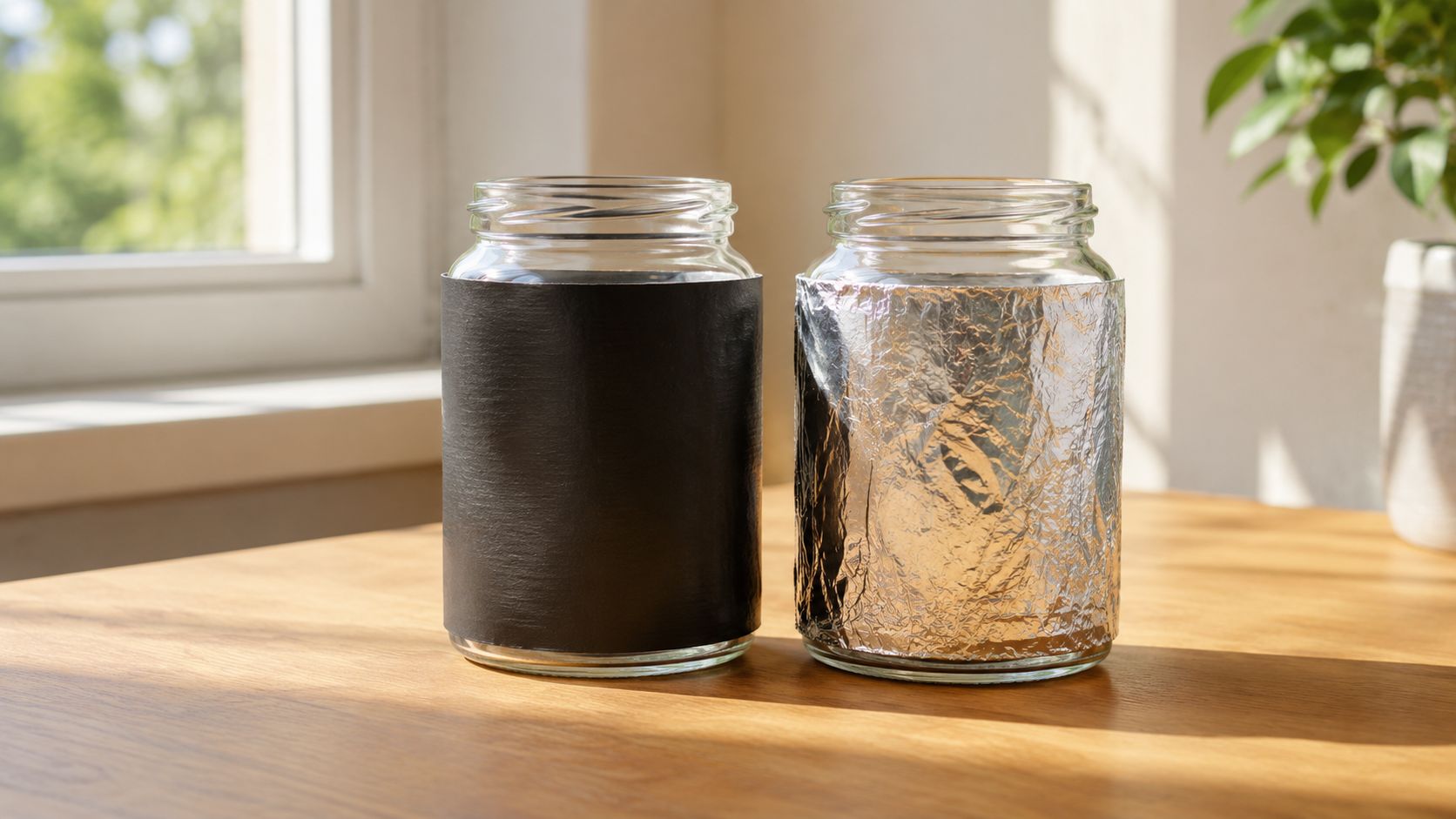
Try this with adult help. Take two similar jars. Wrap one in dark paper and the other in shiny foil. Put them under a lamp for a while and compare how warm they feel. You're testing the shininess rule in a simple, hands-on way.
A home or classroom mission
- Dark jar: This stands in for a surface that absorbs more light.
- Foil jar: This stands in for a more reflective world.
- Lamp: This acts as your little Sun.
Afterwards, ask children four short questions:
- What did I think would happen?
- What did I try?
- What can I say happened?
- Can I explain why?
That sequence matters. It builds confidence as well as knowledge.
There's also a real science gap that teachers sometimes run into. Data for Uranus and Neptune remains outdated because of the lack of recent missions, which leaves educators searching for fresher classroom material, as noted in UCL Culture Online's discussion of temperatures on different planets.
For another simple way to support this lesson, this explanation of how energy is transferred helps children connect heat, light, and movement.
If you'd like more printable activities and space-themed learning extras, visit the Space Ranger Fred freebies page. Families and schools can also explore another blog post for more curious minds with this guide to the hottest planet in our Solar System.
If your young explorer enjoys story-led science, Space Ranger Fred offers books, activities, and school experiences that connect reading with STEM in a practical, child-friendly way. You can browse the books page for fun learning at home, and if you're a teacher, librarian, or organiser, you can also enquire through the main site about interactive school visits that support confidence, reading, communication, and hands-on science curiosity. Learning should be experienced, not just delivered.