
Have you ever seen pictures of glowing, colourful ribbons dancing in the night sky? That’s an aurora! It's one of nature’s most spectacular light shows, a natural light display put on by the Sun and our very own planet Earth working together.
Earth's Magical Light Show
Welcome, fellow Space Rangers, to one of the most incredible sights our world has to offer! You might already know auroras by their more famous names: the Northern Lights (aurora borealis) up in the Arctic, or the Southern Lights (aurora australis) way down in the Antarctic.
Picture this: the sky filled with shimmering curtains of green, pink, and purple light, waving gently as if they’re dancing to a secret cosmic tune. It looks like magic, but it’s actually amazing science!
Understanding what an aurora is feels like uncovering a cosmic recipe, with a few special ingredients thrown in from space. The Sun is constantly sending out tiny particles in a stream called the solar wind—you can think of it as a giant solar sneeze! When these particles travel all the way to Earth, our planet’s invisible shield, called the magnetic field, catches them.
As these solar particles zip into our atmosphere and mix with the air high above us, they start to glow. And that’s what creates the wonderful, dancing lights of the aurora.
What Makes Auroras So Special?
Auroras are much more than just pretty lights. They're a direct link between our planet and the Sun, a giant star millions of kilometres away, reminding us that we're all part of a huge and active solar system. Spotting one is an unforgettable experience!
Here are the most important things to know about our amazing sky lights.
| What It Is | Where It Happens | What Causes It | Most Common Colour |
|---|---|---|---|
| A natural light show in the sky. | Near the North Pole (Borealis) and South Pole (Australis). | Particles from the Sun hitting gases in Earth's atmosphere. | A beautiful, shimmering green. |
Now that you've got the basics, you're well on your way to becoming an aurora expert!
This amazing display is one of nature’s greatest wonders, and it’s a brilliant way to see science in action. In my book, Space Ranger Fred and the Ghostly Galaxy, we explore all sorts of mysterious cosmic phenomena. Now, let’s get ready to uncover the secrets behind this real-life space mystery right here on Earth.
The Secret Recipe for Creating an Aurora
So, how exactly does this cosmic light show happen? It’s not magic, it’s science! Think of it like baking a very special space cake with three key ingredients. Getting the mix just right is what creates the beautiful patterns we see when we look up and wonder what auroras are.
Ingredient 1: The Sun's Solar Wind
First up, we need the Sun. Our Sun isn't just a big, bright ball of light sitting still in space. It's incredibly active and is constantly sending out a stream of tiny, super-fast particles in all directions.
This powerful stream is called the solar wind. Imagine the Sun letting out a gigantic sneeze, sending millions of little energy particles hurtling across the solar system at speeds of up to 1.6 million kilometres per hour! This energetic flow is what kicks off the entire process.
This constant stream of particles from the Sun is a big part of what scientists call space weather. To learn more about how the Sun affects all the planets, you can check out our guide on what is space weather.
Ingredient 2: Earth's Magnetic Shield
The second ingredient is Earth's magnetic field. Our planet has an amazing, invisible shield wrapped all around it, a bit like a giant bubble. This shield, called the magnetosphere, protects us from the most powerful blasts of the solar wind.
Without this shield, the solar wind would slam directly into our planet, which wouldn't be good for life on Earth. Instead, our magnetic field catches most of these energetic particles and steers them away.
Think of it like this: The magnetic field is like a massive force field that channels the solar wind around our planet, but some particles get caught and pulled towards the North and South Poles. It's Earth's built-in defence system!
Ingredient 3: Our Amazing Atmosphere
The final ingredient is Earth's atmosphere—the blanket of air we all breathe. This is where the real light show begins!
When those solar wind particles, guided by the magnetic field, reach the poles, they don't just stop. They dive down into the upper parts of our atmosphere at incredible speeds.
Here, they crash into tiny atoms and molecules of gas, mostly oxygen and nitrogen. These collisions are like tiny, colourful explosions of light.
- The solar particles transfer their energy to the gas atoms.
- This extra energy makes the gas atoms super excited.
- To calm down again, the atoms release this energy as a flash of light.
This simple infographic shows how the Sun, solar wind, and Earth work together to create an aurora.
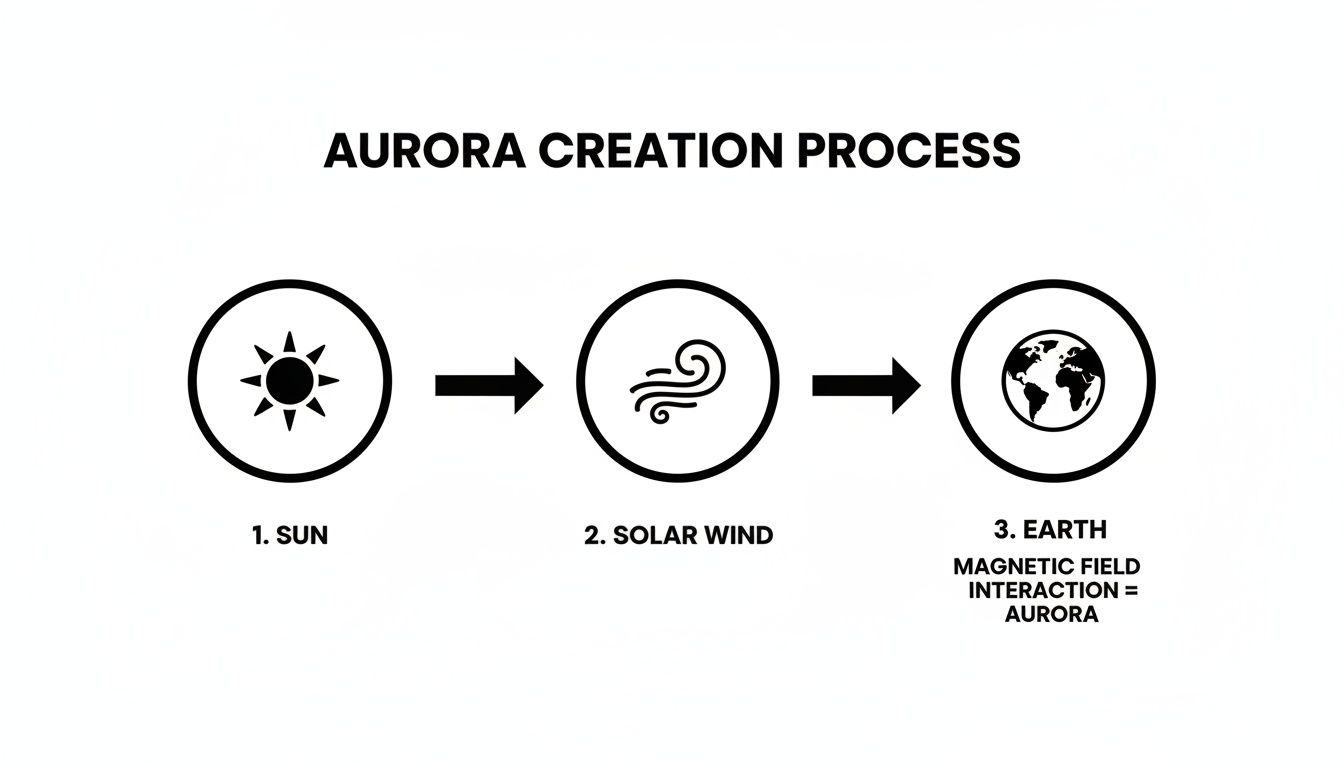
As you can see, it's a fantastic journey that starts millions of kilometres away but ends in a beautiful display right above our heads.
Why Do Auroras Have So Many Different Colours?
One of the most magical parts of watching an aurora is seeing all the beautiful, shifting colours ripple across the sky. While green is the colour we see most often, these cosmic light shows can also splash the night with pink, red, blue, or even purple. But why the variety? It all comes down to a bit of chemistry high up in our atmosphere.
Think of it like being an artist with a very simple paint palette. You only have two colours to work with: oxygen and nitrogen, the two main gases that make up the air we breathe. The final colour of the aurora depends on just two things: which of these gases the solar wind particles bump into, and how high up that collision happens.
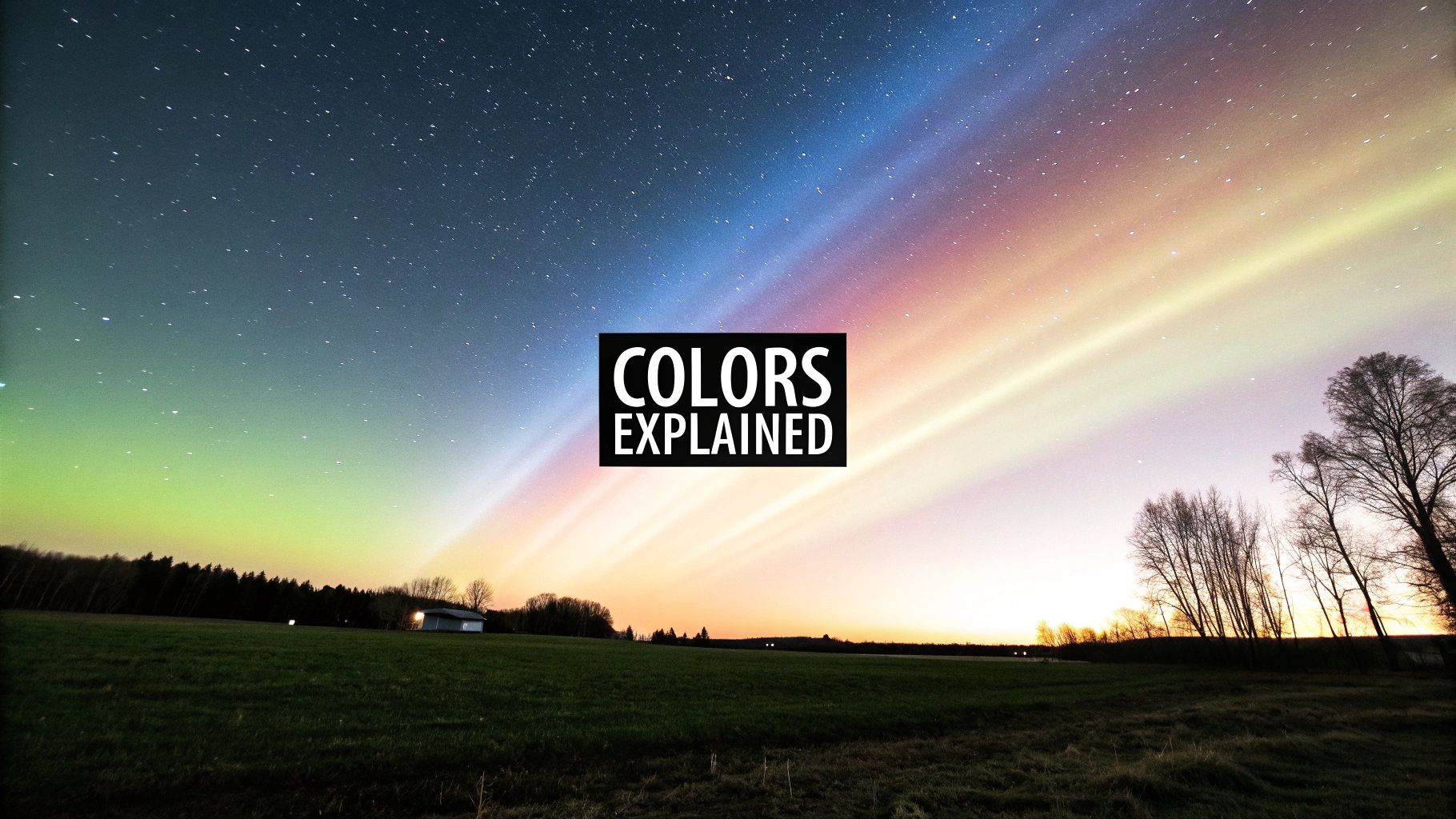
A Rainbow of Gases
The type of gas and the altitude of the collision work together to paint the sky. Each combination creates a unique colour, a bit like hitting different keys on a piano to get different notes.
-
Gorgeous Greens: This is the classic colour most people picture when they think of the Northern Lights. It’s created when solar particles collide with oxygen atoms at lower altitudes—around 100 to 240 km (60 to 150 miles) up. Our eyes happen to be very sensitive to this particular shade of green, which is why it’s the one we see most vividly.
-
Rare Reds: Spotting a deep red aurora is a real treat and a much rarer sight. This colour also comes from oxygen atoms, but only when they’re hit by super-charged particles at extremely high altitudes, usually above 240 km (150 miles). The atmosphere is so thin up there that it takes the oxygen longer to start glowing, creating a faint, crimson light that’s harder to see.
-
Brilliant Blues and Purples: When those energetic solar particles crash into nitrogen molecules instead, they can produce beautiful blue or purplish-red lights. These colours usually appear at the very bottom of the aurora, often as a vibrant fringe hanging below the green curtains.
Experts from the British Geological Survey have confirmed that it's all about these different gases, with oxygen and nitrogen producing the characteristic green, blue, yellow, and red hues we see. You can read more about their scientific observations over at the-independent.com.
The next time you see a picture of an aurora, you can be a science detective! If you spot green, you’ll know it’s oxygen glowing lower down in the sky. And if you see a hint of purple at the bottom, that’s nitrogen joining the cosmic dance.
Where in the World You Can See an Aurora
Right, are you ready to pack your bags and go on an aurora hunt? Brilliant! But you can’t see this spectacular light show from just anywhere. To get the best view, you’ll need to travel towards the very top or the bottom of the world, close to the Earth's poles.
This is all because of our planet's magnetic field, which acts like a giant cosmic funnel. It pulls those super-charged particles from the Sun down towards the North and South Poles, concentrating all that light-making magic in two specific areas.
These prime viewing spots form a ring shape around each pole, a zone known as the auroral oval. This is where the aurora is most active and easiest to see. To witness it for yourself, you need to be inside, or at least very close to, this oval.
The Best Spots for Aurora Spotting
So, where exactly should you point your spaceship? Well, that depends on which lights you want to see!
- For the Northern Lights (Aurora Borealis): You'll want to head way up north into the Arctic Circle. Some of the best countries for this are Iceland, Norway, Sweden, and Finland, as well as parts of Canada and Alaska.
- For the Southern Lights (Aurora Australis): This one is a little trickier, as it mostly happens over Antarctica! But, you can sometimes catch a glimpse from the southern tip of New Zealand, Tasmania in Australia, or even parts of South America.
Finding the Perfect Viewing Conditions
Once you’re in the right part of the world, you still need a few more things to go your way. Planning an aurora trip is a bit like planning a perfect stargazing night. For those who love looking up at the night sky, you might also be interested in other kinds of stargazing experiences.
To give yourself the best chance of seeing a spectacular display, you need three key things: darkness, clear skies, and a whole lot of patience!
The best time to go is during the winter months when the nights are long and properly dark. It’s really important to get as far away from the bright lights of cities and towns as you can. The darker your surroundings, the brighter the aurora will appear!
Finally, you need the weather to cooperate. Since auroras happen incredibly high up in the atmosphere, you’ll need a cloud-free night to be able to see them. A full moon can also make the sky a bit too bright, so checking the lunar cycle can be a huge help. For a kid-friendly guide, you can learn all about moon phases for kids with us.
Can You See the Northern Lights in the UK?
It’s a question lots of us here in Britain ask, and the brilliant answer is yes, you absolutely can! While it’s not quite as regular as in places like Norway or Iceland, the aurora borealis putting on a show over the UK is a special treat that happens more often than you might think.
The UK sits just south of the main auroral oval—that glowing ring around the North Pole where the lights are usually at their best. But when the Sun chucks out a particularly strong blast of solar wind, it can actually push this oval further south, stretching it right down over our skies. This is our golden opportunity to see the magic from our own back gardens.
For the very best chance of catching them, you’ll want to head as far north as you can. Northern Scotland, the Orkney Islands, and the Shetland Islands are without a doubt the UK’s premiere aurora-hunting spots.
Your Guide to UK Aurora Spotting
Seeing the Northern Lights in England, Wales, or Northern Ireland is a much rarer event, but it’s certainly not impossible, especially when a powerful geomagnetic storm hits.
For the perfect aurora display, you need a few things to line up just right:
- A Mighty Solar Storm: Keep an eye on the aurora forecasts online (with a grown-up, of course!). There are brilliant apps and websites that can give you a heads-up when a solar storm is on its way.
- A Clear, Dark Sky: You’ll need a night completely free of clouds. It’s also super important to get away from the bright lights of towns and cities, as that light pollution can easily wash out the aurora’s faint glow.
- A Cracking View North: The lights almost always pop up on the northern horizon. Try to find a spot with a clear, open view in that direction, like a hilltop or a north-facing beach.
One of the most jaw-dropping recent displays happened during a major geomagnetic storm. This cosmic event was so immense that it sparked one of the most extreme and long-lasting auroral light shows seen in the UK in over 150 years, letting people see vivid colours as far south as our big English cities. You can dig into the science behind this incredible night by reading the full report from the British Geological Survey.
A top tip from Space Ranger Fred: the lights might not look as bright to your eyes as they do in photos. Sometimes, they start as a faint, greyish-looking cloud. A camera set to a long exposure can often pick up those amazing colours even when your eyes can’t quite see them.
Fun Aurora Activities for Young Scientists
Watching an aurora is one of nature’s most incredible shows, but you don’t need a trip to the Arctic Circle to bring the magic home! The best way to understand the science behind the Northern Lights is to get your hands messy. These super simple activities turn big, cosmic ideas into a brilliant afternoon of fun.
These projects are designed for our fellow young explorers. They use everyday items to make science feel exciting and easy for everyone. Let’s get started!
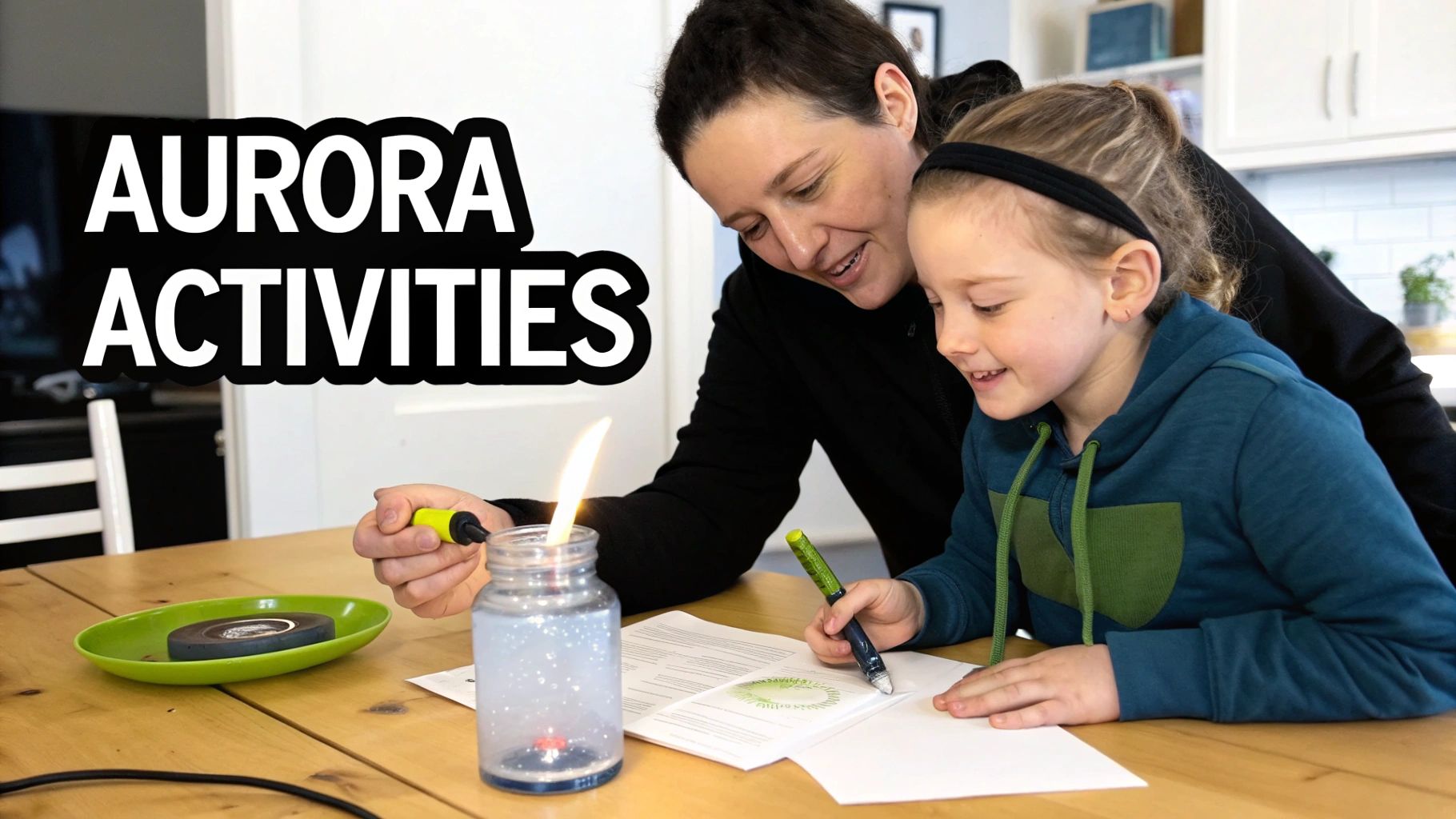
Activity 1: Create an Aurora in a Jar
This classic experiment is a fantastic way to visualise how light scatters through tiny particles, just like the solar wind zipping through our atmosphere. It’s like bottling up a bit of science magic!
What You'll Need:
- A clear glass jar or a see-through container
- Water
- A few drops of milk
- A torch
- A room you can make nice and dark
Step-by-Step Instructions:
- Fill your jar almost to the very top with water.
- Add just two or three drops of milk and give it a gentle stir. You want the water to look slightly cloudy, but not totally white.
- Now for the fun bit! Turn off the lights and shine your torch through the side of the jar. Watch how the beam of light suddenly appears as it travels through the milky water.
- Try looking at the jar from different angles. You might notice a bluish glow from the side, but a reddish-orange hue when you look straight at the torch through the water. This happens because the milk particles scatter the blue light more easily, letting the red and yellow light pass straight through—it’s a similar principle to how different gases in our atmosphere create the aurora’s amazing colours!
Activity 2: Colourful Chalk Aurora Art
Time to get creative! This project lets young artists capture the beautiful, flowing shapes and colours of the aurora. It’s the perfect way to mix art with science and imagine those shimming curtains of light.
What You'll Need:
- Black paper or card
- Soft chalk pastels in green, pink, blue, and purple
- Your fingers or a cotton ball for smudging
Instructions:
- Start by drawing wavy, ribbon-like lines across the black paper with a bright green chalk pastel.
- Add little hints of pink, blue, and purple above and below your green lines to build up that multi-coloured glow.
- Now, use your fingertip or a cotton ball to gently smudge the chalk upwards. This creates a soft, hazy effect that looks just like a real aurora dancing in the night sky.
These activities are just the beginning of your scientific journey. For even more inspiration, check out our massive list of fun science activities for kids that you can do at home or school.
Your Aurora Questions Answered
Over at Space Ranger Fred's mission control, we get some brilliant questions about the Northern and Southern Lights! We've picked a few of the most common ones to help turn you into a proper aurora expert.
Do Auroras Make Any Sound?
Now this is a fantastic question. For a very long time, scientists were sure that auroras were completely silent. But, people who live under these shimmering lights have often sworn they can hear faint crackling or hissing sounds during a really big display.
It turns out they might be right! New research suggests these strange noises could be real, caused by electrical changes happening much, much lower in our atmosphere. It's still a bit of a cosmic mystery, which just makes it all the more exciting!
Are There Auroras on Other Planets?
Yes, absolutely! Earth isn't the only planet in the solar system to get its own amazing light show. Any planet that has both a magnetic field and an atmosphere can have auroras.
Scientists have spotted some truly incredible ones on Jupiter and Saturn that are way bigger and more powerful than anything we see here. Even Mars, with its weak and patchy magnetic field, gets its own unique type of aurora!
What Is the Best Time of Year to See the Aurora?
While you definitely need dark winter nights, the best months are often around March and September. For some reason, the Sun's activity seems to line up just right during the spring and autumn equinoxes, making powerful auroras more likely.
It’s all down to statistics, and if you fancy a deeper dive, you can see the aurora stats and averages to learn more.
Continue your cosmic adventure with Space Ranger Fred! Explore our amazing books or download some brilliant free activities for more space-themed fun.