
Are you ready to turn your home or classroom into a launchpad for imagination? Here at Space Ranger Fred, we believe learning should be an adventure. That's why we've put together this ultimate guide to hands-on space activities for kids. These aren't just crafts; they're missions designed to spark curiosity, build confidence, and make STEM feel like the most exciting game in the universe. We’ve designed these projects to be achievable, using simple household materials and clear, step-by-step instructions that empower children aged 6 to 12 to take the lead.
This guide is designed for busy parents and teachers, providing everything you need to get started straight away. Each activity includes practical details like estimated time, a materials list, and the specific learning goal behind the fun. You'll find activities perfect for a rainy afternoon, like creating a model solar system from recyclable materials, as well as bigger projects ideal for a classroom, such as staging an astronaut training obstacle course. We’ll cover everything from building your own rocket to tracking the phases of the moon in a special observation journal.
Our goal is to make space exploration a hands-on experience that encourages real-world thinking and problem-solving. Many of these projects even include special tie-ins with our hero, Space Ranger Fred, featuring story prompts and challenges to deepen the imaginative play. Get ready to explore the cosmos together, one brilliant project at a time! For more story-led adventures, you can blast off with Fred in his latest book or download some fun challenges from our free activities page. Let the countdown begin!
1. Build and Launch a Rocket
Turn your home into a launch station with one of the most classic and exciting space activities for kids: building and launching your own rocket. This hands-on project transforms everyday items like paper towel tubes and plastic bottles into high-flying spacecraft. It’s a brilliant way to bring complex physics principles—such as thrust, aerodynamics, and Newton’s laws of motion—down to earth in a fun, tangible way. By designing, building, and testing their creations, children get a real feel for the engineering challenges that space agencies face.
This activity is a cornerstone of STEM education for a reason. Organisations like NASA have popularised bottle rockets to demonstrate core scientific concepts. It’s a perfect experiment for a sunny afternoon in the garden or a dynamic classroom project.
Get Ready for Lift-Off
- Estimated Time: 30–60 minutes
- What you'll need: A plastic bottle, cardboard (from a cereal box), paper, tape, scissors, water, a cork, and a bicycle pump with a needle adaptor.
- What you'll learn: About Newton's Third Law of Motion (for every action, there is an equal and opposite reaction) and the basics of aerodynamic design.
How to Try It
- Construct the Rocket Body: Start with an empty plastic bottle. This is the main part of your rocket.
- Add Fins and a Nose Cone: Cut out fins from the cardboard and a nose cone from the paper. Tape them securely to the bottle. The fins will help it fly straight!
- Prepare for Launch: Fill the bottle about one-third full with water. Firmly push the cork into the opening.
- Pressurise and Launch: Push the pump needle through the cork. Stand back, pump air into the bottle to build pressure, and watch your rocket soar as the water is forced out!
Space Ranger Fred Tip: Imagine you're Fred designing a new ship for a special mission. What colour is it? Does it have special fins for navigating an asteroid field? Try adding your own Space Ranger Fred logos to your rocket!
For a simpler version perfect for younger children, try a "stomp rocket" using a paper towel tube and launching it with a swift stomp on another plastic bottle connected by a tube. For a complete guide with different designs, you can learn more about how to make a rocket.
2. Create a Planetarium at Home
Transform any room into a breathtaking galaxy with one of the most magical space activities for kids: creating a personal planetarium. This imaginative project blends art and astronomy, allowing children to map out constellations with glow-in-the-dark paint or stickers. It’s a wonderful way to bring the vastness of the cosmos indoors, making complex concepts like star patterns and celestial navigation feel personal. The activity can then lead to a real-world adventure with guided stargazing, connecting their homemade star charts to the actual night sky.
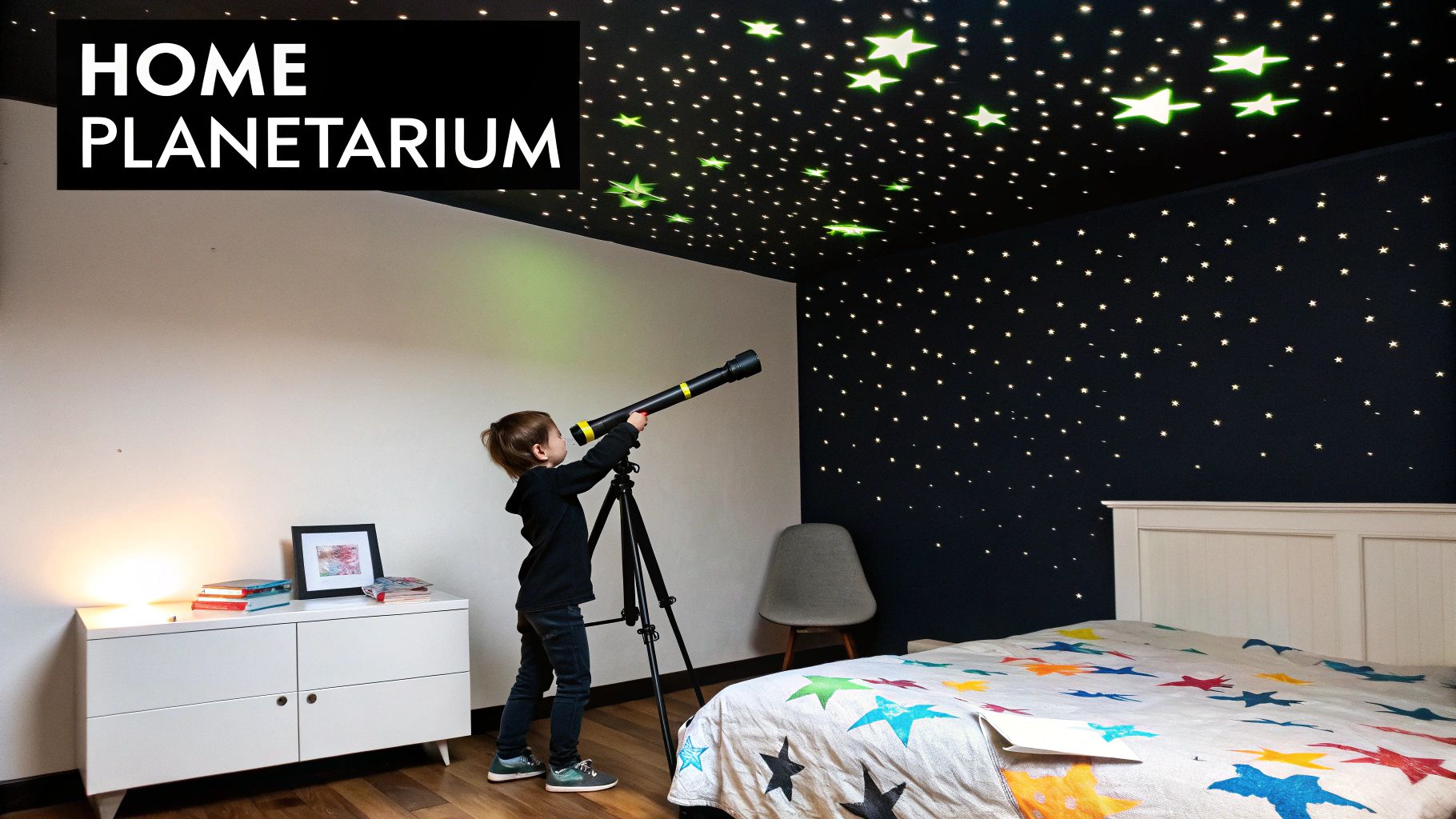
This dual activity is celebrated by educators for its power to foster long-term curiosity. By first crafting the constellations and then seeking them out, children develop spatial awareness and learn to appreciate the night sky. It’s a perfect activity for a quiet afternoon of crafting followed by an exciting evening of discovery.
Get Ready for Discovery
- Estimated Time: 45–60 minutes for the craft; ongoing for stargazing.
- What you'll need: Black or dark blue paper, glow-in-the-dark paint or star stickers, a torch (ideally with a red light setting), binoculars, and a stargazing app like Stellarium or SkyView.
- What you'll learn: How to identify major constellations, understand their myths, and develop observational skills.
How to Try It
- Map Your Constellations: Use pre-printed templates or draw your own constellations onto dark paper. Popular choices include Orion, Ursa Major (The Plough), and Cassiopeia.
- Make Them Glow: Carefully place glow-in-the-dark stickers or paint dots over the stars in your drawings. You could even use different colours for different constellations.
- Create Your Planetarium: Arrange your finished constellation cards on a bedroom ceiling or wall. Turn off the lights to see your personal galaxy shine!
- Go on a Stargazing Adventure: Take your star charts outside on a clear night. Use binoculars and a stargazing app to find the real constellations you created.
Space Ranger Fred Tip: Imagine you are Fred charting a course to a new planet. What constellations will guide your way? Learn the stories behind the stars and log your discoveries in your very own stargazing journal!
For a more immersive experience, project constellations onto the ceiling using a simple DIY projector made from a cardboard tube, a pin, and a torch. You can find more creative ideas in our free activities section.
3. Keep a Moon Observation Journal
Embark on a month-long mission to become an expert lunar observer—one of the most rewarding space activities for kids. This long-term project involves tracking and documenting the Moon's changing appearance every night for a full lunar cycle (about 29.5 days). It’s a fantastic way to connect with the cosmos from your own window, teaching children about the mechanics of the Earth-Moon system, why we see phases, and the importance of patient scientific observation. By keeping a journal, young astronomers create a personal record of their discoveries.
This classic scientific practice is promoted by organisations like NASA to develop core observation and data-recording skills. It transforms the night sky into a familiar, predictable, and fascinating natural laboratory.
Get Ready for Observation
- Estimated Time: 5–10 minutes per night for one month.
- What you'll need: A notebook or our printable journal templates, a pencil, and optionally, binoculars or a camera.
- What you'll learn: That the Moon's phases are a predictable cycle caused by its orbit around the Earth and the way it reflects sunlight.
How to Try It
- Set Up Your Journal: Dedicate a notebook to the project or print out a monthly calendar template. Each day needs a space to draw the Moon.
- Start Observing: On a clear night, find the Moon in the sky. Note its shape and position. Is it a thin sliver (crescent) or a full circle?
- Draw What You See: Carefully draw the shape of the Moon in your journal for that date. Try to be as accurate as possible.
- Repeat Daily: Continue observing and recording each night. Over the weeks, you'll see the pattern of the phases emerge, from New Moon to Full Moon and back again.
Space Ranger Fred Tip: Imagine you’re at Space Ranger Fred's Moon Base Alpha. What does the Earth look like from where you’re standing? As you watch the Moon from Earth, remember that Fred sees the Earth go through phases too, but in reverse!
For a deeper dive into why our view of the Moon changes, you can explore our detailed guide on the moon phases for kids.
4. Play Interactive Space-Themed Games
Blast off into a digital universe where learning and play collide. Our space activities for kids go beyond the physical world with interactive games that turn screen time into an educational mission. These story-driven quests and puzzles embed core STEM principles into exciting gameplay. Children can join Space Ranger Fred on digital adventures, earning badges and unlocking new cosmic challenges while learning about physics, astronomy, and problem-solving without even realising it. It’s a modern, engaging way to capture their imagination.
This gamified approach to learning is a great way to make complex subjects feel fun. By framing education as a game, we tap into a child's natural desire for achievement and exploration. To extend the learning beyond games, consider exploring dedicated space-themed learning apps that offer structured educational content and interactive experiences.
Get Ready for Lift-Off
- Estimated Time: 15–30 minutes per session.
- What you'll need: A computer, tablet, or smartphone.
- What you'll learn: To reinforce STEM concepts such as physics, astronomy, and problem-solving through engaging, interactive challenges.
How to Try It
- Choose a Mission: Select a Space Ranger Fred game or challenge. Missions might involve navigating an asteroid field using physics or identifying constellations.
- Set the Difficulty: Adjust the settings to match your child's age and skill level, from 'Space Cadet' for beginners to 'Space Commander' for experts.
- Play and Learn: Guide your child through the game, encouraging them to think critically to solve puzzles and overcome obstacles.
- Talk About the Science: After playing, talk about the real-world science behind the game. If they built a virtual rover, look up real Mars rovers together.
Space Ranger Fred Tip: Can you beat my high score on the 'Planet Navigator' puzzle? Use your knowledge of the solar system to plot the fastest course. See if you can earn the 'Galactic Explorer' badge before I do!
These games are a fantastic way to supplement hands-on activities, offering a different way to visualise and interact with scientific ideas. You can discover more about the power of play in our guide to the best children’s educational video games.
5. Create a Model Solar System
Bring the vastness of our cosmic neighbourhood into your home with one of the most iconic space activities for kids: building a model of the Solar System. This classic project encourages children to transform everyday items like foam balls, cardboard, and old containers into a vibrant representation of the sun and its orbiting planets. It’s a fantastic, hands-on way to explore planetary science, learning about the order, size, and unique characteristics of each celestial body in our corner of the galaxy.
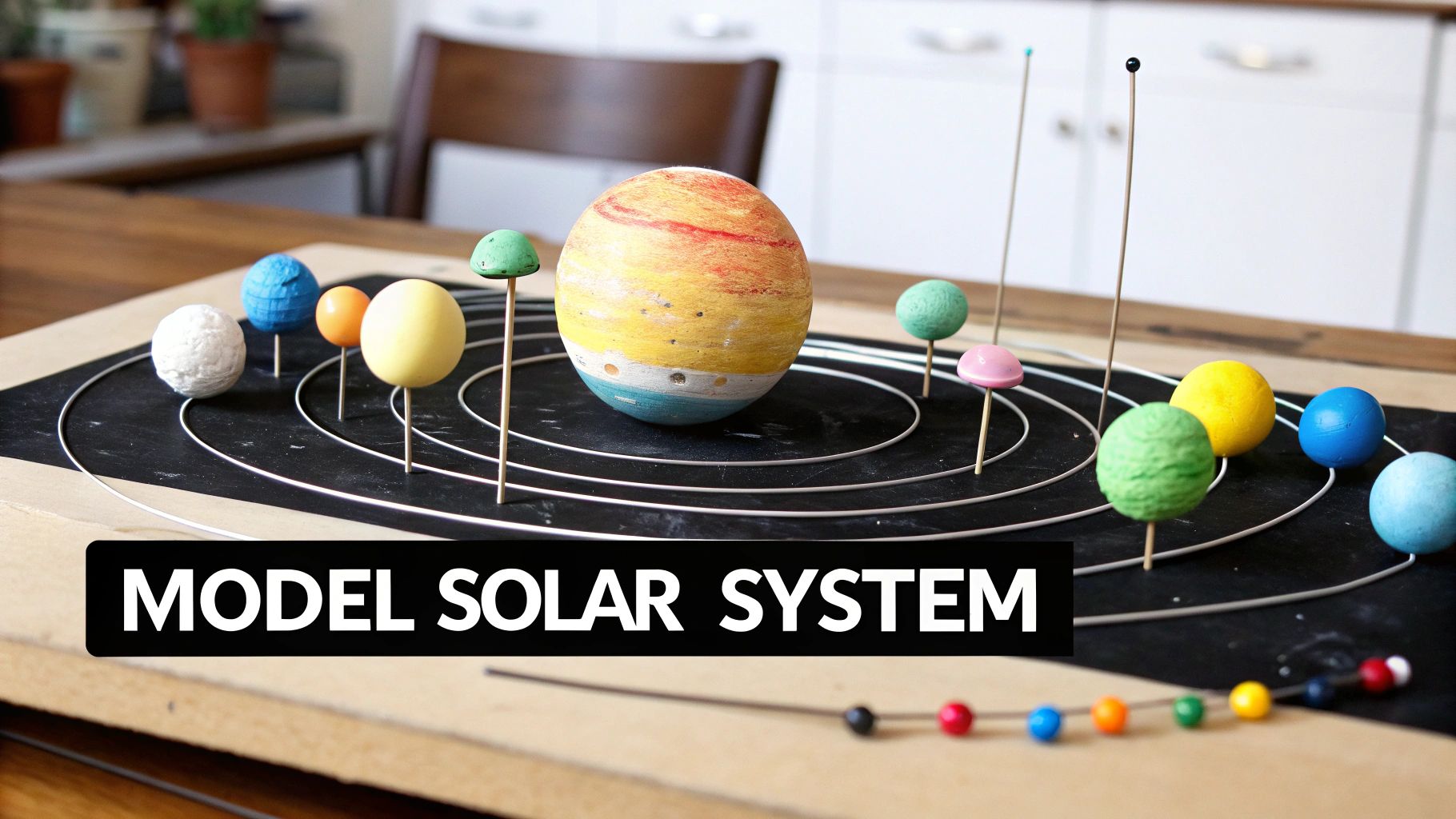
This activity has been a staple of school projects for generations for its power to make abstract astronomical concepts tangible. Whether built as a hanging mobile or a diorama, it provides a powerful visual anchor for understanding our place in space.
Get Ready for Your Cosmic Creation
- Estimated Time: 1–2 hours (can be split into multiple sessions).
- What you'll need: Polystyrene or cardboard spheres of various sizes, paint, markers, cardboard (for rings), wire or string, and a large piece of cardboard or box for the base.
- What you'll learn: To identify the planets in our Solar System, understand their order from the Sun, and learn about their relative sizes and key features (e.g., Saturn's rings, Mars' red colour).
How to Try It
- Research Your Planets: Before you start, look up pictures of the planets. Note their colours, textures, and special features like Jupiter’s Great Red Spot.
- Paint Your Planets: Assign a sphere to each planet and paint it to match its real-life appearance. Paint a large sphere yellow for the Sun.
- Add the Details: Use markers to add surface details. For Saturn, cut a ring out of a thin piece of cardboard and slide it over the painted sphere.
- Assemble Your Solar System: Arrange your finished planets in the correct order from the Sun on your base. You can use glue to fix them in place or string to hang them from a wire frame to create a mobile.
Space Ranger Fred Tip: Imagine you are flying with Fred on a mission from Mercury to Neptune. What does each planet look like from the cockpit of your spaceship? You could make little information labels for each planet in your model to document your journey!
For an extra challenge, try to make your model to scale, discussing how tricky it is to show the real distances between planets. You can learn more about the planets you are building by exploring the Space Ranger Fred books.
6. Take On a Space-Themed Building Challenge
Unleash your inner aerospace engineer with one of the most creative space activities for kids: designing and building with LEGO or magnetic tiles. This activity turns a classic toy box into a high-tech laboratory where children can construct everything from Mars rovers to interstellar space stations. It’s a fantastic way to explore engineering principles like structural integrity, balance, and functional design in a playful environment. By tackling specific challenges, children learn to think like real engineers, trying out different designs to solve problems.
This method is a cornerstone of modern STEM education. It encourages problem-solving, spatial reasoning, and creative thinking, proving that complex engineering concepts can be explored through play. It’s an ideal activity for a rainy afternoon or a structured classroom project that combines creativity with critical thinking.
Get Ready for Engineering
- Estimated Time: 45–90 minutes.
- What you'll need: A collection of LEGO bricks, magnetic tiles, or other building blocks. Paper and pencils for sketching designs are optional.
- What you'll learn: To develop problem-solving skills, understand basic structural engineering principles, and practise the design-build-test-redesign cycle.
How to Try It
- Start With a Mission: Give your child a specific challenge. For example, “Design a lunar rover that can carry a small object and roll across the floor without tipping over.”
- Plan and Sketch (Optional): Encourage older children to sketch their ideas first, thinking about how different parts will connect and function.
- Build Your Prototype: Let the construction begin! Encourage experimentation with different shapes and connections to create a stable and functional model.
- Test and Redesign: Once the build is complete, put it to the test. Does the rover roll? Does the space station stand firm? Identify weaknesses and go back to the building phase to make improvements.
Space Ranger Fred Tip: Imagine you're Fred receiving a mission briefing: "Build a new research habitat for the icy moon of Europa. It must have sleeping quarters for two astronauts and a lab." Use our free printable mission briefings to kick-start your build!
For an extra layer of fun, set a time limit to challenge advanced builders or create a "show and tell" where your young engineer presents their creation and explains their design choices, just like a real project review.
7. Make Your Own Meteor Craters
Bring the destructive beauty of the cosmos into your home with one of the most satisfying space activities for kids: creating your own meteor impact craters. This hands-on experiment uses simple materials like flour or sand to simulate the dramatic collisions that shape planetary surfaces. It’s a fantastic way to explore complex concepts like impact physics and energy transfer in a highly visual way. By dropping "meteors" from different heights, children can directly observe how speed and mass affect the size and shape of a crater.
This experiment is a staple in science centres because it makes abstract astronomical events feel real and immediate. It’s an ideal project for a rainy day indoors and encourages methodical scientific observation.
Get Ready for Impact
- Estimated Time: 20–40 minutes.
- What you'll need: A deep tray, flour with a layer of cocoa powder on top, various small objects to act as meteors (marbles, pebbles), and a ruler.
- What you'll learn: How a meteor's mass and velocity (represented by drop height) affect the size and shape of an impact crater.
How to Try It
- Prepare the Surface: Fill your tray with a layer of flour and dust a fine layer of cocoa powder over the top. Smooth the surface so it’s flat and even.
- Select Your Meteor: Choose your first impactor. Notice its size and weight compared to the others.
- Predict the Outcome: Before you drop it, make a prediction. Will a heavy object make a deeper or wider crater than a light one?
- Create the Impact: Drop the object from a set height (e.g., 30 cm) into the tray. Carefully remove the object and observe the crater. Measure its diameter and depth, and record your findings. Repeat the process with different objects and from different heights to see what changes!
Space Ranger Fred Tip: Imagine you're on a mission with Fred to chart a newly discovered moon. Your job is to analyse the impacts from a recent meteor shower. Can you create a chart to record which 'meteor' (pebble or marble) caused the biggest crater?
8. Run an Astronaut Training Course
Transform your garden or living room into a high-stakes astronaut training facility with one of the most active space activities for kids. This isn’t just an obstacle course; it’s a mission-based adventure that simulates the physical and mental challenges astronauts face. By crawling through "asteroid fields" (cushions), balancing on "space station beams" (tape lines), and completing tasks at different stations, children develop gross motor skills, agility, and problem-solving abilities, all while immersed in an exciting space story.
This blend of physical education and imaginative play is a fantastic way to burn off energy while encouraging teamwork, resilience, and creative thinking, proving that learning about space can be a full-body experience.
Get Ready for Your Mission
- Estimated Time: 45–90 minutes.
- What you'll need: Household items like cushions, chairs, blankets, hula hoops, and buckets. Optional: printed mission briefings and 'mission complete' certificates.
- What you'll learn: To develop gross motor skills (balancing, crawling, jumping) and enhance problem-solving abilities under simulated pressure.
How to Try It
- Design the Course: Arrange household items to create a path with various challenges. Use cushions to crawl over ("lunar rocks") and a blanket-draped table as a "wormhole" to crawl through.
- Set Up Mission Stations: Place tasks along the course. For example, a "spacecraft repair" station with a simple puzzle or a "specimen collection" station to sort coloured blocks.
- Brief the Astronauts: Explain the mission scenario. Are they navigating a Martian canyon to rescue a rover, or moving between space station modules during a solar flare?
- Launch the Mission: Let the children run the course individually or in teams. Time them for an extra challenge and encourage them to beat their personal bests.
Space Ranger Fred Tip: Your mission, should you choose to accept it, is to retrieve a fallen star-crystal from the treacherous surface of Planet Xylos! Fred needs you to navigate the course before the planet’s twin suns set.
For a more structured challenge, create different difficulty levels or add a "zero gravity" section where children have to move in slow motion. Celebrate every completed mission with an official Astronaut Certification from our activities page.
9. Become a Citizen Scientist
Transform your child's fascination with the cosmos into real scientific contributions with one of the most impactful space activities for kids: becoming a citizen scientist. This activity empowers children to participate in genuine research by helping scientists with projects run by organisations like NASA. They can help classify galaxies, discover new planets, or track meteor showers, contributing valuable data to studies. It’s an incredible way to show them that science isn’t just something you learn about; it's something you can do.
This experience moves beyond simulations and brings the scientific method to life. Platforms like Zooniverse have made it possible for thousands of people to contribute to astronomy and Earth science. It’s a perfect ongoing project for a curious child, a family, or a whole classroom.
Get Ready for Discovery
- Estimated Time: 30–60 minutes per session (can be an ongoing project).
- What you'll need: A computer or tablet with internet access.
- What you'll learn: About the scientific method, data collection, and pattern recognition.
How to Try It
- Choose a Project: Explore platforms like Zooniverse or the NASA Citizen Science website. Start with a project that matches your child's interests, such as Galaxy Zoo (classifying galaxy shapes).
- Complete the Tutorial: Most projects have a short, interactive tutorial to explain the task and what to look for. This ensures the data collected is accurate and useful.
- Start Contributing: Begin classifying images or analysing data. The tasks are designed to be simple to perform but contribute to complex scientific questions.
- Track Your Progress: Keep a research journal to note down observations and discoveries. Celebrate milestones, like completing 100 classifications.
Space Ranger Fred Tip: Imagine you are a research officer on Fred's team, tasked with scouting new star systems! Your mission is to analyse deep-space images and report any unusual galaxies back to mission control. Every piece of data you collect helps keep the galaxy safe!
For younger children, start with simple observation projects like tracking cloud cover with the NASA Globe Observer app. To make it official, you can create and print your own Space Ranger Fred research badges to reward their important contributions to science.
10. Create a Space-Themed Story
Blast off into a universe of creativity by combining storytelling with technology. This exciting space activity for kids challenges them to write their own space adventure stories and then bring them to life using multimedia. Children can become authors, illustrators, and directors, transforming their written words into comic strips, animated shorts, or even a mini-movie. It’s a powerful way to merge literacy, art, and digital skills, turning a creative writing project into a full-scale STEAM adventure.
This project mirrors how modern stories are told and encourages children to think like real creators. By documenting their imaginative journeys, kids don’t just tell a story; they build an entire world.
Get Ready for Production
- Estimated Time: 2-4 hours (can be spread over several sessions).
- What you'll need: Paper and pencils, a tablet or computer, free apps/software (e.g., Canva for Kids, Stop Motion Studio), and a vivid imagination.
- What you'll learn: To develop literacy, creative writing, and digital media skills while integrating scientific concepts into a story.
How to Try It
- Plan the Story: Start by brainstorming the main story elements. Who are the characters? Where is the setting—a distant galaxy or an unexplored planet? What is the mission or problem?
- Write the Narrative: Draft the story. Encourage children to include real space facts they’ve learned to make their adventure more believable.
- Choose a Medium: Decide how to bring the story to life. Will it be an illustrated e-book, a stop-motion animation with Lego, or a short video?
- Create and Share: Use accessible tools to create the multimedia project. Once finished, host a “premiere” for family and friends to showcase the amazing work.
Space Ranger Fred Tip: Imagine your story is a new mission report for Space Ranger Fred. Does Fred encounter a friendly alien, or does he have to navigate a tricky meteor shower to save the day?
For a great starting point, use one of our free writing prompts to spark some out-of-this-world ideas.
Your Next Mission Awaits!
What an incredible cosmic journey we’ve had! From launching homemade rockets in the back garden to charting the mysterious phases of the Moon, you now have a launchpad full of engaging space activities for kids. We've explored how simple household items can transform into a stunning model solar system and how a bit of flour can demonstrate the powerful impact of meteors. Each activity is designed not just to teach, but to ignite a lifelong passion for the cosmos.
The real magic of these activities lies in their ability to make vast, complex ideas feel tangible and exciting. When a child builds a rocket, they aren't just learning about thrust; they're experiencing the thrill of engineering firsthand. These hands-on experiences are the bedrock of the Menturity™ approach, building confidence and curiosity with every successful launch and every new discovery.
Key Takeaways from Your Space Expedition
Let's recap the core ideas that propelled us through this galactic guide. The most effective learning happens when it’s active, playful, and tied to a story.
- Learning Through Doing: The most memorable lessons are those we experience. The physical act of building a solar system or the sensory feedback from a crater experiment creates stronger learning connections than simply reading a fact in a book.
- Curiosity is the Fuel: Every activity we've covered begins with a question. Why does the Moon change shape? What would it be like to walk on Mars? Encouraging these questions is more important than having all the answers. It’s about fostering an inquisitive mindset.
- Storytelling Makes Science Stick: By framing activities with narratives, like a mission briefing from Space Ranger Fred, you transform a simple task into an epic adventure. This makes abstract scientific concepts relatable and unforgettable.
Launching Your Next Adventure
Your mission, should you choose to accept it, is to keep the momentum going. Don't let this be a one-off afternoon of fun. Instead, view this list as a resource to return to again and again. How can you integrate these space activities for kids into your regular routine?
Perhaps you could introduce a weekly ‘Space Saturday’ challenge or use our printable templates as a go-to resource for rainy days. For teachers, these activities can serve as brilliant, low-cost foundations for entire lesson plans. The goal is to build a continuous and evolving journey of discovery, not just a single destination.
Remember, the universe is infinitely vast, and so are the opportunities for learning. Whether you’re a parent, a teacher, or a curious young explorer yourself, the journey has only just begun. Keep looking up, keep asking questions, and never lose that incredible sense of wonder.
Ready to take your cosmic adventures to the next level? Join Space Ranger Fred on his official missions! Dive into our book series to see science, courage, and friendship in action, or download more fantastic resources from our activities page to continue your hands-on learning. The Space Ranger Fred universe is waiting to be explored.