
Meta title: Answers to Kids' Questions About Space
Meta description: A friendly guide for parents and teachers answering questions about space with story-led STEM ideas, reading tips, activities, and classroom inspiration.
When “Why is the Sky Blue?” turns into “Is there life on Mars?”, many grown-ups have the same quiet thought.
What on Earth do I say next?
If your child or class fires off questions about space faster than a rocket launch, that's brilliant news. Curiosity is doing its job. The challenge is that space can feel huge, technical, and just a bit intimidating when you're the one expected to have the answers.
You don't need to be an astronomer. You need a good way in.
That's where story, play, and simple teaching choices make all the difference. Children don't learn space best by memorising giant words. They learn it by wondering, asking, testing, imagining, and talking. One moment they're asking about stars. The next they're building a moon base out of cereal boxes and announcing that the cat is now mission commander.
This guide is for the adults in mission control. Below are ten practical answers to the biggest questions parents, teachers, and librarians ask about teaching children questions about space in ways that feel fun, manageable, and meaningful. Along the way, we'll bring in Space Ranger Fred, Zando, and a few mission-ready ideas you can use straight away.
If you want a real object to spark conversation, Astro West's authentic meteorites can turn a chat about rocks from space into something wonderfully tangible.
1. How Can Space Education Make STEM Learning Fun for Children?
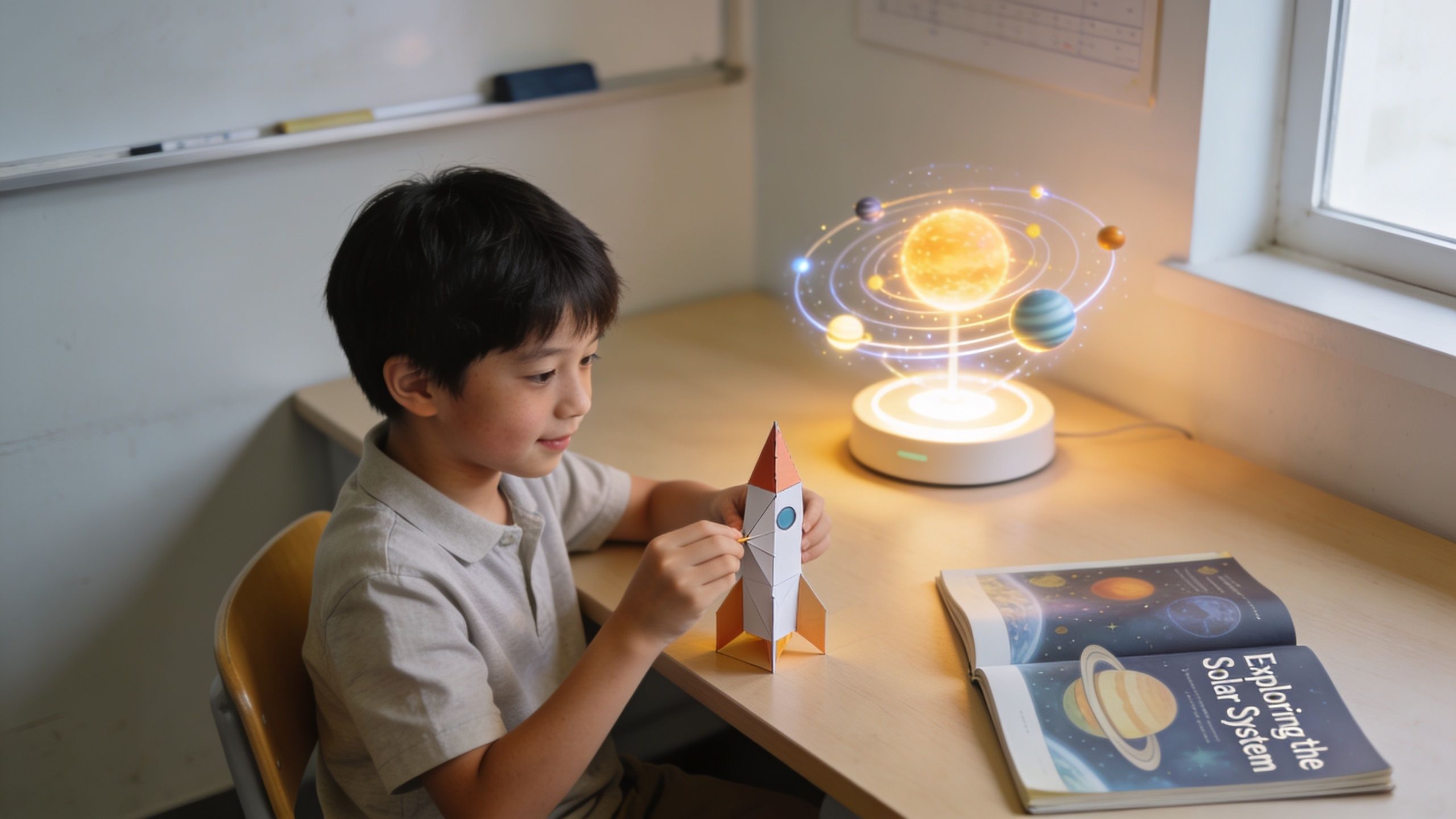
Alt text: child enjoying questions about space with rocket craft and solar system model
How do you turn a child's question about rockets or planets into real STEM learning without draining the fun out of it?
Start with the part children already bring naturally. Wonder. Space gives you a built-in story world full of motion, mystery, distance, danger, discovery, and brilliant machines. That makes it one of the easiest subjects for parents and teachers to use when they want science to feel alive rather than dry.
The teaching goal is simple. Catch the question, then turn it into an investigation.
A child asks, “Why do astronauts float?” That can become a quick prediction, a drawing, a role-play, or a small experiment with objects moving through air. In a few minutes, you are no longer giving a fact to memorise. You are helping a child behave like a scientist by noticing, guessing, testing, and explaining.
Stories help because they give ideas a job to do. If Fred is drifting away from his spacecraft, children suddenly care about force, movement, direction, and problem-solving. The science stops being a list of terms and starts working like a toolkit. It is a bit like teaching vocabulary through a favourite bedtime story. The words stick because they matter to the action.
Start with a question, then build the science
Many adults make space harder than it needs to be by starting with the biggest words first. Children usually learn better in the opposite order. Experience first. Explanation second. Vocabulary third.
A simple pattern works well at home, in class, or at the library:
- Ask a vivid question: “What would happen if you jumped on the Moon?”
- Let children predict: welcome bold, odd, half-right answers
- Test or model the idea: use balls, torches, paper rockets, toy astronauts, or your own bodies
- Add the scientific word last: “gravity”, “orbit”, “surface”, or “force”
That order matters. It gives children something to attach the new word to.
For adults who want a clearer picture of how these subjects fit together, this guide to what STEM learning means for children in practice is a useful starting point.
Space also makes STEM feel broader and more human. A single topic can include measuring, building, drawing, reading, designing, teamwork, and explaining ideas aloud. One child may love the numbers. Another may love the craft table. Another may want to invent a rover and tell you its backstory. All three are learning.
That is one reason space works so well as a teaching theme. It lets you meet children where they are, then stretch their thinking a little further.
For parents and teachers, the primary win is confidence. You do not need every answer ready. You need a strong opening question, a few simple materials, and permission to explore alongside the child. In space education, “Let's find out” is often the best sentence in the room.
2. What Are the Most Effective Ways to Introduce Astronomy Concepts to Primary School Children?
Astronomy lands best when it starts close to home. Before children think about galaxies, let them notice the sky above the playground, the shape of the Moon, or how shadows change through the day. If they can observe it, they can talk about it. If they can talk about it, they can begin to understand it.
Keep the sequence simple. Day and night first. Then the Moon. Then stars and planets. Then the idea that space is much bigger than what we can see.
Move from familiar to far away
A child who has watched sunset already has the foundation for discussing Earth's rotation. A child who has noticed the Moon changing shape can begin to understand patterns and cycles.
Use ordinary objects. A lamp can be the Sun. A ball can be Earth. A smaller ball can be the Moon. Suddenly, “orbit” stops being a tricky word and becomes something children can watch.
After a simple model, a short video can help children picture the scale more clearly.
Some of the biggest questions about space come when children ask whether the universe goes on forever. That's a brilliant teaching moment. You don't need a final answer. You can explain that scientists can observe part of the universe, but some of the biggest ideas are still being explored. Child-friendly teaching often improves when adults are willing to say, “We know some of this, and some of it is still a mystery.”
Some space lessons should end with curiosity, not closure.
A constellation activity also works well here. Let children join dots, invent shapes, and then compare their ideas with named constellations. It mixes pattern spotting, storytelling, and observation in one go.
3. How Does Space Exploration Inspire Creativity and Problem-Solving in Young Minds?
What happens in a child's mind when you ask, “Our rover is stuck on Mars. What should we try now?”
You often get much more than a science answer. You get inventing, testing, debating, sketching, storytelling, and revising. That is one reason space works so well in teaching. It gives parents and teachers a setting where big problems feel exciting rather than intimidating.
Space exploration is full of real puzzles. Astronauts need air, water, food, shelter, power, and a way to fix things when help is far away. For a child, that turns abstract STEM ideas into a mission with a purpose. A question like “How do plants grow in space?” can lead into light, roots, materials, and observation. A question like “How do astronauts talk to Earth?” opens the door to signals, distance, patience, and teamwork.
Stories make this easier to teach.
When Fred and Zando run into trouble, pause before the story gives the answer. Ask, “What would your team do first?” Some children will suggest a sensible engineering plan. Others will offer sticky tape, snacks, or a friendly robot. Start there. Creative problem-solving begins with producing possibilities, then sorting which ideas are useful, safe, or worth testing.
A good adult question is often better than a quick adult explanation.
Try setting up a simple mission challenge at home or in class:
- Mission problem: “Your spacecraft has landed, but one wheel is stuck.”
- Limit: “You may only use paper, string, and two cups.”
- Goal: “Work together to design a rescue plan, then explain why it might work.”
That format helps children practise several habits at once. They plan before acting. They cope with limits. They listen to other people's ideas. They discover that getting stuck is part of solving hard problems, not proof that they have failed.
That matters far beyond space.
Teachers and parents can also connect these challenges to everyday life by explaining that ideas developed for space often lead to useful tools and inventions on Earth. The point for children is simple and powerful. Curious questions can turn into practical solutions that help real people.
If you want more ways to connect imaginative storytelling with scientific thinking, this guide to why creativity and STEM belong together offers helpful ideas for turning one space question into a whole learning adventure.
4. What Role Does Play and Imagination Play in Learning About Space?
Play is not a break from learning. For many children, play is how learning happens.
A cardboard box becomes a lunar rover. Sofa cushions become an asteroid field. One child becomes the captain, another becomes mission control, and someone always insists on being the alien who steals the sandwiches. In the middle of all that, children are sequencing events, using new vocabulary, negotiating roles, and testing ideas.
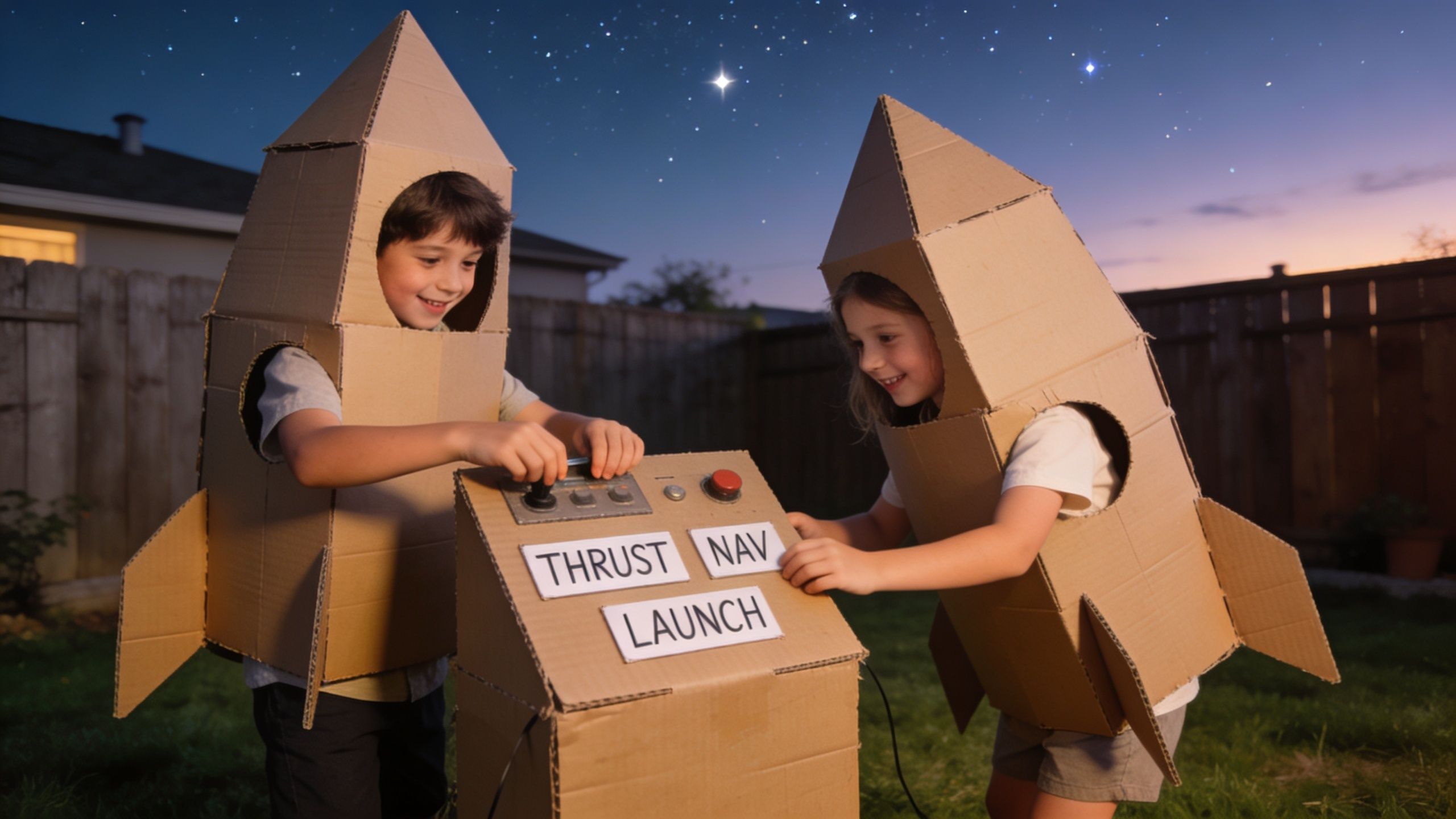
Alt text: children using imaginative play to explore questions about space
Build a mini mission control
You don't need expensive kit. A strong play setup can be very simple:
- Create a base: Use a table, corner, or reading nook as mission control
- Add loose parts: Cardboard tubes, foil, tape, paper, buttons, clipboards
- Give a prompt: “A storm is coming on Planet Zog. What does the crew need?”
- Leave room for invention: Don't over-direct it
Children often reveal understanding through play before they can explain it formally. A child pretending to check oxygen levels may not define “atmosphere” yet, but they're beginning to understand that living in space means meeting certain conditions.
Adults can watch for the menturity layer. I think. I try. I can. I can explain. That sequence matters. First comes thought. Then action. Then confidence. Then language.
Play gives children a safe place to test big ideas.
If you're a teacher or librarian, this is also useful evidence. Space role-play encourages speaking, listening, collaborative learning, and narrative development, all while keeping science alive and playful.
5. How Can Parents and Teachers Support Space Interest Without Needing Expertise?
What if the best way to teach space is not to have all the answers, but to model how to look for them?
That idea reassures many adults. Children do not need a walking encyclopaedia beside them. They need someone who will listen carefully, treat their questions seriously, and help them follow the thread. In practice, your role is closer to a mission guide than a professor. You help choose the route, gather the tools, and keep the excitement alive.
One sentence can change the whole tone of a conversation: “I'm not sure yet. Let's find out together.”
That reply does two useful things at once. It keeps the child's curiosity open, and it shows that learning is an active process. A child who hears this often begins to see questions as starting points rather than tests.
Turn questions into small investigations
A “wonder journal” works well at home, in class, or in a library group. Use one notebook for real questions children ask, then return to them one by one. The journal becomes a record of thinking, not just a place for right answers.
You might collect questions such as:
- Why does the Moon change shape?
- Could people live on Mars?
- What is a shooting star?
- Is there an edge to space?
Then slow the process down. Pick one question. Read a page together. Look at a picture or diagram. Watch a short, age-appropriate clip if it helps. Ask the child to draw what they now think is happening. This works like building a rocket in stages. First comes the frame, then the fuel, then lift-off.
Many adults worry that they are “behind” if they do not already know which app, book, or activity to choose. That worry is common, especially in schools where staff are still testing different ways to bring science topics to life. You do not need expert status to begin. You need a clear next step.
Keep a simple routine
Children learn well from repeated patterns, especially when the topic feels huge. Space is full of scale, distance, and strange vocabulary, so a steady routine helps make big ideas feel manageable.
Try this four-part pattern:
- Notice the question: Pause and show that it matters
- Choose one helpful resource: A book, image, model, sky map, or short video
- Talk it through: Ask what the child sees, thinks, and wonders
- End with making: Draw, build, label, retell, or explain it to someone else
That final step matters because it reveals understanding. A child who builds the phases of the Moon from paper circles, or explains why astronauts float, is doing more than recalling facts. They are organising ideas into a form they can use again.
For parents and teachers, this is the encouraging truth. You do not need to be an expert in space science. You need curiosity, patience, and a few reliable habits that turn each question into a story-led piece of learning.
6. What Are the Best Resources and Tools for Teaching Space Science at Different Age Groups?
What helps a child grasp space best at their age and stage?
The answer is usually a mix, not a single perfect resource. A Reception child often needs pictures, rhythm, and movement to make an idea stick. A KS2 pupil may be ready for richer stories, labelled diagrams, and bigger questions such as why seasons change or how astronauts live in orbit. For parents, teachers, and librarians, the main task is choosing tools that fit the learner and the learning goal.
A good way to plan is to match each resource to what you want the child to do. If the goal is wonder, start with a story or a striking image. If the goal is understanding, add a model, diagram, or short explanation. If the goal is remembering, finish with something the child can make, sort, label, or retell. Space teaching works like using different lenses on a telescope. One lens helps children notice, another helps them focus, and another helps them see detail.
Choose resources by age, but also by purpose
For younger children, simple picture books, puppets, songs, and role-play help turn abstract ideas into something they can feel and act out. For KS1, it helps to bring in basic non-fiction, clear illustrations, and objects they can move around, such as foam planets or Moon phase cards. For KS2, widen the toolkit with chapter books, documentaries, star maps, research tasks, and practical challenges.
A useful space collection often includes:
- Narrative books: build curiosity, vocabulary, and emotional connection
- Non-fiction books: support facts, diagrams, and topic knowledge
- Hands-on materials: help children test, build, and compare ideas
- Digital tools: show movement, scale, and the night sky in ways print cannot
The strongest choices often work together. A child might hear a story about an astronaut, study a diagram of a rocket, then build one from recycled materials. That sequence matters. It moves learning from fascination to understanding.
A good resource does more than explain space. It gives a child a way to explore the idea for themselves.
If you are building a classroom, home, or library collection, aim for variety. Include fiction, non-fiction, comics, visual references, craft prompts, and a few browse-friendly books that children can dip into without needing to read from page one. Different children enter the subject through different doors, and that is good teaching, not a problem to fix.
7. How Can Space-Themed Learning Support Inclusive Education and Diverse Learners?
What if a child is curious about Saturn but finds long explanations hard to follow, noisy group work stressful, or writing their ideas down slow and tiring?
Space teaching can still meet that child beautifully. In fact, it often works especially well for inclusive teaching because the topic naturally invites many ways to learn, show understanding, and join in.
A good space lesson works like a mission with more than one route to the same destination. One child may grasp craters by hearing a short story. Another may need to press a ball into sand or drop pebbles into flour to see the shape form. Another may understand best after drawing the scene as a comic. The learning goal stays the same, but the path changes to fit the learner.
That shift matters for parents and teachers. Instead of asking, “Can this child do the activity?” it helps to ask, “How can I redesign the activity so the big idea is reachable?” Space questions are perfect for this approach because they begin with wonder. Wonder gives every child a place to start.
Start with a shared question, then widen the ways in
A simple question such as “Why does the Moon look different each night?” can lead to talk, movement, model-making, picture sequencing, audio description, or role-play. That gives children options without lowering expectations.
Helpful adjustments include:
- Offer more than one way in: short read-alouds, visuals, objects, and demonstration
- Keep the core idea clear: teach one main concept at a time, with simple instructions
- Let children respond in different formats: speech, pointing, drawing, building, labelling, or acting
- Use repetition with variety: revisit the same idea through story, experiment, and discussion
- Build in thinking time: some children need longer to process before answering
Representation matters too. Space is a powerful theme for showing that science is a team effort, with room for different strengths, backgrounds, and communication styles. A mission needs coders, engineers, medics, designers, problem-solvers, storytellers, and careful observers. That helps children see that there is no single “science type”.
For adults choosing materials, story-led resources can support inclusion especially well because they carry facts inside characters, plots, and problems children can follow. A collection of children's science fiction books that blend adventure with science ideas can give hesitant readers, imaginative learners, and confident talkers a shared starting point.
In classrooms, libraries, and at home, inclusive space teaching sends a quiet but powerful message. You belong here. Your questions count. And there is more than one good way to explore the universe.
8. How Can Reading About Space Adventures Improve Literacy While Teaching Science?
What happens when a child meets a black hole first as part of a gripping story, rather than as a definition in a textbook?
Very often, they want to keep reading.
That matters for parents and teachers because story can carry two kinds of learning at once. A well-chosen space adventure builds reading fluency, vocabulary, inference, and discussion skills while also introducing ideas such as gravity, planets, habitats, and survival in extreme environments. Children follow the plot, but along the way they are also collecting scientific understanding.
Stories help because they give facts a home. A word like atmosphere is easier to remember when a character needs one to breathe on a distant world. Orbit makes more sense when a spacecraft must circle safely instead of flying straight in. The science stops feeling like a cold list of terms and starts behaving like part of the action.
For adults teaching the topic, the primary question is often not, “Should I use fiction?” but, “How do I use it well?” A simple approach works best. Read a short section aloud, pause at a moment of tension, then ask one clear question: “What science idea is hiding in this scene?” That turns reading time into science talk without making the story feel like a test.
A few teaching moves work especially well:
- Pre-teach two or three key words: choose words children will meet in the story, such as crater, gravity, or galaxy
- Pause for meaning, not just plot: ask why a spaceship must land carefully, or why a moon might be icy
- Use retrieval after reading: invite children to retell the adventure using the new science vocabulary
- Follow the story with a practical task: label a planet, design a rover, or write a captain's log
- Compare fiction with fact: ask which parts could happen in real space, and which parts belong to the adventure
This method helps adults teach with confidence, even if they do not see themselves as science specialists. The story provides the context. Your questions provide the bridge.
Book choice matters too. The strongest titles for this kind of learning do not bolt facts onto the side of an adventure. They weave ideas into the problem the characters must solve. If you want examples, this guide to children's science fiction books that blend adventure with science ideas is a useful starting point for choosing texts that support both literacy and curiosity.
One more tip is easy to miss. Let children talk before you ask them to write. Oral rehearsal helps them sort out the science, remember the sequence of events, and borrow useful vocabulary from the story. For many children, especially reluctant writers, that conversation is the runway that gets the writing off the ground.
Reading about space adventures does more than entertain. It gives adults a practical, enjoyable way to teach science through narrative, build stronger readers, and show children that every big question about the universe can begin with a page turn.
9. What Real-World Space Careers Can Inspire Children's Future Aspirations?
What if a child who says, “I want to work in space,” does not need to become an astronaut at all?
That question helps adults open the subject in a much richer way. Space work includes people who build, test, heal, explain, calculate, design, repair, organise, and stay calm when plans change. A mission works like a school production or a football team. The person in the spotlight matters, but the whole effort depends on many skilled people doing different jobs well.
Alt text: diverse careers linked to questions about space and STEM futures
Help children see the full team
Children often start with the visible role. Adults can widen the picture by naming the jobs behind the mission and linking them to strengths a child already recognises in themselves.
- Mission control: people who plan flights, monitor systems, communicate clearly, and make careful decisions
- Engineers and technicians: people who design, build, test, and fix spacecraft, satellites, robots, and tools
- Scientists and analysts: people who study planets, stars, weather, rocks, and the streams of data missions send back
- Health and support specialists: doctors, fitness experts, food scientists, trainers, software developers, teachers, and safety teams
This approach matters because career conversations can become a teaching tool, not just a daydream. If a child loves drawing, talk about spacecraft design. If they enjoy solving puzzles, mention coding or mission planning. If they are caring and practical, discuss space medicine or life-support systems. You are showing them that interest in space can grow through many talents, not one narrow path.
Turn career talk into classroom and home learning
A useful question is, “What job would help this mission succeed?” Try it after a story, a Moon activity, or a short video clip. If children are learning about Mars rovers, ask who had to design the wheels, write the software, choose the landing site, and check the robot was safe to use. That shifts the conversation from hero worship to teamwork and problem-solving.
You can make this even more concrete with simple role cards. One child becomes the engineer, another the communicator, another the medic, another the scientist. Then give the group a mission problem such as a broken solar panel or a dusty landing site. Children begin to see careers as real jobs with real tasks.
That is often the moment aspiration becomes believable.
Space also feels more exciting when adults present it as a living field. New missions, satellite work, Earth observation, robotics, and communications all show children that space is part of modern life, not only the history of moon landings. As noted earlier, current activity in the sector helps make that point. The key teaching move is to connect each mission to the people behind it.
A final tip for parents and teachers is simple. Replace “Do you want to be an astronaut?” with “What kind of problem would you like to solve in space?” One question narrows the future. The other gives children room to grow.
10. How Can Technology and Digital Tools Enhance Space Learning Without Replacing Books and Hands-On Activities?
What can a screen do in space learning that a book, a biscuit tin rocket, or a look at the evening sky cannot?
Quite a lot, if you give each one the right job.
Digital tools are strongest when they reveal motion, scale, and change over time. A child can watch planets orbit, follow a spacecraft's route, or turn the night sky to match the season. Books do a different kind of work. They slow the pace, build vocabulary, and make room for questions. Hands-on activities add the missing piece. They let children test ideas with their own eyes and hands.
That balance matters for parents and teachers. The goal is not more screen time. The goal is better learning time.
A useful rule is simple. Use technology to show what is hard to see, then switch to something physical or verbal so the idea sticks. If an app shows why the Moon seems to change shape, follow it with Oreo Moon phases, a torch-and-ball demonstration, or a quick sketch in a notebook. If a planetarium tool shows constellations, step outside later and ask children to spot one bright star or shape for themselves.
Digital tools work like a telescope. They extend experience. Books, discussion, and practical activities turn that experience into understanding.
For adults teaching space, this is often the most helpful planning question: what is the learning job here? If the job is visualising scale, use an animation. If the job is building scientific language, read aloud and pause to explain words. If the job is checking understanding, ask the child to make, draw, or explain something without the screen.
A balanced routine can be very simple:
- Start with a story or question: Give the topic meaning and spark curiosity
- Add one digital tool: Show movement, scale, or a view children could not easily get otherwise
- Move into a hands-on task: Build, draw, sort, act out, or observe
- Finish with talk: Ask the child to explain what they noticed and what surprised them
This approach also helps adults who do not see themselves as “space experts”. You do not need to know every fact about Saturn or satellites. You need a clear sequence. Story first. Visual support next. Practical follow-up after that. Children learn well when each step has a purpose.
As noted earlier, printable activities and story-led prompts can support this balance well. The strongest space lessons rarely come from one tool on its own. They come from a thoughtful mix of seeing, reading, making, and talking.
10-Question Space Learning Comparison
| Topic | Implementation complexity | Resource requirements | Expected outcomes | Ideal use cases | Key advantages |
|---|---|---|---|---|---|
| How Can Space Education Make STEM Learning Fun for Children? | Moderate, needs storytelling design and teacher facilitation | Quality multimedia, hands-on kits, teacher training | Higher engagement, improved retention, increased curiosity | Early primary classes, assemblies, after-school clubs | Makes abstract STEM tangible; boosts motivation |
| What Are the Most Effective Ways to Introduce Astronomy Concepts to Primary School Children? | Low–moderate, progressive lessons and guided observation | Visual aids, planetarium apps, outdoor observation tools | Foundational astronomy knowledge; observational skills | Science lessons, night-sky events, planetarium visits | Connects learners to real phenomena; builds spatial reasoning |
| How Does Space Exploration Inspire Creativity and Problem-Solving in Young Minds? | Moderate, requires problem-based activities and facilitators | Challenge materials, maker-space tools, narrative prompts | Improved creative thinking, systems-thinking, resilience | Project-based learning, STEM clubs, maker sessions | Models real-world problem solving; encourages innovation |
| What Role Does Play and Imagination Play in Learning About Space? | Low, needs open-ended materials and adult facilitation | Costumes, props, blocks/LEGO, play spaces | Stronger engagement, social skills, deeper concept internalization | Early years, play-based curricula, informal learning settings | Intrinsically motivating; supports social and cognitive development |
| How Can Parents and Teachers Support Space Interest Without Needing Expertise? | Low, uses curated prompts and co-exploration strategies | Curated guides, apps, community resources, simple kits | Increased adult confidence, shared inquiry, sustained child interest | Home learning, beginner classroom activities, parent workshops | Low barrier to entry; models lifelong learning and curiosity |
| What Are the Best Resources and Tools for Teaching Space Science at Different Age Groups? | Moderate, requires curation and curriculum alignment | Diverse formats (books, apps, kits), updated resource lists | Age-appropriate progression; efficient lesson planning | Curriculum design, resource libraries, differentiated instruction | Saves time; ensures scaffolded, multi-modal learning |
| How Can Space-Themed Learning Support Inclusive Education and Diverse Learners? | High, needs intentional UDL design and ongoing evaluation | Multiple formats, assistive tech, teacher training, budgets | Greater accessibility, equity, increased belonging and participation | Diverse classrooms, special education, inclusive programs | Benefits all learners; reduces achievement gaps |
| How Can Reading About Space Adventures Improve Literacy While Teaching Science? | Low–moderate, select quality narratives and link activities | Book series, guided-reading plans, extension activities | Improved literacy, vocabulary growth, motivated reading | Literacy lessons, reading interventions, library clubs | Combines literacy and science gains; engages reluctant readers |
| What Real-World Space Careers Can Inspire Children's Future Aspirations? | Moderate, needs guest access and career-mapping activities | Guest speakers, career resources, multimedia profiles | Broadened career awareness; clearer STEM pathways | Career days, upper-primary guidance sessions, assemblies | Shows diverse pathways; links school subjects to real jobs |
| How Can Technology and Digital Tools Enhance Space Learning Without Replacing Books and Hands-On Activities? | Moderate–high, requires integration strategy and management | Apps, VR/AR, devices, connectivity, teacher training | Immersive experiences, personalized learning, extended access | Blended lessons, remote learning, supplementing field trips | Enables otherwise impossible experiences; supports personalization |
Your Next Mission Spark a Lifelong Love of Learning
The best answers to children's questions about space don't always sound like polished mini-lectures. Often, they sound like this. “Let's test it.” “What do you notice?” “Why do you think that happened?” “Shall we find out together?”
That's the heart of good space teaching.
Children don't need every mystery solved straight away. They need adults who welcome their curiosity and give it somewhere to go. A bedtime story can become a science conversation. A library display can become a launchpad for reading. A classroom role-play corner can become mission control. A question about Mars can become a lesson in inference, vocabulary, teamwork, drawing, speaking, and scientific thinking all at once.
Space is especially powerful because it naturally combines wonder with structure. It invites children to imagine wildly, then test carefully. It helps them say, “I think.” Then, “I'll try.” Then, “I can.” Then finally, “I can explain.” That progression builds confidence far beyond science.
It also helps to remember that space is not some dusty old topic locked in the past. It is active, collaborative, and strongly connected to life on Earth. Children can see themselves in it. Not only as astronauts, but as readers, makers, coders, artists, engineers, question-askers, and brave little problem-solvers.
If you're a parent, start small. Read one story. Look at the Moon tonight. Keep a wonder journal by the kettle. If you're a teacher, choose one strong prompt and let talk do the heavy lifting. If you're a librarian, pair a display of books with a simple mission challenge and let children enter the topic through play.
And if you want help making that journey more lively, humorous, and story-led, Space Ranger Fred gives you an easy way in. The books, activities, and school experiences are designed to make STEM feel warm, accessible, and exciting for children aged 6 to 12.
Learning should be experienced, not just delivered.
If you're ready to turn questions into adventures, explore Space Ranger Fred for story-rich books, playful STEM ideas, downloadable activities, and interactive school visits that build reading, confidence, communication, and curiosity.