
You’re probably here because a child asked one of those brilliant questions that sounds simple at first.
Why does a feather drift down while a conker drops like a tiny cannonball?
That question leads straight into one of the coolest ideas in science. If you can define terminal velocity in a way a child understands, you reveal much more than one tricky phrase. You open the door to forces, motion, experiments, and the joy of saying, “Ohhh, now I get it.”
What Goes Up Must Come Down But How Fast
Fred opens the cargo hatch over Planet Fluffernut. Out slips a science package, a leaf from a snack tree, and Zando’s shiny little tool pouch. All three head downward. All three fall differently.
That is the part that grabs a child’s attention.
A raindrop falls. A hailstone falls. A leaf falls. Yet each one has its own style. One drops straight down. One swirls. One seems to hang in the air for a moment, almost like it is deciding what to do next.
Children spot this quickly at home too. Drop a pencil and a scrap of paper together, and you do not get matching races. The pencil shoots down. The paper flutters and twists as if the air is putting up a fuss.
That is why this question matters. Children are really asking what controls the speed of a fall.

Two objects, two very different falls
A feather and a conker both move toward the ground, but they do not travel the same way.
The conker is small and solid. It slips through the air more easily. The feather spreads out, catches the air, and gets pushed around. Children may not know the science words yet, but they can already spot the big clue. Shape changes how something falls.
A good classroom habit is to ask, “What does the air have to push against?” A flat, wide object usually feels more push from the air than a compact one. If you want a simple refresher on the downward pull itself, this guide to gravity explained for kids helps set the stage.
Fred knows this on Planet Fluffernut. If he drops the wrong package shape, it could zoom down too fast. If he adds a wide flap or a tiny parachute, the package may drift down more gently. That turns a textbook idea into a mission problem kids can picture and test for themselves with paper, cupcake cases, or coffee filters.
Parents and teachers often meet this kind of puzzle in simple homework discussions, and these common forces questions and answers show how children start connecting everyday observations to science.
The question kids really want answered
They want to know why one object plummets while another seems to float.
That curiosity is the perfect starting point for terminal velocity. It helps explain why falling objects do not keep getting faster forever, and why the air matters much more than many children first expect.
Fred would say it like this. “I think this one will fall faster. I try it. I can explain what happened.”
That is real science.
Meet the Forces Gravity and Drag
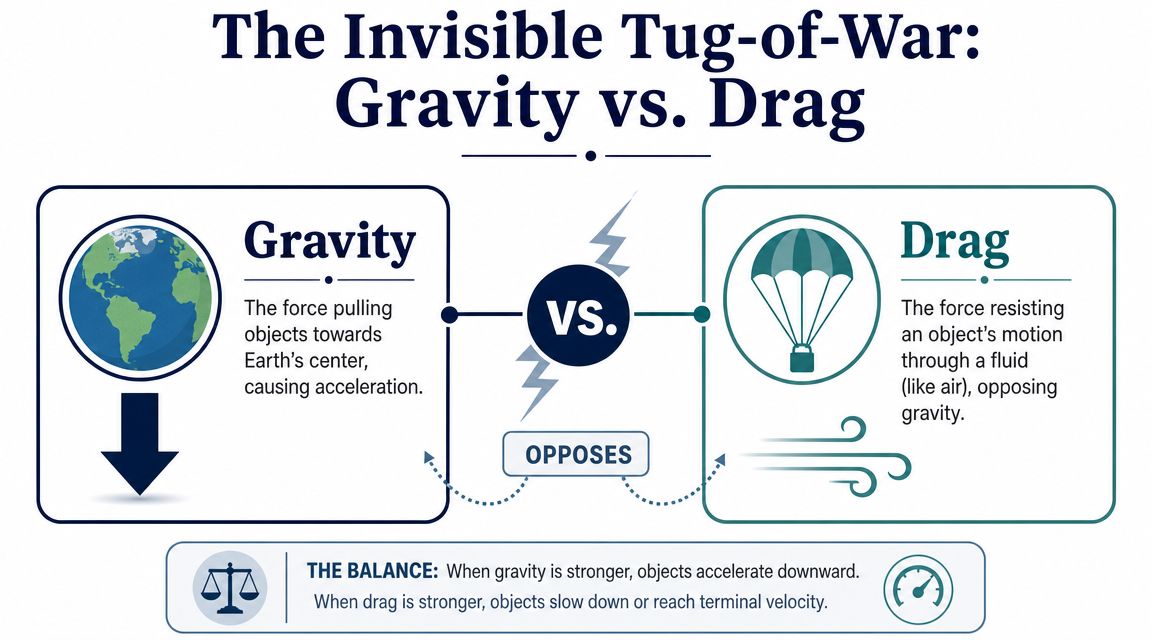
Fred opens the cargo hatch on Planet Fluffernut and drops two supply packs. Gravity grabs both right away. The air pushes back on both too, but not equally, and that push is the part many kids miss at first.
Gravity is the pull
Gravity pulls falling objects downward the whole time. It does not get bored. It does not switch off halfway down.
If your child wants a simple refresher on that downward pull, this guide to gravity explained for kids fits nicely here.
At the beginning of a fall, gravity has the clear advantage, so the object speeds up. That part feels familiar because we see things drop every day.
Drag is the push back
Drag is the air’s push against motion. As a falling object moves faster, that push gets stronger.
Water gives a good clue. Running through a pool is harder than running on dry ground because the water resists your motion. Air does the same kind of job, just more gently, so we do not always notice it until we compare different objects.
Fred notices it fast. A compact tool case drops with a strong whoosh. A package with wide paper fins or a shape that cuts through the air less easily gets more push from the air and slows down more.
What the tug-of-war looks like
A simple way to track the falling object is to watch which force is winning.
- Right after release: Gravity is stronger, so the object speeds up.
- As it falls faster: Drag grows.
- After a bit more time: Drag can grow enough to match gravity.
When the forces match, the speed stops changing and becomes steady. That idea connects neatly to balanced and unbalanced forces, which is why it shows up so often in class discussions and homework. If you want extra practice language for those conversations, these common forces questions and answers can help.
Helpful rule to remember: Unbalanced forces change speed. Balanced forces keep the motion steady.
That is the key moment Fred watches for on every delivery mission. First he thinks. Then he tries. Then he can explain why the fall changed.
So What Is Terminal Velocity
Here’s the clean, memorable definition.
Terminal velocity is the steady speed a falling object reaches when gravity pulling down is exactly balanced by drag pushing up.
At that point, the object stops accelerating. It doesn’t stop falling. It just stops getting faster.
That’s the part children often mix up.
It is not “no gravity”
Gravity is still acting.
The object is still moving downwards. The difference is that drag has grown enough to match the weight, so the net force becomes zero. In technical physics, that’s why acceleration becomes zero.
If your child likes linking ideas across science topics, this post on what is the atmosphere helps explain the air around us, which matters because drag comes from moving through a fluid such as air.
What changes terminal velocity
Not every object has the same terminal velocity.
According to Science Facts on terminal velocity, the fastest speed an object can fall depends on its mass, its cross-sectional area, and its drag coefficient, which describes its resistance to air. That’s why a bowling ball and a beach ball of the same size behave so differently.
A child doesn’t need the full maths to understand the pattern:
| Factor | What usually happens |
|---|---|
| More mass | The object tends to have a higher terminal velocity |
| Larger area | The object tends to have a lower terminal velocity |
| More streamlined shape | The object tends to have a higher terminal velocity |
So if Fred wants the science package to land gently, he needs more drag. A wider shape helps. A parachute helps even more.
Spotting Terminal Velocity in Your World
Space Ranger Fred is hurrying across Planet Fluffernut when he sees three things falling at once. A raindrop, a seed pod, and a supply pack all head downward. They do not fall the same way, and that is your clue that terminal velocity is happening all around you.
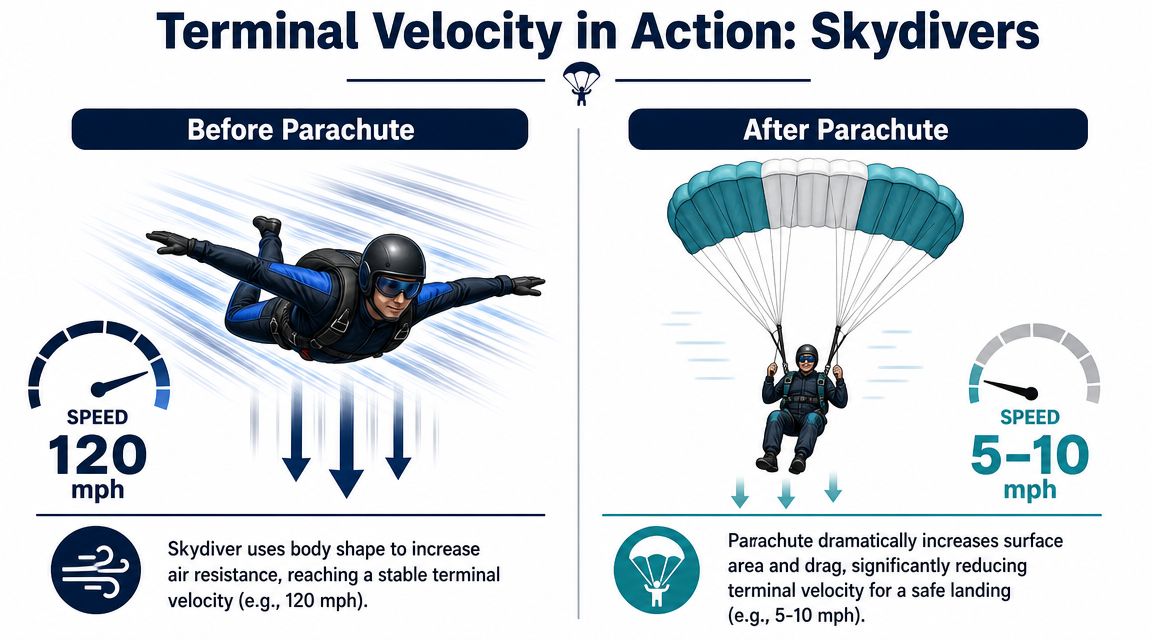
A skydiver is one of the easiest real-world examples to spot. At first, the diver speeds up as they fall. After a short time, the fall looks steady instead of faster and faster. Then the parachute opens, the diver suddenly meets a lot more air resistance, and a new, much slower steady speed appears.
Why raindrops are not tiny meteors
Children ask great questions, and this one deserves applause.
“If raindrops fall from clouds, why don't they hit us like little rocks?”
The answer is that raindrops are small and light, so air pushes back on them very effectively. They settle into a gentle falling speed long before they reach the ground. That is why rain feels splashy, not stingy.
A big, heavy object can keep gaining speed for longer before the air push becomes strong enough to balance things out. A tiny droplet reaches that balance much sooner.
Everyday clues you can spot
You can see the same idea at home, at the park, or on a walk to school.
- A flat sheet of paper wobbles and drifts down.
- The same paper crumpled into a ball drops much faster.
- A dandelion seed, seed pod, or paper helicopter hangs in the air and comes down gently.
Each one falls through the same air. Each one handles that air differently.
That is the part many children love. Terminal velocity is not one special speed for everything. It is the steady falling speed that fits that object's shape, size, and weight.
Back to Planet Fluffernut
Fred studies the science package again. The air on Planet Fluffernut is thick and gloopy, almost like flying through invisible soup. Zando grins and says, “So we do not want fast. We want floaty.”
Exactly.
A wide package catches more air. A parachute catches even more. Fred is using the same science you can spot in a falling leaf or a skydiver drifting safely to Earth.
If your young scientist wants more hands-on ideas after noticing these falling clues, try these fun science activities for kids.
Try a Terminal Velocity Experiment at Home
You don't need a laboratory. You need a safe space, a few simple materials, and a child willing to say, “Let's test it.”

The coffee filter challenge
You'll need:
- Two coffee filters
- A place to drop them safely
- A notebook or scrap paper for predictions
Do this first.
- Hold one coffee filter flat.
- Crumple the other into a tight ball.
- Drop them at the same time.
Most children notice the crumpled one falls faster.
Why? The flat filter has more area facing the air, so it gets more drag.
Make it a fair test
Now try a better scientist's question.
What happens if you change the mass but keep the shape similar?
- Stack coffee filters together without changing their shape too much.
- Drop one filter and then a small stack.
- Watch which falls faster.
This helps children see that falling speed depends on more than one thing. Shape matters. Mass matters too.
A larger surface area creates more drag and slows an object down, which is why classroom activities like parachutes and paper helicopters are such a strong way to teach the core idea, as noted in Wikipedia's overview of terminal velocity.
For more hands-on ideas, browse these fun science activities for kids.
Questions to ask during the experiment
- What do you think will happen first?
- What changed, shape or mass?
- Which object seemed to settle into a steady fall?
- How could you slow it down even more?
Those questions build the lovely learning ladder:
- I think
- I try
- I can
- I can explain
A short video can help children visualise the idea before or after their own test.
“I changed the shape, so I changed the drag.”
That sentence is a big win. It means the child isn't just watching. They're reasoning.
If you'd like printable ideas for rainy-day science, classroom tasks, or home learning, the freebies and activities page is a good next stop.
You Are Now a Terminal Velocity Expert
Space Ranger Fred has reached the end of today's mission, and now he turns to the crew and asks, “Can you explain why some things zoom down while others drift?”
You can.
Terminal velocity is the steady speed a falling object reaches when gravity pulling down and air drag pushing up are equal. The object keeps falling, but its speed stops increasing.
That small idea explains a lot of big things. It helps children make sense of parachutes, raindrops, seed pods, paper helicopters, and the difference between a flat sheet of paper and a crumpled one. It also gives them a clear picture of balanced forces they can see, test, and talk about.
One part can still feel tricky.
A falling object does not start at terminal velocity. First it speeds up. As it moves faster, the air pushes back more strongly. Soon the push of drag grows enough to match the pull of gravity, and the speed levels off. As noted earlier, that is why the first part of a fall changes more than the later part.
A good way to make the learning stick is to let your child become the teacher for a minute at the dinner table, on the sofa, or during bedtime story time with Space Ranger Fred nearby.
They could explain it like this:
- Gravity pulls the object down
- Air drag pushes against the motion
- The drag gets stronger as the object speeds up
- When the two forces balance, the object falls at a steady speed
- That steady speed is terminal velocity
That is real learning.
A child who can say, “I changed the shape, so I changed the drag,” is doing more than repeating a definition. They are connecting an idea, a test, and an answer. That is the heart of science. I think. I try. I can.
If your young scientist can teach terminal velocity back to someone else, they really are a terminal velocity expert.