
Have you ever wondered what the speed of light is? Well, get ready for a mind-boggling fact: it’s the fastest anything can travel in the entire universe! Light zooms along at an incredible 299,792 kilometres per second (that's 186,282 miles per second). It’s so speedy that nothing can ever beat it in a cosmic race!
Just How Fast Does Light Travel?
Imagine a racing car so quick it could zip around the whole world more than seven times in a single second. That's how fast light is! Because it’s the ultimate champion of speed, it sets the universal speed limit for everything, from the tiniest particles to the biggest spaceships.
This amazing speed is a fundamental constant of nature—a rule that everything in the cosmos has to follow. Understanding it helps us get our heads around the enormous distances between planets and stars. It’s one of the most important numbers in all of science and a key piece of knowledge for any young explorer, just like our friend Space Ranger Fred!
A Quick Guide to Light Speed
To make this massive number a bit easier to grasp, let's break it down. Scientists often use the special symbol 'c' to represent the speed of light in their equations. Think of it as a handy shortcut for a very, very big number.
For parents and teachers, seeing the speed in different units can be a big help for explaining it to little ones. This quick table shows just how fast light moves, whether you prefer to think in kilometres or miles.
Light Speed at a Glance
Here’s a simple summary of light’s speed to help put its incredible velocity into perspective.
| Unit of Measurement | Speed |
|---|---|
| Kilometres per second | 299,792 km/s |
| Miles per second | 186,282 mi/s |
This shows just how far a beam of light can travel in the blink of an eye.
This incredible speed isn't just an abstract number; it has a real-world meaning. When we look up at the stars, we’re seeing light that has travelled for a very, very long time to reach our eyes. In a way, it means we’re actually looking back into the past!
Exploring the Universe's Ultimate Speed Limit
Now that we know just how fast light zips around, a brilliant new question pops up: can anything go even faster? It’s a fantastic thought, but the answer is a huge, universe-wide no. The speed of light isn’t just a record-breaker; it’s the absolute speed limit for everything in our universe.
Think of it like one of the most important rules in the cosmos, a law that everyone and everything has to follow. From the teeniest atoms to the biggest rockets Space Ranger Fred could ever dream of piloting, nothing with mass can ever reach the speed of light. It's a true cosmic boundary.
The Einstein Enigma
So, why is this speed limit even a thing? A very clever scientist named Albert Einstein figured this out more than a hundred years ago. He uncovered something amazing about how speed, mass, and energy are all tangled together, and his ideas completely flipped our understanding of the universe on its head.
To get your head around it, imagine you're pushing a toy spaceship. At first, it's easy to get it moving faster and faster. But Einstein realised that as an object with mass speeds up, it actually gets heavier! This isn't something we notice with cars or aeroplanes, but it becomes a massive deal as you get closer to light speed.
The closer something gets to the speed of light, the more energy it takes to speed it up. To actually reach light speed, an object with mass would need an infinite amount of energy—which is simply impossible!
This cosmic rule means that only things without any mass, like the particles of light themselves (called photons), can travel at this incredible speed.
A Universal Law
This isn't just a rule that applies here on Earth; it's a law for the entire universe. It’s one of the bedrock principles that shapes how everything works, from stars burning brightly to galaxies spinning in the vastness of space.
Let’s put it another way:
- The Faster You Go, the Heavier You Get: Imagine trying to push a bike that gets heavier with every single push. Eventually, it would become too heavy to move any faster.
- An Unreachable Finish Line: This means that no matter how much energy you pour in, you can only get closer and closer to the speed of light but never, ever quite touch it.
This universal law is something Space Ranger Fred has to remember on all his adventures. It explains why even the most advanced spaceships in science fiction stories have to find clever workarounds, like wormholes or warp drives, to travel those mind-boggling distances. They can’t just break the universe’s most important speed limit!
Racing Light Across Our Solar System
Now that we know the cosmic speed limit, let’s have a bit of fun with it!
Imagine we're cosmic posties, sending a super-fast message that travels at the speed of light to different places in our solar system. It’s a brilliant way to get your head around just how mind-bogglingly enormous space really is.
Even at its incredible pace, light still takes time to get from one place to another. The further away something is, the longer its journey. By timing these light-speed trips, we get a real sense of the epic distances involved in space exploration—something Space Ranger Fred thinks about all the time!
This fantastic illustration helps visualise some of the big ideas behind the universe's ultimate speed limit.
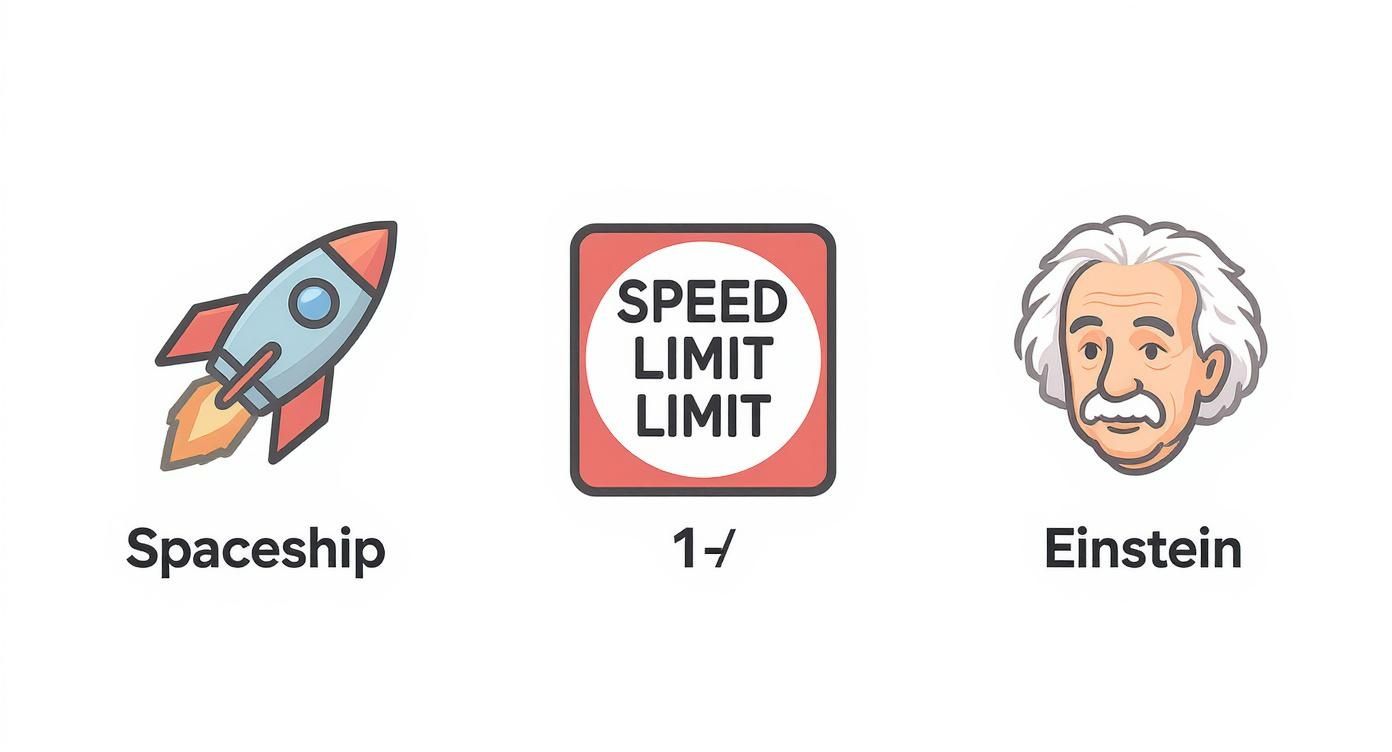
It’s a great reminder that even the fastest rocket has to play by the rules that Albert Einstein helped us understand.
A Cosmic Stopwatch
So, how long would our light-speed message take to arrive? Let's start a cosmic stopwatch and find out! The answer might just surprise you and really shows off the scale of our cosmic neighbourhood.
A trip to our closest pal in space, the Moon, is surprisingly quick. A beam of light zips there in just over a second! That’s faster than you can snap your fingers. But what about destinations much, much further away?
Light's Travel Time from Earth
This table shows how long it takes light, on average, to travel from our planet to a few famous spots in the solar system. It's important to remember these are just averages, as the distances are always changing while the planets orbit the Sun.
| Destination | Average Travel Time |
|---|---|
| The Moon | 1.3 seconds |
| The Sun | 8 minutes and 20 seconds |
| Mars | 12 minutes and 40 seconds |
| Jupiter | 43 minutes |
| Neptune | 4 hours and 15 minutes |
It's pretty mind-boggling when you think about it! When we peek at Jupiter through a telescope, we're actually seeing it as it was over 43 minutes ago. The light carrying that image has been travelling all that time just to reach our eyes.
These incredible travel times really highlight why understanding what is the speed of light is so important for astronomers and space explorers. It’s the ultimate ruler for measuring the universe.
You can learn more about these amazing places in our easy guide to the solar system. It helps put these huge distances and travel times into an even bigger picture, making our corner of the universe feel a little more familiar.
How Scientists First Clocked a Sunbeam
How on earth do you measure something that moves too fast to see? It sounds like an impossible riddle, but for hundreds of years, some very clever scientists have been chipping away at the answer. To find out how they did it, we need to hop in our time machine and meet the brilliant minds who first figured out how to put a number on the speed of a sunbeam.
Before anyone could measure it, they first had to prove that light even had a speed. For a very long time, most people assumed that when a light turned on, it appeared everywhere instantly. But thanks to a few curious thinkers, we now know it has a limit—a cosmic speed limit, if you will.
A Wobbly Starry Night
Our story begins not with a flash of light, but with a wobbly star. In 1728, a British astronomer named James Bradley was busy studying the stars. He wasn’t trying to measure the speed of light at all, but he noticed something strange: the stars seemed to shift their positions ever so slightly throughout the year. It was a tiny wobble, but Bradley knew it had to mean something.
He soon realised the wobble was caused by our own planet, Earth, hurtling through space as it orbited the Sun. This groundbreaking idea is called ‘stellar aberration’. It’s the way a star’s position seems to change because of our own movement. By measuring this tiny shift and knowing how fast the Earth was travelling, Bradley managed to calculate the speed of light with amazing accuracy. You can read more about his clever historical measurement methods and see how his work set the stage for modern physics.
Imagine you're standing perfectly still in the rain. The raindrops fall straight down on your head. But what happens if you start running? The rain seems to come at you from an angle. Bradley realised the exact same thing was happening with starlight! As Earth "ran" through space, the light from the stars appeared to hit his telescope at a slight angle.
A Brilliant Breakthrough
This was a massive ‘aha!’ moment for science. Bradley's work proved once and for all that the speed of light wasn't infinite. Better yet, he gave us one of the first reliable answers to the question, what is the speed of light? His calculation of around 301,000 kilometres per second was astonishingly close to the number we use today.
This journey back in time shows us that science is a thrilling adventure, built piece by piece by curious people asking big questions. It wasn’t just about having fancy equipment; it was about looking at the universe and thinking about it in a whole new way. This is exactly the kind of curiosity Space Ranger Fred loves!
Perfecting the Measurement with Spinning Mirrors
James Bradley’s starry discovery was a brilliant start, but scientists are a bit like detectives—they always want to get closer to the exact truth! Following his breakthrough, the race was on to nail down the speed of light with even more precision. This led to some wonderfully clever experiments right here on Earth, without needing to look at wobbly stars at all.
This new chapter in our story introduces a scientist named Albert A. Michelson, who came up with an ingenious idea involving mirrors. Not just any mirrors, though—spinning ones! His method was all about timing a beam of light on a return journey between two points, a bit like a super-fast game of catch.
Imagine standing on one mountain and pointing a torch at a mirror on another mountain miles away. Now, imagine that mirror is spinning incredibly fast, like a disco ball. You’d have to time it perfectly to catch the beam of light as it flashes back at you. That’s the basic idea behind Michelson's amazing work!
Getting the Numbers Just Right
By making the distance the light travelled incredibly long and measuring the mirror's spin with pinpoint accuracy, Michelson could calculate the speed of light with astonishing precision. He kept refining his experiments for decades, building on the work of others to get closer and closer to that perfect number.
Science is often like a team sport that plays out over many years. Each scientist adds their own discovery, helping the next person get a little bit further. It shows how important it is to learn from others and keep asking questions!
In one of his most famous experiments in 1926, he sent a beam of light on a 22-mile round trip between two mountains! Michelson’s work, which built upon methods first developed in Europe, became so accurate that his result was only about four kilometres per second different from the value we use today. You can learn more about how his spinning mirror methods improved earlier measurements and set a whole new standard for precision.
This incredible dedication shows how our understanding of the universe gets clearer with every new discovery. You can dive into more scientific adventures and mysteries with Space Ranger Fred’s exciting collection of books! It’s a wonderful reminder that every big answer starts with a little bit of curiosity.
Fun Hands-On Light Activities for Home
Exploring what is the speed of light is an amazing adventure, but you don’t need a fancy laboratory to start playing with light. You can become a light explorer right in your own home with a few simple and safe activities!
While we can’t exactly measure its mind-boggling speed with a stopwatch, we can definitely uncover some of its incredible properties. These hands-on experiments are perfect for a rainy day or a classroom project, turning tricky science concepts into memorable fun. Let's get our light adventure started!
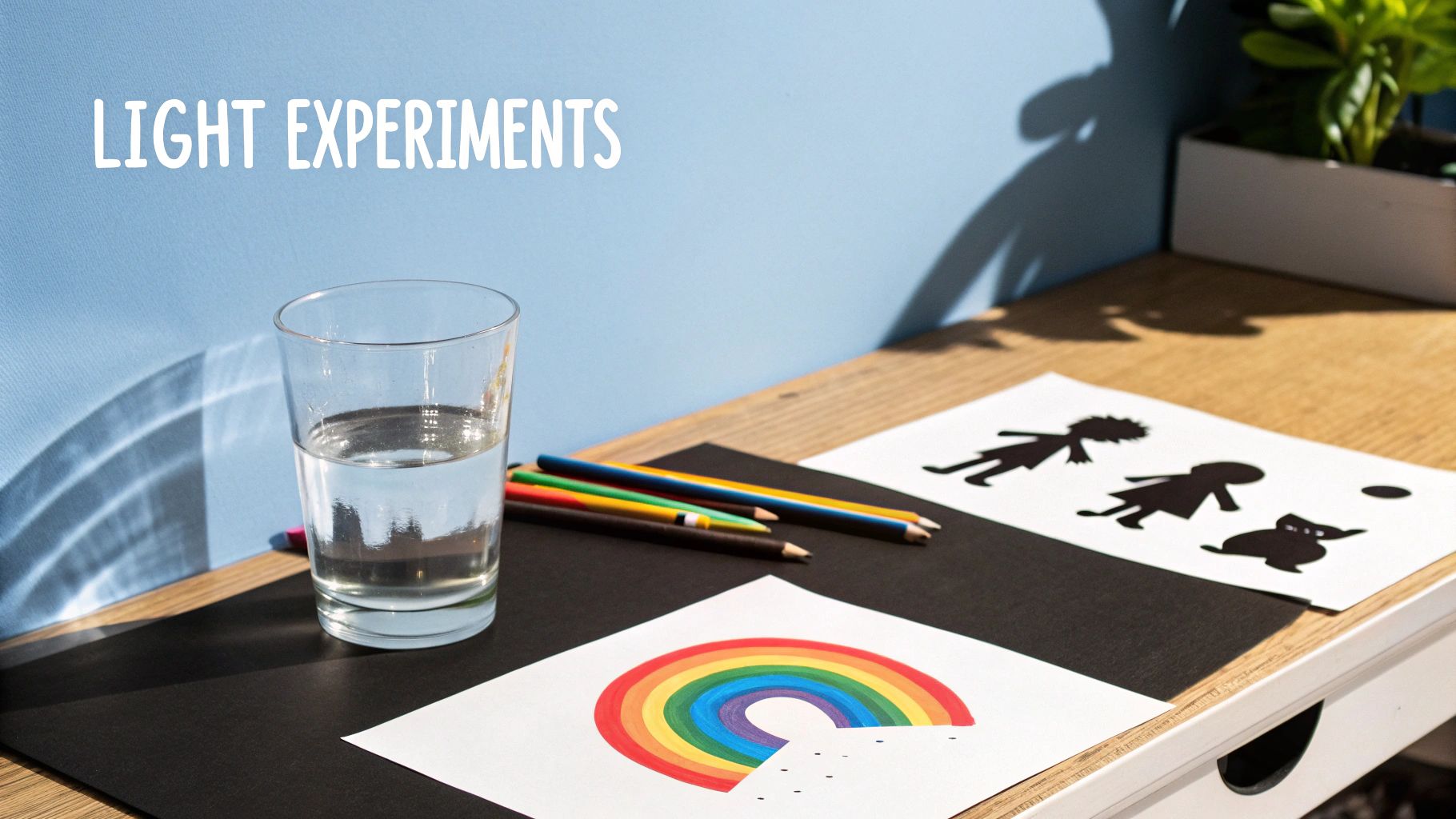
Activity 1: Make Your Own Rainbow
Did you know that plain white light is secretly hiding all the colours of the rainbow? This super simple experiment proves it!
You will need:
- A glass of water, nearly full
- A piece of white paper
- A sunny window or a strong torch
Instructions:
- Find a spot where sunlight is streaming through a window.
- Hold the glass of water up so the sunlight shines right through it.
- Place the white paper on the floor or a table, then move the glass around until a mini rainbow magically appears on the paper!
What's Happening?
When light travels from the air into the water, it actually bends and splits into its different colours. This cool effect is called refraction. Each colour bends at a slightly different angle, which spreads them out to create the beautiful rainbow spectrum you see.
Activity 2: Shadow Puppet Theatre
This classic is a fantastic and fun way to prove that light travels in perfectly straight lines.
You will need:
- A torch or a lamp
- A blank wall or a large piece of white card
- Your hands, or some cardboard cut-outs on sticks
Instructions:
- In a darkened room, shine the torch onto the blank wall.
- Hold your hands between the light and the wall to make different animal shapes.
- Try moving your hands closer to the light to make the shadows bigger, and further away to make them smaller.
What's Happening?
A shadow is just a place where an object has blocked the path of light. Because light zips along in straight lines, it can't just bend around your hands. The dark shape you see is an area where the light simply couldn't reach.
These simple experiments are a brilliant way to bring science to life. They show us the basic rules that light follows on its super-fast journey through the universe! For more creative projects, check out our amazing collection of fun science activities for kids.
Your Questions About Light Speed Answered
You’ve asked some brilliant questions on our journey through the cosmos, so let's tackle a few of the most common ones that pop up when exploring the speed of light. These answers will help clear up some tricky ideas and make you an even bigger light-speed expert!
Does the Speed of Light Ever Change?
That's a fantastic question! In the complete emptiness of space—what scientists call a vacuum—light travels at its absolute, unbreakable top speed. Nothing goes faster.
But when light zips through things like water, glass, or even the air we breathe, it does slow down a tiny bit. Think of it like this: you can run really fast on a clear, flat path. Now, imagine trying to run through a shallow swimming pool. The water would slow you right down, wouldn't it? As soon as you step out of the pool and back onto the path, you're back up to your top speed. Light does the exact same thing!
Are We Looking into the Past When We See Stars?
Yes, absolutely! This is one of the most mind-boggling and amazing ideas in all of science. Space is so enormous that it takes the light from distant stars a very, very long time to reach our eyes here on Earth.
Take our closest stellar neighbours, the Alpha Centauri system. The light from those stars takes just over four years to get to us. So, when you look up at them in the night sky, you are actually seeing them as they were four years ago. For really distant galaxies, we're seeing light that is millions or even billions of years old!
Stargazing is like using a time machine. Every twinkle you see is a little snapshot from the past, telling a story that has travelled across the universe just to reach you.
What Is a Light-Year?
A light-year sounds like it measures time, doesn't it? But it's actually a measure of distance! Because the gaps between stars and galaxies are so unbelievably huge, using kilometres would mean writing down numbers with loads of zeroes. It would get very silly, very quickly.
So, astronomers came up with the light-year. It's the distance a single beam of light can travel in one entire year—a whopping 9.5 trillion kilometres. It’s a much handier way for scientists to talk about the true vastness of the universe without running out of paper.
We hope that's answered some of your biggest questions about what is the speed of light! The universe is full of amazing mysteries, and asking questions is the very best way to start solving them. To continue your cosmic journey, blast off with Space Ranger Fred and explore our exciting collection of books, activities, and more.