Ever heard the phrase “learn by doing”? That, in a nutshell, is kinesthetic learning. It’s a style of learning perfect for those kids who seem to understand the world best through their hands, their feet, and their whole body. Think about learning to ride a bike – you can read all the instructions you want, but the real magic happens the moment you push off and start pedalling.
That’s what kinesthetic learning is all about: connecting with ideas through physical action. Let's explore how to spot these brilliant hands-on learners and make learning an adventure for them!
So, What Is Kinesthetic Learning, Really?
Have you ever met a child who simply cannot sit still during story time, yet can act out the entire plot with astonishing accuracy afterwards? Or one who’d much rather build a model of a volcano than draw a picture of one? If that rings a bell, you probably have a kinesthetic learner in your life.
These are the movers and shakers. They aren't trying to be disruptive; their brains are just wired to connect new information with physical action. For them, learning isn't a spectator sport—it’s a full-contact one. Sitting still and listening to a lecture can feel like trying to solve a puzzle with their hands tied behind their back.
They need to touch the materials, move their bodies, and feel the concepts come to life. This learning style is every bit as valid and powerful as visual or auditory learning, it just looks a little different in a typical classroom.
This hands-on style is closely linked to other active ways of learning. In fact, getting to grips with it can open up a whole new world of understanding, like we explore in our guide on what is experiential learning. Spotting these traits is the first step towards giving these kids the support they need to thrive.
Spotting Your Young Explorer
It’s all too easy to mistake a kinesthetic learner’s need for movement as a lack of focus. But when you shift your perspective, you see these wiggles and fidgets for what they truly are: a child’s brain hard at work, forging connections through physical engagement.
For a kinesthetic learner, the body is a tool for thinking. Movement isn’t a distraction from learning; it’s the path to understanding.
When we create chances for them to move, build, and experiment, we’re not just accommodating them—we’re empowering them to learn in the way that feels most natural.
To help you recognise these hands-on learners, here’s a quick guide to what you might observe in your own young explorer.
Quick Guide to Spotting a Kinesthetic Learner
This little cheat sheet breaks down some common behaviours and what they really mean for how these children take in the world around them.
| What You Might See | What It Means for Their Learning |
|---|---|
| Frequent fidgeting, tapping, or jiggling a leg | Their body is trying to stay engaged and focused on the task. |
| Prefers to stand or move around while working | Movement isn't a distraction; it actually helps them process information. |
| Loves building things (LEGO, models, forts) | They learn best by physically manipulating objects and seeing how they fit together. |
| Uses lots of hand gestures and body language when talking | Physical expression is a key part of how they form and share their thoughts. |
| Picks up new physical skills quickly through practice | ‘Muscle memory’ is one of their most powerful and reliable learning tools. |
Once you start looking for these signs, you’ll begin to see them everywhere. Recognising them is the key that unlocks a whole new way to support their learning journey.
How to Recognise a Kinesthetic Learner
Have you ever noticed a child who just can't seem to sit still during story time? Are they fidgeting, tapping their feet, or swaying in their chair? It’s easy to misread these cues, but what if it isn’t a sign of inattention? For a kinesthetic learner, all that movement is actually how they process the narrative and stay locked in.
It all comes down to a simple preference: they learn by doing, not just by watching or listening. Ask them to learn about the solar system, and you’ll find they’d much rather build a model rocket than simply draw one. They often talk with their hands, using big gestures to explain their thoughts. You’ll also notice their memory for things they’ve physically done is far stronger than for something they’ve only seen or heard.
This means these kids absolutely thrive in subjects with a practical side. Think science experiments, drama, physical education, and art. They learn the rules of a new game by jumping in and playing it, not by sitting down to read the instruction manual first.
Common Behaviours and Traits
Recognising these traits is the first step in supporting their unique learning journey. Here are a few key behaviours to look out for in your young explorer:
- Constant Movement: They often find it tough to sit still for long stretches and learn best when they can move around.
- Hands-On Preference: They're naturally drawn to activities like building with LEGO, crafting, or taking things apart just to see how they work.
- Excellent Motor Skills: They tend to have great physical coordination and often excel in sports, dance, or other physical activities.
- Action-Oriented Problem Solving: When faced with a puzzle, their first instinct is to get stuck in and solve it through trial and error.
If you see a child constantly wanting to engage with their world through movement or touch, that’s a strong sign. Exploring things like sensory seeking toys can be a fantastic way to meet these needs.
This simple infographic really nails down the core ideas behind kinesthetic learning.
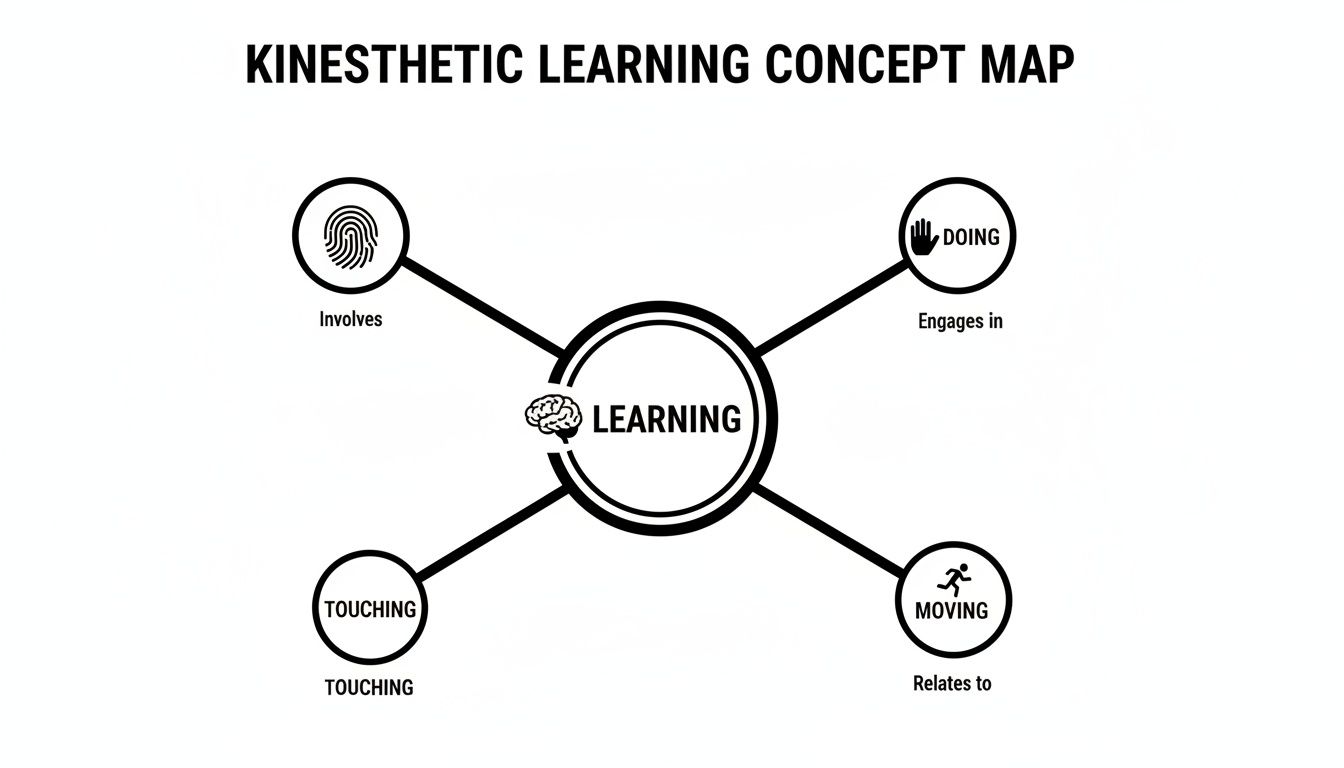
As you can see, learning for these children is a full-body experience, fundamentally tied to action and physical sensation.
A Preference for Practicality
This hands-on approach isn't just a childhood phase; it's a powerful trait that sticks around into adulthood, especially in practical fields. One UK-based study on university students in sports-related programmes found something remarkable: a full 50% of the students identified as having a major preference for kinesthetic learning. It just goes to show how strongly a hands-on method resonates in disciplines where ‘doing’ is the whole point.
Ultimately, spotting a kinesthetic learner is about shifting your perspective. It’s about seeing their need for movement not as a challenge to be managed, but as their greatest strength in the learning process.
Fun Hands-On Activities for Kinesthetic Learners
The secret to helping a kinesthetic learner truly grasp a concept? Simple. Turn the lesson into an adventure. For these kids, sitting still and just listening is a non-starter. They need to get their hands on things, to touch, build, and interact with the ideas they’re exploring. And the brilliant part is, you don’t need a room full of expensive gear—just a bit of creativity and a willingness to embrace a little organised chaos.
From the classroom to the living room floor, there are endless ways to make learning a full-body experience. The aim is to connect physical actions with abstract ideas, cementing knowledge in a way that actually sticks. For instance, why just read about the solar system when you can build it?
Bring STEM to Life With Movement
Science, technology, engineering, and maths (STEM) are tailor-made for hands-on learning. At their core, these subjects are all about figuring out how the world works—which is exactly what drives a kinesthetic learner.
Here are a few simple ideas to get you started:
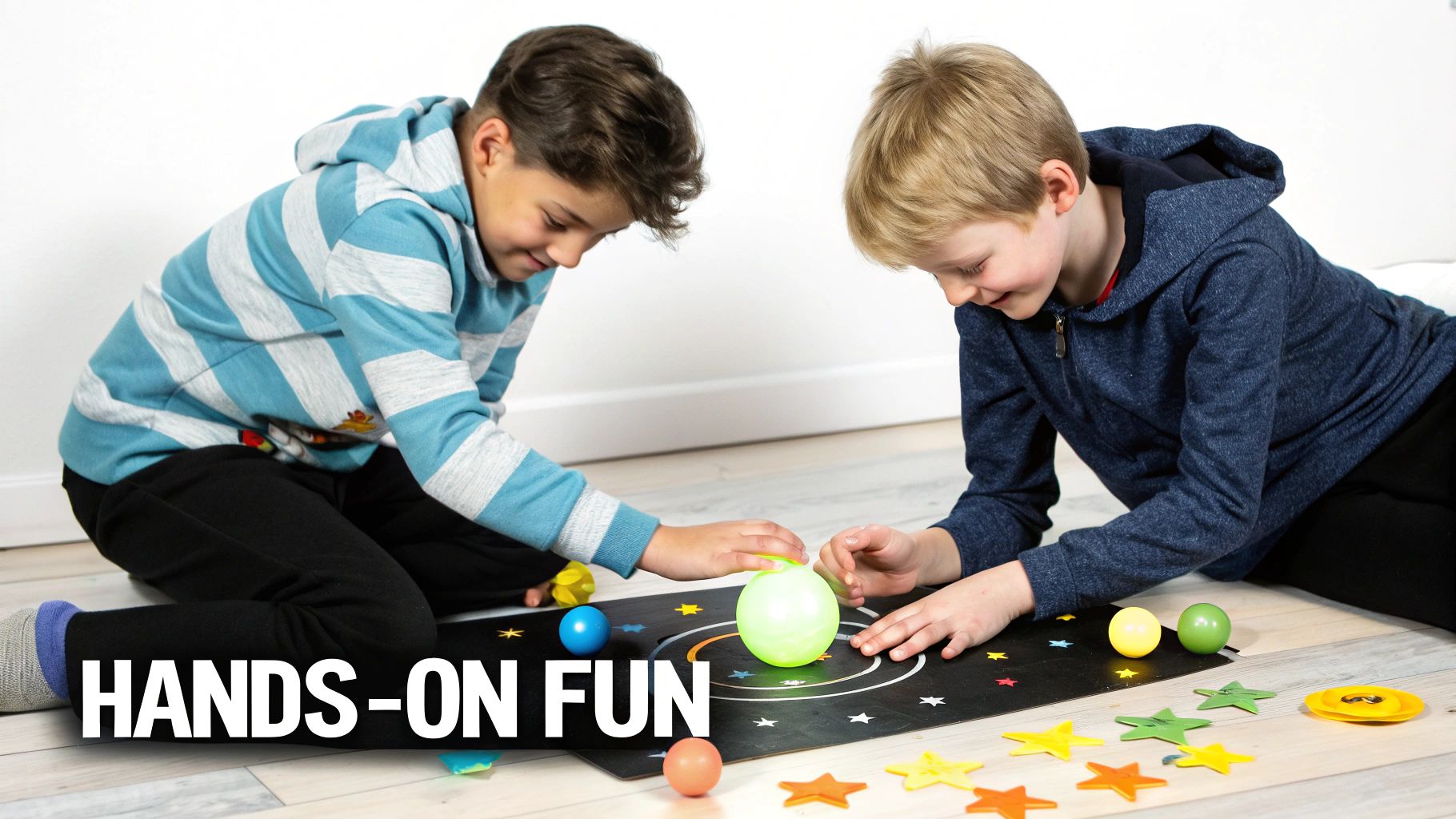
- Build the Solar System: Grab different-sized balls, lumps of play-doh, or even fruit to create a scale model of our solar system. Have your child physically place the planets in orbit around a 'sun' to get a real feel for their cosmic neighbourhood.
- Constellation Creation: On a large piece of dark paper or right there on the floor, use glow-in-the-dark stars or chalk to map out famous constellations. They're not just memorising patterns; they're physically creating them.
- Act Out a Rocket Launch: Forget boring diagrams! Turn a science lesson into a mini-play. Get your child to act out the entire journey of a rocket, from the dramatic countdown and blast-off to orbiting the Earth. This kind of physical storytelling makes the whole process unforgettable.
The most powerful learning happens when a child’s hands are as busy as their mind. For kinesthetic learners, this isn’t just a preference—it’s a necessity.
These activities aren't just about teaching facts; they're about creating memorable experiences that forge a strong link between information and action. This principle works across the board, not just in science. Structured physical activities are brilliant for building skills in any area. Take sports, for example, where you can find inspiration in things like engaging lacrosse ground ball drills that show how repetition and movement create mastery.
Weave in Stories and Imagination
Learning should never feel like a chore. One of the best ways to ignite a child's enthusiasm is by tying activities to characters and stories they already love. If your young explorer is a fan of the Space Ranger Fred books, why not bring his intergalactic missions right into your hands-on activities?
- Create a Mission Diorama: Using a shoebox, a few craft supplies, and some small toys, your child can build a 3D scene from one of Space Ranger Fred’s missions. This is a fantastic way to develop fine motor skills and spatial awareness while they relive the adventure.
- Design a New Planet: Get the craft box out and invent a brand-new planet for Fred to discover. What’s its surface like? What kind of weird and wonderful creatures live there? Building it makes the imaginative world feel real.
For even more ideas on blending storytelling with practical learning, take a look at our post packed with fun science activities for kids. The key is to give children opportunities to physically shape their own learning journey.
Here are a few more ideas to show how easily you can adapt lessons for kinesthetic learners across different subjects.
Kinesthetic Activity Ideas From Earth to Space
| Subject | Classroom Activity Idea | At-Home Activity Idea |
|---|---|---|
| English | Act out vocabulary words or scenes from a story. Use letter tiles or magnets to physically build words. | Write letters in a sand tray or with finger paint. Use body movements to form the shapes of letters. |
| Maths | Use LEGO bricks or blocks for counting, adding, and subtracting. Create a "human number line" on the playground. | Measure ingredients while baking. Go on a shape hunt around the house, touching and feeling each object. |
| History | Build historical landmarks with clay or cardboard boxes. Create a timeline on the floor with masking tape and walk through it. | Cook a meal from a different historical period. Create costumes and re-enact a historical event. |
| Geography | Create a salt dough map of a continent and paint the different countries. Use a large floor map to 'travel' between cities. | Build a model volcano that erupts. Create a 'weather station' in the garden and physically track the changes. |
These are just starting points, of course. The best activities will always be the ones sparked by your child’s own curiosity. The goal is to make learning an active pursuit, not a passive one.
Creating a Movement-Friendly Learning Space
Helping a child who learns by doing doesn't mean you have to turn your classroom or living room into a full-blown gymnasium. In fact, it’s often the small, simple adjustments that make the biggest difference. The goal is to create a space that invites movement, making it a natural part of the learning process rather than a distraction.
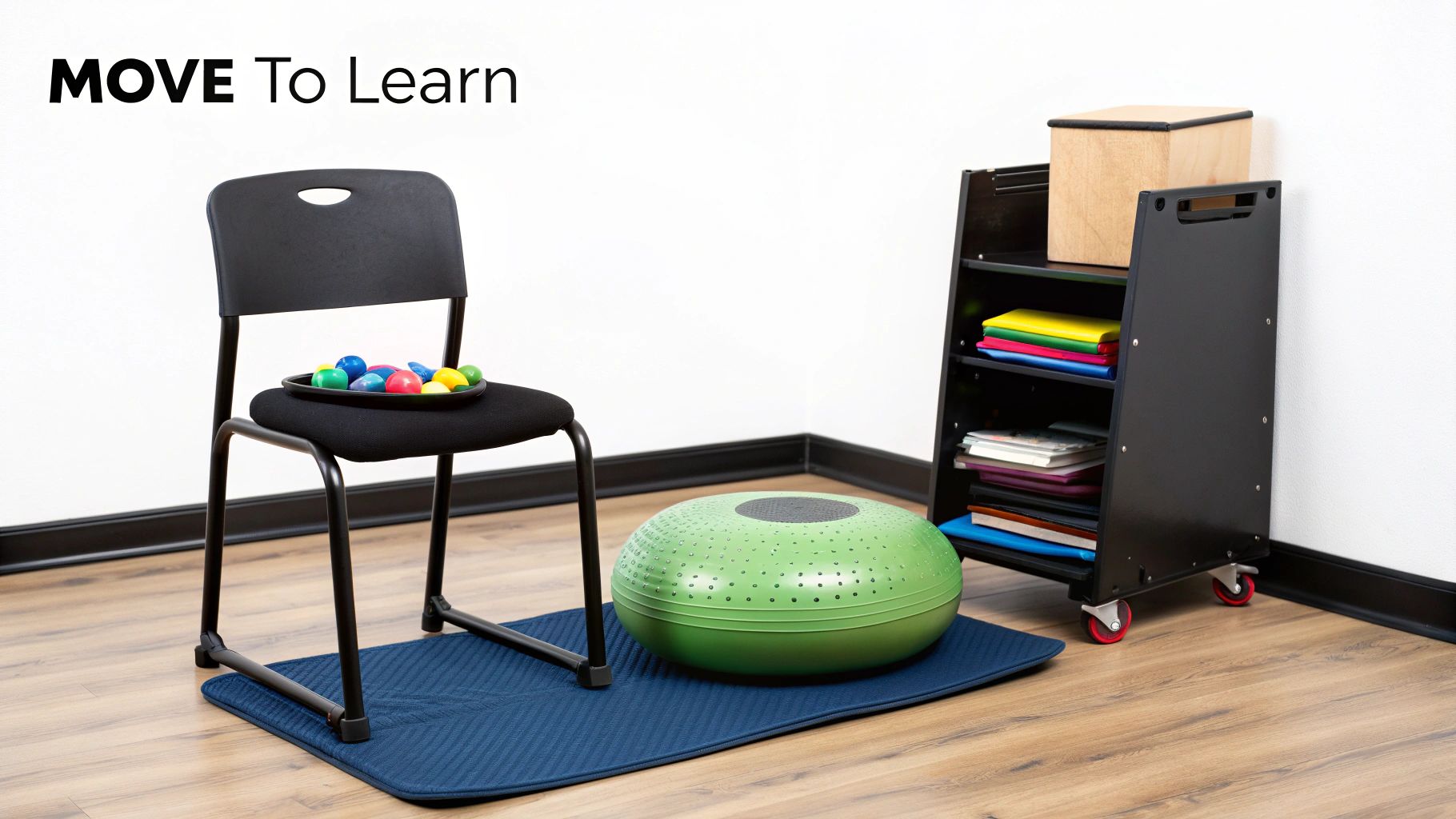
Think of it as adding a bit of ‘wobble room’ to their day, both literally and figuratively. Simple, low-cost solutions can have a massive impact. A wobble cushion on a standard chair can give a child just enough sensory input to help them focus during quiet work. Likewise, having a small basket of fidget tools handy—like squishy balls or textured putty—gives busy hands something to do, freeing up their minds to listen and absorb.
These little tweaks acknowledge a simple truth: for a kinesthetic learner, stillness is often the real enemy of concentration. By providing acceptable outlets for their need to move, you’re empowering them to regulate their own focus and stay engaged.
Embrace the Brain Break
One of the most powerful tools you can use is the brain break. This is just a short, planned pause from a task that's designed purely for movement. It’s a chance for kids to hit the reset button, burn off some steam, and come back to their work feeling refreshed and ready to go.
Brain breaks don’t need to be long or complicated. Even five minutes can be enough to completely change the dynamic.
- Unstructured Movement: This is as simple as it sounds. Crank up a favourite song for a quick dance party. Do some star jumps, run on the spot, or just have a good, long stretch. The idea is to get the blood flowing and give their brains a rest.
- Structured Movement: You can also tie movement directly into what they're learning. A brain break could mean acting out vocabulary words, doing a scavenger hunt for items of a certain colour, or playing a quick round of Simon Says.
Weaving activity into lessons like this is a core part of many effective classroom engagement strategies. It helps all children, but it's an absolute game-changer for kinesthetic learners.
Blend Storytime with Action
Even traditionally quiet activities like reading can be made movement-friendly. Instead of just sitting still and listening, why not turn storytime into an interactive performance? If you're reading an exciting adventure, like one of the Space Ranger Fred books, just pause every few pages.
Ask your child: "What would you do next if you were Fred? Show me!" This instantly transforms them from a passive listener into an active participant.
They can act out blasting off in a rocket, float around in zero gravity, or tiptoe across a new alien planet. This simple trick blends storytelling with physical action, helping them connect more deeply with the narrative and remember it long after the book is back on the shelf. It’s a perfect example of how kinesthetic learning can enrich every single part of a child’s day.
Common Myths About Kinesthetic Learning
Just like any big idea, kinesthetic learning has picked up a few myths along the way. It’s easy for misunderstandings to crop up, especially when we’re all just trying to figure out the best ways to support our kids. So, let’s clear the air and gently bust some of the most common ones.
One of the biggest misconceptions is that kinesthetic learning is only about sports or big, boisterous movements. While it's true that many of these learners absolutely shine in PE, their need for hands-on engagement is so much broader.
This learning style is also about fine motor skills. Think of the quiet focus it takes to click LEGO bricks together, the delicate touch needed for a messy craft project, or the careful handling of a science experiment. These are all kinesthetic activities, connecting physical action with deep thinking. It’s about any kind of physical engagement, not just running around a field.
Are They Disruptive or Just Participating?
Another all-too-common myth is that kinesthetic learners are intentionally ‘disruptive’ or can’t pay attention. It’s an easy mistake to make when you see a child fidgeting during a quiet lesson, but it’s so important to reframe what’s really happening.
That constant need for movement isn’t a sign of defiance; it’s the sign of a brain trying its best to stay switched on. When they tap a pencil, jiggle a leg, or get up to pace, they’re often using that physical input to help them process what they’re hearing. What looks like a distraction is actually their unique way of concentrating and taking part.
The Great Learning Styles Debate
You’ve probably heard the ongoing debate about whether ‘learning styles’ are scientifically a real thing. It’s a lively discussion, and it’s true that many experts are wary of putting kids into rigid boxes. But sometimes, this debate misses the most important point: multi-sensory teaching, especially hands-on activities, is fantastic for all children.
While the theory of learning styles itself is debated, the practical benefit of hands-on, movement-based learning is widely recognised. It’s a powerful tool for every child's toolkit, not just for a select few.
Interestingly, while many educators believe in tailoring their teaching, there’s often a gap between belief and what actually happens in the classroom. A 2017 study found that while 58% of UK academics felt that adapting to learning styles was effective, only about a third of them regularly did so. You can explore more on this fascinating study here.
This just goes to show that while we intuitively know that hands-on learning works wonders, we could all do with more simple, practical ways to bring it into our homes and classrooms.
How to Support Your Young Kinesthetic Explorer
Championing your young kinesthetic explorer is all about celebrating their unique way of engaging with the world. The secret is to shift your perspective—to see their constant need for movement not as a hurdle, but as their greatest learning asset. It’s about creating chances for them to touch, build, and truly experience their lessons firsthand.
This hands-on approach isn't new; it has long been valued in education. The idea of learning styles is deeply embedded in UK educational culture. In fact, a 2012 survey revealed that a huge 93% of UK teachers believed students learn best when taught according to their preferred style. While the academic debate continues, this figure shows just how vital ‘learning by doing’ is for educators on the ground.
Empowering your kinesthetic learner is a team effort. It means embracing a bit of organised chaos, turning lessons into games, and chatting openly with their teachers about what works best for them.
Simple Strategies for Success
Once you understand what kinesthetic learning is all about, providing support becomes so much easier. Here are a few actionable tips to help your child fly:
- Embrace Messy Experiments: Let them get their hands dirty! Things like building with clay, finger painting, or even mucking about with kitchen science experiments create powerful, lasting memories that anchor their learning.
- Use Role-Play for New Ideas: When introducing a fresh concept, ask them to act it out. Whether it’s the life cycle of a butterfly or a major historical event, turning it into a mini-play makes the information stick like nothing else.
- Turn Learning into a Game: Why just spell words when you can hunt for them? Transform spelling practice into a scavenger hunt around the house or turn maths problems into a jumping game in the garden. Add a physical challenge, and it stops feeling like work.
- Celebrate Physical Accomplishments: Acknowledge and praise their wins in sports, dance, or a particularly tricky building project with the same energy you would for academic success. This validates their natural strengths and builds confidence.
Working Together with Teachers
Keeping an open line of communication with your child's teacher is vital. Approach the conversation as a team, sharing what you’ve noticed at home and asking for their insights from the classroom. Together, you can brainstorm strategies that work in both worlds, ensuring your young explorer has all the support they need to thrive.
Ultimately, championing a kinesthetic learner means trusting their instincts. For more inspiration on bringing active learning into your daily routine, check out our free activities page. By giving them the freedom to move, you’re giving them the tools to succeed. And for more adventures through reading, why not explore the world of the Space Ranger Fred books?
Got a Question? We've Got Answers
Here are some of the most common questions that pop up when we talk about kinesthetic learning and how to bring it to life for your child.
How Can I Make Traditional Homework More Hands-On?
We’ve all seen it: the dreaded worksheet that just won’t click. For a kinesthetic learner, sitting still with a pencil and paper can feel like a real struggle.
The trick is to add a physical element. Got spelling words? Use letter tiles or magnets to build them. Tackling maths problems? Break out the LEGO bricks or counters. Instead of just reading a story, get them to act out a favourite scene or trace letters in a tray of sand. It’s all about turning an abstract task into a tangible experience.
Are Fidget Toys Just a Distraction?
It’s easy to think so, but not necessarily! For lots of kids who need to move, having something to do with their hands—like squeezing a stress ball or fiddling with a fidget spinner—actually helps them focus.
It gives their body just enough physical feedback to stay engaged, freeing up their mind to listen and concentrate. The real test is whether the object helps them tune in or pulls their attention away completely. If it’s helping, it’s a tool, not a toy.
What Are the Best Toys for Kinesthetic Learners?
Anything that encourages building, creating, and moving is a winner. You can’t go wrong with classics like LEGO, building blocks, Play-Doh, and craft kits. They’re fantastic because they let children physically shape their world.
Science kits that involve experiments, tricky puzzles, and anything that inspires a bit of role-playing are also brilliant choices. These aren't just toys; they're invitations to explore, construct, and learn through doing.