
You’ve probably heard the term ‘gamification’ being thrown around, but what does it actually mean for your child’s learning? Let’s blast off and explore it together.
At its heart, gamification in education is the brilliant idea of borrowing the fun bits from games and applying them to schoolwork. We're not talking about turning every lesson into a full-blown video game. Instead, it’s about weaving in those engaging elements that make games so captivating.
Turning Learning into an Epic Quest
Think about how a child can stay glued to a game, laser-focused on earning coins or levelling up their character. That powerful sense of motivation is exactly what gamification aims to capture. It uses simple tools like points, shiny badges, leaderboards, and progress bars to reframe learning tasks as exciting challenges.
Take a standard maths worksheet, for instance. To a child, it can feel like a bit of a drag. But what if every correct answer earned them ‘rocket fuel’ points for their spaceship? Collect enough, and they unlock a ‘Galaxy Explorer’ badge, watching their name climb the classroom mission leaderboard.
Suddenly, that worksheet is no longer a chore. It’s a vital part of a grand adventure! This approach gives children a clear, visual way to see their progress, fuelling a wonderful sense of accomplishment with every small victory.
So, is it the Same as Game-Based Learning?
It's easy to get these two mixed up, but there's a key difference. Gamification sprinkles game-like elements onto an existing learning activity. Game-based learning, on the other hand, uses an entire, self-contained game to teach a concept.
Think of it this way: gamification is like adding sprinkles to a cupcake, while game-based learning is like baking a whole new cake. Both are fantastic ways to make learning more delicious!
Gamification is a powerful tool because it connects learning to a child's natural desire for play, achievement, and recognition. It helps frame education not as a task to be completed, but as an exciting mission to embark on.
To make it even clearer, here’s a quick guide to telling them apart.
Gamification vs Game-Based Learning at a Glance
This little table breaks down the main differences between adding game mechanics to a lesson and using a full game to teach.
| Feature | Gamification | Game-Based Learning |
|---|---|---|
| Core Concept | Adds game elements (points, badges) to existing lessons. | Uses an entire game as the lesson itself. |
| Main Goal | To motivate and engage learners in traditional tasks. | To teach a specific skill or concept through gameplay. |
| Example | Earning stars for completing reading chapters. | Playing a history simulation game to learn about ancient civilisations. |
While their methods differ, both approaches share a common goal: making the learning journey more engaging and, most importantly, more fun for our young adventurers.
Why Gamification Captures a Child's Imagination
Ever wondered why a child can get lost in a video game for hours but drifts off the moment homework comes out? That incredible focus is exactly what we're tapping into with gamification. It works because it speaks a language kids already understand: play, progress, and a real sense of achievement.
When you introduce clear goals and instant feedback, learning shifts from being a passive chore into an exciting, hands-on quest. Suddenly, repetitive tasks like spelling practice or memorising times tables feel more like fun challenges to be conquered.
Making Learning Feel Like an Adventure
When a child earns a digital badge or watches their name climb a leaderboard, their brain gets a little buzz of positive reinforcement. This creates a powerful feeling of accomplishment and makes them genuinely eager to tackle the next challenge. It’s the very same feeling they get when they finally nail a tricky level in a game.
This approach also builds incredible resilience. In a game, ‘failing’ isn't some scary final verdict; it's just a chance to try again with a new strategy. Gamified learning creates a safe space where mistakes are simply part of the process, encouraging kids to persevere without that fear of getting things wrong.
This chart breaks down the key differences between adding game-like elements to learning and using a full-blown game.
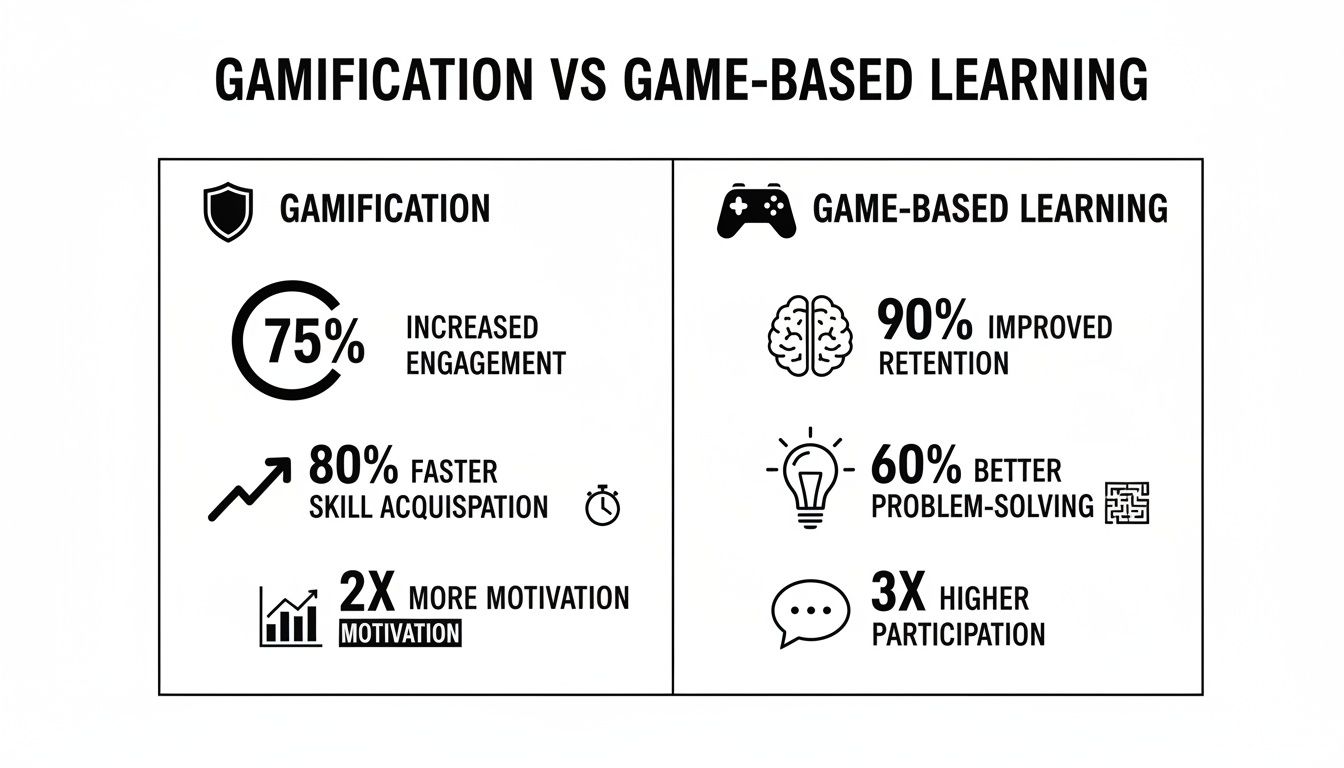
As you can see, gamification is all about weaving motivating elements into the learning you’re already doing. Game-based learning, on the other hand, replaces the entire structure with a game.
Fuelling Motivation with Progress and Rewards
A child's natural hunger for progress and recognition is the secret sauce that makes gamification so effective. It’s not just about winning; it’s about seeing their own growth in a tangible way. Think of it like exploring a new galaxy—every star chart filled in or planet discovered is a milestone that makes the whole journey worthwhile.
This method taps directly into what motivates kids, turning learning into an adventure they actually want to be a part of. For instance, you can capture that same excitement by exploring what is the difference between stars and planets in one of our other articles.
The real magic of gamification is that it shifts a child's mindset from "I have to do this" to "I want to achieve this." It reframes effort as part of a rewarding journey, not just a task to be completed.
The impact of this shift is astounding. The data shows a 34.75% increase in student performance when learning is gamified. In UK classrooms, 83% of students felt more driven in gamified lessons compared to just 61% in traditional ones. It’s a trend backed by the UK’s major investment in EdTech, and you can read more about these gamification findings to see the full picture.
Bringing Gamified Learning to Life with Real Examples
Theory is one thing, but seeing how gamification actually works in the real world is where the magic happens. It’s all about turning abstract ideas into tangible, exciting experiences for children aged 6–12. Let’s look at some popular digital tools and creative offline ideas that bring gamified learning to life.
You’ve almost certainly seen this in action with popular apps. Duolingo, for instance, turns learning a new language into an addictive game. Users earn points for correct answers, build up a ‘streak’ for daily practice, and unlock badges for milestones, making vocabulary practice feel more like a rewarding quest than a chore.
When you start looking, you'll find countless practical examples of gamification in language learning that show just how powerful a few points and a progress bar can be.
Another brilliant example is Kahoot!, which transforms classroom quizzes into fast-paced, competitive games that get everyone buzzing with excitement.
Digital Quests and Classroom Fun
Kahoot! lets teachers build their own multiple-choice quizzes that pupils answer on their devices. Points are awarded for speed and accuracy, and a live leaderboard fuels a friendly sense of competition. This simple format can turn a dry revision session into a high-energy event everyone looks forward to.
The vibrant design and game-show atmosphere make it clear this isn't your typical, stuffy test; it’s an interactive challenge.
Brilliant Ideas Beyond the Screen
But gamification isn't just about apps and technology. You can create incredible learning adventures without any screens at all. The secret is to wrap the learning in a compelling story, set clear goals, and have a fun way to track progress.
Here are a few simple, tech-free ideas you can try at home or in the classroom:
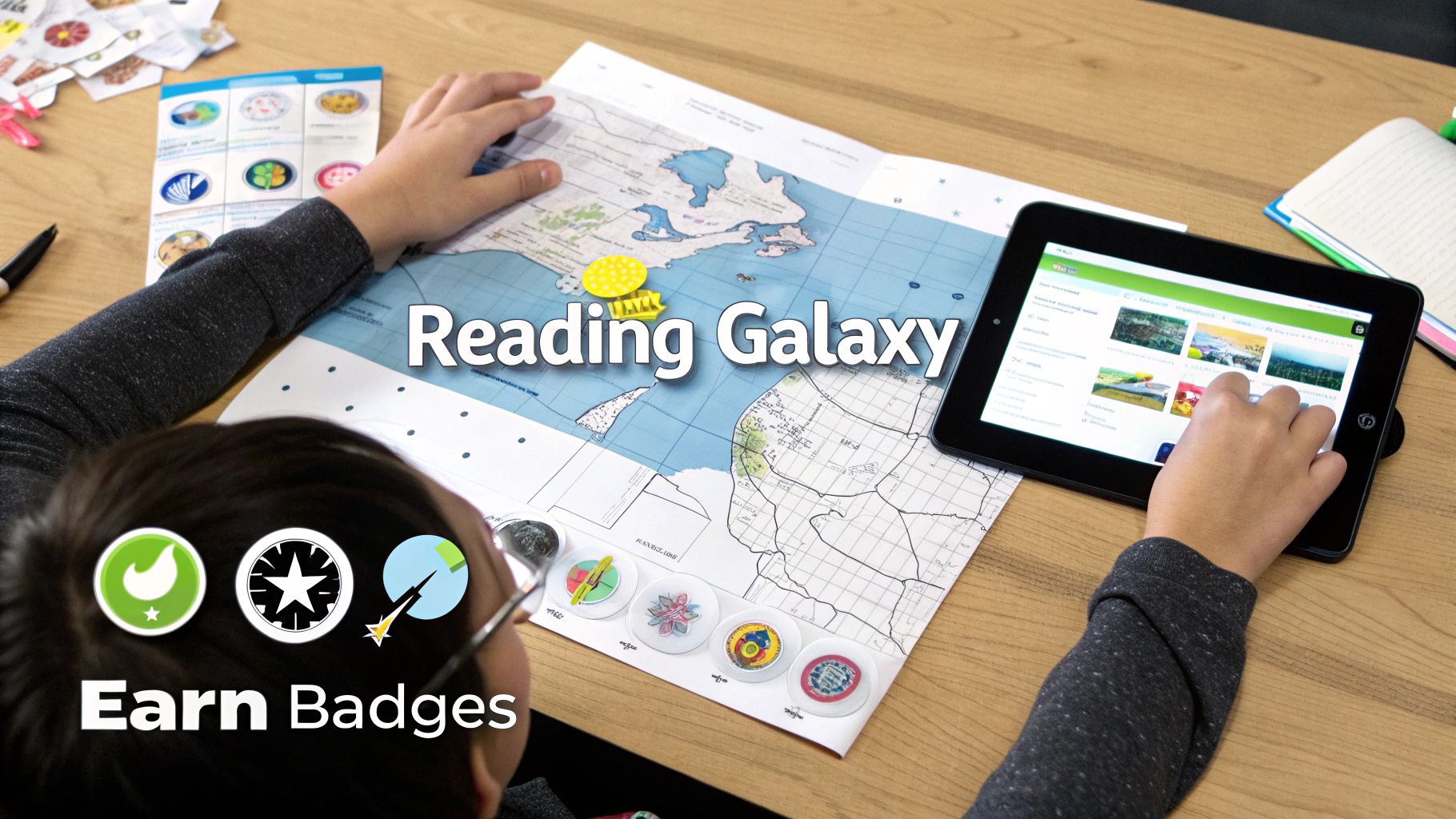
- Create a ‘Reading Galaxy’ Map: Grab a big poster and design a galaxy with different planets. Each time a child finishes a book, they get to move their paper rocket from one planet to the next. It’s a fantastic visual representation of their reading journey. To help populate your new galaxy, check out our guide to the best books for 10-year-old boys.
- Award ‘Cadet Badges’: Turn learning into a mission. Kids can earn physical or sticker badges for completing specific tasks. For example, they could earn a 'Stargazer Badge' for finishing one of our fun space activities or a 'First Class Storyteller' badge for reading a Space Ranger Fred book.
- Start a Personal Mission Log: Give your child a special notebook to track their progress. They can log completed homework, new skills they’ve mastered, or even acts of kindness, earning points towards a bigger reward like a family movie night or getting to choose what’s for dinner.
The most effective offline gamification taps straight into a child’s imagination. By framing learning as part of a bigger story—like a space mission or a treasure hunt—you make the process itself the reward.
These examples show that whether you're using a slick app or a simple sticker chart, the goal is the same. You're adding layers of fun, motivation, and a sense of achievement to everyday learning, turning it into an adventure they’ll actually want to continue.
How to Start Using Gamification at Home and School
Ready to give gamification a go? The fantastic news is you don’t need any special equipment or technical know-how to get started. Think of this section as your practical toolkit for weaving simple, fun game mechanics into learning today, whether you're at the kitchen table or in a busy classroom.
The real secret is to start small, focus on positive reinforcement, and tailor the ‘game’ to your child’s unique personality and interests. What gets one child excited might not land with another, so treat these ideas as launching pads for your own creative learning adventures.
Fun Gamification Ideas for Parents at Home
At home, gamification can turn daily routines and homework from battles into fun, collaborative challenges. The goal is to sprinkle in a bit of playfulness that motivates children without piling on the pressure.
Here are a few simple ideas to get you started:
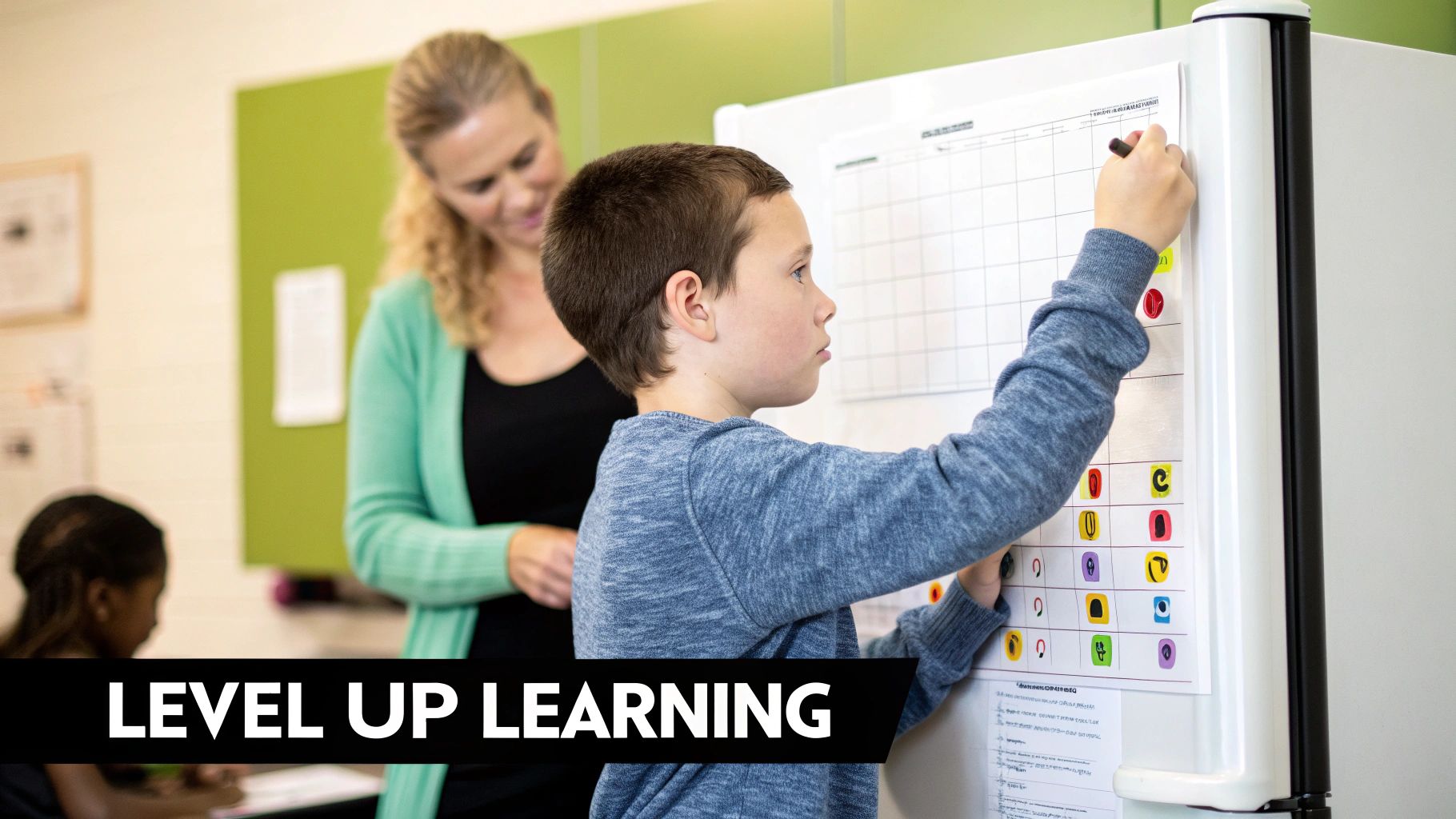
- Chore Charts with a Twist: Create a chart where finishing chores earns points. Instead of money, these points could unlock family rewards, like picking the film for movie night, an extra bedtime story, or a special trip to the park.
- The ‘Beat the Clock’ Homework Challenge: Grab a timer and turn homework into a personal best challenge. Can they finish their spelling practice before the timer buzzes? This adds a little urgency and fun to tasks that can sometimes feel like a drag.
- Create a Reading Quest: Design a simple map and let your child move a counter along it for every 15 minutes they spend reading. Hitting certain milestones could unlock the next chapter of an exciting story you read together.
Simple Gamification Strategies for Teachers in School
In the classroom, gamification can be a brilliant way to boost engagement, encourage positive behaviour, and build a healthy sense of teamwork among pupils.
Try these easy-to-implement strategies:
- Classroom Leaderboards: Set up a leaderboard that celebrates positive actions like helping a classmate, showing great effort, or acts of kindness. The key is to focus on progress and participation, not just right answers, to keep it inclusive for everyone.
- Quest-Based Lessons: Frame a whole topic as a multi-step ‘quest’. For example, a science lesson could become a ‘Mission to Mars’, where pupils complete different tasks (experiments, worksheets, research) to ‘level up’ their knowledge and complete the mission.
- Unlockable Content: Hold back a particularly fun activity—like a cool science video or a creative art project—as a reward that the class can ‘unlock’ once everyone has completed the main learning task.
Remember, the aim of gamification is to foster a genuine love of learning. The points and badges are just the rocket fuel; the real journey is seeing a child's confidence and curiosity soar.
Many digital tools also offer fantastic ways to introduce gamification. For ideas on bringing technology into the mix, you might be interested in our roundup of the best learning apps for kids, many of which use these principles brilliantly.
The Science Behind Why Gamification Works
Gamification isn't just a fun new trend; it’s a powerful tool grounded in real, hard-wired human psychology. It’s so effective because it plugs directly into the brain’s natural systems for motivation and reward. Once you understand the science, it’s easy to see why it can make such a difference, especially for kids who find traditional learning a bit of a slog.
At its heart, gamification cleverly juggles two kinds of motivation: extrinsic and intrinsic. Extrinsic motivation is the drive to do something for an outside reward, like getting points or a shiny new badge. It’s the hook that sparks that initial excitement and gets children to lean in.
But the real magic happens when that spark ignites intrinsic motivation—the desire to learn something for the pure joy of it. As kids start succeeding and seeing their own progress, they develop a genuine interest and a real love for the subject itself.
The Brain's Feel-Good Chemistry
So, what's actually going on inside a child's head during a gamified lesson? When they finally crack a puzzle or reach a goal, their brain releases a tiny burst of dopamine. You’ve probably heard it called the 'feel-good' chemical, and it plays a massive role in both memory and motivation.
That little dopamine hit creates a positive feedback loop with the learning activity. The brain essentially says, "Hey, that was fun! Let's do it again." Over time, this repeated positive feeling helps lock in memories and builds a child’s confidence. A lot of this comes down to the key concepts of social learning, where engagement is driven by these positive, rewarding interactions.
The science is clear: by linking learning to the brain's natural reward system, gamification helps reframe education from a chore into a rewarding experience. It builds positive pathways that encourage curiosity and persistence.
Real-World Results in the Classroom
This isn’t just theory—the results are popping up in classrooms everywhere. One study showed students achieved an 11% increase in factual knowledge and a 9% increase in retention using gamified methods.
Here in the UK, we're seeing similar successes. Take a platform like ClassDojo, which gamifies classroom behaviour by awarding points for positive actions. It’s a simple mechanic, but it has led to real, measurable improvements in student focus, proving just how powerful this science-backed strategy can be. You can discover more about the power of gamification in UK education to see the full impact for yourself.
Getting Gamification Right: What to Avoid
Like anything, gamification is all about balance. It’s a fantastic way to get kids fired up about learning, but a few common missteps can easily turn a fun quest into a bit of a slog. The good news? They’re easy to sidestep with a little planning.
One of the biggest traps is leaning too heavily on competition. A friendly race to the top of a leaderboard can be a blast for some, but for others, it can feel pretty disheartening, especially if they’re finding a topic tricky. The real goal should be celebrating everyone’s personal progress, not just who finishes first.
Keep the Focus on Fun and Learning
Another classic slip-up is letting the rewards become the whole point. If kids are just chasing points for the sake of it, they might completely miss the lesson you’re trying to teach. The real prize isn’t a badge; it’s that "aha!" moment of figuring something out or the pride in mastering a new skill.
To keep things on track, try these simple ideas:
- Team Up! Balance Competition with Collaboration: Instead of just having individual leaderboards, why not create team challenges? Set a goal where everyone has to pitch in to succeed together.
- Celebrate the Effort, Not Just the Win: Give out points for trying hard, thinking outside the box, or helping a friend who’s stuck. It shows that the journey is just as important as the destination.
- Keep It Simple: Don't get bogged down in complicated rules and reward systems. The game should be a launchpad for learning, not a distraction from it.
The best gamification feels effortless and light-hearted. It’s a gentle nudge forward that helps children feel capable and proud of what they can do, without the pressure of winning at all costs.
When it’s done well, the results speak for themselves. In UK schools using gamified eLearning, course completion rates have soared to an incredible 90%. Compare that to the 25% completion rate for non-gamified lessons, and you can see the difference it makes. These approaches don't just get kids to the finish line; they lead to higher scores and better performance because the learning itself becomes genuinely engaging.
You can learn more about these powerful gamification trends and see how they’re shaping the future of education.
Got Questions About Gamification? We’ve Got Answers
To wrap up our mission, let’s tackle some of the most common questions that pop up when parents and teachers start exploring gamification. I’ll keep the answers clear and simple, giving you the confidence to launch your own fun learning adventures.
Is Gamification a Good Fit for All Ages?
Absolutely, but you'll want to tailor the adventure to the age of your little explorer. For younger kids (6-8 years old), simple things like sticker charts, instant praise, and tangible rewards (like getting to pick the bedtime story) work wonders. Their motivation is often very direct and immediate.
With older children (9-12 years old), you can build more complex quests and storylines. Think digital leaderboards, long-term projects, and team-based challenges. These tap right into their growing sense of achievement, friendly competition, and strategic thinking. The real key is matching the game to where they are developmentally.
Does Gamification Mean More Screen Time?
Not unless you want it to! While there are plenty of brilliant educational apps out there that use gamification, you can create powerful learning games entirely offline. It’s all about the method, not the screen.
Just think about these tech-free ideas:
- A garden treasure hunt to learn about different plants.
- A homemade board game to practise maths facts.
- Earning a ‘Story Master’ badge for writing a creative tale.
You could even award points for completing one of the fantastic puzzles on our freebies and activities page.
How Do I Know if It’s Actually Working?
Keep an eye out for the most important first signs: a real boost in enthusiasm and engagement. Is your child more willing to dive into their homework? Are pupils in your class more focused and excited during lessons? That’s your first clue.
While better marks are a fantastic long-term goal, that initial shift in attitude is the first big win. If learning starts to feel less like a chore and more like a fun challenge, you know you’re on the right track.
Ready for your next adventure? The Space Ranger Fred universe is packed with exciting stories and activities that spark curiosity and a love for learning. Blast off into a world of fun and discovery today!