Meta title: Peppa Pig Book Set for Parents and Teachers
Meta description: Explore how a peppa pig book set supports early reading, classroom use, and the natural move into bigger story worlds and STEM curiosity.
You’re probably here because a child in your life loves Peppa. Really loves Peppa.
Maybe you’ve read the same story so many times that you can do the snorty voices without even opening the book. As an educator, I’d say that’s not a problem at all. It’s often the first sign that reading has become joyful, familiar, and safe.
That’s why a peppa pig book set can be such a useful part of a child’s reading journey. It gives young readers repetition, confidence, and stories they already want to revisit. Then, once that love of books is firmly in place, adults can help children take the next step into wider ideas, bigger questions, and more adventurous thinking.
The Wonderful World of Peppa Pig Book Sets
If you’ve ever heard, “Again!” just as you were about to sit down with a cup of tea, you already understand the magic of Peppa.
Children like familiarity. They like knowing who’s coming next, what the joke will be, and when the puddle-jumping might happen. That predictability is not boring for them. It’s reassuring. It helps them join in, remember language, and feel clever.
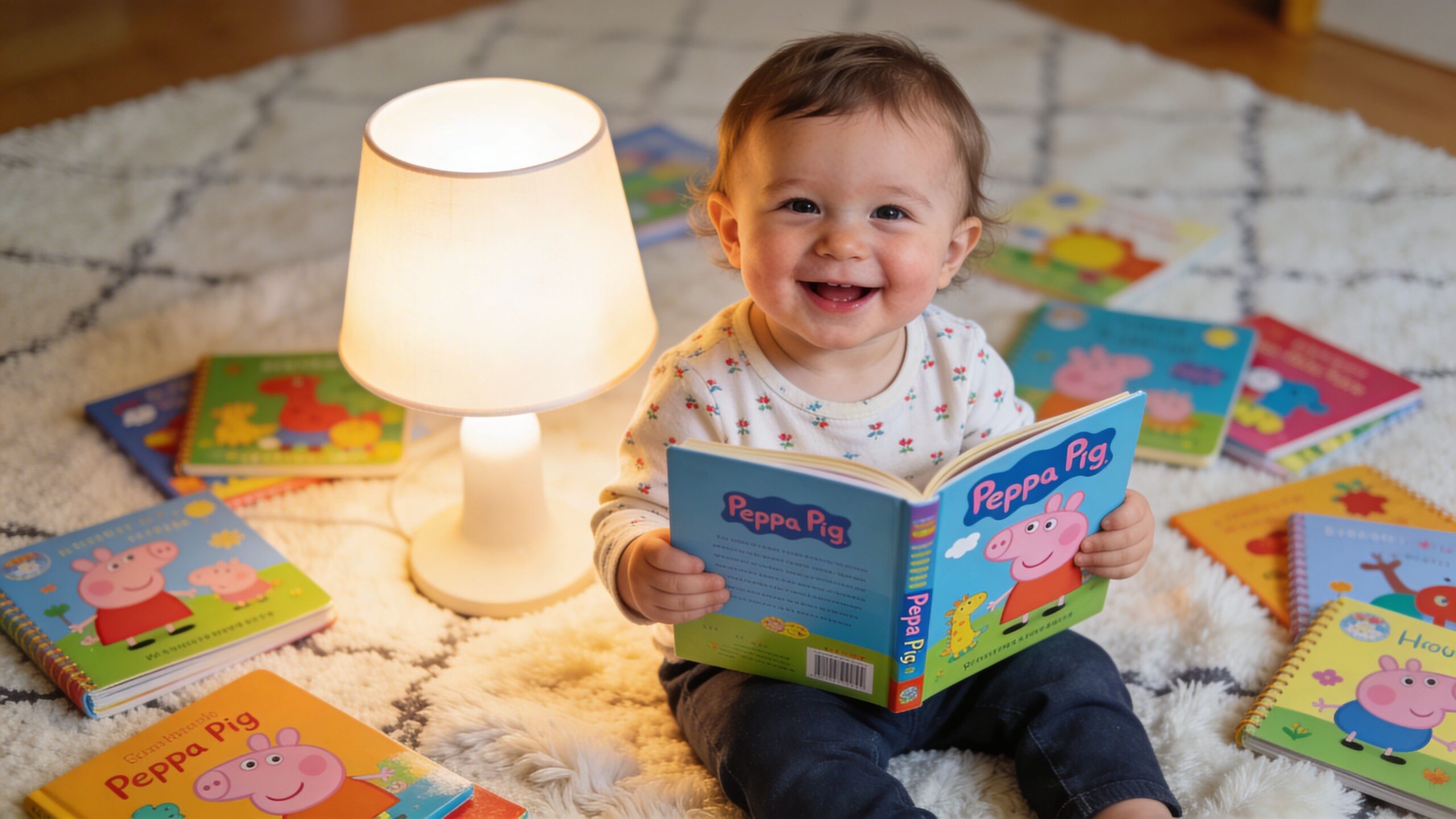
Why children return to Peppa
A Peppa story usually lives in a world young children recognise.
- Home life feels familiar. Mummy Pig, Daddy Pig, George, school, parks, and family outings all make sense to little readers.
- Small problems feel manageable. A lost item, a rainy day, a trip somewhere new. These are big enough to matter, but small enough not to overwhelm.
- Repeated phrases help children join in. Even before they read independently, they begin “reading” from memory.
Children often build confidence long before they decode every word. Familiar books let them practise that confidence safely.
Why adults keep buying the sets
A single storybook is lovely. A set is often better.
With a set, you’ve got variety without losing the comfort of a known character. That matters at home, in nurseries, and in library corners. One day a child wants bedtime calm. Another day they want school stories or something silly.
A good peppa pig book set keeps reading simple. Open the bag, pick a title, and off you go. No long setup. No argument about a new character they’re not ready for yet.
That ease is a big part of the appeal. Peppa doesn’t ask children to leap. She invites them in.
What Exactly Is In a Peppa Pig Book Set
When adults hear “book set”, they sometimes imagine a fancy box and not much else. In practice, these sets are built for regular use.
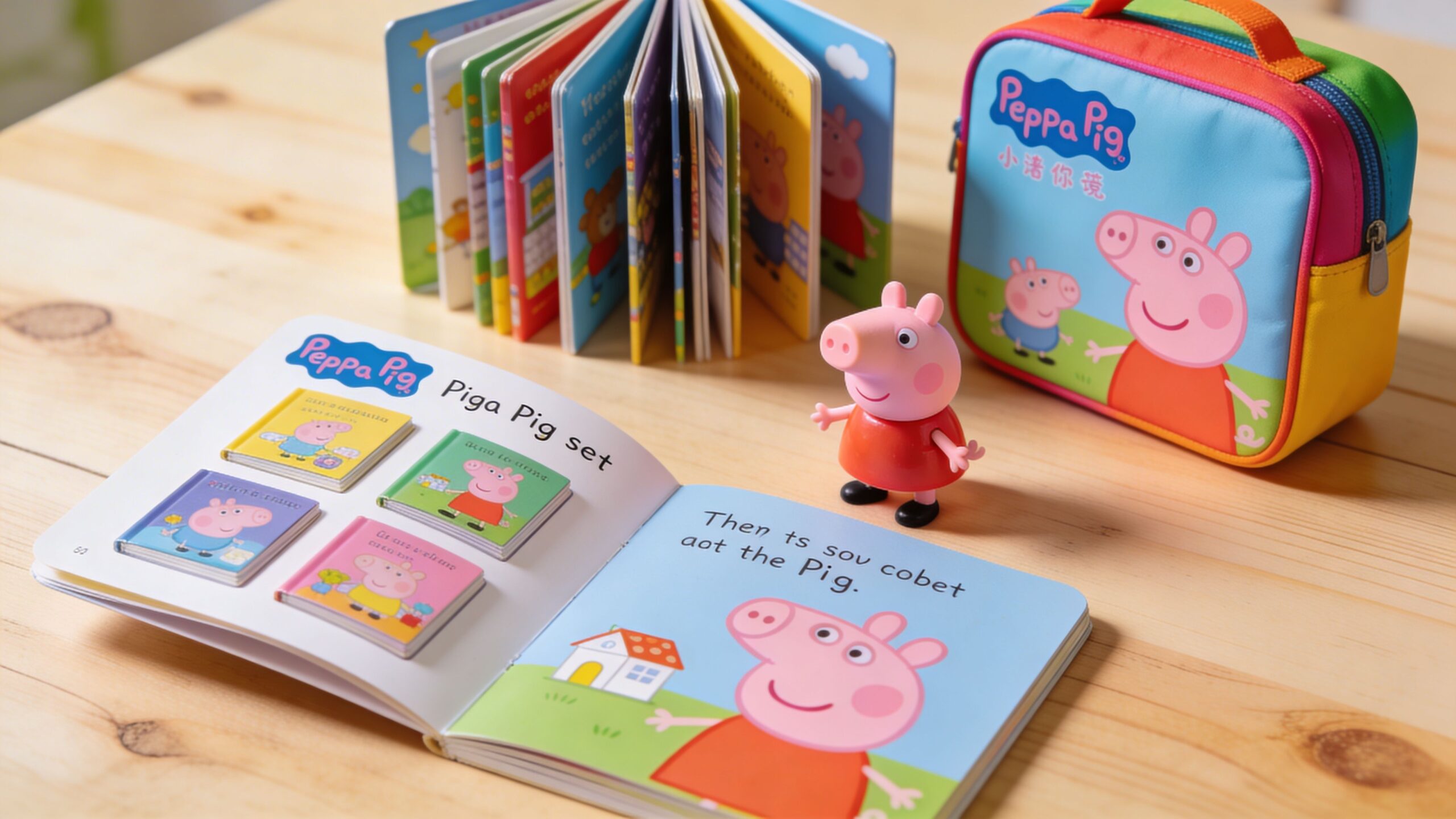
A common format is the 10-book collection. These are often lightweight paperback storybooks designed with young children in mind, rather than heavy hardbacks that are awkward for little hands.
The physical details matter
For nursery and early years use, those practical details are important. A Peppa Pig 10-book collection is described as having paperbacks that weigh around 50g each and measure 210x150mm, with books tested to UK standards to withstand over 100 readings without spine failure. The same source says the stories introduce 15-20 new words each and boosted receptive language in 3-4-year-olds by 35% in UK trials (Peppa Pig 10-book collection details).
For a teacher or librarian, that tells you a lot.
| Feature | Why it helps |
|---|---|
| Lightweight books | Easier for small children to carry and hold independently |
| Standard-sized pages | Comfortable for shared reading and picture pointing |
| Repeated use durability | Better suited to classrooms, book corners, and lending |
| New vocabulary in each title | Supports discussion, retelling, and language development |
What the stories are usually about
The content tends to stay close to a child’s everyday world.
You’ll often find:
- Family routines such as trips, home activities, or celebrations
- First experiences like school events, projects, or small adventures
- Friendship moments where children learn turn-taking, listening, and sharing
- Problem-solving at a gentle level where characters find simple answers together
That’s one reason these books work so well in early settings. They give children a script for life.
If you want to see the style of these sets in action, this video gives a useful visual sense of what families often mean by a Peppa set:
Why this format suits young readers
Young children don’t just read with their eyes. They read with their hands, memory, and routine.
That means the bag, the stack, the short length, and the recognisable covers all matter. A peppa pig book set is not only about text. It’s a ready-made reading habit.
Choosing the Right Set for Your Young Reader
Not every set suits every child or every setting. The best choice depends on age, confidence, and how the books will be used.
For home, nursery, or school
If you’re buying for one child at home, a smaller set can feel manageable. It gives enough choice without flooding the shelf.
If you’re buying for a class or shared space, larger collections can make more sense. In the UK, the 50-book Peppa Pig set is noted for bringing the per-book cost under £0.55, and that same source says it aligns with EYFS literacy goals and is linked to a 28% boost in phonemic awareness in pre-reading children (50-book Peppa Pig collection details).
That’s a practical point, not just a sales one. If a classroom needs many stories that children will choose, cost per title matters.
A simple way to decide
Here’s how I’d think about it as a teacher:
- Choose a smaller set if the child is just beginning to build a reading routine and benefits from limited choice.
- Choose a larger set if you need rotation, group access, and a stronger classroom library base.
- Choose by theme familiarity if the child is anxious about new books and needs a trusted character first.
Practical rule: Don’t choose the “best” set in theory. Choose the one a child will pick up without persuasion.
For very young children who still mouth books, bash corners, or need sturdier page-turning practice, this a guide to picking the perfect board book is a useful companion resource.
Older early years children often enjoy paperbacks because they feel more like “real books”. That small shift matters. It gives children a sense of progress.
Teachers looking at character-led reading more broadly may also find value in this discussion of children’s books and reading choices, especially when thinking about what comes after familiar preschool favourites.
The Hidden Educational Power of Peppa Pig
Peppa’s stories can look very simple on the surface. That’s precisely why they work.
Simple texts free up children’s attention. Instead of wrestling with a complicated plot, they can notice language, join in with repeated lines, and talk about what characters are feeling.
More than a familiar character
A lot of early learning sits inside these short stories.
Children meet everyday vocabulary in context. They hear how conversations work. They notice what happens when someone is excited, worried, cross, left out, or proud. Those social patterns matter just as much as word recognition.
They also get the gift of retelling. That’s a huge step in reading development. A child who can say, “First they went there, then this happened, then they laughed,” is building narrative understanding.
Why Peppa became so widespread
Peppa also became a major part of children’s publishing very early on. By 2009, Peppa Pig book sales in the UK had surpassed 2 million units, while total merchandise sales exceeded £100 million, showing how central the books were to the brand’s early success (Campaign coverage of Peppa Pig sales).
That matters because it helps explain why these books turn up everywhere. Homes, nurseries, libraries, waiting rooms, gift bags. They became a common reading doorway for pre-school children.
The real classroom value
In practice, the educational power often looks like this:
- A hesitant child joins in because they already know the character.
- A chatty child retells the whole plot from memory.
- A quieter child points to pictures and begins naming objects.
- A small group laughs together at the same page and starts to connect reading with pleasure.
A familiar book can do serious educational work while still feeling like play.
That’s Peppa’s real strength. She lowers the barrier to entry.
From Muddy Puddles to Martian Missions What Comes Next
At some point, children who once wanted the same Peppa story every night start asking bigger questions.
Why is the moon out in the daytime? How do rockets work? What’s on another planet? Why does something float, sink, zoom, or crash? That curiosity is a good sign. It means the reading journey is ready to stretch.
When familiar stories stop being enough
Peppa remains popular in early settings, but there is a clear age-related limit to what that world offers. One source notes that Peppa is popular in 78% of UK nurseries, while also pointing to a gap in alignment with STEM curriculum goals for older children. The same source says UK teacher searches for “edutainment book sets” rose by 25% in 2025, showing demand for story-led learning for children aged 6-12 (UK edutainment and nursery trend note).
That doesn’t make Peppa less valuable. It means she isn’t the final stop.
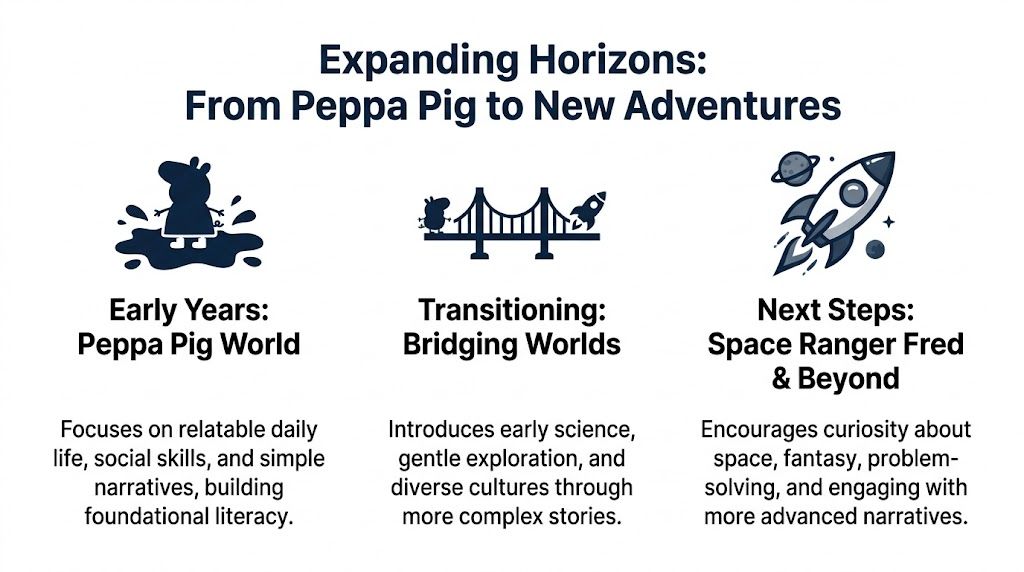
The bridge children need
Children often need a middle step between very simple domestic stories and full factual science texts.
They need stories that still feel funny and approachable, but ask for a bit more thinking. Stories with missions. Questions. Experiments. Obstacles. Consequences. Ideas that nudge them from “I know this character” to “I wonder how that works”.
That’s why many parents and teachers start looking for books that blend narrative with exploration. A child who once loved family outings and school stories may now be ready for challenge, invention, and bigger worlds.
If you’re thinking about how character-based play can open into broader learning, this related piece on a Peppa Pig figure set and imaginative extension offers a helpful angle.
What adults often miss
The shift doesn’t need to be sudden.
A child can still enjoy Peppa and also begin reading stories that ask them to predict, investigate, and explain. In teaching terms, that’s the sweet spot. We keep the comfort. We widen the horizon.
How to Pair Peppa with Space Ranger Fred Adventures
The best transitions in reading don’t feel like transitions. They feel like play.
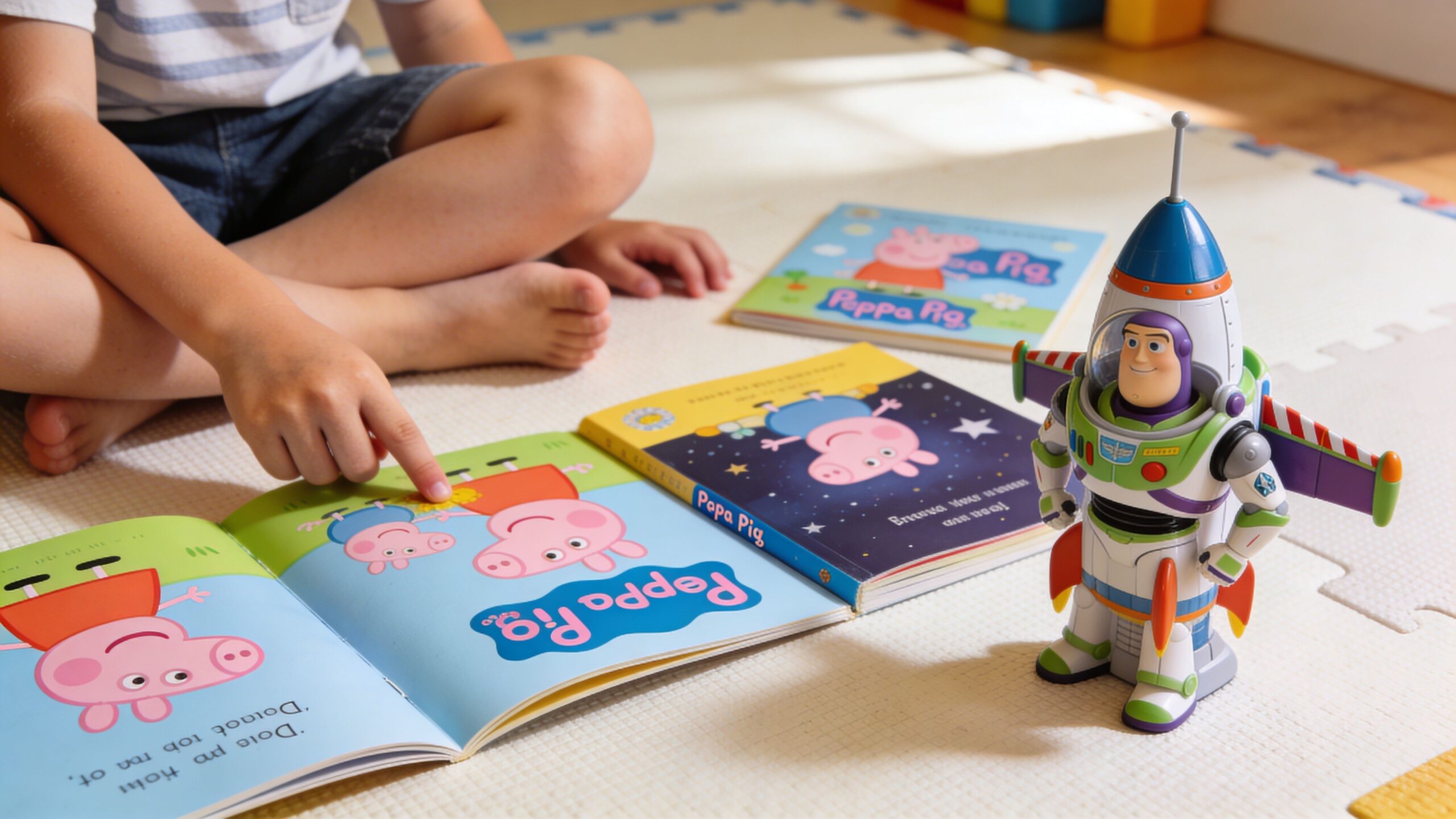
Reading bridges that work
Try pairing a familiar Peppa theme with a bigger thinking question afterwards.
- Camping and night skies. Read a Peppa outdoor story, then ask what children can see in the sky and what they think stars are.
- Building and making. If Peppa builds, sorts, or fixes, follow it with a story challenge about how things are designed.
- Weather and puddles. Start with rain, then ask where water goes, why clouds form, or what happens in space where weather is different.
- Journeys and vehicles. Move from everyday travel to rockets, planets, and navigation.
Children love noticing links. It makes them feel like clever readers.
A teacher’s way to do it
I’d keep the pattern very simple:
- Read the familiar story.
- Ask one “how” or “why” question.
- Introduce a new adventure book that expands the idea.
- Let the child explain the connection in their own words.
If a child can say, “This Peppa story reminds me of that space mission because both characters had to solve a problem,” they’re doing powerful thinking.
For families and schools ready to build that bridge with more adventurous story-led learning, you can explore this excellent book for young children and schools.
You can also mix in drawing, role play, and simple discussion prompts. No fancy setup needed. Just one familiar book, one new idea, and room for a child to wonder.
Your Child’s Journey From First Words to First Missions
Every early story adds a brick to the reading house.
Peppa often helps with the first layer. Familiar characters. predictable patterns. language children can hold onto. That stage matters, and it shouldn’t be rushed.
Reading growth changes shape
As children grow, they often want stories that do more. They still want fun, but they also want challenge. They want to test ideas, solve problems, and feel the thrill of understanding something new.
One recent source notes a Q1 2026 18% dip in UK physical book sales for Peppa Pig as audiences shift towards digital, and suggests that multi-platform brands spanning books, games, and animation may offer a more interactive path for parents and educators (Peppa sales trend note).
That’s worth noticing because children’s reading lives aren’t confined to one format anymore. They read, listen, watch, build, act, and create.
Keeping the joy while raising the challenge
A strong reading journey helps a child say:
- I think
- I try
- I can
- I can explain
That last one is especially important. Explanation shows understanding.
If you want to extend a story into hands-on making, even simple craft prompts can help. Some families enjoy simple and satisfying crafts like making keychains because they give children another way to connect stories, symbols, and imagination through making.
A peppa pig book set can be the beginning. It doesn’t have to be the end. The goal is not to keep children in one reading world forever. It’s to help them move confidently from comfort to curiosity.
If you’d like the next step after Peppa, explore Space Ranger Fred. You’ll find story-led STEM adventures, fun books that build confidence and problem-solving, free activities for children, and interactive school visit ideas that support reading, communication, and classroom curiosity. Learning should be experienced, not just delivered.