Meta title: Why Does Saturn Have Rings for Kids
Meta description: Why does Saturn have rings? A fun, simple guide for kids, parents and teachers with clear science, a craft activity and space-themed learning ideas.
Why does Saturn get the cosmic jewellery while the other planets look a bit more plain?
That’s the question children ask all the time, and it’s a brilliant one. Saturn’s rings look so neat and tidy that many people assume they’ve always been there, like a permanent hula hoop in space. They haven’t. The answer is far more dramatic.
If you’re a parent, teacher, or librarian, this is one of those perfect science topics. It starts with a simple question, opens the door to space, and ends with children saying, “I can explain that.”
Saturn the Solar System's Jewellery Box
Saturn looks like the show-off of the Solar System, doesn’t it. Jupiter is huge. Mars is rusty. Neptune is deep blue. Then Saturn arrives wearing a sparkling ring set like it’s off to a royal ball.
Children often ask a very sensible question. Why does Saturn have rings at all? Why not Earth? Why not Venus? Why does one planet get the dramatic entrance?
The first thing to know is that Saturn’s rings are not a solid disc. They only look that way from far away. From a distance, they seem smooth and flat, a bit like a shiny record or the brim of a hat. Up close, they’re a giant collection of material moving around Saturn in orbit.
That idea can feel odd at first. If the rings are made of separate bits, why do they look so neat? Why don’t they just drift off and make a terrible mess of space?
Saturn is a lovely reminder that space isn’t frozen in time. It changes, collides, breaks apart, and builds new things.
That’s part of the wonder here. Saturn’s rings tell a story about gravity, motion, and a very messy event from the planet’s past.
For children, this question is a great science doorway because it invites four strong learning moves:
- I think Saturn’s rings might be a solid band.
- I try to picture them as lots of separate pieces.
- I can understand that gravity keeps those pieces moving.
- I can explain that the rings likely formed from material that once belonged to a moon.
That last part is a jaw-dropper. Saturn’s rings may be beautiful, but their origin story is not exactly gentle.
What Are Saturn's Rings Made Of
Space Ranger Fred likes to ask a sneaky question here. If Saturn’s rings look like one smooth shiny band, what would they feel like up close. A hard metal hoop? A giant pancake? A flying hula hoop the size of a planet?
None of those, and that is the wow part.
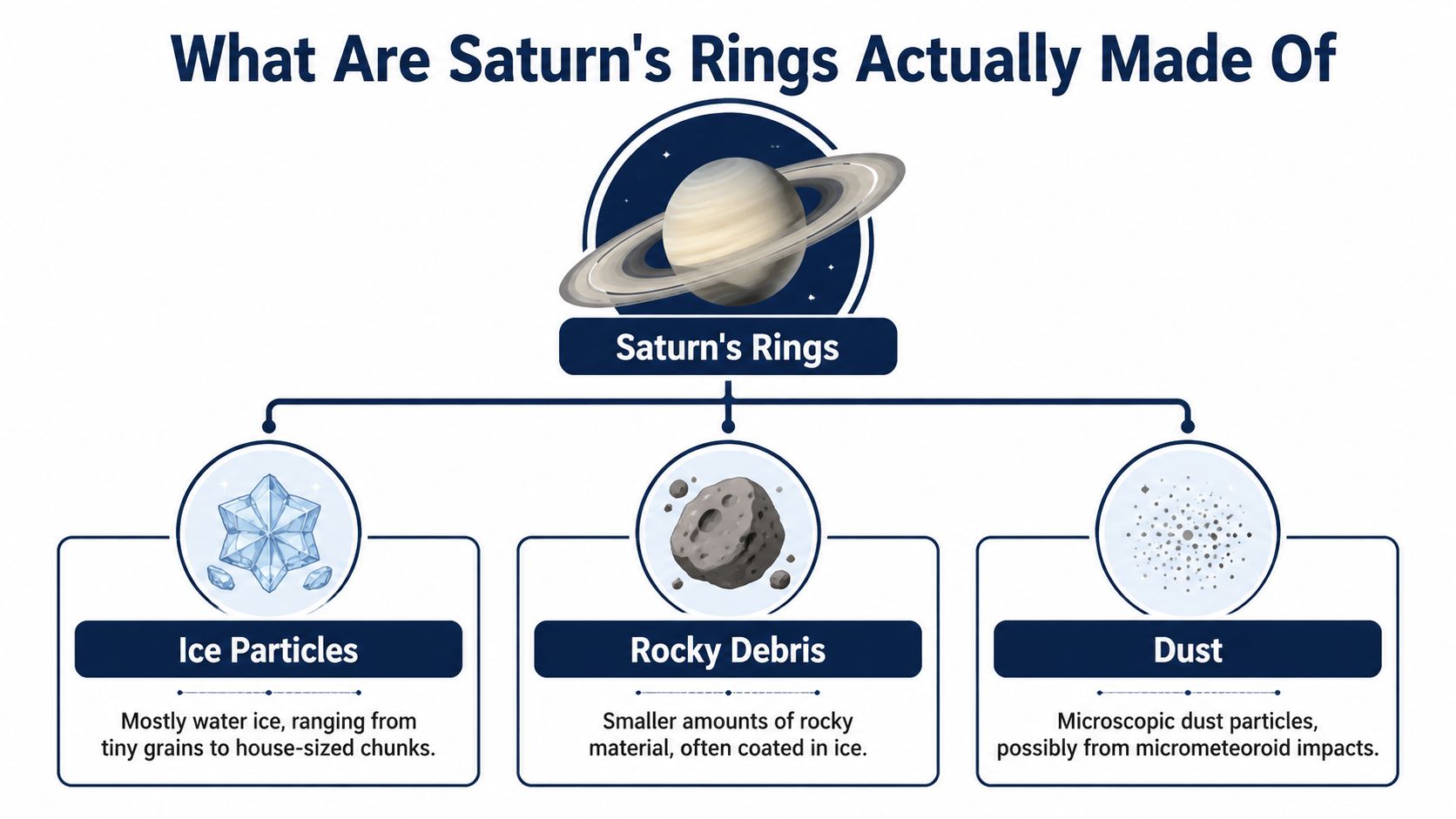
Saturn’s rings are a vast crowd of separate pieces orbiting together. Some bits are as fine as dust. Others are much bigger, even house-sized, according to The Planetary Society’s explanation of planetary rings.
A flat swarm, not a single sheet
Children often pause here and say, “Hang on. If it’s loads of pieces, why does it look so tidy?”
That is a brilliant question. The ring system works like a giant traffic circle in space, with countless icy bits following their own lanes around Saturn. From far away, your eyes blend all those lanes into bright bands, a bit like how a flock of birds can look like one moving shape from the ground.
The rings spread astonishingly far from Saturn, yet they are also surprisingly thin. So thin, in fact, that from the side they can seem to almost vanish. Saturn is showing off again, which feels very on-brand.
Mostly ice, with rocky crumbs and dust
The brightest parts of the rings are made mostly of water ice. That ice reflects sunlight well, which is why Saturn can look as if it has been sprinkled with cosmic glitter. Mixed in with the ice are darker rocky fragments and tiny grains of dust.
A simple classroom way to picture the mix is to use three bowls. Put flour in one for the tiniest dust, rice or lentils in another for the medium pieces, and ice cubes or white pebbles in a third for the largest chunks. Swirl them gently on a tray, and children can see how one “ring” can be made of many sizes at once.
Scientists have identified many separate ring bands and narrower ringlets within them. The main groups have letter names such as A, B, C, D, E, F, and G. That sounds a bit like Saturn forgot to label them properly, but astronomers were doing their best with what they could see.
If your class is comparing icy space stuff, this guide to what comets are made of makes a fun side mission, because comets also contain ice and dust, though they are built very differently.
Fred’s quick fix for a common mix-up: Saturn’s rings are not one giant solid object. They are millions upon millions of separate icy pieces travelling together around the planet.
The Great Crash That Created the Rings
What could turn an ordinary moon into the most famous set of rings in the Solar System?
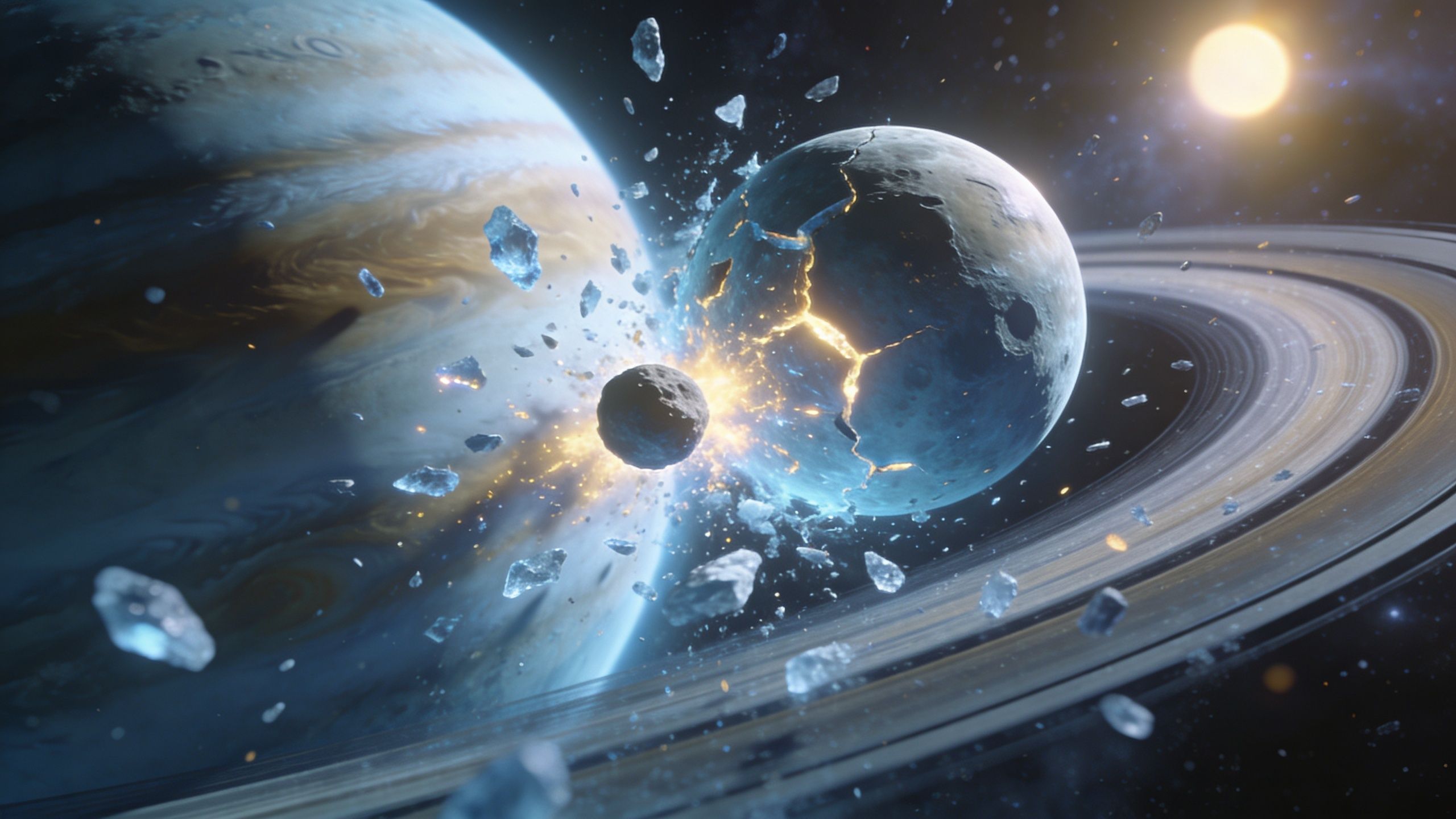
One leading idea says Saturn had a moon that drifted too close and paid a terrible price. Scientists think the rings may be surprisingly young, forming long after Saturn itself was born, as explained in the University of California report on how Saturn got its rings. On a Solar System timescale, that makes the rings rather new. Saturn is ancient. The rings may be more like a recent makeover.
Meet Chrysalis
The moon in this story is called Chrysalis. Space Ranger Fred likes to tell children it sounds like the name of a superhero, but its ending was far less cheerful.
The idea is simple once you break it into pieces. Saturn’s gravity did not pull equally on every part of the moon. The side closer to Saturn felt a stronger tug than the far side. If you want a quick refresher on how gravity pulls objects together, Fred’s guide to gravitational pull in simple terms helps make that force easier to picture.
A classroom activity makes this click. Give children a ball of playdough or soft dough and ask them to gently stretch it from both ends. At first it holds together. Then cracks appear. Then pieces pull away. That is not exactly what happened in space, of course, but it helps children see how a world can be pulled apart when the force becomes too strong.
Scientists think most of Chrysalis did not stay in orbit. It fell into Saturn, while a much smaller leftover share spread out around the planet and became the bright rings we see today. That tiny surviving fraction was enough to create a view so spectacular that even grown-ups tend to stop and stare for a moment. Fair enough, really.
This idea also helps explain why Saturn’s rings still look so bright. Fresh ice looks cleaner than ancient ice that has spent ages collecting grime. So the rings may be giving us a clue about their age just by shining.
Fred’s museum-guide question for the room is this. If only a small part of a moon was left behind, how could it spread into such a huge ring system? That is the lovely twist. In space, small bits can cover an enormous area when gravity and motion keep them circling in the same neighbourhood.
Here’s a short video if you’d like a visual companion for the story:
For children who enjoy big space adventures in story form, you can find the Space Ranger Fred books for more science-fuelled reading fun.
A Cosmic Ballet How the Rings Stay in Place
What stops Saturn’s rings from tumbling into the planet like sprinkles sliding off a giant doughnut?
The answer is a lovely bit of space choreography. Saturn pulls the ring particles inward with gravity, but each tiny piece is also racing sideways around the planet. Those two motions happen at the same time, so the particles keep falling around Saturn instead of falling straight into it.
Space Ranger Fred often tells children to try a playground version of this idea. Swing a soft ball on a string in a circle. Your hand pulls inward. The ball keeps moving sideways. Let go, and off it zooms. Rings work by the same basic rule, although Saturn’s version is rather more impressive and much less likely to bonk anyone on the nose.
The moons that act like ring guides
Saturn’s rings are not a messy heap. Many parts stay in neat lanes, with sharp edges and clear gaps, because nearby moons tug on the particles again and again as they orbit.
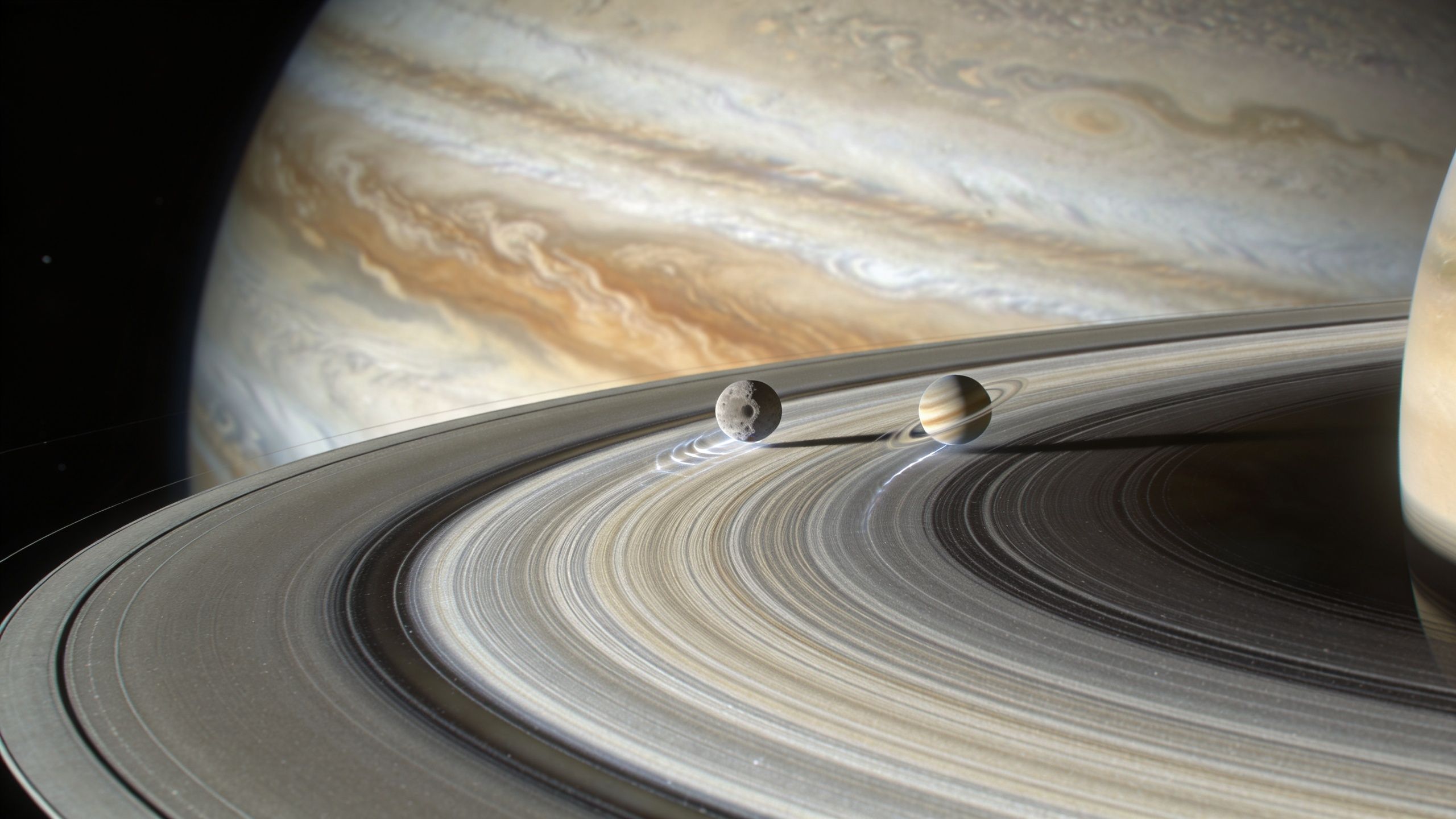
These little helpers are often called shepherd moons. That name fits beautifully. They guide ring material the way a good sheepdog keeps a flock from wandering, minus the barking and muddy paws. Some moons help keep ring edges crisp. Others stir up waves or help maintain the dark gaps between ring bands.
One small moon, Pan, even orbits inside a gap and helps shape the material around it. Wow.
A classroom activity Fred would absolutely approve of
Here is a quick hands-on demo for home or school.
Use:
- a large bowl or tray for Saturn
- dry rice, sugar, or paper dots for ring particles
- two marbles or coins for moons
Ask children to move the “moons” gently around the edge of the tray while watching what happens to the grains. The tray will not copy real gravity, of course, but it helps children notice a big idea. Small objects can influence the path of lots of tiny pieces nearby.
That is the heart of the ballet.
If a child asks, “So why don’t the rings just drift into a blob?” you can answer it step by step:
- Saturn’s gravitational pull on orbiting objects keeps drawing particles inward.
- The particles already have forward motion.
- Nearby moons keep nudging some regions into organised patterns.
So the rings are busy, not frozen. They are a moving system, with countless icy bits circling together in a thin, flat sheet. Rather tidy for something made of cosmic rubble, really.
Secrets from a Space Probe Called Cassini
Human beings didn’t work all this out by squinting very hard from Earth with a cuppa in hand. We learned a great deal by sending spacecraft to Saturn.
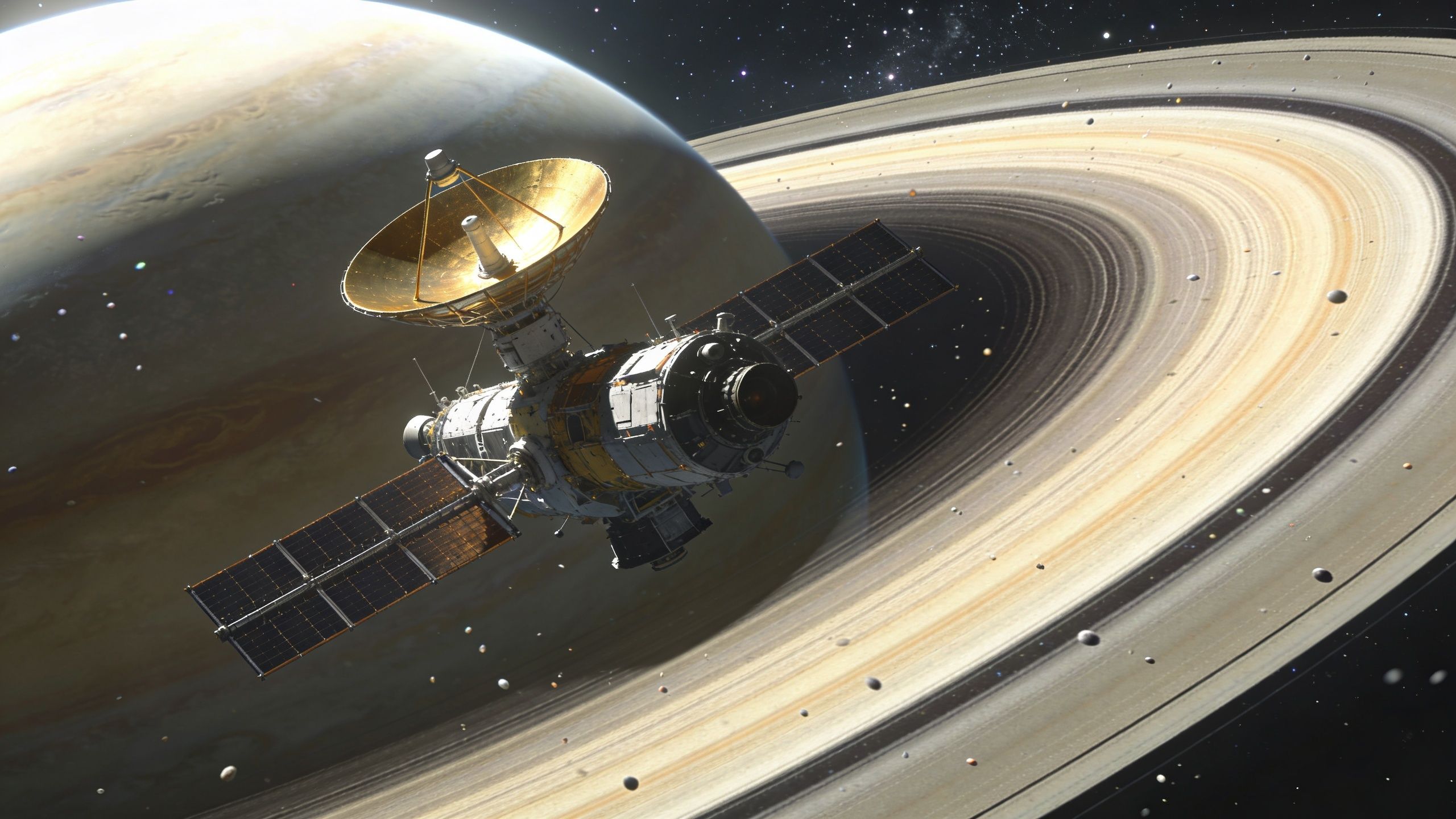
One famous explorer was Cassini, a space probe that studied Saturn and its ring system closely. For children, that’s a brilliant reminder that science is active. People build machines, send them into space, collect evidence, and slowly solve mysteries.
What a probe helps us do
A space probe can do jobs that are impossible from the ground alone. It can fly near a planet, study its rings in detail, and send observations back to Earth.
For a child, you might say a probe is a robot explorer. It doesn’t eat crisps, complain about the cold, or need a toilet break. Very convenient.
Cassini helped scientists build a clearer picture of Saturn’s rings, their structure, and their past. It added to the evidence that the rings are relatively young and helped scientists examine the moons that interact with them.
Why this matters for children
This part often sparks something special in classrooms and libraries. Saturn’s rings are not just a fact to memorise. They are a puzzle that people investigated.
That means children can think like scientists too:
- Ask a question
- Look for clues
- Test an idea
- Explain your reasoning
If you’d like a simple starter for younger readers, this page on what a space probe is fits nicely with the Saturn topic.
Space science is full of mysteries, but it’s also full of methods. Curiosity begins the journey. Evidence keeps it honest.
Build Your Own Saturn A Cosmic Craft Mission
Could a paper plate, a bit of glue, and a handful of rice help a child explain one of the Solar System’s best mysteries?
Space Ranger Fred would say yes, and with great ceremony too. A craft like this turns Saturn from a distant fact into something children can hold, point to, and talk about. That matters because learning sticks better when hands and brains are working together.
Parents, teachers, and curious older siblings can use this as a mini lesson, not only an art activity. By the end, children are building a model and practising the science story out loud. That is a splendid two-for-one.
What you need
You only need simple supplies:
- A paper plate for the rings
- A small ball or circle of card for Saturn
- Paints or colouring pencils in sandy, gold, or pale brown shades
- Glue
- Glitter, rice, or tiny paper bits to represent ring particles
- Scissors with adult help where needed
No fancy equipment required. Good news for your cupboard. Good news for your wallet too.
How to make it
-
Make Saturn
Colour your card circle or small paper ball to look like the planet. Add soft stripes and swirls. Saturn is a gas giant, so it looks more like a cloudy marble than a flat yellow dot. -
Create the ring shape
Cut the centre from the paper plate so you are left with a wide ring. That gives children the right overall shape straight away. -
Add texture
Glue on glitter, rice, or paper bits. This helps children see an important idea. Saturn’s rings are made of countless separate pieces, more like icy crumbs in orbit than a single solid hoop. -
Attach the planet
Fix Saturn into the middle so the ring sits around it. If it ends up a bit lopsided, carry on. Even mission commanders have untidy desks. -
Talk while you build
Ask questions as the model comes together. Are the rings one piece or many? What might those pieces be made of? Why do they keep going round Saturn instead of dropping straight in?
Turn craft time into science talk
Here is where the activity becomes a proper lesson. The model gives children something concrete to point at while they explain what they have learned.
Try these sentence starters:
- I think Saturn’s rings are made of icy and rocky pieces.
- I can show that the rings are made of many separate particles.
- I know the rings probably formed from debris after an object broke apart near Saturn.
- I can explain why the pieces keep orbiting instead of joining into one solid band.
For younger children, keep the language short and clear. “The rings are lots of tiny bits going round and round.”
For older children, add a challenge. Ask them to explain how gravity pulls the pieces inward while motion carries them forward, rather like runners going round a track without cutting across the middle. That balancing act is a lovely wow moment.
A simple classroom extension works brilliantly here. Turn the room into a mini space museum. Each child holds up their Saturn model and gives a short explanation to a partner, a table group, or the whole class. Space Ranger Fred can introduce each “exhibit” with full explorer flair and a slightly over-serious voice, which children usually find hilarious.
One child might explain what the rings are made of. Another might explain how the debris formed. Another might describe how scientists used a robot probe to gather clues. Suddenly, a paper plate has turned into speaking practice, memory work, and scientific reasoning.
That is a pretty good mission for one afternoon.