
It’s easy to dismiss a children's word search book as just another puzzle, but it’s so much more. It's a powerful and genuinely fun tool that gets a child’s brain firing, helping them build vocabulary, sharpen their spelling, and stretch their concentration muscles—all while they think they’re just playing a game.
Ready to turn a simple puzzle into a learning adventure? Let's dive in!
The Hidden Power of a Simple Word Search
You’ve probably seen it before: a child, pencil gripped in their hand, completely lost in a grid of letters. Their head is tilted, eyes scanning the page, and the rest of the world just melts away. In that quiet moment of focus, something brilliant is happening.
It might look like a simple pastime, but a good word search is one of the most effective ways to build crucial skills in a low-pressure, playful way. It cleverly turns learning into a rewarding game of hide-and-seek with words.
An Explorer Charting New Territory
Imagine your child as an explorer discovering new lands. The word search grid is their map, and every word they find is a new landmark. As they hunt for each word, they’re not just circling letters; they're building mental maps and reinforcing the connections in their brain.
This simple act strengthens key cognitive skills in a natural, hands-on way:
- Vocabulary and Spelling: Seeing and searching for words over and over again helps cement their correct spelling. Finding "PLANET" or "GALAXY" in a puzzle makes it stick far better than just reading it from a list.
- Pattern Recognition: The brain learns to spot letter sequences forwards, backwards, and diagonally. This is a fundamental skill that underpins everything from reading fluency to mathematical reasoning.
- Focus and Concentration: You can't finish a word search without sustained attention. This helps children build their mental stamina and teaches them the quiet satisfaction of seeing a task through to the end.
A word search transforms the abstract task of learning words into a concrete, hands-on quest. It gives children a sense of achievement with every single word they circle, building confidence one puzzle at a time.
This table breaks down the core developmental skills a child strengthens every time they sit down with a word search.
Key Learning Benefits at a Glance
| Skill Developed | How Word Searches Help |
|---|---|
| Vocabulary Expansion | Introduces new words in a memorable, game-like context. |
| Spelling Reinforcement | Repeatedly seeing a word's correct spelling helps commit it to memory. |
| Pattern Recognition | Trains the brain to spot sequences and patterns, a key skill for reading. |
| Sustained Attention | Requires focus and concentration to find all the hidden words. |
| Problem-Solving | Encourages logical thinking and scanning strategies to solve the puzzle. |
| Working Memory | Kids have to hold a word in their mind while scanning the grid to find it. |
As you can see, it’s a full brain workout disguised as simple fun.
From Puzzle to Story
But the real adventure begins when a word search connects to a story. When the words in the puzzle are pulled from a character's journey, like one of the missions in the Space Ranger Fred books, the activity takes on a whole new meaning. A list of space-themed words is no longer just a list; it’s a mission briefing.
Finding words like 'NEBULA', 'ASTEROID', and 'SPACESHIP' becomes part of the adventure itself. This bridge between storytelling and puzzling deepens a child's engagement and makes learning feel genuinely exciting. It reframes a simple activity as an essential part of a STEM learning toolkit, which perfectly aligns with our mission to make education an adventure.
By blending the thrill of a good story with the satisfaction of cracking a puzzle, you create a powerful learning experience that sparks curiosity and shows children that knowledge is something to be discovered, explored, and enjoyed.
Choosing the Right Word Search for Your Young Explorer
Not all word search puzzles are created equal. Far from it. Choosing the right one can be the difference between a fun challenge that builds confidence and a frustrating task that gets abandoned. The secret is matching the puzzle’s complexity to the child’s age and reading level, making sure it always feels like an achievable adventure.
A well-chosen word search meets a child where they are, gently encouraging them to stretch their skills without ever feeling overwhelmed. Think of it like setting up a mission for a young space ranger: you want the objective to be just tricky enough to be exciting.
For Younger Adventurers (Ages 6-8)
For kids just starting their puzzle-solving journeys, simplicity is absolutely key. The goal here is all about building confidence and making the whole experience feel joyful and rewarding.
- Smaller Grids: Look for puzzles with smaller grids, like 8×8 or 10×10. This makes the search area feel manageable and helps them find words more quickly, giving them those little wins that keep them going.
- Simple Word Directions: At this stage, stick to words hidden only forwards (left to right) and downwards (top to bottom). This keeps the scanning process straightforward and less confusing for little eyes.
- Large, Clear Fonts: A big, easy-to-read font is a must. It helps prevent eye strain and makes recognising letter shapes much easier for those who are still early on in their reading journey.
This simple decision tree shows how a single puzzle can be both a fun game and a brilliant learning tool.
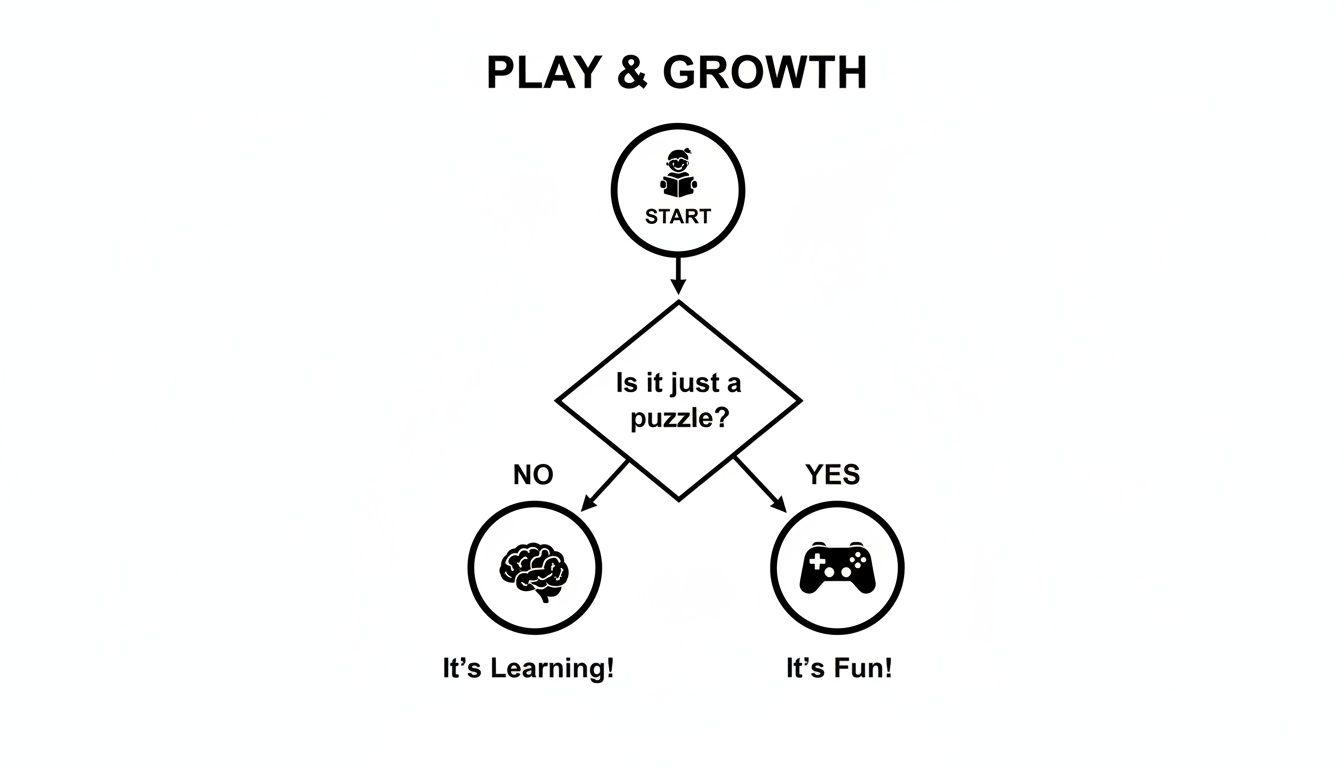
It all comes down to this: whether a child sees it as a game or a learning activity, the result is positive engagement and real growth.
For Seasoned Explorers (Ages 9-12)
Older or more confident children are usually ready for a bigger challenge. This is where you can introduce more complex puzzles that really put their observation skills to the test.
- Larger Grids: It’s time to move up to 15×15 grids or even larger. These puzzles require more patience and a bit more strategic thinking to conquer.
- Complex Word Directions: Now you can introduce words hidden backwards, diagonally, and even overlapping with each other. This really sharpens their pattern-recognition abilities.
- More Challenging Vocabulary: Puzzles for this age group can include longer, more complex words, subtly expanding their vocabulary with every single search.
The demand for engaging, hands-on activities is as strong as ever. While the UK print book market has seen its shifts, activity-based children's categories have shown incredible resilience. The Pre-School & Early Learning sector, for instance, has grown in both value and volume, proving just how much parents value screen-free formats that make learning literacy skills feel like pure play.
The perfect puzzle is one that stretches a child’s abilities just enough to feel rewarding. It should feel like they’ve cracked a code, not like they’ve been given an impossible task.
The Power of a Great Theme
Beyond the grid size and word direction, the single most important factor is the theme. A generic word search is fine, but a puzzle themed around a child’s passion—whether it's dinosaurs, magic, or a space mission—transforms the activity into an exciting quest they can’t wait to start.
This is where books and puzzles can work together so brilliantly. A children's word search book tied to a story, like a Space Ranger Fred adventure, makes the learning feel relevant and genuinely exciting. When kids are searching for words like 'ASTEROID' or 'ALIEN', they are reliving the story and connecting with the characters on a whole new level. You can learn more about how children’s books spark imagination in our guide.
By choosing puzzles that align with your child’s interests, you’re not just giving them a fun activity; you’re showing them that learning can be a thrilling part of the worlds they already love.
Turning Puzzles into STEM Learning Adventures
A brilliant children's word search book does more than just keep a child occupied; it can launch their learning into a whole new orbit. With a bit of creative thinking, that simple grid of letters becomes a launchpad for exciting STEM adventures, turning a quiet activity into a catalyst for real-world exploration.
The magic happens when you connect the words on the page to the world around them. Instead of just a random list of words, a themed puzzle inspired by a story or a scientific idea gives each word meaning. This is where you can bridge the gap between a fun puzzle and hands-on learning, making big concepts feel approachable and exciting.
From Word List to Mission Briefing
Let's imagine some themed puzzles inspired by the Space Ranger Fred universe. Think of these not just as word lists, but as mission briefings designed to spark questions and set up the next activity.
Example 1: The 'Mission to Mars' Puzzle
- Word List: ROVER, CRATER, ATMOSPHERE, RED PLANET, EXPLORE, ROCKS, MISSION, ORBIT, DUST STORM, GRAVITY.
- The Learning Spark: This puzzle is packed with core vocabulary for Mars exploration. Finding the word ROVER isn't just about spotting letters; it's an invitation to ask, "What does a rover actually do?"
Try This Next! Build Your Own Mars Rover
Once the puzzle is complete, grab a cardboard box, some bottle caps for wheels, and tin foil for antennae. Challenge your young explorer to design and build their very own Mars rover. Can it carry a small rock? Can it handle the bumpy terrain of the living room carpet? This simple craft brings the word ‘rover’ to life in a tangible, memorable way.
Sparking Curiosity with Every Word
The goal is to use each puzzle as a gentle starting point for a bigger conversation or a hands-on project. You’re connecting the dots between abstract words and concrete experiences.
Example 2: The 'Alien Galaxy' Challenge
- Word List: NEBULA, CRYSTAL, TELEPORT, GALAXY, ALIEN, SPACESHIP, UNIVERSE, COMET, PLANET, STARGAZE.
- The Learning Spark: This puzzle is filled with imaginative, cosmic words that get creative gears turning. What does an alien planet look like? What colours would you see in a nebula?
Try This Next! Design a New Planet
Hand over some paper and crayons, felt tips, or paints. Ask your child to imagine and draw the alien planet from the puzzle. Does it have crystal mountains? Do strange creatures live there? This activity encourages creativity and helps them visualise the amazing concepts they’ve just discovered. You can learn more about how to connect different learning concepts in our guide to what is STEAM education.
By linking a puzzle to a playful activity, you show children that learning isn't just about finding answers—it's about asking great questions and trying things out for themselves.
This approach transforms a simple children's word search book into a truly interactive learning tool. It seamlessly blends literacy skills with science, technology, engineering, arts, and maths, proving that they are all part of the same grand adventure. Pushing this idea further, exploring engaging science fair ideas can be a fantastic next step to cultivate a child's scientific curiosity from a young age.
Ultimately, turning puzzles into STEM adventures is about fostering a mindset of curiosity. It’s about showing children that the words they find on a page are connected to incredible ideas, amazing stories, and a universe of things to discover, build, and imagine.
Create Your Own Space Ranger Fred Puzzle
Ready to swap your puzzle-solving hat for a puzzle-creator’s helmet? Making your own word search is a brilliant, hands-on activity to do with your child. It flips the script, turning them from a puzzle-solver into a puzzle-maker and giving them a fantastic sense of ownership over their learning.
Crafting a custom children's word search book (or even just a single puzzle sheet) is a brilliant way to fill an afternoon. It’s a fun, collaborative mission that mixes creativity, spelling, and a bit of design thinking all into one.
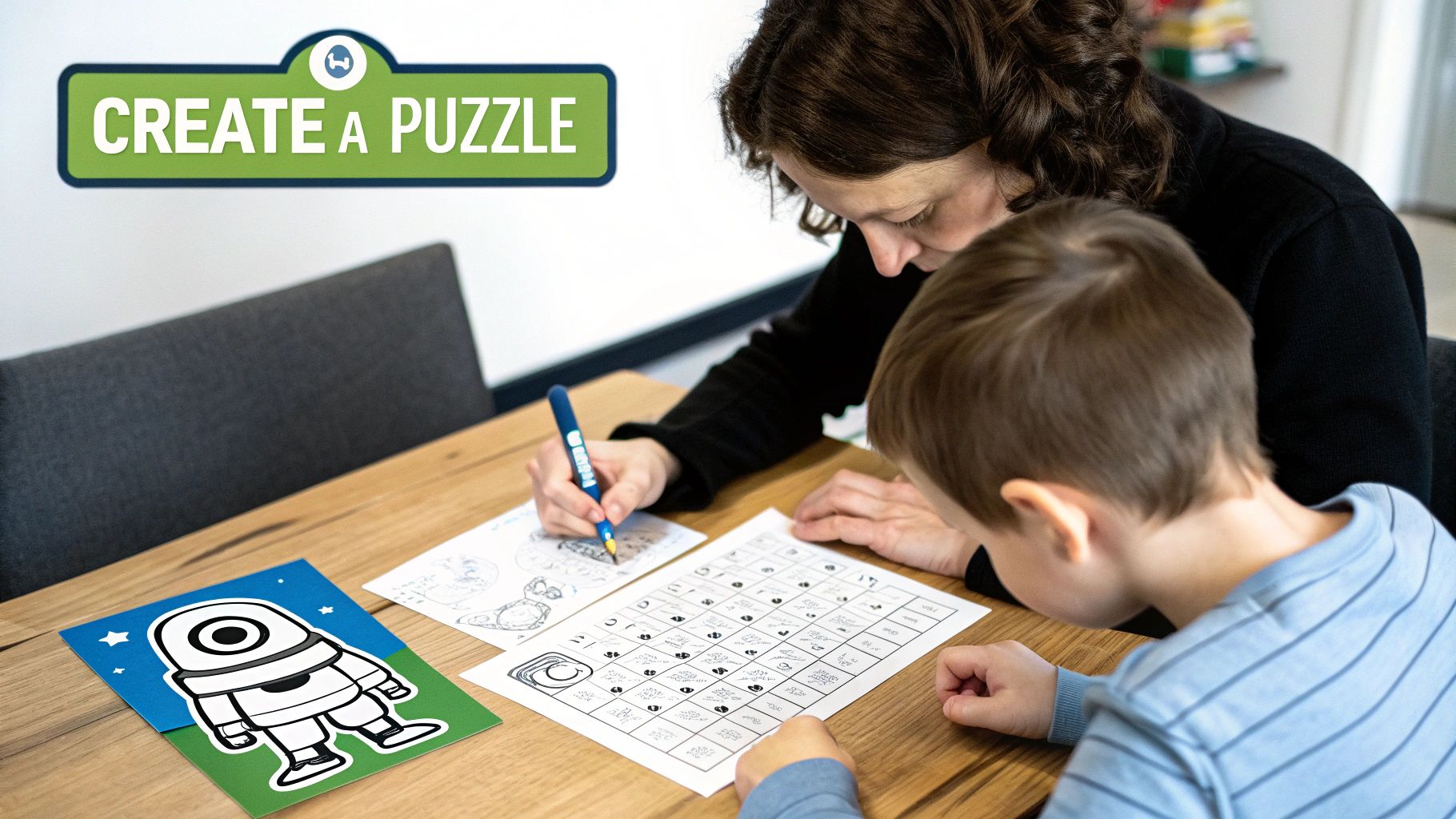
Step 1: Choose Your Adventure Theme
Every great puzzle starts with a great story. Before you even think about grids and letters, settle on a theme for your adventure. This is the perfect moment to let your child's imagination take the lead.
Maybe they want to design a puzzle based on their favourite Space Ranger Fred mission, a trip to a mysterious new planet, or an encounter with a friendly alien. The theme will guide every word you choose and make the final puzzle far more exciting to solve.
Step 2: Brainstorm Your Mission Word List
This is where the teamwork really kicks in. Sit down together and brainstorm a list of 10 to 15 words that fit your theme. Let your child pick their favourites—it gives them a real stake in the project.
For a Space Ranger Fred theme, your list might look something like this:
- SPACESHIP
- ASTRONAUT
- GALAXY
- PLANET
- MISSION
- ALIEN
- ROBOT
- NEBULA
- CRATER
- EXPLORE
Writing the words out together is also a great, low-pressure way to practise spelling without it feeling like a chore.
The best puzzles are personal. When you let a child choose the words, you're not just making a game; you're creating a snapshot of their interests and imagination.
This move towards customisation is getting more and more popular. Parents are looking for tools that feel special and relevant to their child, helping to cut through the digital noise and support their education in a meaningful way. Creating your own puzzle taps right into that.
Step 3: Design Your Grid
Now it's time to map out the playing field. Grab some graph paper or just draw a grid with a ruler. The size depends on the age and confidence of your little puzzle-solver:
- For ages 6-8: A 10×10 grid is a great starting point.
- For ages 9-12: A 15×15 grid offers a more satisfying challenge.
Make sure the squares are big enough to write each letter clearly. If you need a hand, you can find some ready-to-go grid templates on our freebies and activities page.
Step 4: Hide Your Words
Here comes the fun, sneaky part. Carefully write your chosen words into the grid. You can decide just how tricky you want to make it:
- Easy: Place words only forwards and downwards.
- Medium: Add in some words hidden backwards.
- Challenging: Include words hidden on the diagonal, both forwards and backwards.
Write one letter in each square, and don't forget to keep your master list handy.
Step 5: Fill in the Gaps
Once all your mission words are hidden, the last step is to fill every empty square with random letters of the alphabet. This is the camouflage that makes it a real challenge. The more random the letters, the better the puzzle!
And that’s it—mission accomplished! You've created your very own word search. If you’re keen on more hands-on creative projects, learning how to make your own board book can be another wonderful way to bring stories to life.
More Than Just a Puzzle: Creative Group Activities
A word search is usually a quiet, solo mission, right? But what if it could be the launchpad for a buzzing group adventure? With a little imagination, a simple children's word search book can transform into a fantastic tool for collaborative play, perfect for family game night or a lively classroom warm-up.
When we reframe the puzzle as the start of the conversation, not the end, we unlock its power to build communication skills, encourage teamwork, and spark some serious creativity. It’s all about taking the fun of the hunt and sharing it.
The Word Search Race
This one is brilliantly simple and a guaranteed way to inject some friendly competition into the room. It’s perfect for getting a group energised and focused.
- Get Ready: Give each child (or small team) a copy of the same word search puzzle.
- Get Set: On the count of three, they all start searching at the same time.
- Go! The first person or team to find all the words correctly wins a small prize or, even better, ultimate bragging rights.
You can easily add fun twists, too. Try having them shout out each word as they find it or awarding bonus points for finding the longest word first. It turns a quiet task into an exciting race against the clock.
Definition Detectives
This activity cleverly layers vocabulary practice onto the fun of the puzzle. It nudges children to think more deeply about the words they’re finding, moving beyond just spotting a jumble of letters.
- The Mission: Every time a child finds a word, they have to explain what it means in their own words.
- The Teamwork: If they get stuck, they can ask a teammate for help or grab a dictionary to look it up together.
This game is especially powerful for STEM-themed puzzles. Finding the word ‘ORBIT’ is one thing, but explaining that it’s the curved path an object takes around a planet or star? That’s where the real learning clicks into place.
By talking about the words, children move from passive recognition to active understanding. They aren’t just finding words; they are making meaning together, which is the heart of collaborative learning.
The Story Starter Challenge
Here’s where you can really let their creativity run wild. This game uses the word search as a bank of story prompts, turning a simple word list into the building blocks of a completely new adventure.
- Find a Word: The first player finds any word in the puzzle.
- Start the Story: They must use that word to kick off a story with a single sentence. For example, if they find ‘SPACESHIP’, they might say, "The rusty old spaceship creaked as it landed on the purple planet."
- Pass It On: The next player finds a new word and adds the next sentence, building on what came before.
The tale gets sillier and more exciting with every word found, resulting in a unique story created by the whole group. You can learn more about the power of working together in our article exploring what is collaborative learning.
These group activities prove that a children's word search book is so much more than a puzzle—it's a launchpad for connection, conversation, and shared creativity. It’s proof that learning can be a social, joyful, and truly memorable experience.
Why a Physical Book Still Matters in a Digital World
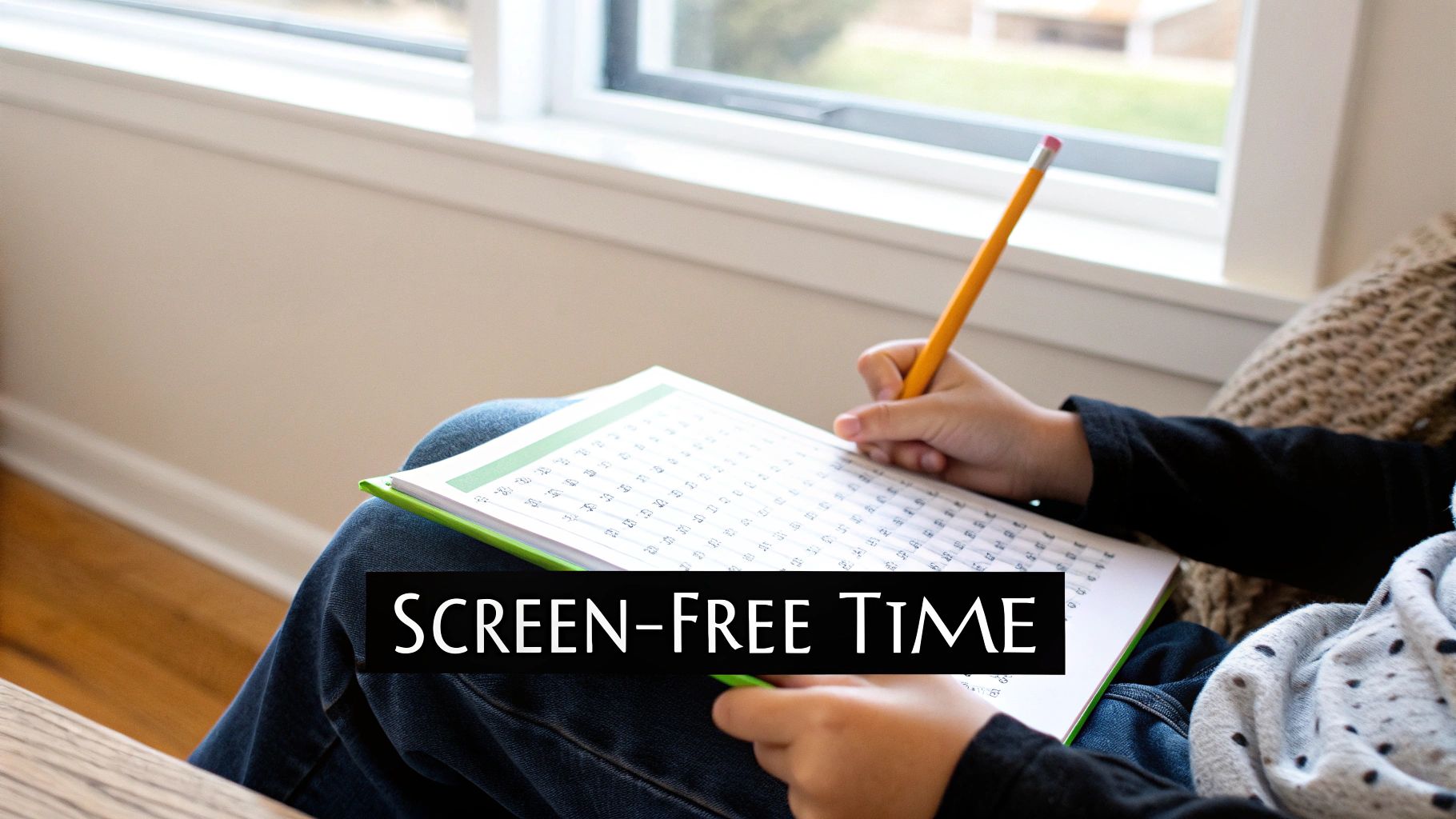
In a world buzzing with screens and notifications, the quiet, simple joy of a physical book feels more important than ever. A children's word search book offers something unique—a tangible experience that apps just can't replicate. It’s a much-needed break from screen time, helping to reduce eye strain and create a moment of calm, focused fun.
The act of holding a book, feeling the paper, and using a pencil is incredibly powerful. When a child grips a pencil to circle a word, they’re not just playing a game; they're developing the fine motor skills and hand-eye coordination essential for confident handwriting. It's a physical connection to learning that grounds them in the present moment.
The Enduring Appeal of Hands-On Play
Despite the explosion of digital entertainment, physical books for children are here to stay. This isn’t just nostalgia talking; parents and teachers instinctively recognise the value of hands-on, focused activities. The UK children's book publishing industry continues to thrive, with strong revenues showing an enduring preference for physical books that encourage this kind of engaged learning. Even with all the new media, the market's resilience highlights a deep desire for creative content that blends education with entertainment. You can explore more insights on the children's book market to see the full picture.
A word search book is the perfect portable companion for almost any situation:
- Long Journeys: It’s a brilliant, self-contained activity for a plane, train, or car trip.
- Quiet Afternoons: It offers a peaceful, screen-free alternative to digital games.
- Waiting Times: It turns a boring wait at a restaurant or doctor's office into a fun challenge.
A physical book doesn't buzz, send notifications, or tempt a child to click away. It invites them into a single, focused world where they can concentrate, solve a puzzle, and feel a genuine sense of accomplishment.
This is exactly what the Space Ranger Fred brand is all about—championing the enduring power of reading, imagination, and tangible play. A book you can hold in your hands offers a unique opportunity for connection. It’s a chance to sit side-by-side, solve a puzzle together, and share an experience in a way that screens often prevent. It's a reminder that sometimes the most meaningful adventures happen on the quiet pages of a book.
Your Word Search Questions Answered
We’ve seen how a humble children's word search book can launch a grand adventure, but you might still have a few questions floating around. Here are some quick answers to the things parents and teachers ask most often.
At what age can children start doing word searches?
Most kids are ready to give simple word searches a go around age 6 or 7, right about the time they start recognising words with confidence. The trick to setting them up for success is to start small. Think small grids, big, clear print, and words hidden only horizontally. No one wants their first try to feel impossible!
As their reading skills blossom, you can gradually bring in more complex puzzles—bigger grids, more words, and maybe even a few diagonals thrown in for good measure. The key is to keep the challenge just right for their ability, making it a rewarding game rather than a frustrating chore.
Are word searches genuinely good for learning?
Absolutely! They are a fantastic, play-based way to build vocabulary, lock in spelling, and sharpen those all-important pattern recognition skills. A good word search requires real focus, helping children stretch their concentration stamina without ever feeling like they're "working".
And when the puzzles are themed, like our Space Ranger Fred activities, they can gently introduce new STEM concepts and spark a genuine curiosity in subjects like astronomy and science. It makes learning feel relevant and exciting, not just like another school task.
How can I make word searches more engaging?
Simple—connect the puzzle to something your child already adores. A custom puzzle packed with words from their favourite book, film, or character is always a massive hit. You can find some great templates to get you started over on our freebies and activities page.
Another brilliant tip is to make it a team effort. Solve it together, have a friendly race to see who finds the next word, or use the found words as prompts to create a silly story. Turning it into a shared adventure makes all the difference and builds positive memories around learning.
Continue the adventure with Space Ranger Fred and discover a universe of stories, activities, and fun that makes learning an exciting mission for every young explorer. Start your journey today.