
Ever dreamed of building a secret moon base or your very own city on a faraway planet? That’s the magic behind a base builder game! Think of it as a giant, digital box of LEGO bricks, where you start with just a few pieces and can build anything you can imagine.
In this guide, we'll explore what makes a base builder game tick, how it secretly boosts your child’s brainpower, and even try a fun, hands-on activity to bring the adventure into your living room. Let’s blast off!
So, What Is a Base Builder Game?
A base builder game is a creative sandbox where you get to be the architect, the manager, and the chief explorer, all at once. It’s all about starting from scratch and building something incredible. Imagine Space Ranger Fred landing on a new world and needing to set up a base camp—these games hand you the tools to design and grow a whole new world from the ground up.
It all starts with a simple first step: gathering materials, or resources. In a space-themed game, that might mean mining for glowing crystals or harvesting unusual alien plants. If you were building a castle, you'd be collecting stone and wood instead.
Once you have your materials, the real fun begins: construction. You can start designing and placing all kinds of buildings, each with a special job to do.
- A Command Centre: The heart of your base, where you make all the big decisions.
- Living Quarters: A cosy spot for your space explorers or brave colonists to rest.
- Science Labs: For researching amazing new technologies and making discoveries.
- Power Stations: To keep all the lights on and the futuristic gadgets humming.
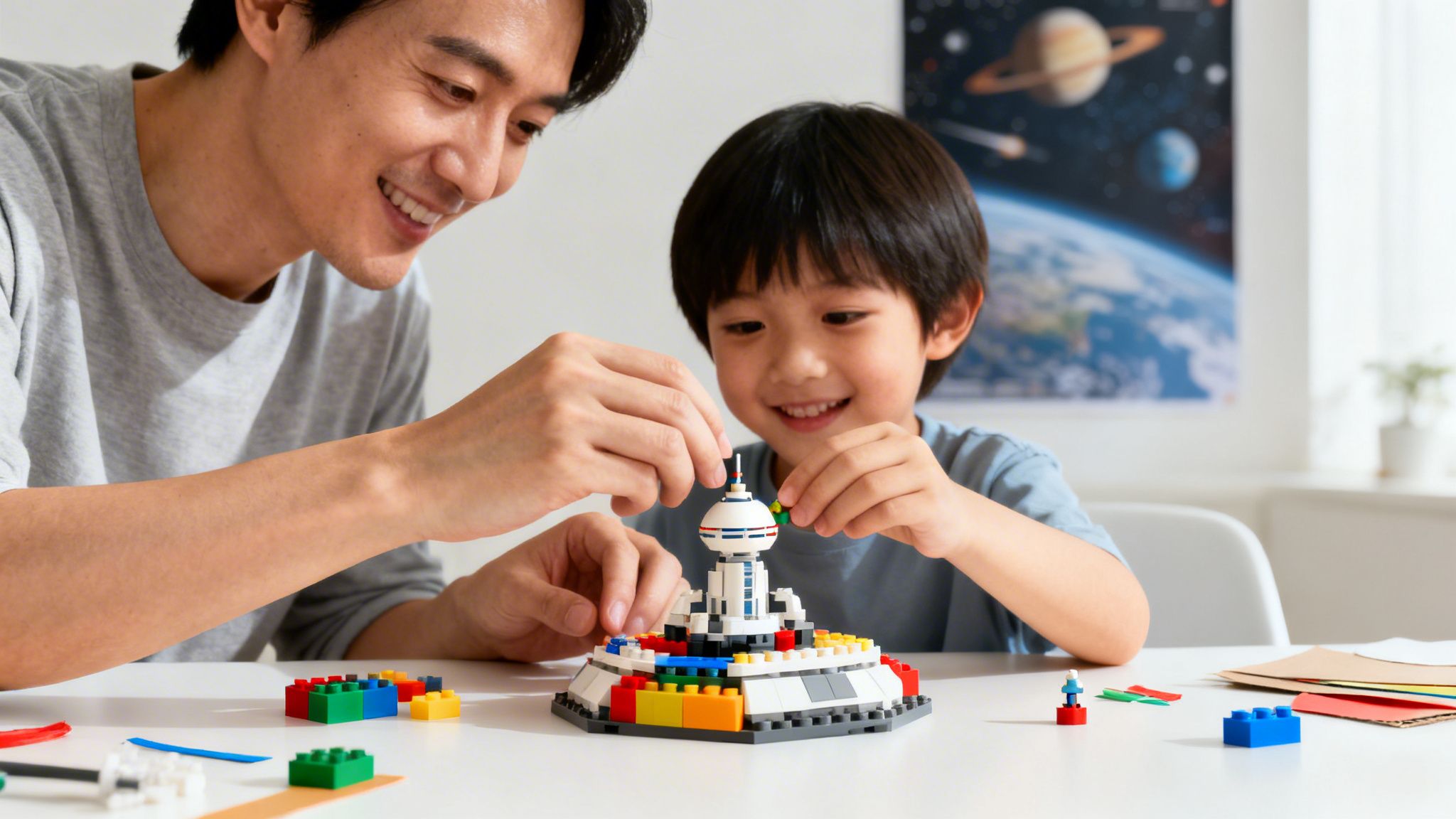
But it isn’t just about building. It's about bringing your creation to life. You’ll need to make sure your community has enough food, power, and supplies to thrive and grow. It’s this fantastic mix of creativity and strategy that makes these games so engaging.
It’s a brilliant blend of fun and learning that we explore further in our guide on how building games help children develop essential skills.
The Core Mechanics Of A Base Builder Game
So, what’s actually involved in playing a base builder game? Think of it like being a chief inventor, a starship captain, and a pioneering explorer all rolled into one. At their heart, these games are driven by a simple, satisfying loop of four key activities.
It’s this cycle that makes them so hard to put down—there's always a new challenge to tackle or a brilliant idea to bring to life.

Let’s see how this works in practice.
Gather, Build, Manage, And Explore
Picture this: Space Ranger Fred touches down on an uncharted planet. His first job isn't building a giant rocket launchpad. It’s much more fundamental. He needs to find the bare essentials just to get started.
1. Resource Gathering: Fred’s first task is to scout for useful materials. He might mine a strange, shimmering mineral to craft new tools, collect ice from a crater for drinking water, or even harvest alien plants for food and fuel. This is always the first step—collecting the bits and pieces you need to survive and thrive.
2. Construction and Design: With a stockpile of resources, Fred can finally start building. Maybe he’ll design a small solar farm to generate power or a greenhouse to grow his own space vegetables! This is where a child's creativity really takes over as they design a base that’s uniquely theirs.
3. Strategic Management: Once a few buildings are up, Fred has to make sure everything is running smoothly. Is there enough power for the science lab? Are all the astronauts fed and happy? This is the management piece of the puzzle, where players learn to make smart decisions to keep their base efficient and growing.
4. Exploration and Discovery: With the base humming along nicely, it’s time for Fred to venture out and see what else this new world holds. Exploring uncovers new resources, amazing discoveries, and fresh ideas for what to build next, which kicks the whole wonderful cycle off again. If you're looking for more ways to fire up that sense of discovery, check out our free activities for kids.
Fun Fact: This gameplay loop—Gather, Build, Manage, Explore—is a classic formula that makes these games so satisfying. Every action leads to a new opportunity, encouraging players to keep experimenting and growing their world!
But these game mechanics aren't just for fun; they're brilliant for building real-world skills in a way that doesn't feel like a lesson. This table shows just how these in-game activities translate into valuable abilities for young learners.
How Base Builder Games Develop Real-World Skills
| Game Mechanic | What Your Child Does | Skill It Develops |
|---|---|---|
| Resource Gathering | Finds and collects materials like wood, stone, or alien minerals. | Planning and prioritisation. |
| Construction & Design | Uses resources to create buildings, tools, and vehicles. | Creativity, spatial reasoning, and engineering principles. |
| Strategic Management | Balances needs like power, food, and citizen happiness. | Problem-solving and logical thinking. |
| Exploration | Ventures into unknown areas to find new resources and secrets. | Curiosity and adaptability. |
This powerful cycle is precisely what makes base builder games so captivating. It’s a playful rhythm of action and reward that encourages children to think, create, and solve problems—just like a real Space Ranger.
How Base Building Gives Your Child's Brain a Boost
A base builder game might look like just another bit of fun on a screen, but it’s secretly a brilliant brain-training exercise. These games are like virtual playgrounds for growing minds, creating a space where kids can pick up some seriously valuable skills without it ever feeling like a lesson. It’s learning by doing, the most exciting way there is.
You’ll find many base builder games are fantastic models of what’s known as experiential learning. Put simply, it’s where children learn things not from a textbook, but by trying out ideas for themselves and seeing what happens. Every single decision, from where to place a power generator to how they organise a production line, becomes a fun little experiment.
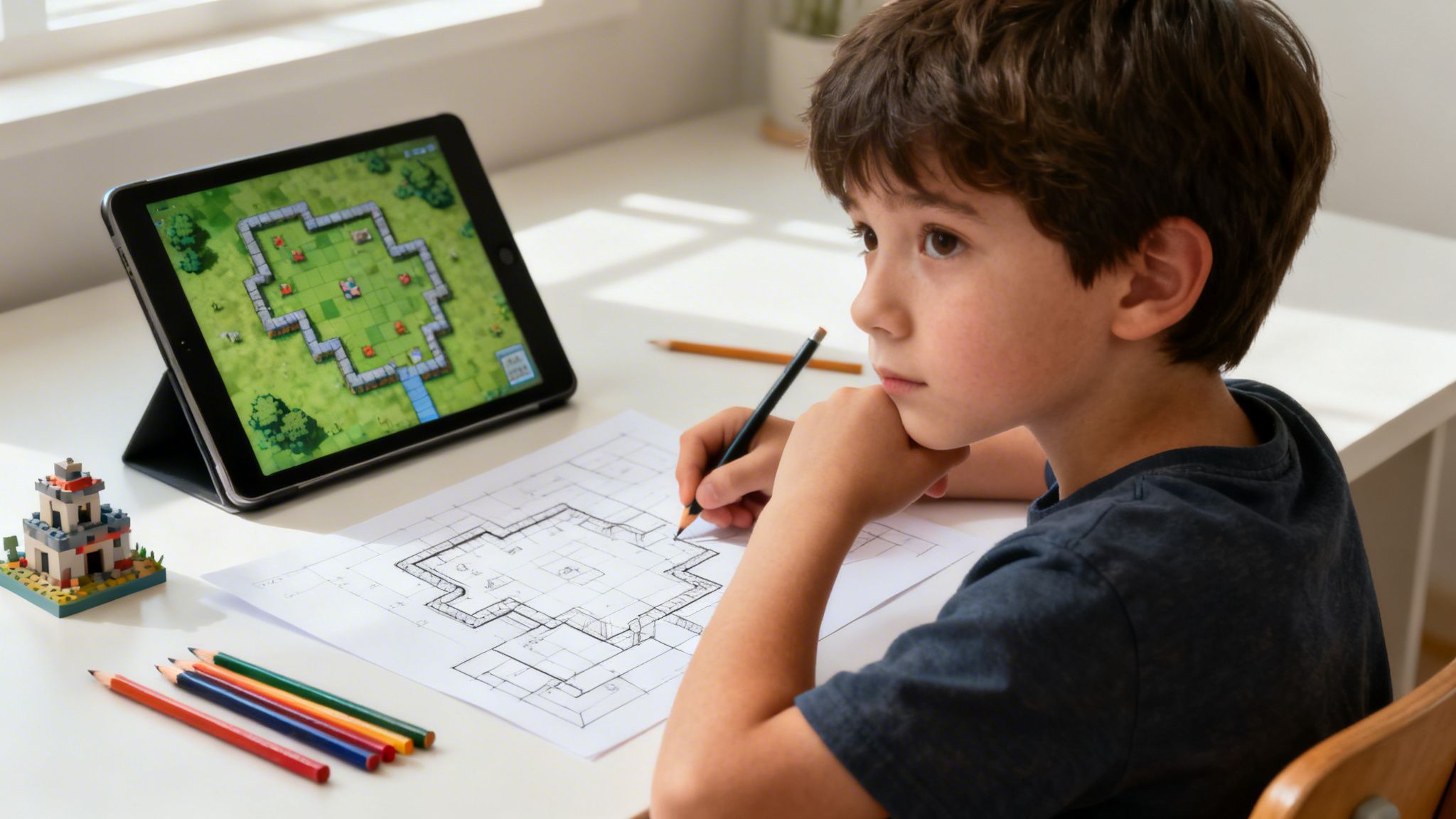
This hands-on approach helps children naturally connect their actions to the consequences, which is really the heart of all logical thinking.
Sparking STEM Skills the Natural Way
What’s truly amazing about base building is how it brings core STEM (Science, Technology, Engineering, and Maths) ideas to life without any fuss. Your child might not even realise it, but while they play, they’re practising the very same skills that scientists and engineers rely on every single day.
- Resource Management (Maths): Do I have enough fuel to get through the night? Have we got enough metal plates to build that new habitat? Players are constantly doing little sums in their heads, budgeting resources, and planning for what’s next.
- Logical Planning (Technology): Kids quickly learn to think in systems. For instance, they’ll realise a science lab needs power, the power generator needs fuel, and the fuel refinery needs workers—creating a logical chain where everything is connected. Just like how real engineers at NASA plan missions, every piece has to work together!
- Spatial Reasoning (Engineering): Figuring out how to design a base that’s both functional and easy to get around requires a great sense of space. Children learn to fit different buildings together like a puzzle, designing layouts that just work.
When a child solves a power shortage in their game, they aren't just clicking buttons. They're spotting a problem, figuring out the cause, thinking up solutions, and putting a fix in place. That’s how you build real resilience and a bit of self-belief.
Fostering Creativity and Problem-Solving
Beyond the nuts and bolts of STEM, base builder games are incredible launchpads for creativity. They hand children a blank canvas and a toolbox packed with possibilities. One child might build a huge, perfectly ordered city, while another creates a cosy, hidden-away base nestled in a mountain. There's no single "right" way to do it, which gives them the freedom to express themselves.
This freedom is also fantastic for strengthening their problem-solving muscles. When something unexpected happens—like a sudden meteor shower or a resource running low—players can’t just follow a script. They have to think on their feet, adapt, and invent creative solutions, turning a setback into a victory. Every little challenge they overcome is a win that builds a brilliant can-do attitude.
Bring Base Building to Life with a Fun At-Home Activity
Ready to take all that amazing on-screen creativity from a base builder game and launch it into the real world? Let’s bring the mission to the living room floor with a hands-on project the whole family can get behind. It’s a brilliant chance to build together, tell stories, and make something incredible with no fancy supplies needed.
This activity is a fantastic way to mirror the game’s creative process, sparking teamwork, imagination, and a bit of practical problem-solving. For even more screen-free fun, be sure to check out our Free Activities page.
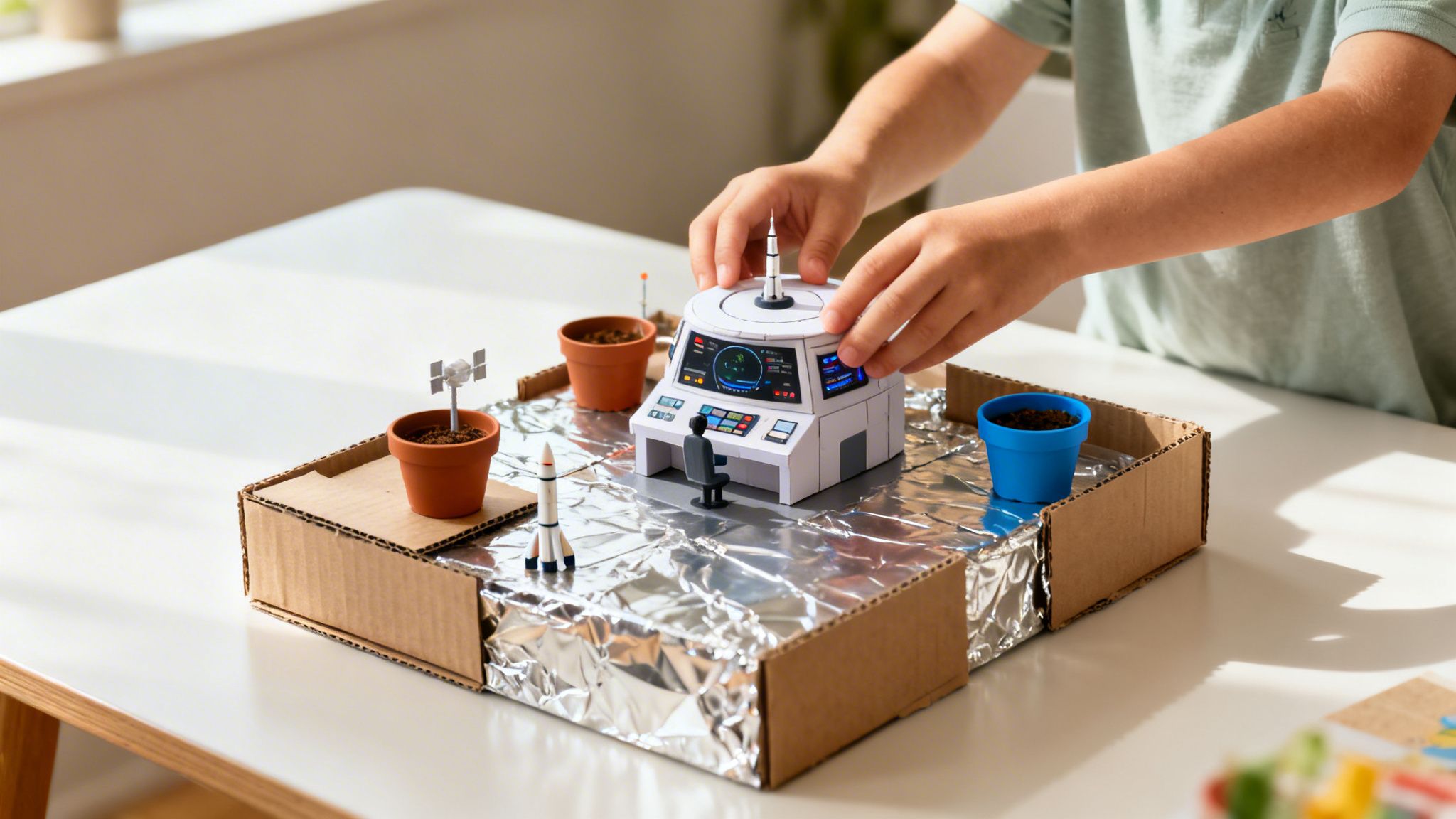
Try This: Design Your Own Tabletop Space Base
Your mission, should you choose to accept it, is to design and construct your very own space base using everyday items from around the house. It all starts with a plan and a bit of imagination.
1. Plan Your Base (Blueprint Time!)
Every great mission starts with a plan. Before you start building, grab a piece of paper and sketch out a blueprint for your base. Think about what every good space station needs. Where will the command centre go? What about the science labs, living quarters, or the all-important solar panels for power?
This is a great step for developing those crucial planning skills, much like the ones we explore in our guide to kids' problem-solving activities.
2. Gather Your ‘Resources’
Now it’s time to go on a resource-gathering expedition! This is just like mining for materials in a game, but instead of space crystals, you’re on the hunt for household treasures.
- Cardboard boxes make excellent command centres or habitats.
- Plastic pots or tubs are perfect for biodomes or science labs.
- Kitchen foil can be turned into shiny solar arrays or satellite dishes.
- Bottle caps and buttons are fantastic for creating detailed control panels.
3. Start Building!
With your blueprint drawn and your resources collected, you’re ready for construction. Arrange your boxes, connect different modules with tubes made from toilet paper rolls, and add all the little details that will bring your base to life.
As you build, spark some imaginative storytelling with a few simple questions. Ask your little engineer, ‘What amazing discovery will your science lab make?’ or ‘How does your base recycle its water?’ This helps connect their creation to the real-world challenges Space Rangers face.
How To Choose The Right Base Builder Game
With so many options out there, picking the perfect base builder game for your child can feel a bit like navigating an asteroid field. How do you find one that’s just right? The key is to look for a few specific things that ensure the game is fun, safe, and genuinely good for their development.
A great first step is to check the age rating. Systems like PEGI in Europe or the ESRB in North America give you a quick idea of whether a game’s content is suitable for your child. I always suggest looking for games with low ratings (like PEGI 3 or 7) that focus more on creativity and less on conflict. You can learn more about finding great educational video games for children in our dedicated guide.
Finding The Right Balance
The best games for young explorers strike a lovely balance between freedom and gentle challenges. You want a game that encourages creativity but also gives them small problems to solve.
This is where a ‘sandbox mode’ is brilliant. A sandbox mode removes any pressure, like timers or enemies, and gives children a completely open playground to build and experiment without fear of ‘failing’.
This pressure-free environment is perfect for building confidence. It lets them try out ambitious ideas, see what happens, and learn at their own pace.
Turning Playtime into Talking Time
One of the most powerful things you can do is play together or simply show curiosity about their creations. This transforms screen time into quality time and creates a wonderful launchpad for real-world conversations.
Ask your child to give you a tour of their base. Questions like, ‘I see you built the power station first, why was that important?’ or ‘What’s the trickiest thing about keeping everyone in your colony happy?’ connect their in-game decisions to real-world science and logic.
These chats help them articulate their thinking and feel proud of the problems they’ve solved. It’s a simple way to foster healthy gaming habits and share in their achievements.
Look for games that spark this kind of curiosity—much like the themes you'll find in Space Ranger Fred and the Shoelace Adventure. Soon, you’ll also be able to explore the upcoming Space Ranger Fred game, which we’re designing from the ground up as a safe, educational option for young adventurers.
Ready to Explore More?
We hope this guide has sparked your curiosity about the wonderful world of the base builder game! These creative adventures are a brilliant way to encourage STEM learning, problem-solving, and storytelling, all while having heaps of fun.
If you and your little explorer are looking for your next adventure, why not:
- Dive into a story: Blast off with our latest Space Ranger Fred book and discover a universe of curiosity, confidence, and courage.
- Get your FREE printables: Sign up for our newsletter and get access to our library of fun, free activities for creative kids. You'll find colouring sheets, puzzles, and more!
- Share your thoughts: Did you try our tabletop space base activity? We’d love to hear about it! Leave a comment below or share your creations with us on social media.
Happy building, Space Rangers!
Frequently Asked Questions (FAQ)
Are Base Builder Games Too Complicated for Younger Children?
Not at all! While some are definitely built for grown-ups, many of the best new games are designed with kids in mind. They usually have simple controls, friendly tutorials, and brilliant ‘sandbox’ modes where there’s no pressure and your child can just experiment. The magic of these games is how they build skills step-by-step.
What Are Some Good Examples of Kid-Friendly Base Builder Games?
There are some wonderful games out there that are all about creativity and discovery.
- Minecraft (Creative Mode): The classic digital sandpit! It offers endless building possibilities without any monsters or threats to worry about.
- Astroneer: A beautiful, gentle game about exploring space. Players reshape planets and build amazing bases with a real focus on science and wonder.
And of course, we’re building our own Space Ranger Fred game with exactly this in mind, designed to be a safe, fun, and educational adventure for young explorers.
How Can I Make Sure My Child Is Learning While They Play?
The learning in a base builder game often happens naturally, but the best way to help your child connect the dots is simply to get involved and be curious! Ask for a tour of their latest creation. A few open-ended questions like, ‘Wow, that building looks amazing! What does it do?’ or ‘What was the trickiest problem you had to solve today?’ can get them thinking and explaining their logic.
Do All Base Builder Games Involve Fighting?
Definitely not. A huge number of games in this genre are completely peaceful, focusing entirely on building, exploring, and managing a thriving creation. These are often called ‘city-builders’ or ‘colony sims’. When you’re looking for a new game, just check the reviews or settings to see if combat is a feature. Even in games that do have some conflict, you can often find an option to turn it off for a more relaxed and creative experience.
What is the difference between a base builder game and a city builder game?
They're very similar! A base builder game often focuses on survival and expansion in a new, sometimes hostile, environment (like space!). A city builder is usually about managing a growing urban area, focusing on things like traffic, taxes, and public services. Both are fantastic for developing planning and management skills.