
Ever feel like you’re searching a whole galaxy for a book that captures your child’s imagination? In a world of flashing screens and endless games, finding space stories for kids that are both wildly entertaining and educational without being obvious can feel like a mission all by itself.
But the right story can do far more than fill ten minutes before bed. A good space book can spark questions about planets, gravity, rockets, time, teamwork, and problem-solving. It can help a child say, “I think… I’ll try… I can do this… I can explain it.”
That’s why space stories matter so much. The British Interplanetary Society, formed in 1933, helped popularise space ideas in Britain long before the Space Age, and its early Moon rocket concepts fed public imagination as well as children’s storytelling about space (Britannica space exploration overview). In other words, British children have been growing up with space wonder for generations.
Today, many parents and teachers want more than a pile of random book titles. They want stories that match how a child learns. Some children like to dive into plots. Some want flaps, tabs, and models. Some need visual support. Some light up when a character feels like them.
That’s where this guide comes in. Rather than handing you one narrow reading list, it shows you eight types of space stories for kids and what to look for in each one. You’ll spot which style suits your child, your class, or your library shelf best.
And yes, there’s room for humour, aliens, odd gadgets, and the occasional mission gone gloriously wrong. Space is big. Story possibilities are even bigger.
1. Story-Led STEM Adventures
What makes a child keep turning pages in a space book. A list of facts about planets, or a mission that cannot succeed unless someone understands gravity, timing, or fuel?
Story-led STEM adventures hook children with plot first and science second. The science is still there, but it behaves like a tool in the story, much like a torch helps explorers see where to go. A crew may need to fix a broken route, survive a risky landing, or solve a strange signal from a moon base. As the problem grows clearer, the science starts to feel useful instead of school-like.
That difference is easy to spot on the page. In a weaker book, facts sit beside the story like stickers added at the end. In a stronger one, the facts hold the story together. Remove the science, and the mission falls apart.
Why this type works
Many children learn best when ideas arrive with a purpose. If a spacecraft must slow down, speed and force suddenly make sense. If a character misreads a star map, direction and distance matter for a reason. The plot gives each concept a job.
That also makes these books easier to match to a child’s learning style. A story-first reader may need suspense, humour, or a rescue mission before they are ready to absorb ideas about orbits or engineering. A curious fact-collector may enjoy stopping mid-chapter to ask, “Could that really happen?” Both readers can thrive with this format if the story and science are properly connected.
The value of this approach also shows up in classroom practice. The Royal Society’s science education work highlights the importance of helping children connect scientific ideas to real-world problem solving and curiosity-led learning (Royal Society education work). Story-led space books do that neatly because they turn abstract ideas into problems children can follow.
Practical rule: If the science could disappear and the plot would still make perfect sense, the book is probably using space as wallpaper rather than building a real STEM adventure.
What to look for on the page
A strong story-led STEM book usually includes:
- A mission with stakes: The characters need to solve, repair, test, escape, or discover something.
- Science woven into events: Orbit, gravity, light, distance, or materials appear because the story needs them.
- Clear cause and effect: Children can trace what happened and why it happened.
- Explanations in child-sized language: The book clarifies ideas through action, dialogue, or pictures rather than long blocks of definition.
- A real payoff: The scientific idea helps solve the problem in a satisfying way.
One helpful way to choose this category is to start with the child, not the title. A reader who says, “I don’t like educational books,” may still love a funny rescue story with a spacecraft that keeps malfunctioning. While following the chaos, they begin to absorb patterns of testing, revising, predicting, and solving. That is one reason story-led STEM books often work well for reluctant nonfiction readers too.
Space Ranger Fred fits this kind of blend. Its mix of adventure, humour, and science-linked problem solving reflects the wider idea explored in this post about why creativity and STEM belong together.
For many families and classrooms, this is the easiest place to start. Children feel pulled into a mission, and learning comes aboard with them.
2. Interactive Pop-Up and 3D Books
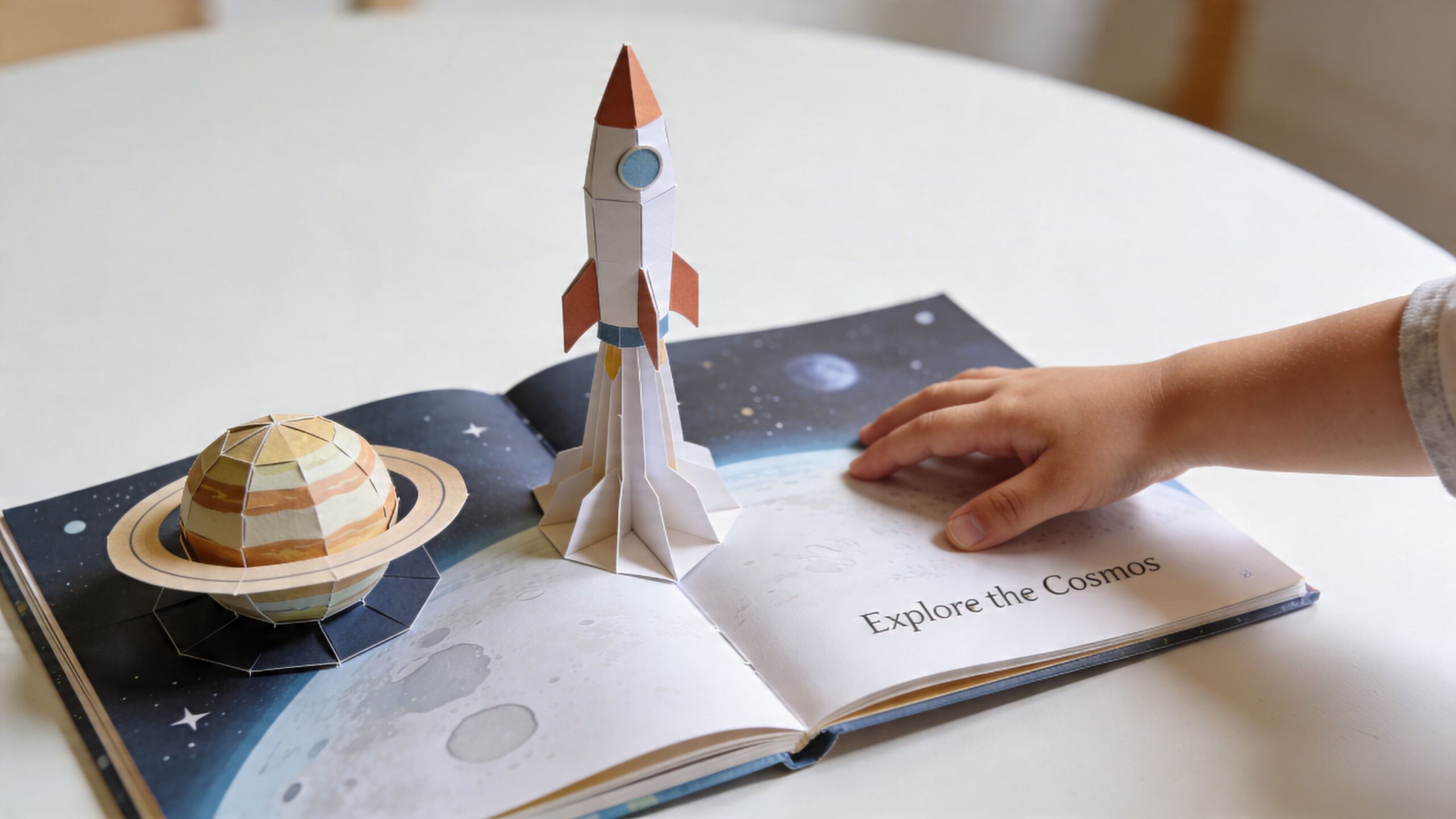
Some children want a story they can physically hold in their hands. For them, pop-up and 3D books can feel like magic.
When Saturn lifts off the page or a rocket unfolds across a spread, abstract ideas become visible. “Big” is no longer just a word. “Far away” starts to feel real.
Why younger readers love them
Pop-up books are brilliant for children who still need movement, touch, and surprise built into reading time. They also work well for shared reading. An adult can read the text aloud while the child pulls tabs, opens panels, and explores the scene.
National Geographic Kids UK uses vivid space facts that naturally suit this style of reading. Its child-friendly space content includes facts such as comets being ancient solar system objects made of sand, ice, and carbon dioxide, and that there are an estimated 500,000 pieces of space junk orbiting Earth (National Geographic Kids UK space facts). Facts like those are easier to grasp when children can see layers, scale, and movement in front of them.
What makes a good pop-up book
Not every fancy-looking book earns its shelf space. Check for these features:
- Strong construction: Tabs should feel sturdy enough for repeated use in a classroom or bedtime setting.
- Clear labels: Children should be able to connect the moving part to a planet, moon, spacecraft, or idea.
- Short text blocks: The best pop-up books don’t bury the fun under dense explanation.
- A sense of scale: Good design helps children compare sizes and distances, even in a simplified way.
Some children understand space best when they can touch it first and name it second.
A useful real-world example is a reception or Year 1 child who struggles to sit through a long story but eagerly explores a fold-out solar system. You may not get a silent, still reading session. You may get questions, pointing, laughter, and repeat page turns. That still counts as deep reading.
For libraries and classrooms, these books also make excellent display pieces. They draw children in before a single sentence is read.
3. Books with Activity Supplements
Some stories shouldn’t end at the last page. The best ones spill onto the kitchen table, the classroom carpet, or the library craft corner.
Books with activity supplements are ideal when you want reading to lead into making, testing, drawing, discussing, or acting. One story can become a whole afternoon.
Why they’re useful for home and school
This style works particularly well for adults who want a bridge between reading and doing. After the story, children might build a paper rocket, sort planets, write a mission log, colour a character scene, or try a simple space-themed challenge.
That appetite for connected formats is growing. A 2025 BookTrust survey found that 82% of parents and 71% of nursery educators wanted space stories that combine books, animation, and games aligned with UK early years frameworks, while only 15% of space content platforms offered that kind of integration (interactive multi-platform demand for children’s space content).
Good signs to look for
The strongest activity-linked books usually include one or more of these:
- Printable extras: Colouring pages, mission sheets, or cut-out activities.
- Discussion prompts: Questions that help children retell, predict, and explain.
- Simple experiments: Safe, clear tasks using ordinary materials.
- Creative extension: Drawing, writing, or role-play ideas rather than passive screen time alone.
If your child loves to keep the adventure going, the Space Ranger Fred colouring book page shows how story worlds can carry on through hands-on activity.
In the classroom: A space book with follow-up tasks often works better than two separate resources, because the children already care about the setting and characters.
A simple example is reading a mission story, then asking children to design a safer spaceship cockpit or invent a new planet guide for Zando. That turns comprehension into creation. It also helps with the “I can explain” part of learning.
For teachers and librarians, this format is practical. It supports World Book Day sessions, STEM corners, and mixed-ability groups without needing a huge pile of extra planning.
4. Adventures with Diverse Heroes
Who gets to wear the space suit in the stories your child picks up?
Children notice that quickly. They see who solves the problem, who asks the smart question, and who gets chosen for the mission. In a space story, those details provide a lesson about who belongs in science, exploration, and leadership.
That is why this category matters. Diverse-hero space stories help children connect reading with identity. For one child, that might mean spotting a main character who looks like them. For another, it might mean meeting a family structure, disability, language background, or personality type that feels familiar. The best books widen the future instead of narrowing it.
Why this type of story holds attention
A good match often starts with recognition.
Research from the Centre for Literacy in Primary Education highlights the value of inclusive books because children engage more readily when classroom reading reflects a broader range of lives and experiences (CLPE Reflecting Realities). In simple terms, children are more likely to stay with a story when it feels open to them, not written for somebody else.
That does not mean every child needs a hero who is exactly like them. Reading also grows through windows as well as mirrors. One book lets a child feel seen. Another lets them understand somebody different. The strongest space shelves usually make room for both.
What to look for before you choose
This is less about a label on the cover and more about the role a character gets inside the story.
Look for signs such as:
- The diverse character leads the plot: They make choices, solve problems, and change the outcome.
- Difference is present without becoming the whole story: A child can be a brilliant navigator, nervous space cadet, or funny inventor first.
- Families and friendships feel natural: Variety appears as part of the world, not as a lesson pasted on top.
- Strengths come in different forms: Curiosity, patience, teamwork, observation, and creativity all count in space.
- The future looks open: Children see that astronauts, engineers, coders, botanists, and explorers can come from many backgrounds.
A useful test is to ask, "If I changed this character, would the story still treat them as the hero?" If the answer is yes, the book is probably giving that child real agency, not just a place in the background.
For parents and teachers, this category is especially helpful when a child likes stories for emotional connection more than gadgets or facts. A child who does not care much about rocket diagrams may care a great deal about a brave sibling team on a moon mission or a wheelchair-using inventor fixing a shuttle problem. That is the smarter way to choose. Match the book type to the child’s way into reading.
For schools, these stories support conversations about belonging in STEM and in the classroom. At home, they can spark a smaller but powerful moment. A child closes the book and says, "I could go there too." That is often the point where interest turns into ambition.
5. Space-Themed Graphic Novels
If a child says they don’t like reading, I always want to know what kind of reading they’ve been offered.
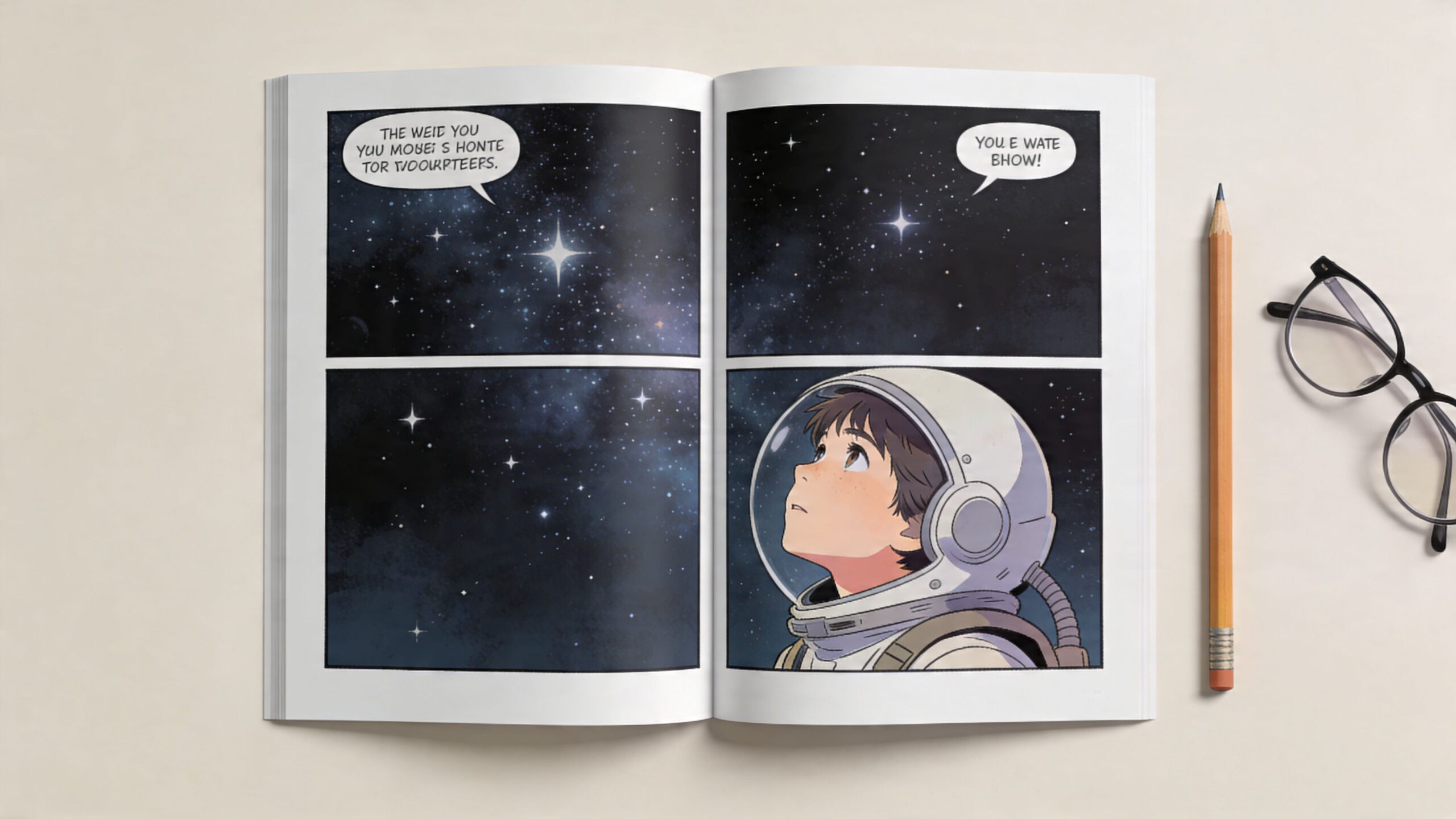
Graphic novels can be a turning point. They break the story into panels, expressions, motion, colour, and short bursts of text. That makes them especially helpful for visual learners and many reluctant readers.
Why the format helps
Children don’t have to imagine every detail from scratch. The art carries part of the load. They can track a rocket launch, a funny alien reaction, or a dangerous moon landing through pictures as well as words.
That matters because many adults still underestimate visual storytelling. Yet in the UK, interactive and visually engaging children’s formats are widely used in education. A 2025 Department for Education survey reported that 68% of primary teachers and librarians regularly use interactive formats to support literacy and science engagement (interactive children’s books in UK education settings).
How to choose one well
A strong space graphic novel usually has:
- Clean panel flow: The child can follow where to look next.
- Expressive art: Emotions and action should be easy to read.
- Manageable text: Enough challenge to build reading stamina, not so much that the art becomes decoration.
- Real narrative momentum: It still needs a proper story, not just a sequence of cool poses.
Graphic novels don’t lower the bar. They change the route into the story.
A real-world example is the child who loves comics, gaming, or animation but avoids chapter books. Give that child a space graphic novel with a mission, a mystery, and a few laugh-out-loud visual moments, and suddenly reading feels less like work. They may reread favourite panels, predict what comes next, and talk more confidently about plot.
That’s reading growth. It may arrive in a speech bubble.
6. Books with Augmented Reality AR
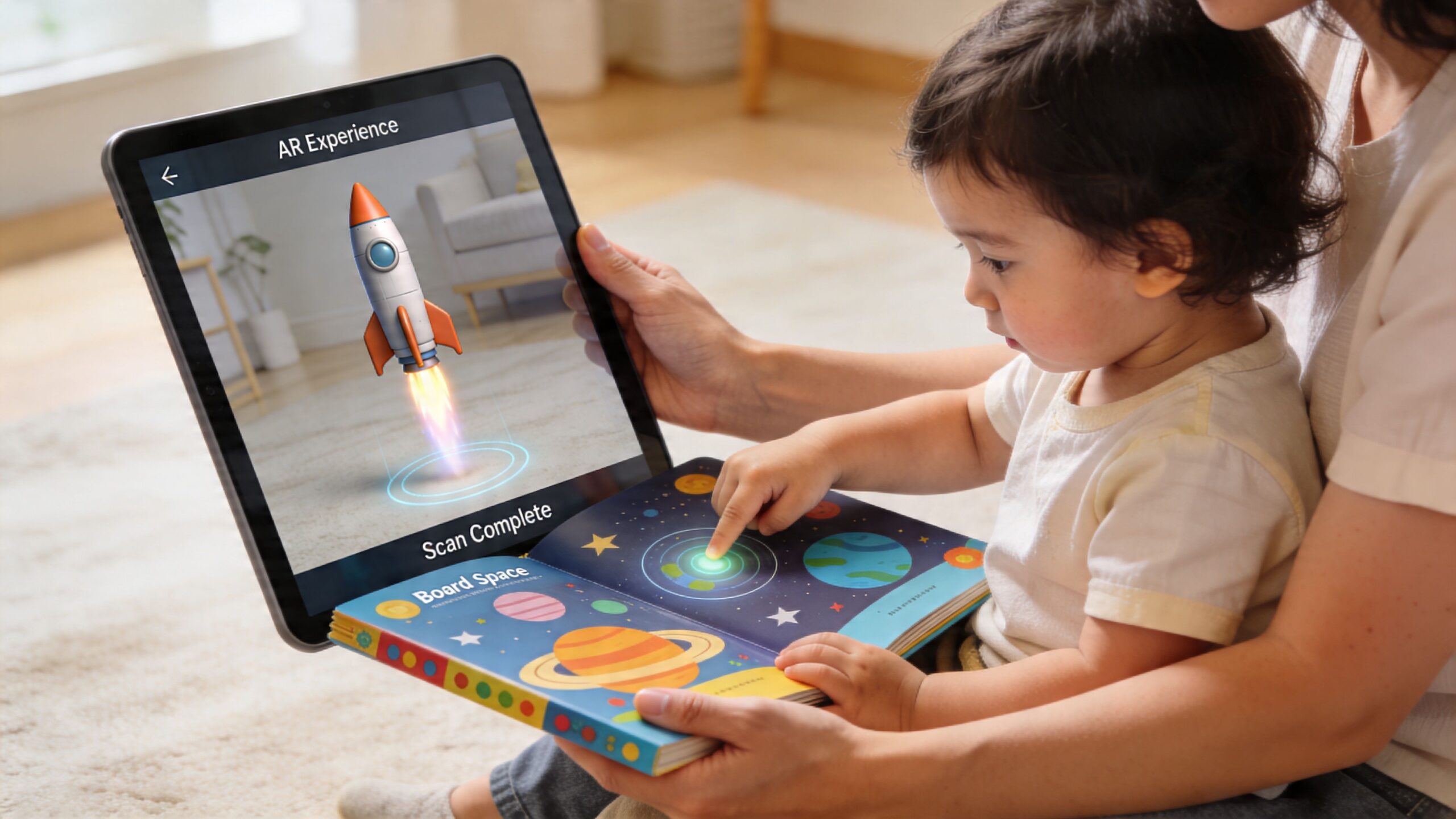
Some books now do something that would have sounded like science fiction not long ago. You point a tablet or phone at the page, and the book starts moving.
AR storybooks can rotate planets, launch 3D spacecraft, add narration, or reveal hidden information. For many children, that blend of page and screen feels exciting rather than distracting, provided the story still comes first.
When AR adds value
AR is most helpful when it clarifies something that is hard to picture in flat print. A rotating planet, a spacecraft interior, or the path of a comet can become easier to understand when the child can move around it visually.
Parents in the UK seem to respond well to this style. A 2025 Nielsen Book Research UK study found 89% user satisfaction with projection and AR-enhanced space stories for children, linked to features such as clear projection quality and AI-narrated audio (UK satisfaction with AR-enhanced children’s space stories).
What to check before you buy
AR books vary a lot. I’d look for the following:
- Easy setup: If the app takes ages to load, children lose interest quickly.
- Useful interaction: The digital layer should deepen understanding, not just add noise.
- Readable without the tech: The book should still work if the battery dies.
- Calm design: Good AR supports attention rather than scattering it.
A practical example is a Year 3 child learning about the solar system who struggles with scale and movement. A flat diagram may not click. A page that triggers a rotating model might. Suddenly, “this planet turns” becomes something the child can observe and describe.
AR can also work well in school visits or reading events because it creates a shared “wow” moment. Then the adult can bring everyone back to the question that matters most. What did we just notice, and why?
The best AR books don’t replace reading. They make reading feel more alive.
7. Character-Driven Series with Collectibles
Some children don’t just want one good book. They want a world they can return to.
Character-driven series are built around familiar heroes, running jokes, repeated settings, and mission patterns children love to revisit. Add collectibles, activity tie-ins, or themed extras, and the reading experience spills into everyday play.
Why children come back to them
A memorable character gives a child a steady point of connection. They know who the clever one is, who causes trouble, who says the funny line, who saves the day in an unexpected way. That familiarity lowers the effort of starting the next book and raises the excitement of continuing.
This kind of multi-platform storytelling is still under-served. UK parents and educators have shown strong interest in books, animation, and games working together, yet relatively few space content platforms offer that joined-up experience, as noted earlier in this guide.
What makes a series worth following
Not every branded series builds real reading loyalty. The strongest ones usually offer:
- Distinct characters: Children can describe each one without prompting.
- A recognisable world: Planets, gadgets, rivals, and mission rules feel consistent.
- Collectible elements with purpose: Stickers, cards, badges, or extras deepen engagement rather than replacing the book.
- A story ecosystem: Reading leads naturally into drawing, role-play, discussion, and anticipation.
For adults, this matters because repeated voluntary reading is gold. A child who asks for “the next one” is doing part of the literacy work for you.
If you're curious about how stories expand across formats, the Space Ranger Fred article on transmedia storytelling is a useful starting point.
A simple example is a child who keeps a cardboard “mission folder” for favourite characters, draws new alien worlds, and talks about what should happen in the next instalment. That’s not a distraction from reading. That’s deep investment in narrative.
And yes, a badge, card, or toy can help. Sometimes a story needs a little help sneaking into the toy box.
8. Bilingual and Multilingual Stories
Space is a wonderful topic for bilingual reading because it belongs to everyone. Moon, star, rocket, planet. These are universal ideas, even when the words change.
Bilingual and multilingual books can support children who speak more than one language at home, children learning a new language, and classrooms where several languages sit side by side. They can also help adults read together with more confidence.
Why this format matters
Dual-language stories do more than translate vocabulary. They let children connect ideas across languages while staying anchored in one shared adventure. A rocket launch feels exciting in any language. So does an alien misunderstanding.
This type of book can be especially helpful when a family wants to preserve a heritage language without making reading feel like formal study. It also supports belonging. A child who sees their home language in print receives a quiet message that it matters.
What to look for in a strong bilingual book
The best examples tend to include:
- Clear page layout: The two languages should be easy to compare.
- Natural translation: The story should sound like a real story in both versions.
- Helpful repetition: Repeated phrases support confidence.
- A strong visual context: Illustrations help children infer meaning even if one language is less familiar.
A good bilingual story lets one child practise language while another practises confidence.
A real-world example is a child reading English at school and another language at home. A bilingual space book lets both worlds meet on the same page. In class, it can invite peer discussion. At bedtime, it can let grandparents, parents, and children all share the same mission in slightly different words.
These books are also useful for teachers building inclusive reading corners. They say, without fuss, that curiosity is multilingual.
Space Stories for Kids: 8-Point Comparison
| Item | Implementation complexity | Resource requirements | Expected outcomes | Ideal use cases | Key advantages |
|---|---|---|---|---|---|
| Story-Led STEM Adventures | Medium, narrative plus accurate STEM integration | Low–Medium, research and editorial time | Strong critical thinking, problem-solving, STEM interest | Curious 6–12-year-olds, read-alouds, classroom prompts | Engaging story-driven learning, motivates inquiry |
| Interactive Pop-Up and 3D Books | High, paper engineering and design complexity | High, specialty printing, durable materials | Enhanced tactile engagement, fine motor and spatial skills | Kinesthetic learners, younger readers (4–8), hands-on sessions | Multi-sensory, makes abstract ideas tangible |
| Books with Activity Supplements | Medium, coordinating content and activities | Medium, workbooks, digital assets, experiment materials | Better retention, practical skills, curriculum alignment | Home-schooling, classrooms, parents wanting extended learning | Extends learning beyond reading, measurable impact |
| Adventures with Diverse Heroes | Low–Medium, inclusive character development | Low, research, cultural consultation as needed | Increased representation, empathy, relatable role models | Diversity-focused education, inclusive classrooms, libraries | Promotes inclusion, inspires underrepresented readers |
| Space-Themed Graphic Novels | Medium, sequential art and pacing | Medium–High, illustrators, layout, printing | Improved comprehension for visual learners, reading motivation | Reluctant readers, visual learners, upper early readers (8–12) | Visual storytelling boosts engagement and literacy |
| Books with Augmented Reality (AR) | High, app/AR development and integration | High, developers, 3D assets, device access | Very high engagement, multimodal learning, spatial visualization | Tech-savvy families, museums, edtech programs, early STEM exposure | Immersive interactivity, blends physical and digital learning |
| Character-Driven Series with Collectibles | Medium, transmedia and brand planning | Medium–High, merchandise production, licensing | Sustained engagement, brand loyalty, repeat reading | Fans, collectors, long-term series readers, transmedia projects | Deepens attachment, play-based reinforcement, community |
| Bilingual and Multilingual Stories | Medium, translation and cultural adaptation | Medium, translators, localization, audio support | Language development, cultural awareness, cognitive benefits | Bilingual families, ELL learners, multicultural classrooms | Supports language learning, inclusive and accessible content |
Your Mission Launch a Lifelong Love of Reading
Finding the right space story isn’t only about age bands or shiny covers. It’s about knowing how a child enters a story best. Some need a gripping plot. Some need tabs to pull. Some need pictures carrying the pace. Some need an activity after the last page. Some need to see themselves in the hero’s seat.
When you start noticing those patterns, choosing books becomes much easier. You stop asking only, “Is this a good book?” and start asking better questions. Will this child want to turn the page? Will they ask a question afterwards? Will they pretend to be the character tomorrow? Will they explain something they’ve learned in their own words?
That’s where the magic sits. Reading isn’t just decoding lines of print. It’s attention, memory, imagination, vocabulary, confidence, curiosity, and conversation all working together. A well-chosen space story can support every one of those.
There’s a long British tradition behind that excitement. Space storytelling in the UK didn’t arrive out of nowhere. It grew through decades of public fascination, education, and scientific imagination. Today, that same energy still matters in homes, schools, and libraries, especially when adults choose books that connect wonder with learning.
For parents, this may mean trying one format you wouldn’t normally pick. If your child resists standard chapter books, a graphic novel might be the way in. If bedtime reading feels restless, a pop-up or AR title may reawaken attention. If your child finishes a story and instantly wants more, a series or activity-linked book may suit them best.
For teachers and librarians, the goal is slightly different but just as exciting. You’re not only matching a child to a book. You’re building a reading culture. The right space shelf can support science talk, creative writing, speaking and listening, art, role-play, and that brilliant classroom moment when one pupil explains an idea to another.
I also think it helps to remember that stories carry themes children can revisit again and again. Curiosity. Bravery. Mistakes. Teamwork. Discovery. Those are the kinds of ideas that make books stick, and they’re part of what gives unforgettable themes in literature their staying power.
If you’re exploring story-led space adventures specifically, Space Ranger Fred is one relevant option for children aged 6 to 12. The brand blends storytelling, humour, and science through books and related experiences, which may suit families, schools, or event organisers looking for that mix.
Every book is a launchpad. Sometimes the launch is loud and instant. Sometimes it’s quiet. A child asks one more question at bedtime. They draw a moon base the next morning. They explain what an orbit is to a friend. They start to believe that learning is something they can do, not just something delivered to them.
That’s the mission worth aiming for.
If you’d like a story world that mixes humour, missions, and simple STEM ideas, explore Space Ranger Fred. You can browse the books, find activities to extend reading at home or in school, and look into interactive storytelling visits that support confidence, reading, and communication.