
Ready for a Jupiter adventure? Ever wondered what it's like on the biggest planet in our Solar System? Jupiter often gets described as “very big” and “very stormy”, but that hardly feels enough, does it? If a planet is so enormous that it can make Earth look like a pea next to a bowling ball, we need better words.
Space Ranger Fred is on a mission to gather the best Jupiter facts for kids, and he needs a sharp-eyed crew. That means parents hunting for homework help, teachers planning a space topic, librarians building curiosity, and young explorers who love a good cosmic surprise.
We're going to keep this simple, fun, and full of proper mission-briefing energy. No waffle. No dusty textbook voice. Just ten brilliant facts that help children build understanding step by step. By the end, you'll know why Jupiter stands out, why you can't really land on it, and why people in the UK can sometimes spot it shining in the night sky.
Strap in, Rangers. Zando has packed the snacks, Fred has checked the controls twice, and nobody has pressed the mysterious red button yet. That's already a success.
1. Jupiter is the king-sized planet
What does a Space Ranger notice first when arriving in the Solar System's giant league? Jupiter. It is the largest planet of them all, so this first mission briefing is all about scale.
Earlier, NASA notes that Jupiter is so enormous that roughly 1,000 Earths could fit inside it if it were hollow. That is not just “quite big”. That is “pause your biscuit and stare at the ceiling for a moment” big.
How to picture that size
A small object can sit beside a much larger one and still belong to the same set. That is true with planets too. Earth and Jupiter are both planets, but Jupiter is far wider, far bulkier, and far harder to ignore.
Children often hear “largest planet” and think it just means a slightly bigger version of Earth. It helps to slow that down. Jupiter is not a little bit bigger. It is in a completely different size class.
Try this with your young Space Rangers:
- Draw a small circle for Earth.
- Draw a much larger circle for Jupiter beside it.
- Ask, “Which one would Space Ranger Fred spot first from the spaceship window?”
That question gets children comparing, noticing, and explaining. That is real science thinking, with fewer lab coats and more coloured pencils.
Mission note: If a child can explain that Jupiter is the biggest planet and show the difference in a drawing, they are already learning how scientists compare worlds.
For a quick classroom activity, ask children to make a “planet size parade” and place Jupiter at the front as the king-sized world. Then let them write one sentence as Fred's mission log: “Jupiter looked so large that…”
2. Jupiter is a gas giant, not a rocky world
What would happen if Space Ranger Fred tried to land on Jupiter? He would have a rather tricky day. Jupiter is mostly made of light gases, mainly hydrogen and helium, so it does not have the kind of solid ground you stand on here on Earth.
That can feel odd at first. Children often picture every planet as a ball of rock with a surface on top. Jupiter helps correct that idea. It belongs to a different planet family.
Mission briefing: what makes Jupiter different?
Earth is a rocky planet. Jupiter is a gas giant. That means Jupiter is built more like a huge ball of thick, swirling layers than a world with fields, mountains, and pavements.
A useful way to explain it is to compare what a visitor would expect:
- Earth: You can stand on solid ground.
- Jupiter: You would move into deeper and deeper layers, with no normal landing spot.
- Mission lesson: Planets are not all made from the same stuff.
This is a brilliant science moment for young Space Rangers. It shows that the word "planet" covers more than one kind of world. Some are rocky. Some are giant and gassy. Space likes variety. It rarely does the boring thing.
Try a quick classroom challenge. Ask children to sort the planets into groups, then explain why Jupiter belongs with the gas giants. After that, let them write a short mission log for Fred: “We could not land on Jupiter because…”
That turns one fact into understanding.

3. A day on Jupiter is surprisingly short
How can the biggest planet in our Solar System have one of the quickest days? That is today's Space Ranger mission briefing, and yes, Jupiter is being gloriously odd again.
As noted earlier, Jupiter spins so fast that a full day there lasts less than half an Earth day. Size does not decide how long a day is. Spin does.
Mission briefing: big planet, speedy spin
Children often expect a giant planet to turn slowly, a bit like a heavy roundabout that takes ages to get going. Jupiter does the opposite. It rotates at a terrific speed, so sunrise and sunset would come around in a hurry.
That can be a tricky idea at first, because “big” and “slow” seem like they should match. In space, they do not always. Jupiter is a fine reminder that planets enjoy breaking our neat little rules.
Space Ranger Fred would have to keep his mission log tidy. Breakfast, training, and lights out would all rush past before he had properly finished faffing about with his helmet.
A simple way to explain it
A day means one full spin.
That is all.
It does not mean how long a planet takes to go around the Sun. That part belongs to a year, which your young Space Rangers will meet in the next mission.
Try this Space Ranger challenge
- Mission note: Write your normal school-day routine in order.
- Ranger question: Which jobs would fit into a Jupiter day?
- Explain it like a scientist: Why can a huge planet still have a short day?
This works well in class because children do more than repeat a fact. They explain the idea in their own words. That is when real understanding starts.
4. A year on Jupiter takes a very long time
How can a planet race through a short day, yet take ages to finish a year? That is your next Space Ranger mission briefing.
Jupiter goes around the Sun very slowly compared with Earth. One Jupiter year lasts about 12 Earth years. So if Space Ranger Fred celebrated a birthday on Jupiter, he would need a great deal of patience and probably a larger cake.
Mission briefing: a year is an orbit
Children often muddle up a day and a year, so this fact is a brilliant one to pause on.
A day is one full spin.
A year is one full trip around the Sun.
Jupiter makes that difference clear. It turns quickly, but its journey around the Sun takes much longer. That is because its path is enormous. A bigger track takes longer to travel, a bit like walking round a giant football stadium instead of doing a lap of the living room.
Why this can feel confusing
Big planets can trick our brains.
Children may assume Jupiter should do everything quickly because it spins fast, or everything slowly because it is huge. Space does not follow those tidy little guesses. Spin and orbit are separate jobs.
That is why this fact matters. It helps young Space Rangers sort two important ideas into the right boxes.
Try this Space Ranger activity
Pick one child to be the Sun. Pick another to be Jupiter.
Ask Jupiter to turn round on the spot while also walking in a very wide circle around the Sun. The turning shows a day. The big walk shows a year. It looks a bit daft, which is excellent for learning.
For a story prompt, ask: What would Space Ranger Fred do while waiting 12 Earth years for one Jupiter birthday? Children can write a mission log, draw a comic, or invent a birthday message sent back to Earth.
That turns one fact into a proper space adventure.
5. Jupiter is very far from the Sun
How far out does a Space Ranger have to travel before the Sun starts to feel less like a blazing campfire and more like a bright lamp in the distance?
Jupiter sits far beyond Earth, out in the colder, wider part of the Solar System. As noted earlier, astronomers describe its path as much farther from the Sun than ours. That big gap is one reason Jupiter feels so different from the inner planets.
Children often picture the planets as neatly lined up with tiny spaces between them. The Solar System is far more spread out. Jupiter helps fix that idea fast.
Mission briefing: the Solar System has huge gaps
A simple model works wonders here. Put one child in the middle as the Sun. Place Earth fairly nearby. Then send Jupiter much farther away across the playground or hall.
Suddenly the lesson clicks.
Jupiter's distance shows that space is mostly, well, space. Lots of it. If Earth and Jupiter were houses on the same road, you would not be popping next door for a biscuit.
Why this fact helps young Space Rangers
This fact builds map skills as well as science knowledge. Children can ask where Jupiter is, why it gets less sunlight, and how distance changes a planet's weather and temperature. Those are strong mission questions.
It also helps sort out a common muddle. Being a big planet does not mean being close to the Sun. Position and size are different clues.
Try this Space Ranger activity
Give Space Ranger Fred a mission map to draw.
Ask children to sketch the Sun, Earth, and Jupiter with very large spaces between them. Then ask, “What would Fred pack for a trip so far from the Sun?” They might add a spacecraft heater, extra power, or a very thick pair of socks.
If your class enjoys comparing faraway planets, they might also like this guide to why Saturn has rings. If your child or class enjoys this kind of space comparison, you can keep the mission going with the Space Ranger Fred books, where story and science travel together nicely.
6. You can often see Jupiter from the UK
Have you ever looked up on a clear night and wondered whether one of those bright dots is a planet? Space Rangers in the UK often have a good chance of spotting Jupiter, because it shines brightly enough to see without a telescope. NASA's Jupiter page for children explains that people have known Jupiter since ancient times because it is visible with the naked eye.
That makes this mission feel real very quickly.
Jupiter is not a tiny speck that only scientists can find with giant machines. It can be a family garden planet, a playground planet, or a bedtime-window planet. For a child, that is a wonderful jump from reading about space to meeting it in the sky.
Mission briefing for UK sky-watchers
For families, schools, and clubs, this is cheering news. The Royal Observatory Greenwich guide to Jupiter explains that Jupiter is a prominent object in the night sky, and binoculars can even show its four Galilean moons as tiny points of light.
Children sometimes get muddled here, so it helps to say this plainly. Jupiter is bright, but it does not stay in the same bit of sky all year. Some months are much better for spotting than others. Clouds matter too, of course. Typical British behaviour from the weather.
If children ask why Jupiter looks different from stars, give them this simple clue. Stars often twinkle more, while Jupiter usually looks steadier. It is still a point of light to your eye, but it often has a calmer glow.
If your young ranger wants to know why planets look different from one another, this guide to what planets are made of helps build that bigger picture.
Try this Space Ranger spotting activity
Send Space Ranger Fred on a night-watch mission. Ask children to make a simple observing sheet with three boxes: date, weather, and “What did you spot?” They can draw the brightest object they see and write whether it looked steady or twinkly.
That turns stargazing into proper scientific observing, just with fewer clipboards and less panicking.
For extension learning, our freebies and activities page is handy for observation sheets and creative follow-up work.
7. Jupiter's storms make it look wild
What kind of planet wears giant stripes and keeps enormous storms spinning for ages? Jupiter does, and it gives our Space Rangers a proper clue about what this world is like.
Jupiter looks busy from far away. Its cloudy atmosphere is wrapped in bands, swirls, and huge storms, so it does not look plain or smooth. Those stripes are made by fast-moving clouds high above the planet, which is one reason Jupiter looks so dramatic in pictures.
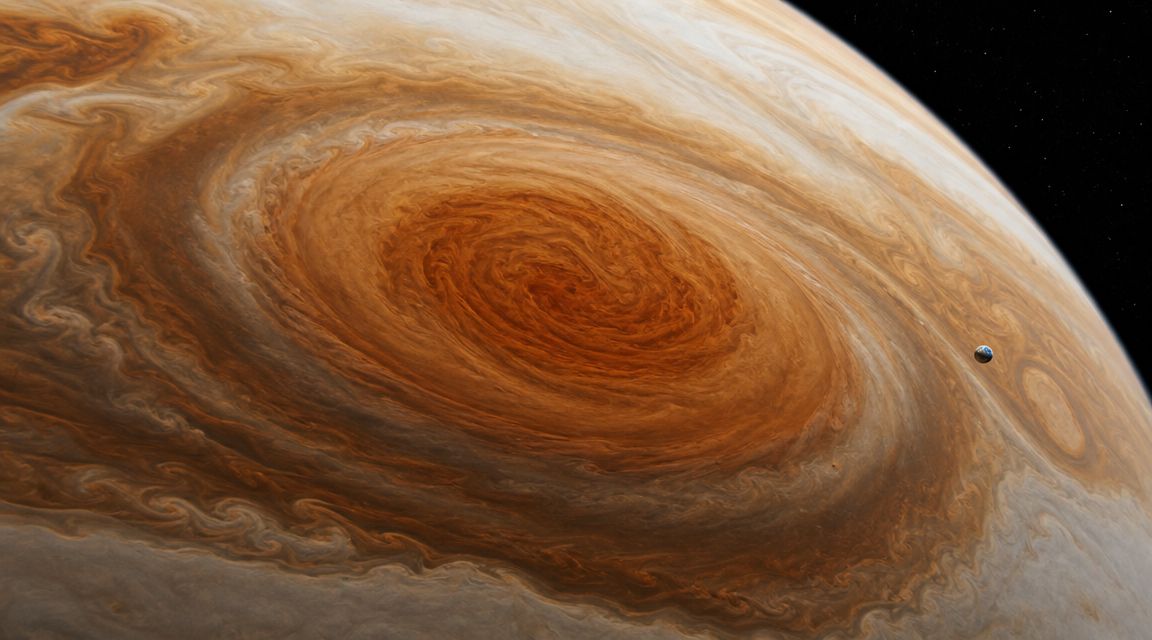
Mission briefing. Why do the storms matter?
They show that Jupiter is active.
Children can picture the atmosphere like layers of cream, caramel, and cocoa being stirred round and round in a giant bowl. The colours and bands help us spot movement. Jupiter is a gas giant, so its outer layers can churn, twist, and race around in ways a rocky planet cannot. If your young ranger wants the bigger picture, this guide to what planets are made of helps explain why different planets look so different.
A famous example is the Great Red Spot, a gigantic storm that has been watched for a very long time. That often surprises children. A storm on Earth comes and goes. Jupiter can keep storms going on a much grander scale, which makes the planet seem a bit like a wild weather machine.
Try this Space Ranger Fred activity
Give Space Ranger Fred a storm-tracker mission. Ask children what Jupiter's bands remind them of. Toffee swirls? Marbled paint? Soup after an enthusiastic stir? Silly answers are welcome. They help observations stick.
Then make a Jupiter artwork with paint, chalk, or torn paper. Ask children to curve the stripes instead of drawing straight lines. That small detail helps them show movement, not just colour.
Jupiter teaches a brilliant early science lesson. Careful looking can lead to big questions.
This mission works nicely across science, art, and story writing. Children start with, “What does Jupiter look like?” Then they move to, “What might be happening in those clouds?” That is proper Space Ranger thinking.
8. Jupiter has rings too
Poor Saturn gets all the ring glory. Jupiter has rings as well, though they aren't as famous. That surprises many children, and quite a few adults too.
Its rings are faint, so they don't leap out in the same dramatic way Saturn's do.
A nice comparison with Saturn
This is a great moment to teach that planets can share features without being identical. Jupiter and Saturn both have rings, but they don't look the same to us.
If children already know Saturn's ring system, compare the two and ask which planet they think would be easier to recognise in a picture. That sort of contrast helps knowledge settle in place.
For a child-friendly follow-up, our post on why Saturn has rings helps build a wider picture of ringed planets without making the lesson too heavy.
A crafty classroom task works well here. Cut out paper circles for planets and add different styles of rings. Some can be bold and bright like Saturn in children's imaginations. Others can be faint and subtle like Jupiter's.
That teaches an important idea. Space objects can be spectacular even when they aren't show-offs.
9. Scientists have studied Jupiter with spacecraft
Children often ask, “How do we know all this?” Fair question. We know because astronomers observe Jupiter from Earth, and spacecraft have visited it too.
One important mission is Juno, a spacecraft sent to study Jupiter up close.
Why probes matter
A space probe is a robotic explorer. It doesn't need packed lunches or a pillow. It just keeps gathering information and sending it back to scientists.
That idea can feel wonderfully real for children. Jupiter stops being just a picture in a book and becomes a place humans actively investigate.
If your class is learning how machines help us explore space, our article on what a space probe is gives a clear next step.
Mission prompt for young Rangers
- Question: If you sent a probe to Jupiter, what would you want it to study?
- Drawing task: Design the front of your probe
- Writing task: Give it a mission name and one important job
Space Ranger Fred fits so naturally. Story turns science into action. Fred doesn't just read about a world. He heads off to investigate it, usually with Zando saying something sensible while everyone else presses buttons.
10. Jupiter is perfect for curiosity
The final briefing is less about one isolated number and more about why Jupiter matters so much in children's learning. It combines size, speed, history, distance, sky-watching, and space exploration in one glorious package.
In other words, Jupiter is a teacher's dream and a child's delight.
Why kids remember Jupiter
It gives children plenty to hold onto:
- It's the biggest planet
- It spins very fast
- It has been observed for centuries
- It can sometimes be spotted from the UK sky
- It helps children compare different kinds of planets
That's why jupiter facts for kids work so well in classrooms, libraries, and home learning. The facts aren't floating about on their own. They connect to maths, history, art, observation, and imagination.
If you want to keep that curiosity moving, a story-led approach often helps children remember more than a worksheet alone. Space Ranger Fred materials are designed to support exactly that kind of playful learning.
Quick Comparison: 10 Jupiter Facts for Kids
| Item | Study Complexity | Resource Requirements | Expected Outcomes | Ideal Use Cases | Key Advantages |
|---|---|---|---|---|---|
| 1. Jupiter is Bigger Than 1,300 Earths! | Low–Moderate, size/volume are straightforward to measure | Telescopes, spacecraft imaging, orbital mechanics data | Accurate mass/volume estimates, formation constraints | Education, comparative planetology, public outreach | Clear scale demonstration of planetary mass and volume |
| 2. It Has a Great Red Spot (A Storm Bigger Than Earth!) | Moderate–High, long-term monitoring and modeling needed | High-resolution imaging, spectroscopy, long-duration missions | Understanding atmospheric dynamics and storm longevity | Atmospheric science, storm dynamics research, outreach | Visually striking, long-lived natural laboratory for fluid dynamics |
| 3. A Day on Jupiter is Only 10 Hours Long | Low, rotation measured by cloud tracking and radio data | Imaging, Doppler/radio measurements, spacecraft data | Rotation profile, constraints on interior structure and dynamics | Teaching rotational physics, atmospheric circulation studies | Extreme rotation rate that shapes weather and planetary oblateness |
| 4. Jupiter Has at Least 95 Moons | Moderate, discovery and orbit determination of many bodies | Survey telescopes, tracking observations, orbit modeling | Satellite cataloging, formation and capture history insights | Satellite dynamics research, comparative satellite studies | Large, diverse system provides many natural laboratories |
| 5. One of Its Moons Might Hide an Alien Ocean (Europa) | High, detecting subsurface ocean and habitability signs is complex | Dedicated missions, ice-penetrating radar, landers, spectrometers | Assessment of subsurface water, chemistry, and habitability potential | Astrobiology missions, prioritized exploration target | High potential for subsurface water and possible biosignatures |
| 6. Jupiter Has Rings, Too! | Low–Moderate, rings are faint and require sensitive observations | Space/large ground telescopes, dust detectors, imaging | Composition and origin of faint rings, dust source processes | Comparative ring studies, dust dynamics research | Demonstrates diversity of ring systems beyond Saturn |
| 7. You Can't Stand on Jupiter | Low, conceptual and model-based understanding | Theoretical models, probe atmospheric data | Clarification of gas giant composition and interior layers | Education, mission planning constraints, modeling | Clearly communicates exploration limits and gas giant nature |
| 8. It Has the Biggest Moon in the Solar System (Ganymede) | Moderate, mapping and magnetic/geologic studies required | Spacecraft flybys/orbiter, magnetometers, imaging | Geological history, possible subsurface ocean, magnetism data | Comparative moon geology, future landing site selection | Largest moon with intrinsic magnetic field and complex geology |
| 9. A Spacecraft Took Pictures of its Poles (Juno) | High, polar imaging demands specialized mission design | Dedicated polar-orbit spacecraft, remote sensing instruments | New views of polar storms, improved atmospheric models | Advanced planetary research, mission demonstration | Novel polar datasets that reveal unique atmospheric structure |
| 10. Jupiter is a Bright Star in Our Sky | Low, easily observed with naked eye or small optics | None to small telescopes, binoculars, basic sky charts | Public engagement, simple observational records | Outreach, amateur astronomy, educational demonstrations | Readily visible, excellent target for public observation |
Your Jupiter Mission Debrief!
Congratulations, Ranger. You've gathered some excellent intelligence on the Solar System's giant champion. Jupiter is huge, fast-spinning, far from the Sun, made mostly of gases, and bright enough that many people can spot it in the night sky when conditions are right. That's a lot of wonder packed into one planet.
These facts help children build understanding in layers. First, they notice what Jupiter looks like. Then they compare it with Earth. Then they begin asking better questions. Why is its day so short? Why can we see it from Earth? Why isn't it rocky like our planet? That's the kind of thinking we want.
The lovely thing about space topics is that they support the menturity layer so well. I think. I try. I can. I can explain. A child who can say, “Jupiter is a gas giant, so it's different from Earth,” is doing more than repeating a line. They're making sense of the world.
Classroom and home activities
- Make a gas giant jar: Fill a clear jar with water, add a few drops of food colouring, then swirl gently to create cloud bands.
- Create a Jupiter sketchbook page: Draw the planet, then label what makes it different from Earth.
- Try a sky-watch challenge: See whether your family or class can spot Jupiter when it is visible from the UK.
- Write a mission log: Ask children to pretend they are Space Ranger Fred reporting back to Mission Control.
A story prompt for young explorers
Space Ranger Fred and Zando are travelling past Jupiter when their dashboard starts flashing. Something bright has appeared near the giant planet, and nobody can agree if it's a moon, a reflection, or Zando's lunchbox foil drifting past the window again. Fred needs a calm crew, sharp eyes, and a very good explanation.
That sort of story-led learning helps facts stick. If you'd like more of that mix of humour, reading, and STEM, you can explore the Space Ranger Fred books for home or classroom use.
For teachers and parents
Use these facts as springboards, not finish lines. Ask open questions. Invite children to explain ideas out loud. Let them draw, move, compare, and imagine. A single Jupiter lesson can support science knowledge, speaking skills, reading confidence, and creative writing all at once.
If you'd like to turn a topic lesson into an interactive event, you can also explore Space Ranger Fred school visits, which use storytelling and STEM-based activities to support reading, communication, and curiosity in a lively way.
If you'd like more story-led science for children aged 6 to 12, explore Space Ranger Fred for books, activities, and school resources that make STEM feel like an adventure.