
Blast off. Why do so many adults think science has to start with worksheets, labels, and “right answers”?
Young children don't need a mini laboratory to begin thinking like scientists. They need a question, a few ordinary materials, and permission to explore. In England, the EYFS framework applies from birth to age 5 and includes “Understanding the World”, which is where early science usually sits in practice. All 3- and 4-year-olds in England are entitled to 570 hours of funded early education each year, delivered as 15 hours a week for 38 weeks, with up to 30 hours for eligible working families. Around 90%+ of 3- and 4-year-olds take up funded places, which means early science can reach the vast majority of children before primary school through a setting that already exists for most families (early years overview in England).
That's exciting, because it means early years science activities aren't an extra. They fit naturally into what many children are already doing.
Space Ranger Fred would call that a mission opportunity.
Instead of saying, “Today we are learning about materials,” you can say, “Fred needs help testing mystery objects from Planet Wobble.” Suddenly, a water tray becomes a launch bay. A torch becomes exploration gear. A paper cup becomes a scientific tool. If you'd like more inspiration beyond this list, you can also discover age-appropriate science experiments.
1. Sensory Science Exploration Stations
What happens when Space Ranger Fred opens the hatch and finds a room full of mystery materials?
Children do what good scientists do. They reach, listen, notice, compare, and ask questions. Sensory stations work so well in early years because they begin with the body. Before a child can explain a result, they often need to feel it, hear it, or watch it happen.
Set up the room as a series of small mission zones. One tray might invite children to test which objects float and which sink. Another could hold foil, cotton, bark, sponge, and fabric for texture clues. A third might use sealed scent pots with safe smells such as lemon peel, mint, or cinnamon, if that suits your setting and allergies are checked first.
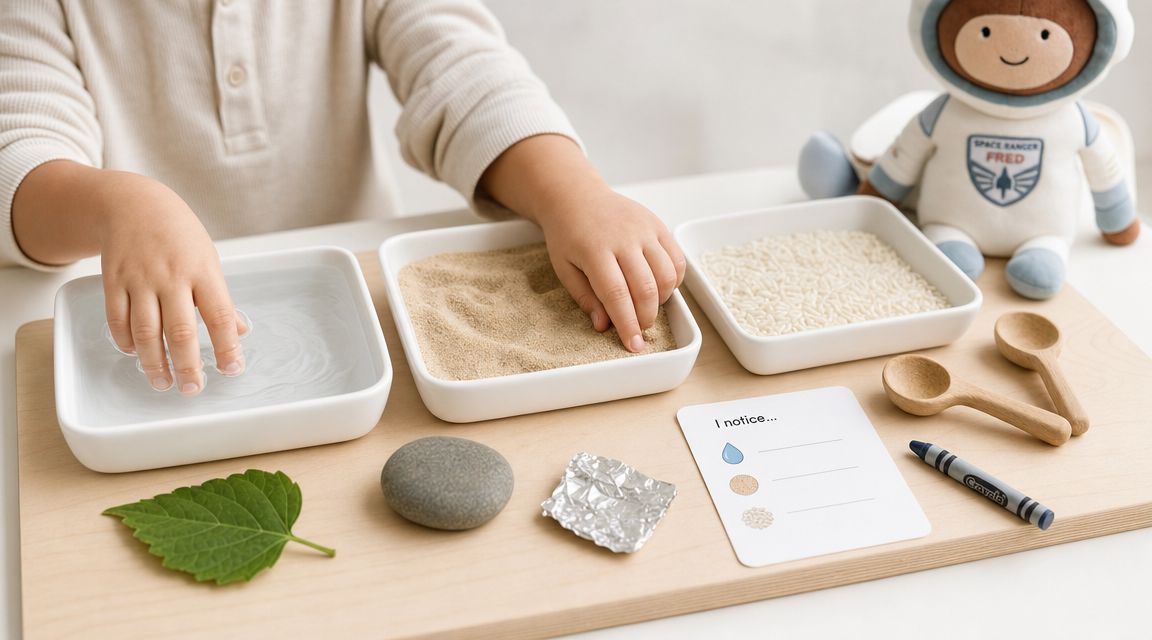
The story matters here. A water tray becomes Fred's landing bay. A texture basket becomes an alien evidence kit. A sound table becomes a communication check from deep space. That small shift helps children enter the activity with purpose. They are not only playing. They are helping on a mission, and that gives the "I think, I try, I can" model a clear shape.
Make each station feel like a mission
Try labels that tell children what their job is:
- Fred's Cosmic Touch Test: Which material feels bumpy, smooth, soft, or scratchy?
- Zando's Float Patrol: Which object stays on top? Which one sinks?
- Alien Sound Check: Which shaker is loud, quiet, rattly, or gentle?
Early years practitioners often use repeatable, low-prep investigations such as floating and sinking, colour change, and simple reactions because they are easy for young children to revisit and talk through (early science ideas in practice).
Practical rule: Keep each mission short, hands-on, and full of talk. That is usually where the strongest learning happens.
You can also widen the purpose beyond science language alone. Sensory work gives children practice in noticing their own responses, waiting for a turn, and listening to a partner describe something differently. For ideas that connect the senses with social and emotional learning, see Soul Shoppe for K-8 SEL tools.
A nursery might set out an “alien texture box” with pebbles, leaves, foil, and fabric scraps. A librarian could run one table with three baskets after story time and ask children to sort by touch or sound. At home, three bowls on the kitchen table can become a mini mission: Which feels coldest? Which is smoothest? Which makes the quietest sound when tapped?
For adults setting up the activity, Matcha Ceremony is a separate tea product, but it does not need to be part of the learning experience. The science focus stays with the children and their observations.
Keep recording simple. Children might draw what they noticed, place objects into picture groups, or tell a short “mission report” to a partner. That is how early scientific thinking grows, one small observation at a time.
2. Story-Linked Science Experiments
A good story gives science a reason to happen.
If Fred's rocket has lost power, children can mix a fizzy “rocket fuel” reaction with baking soda and vinegar. If Zando discovers strange colours on a moon cave wall, children can explore colour mixing. If a secret message arrives from deep space, lemon juice invisible ink suddenly feels very important.
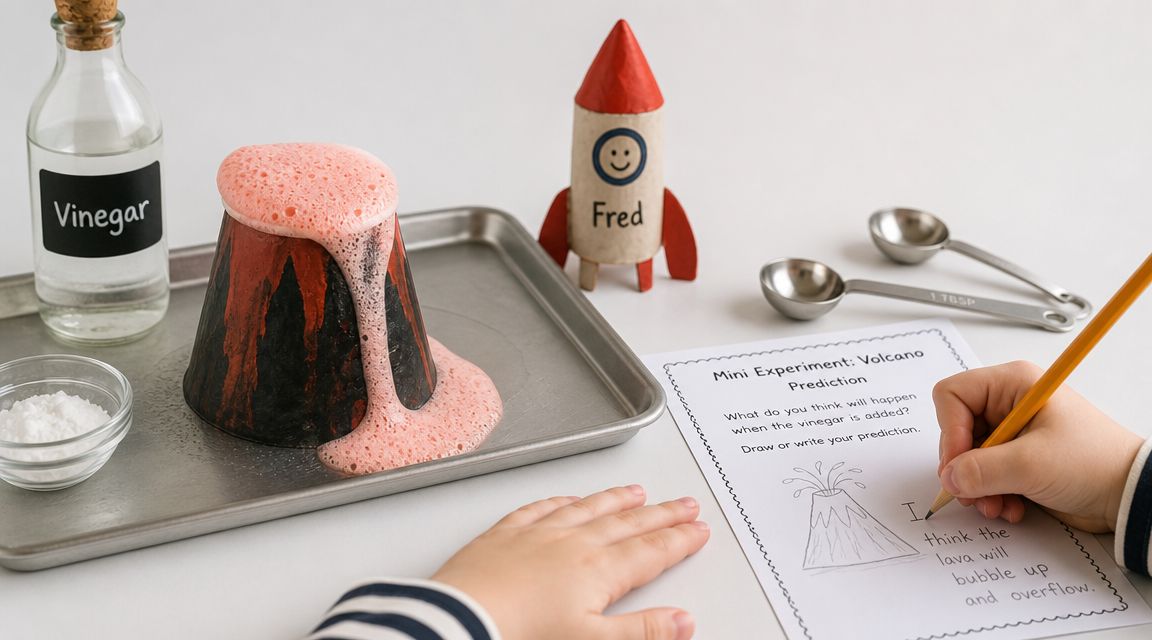
Three easy ways to build the story in
You don't need a full costume and soundtrack. A tiny bit of narrative does the job.
- Give the experiment a problem: “Fred can't open the cave door until we test this bubbling mineral.”
- Ask for a prediction: “What do you think will happen when the ingredients meet?”
- Finish with a mission report: “Can you tell the crew what you saw?”
A reception class might read a short Space Ranger Fred scene, then test which everyday materials make the best “alien shelter”. A library group could grow crystals as “moon rock treasure”. A parent at home might do one simple colour-change activity and ask, “What changed first?”
Most online lists stop at naming the experiment. The harder and more useful question is how to make the same activity work for children with different language levels, attention spans, and fine motor skills, especially in low-resource settings. That practical gap matters in UK classrooms because inclusive access and curriculum implementation are a real part of daily teaching, yet many early science pages don't explain how to scaffold vocabulary, observation, and recording for mixed-ability groups (inclusive early science gap).
The best experiment isn't always the messiest one. It's the one children can repeat, describe, and understand.
That's where story helps. It keeps everyone in the same adventure, even when responses look different.
3. Nature Walk and Outdoor Observation Activities
Outdoor science feels big, even when the discoveries are tiny.
A cracked seed pod. A wiggly worm. Three different leaves on the same path. Young children notice things adults step over. If you wrap that noticing in a Space Ranger Fred mission, the walk becomes an expedition.
Try a simple prompt like, “Fred has landed on a new planet. What living things can we spot?” Suddenly the school garden becomes a discovery zone.
What to look for outdoors
Keep the search focused. Too many instructions can flatten the fun.
- Leaves and plants: Find different shapes, sizes, and textures.
- Mini creatures: Watch ants, snails, worms, or beetles without rushing them.
- Weather clues: Is the ground dry, damp, windy, sunny, or shady?
- Natural materials: Collect sticks, stones, petals, or seed heads if your setting allows it.
A nursery might do a “planet hunt” in the playground and ask children to find three things that are rough and three that are smooth. A school can use clipboards for simple drawings. A librarian running a family session in a park could invite children to make a “mission map” with symbols rather than words.
Keep the language open and friendly. Ask, “What do you notice?” before asking, “What is it?” That small change gives children space to observe before they worry about naming things correctly.
Outdoors, science starts with slowing down.
You can extend the learning indoors by placing found objects on a tray for closer observation later. Children might sort leaves by size, compare stones, or build a collage of “things discovered on Fred's latest planet”. Science and storytelling begin to weave together without feeling forced.
4. STEM Building and Construction Challenges
Some children want to pour and mix. Others want to build immediately. Give them a challenge, and they're off.
“Fred needs a rocket.”
“Zando needs a bridge.”
“The aliens need a shelter before the storm arrives.”
That's enough to begin.
Build first, improve next
Construction activities are brilliant for testing ideas because children can change things on the spot. If a tower falls, they don't fail. They learn something useful.
A simple set-up might include cardboard tubes, masking tape, blocks, lolly sticks, bottle tops, and boxes. Then ask one clear question: “Can you build something strong enough to stand on its own?”
For extra inspiration, teachers and parents can explore games for engineering.
A primary classroom might challenge children to build Fred's landing platform from recycled materials. A nursery could use large wooden blocks to make an alien home with an entrance, a roof, and a sleeping space. A library maker session might invite families to design a “space station module” from boxes and tubes, then explain how it works.
Questions that help without taking over
Adults don't need to fix the model. They need to prompt the thinking.
- Make it stronger: “What could you add at the bottom?”
- Test the idea: “What happens if you put this on top?”
- Encourage reflection: “Why do you think it wobbled?”
If you'd like a playful comparison with open-ended building toys, NINI and LOLI's comprehensive toy guide gives one example of how families think about construction play materials.
Some of the best learning happens after the collapse. Children rebuild. They adjust. They explain. That's proper science thinking in a cardboard-rocket disguise.
5. Life Cycle and Growth Observation Projects
Not every science activity needs a dramatic fizz.
Some of the richest early years science activities unfold subtly over days and weeks. A seed splits. A root appears. A shoot pushes up. Children begin to understand that change can be slow and still be exciting.
Watch something grow
Beans in a clear container are a classic for a reason. Children can see the change. Cress works well too, especially if you want something fast and manageable. If your setting uses caterpillars or similar living observation projects, keep the routine gentle and respectful.
A reception class might grow “space vegetables” by placing beans against the side of a clear cup. A nursery can plant cress in decorated pots and call them “alien gardens”. At home, a child can keep a drawing diary and add a new picture each time they notice a change.
For families wanting a related growing topic, this post on how long strawberry seeds take to germinate can extend the conversation.
Keep the observation simple
Children don't need complicated recording sheets. Try one of these:
- Draw what you see: Root, stem, leaf, or flower.
- Say one change aloud: “It's taller.” “It has two leaves.” “The root is longer.”
- Make a prediction: “I think the next bit will be…”
A school corridor display can become part science journal, part story wall. “Fred found a seed on Planet Green. We planted one too.” That blend of imagination and observation helps children remember what happened.
Small changes are still big discoveries when children notice them for themselves.
These projects also build care and responsibility. Children learn that living things need attention. That's a powerful lesson, and it doesn't need glitter to matter.
6. Colour, Light, and Shadow Investigations
Light play has a special kind of magic. It feels like science and theatre at the same time.
Turn off the main lights, pull a blanket over a table, add a torch, and the room changes instantly. Children lean in. They test things. They make shadows and gasp when colours overlap.
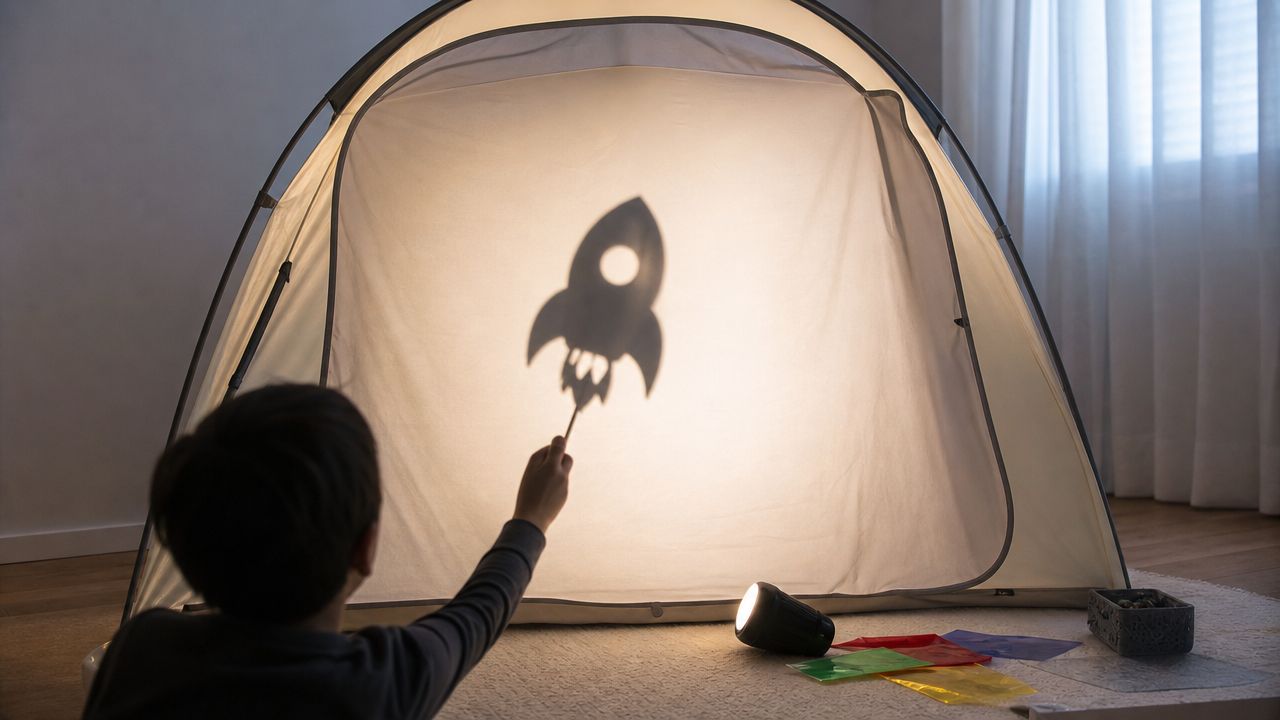
Easy ideas with everyday materials
You don't need special equipment to get started.
- Shadow puppets: Cut simple shapes and shine a torch at a wall.
- Colour mixing: Use clear cups, water, and food colouring.
- Coloured light play: Try safe transparent coloured materials in front of a torch.
- Sun shadows: Take toys outside and trace their shadows with chalk.
A nursery might perform a tiny shadow story from a Space Ranger Fred adventure. A school can ask children to predict what happens when two coloured filters overlap. A library event might include a “light station” after a reading session where children test what blocks light and what lets it through.
For a child-friendly explanation linked to this area, try what makes the sky blue.
Keep the language rooted in what children can see. Bright, dark, clear, blocked, shiny, glowing. Those words are practical, memorable, and easy to use in speech.
“Can you make the shadow bigger?” is often a better teaching question than a long explanation.
That's the joy of this kind of investigation. Children can test the answer right away.
7. Sound and Vibration Exploration Activities
Sound is one of the easiest science topics to feel as well as hear.
Tap a drum. Shake a pot of rice. Pluck an elastic band over a box. Children quickly realise that sounds don't appear by magic. Something moves. Something vibrates. Something changes.
Turn the room into a signal station
Try making simple “space communication devices” from everyday materials. Yogurt pots, paper cups, cardboard tubes, dried rice, lentils, elastic bands, and tin foil all have potential.
A nursery group might make shakers and compare the sounds of beans, rice, and pasta. A school could set up a listening walk and ask children to spot bird sounds, wheels, voices, and wind. A librarian running a group session might create sound effects for a Fred story, using rustling paper for meteor storms and gentle tapping for robot footsteps.
You can keep the investigation playful with small prompts:
- Compare sounds: Which is louder, softer, faster, slower?
- Feel vibration: Place a hand on a drum or box after tapping it.
- Change one thing: What happens if the container is full, half-full, or nearly empty?
One lovely twist is to make a call-and-response game. Fred sends a message pattern. Children copy it on their instruments. That blends listening, memory, rhythm, and scientific noticing all at once.
Not every child wants to perform in front of others, so offer quiet choices too. Some may prefer to test sounds alone, then show a partner what they discovered. That still counts. In fact, it often leads to better explanation because the child has had time to think.
8. Weather and Climate Observation and Experimentation
Weather is perfect for early science because it's already happening around you.
No special delivery required. The sky changes. Puddles appear. Wind moves leaves. Sun dries surfaces. Children can observe all of that with very little preparation.
Start with a daily noticing habit
A quick weather board works beautifully in nurseries, reception classrooms, libraries, and homes. Ask the same questions each day.
- What can we see? Sun, cloud, rain, mist, puddles.
- What can we feel? Warm, cool, windy, still.
- What do we think might happen next? More rain, brighter sky, stronger wind.
A school might create an “Alien Weather Station” with homemade rain gauges and pinwheels. A nursery can photograph the same outdoor spot in different weather and compare it over time. A family could tape a simple weather chart to the fridge and let the child draw the day's conditions.
Add one simple experiment
Condensation in a sealed clear bag on a sunny window can prompt good conversation. So can watching a puddle shrink after rain, or testing which materials dry fastest outdoors.
Children don't need formal meteorology terms to begin. They need repeated opportunities to notice patterns and talk about them. “The ground is wet.” “The wind moved the ribbon.” “The sun came out and the puddle changed.” That's real observation.
A lovely story-led version is to say Fred has landed on a planet with puzzling weather. Children become the crew scientists. Their job is to report what the sky, air, and ground are doing.
Early Years Science Activities: 8-Point Comparison
| Activity | Implementation complexity | Resource requirements | Expected outcomes | Ideal use cases | Key advantages |
|---|---|---|---|---|---|
| Sensory Science Exploration Stations | Low, simple setup, rotation, supervision needed | Low-cost, reusable materials; tabletop space; adult oversight | Sensory engagement, fine motor development, early curiosity; limited depth without guidance | Classrooms, nurseries, home stations, mixed-age groups | Inclusive for learning styles; easy to run; strong storytelling tie-ins |
| Story‑Linked Science Experiments | Moderate, prep, safety checks, pre-testing recommended | Household consumables; prep/cleanup time; adult scaffolding | Hands-on scientific method, prediction skills, high engagement | Timed lessons, library workshops, book‑linked sessions, events | Powerful narrative engagement; memorable; easy to market as kits |
| Nature Walk & Outdoor Observation Activities | Low‑moderate, route planning, safety briefings, weather backup | Minimal gear (clipboards, magnifiers); outdoor access; supervision | Observation, classification, environmental awareness, physical activity | School gardens, parks, forest‑school, community outings | Authentic outdoor learning; low cost; supports well‑being |
| STEM Building & Construction Challenges | Moderate‑high, organise materials, clear goals, behaviour management | Blocks/kits/recycled materials; open workspace; time for iteration | Engineering thinking, spatial reasoning, collaboration, resilience | Makerspaces, classroom projects, clubs, STEM events | Teaches engineering concepts; high motivation; product/merch tie‑ins |
| Life Cycle & Growth Observation Projects | Moderate, long‑term scheduling, regular care, holiday planning | Seeds/organisms, clear containers, light/dedicated space | Biological concepts, responsibility, sustained observation, record keeping | Term‑long school projects, class journals, home continuations | Demonstrates change over time; strong narrative hook; low material cost |
| Colour, Light & Shadow Investigations | Low‑moderate, darkened spaces or tents; simple setups | Torches, coloured cellophane, screens; photo/video for documentation | Visual physics understanding, colour mixing, creative expression | Indoor stations, storytelling events, art‑science crossovers | Highly visual and immediate; ties to animation/visual storytelling |
| Sound & Vibration Exploration Activities | Low‑moderate, instrument making, noise management strategies | Recycled containers, strings, rubber bands; open area for movement | Acoustic concepts, listening skills, rhythm and composition | Music‑integrated lessons, movement sessions, storytelling | Tactile/auditory learning; highly engaging; inclusive adaptations |
| Weather & Climate Observation & Experimentation | Moderate, regular recording, instrument placement, data tracking | Low‑cost materials, outdoor access, time for ongoing observation | Weather literacy, measurement and graphing skills, pattern recognition | Seasonal studies, long‑term classroom projects, outdoor curriculum | Real‑world science relevance; curriculum alignment; climate links |
Your Next Mission Keep Exploring
What changes when a child hears, “Ranger, we have a new mission”?
Science begins to feel like an adventure with a job to do. A torch becomes a shadow tracker. A puddle turns into a weather clue. A tub of water becomes a test area for floating space cargo. The materials stay simple, but the story gives each action a clear reason, much like a map helps young explorers know where to go next.
That is why the mission approach works so well in early years settings. Children are more ready to observe closely, ask better questions, and try again after a wobble when the activity feels like part of a bigger journey. They are not only watching what happens. They are gathering evidence, solving problems, and reporting back to the crew.
The Space Ranger Fred story frame adds something many science lists miss. It gives children a thread to follow from one activity to the next. One day they may investigate light signals. Another day they may test building materials for a lunar shelter. Across all of it, the same message stays steady: I think, I try, I can.
That learning rhythm matters. Young children often need a bridge between “I'm not sure” and “I want to have a go.” “I think” invites an idea. “I try” makes room for effort, mistakes, and change. “I can” helps confidence grow through real experience, not empty praise.
Adults do not need specialist equipment for this.
They need curiosity, a little preparation, and the habit of saying, “Let's test it and see.” That kind of response shows children that science is active, shared, and full of possibility. It tells them that questions are welcome, and that careful noticing is part of the mission.
If you want to keep that sense of wonder going, you can carry the mission frame into story time, outdoor play, snack-table conversations, and simple classroom investigations. A child who starts by pretending to be a space explorer often ends by speaking like a scientist.
And that belief can stay with them for a long time.