
Mission Briefing: Operation Valentine! Ready for a top-secret mission, Space Ranger? Valentine's Day is approaching, and your challenge, should you choose to accept it, is to spread friendship across the galaxy. But here's the question most grown-ups miss. Why do so many Valentine crafts stop at glittery hearts and toddler-level sticking, when older children are ready for proper design challenges too?
Space Ranger Fred and Zando have intercepted a better plan. In the UK, Valentine's Day is still a huge card-giving moment, with nearly 21 million Valentine's cards bought in 2024 and £51 million spent overall, according to the Greeting Card Association. That tells us something useful. Cards and handmade tokens still matter. They're part of a tradition that goes back hundreds of years, with surviving valentines dating to the 15th century.
So let's make your arts and crafts valentine ideas feel bigger, brighter, and more adventurous. These missions mix art, STEM, and storytelling in ways that work for home, school, or library tables. Some are quick. Some are build-and-test jobs. All of them help children say, “I think, I try, I can, I can explain.”
If you also need visuals for displays or activity promos, you can generate Valentine images for marketers.
1. Space-Themed Valentine Cards with Planet Pop-Ups
A folded card can become a tiny engineering project. Children love the surprise of opening a card and watching a paper planet spring into view. That single movement turns a simple arts and crafts valentine into a lesson about folds, tension, and structure.
Use card blanks or folded cardstock. Add a pop-up tab inside, then glue on planets, stars, a rocket, or even Fred waving from the cockpit. Older children can label the planets or invent their own galaxy.
Mission idea
Set the challenge like this. “Your card must open smoothly, stand up properly, and include one fact or story detail from your mission log.” That keeps the activity creative but purposeful.
A class version works well if you prep shapes in advance. At home, children can draw everything themselves for a more open-ended build. If you want more cosmic making ideas, Space Ranger Fred's space crafts for kids page fits nicely with this mission.
Practical rule: Pre-score the fold lines before children decorate. The card works better, and there's less last-minute panic.
A lovely real-world use is a library display. Children can make cards inspired by stories they've read, then open them for visitors like mini paper exhibitions.
For children who want a digital twist after making the physical card, adults could also look at personalised ecards with messages.
2. Astronaut Helmet Valentines with Message Capsules
This one always gets giggles. A paper astronaut helmet feels part costume, part container, part confidence booster. Children make a helmet front, decorate it with hearts and mission badges, then tuck friendship notes inside like little space capsules.
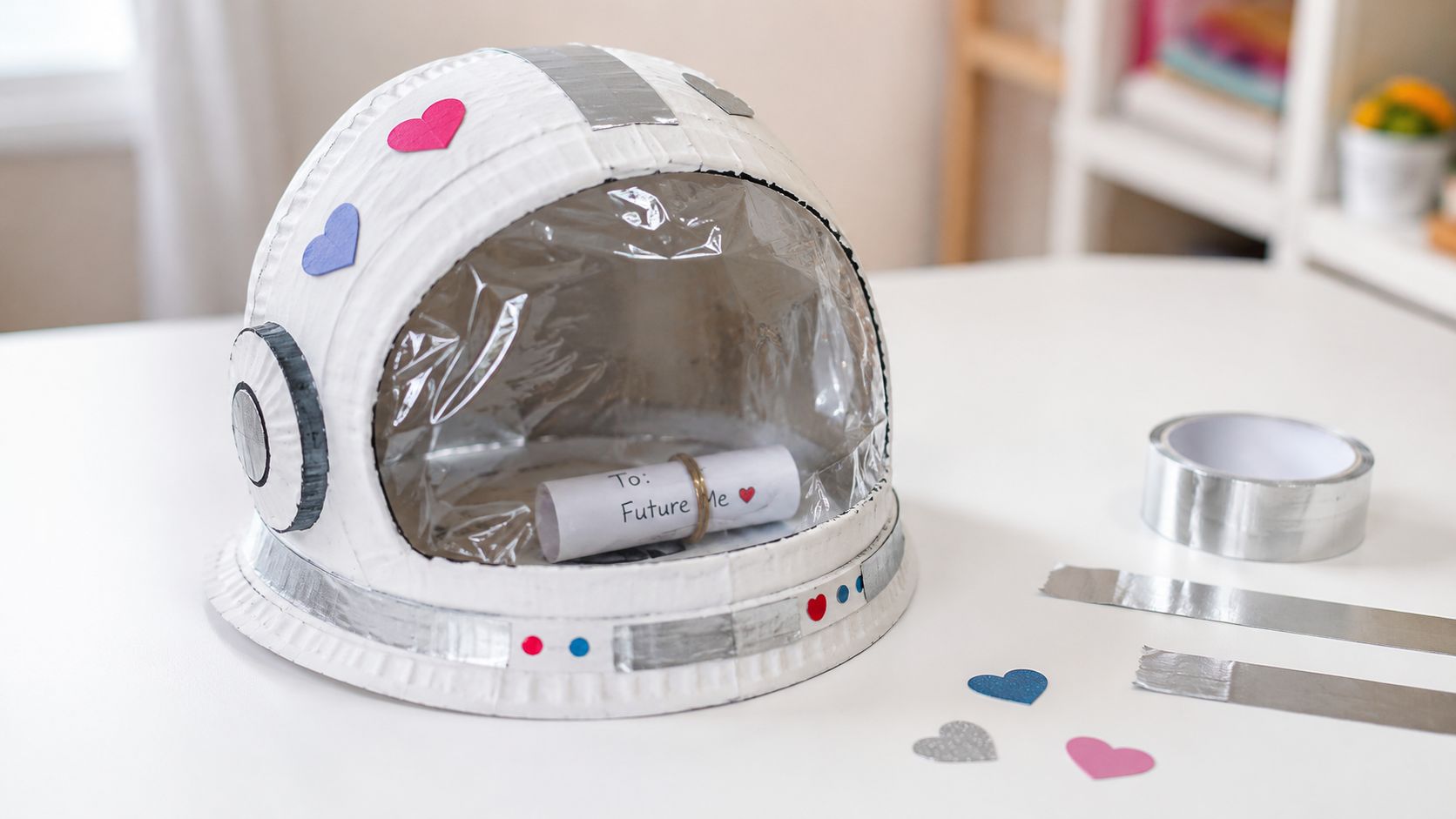
The STEM link is easy to explain. Real astronauts need helmets for protection, visibility, and communication. Your classroom version doesn't need to be scientifically perfect. It just needs children to think about design choices. Why does the visor need to be clear? Why must the structure stay firm?
What children can write inside
- A friendship boost: “You are brilliant at helping.”
- A mission note: “You are cleared for kindness duty.”
- A future message: “Dear future me, keep exploring.”
This idea suits children who aren't excited by flat card-making. They get to build something wearable or displayable, and that changes the energy at the table. Teachers can line the finished helmets along a wall for a “crew of kindness” display.
It also supports emotional literacy without making it feel like a worksheet. Children are writing encouragement, noticing others, and practising thoughtful communication while they glue stars onto a helmet. That's a strong trade.
3. Galaxy Slime Valentine Jars with Personalised Labels
Not every setting wants slime. Fair enough. But in a home craft session or a supervised club, galaxy slime can feel like a science-mission treat. Clear jars, swirling colours, and handwritten labels make it memorable.
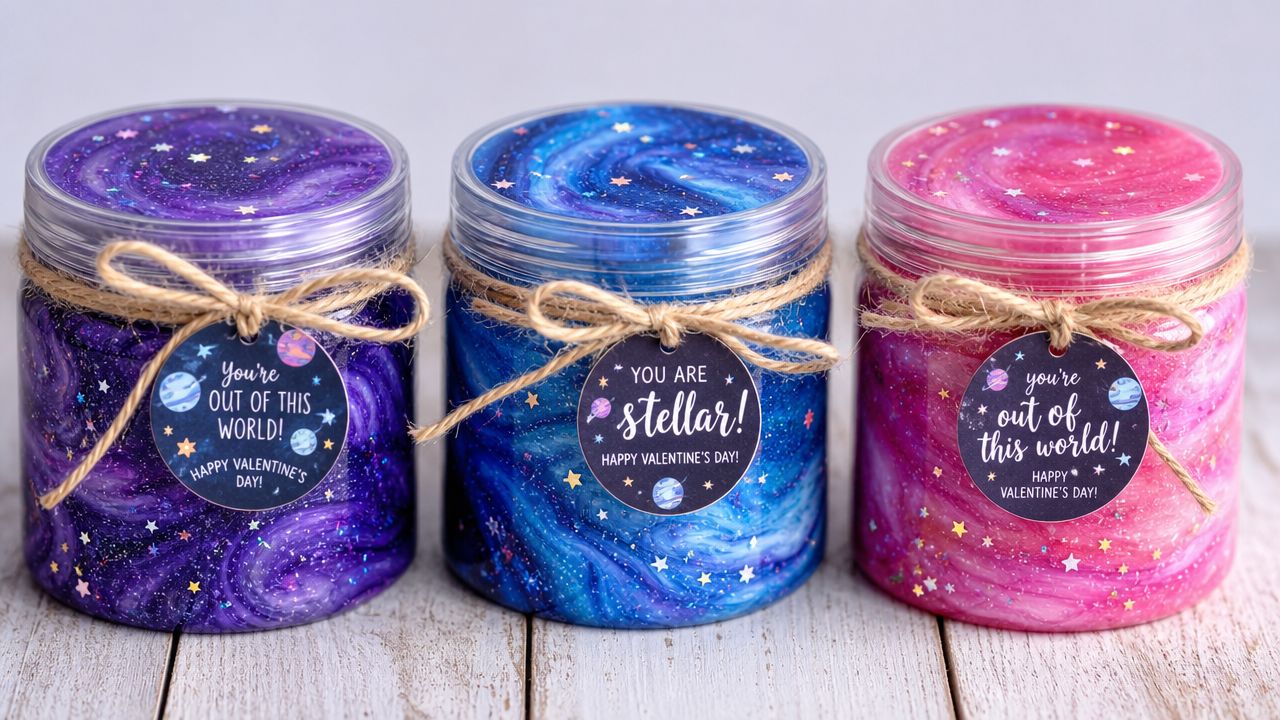
The trick is not to overcomplicate it. Prepare some of the base if needed, then let children focus on colour mixing, naming their slime, and designing labels such as “Nebula Friendship Goo” or “Zando's Star Swirl.”
Keep the mission under control
A jarred version is much easier than loose slime on tables. Add a label, a tag, and a short care note. Suddenly it becomes a giftable object, not just a blob with ambitions.
This kind of activity works best in informal settings, but it's also a good reminder that children often learn more when they can touch and test materials. They squeeze, stretch, compare, and describe what changes.
Later in the session, you can show a demo to support the making.
If you need labels or sticker ideas for the jar lids, some adults may find inspiration from durable automotive graphics, especially for bold shape-and-colour thinking.
For classrooms and libraries, though, low-mess paper crafts usually travel better. Existing Valentine craft ideas often lean into paint, glitter, and mixed-media mess, while many educators need low-cost, quick-clean options with clear instructions, as noted in these Valentine art lesson observations.
4. Constellation Connect-the-Dots Valentine Cards
Some children want a challenge they can solve. This is perfect for them. Instead of starting with a finished picture, they reveal the design by connecting dots, then turning that hidden pattern into a Valentine card.
You can make simple constellations for younger children and trickier versions for older ones. Add stars, black or navy backgrounds, and a short message such as “Our friendship is written in the stars.”
Why it works so well in mixed-age groups
The same format scales beautifully. One child may connect ten large dots and colour in a rocket. Another may map a denser star pattern and add labels, borders, and a mission report. That makes it handy for Key Stage 1 and Key Stage 2 settings.
For printable cutting and sticking support, Space Ranger Fred's cut-and-stick activities can slot in neatly beside this project.
Older children often prefer a task with a puzzle built into it. They're not just decorating. They're decoding, planning, and finishing.
That matters because so much Valentine craft content skews towards preschool-style sticking and painting. Yet there's a real gap for more story-led, skill-building activities for children aged 6 to 12, highlighted in this discussion of younger-skewing Valentine craft content.
A smart classroom example is to let each child create one constellation card, then swap and solve a partner's version before the final decoration goes on.
5. Recycled Rocket Valentine Gift Boxes
This mission starts in the recycling tub. Paper towel tubes, scrap card, leftover wrapping paper, and odd stickers can all become rocket gift boxes. That's part of the fun. Children get to see ordinary materials transformed into something gift-worthy.
The engineering challenge is simple but satisfying. Can the rocket stand? Will the lid fit? Is there enough room inside for a note, a joke, or a tiny treat?
Build sequence
- Body first: Cover the tube before assembly. It's much easier.
- Nose cone next: Pre-cut cones help younger children succeed.
- Fins last: Test balance before adding decorations.
This is one of the best arts and crafts valentine ideas for school corridors or library windows because the finished rockets have real display value. They look cheerful, upright, and purposeful.
For a themed extension, pair it with Space Ranger Fred's how to make a rocket activity so children can compare decorative rockets with launch-inspired models.
There's also a wider craft habit behind this. The global arts and crafts market is estimated at USD 50.7 billion in 2026 and projected to reach USD 67.39 billion by 2030, with DIY, recycled materials, online craft platforms, and virtual workshops noted as growth drivers. For teachers and families, that points towards practical kits and repeatable, low-friction projects rather than one-off fussy makes.
6. Heart-Shaped Planet Mobile Craft
A mobile brings movement into the mission. Instead of one flat picture, children create hanging planets shaped like hearts, each swinging gently at a different height. It feels part art, part engineering, part room decoration.

The science connection is balance. If one side is too heavy, the whole thing tilts. Children notice that quickly, then start adjusting lengths and positions. That's proper hands-on problem solving.
A lovely twist for libraries and classrooms
Give each child one hanging heart-planet to design, then combine them into a shared mobile for the room. One might be a fiery red world. Another could be an icy blue moon. Someone else will absolutely make a biscuit planet, and frankly that's good science fiction.
Use thick card if you can. Thin paper curls and droops, especially if children use wet paint or lots of glue. Mark string lengths in advance to save time.
This mission is particularly good for children who enjoy a slower, more thoughtful task. They can focus on colour, naming, and arrangement without racing through. Hang the final mobile near a reading corner and it becomes both decoration and conversation starter.
7. Fingerprint Alien Valentine Art
Here's a mission with a very low barrier to entry. One fingerprint becomes an alien body. Add eyes, antennae, tiny boots, and a speech bubble, and suddenly the page is full of cheerful extraterrestrials saying kind things.
The secret strength of this activity is individuality. No two fingerprints match, so no two aliens match either. Children instantly see that difference isn't a mistake. It's the whole point.
Friendship through tiny details
This works beautifully for Valentine messages that go beyond “Be mine.” Try lines like “You make our crew stronger” or “Thanks for helping on tricky missions.” Those are more natural for school and library spaces, where friendship and community matter more than romantic themes.
Use washable ink pads or paint and keep hand wipes nearby. Once the prints dry, children can use fine liners or felt tips for details. Older children can invent whole alien species with habitats and names.
Everyone's print is different. Everyone's alien is different. That makes the finished gallery feel welcoming straight away.
A real-world classroom example is a class poster titled “Our Friendly Galaxy”. Each child contributes one alien and one positive message. The final result looks playful, but it also builds belonging.
8. Glow-in-the-Dark Star Valentine Decorations
What makes a paper star feel like a tiny piece of night sky. Space Ranger Fred logs this as a high-excitement, low-fuss mission, because children get art, science, and a little bit of wonder in one go.
Cut stars from card, add Valentine messages, then paint details with glow-in-the-dark paint or use glow stickers. Hearts, constellations, and short notes such as “You light up our crew” work especially well. When the room darkens, the stars seem to store daylight and give a little of it back, rather like a sponge holding water and slowly releasing it.
That simple test is the STEM hook.
Children can charge their stars near a lamp, step into a dim corner, and observe what changes. You can guide the discussion with clear questions. Which star glows longest. Does a thicker layer of paint make a difference. Which shapes are easiest to see first. Those little observations help children practise prediction, testing, and noticing patterns without turning the craft table into a formal lesson.
Best setting for this project
This mission shines in homes, after-school clubs, libraries, and small group sessions where decorations can dry flat before display. Large classrooms can still run it successfully, but it helps to keep the designs bold and the paint layers light so everything dries in good time.
Display is part of the fun here. Hang the finished stars near a reading nook, across a bedroom wall, or in a class corner set up as a “night orbit” display. Children can write a secret message on the back, then explain to a friend how the glowing effect works. That turns a pretty decoration into a mini science demonstration with a Valentine twist.
9. Origami Space Shuttle Valentine Boxes
This one is for children who like precision. Folding paper into a shuttle-shaped box takes patience, care, and a bit of bravery when the steps look fiddly. That's exactly why it's brilliant.
Origami teaches geometry. Children notice halves, corners, lines, symmetry, and sequence without needing a worksheet. They also learn something equally important. If a fold goes wrong, you can often unfold, correct it, and continue.
How to keep frustration low
Start with bigger paper than you think you need. Small paper looks neat but makes early folds harder. Demonstrate each step slowly and keep one finished sample nearby so children can see where they're heading.
This project suits older primary children especially well because it feels more like a proper build than a quick decorative task. Once the shuttle box is complete, children can add hearts, mission numbers, or a tiny note tucked inside.
A lovely use in a school setting is a “mail dock” where finished shuttle boxes are lined up for class message exchanges. Children don't just make a craft. They produce a functional object with a job to do.
10. Collaborative Mural Space of Love with Handprints
Some missions are better as a team effort. A giant mural made from handprints, stars, planets, and messages gives every child a visible place in the final artwork. That's powerful.
Each handprint can become something different. A comet. A planet ring. An alien flower. A rocket flame. Add names and short notes around the edge, and the mural becomes a big public statement of kindness and belonging.
Why this one suits events so well
Family reading programmes, school fairs, and library Valentine sessions often need one activity that children can join at different times. A mural solves that neatly. People can contribute in minutes, but the final display looks rich and communal.
For organisers, distribution matters too. Independent craft-business research found that 81.9% of creators use social media to market their work, 72.8% rely on events, and 71.5% on word of mouth. That supports a simple idea for Valentine activities. Shareable, event-ready crafts often travel further than projects that only make sense on a shop shelf.
A collaborative mural gives children public proof that their ideas belong in the room.
If you run this mission, photograph the mural in stages. Children love seeing how individual handprints become a whole universe when everyone joins in.
Space Valentine Crafts: 10-Item Comparison
| Project | Implementation Complexity | Resource Requirements | Expected Outcomes | Ideal Use Cases | Key Advantages |
|---|---|---|---|---|---|
| Space-Themed Valentine Cards with Planet Pop-Ups | Moderate, folding and pop-up assembly | Cardstock, pre-printed templates, stickers, markers, glue | Interactive 3D cards with planet facts and personalized messages | Primary classrooms, craft stations, parents seeking STEM crafts | Combines STEM learning with creativity; branded and memorable |
| Astronaut Helmet Valentines with Message Capsules | Moderate–High, 3D assembly and visor work | Paper plates, clear plastic wrap, tape, decorative materials, message capsules | Wearable/display helmets that store valentines and compliments | Early years classes, Valentine's parties, STEM night demos | Highly engaging; teaches space suit concepts; promotes peer connection |
| Galaxy Slime Valentine Jars with Personalized Labels | Low–Moderate, simple mixing and decorating | Slime ingredients, clear jars, glitter/confetti, labels, lids | Sensory jars with cosmic appearance and attached personalized valentines | Classroom exchanges, sensory activities, parent-led crafts | High child appeal; low cost; easily customizable |
| Constellation Connect-the-Dots Valentine Cards | Low, print-and-complete activity | Printed dot-to-dot templates, pencils, cardstock | Educational cards revealing constellations with facts and messages | Curriculum integration, librarians, homeschool lessons | STEM-focused, low-prep, cost-effective |
| Recycled Rocket Valentine Gift Boxes | Moderate, cutting, assembling 3D rockets | Recycled tubes, craft paper, glue, paint, scissors | Eco-friendly rocket boxes for small gifts or treats | Eco-conscious classrooms, family crafts, Earth Day crossovers | Promotes recycling and sustainability; highly customizable |
| Heart-Shaped Planet Mobile Craft | Moderate–High, balance and assembly required | Sturdy cardstock, string, craft sticks, adhesives | Hanging mobiles combining hearts and planet designs for display | Classroom or nursery decorations, home bedroom displays | Visually striking; integrates art and basic physics; interactive |
| Fingerprint Alien Valentine Art | Low, fingertip stamping and drawing | Washable ink pads, cardstock, fine-tip markers, wipes | Quick, unique fingerprint alien valentines, sensory-friendly | Early years, mixed-age family activities, quick craft stations | Inclusive and low-skill; fast to complete; highly personal |
| Glow-in-the-Dark Star Valentine Decorations | Low–Moderate, painting with safety considerations | Glow paint, star templates (cardstock/foam), well-ventilated space | Long-lasting glowing stars that illustrate photoluminescence | Science-focused classes, family STEM crafts, bedroom decor | Teaches light science; creates magical, memorable decorations |
| Origami Space Shuttle Valentine Boxes | Moderate–High, precise folding and instruction | Colored paper/cardstock, step-by-step guides, decorating supplies | Functional shuttle-shaped boxes that hold small gifts/messages | Older primary students, gifted programs, math-integrated lessons | Develops spatial reasoning and patience; minimal materials |
| Collaborative Mural "Space of Love" with Handprints | High, coordination, space, and logistics | Large backdrop (paper/fabric), washable paint, stations, drying area | Large community mural showcasing handprints and written valentines | School-wide events, community centers, multi-age programs | Builds community inclusivity; creates a lasting, professional display |
Mission Complete! You're a Valentine's Day Hero!
What do children learn when a Valentine craft arrives as a mission from Space Ranger Fred's activity log?
Quite a lot. A pop-up planet card becomes a lesson in paper engineering. A glowing star decoration turns into a simple investigation about how light is stored and released. A rocket gift box asks children to build, test, adjust, and try again, which is exactly how good STEM learning often works.
That is what makes this arts and crafts valentine theme so useful. Children are not only decorating. They are observing cause and effect, following sequences, comparing shapes, and explaining results. The craft gives them something concrete to point to, rather like a mini science model they can hold in their hands.
The mission format helps, too.
A mission briefing gives each activity a purpose. Instead of “make a card”, the task becomes “deliver a message capsule safely” or “map a constellation clearly enough for another ranger to follow”. That small story shift can make older primary pupils more willing to stick with careful steps, especially in projects such as origami boxes or balanced mobiles where patience matters.
It also opens the door for different learners. Some children enjoy precise folding and pattern spotting. Others prefer sensory work such as slime or paint. Some want a solo mission they can finish independently. Others do their best work in a crew, adding handprints and ideas to a shared mural. A good mission table has room for all of them.
The ultimate victory comes at the end, when a child can say what happened and why. “My mobile swings because the sides are uneven.” “My stars glowed after sitting in the light.” “My shuttle box stayed closed because of the folds.” That sort of explanation shows that the craft did more than fill time. It helped children notice how things work.
Mission complete, Rangers. Valentines delivered, curiosity launched.