
You're probably here because someone looked up at the sky and shouted, “The Moon's been cut in half!”
Fair question. Brilliant question, in fact.
That sharp, bright half-Moon is one of the most useful things in the sky for teaching children how the Moon really works. It's easy to spot, fun to talk about, and perfect for a family sky-watch after school in the UK.
Have You Ever Seen Half a Moon
A child spots the Moon on the way home. One side is bright. One side is dark. Then comes the big question.
“Has half the Moon disappeared?”
That's exactly the sort of question I love. It's how real science starts. Not with giant words. With noticing.
I've had plenty of Moon detective moments like this with children and parents. One points up. Another guesses it's a cloud. Someone else says it must be “a half moon”. Then everyone starts looking properly. That's when the fun begins.
The Moon hasn't changed shape. Our view of the lit part has changed.
That idea can feel slippery at first, especially for younger children. If it looks half, surely it is half? Not quite. The Moon is still a whole round world. The Sun is always lighting one half of it. From Earth, we only see different amounts of that lit half as the Moon moves through its cycle.
This is one of those lovely science moments where children can say:
- I think something strange is happening
- I try to work it out
- I can test it with a model
- I can explain what I saw
That's a proper Space Ranger way to learn.
What We Call the First Quarter Moon
That “half moon” has a proper name. It's the first quarter moon.
Now, I know what you're thinking. If we can see half of it lit, why on Earth is it called a quarter?
Half lit, quarter gone round
The answer is about the Moon's journey, not its shape. The first quarter moon happens when the Moon is one-quarter of the way through its cycle around Earth. Astronomically, this phase is defined by a geocentric elongation of 90° from the Sun, and at this phase 50% of the Moon's disk is illuminated, with the Moon still growing brighter on its way towards full Moon, as explained by the U.S. Naval Observatory moon phases guide.
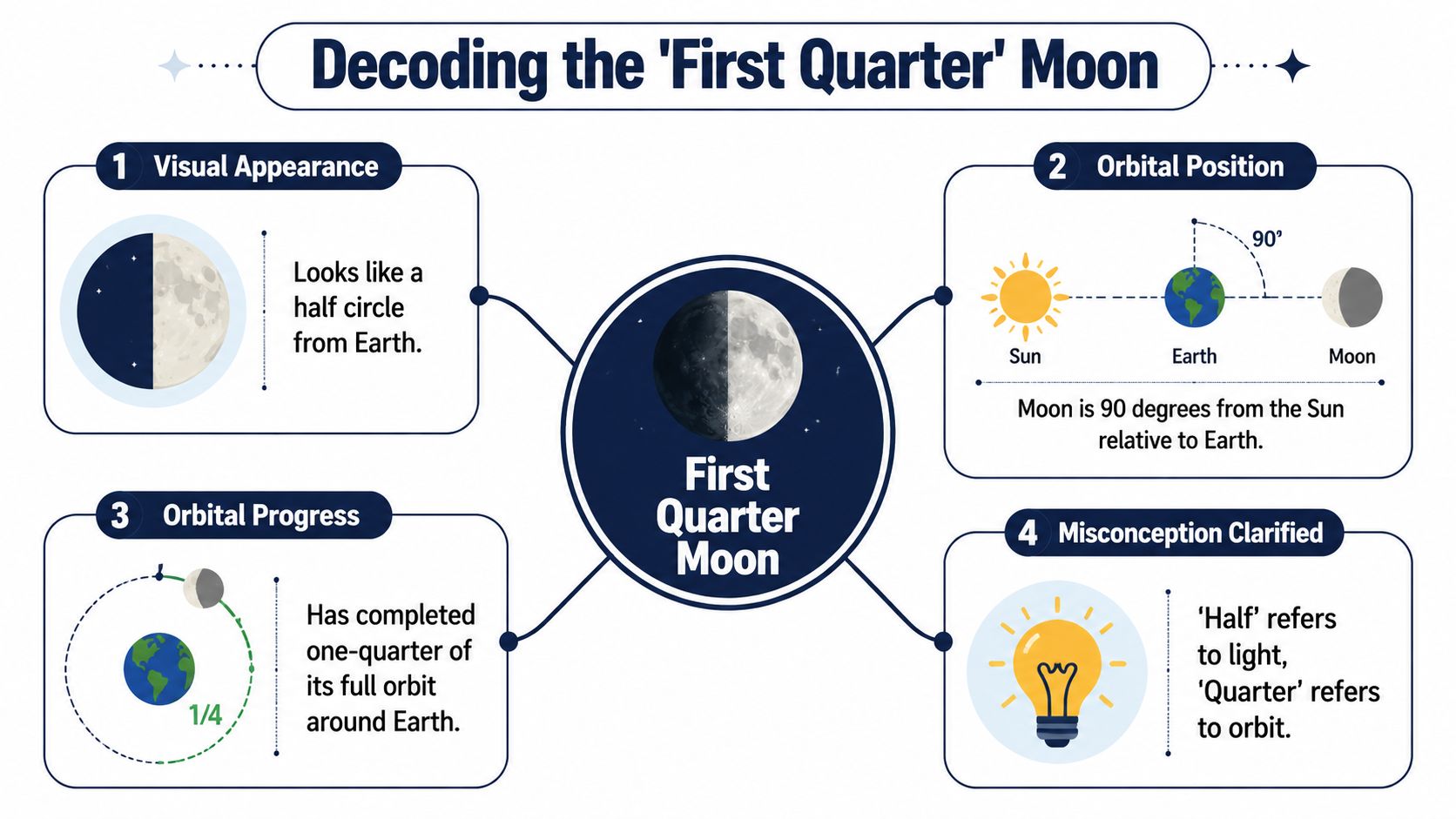
Consider a runner on a track. If the runner has finished one quarter of the lap, we don't say they've vanished. We say they've reached the quarter mark. The Moon is doing the same sort of thing in space.
A simple way to picture it
Try this with children. Pretend the Moon is a ball. Pretend the Sun is a giant torch. One half of the ball is always lit by that torch. But where you stand changes what you can see.
So the phrase to remember is this:
- “Half” refers to what looks bright
- “Quarter” refers to where the Moon is in its orbit
If your young astronomer wants more Moon phase help, this Moon phases for kids guide is a handy follow-on.
A short visual can help too:
A Simple Mission to See Why It Happens
You don't need a telescope. You need a ball and a torch.
That's it. Science mission ready.
The ball and torch experiment
Here's a simple home or classroom activity:
- Get a ball. A tennis ball or orange works nicely.
- Get a torch. This will be your Sun.
- Stand still as Earth.
- Hold the ball out at arm's length. That's the Moon.
- Ask someone to shine the torch from one side.
- Turn slowly until you see the ball with its right half lit.
For children in the UK, this model is especially helpful because it matches what they usually notice in the sky during this phase.
What children often get muddled about
Some children think Earth's shadow causes the phases. It doesn't. The phases happen because we see different amounts of the Moon's sunlit half.
Others think the Moon only comes out at night. Also not true. The Moon can be up in daylight too, depending on the phase.
Try this sentence: “The Moon is always a whole ball. I only see different parts of the lit side.”
That one sentence clears up a lot.
You can turn this into a speaking challenge as well. Let one child be the scientist and explain the model to the family. That's a lovely confidence-builder. They move from “I watched” to “I can explain”.
Your Guide to Spotting the First Quarter Moon
You finish tea, pull on a jumper, and step into the garden just before bedtime. There it is. A bright half-Moon hanging in the south or southwest, easy to spot before the sky goes fully dark. That is one reason families in the UK often get on well with the first quarter Moon. It turns up at a friendly time.
When to look
Start in the late afternoon or early evening and keep watching as the sky darkens. The Moon is often easier to notice once the blue sky begins to fade, but you do not need to wait until late at night.
A handy family question is, “Can we spot it before the stars really pop out?” Often, yes.
If you are planning a school club, library event, or garden observing session with Space Ranger Fred energy, choose a clear evening and give children a simple job. Ask them to look for a half-lit Moon with the right-hand side bright in the UK. That small detail helps them connect what they learned indoors with what they can see outside.
What to look for
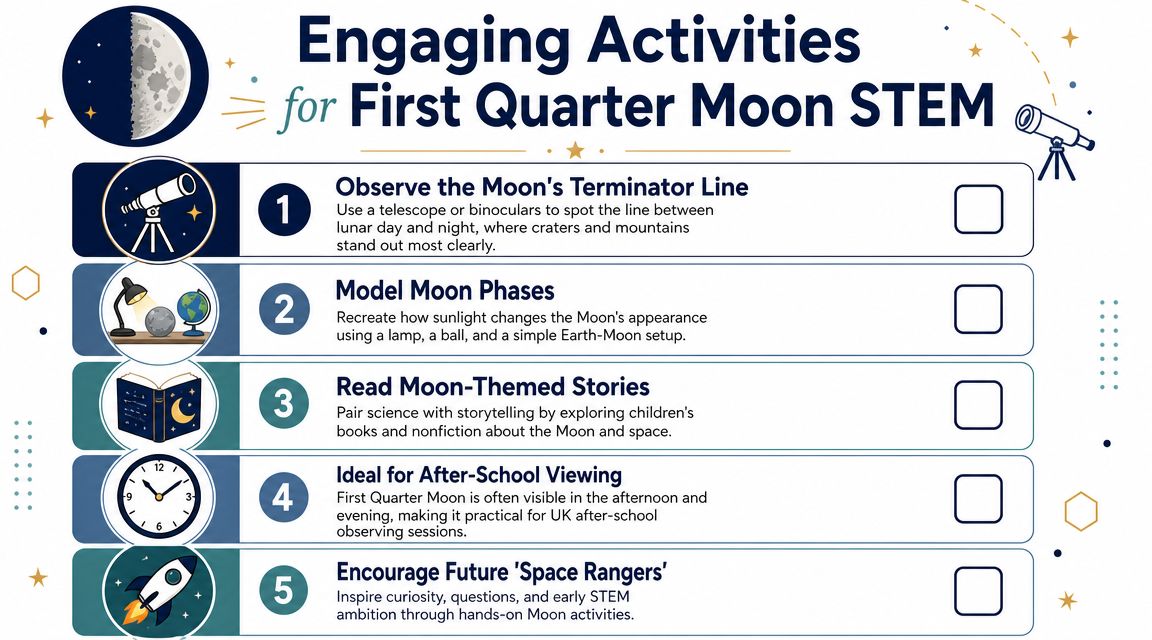
The most exciting part is the border between the bright half and the dark half. Astronomers call that line the terminator. It works a bit like sunrise and sunset on Earth. Near that boundary, shadows stretch out, so bumps and dents on the Moon stand out more clearly.
Look for these features:
- Craters with one side lit and one side in shadow
- Mountain areas that look rough and textured
- Dark, smoother patches called maria, which were once huge lava plains
- A clean half-moon shape that helps children remember this phase
You do not need fancy equipment to enjoy that view. A pair of binoculars can show plenty, and if your family wants help choosing and using kit, this how to use telescopes article gives a clear beginner-friendly guide.
NASA's Moon phases page is also useful for grown-ups and teachers who want a reliable reference before heading outside.
Smart observing tips for UK families
Clouds love to interrupt British skywatching, so keep the plan simple. Check the forecast, pick a safe outdoor spot with a decent view of the sky, and let children look for the Moon as soon as it becomes obvious rather than waiting for “perfect” darkness.
A driveway, park, playground, or library yard can work well.
Teachers making slides or short clips for class sometimes like to create hyper-realistic videos of lunar phases before an outdoor session. That helps children know what shape they are hunting for if the sky remains stubbornly cloudy.
And if the grown-ups want a warm drink for the mission, Matcha Ceremony costs 29.9 and is in_stock. It is one cosy option to sip while young moon-watchers report back with their crater discoveries.
Moon Missions for Classrooms and Libraries
A good Moon lesson should not end when the bell rings.
The first quarter moon is great for schools, libraries, and family groups because children can learn the idea indoors, then test it outside later the same day. That makes the Moon feel less like a diagram in a book and more like a real neighbour in the sky. For teachers and librarians in the UK, that is a gift. You can turn one sky event into science, storytelling, sketching, and home learning all at once.
Mission ideas children remember
Space Ranger Fred would call these short, cheerful Moon missions. They work well in classrooms, library clubs, and family activity sessions.
-
Moon diary mission
Ask pupils to draw the Moon on several evenings. What changes. What stays the same. Children start spotting patterns for themselves, and that sticks far better than copying phase names from a worksheet. -
Biscuit phase mission
Use sandwich biscuits with cream filling to model Moon phases. Children can scrape away the bright part they do not need and build each shape by hand. It is a simple way to show that the Moon changes in a cycle. -
Ball and torch mission
Place one child in the middle as Earth, one with a torch as the Sun, and one holding a ball as the Moon. As the "Moon" moves around "Earth," everyone can watch the lit part shift. It works like a tiny classroom theatre version of the solar system.
A useful UK detail
Children in the UK usually see the right side lit during the first quarter moon. That can confuse them at first, especially if they have seen photos from the Southern Hemisphere showing the bright side the other way around. Are both pictures correct? Yes. The Moon is the same. Our viewing angle changes.
That question opens the door to a brilliant discussion about perspective. Two people can look at the same football from opposite sides and describe different parts facing the lamp. The Moon works in a similar way.
Library and lesson extensions
Libraries can turn this phase into a whole mini topic, not just a single activity sheet. Start with a read-aloud space story, then ask children to give a "junior astronomer briefing" where they explain what they expect the Moon to do next. Add an art table for crater shading or Moon phase sketches, and suddenly science, speaking, and drawing are all working together.
Teachers who want ready-to-use extras can use the freebies page. For a follow-up read that keeps the curiosity going, this child-friendly Moon facts post fits nicely into class discussion or library browsing.
One small mission can lead to a big click of understanding. That is the fun part.
Your Final Moon Debriefing
So, mission report time.
The Moon isn't being sliced in half. It's still a whole world. We're seeing half of the lit part from Earth.
It's called the first quarter moon because the Moon is at the quarter-point in its cycle, even though the bright part looks like a half shape to us. That's the bit children often mix up, and once it clicks, it really clicks.
A few strong ideas to keep:
- The Moon's cycle is about 29.5 days
- The first quarter comes roughly a week after new Moon
- It's one of the easiest phases for families to spot in the evening
- The shadows near the terminator make surface features stand out
If a child can say, “I know why it looks half lit, and I can show you with a ball and torch,” that's excellent learning.
Keep looking up. Keep asking questions. That's how young explorers grow.
If you'd like one more child-friendly Moon read, this fun facts about the Moon article makes a good next stop. And if you want story-led learning materials, the book series and school visits are there for families, teachers and librarians.
If you'd like more playful STEM ideas, story-led space learning, and resources for schools and families, visit Space Ranger Fred. Learning should be experienced, not just delivered.