
Welcome, fellow explorers! Are you on a mission to find the best games for children? You've landed in the right place! Finding games that are both incredibly fun and secretly educational can feel like searching for a new planet in a galaxy of options. But don’t worry, your mission is about to become much clearer.
Play is one of the most powerful tools for learning. It builds problem-solving skills, sparks creativity, and teaches teamwork, all while children are simply having a brilliant time. To unlock a universe of fun that also develops crucial abilities, consider exploring this list of 9 Fun Learning Games for Kids That Actually Build Skills.
Here at Space Ranger Fred, we believe learning should be an adventure. That’s why we’ve organised this ultimate list of 10 amazing types of games, perfect for young adventurers aged 6–12. From mind-bending puzzles that sharpen STEM skills to epic outdoor quests, this guide will help you choose the perfect activity to fuel your child's curiosity. Prepare for a galaxy of fun as we explore games that boost brainpower and encourage active play. Let's blast off!
1. Educational Puzzle Games
Educational puzzle games are a brilliant way to blend learning with play, turning core subjects like maths, spelling, and logic into an exciting adventure. These digital and physical games for children are designed with specific learning objectives, embedding academic concepts directly into their mechanics. Instead of just drilling facts, children absorb knowledge organically while solving challenges and reaching new levels.
This approach transforms screen time into a productive and engaging activity. For instance, Prodigy Math Game adapts its difficulty to your child's skill level, making complex maths problems feel like an epic quest. Similarly, Endless Alphabet uses playful monsters and animations to teach letters and vocabulary in a way that sticks.
Why Choose Educational Games?
These games are particularly effective because they provide immediate feedback and reward progress, which helps to build confidence and a positive attitude towards learning. They create a low-pressure environment where making mistakes is just part of the fun, encouraging children to experiment and develop crucial problem-solving skills.
Top Tip: When selecting a game, look for those that align with your child's current school curriculum. This can help reinforce what they're learning in the classroom and address any areas where they might need extra support.
Making it Work for Your Family
To get the most out of educational games, balance is key. It's a good idea to set clear time limits for digital play to prevent screen fatigue. You can also make it a collaborative activity by playing alongside your child, discussing strategies, and celebrating their achievements together. Many games, like Minecraft Education Edition, offer progress reports for parents, allowing you to see which skills your child is mastering.
2. Cooperative Multiplayer Games
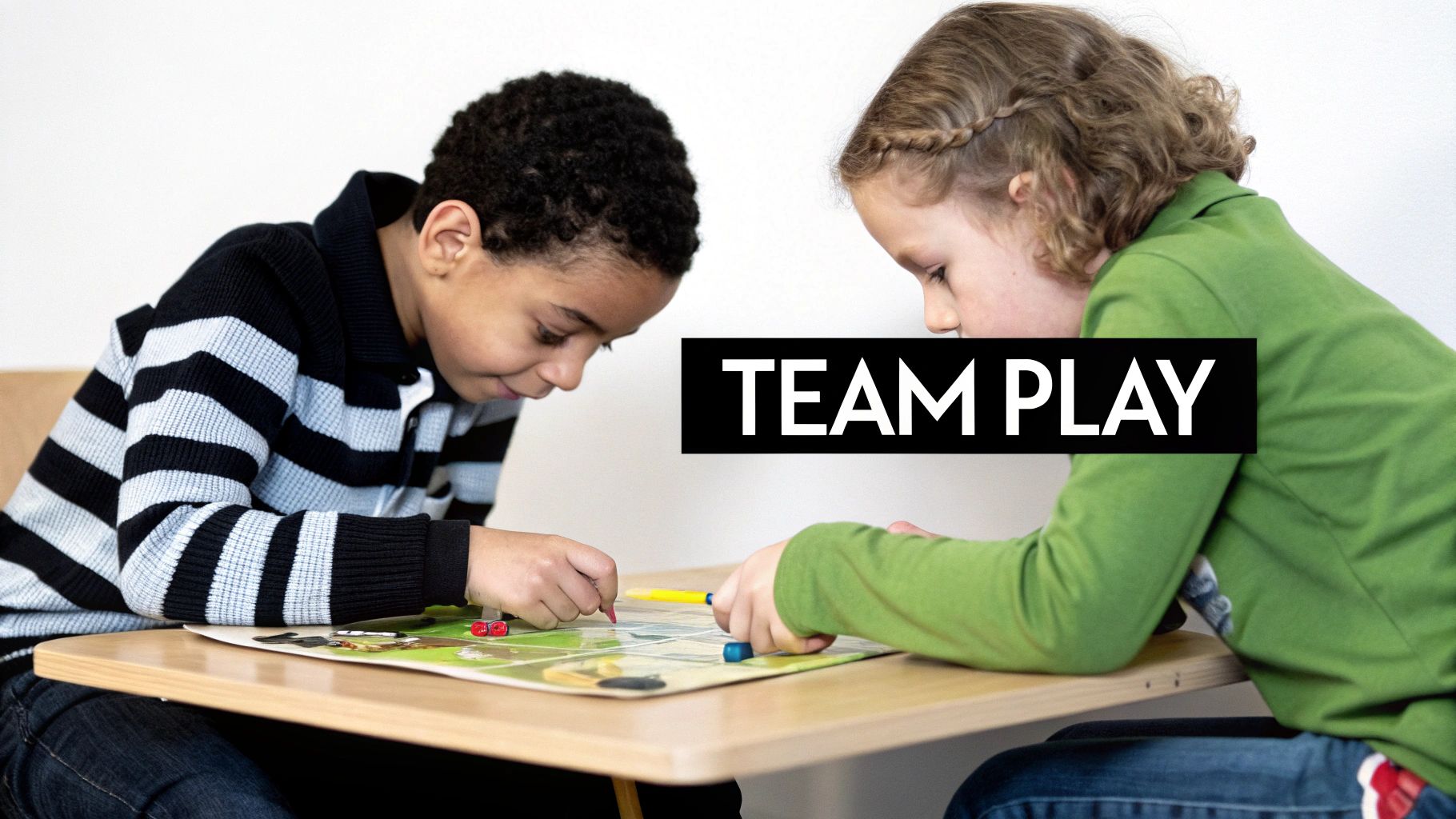
Cooperative multiplayer games are a fantastic way for children to learn the value of teamwork and communication in a fun, shared environment. Unlike competitive games, these games for children require players to work together towards a common goal, meaning everyone wins or loses as a team. This collaborative approach helps to build crucial social skills like negotiation, empathy, and collective problem-solving.
This style of play shifts the focus from individual victory to group success, making it a positive and bonding experience. For example, in Overcooked, players must coordinate as chefs in a chaotic kitchen, while It Takes Two sends players on a narrative journey where every puzzle requires synchronised action. These games masterfully weave cooperation into their core mechanics.
Why Choose Cooperative Games?
These games are particularly effective for developing strong interpersonal skills and emotional intelligence. They create a supportive space where children learn to listen to others' ideas, articulate their own thoughts, and manage disagreements constructively. Success depends entirely on how well the group works together, reinforcing the idea that collaboration leads to better outcomes.
Top Tip: When starting out, choose games with flexible difficulty settings and clearly defined roles. This allows players to contribute meaningfully without feeling overwhelmed and helps everyone understand their part in the team's success.
Making it Work for Your Family
To get the most out of cooperative play, it helps to establish clear communication guidelines before you start. Encourage children to take turns leading or making decisions, ensuring everyone feels heard and valued. After a session, take a few minutes to talk about what worked well and what could be improved next time. Many games, like the Jackbox Party Packs, are designed for group fun and create a perfect setting for family game night.
3. Outdoor Adventure Games
Outdoor adventure games are a fantastic way to combine physical activity with imaginative play, encouraging children to explore the natural world around them. These games for children move the fun outside, turning parks, gardens, and forests into exciting playgrounds for exploration and developing spatial awareness. Instead of being confined indoors, kids can run, jump, and learn through direct experience.
This approach transforms playtime into a memorable adventure that also promotes health and well-being. For instance, a simple forest scavenger hunt encourages observation skills, while setting up a parkour-inspired obstacle course builds agility and coordination. Classic games like Capture the Flag teach teamwork and strategy in a dynamic, open-air environment.

Why Choose Adventure Games?
These games are highly effective because they engage children's natural curiosity and sense of adventure, making physical exercise feel like pure fun rather than a chore. They offer a hands-on way to learn about nature, navigation, and resilience, all while creating a screen-free environment where children can connect with their surroundings and each other.
Top Tip: When planning an outdoor game, establish clear safety rules and physical boundaries first. This ensures everyone understands how to play safely, allowing them to focus on the fun and adventure.
Making it Work for Your Family
To get the most out of outdoor adventures, preparation is key. Ensure everyone has appropriate gear, like sturdy shoes and water bottles, and adapt activities to suit different age groups and abilities. You can also make it a learning opportunity by documenting your adventures through photos or a nature journal. These missions are a great way to put the problem-solving skills from the Space Ranger Fred books into practice!
4. Story-Driven Narrative Games
Story-driven narrative games place a strong emphasis on plot and character development, inviting children to step into the shoes of a protagonist whose choices shape the entire experience. These games for children function like interactive novels, where decisions directly influence dialogue, relationships, and major story outcomes. This format provides a powerful and immersive way to explore complex themes and develop crucial life skills.
Unlike action-focused games, the core mechanic here is decision-making. For example, in titles like Life is Strange: True Colors, players navigate social situations and moral dilemmas, learning how their actions affect others. The focus is not on winning or losing but on experiencing a compelling story and understanding the consequences of one's choices, fostering empathy and critical thinking in an engaging, safe environment.
Why Choose Narrative Games?
These games are exceptional tools for developing emotional intelligence and empathy. By seeing the world through a character's eyes, children can safely explore different perspectives and learn to understand complex emotions and motivations. The cause-and-effect nature of the storytelling also reinforces decision-making skills and encourages thoughtfulness.
Top Tip: Always check content ratings and read reviews before letting your child play. Games like these can explore mature themes, so play alongside them to discuss the story and its ethical questions together.
Making it Work for Your Family
Turn these games into valuable conversation starters about values and real-world scenarios. After a play session, ask your child why they made a particular choice and what they think might have happened differently. Encourage them to replay sections to explore alternative narrative paths and see how small changes can lead to big differences. You can also explore how storytelling is used to teach important lessons in books like the Space Ranger Fred series.
5. Building and Creation Games
Building and creation games offer a digital sandbox where a child’s imagination is the only limit. These games for children emphasise creative expression, providing open-ended environments where kids can design, experiment, and build entire worlds from scratch. Unlike games with rigid goals, these platforms foster ingenuity and self-directed play, allowing children to bring their unique ideas to life.
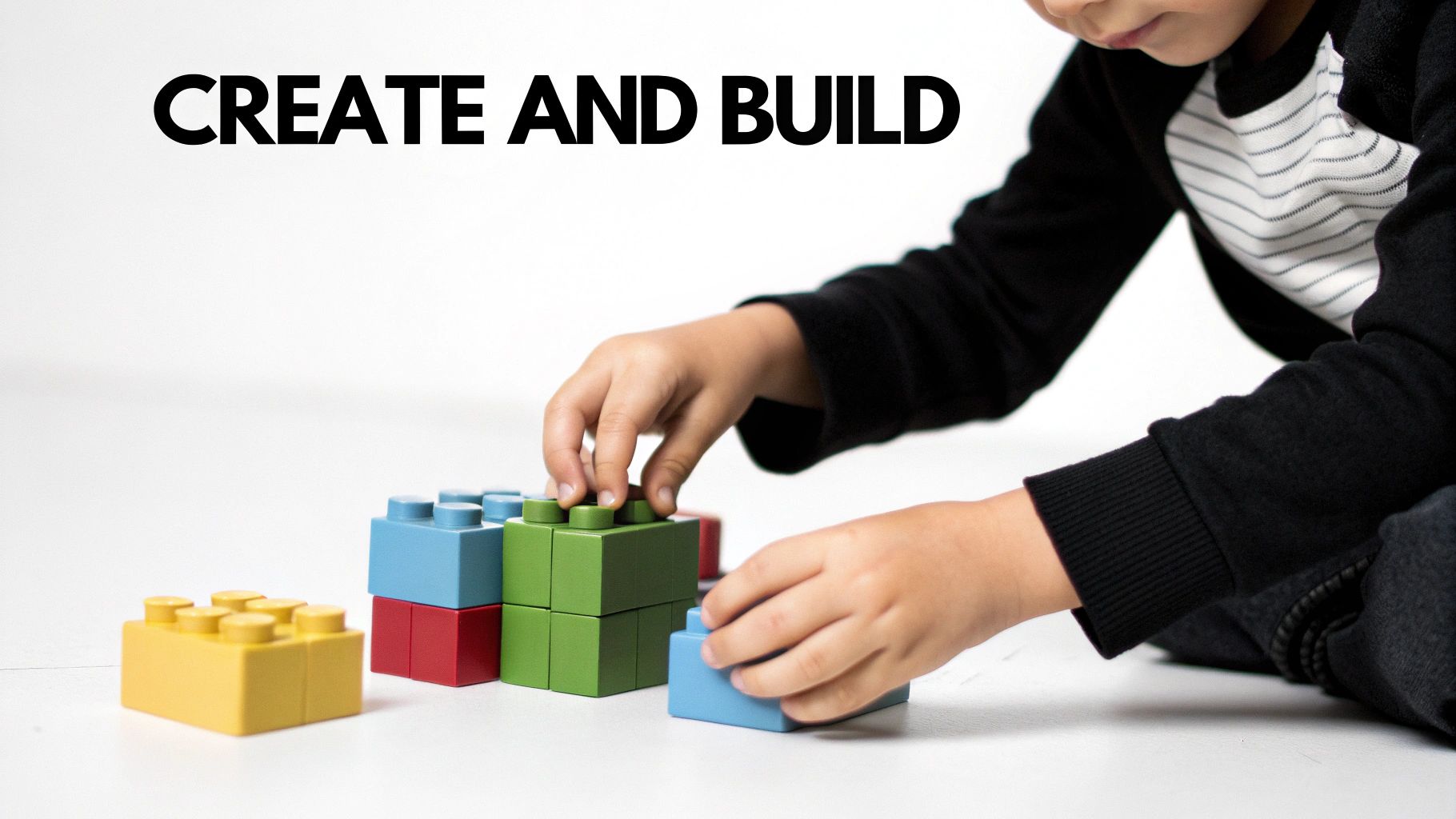
This free-form approach makes learning feel natural and exciting. Titles like Minecraft allow children to construct anything from simple homes to complex machines, teaching spatial reasoning and resource management. Similarly, Roblox empowers players to design and share their own games, introducing basic coding and design principles in a fun, collaborative setting.
Why Choose Building and Creation Games?
These games are exceptional for developing crucial STEM skills, including problem-solving, engineering fundamentals, and project planning. They encourage persistence and resilience as children work through design challenges to realise their vision. The process of planning, building, and refining a creation helps to build confidence and a strong sense of accomplishment.
Top Tip: Encourage your child to document their creative process. They could take screenshots of their progress or even create a short video tour of their creations, helping them to develop storytelling and presentation skills alongside their building abilities.
Making it Work for Your Family
To get the most out of these games, set creative challenges like "build a futuristic space station" or "design a new animal". For online platforms, it's vital to establish clear internet safety guidelines and use parental controls to manage interactions. You can combine digital play with real-world activities, using LEGOs or other construction toys to replicate their in-game creations. For more hands-on building fun, check out our free activities and printables.
6. Memory and Concentration Games
Memory and concentration games are fantastic tools for sharpening young minds, improving focus, and enhancing cognitive function. These engaging games for children challenge them to pay close attention, recognise patterns, and recall information under fun, low-pressure conditions. From classic card-matching games to digital brain trainers, the core mechanic involves exercising the mental muscles responsible for short-term memory and sustained attention.
This type of play is crucial for developing foundational learning skills. For example, a simple game of Concentration (or Memory) with a deck of cards helps children practise visual recognition and recall. Digital versions like the classic Simon Says or modern apps such as Lumosity Brain Training turn this skill-building into a fast-paced, rewarding challenge that feels less like work and more like play.
Why Choose Memory Games?
These games are particularly beneficial because they directly train a child's working memory, which is essential for tasks like following multi-step instructions and solving maths problems. Regular play can lead to noticeable improvements in focus and attention span, helping children to stay on task both in the classroom and at home. They build mental stamina in a fun, accessible way.
Top Tip: Use these games as a quick "warm-up" before homework or other learning activities. Just five to ten minutes of a memory game can help a child switch into a focused mindset and prepare their brain for more structured tasks.
Making it Work for Your Family
To introduce memory games effectively, start simple and gradually increase the difficulty. For card games, begin with a small grid of pairs and expand it as your child’s confidence grows. Make it a regular family activity, perhaps after dinner, to encourage consistent practice. You can also discuss different memory strategies together, such as grouping items or creating stories to remember sequences.
7. Role-Playing and Pretend Play Games
Role-playing and pretend play games are powerful tools for nurturing imagination, where children step into the shoes of different characters and explore fictional worlds. These immersive games for children encourage them to create storylines, solve problems in character, and develop a deeper understanding of social dynamics. This can range from digital adventures to classic living room make-believe.
This form of play is crucial for emotional and creative development. In a video game like The Legend of Zelda: Breath of the Wild, a child becomes a hero navigating a vast world, making decisions that shape their journey. In traditional pretend play with costumes and props, they might become a scientist, an artist, or an explorer, acting out scenarios and learning to cooperate with others.
Why Choose Role-Playing Games?
These games are exceptional for building empathy and social skills. By adopting another persona, children learn to see situations from different perspectives and practise communication and negotiation. This imaginative process also strengthens creative thinking and storytelling abilities, laying the foundation for complex problem-solving in a fun, story-driven context.
Top Tip: Encourage your child to create a simple backstory for their character. Ask questions like, "Where did they come from?" or "What is their biggest dream?" This adds depth to their play and enhances their connection to the story.
Making it Work for Your Family
To get the most from role-playing, establish a few simple ground rules for fairness, especially when playing with others. You can also make it a family activity by joining in or helping them set up their play space. Documenting their adventures through drawings or a story journal can be a wonderful way to reflect on their creative journeys. For more ideas on blending stories with learning, explore the adventures of Space Ranger Fred and his friends.
8. Physical Active Games
Physical active games are an excellent way to get children moving, combining the excitement of digital entertainment with the benefits of physical exercise. These innovative games for children use motion controls, kinetic sensors, or virtual reality to turn body movements into in-game actions. Instead of sitting on the sofa, children are jumping, dancing, and stretching to achieve their goals.
This approach makes physical activity feel less like a chore and more like a thrilling adventure. For example, Nintendo Switch Sports brings the fun of tennis and bowling into the living room, while Just Dance encourages children to learn and perform choreographed routines. These games effectively bridge the gap between screen time and active play, promoting a healthier, more balanced lifestyle.
Why Choose Active Games?
These games are particularly beneficial for developing gross motor skills, coordination, and cardiovascular health in an engaging way. They provide a fantastic indoor alternative for physical activity when outdoor play isn't an option. The clear objectives and rewarding feedback loops help motivate children to stay active and build physical confidence in a fun, low-pressure environment.
Top Tip: Before starting, ensure you have cleared an adequate and safe play space free from obstacles. It’s also wise to start on a lower difficulty setting to help your child learn the movements correctly and prevent frustration.
Making it Work for Your Family
To integrate active games successfully, treat them as a fun supplement to outdoor play and organised sports, not a replacement. You can make it a family affair by setting up friendly competitions or working together to beat high scores. Always encourage taking short breaks to rest and rehydrate, preventing fatigue and potential injury.
9. Strategic Board and Card Games
Strategic board and card games are a fantastic way to develop critical thinking, planning, and tactical skills through engaging, turn-based play. These tabletop games for children challenge players to manage resources, think ahead, and adapt their strategies to changing circumstances. By embedding concepts like maths and logic into their rules, they make learning feel like an exciting competition.
This type of play moves beyond simple luck, encouraging children to make meaningful decisions. For instance, Ticket to Ride teaches geography and route planning as players build railway networks, while classics like chess and checkers are masterclasses in forward-thinking. Even simpler card games like Uno introduce basic strategy and probability in a fun, accessible format.
Why Choose Strategic Games?
These games excel at teaching patience, sportsmanship, and complex problem-solving. They create a structured environment where children learn to anticipate consequences, weigh risks and rewards, and understand that their choices directly impact the outcome. This process helps build resilience and analytical skills that are valuable both in and out of the classroom.
Top Tip: When introducing a new game, start by playing as a cooperative team. This allows you to explain the rules and discuss strategic choices together, reducing pressure and making the learning process more collaborative and enjoyable.
Making it Work for Your Family
To make strategic games a family favourite, begin with titles designed for your child’s age group, such as Catan Junior. Introduce the rules gradually rather than all at once, perhaps playing a simplified version first. Discussing why a particular move was strong or what could have been done differently helps reinforce strategic thinking. For more hands-on fun, you can explore our free activities for other ways to build tactical skills.
10. Social Simulation Games
Social simulation games offer a wonderful digital playground for exploring social interactions, relationships, and community life. These immersive games for children allow players to manage characters, build friendships, and navigate complex social dynamics in a safe, controlled environment. By taking on roles and making decisions, children can develop empathy, social awareness, and emotional intelligence.
This genre turns everyday life into an engaging adventure. For example, in Animal Crossing: New Horizons, children build a community on a deserted island, interacting with charming animal neighbours and collaborating with friends. Similarly, Stardew Valley allows players to restore a farm while forming deep relationships with townspeople, teaching the value of kindness and cooperation.
Why Choose Social Simulation Games?
These games are particularly effective for teaching subtle social cues and the consequences of one's actions in a low-stakes setting. They encourage children to think about others' feelings and perspectives, fostering crucial life skills. The long-term nature of these games also teaches patience, planning, and the rewards of sustained effort in building relationships.
Top Tip: Use game scenarios as conversation starters. Ask your child why a character felt a certain way or what they could have done differently in a social situation to encourage real-world emotional reflection.
Making it Work for Your Family
To get the most out of social simulation games, it's important to set clear boundaries between fictional and real-life relationships. Discuss how in-game interactions can mirror real friendships but also how they differ. Balance screen time with real-world social activities to ensure skills are practised.
10-Item Comparison of Childrens Games
| Type | Implementation Complexity 🔄 | Resource Requirements ⚡ | Expected Outcomes 📊⭐ | Ideal Use Cases 💡 | Key Advantages ⭐ |
|---|---|---|---|---|---|
| Educational Puzzle Games | Medium — curriculum integration | Medium — devices or physical sets | ★★★★ — improves academics & critical thinking | Classroom supplements, self‑paced learning | Engaging learning; measurable progress |
| Cooperative Multiplayer Games | Medium — social systems & sync | Medium — multiplayer infra & scheduling | ★★★★ — teamwork & communication | Group activities, team-building, family play | Builds collaboration; social bonding |
| Outdoor Adventure Games | Low — simple rules, logistics planning | Low — minimal equipment; outdoor space & supervision | ★★★★ — fitness, resilience, spatial skills | Parks, camps, PE, nature exploration | Encourages activity and nature exposure |
| Story-Driven Narrative Games | High — branching narratives & writing | High — content development, voice acting | ★★★★ — empathy, moral reasoning, reflection | Emotional learning, ethics discussion, literacy | Deep engagement; encourages reflection |
| Building and Creation Games | Medium — sandbox tools & moderation | Medium — devices; optional online features | ★★★★★ — creativity, planning, spatial reasoning | STEM projects, creative play, collaborative builds | Unlimited creativity; community sharing |
| Memory and Concentration Games | Low — simple mechanics & scaling | Low — portable; minimal setup | ★★★★ — improved attention & working memory | Warm-ups, short practice, cognitive training | Portable; measurable cognitive gains |
| Role-Playing & Pretend Play Games | Medium — character systems & narrative | Medium — props/devices; time investment | ★★★★ — empathy, problem-solving, resilience | Imaginative play, social-emotional learning | Encourages identity exploration; empathy |
| Physical Active Games | Medium — motion tech & safety setup | High — motion hardware & open play area | ★★★★ — fitness, coordination, reduced sedentary time | PE classes, family fitness, therapy | Combines exercise with play; engaging |
| Strategic Board & Card Games | Medium — rule design & balancing | Low — physical components; multiple players | ★★★★ — strategic thinking & math skills | Family game night, math enrichment, clubs | Teaches planning; turn-taking and patience |
| Social Simulation Games | High — relationship systems & moderation | Medium — devices; ongoing content support | ★★★★ — emotional intelligence & social skills | Social skill practice, discussion starters | Safe space to practice social scenarios |
Your Next Adventure Awaits!
Our galactic tour of the best games for children has reached its final destination, but the adventure for your family is only just beginning. We've navigated a universe of play, from the cerebral challenges of strategic board games to the boundless creativity of building sandboxes. We've seen how outdoor adventure games encourage physical health and how cooperative titles build essential teamwork skills. Each category offers a unique pathway to learning, proving that fun and development are two sides of the same cosmic coin.
The most important takeaway is that play is not just a pastime; it's a powerful engine for growth. The right game acts as a launchpad for curiosity, resilience, and critical thinking. When a child masters a tricky puzzle or builds an elaborate digital fortress, they are actively practising problem-solving, strategic planning, and creative expression. These experiences build confidence and a genuine love for learning that extends far beyond the screen or the game board.
Turning Play into Progress
So, what's your next mission? The first step is to observe and listen. Pay attention to what genuinely excites your child. Are they a natural storyteller, drawn to narrative games? Or are they a budding engineer, meticulously constructing worlds in a building game?
- Actionable Next Steps:
- Choose Your Next Game Together: Instead of choosing for them, browse options together. Discuss what makes a game look exciting. This collaboration empowers them and gives you valuable insight into their interests.
- Set Up a 'Games Night' Routine: Dedicate one evening a week to playing together. This consistent family time transforms gaming from a solitary activity into a shared, bonding experience.
- Connect Play to Real-World Learning: Did they enjoy a game about building a city? Visit the library to find books on architecture or engineering. Our blog post on making STEM fun at home offers even more ideas for bridging these connections.
By thoughtfully selecting games for children, you aren't just providing entertainment; you are curating a toolkit for their development. You are giving them a safe space to experiment, to fail, to try again, and to ultimately succeed. This process cultivates a resilient mindset, showing them that challenges are simply puzzles waiting to be solved—a skill that will serve them well throughout their lives.
Ready to launch into a new universe of fun and learning? The Space Ranger Fred book series combines thrilling space adventures with real STEM concepts, making it the perfect companion for any young explorer. Discover the stories that inspire the next generation of scientists and adventurers today!