
Alright, Space Rangers! Ever stared up at the night sky, spotted all those twinkling stars, and wondered, "Where do they all live?" Well, they live in absolutely enormous star cities called galaxies.
A galaxy is a gigantic family of stars, gas, dust, and mysterious dark matter, all held together in a big cosmic hug by gravity.
Your Guide To Galaxies
Think of a galaxy as a huge, glowing island floating in the dark ocean of space. Our home, Planet Earth, goes around a star we call the Sun. But our Sun is just one of hundreds of billions of stars swirling around inside our home galaxy, the Milky Way.
It’s a mind-bogglingly big idea, I know, but we’re going to break it down. Figuring out what a galaxy is helps us understand our place in the universe. It’s a bit like learning your address, but on a cosmic scale! Instead of a house on a street in a town, you live on a planet, in a solar system, inside a galaxy.
The Main Ingredients of a Star City
So, what are these ginormous star cities actually made of? Every galaxy is a fantastic mix of different cosmic ingredients, all swirling together like a giant space recipe. Getting to know these parts is your first step to becoming a true galaxy expert.
Let’s take a closer look at what goes into building one of these incredible structures.
A Galaxy's Main Ingredients
| Component | What It Is | Its Role in the Galaxy |
|---|---|---|
| Stars | The bright, twinkling lights we see at night. Galaxies can have anything from a few million to trillions of stars. | They are the main event! Stars create light, heat, and all the heavier elements needed to build planets (and us!). |
| Gas and Dust | Huge clouds of gas (mostly hydrogen and helium) and tiny dust particles floating between the stars. | This is the galaxy's construction yard. New stars and planets are born from these massive clouds, called nebulae. |
| Dark Matter | An invisible and mysterious substance that we can't see or touch, but we know it's there. | It’s the invisible glue! Dark matter provides most of the gravity that holds the entire galaxy together and stops it from flying apart. |
| Supermassive Black Hole | A colossal black hole, millions or even billions of times bigger than our Sun, usually found at the centre. | It acts as the galaxy's anchor, with its immense gravity helping to keep stars and gas clouds in a steady orbit around the centre. |
Understanding these components helps us see how a galaxy works as one massive, connected system. Each part has a super important job to do.
Here's a mind-blowing fact: everything you can actually see in a galaxy—all the stars, planets, and glowing gas—makes up only about 15% of its total stuff. The other 85% is that invisible dark matter!
Ready to dive deeper and see how these ingredients come together? You can find some brilliant projects to explore these ideas on our free activities page.
Learning the Different Shapes of Galaxies
Just like animals or plants, galaxies come in all sorts of beautiful shapes and sizes! Astronomers, the clever scientists who study space, have put them into three main groups based on what they look like through their powerful telescopes. Learning to spot these shapes is a bit like being a galaxy detective.
Thinking about the different types helps us understand a galaxy’s history and what’s going on inside it. Some shapes, for example, are packed with brand-new, hot blue stars, while others are home to older, cooler red ones. Let’s get our detective work started and explore the main shapes you can find in the cosmic zoo!
This simple diagram shows the key ingredients that mix together to create every single type of galaxy.
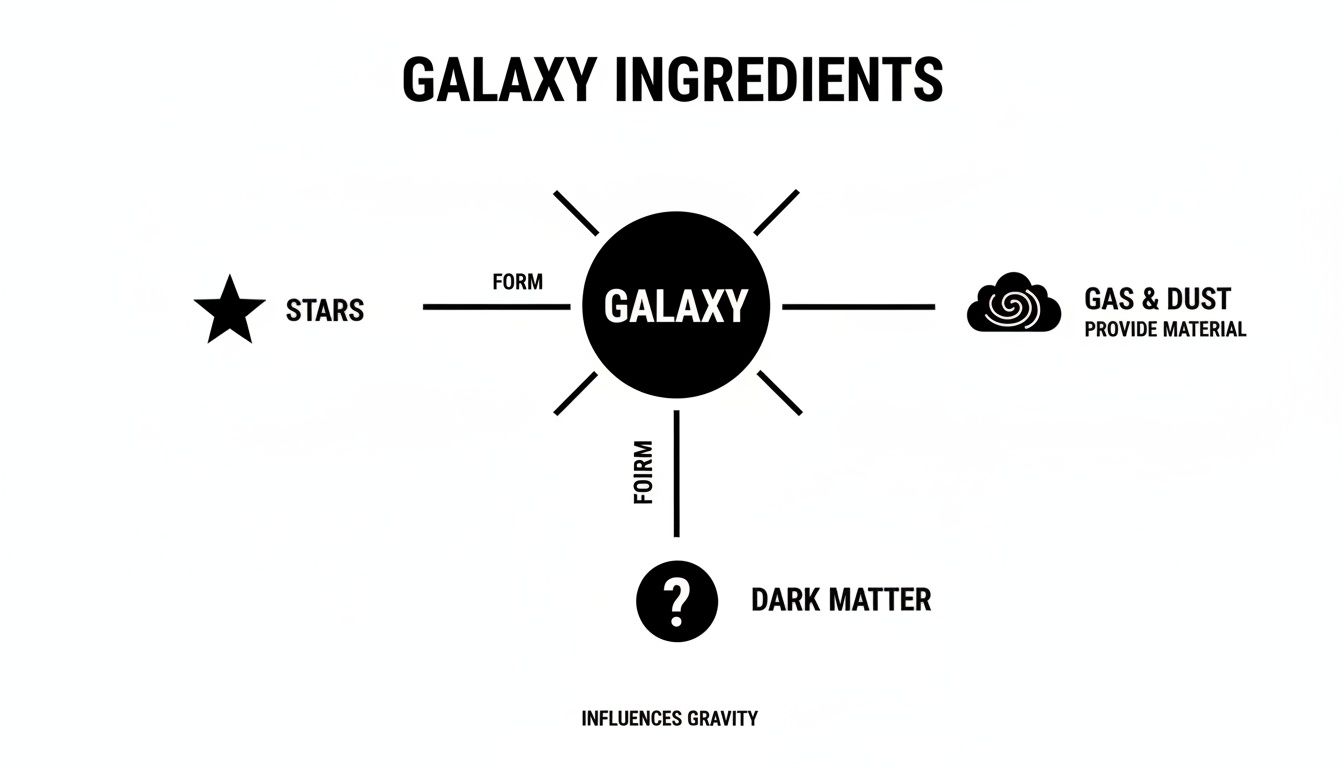
As you can see, every galaxy is a cosmic recipe of stars, gas, dust, and the mysterious dark matter that holds it all together.
Spiral Galaxies: The Cosmic Pinwheels
Have you ever seen a spinning pinwheel or watched water swirl down a drain? That’s almost exactly what a spiral galaxy looks like! These are some of the most beautiful and common galaxies out there. In fact, our own Milky Way is a fantastic example.
They have a few key features that make them easy to spot:
- A Bright Centre: A glowing, ball-shaped hub right in the middle, packed with older stars.
- A Flat Disc: A flat, spinning disc of stars, gas, and dust that surrounds the centre.
- Graceful Arms: Sweeping arms that spiral out from the middle, a bit like a cosmic octopus. These arms are star-making factories, filled with bright young stars!
These galaxies are full of action, constantly building new stars in their colourful, swirling arms.
Elliptical Galaxies: The Giant Cosmic Eggs
Next up, we have elliptical galaxies. Instead of being flat and spinning, these are shaped more like a giant cosmic egg or a rugby ball. They can be almost perfectly round or stretched out into a long oval shape.
Unlike spirals, elliptical galaxies are a lot calmer. They don't have those signature swirling arms and contain very little gas and dust, which means they aren’t making many new stars.
Elliptical galaxies are the golden oldies of the universe. They are typically filled with billions of older, redder stars that have been around for a very, very long time.
They also happen to be the biggest galaxies in the universe. The largest ones we know of are giant ellipticals, containing trillions of stars!
Irregular Galaxies: The Unique Ones
Finally, we have the most unusually shaped star cities: irregular galaxies. These are the rebels of the cosmos and don't fit neatly into the spiral or elliptical boxes. They have no definite shape at all!
They often look messy and jumbled, like a cosmic cloud of stars, gas, and dust. This is usually because they’ve had a close call with another galaxy, and gravity has pulled them out of shape. Because of all that chaos, irregular galaxies are often bursting with star-forming activity.
Exploring these different types shows us just how much variety there is in the universe. To see how these galaxies get their start in the first place, check out our amazing blog post, What Is a Nebula?.
How Galaxies Are Born and Grow
Every single galaxy has an incredible origin story, a tale that kicked off billions of years ago, right after the universe itself burst into life. But how did these gigantic cities of stars first appear? Let's hop in a time machine and find out.
It all started with the Big Bang. In the moments after, the universe was filled with enormous, floating clouds of simple gases—mostly hydrogen and helium. There were no stars, no planets, nothing but these massive, dark clouds drifting through empty space. These clouds were the building blocks for everything we see today.
Over millions of years, a quiet but powerful force got to work: gravity.
The Slow and Steady Pull of Gravity
Think of gravity as a cosmic magnet. It started to gently pull these massive gas clouds closer together. The bits of the clouds that were already a little thicker and clumpier started to attract more and more gas and dust. As these clumps got bigger, their gravity grew stronger, pulling in even more material from all around.
It was a bit like making a giant cosmic snowball. The process was incredibly slow, but once it began, there was no stopping it. Eventually, these clumps of gas became so dense and hot that something amazing happened—the very first stars flickered into existence!
These first "baby" galaxies are often called protogalaxies. They were much smaller and messier than the grand galaxies we see today, but they were the first bright sparks in a very young and dark universe.
Growing Up Through Cosmic Collisions
Galaxies don't just stay the same size; they grow and change over billions of years. One of the main ways they get bigger is by crashing into and merging with other galaxies. It might sound violent, but it's more like two cosmic dancers swirling together into one.
When a larger galaxy’s gravity grabs hold of a smaller one, they start a long dance of merging. Over millions of years, their stars, gas, and dust all mix together until they form a single, much bigger galaxy. Our own Milky Way has "eaten" several smaller galaxies in its lifetime and is still nibbling on a few neighbours!
Scientists are always working to piece together this ancient story. In fact, UK research groups are playing a huge part in this cosmic detective work, using incredible tools like the James Webb Space Telescope to peer back in time. Researchers at the University of Edinburgh recently helped spot some of the earliest galaxies ever seen, which appeared just ~235 million years after the Big Bang. You can read more about these incredible findings on the university's research page. Discoveries like this are like finding the first-ever baby pictures of the universe, helping us figure out how it all began.
The giant gas clouds where stars are born are called nebulae, and they are truly fascinating places. You can learn all about them in our guide, what is a nebula.
Exploring Our Home Galaxy: The Milky Way
Now, let's take a tour of our very own cosmic neighbourhood: the Milky Way! Our home is a stunning spiral galaxy, and our Solar System is tucked away in one of its swirling, star-packed arms. Get ready to be amazed by the incredible place we call home!
It might seem a bit tricky to know what our own galaxy looks like since we're stuck right inside it. Imagine trying to draw a map of your house while you're still sitting in your bedroom! Astronomers are like cosmic detectives, using clever tricks to figure it all out.
They study the positions, movements, and types of stars they can see to piece together a picture. This lets them map out our galaxy's main parts, from its bright, bustling centre to the flatter disc where we live.
Mapping Our Galaxy From the Inside
One of the biggest clues is that faint, milky band of light you can see stretching across a very dark night sky. This is where our galaxy got its name! That beautiful band is the combined light from billions of faraway stars, all located in the flat, pancake-shaped part of the galaxy called the disc.
By measuring how stars and huge gas clouds move, astronomers realised the Milky Way is a spinning spiral. Our Solar System is about two-thirds of the way out from the centre, sitting pretty in a smaller spiral arm known as the Orion Arm.
It's a vast place! The main disc of the Milky Way is about 100,000 light-years across. That means a beam of light, the fastest thing in the universe, would take a mind-boggling 100,000 years to travel from one side to the other.
The UK’s Role in Charting the Stars
Mapping our galaxy has become much more precise thanks to some amazing space missions. UK astronomers have been right at the heart of producing the most detailed 3D atlas of the Milky Way ever created. This incredible project is built on data from the European Space Agency’s Gaia mission, which has measured the positions and speeds of over a billion stars. You can learn more about how UK scientists are revealing our galaxy's secrets on GOV.UK.
This new data is helping astronomers uncover our galaxy’s history and hidden structures. If you'd like to dive even deeper into our cosmic home, you should explore our detailed guide, What Is The Milky Way?. It’s the perfect next step in your galactic adventure!
Fun Hands-On Galaxy Activities for Kids
Ready to bring the cosmos into your home or classroom? Reading about what a galaxy is can be exciting, but the best way to really get a feel for these giant star cities is to get creative and make your own!
These hands-on activities are designed to turn massive space ideas into tangible, unforgettable fun for your little explorers.

They're just the ticket for a rainy afternoon or a classroom science lesson, helping to spark a real love for STEM by bringing the wonders of the universe right down to Earth.
Make a Mesmerising Galaxy in a Jar
This is a classic and wonderfully calming activity that beautifully shows how stars, gas, and dust all swirl together in a galaxy. It’s simple, looks absolutely stunning, and uses materials you probably already have around the house.
What You'll Need:
- A clean, empty jar with a lid (a jam jar is perfect).
- Water.
- Cotton balls.
- Different colours of paint or food colouring (blues, purples, and pinks work a treat).
- Glitter to represent all the stars.
Step-by-Step Guide:
- Fill the jar about one-third full with water.
- Add a few drops of your first colour and give it a stir.
- Stretch out some cotton balls and push them down into the coloured water until they sink.
- Sprinkle in some glitter right on top of the cotton. These are your star clusters!
- Keep repeating the process, layering different colours of water, cotton, and glitter until the jar is full.
- Screw the lid on tightly and marvel at your beautiful, swirling galaxy!
This activity is a fantastic way to explain that a galaxy isn’t just empty space. It's filled with colourful gas clouds (the paint and cotton) and countless stars (the glitter), all mixed together in a vast cosmic dance.
Build a Spinning Spiral Galaxy Pinwheel
Want to see for yourself how a spiral galaxy, just like our Milky Way, gets its shape? This fun pinwheel craft demonstrates the spinning motion that creates those beautiful, sweeping arms. It's a brilliant way to mix a bit of art with some simple physics.
What You'll Need:
- A square piece of paper or card.
- Scissors.
- A pencil with a rubber on the end.
- A drawing pin.
- Crayons or felt-tip pens.
Step-by-Step Guide:
- Decorate your paper with stars, swirls, and bright colours to make it look like a galaxy.
- Draw lines from each corner towards the centre, but stop about halfway.
- Carefully cut along these lines.
- Fold every other corner point into the centre, but try not to crease the paper.
- Push the drawing pin through the folded corners and right through the centre of the paper.
- Finally, push the pin securely into the pencil’s rubber.
Now, give your pinwheel a blow and watch it spin! That simple motion is just like how the stars and gas in a spiral galaxy orbit the centre, creating those amazing arms.
Once you’ve mastered crafting your own galaxies, why not try spotting some real ones? You can learn how with our guide on how to use telescopes to explore the wonders of the night sky.
Your DIY Galaxy Activity Planner
To help you choose the best project for your little space cadets, here's a quick guide to our hands-on galaxy activities. The table shows what each one teaches and how easy it is for younger children.
| Activity Name | What You'll Learn | Difficulty Level |
|---|---|---|
| Galaxy in a Jar | How galaxies are a mix of stars, dust, and colourful gas. | Easy |
| Spiral Galaxy Pinwheel | How the spinning motion of a galaxy creates its spiral arms. | Easy |
| Edible Galaxy Swirls | How different types of matter (dark and visible) mix in a galaxy. | Medium |
| Starry Night Sky Viewer | How stars form constellations and clusters within a galaxy. | Easy |
These activities are a fantastic, screen-free way to make huge astronomical concepts feel small, understandable, and most importantly, fun!
Your Galaxy Questions Answered
When you start exploring a topic as enormous as the universe, it’s only natural to have some really big questions buzzing around in your head! Learning about what a galaxy is can make you wonder about all sorts of things.
This section is here to answer some of the most common questions that curious Space Rangers like you ask about these cosmic wonders. We’ll keep the answers clear, simple, and packed with amazing facts to help you get your head around it all.
How Many Galaxies Are There in the Universe?
It's a number so huge it can make your brain feel a bit fuzzy! Scientists estimate there are hundreds of billions, and maybe even up to two trillion, galaxies in the part of the universe we can see.
Think about this: telescopes like the Hubble and the James Webb Space Telescope can take a picture of a tiny, tiny speck of the night sky and find thousands of individual galaxies hiding in that single image. Each of those galaxies has its own billions of stars, which just shows how incredibly vast and busy space really is!
What Is at the Centre of Most Galaxies?
At the very heart of most big galaxies, including our own Milky Way, astronomers have discovered something truly mind-boggling: a supermassive black hole. It sounds a bit scary, but it’s not some kind of monster space hoover!
These black holes are incredibly dense objects with a gravitational pull so powerful it helps to hold the entire centre of the galaxy together. All the nearby stars and enormous gas clouds orbit safely around it, a bit like how the planets in our solar system circle the Sun.
A fantastic way to bring these big ideas to life is by exploring our books. In Space Ranger Fred and the Blasteroid Beasts, Fred and his crew have to navigate gravitational forces, giving kids a fun story to connect with these powerful concepts.
Can We Ever Travel to Another Galaxy?
What a brilliant idea for a science fiction story! Unfortunately, travelling to another galaxy is impossible with the technology we have today. The distances are just too gigantic to cross.
Our nearest large galactic neighbour, the Andromeda Galaxy, is over 2.5 million light-years away. That means even if you could travel at the speed of light (the fastest speed possible in the universe), it would still take you 2.5 million years to get there! For now, we'll have to keep exploring them with our amazing telescopes.
Will Our Milky Way Ever Crash Into Another Galaxy?
Yes, it will! But there's no need to worry—it’s not scheduled to happen for another 4.5 billion years. Our Milky Way is on a very, very slow-motion collision course with the nearby Andromeda Galaxy.
When they finally meet, they will begin a long dance of merging together to form one giant, brand-new galaxy.
Here's the really cool part:
- Because there is so much empty space between the stars in each galaxy, it’s very unlikely that any stars or planets will actually bump into each other.
- Instead, gravity will mix and rearrange everything into a whole new cosmic pattern.
- Astronomers have even nicknamed this future merged galaxy "Milkomeda"!
This amazing future event shows that the universe is always changing, with galaxies constantly growing and evolving over billions of years.
We hope this guide has answered your biggest questions about galaxies and sparked your curiosity to learn even more! The universe is full of incredible things to discover. To continue your mission, check out the books, activities, and other amazing resources here at Space Ranger Fred. Explore more at https://spacerangerfred.com.